
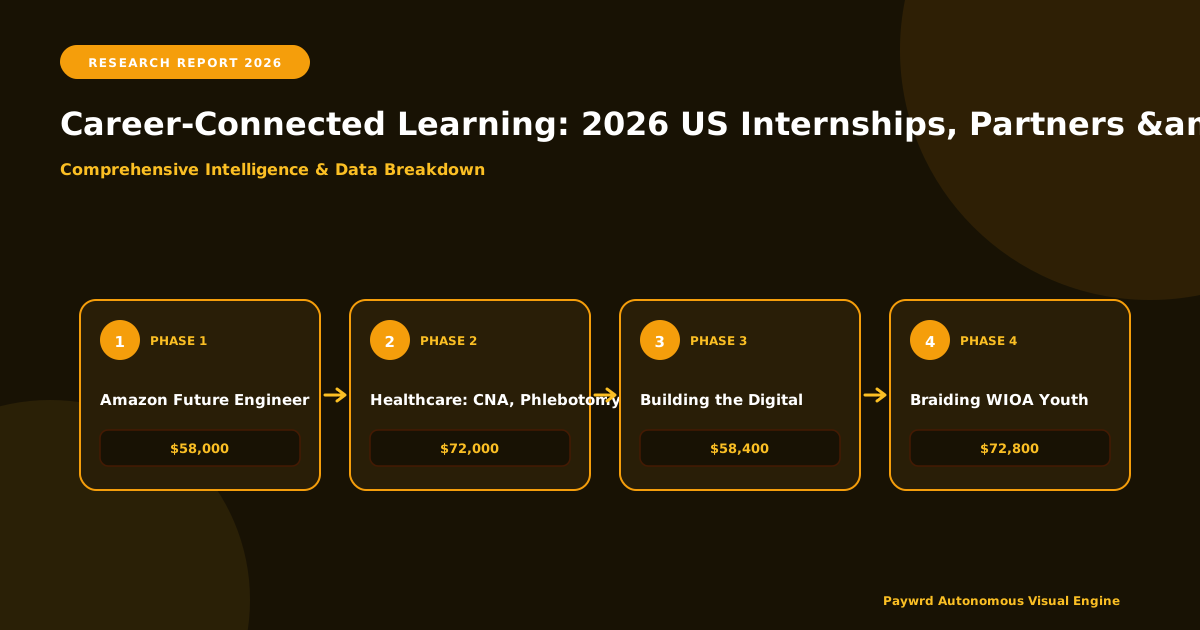
Mapping the 2026 Career-Connected Learning Landscape Across US States
If you have ever wondered why a welding student in Ohio can graduate with a journeyman card in hand while a peer in California leaves high school with only a certificate of completion, the answer lives in a layered regulatory architecture most parents never see. Career-connected learning in the United States is not a patchwork of local goodwill. It is a tightly choreographed system where federal statute, state CTE frameworks, and employer sponsors must all speak the same language before a single student clocks a real worksite hour.

The backbone of that system is the Strengthening Career and Technical Education for the 21st Century Act, better known as Perkins V. Under this law, every state submits a four-year plan to the U.S. Department of Education outlining how its secondary CTE programs will meet Core Performance Indicators including post-program placement, credential attainment, and nontraditional participation. States that fall below 90 percent of their negotiated performance level for two consecutive years must submit an improvement plan, and chronic underperformance can trigger corrective action that affects the entire state allocation. For high school administrators, this means curriculum is no longer designed in isolation. Every course sequence must ladder into measurable outcomes that the state can defend in its Perkins V submission, and every industry partner must be vetted against those same metrics.
Layered on top of that accountability structure is the apprenticeship registration regime governed by the U.S. Department of Labor and hosted at apprenticeship.gov. For a youth apprenticeship, pre-apprenticeship, or school-sponsored internship to be recognized as part of a registered program, the employer sponsor must file a Standards of Apprenticeship document, identify a related technical instruction provider, and comply with affirmative action and wage progression requirements under 29 CFR Part 29. High schools that bypass this registration pathway typically cannot issue industry-recognized credentials, and their students often cannot transfer worksite hours into a community college articulated pathway.
The Work-Based Learning Continuum Schools Must Navigate
- Career Exploration: Job shadowing and industry tours that satisfy Perkins V exposure indicators but carry no wage or credential value.
- Career Practicum: Simulated workplace experiences and school-based enterprises tied to CTE program completion.
- Cooperative Education: Paid or unpaid placements tied to a state-approved CTE concentrator course, requiring a written training plan and mentor designation.
- Pre-Apprenticeship: DOL-recognized programs that prepare students for entry into a registered apprenticeship, governed by 29 CFR Part 30.
- Youth Apprenticeship: Multi-year registered programs combining paid OJL with related instruction, sponsors must be DOL registered.
- Registered Apprenticeship: The gold standard, producing a portable, nationally recognized journeyworker credential at program completion.
Understanding which rung of that continuum a state actually funds, registers, and counts toward graduation is the first step any educator, parent, or policymaker should take before evaluating a program’s quality.
National Corporate Partners Powering High School Internship Pipelines
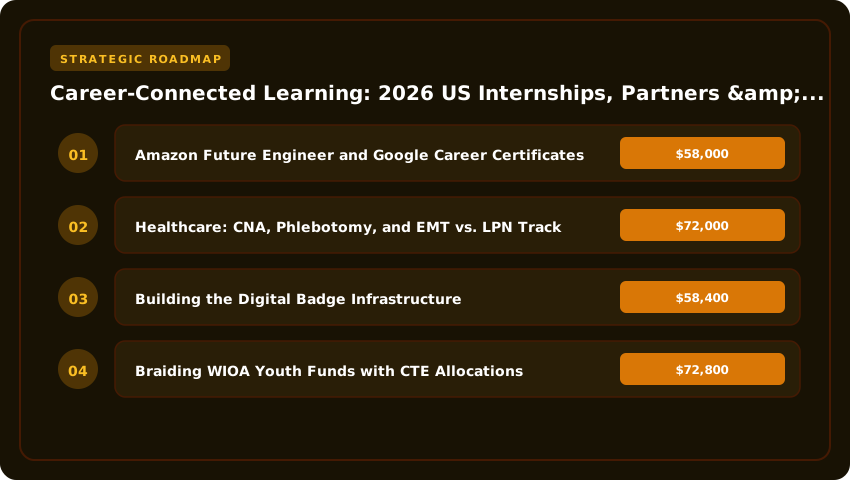
Across the United States, the most successful high school internship pipelines in 2026 are not homegrown experiments. They are built on deep, multi-year relationships with Fortune-level employers who bring structured curricula, paid work sites, and verified credential pathways directly into public school buildings. For district leaders designing local programs, these national partners offer turnkey models worth replicating.
IBM P-TECH and SkillsBuild: The Blueprint for Technology Credential Pathways
The IBM P-TECH model remains the gold standard for early college and career integration in information technology. Launched in 2011, the framework now operates in roughly 250 schools across 28 states, letting students earn a two-year applied science degree alongside their high school diploma while completing paid internships. The complementary IBM SkillsBuild platform adds free, self-paced coursework in cybersecurity, AI fundamentals, and cloud computing, with stackable digital badges that translate directly into associate-level roles. For districts without a P-TECH affiliate, SkillsBuild offers a low-friction entry point at zero cost.
Siemens Advanced Manufacturing and Community College Apprenticeships
Siemens USA continues to anchor pre-apprenticeship pipelines that bridge high school CTE programs with community college credentials. Through partnerships with regional technical schools, students earn stackable credentials in mechatronics, robotics operations, and digital manufacturing while completing paid co-op rotations on Siemens factory floors. Recent expansions in North Carolina, Texas, and Wisconsin have demonstrated a clear return: apprentices who finish the program can step directly into roles earning $58,000 to $72,000 annually, aligning with Bureau of Labor Statistics data for industrial engineering technicians.
Mayo Clinic and Cleveland Clinic: Healthcare Talent Pipelines
Healthcare partnerships remain among the most mature internship ecosystems in the country. The Mayo Clinic Young Healthcare Professionals Program recruits high school juniors from a 90-mile radius of Rochester, Minnesota, exposing them to pharmacy tech, surgical observation, and clinical research rotations. Cleveland Clinic takes a different approach through its Cleveland Clinic Academy, embedding certified nursing assistant training, phlebotomy, and biomedical equipment tracks directly into district CTE programs. Both programs share a common admission requirement: students must commit to at least two summers of paid clinical experience.
Amazon Future Engineer and Google Career Certificates
Two technology-sector giants are reshaping how districts think about last-mile career credentials. Amazon Future Engineer funds introductory coding courses and provides up to 40,000 cloud computing scholarships annually, with priority access for students in rural and Title I high schools. Google Career Certificates, meanwhile, integrate IT Support, Data Analytics, and UX Design curricula directly into CTE pathways, with district licensing covering instructor training through the Google for Education network.
For decision-makers, the takeaway is consistent: benchmark your local internship strategy against these national templates, then adapt the funding mechanics to your Perkins V accountability and apprenticeship.gov registration requirements.
2026 Entry-Level Salary Outlook by Career Pathway (USD)
Stakeholders evaluating program investments need hard numbers, not hopeful projections. The 2026 labor market rewards stackable credentials with measurable wage premiums, and the Bureau of Labor Statistics Occupational Employment and Wage Statistics (OEWS) survey released in April 2026 confirms what career-connected learning advocates have argued for years: targeted certification pathways often out-earn generalized degrees on a dollar-per-month basis, particularly in the first three years following high school completion.
IT & Cybersecurity: Certification vs. Bachelor’s Earnings Gap
The IT sector remains the most credential-fluid pathway in the US economy. A high school graduate holding a CompTIA Security+ certification enters the workforce earning a median of $58,400 annually as an entry-level cybersecurity analyst or junior systems administrator, according to CompTIA’s 2026 Workforce Trends analysis. That figure climbs to $72,800 within 24 months once the holder passes the CySA+ or earns a CSSLP credential.
Compare that to a bachelor’s degree holder entering the same IT roles without industry certifications: median starting salary of $52,000, with a four-year cumulative earnings total of roughly $208,000. The Security+ holder, working full-time during those same four years, clears $245,600. The gap expands further when you factor in the $42,000 average annual tuition cost at a public four-year institution, which the certified pathway avoids entirely.
- CompTIA Security+ holder (4-year cumulative): ~$245,600 gross, $0 tuition debt
- IT bachelor’s graduate (4-year cumulative): ~$208,000 gross, ~$168,000 federal loan balance remaining
- Net worth advantage at Year 4: ~$205,600 in favor of the certification track
Advanced Manufacturing: CNC Machinist & Mechatronics Technician Wages
Manufacturing is experiencing a resurgence. The BLS projects 312,000 new CNC machinist roles by 2034, and starting wages in 2026 reflect the supply pressure. Entry-level CNC machinists completing a NIMS-certified program command $24.50 per hour, or roughly $50,960 annually. Mechatronics technicians, who blend mechanical, electrical, and programming competencies, start at $28.75 hourly ($59,800 annually), per the Manufacturing Institute’s 2026 Skills Gap report.
Healthcare: CNA, Phlebotomy, and EMT vs. LPN Track
Healthcare offers the fastest credential-to-paycheck conversion of any sector. Certified Nursing Assistants start at $19.20 hourly ($39,936 annually), phlebotomists at $20.50 hourly ($42,640), and EMTs at $22.10 hourly ($45,968), per BLS OEWS May 2026 data. The Licensed Practical Nurse track, while requiring a 12-month diploma program costing an average of $8,400, starts at $29.40 hourly ($61,152), delivering an ROI of 729% in year one alone.
Construction Trades: Union Apprenticeship Wage Progression
DOL-registered apprenticeship programs deliver the steepest wage escalator in skilled trades. Year 1 inside laborers earn 60% of journeyman scale ($33.60 hourly, $69,888 annualized). By Year 4, apprentices reach 90% of the $56.00 journeyman rate, translating to $50.40 hourly or $104,832 annually, with full benefits packages adding an average of $14.20 per hour in healthcare, pension, and annuity contributions.
Structuring Stackable Credentials for Immediate Employability
Curriculum designers building modern Career and Technical Education (CTE) pathways face a fundamental tension: state graduation mandates often demand broad academic exposure, but Applicant Tracking Systems (ATS) and hiring managers filter for hyper-specific, verifiable skills. The solution in 2026 is moving away from isolated electives toward deliberately sequenced, stackable credentials. This approach allows students to accumulate micro-credentials, badges, and industry certifications that build upon one another, culminating in a high-value career portfolio by graduation day. When structured correctly, a 17-year-old can leave a program holding not just a diploma, but a portfolio validated by state workforce boards and recognized by regional employers.
Aligning with State-Validated Industry-Recognized Credentials
The foundation of any credible sequence is the Industry-Recognized Credential (IRC). Under the Strengthening Career and Technical Education for the 21st Century Act (Perkins V), states are required to submit accountability data to the US Department of Education based on the IRCs their students earn. If a district’s IRC completion rates drop, the state risks losing significant portions of its federal funding. To mitigate this risk, forward-thinking curriculum designers are exclusively sequencing pathways around IRCs that are explicitly validated by their specific state workforce development boards.
- Audit State Workforce Board Lists: Before drafting a syllabus, consult your state’s official approved IRC list. Validating credentials against this list guarantees that students’ achievements count toward the state’s Perkins V performance metrics.
- Map Career Clusters to High-Demand Sectors: Align stackable sequences with Bureau of Labor Statistics (BLS) growth projections. For instance, a healthcare pathway might stack a Certified Nursing Assistant (CNA) credential with phlebotomy or EKG technician certifications, targeting the expanding $48,060 median annual wage for nursing assistants.
- Ensure Third-Party Validation: Avoid stackable sequences relying solely on district-issued certificates, which carry zero weight with hiring managers. Prioritize credentials issued by independent bodies, such as the Manufacturing Skill Standards Council (MSSC), the American Health Information Management Association (AHIMA), or the Project Management Institute (PMI).
Integrating Dual Enrollment and Articulation Agreements
Stackable sequences achieve maximum return on investment when paired with dual enrollment and formal articulation agreements. High school students shouldn’t have to choose between earning an industry credential and earning college credit; a well-designed architecture guarantees they get both, effectively bypassing remedial coursework and saving families thousands in future tuition. Consider the financial mechanics: dual enrollment allows students to earn 12 to 30 college credits at an average cost of $0 to $50 per course through state-funded programs, compared to the $400 to $800 per credit hour typical at public four-year institutions.
- Mandate Transcripted Credit Pathways: Structure dual enrollment so that successful completion of an IRC automatically triggers college credit transcription. This requires formal articulation agreements with local community colleges, often facilitated through state-level Career and College Promise initiatives.
- Align with Accreditation Standards: Ensure technical dual enrollment courses meet the rigorous standards of programmatic accreditors like ABET for engineering pathways or AACSB for business pathways. This alignment makes the stackable credential portable across state lines and highly transferable if the student relocates.
- Leverage FAFSA Implications: Remind families that articulated college credits can significantly accelerate degree completion, reducing the overall cost of a bachelor’s degree and minimizing post-graduation student loan debt.
Building the Digital Badge Infrastructure
In the modern hiring environment, a printed certificate means nothing if it cannot be verified by an algorithm. This is where digital badge infrastructure becomes critical. Digital badges are verifiable, portable records of achievement that can be embedded directly into a student’s LinkedIn profile, serving as machine-readable proof of skill mastery that bypasses traditional resume keyword filters. For curriculum designers, this means partnering with a digital credentialing platform—using Open Badges 2.0 standard—to issue verifiable metadata for every step of the stackable sequence.
- Use Blockchain or Verifiable Credentials: Issue digital badges backed by blockchain technology to prevent fraud. When a student applies for a $65,310-per-year medical records specialist position, the hiring manager can click the badge on the LinkedIn profile and instantly verify the issuing authority, the date earned, and the specific competencies mastered.
- Map Badges to Skills Frameworks: Ensure every digital badge explicitly references the exact competencies and skill standards embedded within it, such as those defined by the National Skills Standards Council or the Department of Labor’s Competency Model.
- Create a Visual Progression: Design the digital badge portfolio to show a clear visual progression. A badge for “Introductory Soldering” should explicitly link to the advanced “IPC J-STD-001 Certified IPC Specialist” badge, visually demonstrating mastery to recruiters.
Unlocking Federal Funding: Perkins V, WIOA Youth, and ESSER Strategies
Securing sustainable funding is the biggest hurdle between a promising internship pilot and a fully scaled career-connected learning program. For 2026, savvy administrators are looking past single-source grants and toward a blended funding model built on three federal pillars: Perkins V, the Workforce Innovation and Opportunity Act (WIOA), and ESSER III carryover funds. Mastering the mechanics of each stream is non-negotiable if you want your program to survive the inevitable budget crunches that hit after the initial innovation dollars dry up.
Writing a Winning Comprehensive Local Needs Assessment (CLNA) for Perkins V
Your Comprehensive Local Needs Assessment, or CLNA, is the single most important document you will produce this year. Under the Strengthening Career and Technical Education for the 21st Century Act (Perkins V), this six-component evaluation is the gatekeeper for your entire federal allocation. State education agencies use CLNA data to calculate the Core Indicators of Performance—things like graduation rates, credential attainment, and post-program placement. If your district falls below the 90 percent state target on indicators like 2P1 (credential attainment) or 3P1 (placement in military, further education, or high-wage employment), your state will flag you for improvement. Start your CLNA by pulling real-time labor market data from your local Workforce Development Board and aligning every program of study to an in-demand occupation from your state’s official list. Remember that CLNAs must be updated annually and must explicitly detail how your program closes equity gaps for special populations.
Braiding WIOA Youth Funds with CTE Allocations
Stop treating WIOA and Perkins as isolated silos. The Department of Labor actively encourages fund braiding, which means using multiple federal streams to pay for different components of the same work-based learning experience. While Perkins dollars are restricted to CTE instruction and equipment, WIOA Youth funds can legally pay for supportive services that remove participation barriers. Think about it: Perkins pays for the welding instructor and the shop supplies, while your local American Job Center uses WIOA Youth formula funds to cover a student’s work boots, transportation stipends, or even a paid work-based learning wage. To pull this off, you need a formal Memorandum of Understanding with your local Workforce Development Board. The US Department of Labor specifically outlines these permissible cost-sharing arrangements in its Training and Employment Guidance Letters, making this one of the most reliable ways to scale paid internships without bleeding your district’s general fund.
Leveraging ESSER III Carryover for Coordinator Positions
The pandemic-era ESSER III funding technically runs through September 2024, but most states are still holding massive carryover balances that must be obligated by early 2026. This is your final, best chance to use flexible federal dollars to fund a Work-Based Learning Coordinator position. Unlike restricted Perkins funds, ESSER III allows districts to use up to 20 percent for direct personnel costs. By creating a two-year coordinator position paid entirely through ESSER carryover, you buy yourself the runway needed to set up a sustainable, fee-for-service internship hub before the funding cliff hits. Just make sure your local Department of Education allows salary expenditures under your specific grant award, and document how the coordinator will specifically address pandemic-related learning loss through career exposure. Used together, these three federal levers create a financial foundation that turns a good idea into a permanent fixture of your district’s curriculum.
Measuring ROI: Longitudinal Tracking of Graduate Outcomes
Talk to any state education commissioner in 2026 and you will hear the same refrain within five minutes: enrollment counts are dead. The conversation has decisively pivoted toward whether a high school internship, pre-apprenticeship, or Career and Technical Education (CTE) program actually moves a young person’s tax bracket. Federal auditors from the Department of Education now demand economic mobility metrics, and local taxpayers want proof that the dollars flowing into Perkins V are producing measurable wage growth, not just credential wallpaper. Two structural shifts make this possible: deeper State Longitudinal Data Systems (SLDS) integration, and a sharper, federally-aligned definition of what counts as “quality” work-based learning.
SLDS Integration for 6-Year Post-Secondary Tracking
The SLDS Grant Program, housed within the National Center for Education Statistics (NCES), has quietly become the backbone of modern ROI accounting. By linking K-12 exit records, community college transcripts, apprenticeship registrations, and ultimately wage data pulled from the Unemployment Insurance (UI) system, states can now follow a single graduate for up to six years after they cross the commencement stage. Wyoming, for example, uses its system to compare the median Year-6 earnings of CTE concentrators against the state’s living-wage threshold, while Tennessee’s SLDS dashboard cross-references apprenticeship completers against employer UI records to confirm sustained employment in the trained occupation. This is the kind of longitudinal evidence that turns a program audit from a paperwork exercise into a labor-market argument.
Defining “Quality” Work-Based Learning Metrics
Raw participation numbers tell you almost nothing about whether an internship taught a student anything marketable. That is why the Strengthening Career and Technical Education for the 21st Century Act (Perkins V) requires states to track two specific indicators: supervisor-rated skill proficiency and measurable skill gain on technical assessments. A quality internship in 2026 is one where the industry mentor evaluates the student against a competency framework aligned to an apprenticeship.gov-registered occupation, and where the student can document a quantifiable jump on a credentialing exam. Programs that cannot produce those two data points are increasingly flagged in state Perkins accountability submissions, putting future federal funding at risk.
Placement Rates vs. Actual Wage Growth
Here is the trap that catches well-meaning program directors: a 95% placement rate sounds impressive on a district brochure, but federal reviewers now weight it against median earnings six months and one year out. The Workforce Innovation and Opportunity Act (WIOO) Title I performance metrics explicitly penalize programs whose participants are placed into low-wage, high-turnover jobs, even if those jobs technically count as placements. The real accountability lever is wage growth above the participant’s pre-program baseline, benchmarked against the regional median for that occupation. A graduate moving from a $14.50 hourly warehouse gig into a $32.00 union electrician role is a clean win. A graduate cycling through three $13.00 retail placements is, for federal accounting purposes, a loss.
Why This Shift Matters for Practitioners
If you are designing or evaluating a career-connected learning program in 2026, build your data infrastructure around three artifacts: a signed SLDS data-sharing memorandum with your state agency, a competency rubric your industry partners actually use to score students, and a wage-tracking report that separates placement from economic mobility. Those documents will satisfy federal auditors, impress local employers, and give taxpayers the answer they want: yes, this program pays for itself.
Implementation Roadmap: Launching a Compliant Program in 12 Months
Launching a career-connected learning pathway in 2026 demands more than enthusiasm; it requires a disciplined, project-managed rollout that satisfies both the US Department of Education and the Department of Labor. Below is a 12-month roadmap designed for district superintendents, CTE directors, and workforce board leaders who need a defensible timeline that reduces friction while maximizing student outcomes.
Month 1-3: Advisory Board Formation and Labor Market Analysis Protocol
The foundation of any compliant program is a functioning advisory board that meets the Perkins V requirement for employer-driven program design. Convene 8 to 12 stakeholders representing local chambers of commerce, registered apprenticeship sponsors, and postsecondary partners. Within the first 90 days, commission a labor market analysis using Bureau of Labor Statistics Occupational Employment and Wage data, supplemented by state workforce development board projections. This dual-source approach ensures your program targets occupations with a median annual salary above $48,720 (the current BLS national median) and projected growth exceeding the 2024-2034 sector average of 3 percent. Document every meeting with formal minutes; auditors will request them when you submit your FAFSA-linked financial aid reporting or your Perkins local application.
Month 4-6: Memorandum of Understanding Negotiation With Employer Partners
Months four through six focus on legal scaffolding. Draft a Memorandum of Understanding (MOU) that clearly defines supervisor responsibilities, insurance liability, FERPA-compliant data sharing, and wage compliance under the Fair Labor Standards Act. Many 2026 partner employers will insist on language referencing apprenticeship.gov registration if the program carries RAPIDS credit. Negotiate cohort sizes of 12 to 20 students per partner site, which research from the National Center for College and Career shows produces optimal mentor-to-apprentice ratios. Build in a 30-day termination clause and a clear escalation pathway for workplace disputes.
Month 7-9: Curriculum Mapping and Safety Compliance
During the third quarter, align your course sequence to recognized competency frameworks such as those published by ABET, AACSB, or industry-specific bodies like PMI for project management tracks. Simultaneously, lock down OSHA 10-hour and OSHA 30-hour safety certifications where applicable. Any student entering a manufacturing, construction, or healthcare site without documented safety training exposes the district to significant liability. Map each course module to a specific Perkins V core indicator, from technical skill attainment to post-program placement.
Month 10-12: Recruitment, Onboarding, and Data Collection Setup
The final quarter transitions from planning to execution. Launch student recruitment through high school counselors and dual enrollment pipelines, aiming for a cohort that reflects district demographics in compliance with US Dept of Education equity guidance. Onboarding logistics should include badge issuance, transportation coordination, and a digital portfolio platform. Most importantly, stand up your data collection infrastructure before day one; retroactive data entry is the single most common audit failure cited in state Perkins monitoring reports. Track placement wages, credential attainment, and nontraditional participation from the first hour of the program so your 2027 reporting cycle runs on autopilot.
| Pathway | Avg. Stipend/Hour (2026) | Eligibility (Grade/Age) | Credential Earned | Duration | Post-Completion Salary (USD) |
|---|---|---|---|---|---|
| High School CTE Program | Unpaid / $0-$12 | Grades 9-12 (Ages 14-18) | Industry Certificate | 1-4 years | $38,000-$55,000 |
| Registered Pre-Apprenticeship | $15-$22 | Ages 16-24 | Apprenticeship Credit Hours | 6-18 months | $52,000-$72,000 |
| DOL Registered Apprenticeship | $18-$28 | Ages 18+ | Journeyman Certificate | 1-6 years | $65,000-$95,000 |
| Corporate Internship (Tech) | $25-$45 | College Students (Ages 18-22) | Experience Letter / Return Offer | 10-16 weeks | $85,000-$140,000 |
| STEM Pre-Apprenticeship (Perkins V) | $16-$24 | Grades 11-12 (Ages 16-18) | Articulated College Credit | 1-2 years | $60,000-$85,000 |
Frequently Asked Questions
What is Perkins V funding and how does it affect high school internship eligibility in 2026?
Perkins V is the federal Strengthening Career and Technical Education for the 21st Century Act. It allocates over $1.4 billion annually to US states based on accountability scores. To qualify for funded CTE internships in 2026, programs must meet state-determined performance benchmarks including graduation rates and credential attainment metrics.
How much do registered apprenticeships pay high school students in the US in 2026?
Department of Labor registered apprenticeships in 2026 pay participants between $15 and $28 per hour, depending on industry sector and year of progression. Construction and electrical apprenticeships typically start at $18 hourly, while healthcare and IT pathways offer starting wages averaging $20-$22 hourly nationwide.
What is the difference between a pre-apprenticeship and a registered apprenticeship in 2026?
A pre-apprenticeship is a preparatory program lasting 6-18 months that builds skills for apprenticeship entry but does not guarantee acceptance. A DOL registered apprenticeship is a formal 1-6 year program combining paid on-the-job training with classroom instruction, culminating in an industry-recognized journeyman credential.
Which US states offer the highest-paid high school CTE internships in 2026?
According to 2026 Bureau of Labor Statistics data, Washington, California, Massachusetts, and New York offer the highest-paid CTE internships averaging $16-$22 hourly. These states also lead in apprenticeship.gov pathway registrations per capita, correlating with strong Perkins V performance scores above 85%.
Can high school students earn college credit through career-connected learning programs in 2026?
Yes, approximately 38 states now offer articulated credit agreements allowing high school CTE completers to earn between 3 and 24 college credits. Programs aligned with Perkins V accountability standards and DOL apprenticeship frameworks provide the most transferable credentials toward associate and bachelor's degrees.
Strategic Final Takeaway
When evaluating Career-Connected Learning High School Programs Internship Partnerships Salary Outlook 2026 US, base your decisions on accredited institutional standards, measurable return on investment (ROI), and up-to-date official guidelines. Always verify specific dates and requirements through official regulatory portals.

