Salary Reality Check: What an Early Childhood Education Bachelor Degree Actually Pays in the US
Let’s be honest: early childhood education isn’t the path you pick to get rich. But it is a stable, recession-resistant career with predictable wage growth, especially once you stack credentials. Before comparing a community college transfer track against a four-year university route, you have to anchor your expectations in real numbers. Here’s what the data actually shows.
Median Annual Wages: Preschool vs. Kindergarten Teachers
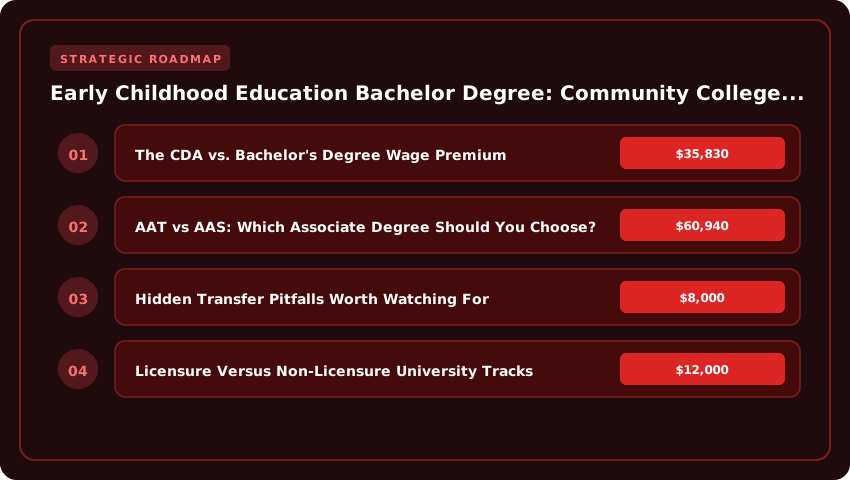
According to the most recent US Bureau of Labor Statistics (BLS) Occupational Employment and Wage Statistics, preschool teachers nationally earn a median annual wage of $35,830, or roughly $17.23 per hour. Kindergarten teachers, who typically must hold a bachelor’s degree and state certification, earn a median of $60,940. That gap is significant, and it reflects one of the most important financial decisions you’ll make in this field: whether to pursue public school licensure or stay in the private/center-based preschool world.
Entry-Level vs. Five-Year Benchmarks in Public Districts
Public school districts publish step-and-lane salary schedules, and they’re a goldmine for planning. A first-year kindergarten teacher with a bachelor’s degree in a mid-sized district might start around $45,000–$48,000. By year five, that same teacher on the standard salary lane typically earns $52,000–$58,000, depending on cost-of-living adjustments. Add a master’s degree lane and you can push past $65,000 within six to eight years. These figures come from publicly posted collective bargaining agreements and are consistent with what the National Education Association (NEA) reports for new teachers nationally.
How Pay Scales Differ: Head Start, Private Centers, and Charter Schools
- Head Start programs: Federal Head Start guidelines now require at least 50% of lead teachers to hold a bachelor’s degree. Salaries typically range from $38,000–$48,000, often with strong benefits packages funded through federal grants administered by the US Department of Health and Human Services.
- Private for-profit centers: These usually pay the least, often $30,000–$36,000 for degreed teachers, though corporate chains like KinderCare and Primrose may offer tuition reimbursement and slightly higher starting wages in metro areas.
- Charter schools: Highly variable. Some charter networks pay on par with district schedules, while others operate with leaner budgets that suppress wages by $5,000–$10,000 compared to traditional public schools.
The CDA vs. Bachelor’s Degree Wage Premium
A Child Development Associate (CDA) credential, issued by the Council for Professional Recognition, qualifies you for entry-level roles at roughly $27,000–$32,000. That’s a real starting point, especially if you need to earn while studying. However, BLS data and state workforce studies consistently show that CDA holders cap out near $38,000 without further education. The bachelor’s degree unlocks state certification, lead-teacher roles in Head Start, and the public school salary schedule. Financially, that’s an $8,000–$12,000 annual premium, which means the degree often pays for itself within three to five working years, assuming you use FAFSA and complete your program at a public university.
Community College Track: Low-Cost Associate Degrees That Transfer Into a Bachelor Program
If you want a Bachelor of Science in Early Childhood Education without drowning in student loan debt, the smartest first step is starting at your local community college. In-district tuition at public two-year colleges in the US currently averages around $130 per credit hour, according to College Board data, while out-of-state rates hover near $320. By comparison, a four-year private nonprofit university will charge anywhere from $1,200 to $1,800 per credit hour — roughly ten times more. Over 60 credits of general education coursework, that gap can easily exceed $40,000, which is why so many working adults and career-switchers start their ECE journey at a community college before transferring.
Articulation Agreements That Guarantee Your Junior-Year Spot
Most US states have formal articulation agreements between the community college system and state universities, meaning if you graduate with the right associate degree and hit a minimum GPA (usually 2.5–2.75), you are guaranteed admission as a junior at the partner four-year school. For ECE students, this is huge. Programs like Texas’s “Core Curriculum,” Florida’s “Statewide Articulation Agreement,” and California’s CSU system lock in transferability of general education courses, electives, and even some upper-division ECE foundations. Before enrolling, confirm that your target bachelor’s program is on the approved transfer list through your state’s higher education agency or the receiving university’s registrar office.
AAT vs AAS: Which Associate Degree Should You Choose?
Two-year ECE transfer students typically choose between the Associate of Arts in Teaching (AAT) and the Associate of Applied Science (AAS). The AAT is designed for students planning to pursue state teacher certification, which makes it the better choice if your goal is a public PreK-3 classroom. The AAS leans more toward childcare management, Head Start leadership, or NAEYC-accredited private program roles. NAEYC-recognized bachelor programs generally accept both, but an AAT keeps more doors open if you later want to add an elementary or special education endorsement. Either way, verify that the destination university is regionally accredited by bodies like SACSCOC, HLC, or MSCHE — employers and state licensing boards will check.
Hidden Transfer Pitfalls Worth Watching For
The “2+2” promise sounds clean, but working ECE transfer students frequently hit three speed bumps. First, lost credits: an introductory education course taught at your community college may not be considered equivalent to the university’s version, forcing you to retake it. Second, capstone redesigns: most bachelor programs require a final semester practicum or student teaching residency that community college associate degrees cannot substitute for. Third, capped admissions: competitive ECE cohorts at universities may have limited seats, so even with an articulation agreement you are not always automatically enrolled in the major. Submit your transfer application six to nine months early, and ask the admissions office for a course-by-course transcript evaluation before committing to a sequence.
- Request a transfer credit audit before completing 30 credits.
- Confirm the receiving program holds NAEYC or CAEP accreditation.
- Ask about GPA minimums and capstone practicum expectations upfront.
Direct University Path: Four-Year Bilingual, Special Education, and Early Childhood Tracks
Choosing a direct four-year university route for an Early Childhood Education (ECE) bachelor degree means stepping into a more academically rigorous, licensure-ready experience than most community college pathways can offer. At a four-year institution, you will encounter structured programs that lead directly to PreK-3 (PK-3) or PreK-4 (PK-4) state licensure, the credentials required to teach in public elementary schools across most US states. Universities approved by their state’s Department of Education and often accredited by bodies like CAEP (Council for the Accreditation of Educator Preparation) design these tracks to meet both content mastery and pedagogical standards.
Licensure Versus Non-Licensure University Tracks
Not every four-year ECE program leads to a teaching license, and understanding this distinction matters for salary outcomes. A licensure track, such as a Bachelor of Science in Education with a PK-3 concentration, prepares you to sit for state Praxis exams and qualify for public school roles paying $45,000–$60,000 annually in entry-level positions, according to the National Education Association. A non-licensure track, sometimes called Early Childhood Leadership or Child Development, skips the student teaching requirement and instead emphasizes program administration, curriculum design, or policy. Graduates of leadership tracks often pursue preschool director roles, Head Start management, or nonprofit ECE program coordination, positions that can pay $50,000–$75,000 depending on region and organization size.
Student Teaching Placement and Practum Hours
University programs require a full-semester student teaching placement, typically 12–16 weeks of full-time classroom immersion in an approved P-3 setting. This is significantly more intensive than the 60–120 practicum hours commonly embedded in a community college Associate of Applied Science (AAS) transfer degree. The university placement is supervised by a cooperating teacher and a university supervisor, giving you documented evidence of classroom readiness that hiring principals value. For bilingual or special education concentrations, placements are often arranged in dual-language immersion schools or inclusive early childhood classrooms, giving you specialized experience that translates directly into higher starting salaries in districts with hard-to-fill bilingual or special education roles.
Research Assistantships and On-Campus Lab Schools
One of the most overlooked advantages of a direct university path is access to funded research assistantships and campus-based ECE lab schools. Many universities, both public and private, operate demonstration preschools where undergraduates earn tuition remission or hourly stipends ($1,200–$4,500 per semester) while working alongside faculty researchers. These roles strengthen a resume far beyond what a community college practicum can offer, particularly if you plan to pursue a Master of Education, a PhD, or a corporate training role in educational publishing. Lab school experience also signals to graduate admissions committees that you understand evidence-based practice, child assessment, and curriculum design at a deeper level.
Cost Differential: Private University Versus Public Transfer Route
According to College Board data, a four-year private university ECE program runs $38,000–$56,000 per year in tuition, fees, and room and board, totaling roughly $152,000–$224,000 over four years. The same degree completed through a public university transfer pathway (two years at a community college at roughly $4,000/year, then two years at a state university at $11,000–$22,000/year in-state) totals $30,000–$52,000. However, the private university sticker price frequently shrinks once you factor in ECE-specific scholarships, Pell Grants via FAFSA, and state-funded teaching fellowship programs that cover tuition in exchange for a 3–5 year teaching commitment in high-need districts. For many aspiring bilingual or special education teachers, the private university path effectively pays for itself through forgivable loan programs and signing bonuses that can reach $10,000–$20,000 in states like Texas, California, and New York.
The bottom line: a direct four-year university program delivers licensure eligibility, deeper practicum immersion, research opportunities, and access to financial aid structures that a community college transfer route simply cannot match. If your goal is public school certification, graduate study, or a leadership role in a competitive metropolitan district, the four-year path is a clear strategic advantage.
Accreditation and State Licensure Outcomes by Pathway
Picking between a community college and a university for your Early Childhood Education bachelor’s degree is really a question about two very different finish lines. Both paths can lead to a state teaching certificate, but the compliance checkpoints along the way look almost nothing alike, and getting the accreditation question wrong is the fastest way to spend four years earning a degree that won’t actually move you into a public school classroom.
NAEYC Standards at Both Tiers
The National Association for the Education of Young Children (NAEYC) sets the professional benchmark for ECE preparation programs, and its recognition applies equally to community colleges and four-year universities. A two-year associate degree aligned to NAEYC standards covers foundational coursework in child development, observation, and practicum experience, but it stops short of the advanced study in curriculum design, assessment, and supervised teaching that NAEYC expects from bachelor’s-level programs. If you’re stacking credentials (associate, then transfer into a bachelor’s completion program), make sure both the sending community college and the receiving university hold NAEYC recognition or candidacy status for the level you’re claiming.
State Teaching Certificate Variations
Licensure is where the two pathways diverge sharply. Roughly 20 states, including California, Texas, and New York, allow candidates with an associate degree plus an active state-issued permit to lead public pre-K classrooms while completing a bachelor’s. Other states, particularly across the Midwest and New England, require a completed bachelor’s before issuing the initial teaching license, no matter how many practicum hours the associate degree included. The U.S. Department of Education doesn’t standardize this; each state’s Department of Education (or Board of Education) publishes its own approved-program list, so you’ll need to confirm reciprocity if you plan to teach across state lines.
Why ABET and AACSB Don’t Apply Here
Engineering and business students chase ABET and AACSB accreditation because those seals unlock licensure and employer pipelines. Early childhood education lives under different accreditors, primarily CAEP (Council for the Accreditation of Educator Preparation) and regional bodies such as HLC or SACSCOC. If a university’s education program only lists ABET or AACSB credentials, that signal belongs to its engineering or business school, not its ECE department.
The Non-Negotiable Gatekeepers
Regardless of which pathway you choose, every public school employer will require the same baseline:
- Federal and state background check (including FBI fingerprinting in most states)
- Praxis Core Academic Skills for Educators passing scores
- edTPA portfolio submission during student teaching, now required or strongly preferred in 40+ states
These requirements don’t care whether your credits came from a $130/credit associate program or a $45,000/year university tuition. What they care about is whether your preparation program holds state approval, your fingerprint clearance comes back clean, and your edTPA portfolio meets the state rubric. Nail those three, and your degree title actually translates into a portable, employable teaching credential.
Career Pathways and Lifetime Earnings Beyond the Classroom
An Early Childhood Education (ECE) bachelor degree unlocks far more than a public school classroom. The credential is a passport into corporate training, nonprofit program management, and curriculum design roles where compensation routinely outpaces traditional teaching salaries. Graduates who pivot into instructional coordination at organizations like Bright Horizons or KinderCare can climb into operations leadership earning $75,000–$95,000 within a decade, according to aggregated BLS Occupational Employment Statistics. Corporate learning and development, a field projected by the Bureau of Labor Statistics to grow 8 percent through 2032, actively recruits ECE graduates for their applied expertise in adult pedagogy, behavior shaping, and assessment design.
Non-Teaching Routes That Multiply Your Degree
- Curriculum Design: Ed-tech firms and publishers like Pearson and Scholastic hire ECE graduates as content specialists, with mid-career salaries between $68,000 and $102,000.
- Nonprofit Program Management: Directors at organizations such as Head Start and local United Way affiliates commonly earn $70,000–$90,000, with the Head Start director median sitting near $82,400 per the BLS.
- Corporate Training: Learning and development specialists averaged $65,480 in 2023, and ECE graduates who layer facilitation skills on top of pedagogical theory often out-earn generalist competitors within five years.
Graduate School Acceleration
Students aiming at a Master of Education in Educational Leadership or Curriculum and Instruction should weigh how their undergraduate pathway primes them for graduate admissions. University ECE programs typically embed supervised practicum hours and faculty-mentored research that admissions committees at institutions like Harvard Graduate School of Education, Vanderbilt Peabody, and USC Rossier explicitly look for. Community-college transfers can match these benchmarks, but they require proactive documentation of practicum depth, letters from university faculty, and a stronger GRE or MAT performance to stay competitive for top-ranked programs. The 30-credit M.Ed. adds roughly $18,000–$35,000 in tuition, yet it accelerates access to principal licensure and district-level administration, where Boston Public Schools assistant principals start near $103,000 and Chicago Public Schools principals average $128,400.
Metro Salary Trajectories in High-Demand Districts
Geography reshapes lifetime earnings dramatically. Boston, Los Angeles, Chicago, and Houston anchor some of the strongest demand for certified early childhood educators:
- Boston: Boston Public Schools kindergartners start near $68,000, with master’s-lane pay pushing veteran teachers past $98,000.
- Los Angeles: LAUSD early childhood educators begin around $66,000 and top out above $103,000 after 20 years with a bachelor’s, per district salary tables.
- Chicago: Chicago Public Schools offers a starting salary near $60,000 and a six-figure ceiling above $102,000 for veteran bachelor’s-credentialed teachers.
- Houston: HISD teachers start around $61,000 and can reach $84,000, while Houston’s private and charter networks often add stipends that lift effective pay above $90,000.
30-Year ROI: Community College Then University Versus Straight University
Modeling the long-term return requires honest math. A community-college-to-university pathway typically costs between $35,000 and $55,000 total, while a straight four-year university pathway runs $80,000 to $180,000 depending on whether the student attends an in-state public institution, a private nonprofit, or an out-of-state flagship. Assuming a $10,000 annual earnings premium for holding a bachelor’s over a CDA, compounded over 30 years at a 3 percent wage growth rate, the bachelor’s-credentialed educator earns roughly $300,000 more in cumulative wages than a CDA-holding peer. Subtract the incremental tuition of the university pathway (about $45,000–$125,000 more than the community-college-then-university route) and the net lifetime ROI still favors the community college start by $20,000–$60,000, assuming both graduates land equivalent positions. For students who pursue the M.Ed. and pivot into administration, the gap widens substantially, because metro principal and director salaries compound over the back half of a career, pushing lifetime earnings past $3.5 million for the highest-earning quartile of educational leaders.
FAFSA, Scholarships, and Employer Tuition Reimbursement Strategies for Both Routes
Paying for an Early Childhood Education degree doesn’t have to mean drowning in student debt, whether you start at a community college or transfer into a four-year university. The smartest ECE students in the US stack federal aid, state-level scholarships, and employer tuition benefits to slash their out-of-pocket cost by 30% to 60%, and sometimes entirely. Let’s break down the four funding levers that move the needle most.
1. FAFSA and Pell Grant Eligibility at the Community College Starting Point
Community college is already the cheaper tuition route, typically $3,500–$5,000 per year for in-district students, but the real win is Pell Grant eligibility. Submitting the Free Application for Federal Student Aid (FAFSA) through the US Department of Education can unlock up to $7,395 in annual Pell funding for low-income learners, which frequently covers 100% of community college tuition and textbooks. Starting at a two-year program lets students preserve their Pell lifetime eligibility (max 12 semesters) while building transfer credits toward a bachelor’s, so they enter the university phase with significantly less debt and a stronger GPA for institutional scholarships.
2. State TEACH Grants and ECE-Targeted Scholarships
The federal TEACH Grant offers up to $4,000 per year for students who commit to teaching in high-need fields, including early childhood, at a Title I school or low-income district for four years. If you skip the service requirement, the grant converts to an unsubsidized loan, so read the fine print. On top of that, most states run their own scholarship pipelines:
- California: the Child Development Permit stipend and Cal Grant B cover ECE cohorts at public universities.
- Texas: the T-STEM and Early Childhood Certification scholarships target bilingual educators.
- New York: the NYS Scholarship for Early Childhood Educators covers tuition at both community colleges and SUNY schools.
- National options: the Bright Horizons Future Educator Scholarship and the NAEYC Foundation Scholarship Fund award $2,500–$10,000 annually to ECE majors.
3. Employer Tuition Assistance at Major Childcare Chains
Here’s the strategy most ECE students miss: large childcare employers offer tuition reimbursement that effectively pays you to study. KinderCare Education’s Learn. Grow. Lead. program reimburses up to $5,250 per year (the IRS tax-free limit under Section 127) for coursework leading to a degree in early childhood. Bright Horizons runs a similar College Coach benefit covering CDA, associate, and bachelor’s programs for full-time educators. Public preschool chains, Head Start grantees, and YMCA early learning programs frequently partner with community colleges to offer free cohort-based ECE degrees. Since tuition reimbursement is excluded from taxable income up to the annual cap, a $5,250 benefit is functionally equivalent to a $7,000+ pre-tax raise, dramatically accelerating your break-even point on salary.
4. Public Service Loan Forgiveness for Title I School Educators
Graduates who take jobs at Title I schools, Head Start programs, or other qualifying nonprofit early childhood organizations can pursue Public Service Loan Forgiveness (PSLF). After 120 qualifying monthly payments (roughly 10 years) under an income-driven repayment plan, the remaining federal loan balance is forgiven tax-free. For an ECE graduate carrying $30,000 in debt, PSLF can deliver $30,000+ in forgiveness on top of the $35,830–$60,940 median salary the BLS reports for the field. Combine PSLF with an income-driven plan like SAVE or PAYE, and your monthly payment may be only $0–$200, even on a teacher’s paycheck.
Bottom line: stack FAFSA → Pell/TEACH Grants → state scholarships → employer tuition reimbursement → PSLF, and the net cost of either pathway drops sharply. That compressed break-even timeline is exactly what makes the ECE bachelor’s worth pursuing.
| Decision Criteria | Community College (CDA + Associate / Transfer Track) | Four-Year University (Bachelor’s in ECE) |
|---|---|---|
| Total Tuition Cost (US Average) | $4,000 – $11,000 (2-year associate + CDA fees) | $40,000 – $110,000 (4-year in-state/out-of-state) |
| Program Length | 2 years (Associate) + 2 years transfer = up to 4 years | 4 years (standard full-time) |
| Starting Salary (Preschool / Kindergarten) | $28,000 – $35,830 (CDA entry-level, preschool median) | $38,000 – $60,940 (Bachelor’s, kindergarten median) |
| Annual Salary Lift vs CDA | +$0 – $4,000 | +$8,000 – $12,000 |
| Public School Certification Eligibility | Requires additional bachelor’s completion | Direct path to state teaching license (PK-3) |
| ROI Payback Period | 3–5 years (low upfront cost) | 8–12 years (high upfront cost) |
| Administrative Role Access (Director, Principal) | Limited; requires bachelor’s + state director credential | Direct eligibility after 5+ years experience |
| Prerequisites | High school diploma; CPR/first aid; background check | High school diploma; GPA 2.5+; SAT/ACT (varies); field observations |
Frequently Asked Questions
How much more money does a bachelor's degree in early childhood education pay in the US?
According to the US Bureau of Labor Statistics, early childhood educators with a bachelor's degree earn a median salary of $60,940 (kindergarten) compared to $35,830 for preschool teachers with a CDA credential. That's an annual salary lift of roughly $8,000 to $12,000, depending on state and public school certification status.
Is it cheaper to start early childhood education at a community college in the US?
Yes. A US community college Associate degree in Early Childhood Education averages $4,000 to $11,000 total tuition versus $40,000 to $110,000 at a four-year university. Students can transfer credits to a bachelor's program, reducing overall debt while meeting state teaching certification prerequisites efficiently and affordably.
Can you become a public school kindergarten teacher with only a community college degree in the US?
No. All 50 US states require a bachelor's degree plus a state-issued teaching license for public school kindergarten positions. A community college associate degree qualifies you for private preschool or childcare roles but cannot substitute for the bachelor's requirement in public K-3 classrooms.
What is the ROI of a four-year early childhood education degree in the US?
A four-year ECE bachelor's degree in the US costs roughly $40,000 to $110,000 but raises lifetime earnings by an estimated $200,000 to $350,000 compared to a CDA credential. Most graduates recoup their investment within 8 to 12 years through higher salaries and administrative promotion eligibility.
What are the prerequisites for an early childhood education bachelor's degree program in the US?
US universities typically require a high school diploma with a minimum 2.5 GPA, SAT or ACT scores (many schools are test-optional), background check clearance, CPR certification, and completion of field observation hours in a licensed early childhood classroom before formal admission into the ECE major.
Strategic Final Takeaway
When evaluating Early Childhood Education Bachelor Degree Community College Vs University Salary Outcomes, base your decisions on accredited institutional standards, measurable return on investment (ROI), and up-to-date official guidelines. Always verify specific dates and requirements through official regulatory portals.