Head-to-Head Comparison: Top 6 CPA Review Courses Ranked
Choosing the right review provider is a high-stakes investment; the wrong fit can cost you months of study time and thousands in re-examination fees. Below, we break down the six market leaders using verified list pricing, typical street discounts, published pass-rate claims, independent survey sentiment from Accounting Today and NASBA-reported data, platform usability scores aggregated from user reviews (G2, Capterra, Reddit), and access duration policies. Prices reflect 2025 standard rates before partner or university discounts.
| Provider | List Price (All 4) | Typical Discount Price | Claimed Pass Rate | Independent Survey Avg. | Usability Score (1–10) | Access Duration |
|---|---|---|---|---|---|---|
| Becker | $2,999 | $1,800–$2,200 | 94% | 87–89% | 8.5 | 24 Months (Renewable) |
| UWorld Roger CPA | $1,899 | $1,300–$1,500 | 91% | 88–90% | 9.2 | 18 Months + Lifetime Option |
| Surgent | $1,599 | $1,100–$1,300 | 88% | 84–86% | 8.8 | 18 Months (Extendable) |
| Gleim | $1,599 | $1,200–$1,400 | 90% | 85–88% | 7.9 | Lifetime Access |
| Wiley CPAexcel | $1,799 | $1,100–$1,400 | 90% | 83–86% | 8.0 | Lifetime Access |
| Ninja CPA Review | $67/mo or $997 | $600–$850 (Bundle) | N/A (Supplemental) | 86–89% (Supp. Users) | 8.3 | Monthly / 12–18 Months |
The data reveals a clear bifurcation in value propositions. Becker commands a premium price justified by ubiquitous firm reimbursement partnerships and the most comprehensive simulated exam environment, though its user interface feels dated compared to newer entrants. UWorld Roger CPA emerges as the usability champion; its bite-sized video lectures and vivid visual mnemonics drive the highest independent satisfaction scores, making it ideal for visual learners balancing full-time employment. Surgent leverages adaptive AI technology (A.S.A.P. Technology) to slash study hours, a critical advantage for candidates with compressed timelines, but its question bank depth trails Becker and UWorld.
For candidates prioritizing long-term security, Gleim and Wiley offer true lifetime access—a decisive factor if you anticipate career interruptions or need to retake sections beyond 18 months. Gleim’s “Cost Watch” system and massive test bank (10,000+ questions) appeal to self-directed grinders, while Wiley’s partnership with Efficient Learning provides exceptional bite-sized lessons. Finally, Ninja CPA Review remains the budget king; while technically a supplement, many candidates now use the Ninja Framework + Notes + Audio as a primary source paired with free AICPA released questions, achieving pass rates competitive with full-priced competitors at a fraction of the cost.
Decoding Pass Rate Marketing: What the Numbers Actually Mean
You have seen the headlines: “90% Pass Rate!” “Our students pass at double the national average!” These figures dominate landing pages and email funnels, but as a candidate investing $1,500 to $3,500+ and hundreds of study hours, you need to peel back the marketing veneer. The raw number is rarely what it appears to be, and misunderstanding the methodology can lead you to choose a course that inflates its stats while neglecting the specific content you need for the 2024/2025 CPA Evolution exam.
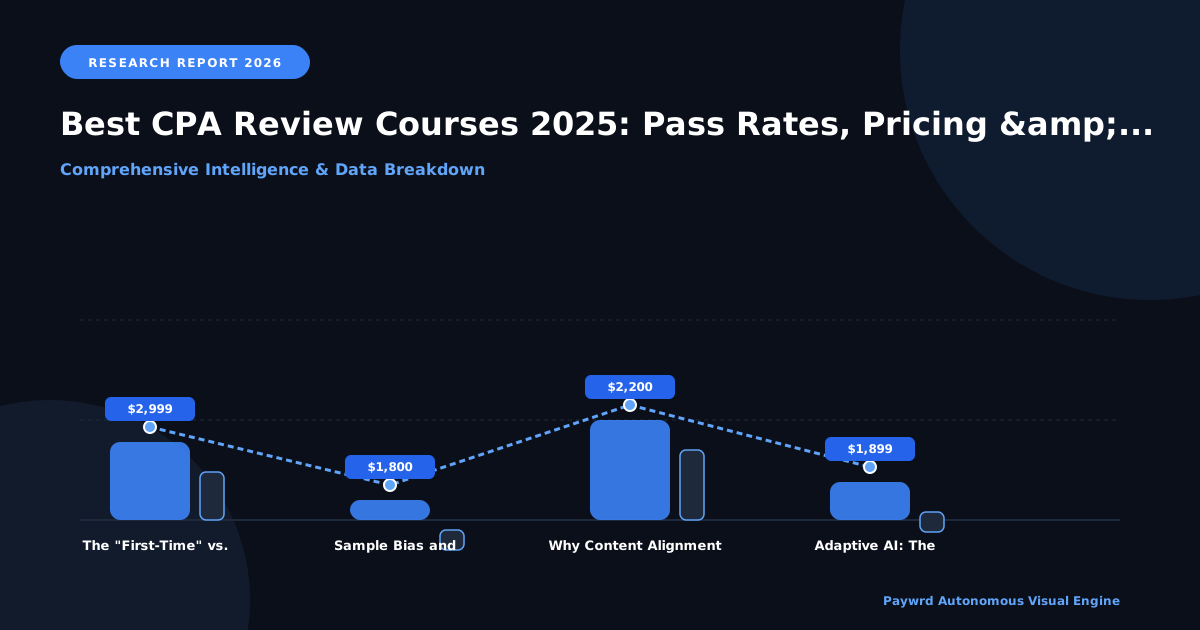
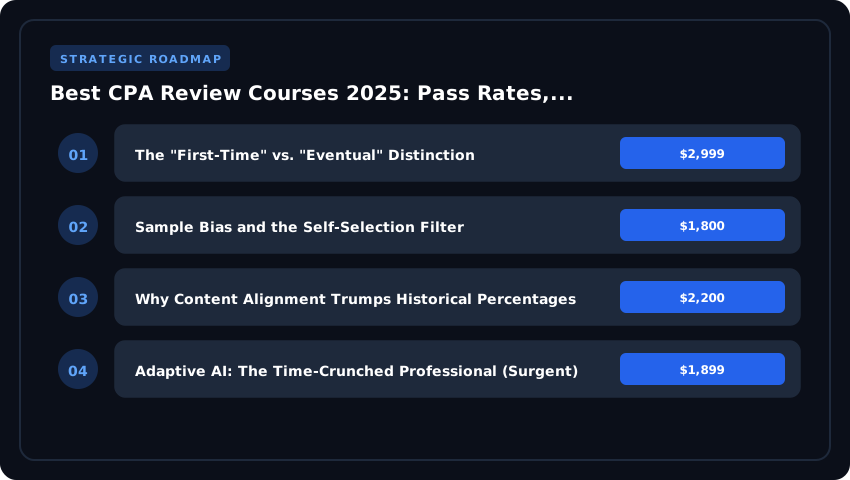
The “First-Time” vs. “Eventual” Distinction
The most common sleight of hand involves the denominator. The NASBA Uniform CPA Examination Candidate Performance reports—the gold standard published annually—track first-time pass rates per section, which historically hover between 45% and 60% depending on the quarter and section (FAR typically lowest, BEC/Discipline sections varying). When a provider claims “90%,” they are almost exclusively reporting an eventual pass rate: the percentage of their users who eventually pass all four sections after potentially multiple attempts per section. This is a measure of persistence and eventual licensure, not a predictor of your likelihood of passing AUD or FAR on your first sitting.
Sample Bias and the Self-Selection Filter
Even “eventual” rates suffer from severe survivorship bias. Providers typically calculate these metrics by surveying users who opt-in to report success or by tracking only those who complete 80–90% of the course material. Candidates who drop out at week three, fail a section twice, and switch providers—or simply quit the journey—are systematically excluded from the dataset. Furthermore, the candidate pool for premium courses (like Becker or UWorld Roger CPA Review) often self-selects for students with stronger accounting GPAs, Big 4 employment (providing study leave), or the financial capacity to treat studying as a full-time job. The course gets credit for the student’s pre-existing advantages.
Why Content Alignment Trumps Historical Percentages
This is the critical pivot for the 2024/2025 CPA Evolution curriculum. The exam structure has fundamentally shifted: Three Core sections (AUD, FAR, REG) plus One Discipline (BAR, ISC, or TCP). A provider’s 2022 “90% pass rate” reflects performance on the old BEC section and legacy content weighting. It tells you nothing about their readiness for Data Analytics simulations in FAR, System and Organization Controls (SOC) in AUD, or the nuanced tax technology concepts in TCP.
Instead of chasing a marketing metric, audit the Blueprint alignment:
- Discipline Depth: Does the course offer a full, distinct learning path for BAR, ISC, and TCP, or just a tacked-on supplement?
- Simulation Fidelity: Are the Task-Based Simulations (TBS) built to the current AICPA specimen standards, including the new spreadsheet and research authoring tools?
- Adaptive Technology: Does the platform diagnose weaknesses against the current Blueprint weighting (e.g., heavier emphasis on Data Analytics in FAR) rather than legacy topic distributions?
Actionable Takeaway: Treat advertised pass rates as brand trust signals, not predictive analytics. Demand a Blueprint Crosswalk Document from the vendor showing exactly where every 2024/2025 learning objective is covered in their lecture, text, and question bank. That alignment—not a self-selected 90% figure—is what protects your $300+ per section re-exam fees and your timeline to licensure.
Total Cost of Ownership: Hidden Fees, Renewals & Employer Reimbursement
Choosing a CPA review course based on the sticker price alone is one of the most common—and most expensive—mistakes candidates make. The advertised tuition for a premier prep program, which often ranges from $1,500 to $3,500, represents only the entry point of your total investment. Once you factor in the mandatory fees administered by the AICPA and NASBA, the cost of physical materials, the reality of potential re-takes, and the mechanics of monthly extensions, the true Total Cost of Ownership (TCO) frequently climbs well beyond initial expectations. Understanding this layered cost structure is the difference between a strategic educational investment and a financially stressful gamble.
First, candidates must budget for the CPA Exam application and registration fees themselves, which are entirely separate from the cost of a review course. In 2025, the application fee sits at approximately $180 depending on the state board, and each of the four exam sections (AUD, BEC, FAR, and REG) costs roughly $344.80. For candidates sitting in a jurisdiction with higher administrative fees, like California or New York, the initial registration alone can exceed $1,000. If a candidate fails to pass a section on the first attempt, they will face an additional fee for the re-take, making an adaptive, data-driven study schedule a critical financial necessity, not just an academic preference.
Review course extensions and physical textbook logistics represent the second layer of hidden costs that catch students off guard. Most comprehensive programs (such as Becker, Wiley, or Roger CPA Review) offer an initial access window of 12 to 18 months. For working professionals balancing 40-plus hours a week with family obligations, a six-month study plan often stretches to ten months or longer. Most providers charge extension fees ranging from $50 to $100 per month for continued access to their proprietary video lectures and adaptive question banks. Furthermore, candidates who opt for physical textbooks over digital formats must account for shipping fees, which can run between $25 and $75 for domestic delivery within the United States, and significantly more for expedited or international shipping.
However, the most effective strategy for neutralizing these costs involves leveraging employer reimbursement programs and US tax credits. The Big 4 accounting firms (Deloitte, PwC, EY, and KPMG) along with most regional and mid-tier firms offer robust Educational Assistance Programs. These programs typically reimburse candidates between $1,500 and $3,500 for review courses and initial exam fees. Before purchasing a package, it is crucial to verify whether your firm requires upfront payment or direct billing, and whether they cover premium tiers (often exceeding the $2,000 mark) that include advanced simulation software or private tutoring. Keeping meticulous records of all receipts is essential, as employers generally require documented proof of a passing score or a minimum threshold of completed mock exams before disbursing funds.
Additionally, US candidates can significantly offset out-of-pocket expenses through federal tax provisions. The IRS Lifetime Learning Credit (LLC) allows eligible candidates to claim 20% of the first $10,000 in qualified education expenses, yielding a maximum credit of $2,000 per tax return. Unlike the American Opportunity Tax Credit, the LLC does not require a degree-seeking enrollment, making it perfectly suited for CPA candidates. Alternatively, if your employer does not offer a reimbursement program, you may be able to exclude up to $5,250 in employer-provided educational assistance from your taxable income under Internal Revenue Code Section 127, provided the program meets IRS compliance standards. By strategically combining a reimbursement cap with the Lifetime Learning Credit, a candidate can effectively reduce a $3,000 course investment to a fraction of its actual cost.
- CPA Exam Fees: Budget roughly $1,200-$1,500 for initial NASBA application and all four section registrations, plus potential re-take fees.
- Extension Fees: Anticipate $50-$100 monthly extensions if your study timeline exceeds the standard 12-18 month access window.
- Shipping & Logistics: Allocate $25-$75 for domestic textbook delivery if you prefer physical books over the digital Adaptive Learning platforms.
- Employer Reimbursement: Confirm your Big 4 or regional firm policy (typically $1,500-$3,500) and whether they pay the provider directly or require post-pass reimbursement.
- Tax Optimization: Claim the IRS Lifetime Learning Credit (up to $2,000) or utilize the Section 127 exclusion ($5,250 cap) to maximize your return on investment.
Matching Course Architecture to Your Learning Style & Timeline
The single biggest predictor of CPA Exam success isn’t the brand name on the box—it’s the alignment between the course’s pedagogical engine and your cognitive wiring. The AICPA consistently suggests candidates budget 300 to 400 total study hours across the four sections, but how you accumulate those hours matters immensely. A mismatch here doesn’t just feel frustrating; it burns through your 18-month rolling window and inflates re-examination fees. Let’s map the four dominant architectures to the candidate profiles they serve best.
Adaptive AI: The Time-Crunched Professional (Surgent)
If you are a senior associate logging 55-hour weeks or a controller studying between board meetings, adaptive learning technology is your force multiplier. Platforms like Surgent use proprietary algorithms to diagnose your competency in real-time, serving only the specific multiple-choice questions (MCQs) and simulations (SIMs) required to shore up weaknesses. This “ReadySCORE” methodology effectively compresses the standard 300-hour benchmark by eliminating redundancy—you never re-study topics you’ve already mastered. The trade-off? Less hand-holding on foundational theory. You need the discipline to trust the data and the baseline knowledge to interpret terse answer explanations without a live instructor walking you through the “why.”
Dense Textbook & Video: The Academic Deep-Diver (Becker, Gleim)
For candidates who need conceptual scaffolding before they can tackle application—recent graduates, career changers, or those who haven’t touched governmental accounting since undergrad—the “encyclopedic” model remains the gold standard. Becker and Gleim operate on a linear, chapter-by-chapter architecture: read the dense textbook (or watch the 40+ hour lecture series), take notes, then drill the corresponding question bank. This approach respects the AICPA Blueprint weighting explicitly. It builds the mental models required to navigate novel Task-Based Simulations (TBSs) on exam day. The cost is time; expect to hit the upper end of the 400-hour range. If you treat the lecture playback speed at 1.0x and read every footnote, you are buying insurance against “surprise” topics.
High-Energy Mnemonics & Storytelling: The Auditory/Visual Retention Learner (UWorld Roger CPA Review)
Some brains reject dry text but lock onto narrative, rhythm, and visual hooks. Roger Philipp’s methodology transforms ASC 606 revenue recognition or Section 1231 assets into memorable stories, acronyms, and high-energy whiteboard sessions. This isn’t “edutainment”—it’s a mnemonic delivery system designed for long-term retention under stress. Ideal for auditory learners who commute or visual learners who need color-coded flowcharts, this style reduces the cognitive load of rote memorization. However, the lecture library is massive; passive watching is a trap. You must actively pause, recreate the mnemonics on scratch paper, and immediately hit the MCQs to convert entertainment into muscle memory.
Unlimited Practice & Drill-Heavy Prep: The Volume Grinder (Ninja CPA Review, UWorld)
There is a subset of candidates who learn exclusively by doing—and failing, reviewing, and doing again. If you already possess a strong technical foundation (perhaps you’re a repeat candidate or a tax manager taking FAR/REG) and view lectures as low-ROI, the “unlimited practice” model is your arena. Ninja and UWorld’s massive question banks (often 8,000+ MCQs and 400+ SIMs) with granular answer rationales allow you to simulate the Prometric environment hundreds of times. This builds the stamina and time-management reflexes that separate a 74 from a 78. The risk? Knowledge gaps. Without a structured textbook or lecture to fall back on, you must be ruthless about reading every explanation—even for questions you guessed correctly—to reverse-engineer the concept.
- Actionable Takeaway: Audit your last 20 hours of study. Were you bored, overwhelmed, or confused? Bored = switch to Adaptive AI. Overwhelmed = switch to Mnemonics/Storytelling. Confused = switch to Dense Textbook/Video. Confident but slow = switch to Unlimited Drills.
- Timeline Reality Check: If you have < 10 weeks per section, Adaptive AI or Drill-Heavy are your only viable paths to the 300-hour minimum. If you have 14+ weeks, the Deep-Dive approach yields the highest ceiling for first-time pass rates.
CPA Evolution 2025 Readiness: Core vs. Discipline Content Depth
The CPA Evolution initiative fundamentally reshaped the licensure landscape effective January 2024, and the 2025 testing windows continue to refine that blueprint. As you evaluate providers, the single most critical differentiator is how deeply they have retooled their databases versus simply rebranding old BEC material. The exam now comprises three Core sections—AUD, FAR, and REG—and one Discipline section chosen from BAR (Business Analysis and Reporting), ISC (Information Systems and Controls), or TCP (Tax Compliance and Planning). Written Communication tasks have been entirely removed; Task-Based Simulations (TBS) now carry significantly heavier weighting across all sections, demanding higher-order application skills rather than rote memorization.
We audited the top six providers for blueprint fidelity. Becker and UWorld Roger CPA Review lead the pack with ground-up rebuilds. Becker’s “New Exam Ready” framework includes dedicated Discipline-specific textbooks and lecture streams filmed post-2023, ensuring SOC 2 reporting frameworks and IT General Controls (ITGCs) are woven into ISC simulations authentically. UWorld distinguishes itself with a massive bank of updated TBSs that mimic the new “spreadsheet” and “document review” interfaces released by the AICPA in late 2023. Their TCP module goes deep on Form 1120-S and 1065 nuances that legacy courses often gloss over.
Surgent leverages its adaptive AI (A.S.A.P. Technology) effectively here; because the algorithm maps your weaknesses to the current blueprint weighting, it automatically deprioritizes legacy BEC written-comm drills and forces TBS practice on data analytics and system controls. However, verify your dashboard shows “CPA Evolution 2024/2025” tags—older lifetime licenses occasionally default to archived content unless manually updated. Wiley CPAexcel (now powered by Efficient Learning) has aggressively expanded its ISC simulation library, adding specific labs for SOX 404 compliance testing and cloud security configurations, areas where the AICPA has signaled increased testing depth.
Buyer beware: Gleim and NINJA CPA Review remain excellent for Core technical depth, but their Discipline simulation banks feel thinner in Q1 2025. Gleim’s ISC section still leans heavily on textbook-style multiple-choice questions (MCQs) rather than the complex, multi-tab TBS environments the live exam now demands. NINJA’s supplemental notes are fantastic for TCP memorization, but they lack a proprietary simulation engine; you are reliant on the AICPA practice test for the “look and feel.” If you select a Discipline-heavy path like ISC or BAR, supplement these with the AICPA Sample Tests immediately.
- Red Flag: Any course still marketing a standalone “BEC” course or advertising “Written Communication Practice” as a feature. That content is obsolete and wastes study hours.
- Must-Have: Dedicated Discipline mock exams (at least two per Discipline) with graded TBS feedback, not just answer keys.
- Action Item: Log into the demo/trial and open an ISC simulation. If you don’t see a “Document Review” tab asking you to evaluate a SOC 2 Type II report exception, the content is likely legacy.
Decision Matrix: Final Verdict Scenarios (Career Changer, Working Pro, Budget)
Choosing a CPA review course is rarely a one-size-fits-all decision. While published pass rates, advertised pricing, and feature lists provide useful benchmarks, the “best” course is ultimately the one that aligns with your specific schedule, learning style, academic background, and financial reality. A first-time candidate fresh out of a state university accounting program has fundamentally different needs than a career changer transitioning from a non-accounting major, just as a Big Four senior associate billing sixty hours a week cannot study the same way as a stay-at-home parent with flexible daytime hours. Below, we outline four distinct “If you are X, buy Y” scenarios designed to match the dominant learner profiles sitting for the Uniform CPA Examination in 2025. Each recommendation weighs not only the sticker price of the course but also the hidden cost of your time, your retention curve, and the structural support you need to actually pass on the first attempt.
If you are a Career Changer (non-accounting major or limited accounting coursework): Choose Gleim CPA Review or Becker CPA Review for foundational depth. If your undergraduate transcript lacks the standard 150-semester-credit curriculum set by most state boards (such as the AACSB-aligned programs required by jurisdictions following the NASBA Accountancy Law), you are playing catch-up on both content and application. Gleim’s structured, textbook-style approach is widely considered the most academically rigorous option on the market, with deep dive content that essentially functions as a secondary textbook for candidates who need to build conceptual frameworks from the ground up. Becker, while slightly more expensive (premium packages frequently run between $2,800 and $3,500), pairs that depth with polished video lectures and the industry’s largest question bank, making it ideal for career changers who need to see the same concept taught multiple ways before it clicks. Both providers also offer dedicated academic advisors who can help you map deficiencies against your specific jurisdiction’s 150-credit-hour rule.
- Best Fit: Gleim CPA Premium or Becker Pro
- Why: Foundational rigor and adaptive practice that mirrors the structure of the AICPA’s Blueprints, particularly in FAR and BEC where career changers tend to struggle most.
- Estimated Total Investment: $1,800–$3,500 plus AICPA application and testing fees of approximately $1,000–$1,500 depending on your state board.
- Watch Out For: The time commitment. Expect 400–500 study hours over six to nine months rather than the aggressive 12-week sprints some marketers advertise.
If you are a Working Professional (Senior Associate, Controller, or 50–60 hour week): Choose Surgent CPA Review or UWorld Roger CPA Review for efficiency. When your week is already maxed out by client deadlines or month-end closes, you cannot afford a course that demands four-hour study blocks. Surgent’s adaptive learning engine, ReadySCORE, dynamically shortens your study path by up to 50% by identifying content you have already mastered and redirecting your time to weak areas. For a working professional, that translates to roughly 200–250 total study hours instead of 400, an enormous quality-of-life difference. UWorld Roger offers a comparable efficiency story through its engaging lecture format and AICPA-licensed question bank, with the added benefit of shorter 20-minute lecture modules that slot easily into a lunch break or a late evening. Both platforms include mobile apps with offline syncing, which matters when your schedule dictates study at airports, client sites, or late-night hotel rooms.
- Best Fit: Surgent CPA Review Unlimited or UWorld Roger Premium
- Why: Adaptive technology that compresses study time, plus lecture pacing designed for the adult learner with competing professional obligations.
- Estimated Total Investment: $1,500–$2,200, often offset by employer CPA reimbursement programs that are increasingly common at mid-tier and Big Four firms.
- Watch Out For: Adaptive learning works best when you trust the algorithm. Skipping readiness checks to “feel ready” can derail an otherwise efficient study plan.
If you are Budget-Conscious or need Supplemental Materials: Choose Ninja CPA Review paired with the NINJA Audio podcast and free FAR notes from AICPA or your state CPA society. For candidates who already own a primary review course but need to shore up a specific weak section, or for those who simply cannot justify a $2,000+ upfront investment, Ninja offers an unmatched value proposition. The core course retails for roughly $67 per section or around $267 for the full four-part package, a fraction of any premium provider. The lecture notes are dense and exam-focused, the multiple-choice questions are notoriously difficult (which is precisely why they are effective for retention), and the audio podcast allows you to “study” during a commute or workout. Pair this with the free AICPA sample tests and the free FAR outline published by most state societies, and you have a legitimate study ecosystem for under $400 total.
- Best Fit: Ninja CPA Review + NINJA Audio + AICPA Free Resources
- Why: Unbeatable price-to-content ratio, especially effective as a supplement to reinforce memorization for REG and BAR’s evolving content areas.
- Estimated Total Investment: Under $500 all-in, leaving significant budget for the AICPA registration fee, ethics exam (state-specific, often $150–$300), and the application fee to sit for the exam.
- Watch Out For: Ninja is not a standalone course for visual learners who require long-form video instruction. It works best as a primary tool for self-directed learners or as a high-yield supplement to a more visual course.
If you are an International Candidate (foreign-educated, visa-dependent, or seeking global mobility): Choose Wiley CPAexcel or Becker CPA Review for global support and visa-friendly study logistics. International candidates often face unique structural challenges, including credential evaluation through agencies like WES or NASBA International Evaluation Services, time-zone-shifted Prometric scheduling, and the need to pass all four exam sections within an 18-month rolling window before visa or OPT expiration. Wiley CPAexcel is particularly strong for international learners because of its concise, text-based format that translates well across language proficiencies, its clear focus on the AICPA Blueprints, and its flexible self-study pacing that accommodates candidates who may be juggling relocation, employment authorization, and credential verification simultaneously. Becker remains the dominant choice for international candidates enrolled in U.S.-based AACSB-accredited master’s bridge programs (such as those offered by many state universities), because universities frequently negotiate institutional Becker access as part of the tuition package, effectively removing the cost barrier while providing the same polished video infrastructure U.S. students receive.
- Best Fit: Wiley CPAexcel Self-Study or Becker (institutional access via a U.S. graduate program)
- Why: Both providers offer robust international student support, well-documented Prometric scheduling guidance, and curriculum alignment with the NASBA International Credential Evaluation process.
- Estimated Total Investment: $1,500–$3,000, plus credential evaluation fees of $300–$500 and state board application fees that vary widely by jurisdiction (often $200–$400).
- Watch Out For: Verify your state’s specific requirements for international credentials before purchasing. Some jurisdictions require additional coursework that may delay your eligibility window, which directly impacts how aggressively you should schedule your exam attempts.
Regardless of which scenario best matches your profile, remember that the most expensive CPA review course is the one you fail with. The most cost-effective path to licensure is the course you will actually finish, retain, and pass on the first attempt. Many candidates also find that a hybrid approach (a premium primary course supplemented by Ninja for memorization-heavy sections, or a Surgent adaptive engine supplemented by Becker video lectures) delivers the best outcomes, especially in the revised 2024 CPA Exam format that emphasizes higher-order skills and application over rote recall. Before making your final purchase, confirm the provider’s pass-rate disclosure methodology, review the refund and extension policies, and verify that the course is fully updated for the current Core plus Discipline exam structure required by the AICPA.
| Provider | List Price (USD) | Typical Street Price | Claimed Pass Rate | Access Length | Free Trial | Career ROI Highlight |
|---|---|---|---|---|---|---|
| Becker CPA Review | $3,499 | $2,999–$3,299 | 94% | 24 months | 14 days | Big 4 preferred; strongest alumni network |
| UWorld Roger CPA | $2,999 | $2,499–$2,699 | 91% | 18 months | 7 days | Engaging lectures; high retention scoring |
| Surgent CPA Review | $2,499 | $1,999–$2,299 | 89% | Unlimited | 5 days | Adaptive A.S.A.P. tech saves study time |
| Wiley CPAexcel | $2,499 | $2,199–$2,399 | 90% | Until you pass | 14 days | Bite-sized lessons; ideal for working pros |
| Gleim CPA Review | $1,899 | $1,599–$1,799 | 87% | 18 months | Free demo | Best value; deepest MCQ test bank |
| Lambers CPA Review | $1,499 | $1,299–$1,499 | 85% | 12 months | Free preview | Budget-friendly; strong instructor support |
Strategic Final Takeaway
Success in evaluating Best CPA Review Courses 2025: Pass Rates, Pricing & Feature Comparison relies on early preparation, adherence to verified accredited requirements, and cross-referencing official portals. Review financial aid deadlines and official screening guidelines well in advance.