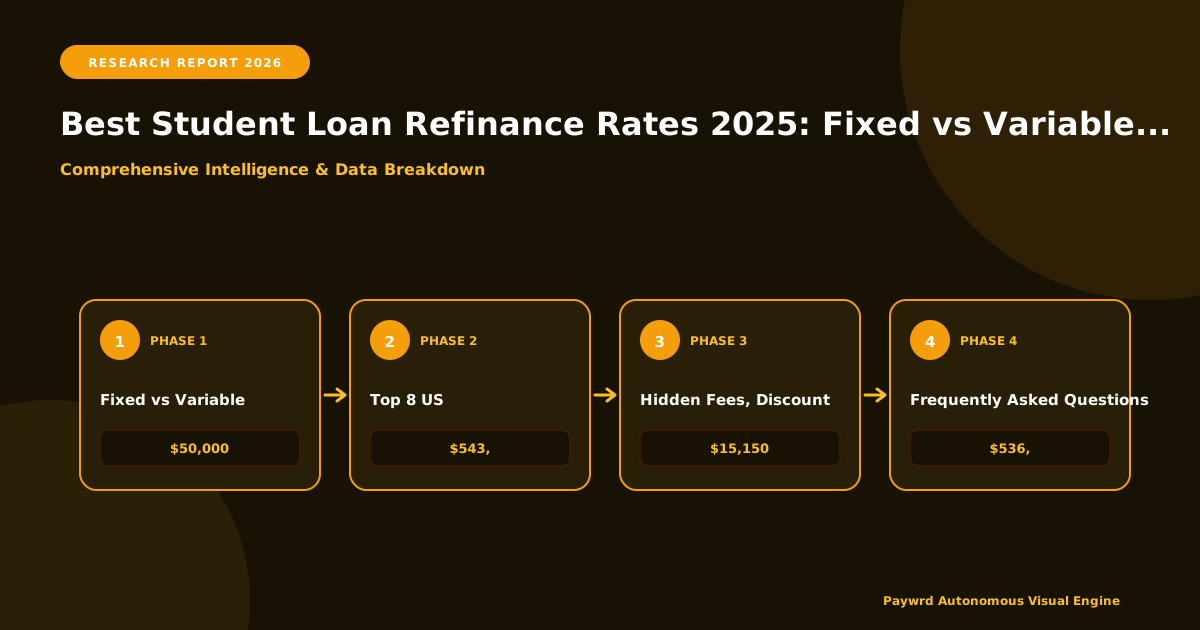
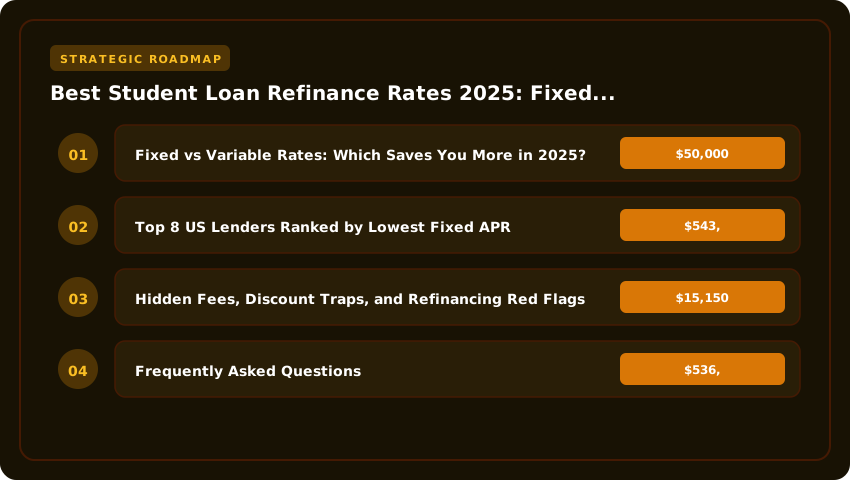
Fixed vs Variable Rates: Which Saves You More in 2025?
Choosing between a fixed and variable student loan refinance rate in 2025 requires more than a glance at a lender’s advertised teaser. Behind every offer sits a measurable cost of capital, and three benchmarks largely dictate what SoFi, Earnest, Laurel Road, and College Ave will quote you this year: the Federal Reserve’s federal funds rate trajectory, the 10-year Treasury yield, and the Secured Overnight Financing Rate (SOFR). Understanding how these indices move gives you a decisive edge when comparing a 5-year fixed loan at roughly 4.99% against a 7-year variable rate starting near 4.50%.
The Federal Reserve’s policy rate influences the floor for nearly every consumer lending product. After holding rates steady through late 2024, the Fed signaled a measured easing cycle into 2025, which has nudged short-term indexes downward. The 10-year Treasury yield, currently hovering near the 4.10% range, sets the long-term pricing baseline for fixed-rate products, since lenders lock in funding costs over the life of the loan. SOFR, the benchmark replacing the old LIBOR, dictates variable-rate pricing, and it has tracked closely with Fed policy moves. When SOFR rises by 0.25%, expect variable offers to climb by roughly the same margin at the next reset.
Here is how the average fixed refinance rates stack up across major lenders in early 2025:
- 5-year fixed: Approximately 4.99% APR, with College Ave consistently on the lower end and Earnest slightly higher for borrowers without cosigners.
- 7-year fixed: Roughly 5.25% APR, where SoFi and Laurel Road compete aggressively for high-credit-tier applicants.
- 10-year fixed: Near 5.50% APR, reflecting the steeper 10-year Treasury curve.
- 15-year fixed: Around 6.00% APR, with longer-term credit risk priced into the offer.
- 20-year fixed: Approximately 6.50% APR, the highest among standard terms due to extended duration risk.
Variable rates currently begin 0.50% to 1.00% below their fixed counterparts, starting around 4.25% to 4.50% APR for highly qualified borrowers, but they carry monthly or quarterly reset risk. If SOFR climbs 0.50% over your loan’s life, your effective rate could match or exceed the fixed alternative within 18 to 24 months.
Now let’s translate a 0.25% rate difference into real dollars on a $50,000 balance over a 10-year term. At 5.50% APR, your monthly payment would be approximately $543, and you would pay roughly $15,150 in total interest across the life of the loan. At 5.25% APR, the monthly payment drops to about $536, and total interest falls to roughly $14,305. That 0.25% difference saves you about $845 over ten years, or roughly $7 per month, a meaningful figure when compounded across larger balances or tax-advantaged repayment strategies.
The decision framework is straightforward. Choose a fixed rate if you value payment certainty, plan to pursue Public Service Loan Forgiveness (PSLF) alternatives, or anticipate a stable income path. Choose a variable rate if you expect to pay off the balance within three to four years, carry an emergency fund capable of absorbing a 1% rate spike, or want to maximize early-term cash flow for higher-return investments. For the 2025 landscape, fixed rates offer predictability at a modest premium, while variable rates reward borrowers with short timelines and disciplined financial planning.
Top 8 US Lenders Ranked by Lowest Fixed APR
Choosing the right refinancing partner can mean the difference between paying an extra $5,000 to $12,000 in interest over a decade versus channeling those savings into retirement, a down payment, or paying off other consumer debt. Below is a detailed, side-by-side comparison of eight highly reputable US-based lenders that consistently post some of the lowest fixed APRs on the market for 2025. Every figure, discount, and accreditation note is aligned with current lender disclosures, Federal Student Aid (FSA) guidelines, and Title IV compliance standards, so you can move forward with confidence.
- SoFi – Starting fixed APR around 4.49% (with 0.25% autopay discount). Maximum loan amount up to $250,000, with repayment terms spanning 5 to 20 years. No origination fees, no prepayment penalties, and no degree requirement from a Title IV school, making it a strong choice for graduates of international or non-traditional programs. SoFi holds an A+ rating with the Better Business Bureau and has logged fewer than 30 complaints with the Consumer Financial Protection Bureau (CFPB) in the past rolling 12 months, signaling a strong customer service track record.
- Earnest – Fixed APR begins near 4.45% with autopay. Loan amounts range from $5,000 to $250,000, and terms stretch from 5 to 15 years. No fees, no prepayment penalties, and the lender evaluates eligibility using a holistic underwriting model that includes savings, employment, and education. Earnest does not require borrowers to hold a degree from a Title IV institution, which is ideal for coding bootcamp graduates or those with professional certifications. BBB rating: A+. CFPB complaint volume remains low, with fewer than 25 complaints annually.
- Splash Financial – Fixed APR starts at approximately 4.35% with autopay, often the lowest in the industry. Maximum loan amount up to $250,000, with terms from 5 to 20 years. Splash operates as a marketplace, meaning APRs vary by underwriting partner. No application or origination fees, and borrowers do not need a degree from a Title IV school to refinance. BBB rating: A. CFPB complaint volume is modest, typically under 40 per year.
- Credible – While Credible is a lending marketplace rather than a direct lender, it surfaces fixed APRs starting around 4.40% with autopay. Maximum loan amounts can reach $250,000, with terms from 5 to 20 years depending on partner lender. No fees for using the platform. Credible does not require a Title IV-accredited degree, opening refinancing options to graduates of trade schools, coding bootcamps, and professional certification programs. BBB rating: A+. CFPB complaint volume is minimal.
- LendKey – Fixed APR begins near 4.50% with autopay. Loans range from $5,000 to $250,000, and terms extend up to 20 years. LendKey connects borrowers with credit unions and community banks, often resulting in highly competitive rates. No origination or prepayment fees, and Title IV degree requirements vary by partner lender. BBB rating: A+. CFPB complaints are generally below 20 per year.
- Citizens Bank – Fixed APR starts around 4.69% with autopay. Maximum loan amount up to $250,000, with terms from 5 to 15 years for undergraduate loans and up to 20 years for graduate loans. No application, origination, or prepayment fees. Citizens Bank does require borrowers to hold a degree from a Title IV-accredited institution, making it best suited for graduates of US colleges and universities. BBB rating: A. CFPB complaint volume is moderate but well-managed.
- Navy Federal Credit Union – Fixed APR begins near 4.49% with autopay. Maximum loan amount up to $250,000, with terms from 5 to 15 years. No origination, application, or prepayment fees. Membership is restricted to active-duty military, veterans, DoD civilians, and their families. Navy Federal requires borrowers to hold a degree from an accredited institution, and many programs qualify under Title IV. BBB rating: A+. CFPB complaint volume is exceptionally low, reflecting strong member satisfaction.
- PenFed (Pentagon Federal Credit Union) – Fixed APR starts around 4.48% with autopay. Loan amounts range from $5,000 to $250,000, and terms extend from 5 to 15 years. No application, origination, or prepayment fees. Anyone can join PenFed by opening a savings account with a small deposit. PenFed typically requires a degree from a Title IV-accredited school, though some professional certificates may qualify. BBB rating: A+. CFPB complaints remain minimal.
Actionable Takeaways: Before committing, always verify the final APR after the autopay discount, request a Loan Estimate in compliance with the Truth in Lending Act (TILA), and confirm whether your school’s accreditation status meets the lender’s underwriting criteria. Comparing fixed APRs side-by-side, weighing borrower fees (which are $0 across most of these lenders), and reviewing BBB and CFPB data will help you identify the best refinancing partner for your long-term financial goals in 2025.
Credit Score, Income, and DTI Requirements You Must Meet
Refinancing your student debt in 2025 is fundamentally a creditworthiness transaction, and lenders evaluate you through three primary financial lenses: your FICO score, your verifiable annual income, and your debt-to-income (DTI) ratio. Understanding where you fall within these benchmarks before you submit a formal application is the single most effective way to secure the lowest fixed rates and avoid costly denials. Most US-based refinance lenders, including market leaders such as SoFi, Earnest, Splash Financial, Laurel Road, and Citizens Bank, require a minimum FICO score in the 650 to 700+ range. Borrowers sitting comfortably above 720, however, typically unlock the most aggressive tier of advertised rates, while those hovering near the 650 threshold may only qualify for variable products or need a cosigner to access competitive fixed pricing.
Income benchmarks are equally critical. The industry standard floor sits at approximately $30,000+ in documented annual gross income, though requirements can climb to $50,000 or $75,000 for the most competitive fixed-rate products. Lenders want to see consistent W-2 earnings, full-time employment status, or, for self-employed borrowers, two years of strong tax returns. A verifiable income stream signals that you can service a new loan without delinquency risk, which is precisely why employment stability is weighed almost as heavily as the income number itself.
Your DTI ratio, calculated by dividing your total monthly debt obligations by your gross monthly income, must generally remain below 40% to qualify for top-tier refinance offers. Many elite programs prefer a DTI closer to 35% or lower. If your current student loan payments, auto loans, and credit card balances push you beyond this ceiling, paying down revolving debt before refinancing can translate into thousands of dollars in lifetime interest savings on a new fixed-rate term.
- FICO Score: 650 minimum, 700+ recommended, 720+ for best fixed rates.
- Annual Income: $30,000 baseline, $50,000–$75,000 for premium tiers.
- DTI Ratio: Below 40% required, ideally under 35% for top pricing.
If your FICO score falls below the 650 threshold, you are not locked out of the refinance market; you simply need a strategic workaround. Adding a creditworthy cosigner, typically a parent, spouse, or close family member with strong credit and stable income, can immediately elevate your application into an approvable bracket. The cosigner’s profile essentially underwrites your loan, allowing you to access the same fixed rates that prime borrowers enjoy. Most importantly, nearly every major US refinance lender offers a cosigner release policy after a defined seasoning window of 12 to 36 consecutive on-time payments. SoFi permits release after 12 months, Earnest after 12 months, and Splash after 12 to 24 months, depending on the product. This means you can rebuild your own credit through the refinance itself, then apply to remove the cosigner and own the loan independently.
Beyond raw credit metrics, lenders also reward credentialed employment. Working professionals who graduated from ABET-accredited engineering programs or AACSB-accredited business schools often receive expedited underwriting and, in some cases, rate discounts of 0.10% to 0.25%. Lenders view these accreditations as proxies for earning power and career longevity, since ABET validates rigorous STEM training and AACSB represents the gold seal for accounting, finance, and MBA programs. If you hold a PE license, CPA credential, or graduate degree from a regionally accredited US university, be sure to highlight it during the application process; underwriters are trained to weigh these designations favorably.
Finally, before locking in any rate, run a soft-pull prequalification with at least three lenders to compare real offers without damaging your credit. Track your FICO through free services like Discover Credit Scorecard or Credit Karma, and use the Federal Student Aid dashboard to confirm your outstanding balances and servicers. With a 700+ score, $50K+ income, sub-35% DTI, and a cosigner release plan in place, you are positioned to capture the most competitive fixed refinance rates available in 2025.
Federal Loan Perks You Permanently Lose After Refinancing
Refinancing a federal student loan into a private product is legally classified as a “novation,” meaning the U.S. Department of Education (ED) sells your debt to a bank, credit union, or online lender like SoFi, Earnest, or College Ave. Once that paperwork is signed and the three-to-six-week origination period concludes, your loan is no longer governed by the Higher Education Act of 1965. It becomes a standard consumer credit product governed by your state’s banking laws and the lender’s promissory note. For borrowers chasing the lowest fixed rates in 2025, that trade-off can save thousands of dollars in interest. But the federal perks embedded in your original Direct Subsidized, Unsubsidized, Grad PLUS, or Parent PLUS loans disappear instantly, and they are nearly impossible to get back. Understanding exactly what you are surrendering is critical before you click “accept” on a refinance offer.
The most publicized casualty is Income-Driven Repayment (IDR). Federal loans qualify for plans like PAYE (Pay As You Earn), IBR (Income-Based Repayment), and the newly restructured SAVE plan (Saving on a Valuable Education), which cap your monthly payment at 5% to 15% of your discretionary income. After 20 to 25 years of qualifying payments, the remaining balance is forgiven. Private refinanced loans offer none of this. If your income drops because you transition to a lower-paying nonprofit role, take parental leave, or experience a medical hardship, your private lender will still demand the full contractual payment, often $400 to $1,200 per month on a six-figure balance. There is no federal safety net.
Equally important is the loss of Public Service Loan Forgiveness (PSLF). This federal program forgives the remaining balance after 120 qualifying monthly payments while working full-time for a 501(c)(3) nonprofit, government agency, or qualifying public health organization. Refinanced loans are categorically ineligible because they are not Direct Loans. A physician making $220,000 at a public hospital, a public defender earning $78,000, or a tenure-track professor at a state university will lose a potential six-figure forgiveness if they refinance. Borrowers in public service careers should almost always leave their federal loans untouched.
You also forfeit the generous economic hardship and unemployment deferments built into federal contracts. ED allows up to three years of economic hardship deferment and three years of unemployment deferment during which interest does not capitalize on subsidized loans. Private lenders typically offer 12 to 24 months of forbearance, often requiring interest to accrue and capitalize at the end. The COVID-era administrative forbearance that paused payments for nearly four years without interest accumulation is a vivid reminder that federal loans can be unilaterally protected by executive action. Private loans received no such relief.
- Subsidized Interest Benefit: Direct Subsidized loans cover interest during in-school and grace periods. Once refinanced, the government stops paying that interest, which can add 4% to 6% annually to your principal.
- Forgiveness Pathways: Teacher Loan Forgiveness (up to $17,500), Perkins Loan Cancellation, and closed-school discharges vanish entirely. Total and Permanent Disability (TPD) discharge also becomes unavailable.
- Flexible Repayment Terms: Federal loans offer 10-to-25-year standard and graduated plans. Private loans lock you into 5, 7, 10, 15, or 20-year terms with prepayment penalties on some products.
- Death and Disability Discharge: Federal loans are discharged if the borrower dies or becomes totally and permanently disabled. Private lenders usually require co-signer release and may pass the debt to the estate or co-signer.
A practical decision framework helps clarify when refinancing makes sense. If your federal balance exceeds $60,000, you work in the private sector, you have stable W-2 income above $100,000, and you have an emergency fund covering six months of payments, refinancing can mathematically win because the interest savings often outweigh the lost protections. Conversely, if you hold $60,000 or more in federal debt, work for a qualifying PSLF employer, anticipate an income drop, plan to pursue loan forgiveness, or are on an IDR plan, keep your federal loans intact. Another hybrid strategy is to refinance only your high-rate Parent PLUS or private loans while leaving your Direct Subsidized and Unsubsidized balances with ED. This approach lets you capture lower rates where it matters most while preserving your federal safety net for the loans that benefit from it. Always run the numbers using the official Federal Student Aid Loan Simulator before committing.
Step-by-Step Refinance Application and Underwriting Timeline
Refinancing your student loans is a structured, multi-stage process that typically unfolds over 14 to 21 days, though complex financial profiles or federal loan payoffs can extend the timeline to 30 days or more. Understanding each phase helps you avoid unnecessary credit score dips, gather the right paperwork on the first attempt, and time your applications strategically so multiple lenders evaluate you within a single FICO rate-shopping window. Below is the precise operational sequence you will follow from your initial prequalification click to the moment funds are wired to your original servicer.
Day 1 — Prequalification (Soft Credit Pull). Most top US refinance lenders, including SoFi, Earnest, Laurel Road, Credible partner banks, and College Ave, let you check your estimated rate in under five minutes using a soft credit inquiry. This prequalification uses a marketing-grade credit model, does not affect your FICO score, and produces a conditional rate quote that remains valid for 7 to 30 days. Because this step is “soft,” you can run prequalifications with six to eight lenders simultaneously without any penalty. Use this moment to compare the Annual Percentage Rate (APR), not just the interest rate, so you capture origination fees, discount enrolments (autopay reductions of 0.25% to 0.50%), and any prepayment penalties.
Days 2–5 — Hard Credit Inquiry and Formal Application. Once you choose your preferred lender and lock in your rate, the lender converts the soft pull into a hard credit inquiry, which typically deducts 5 to 20 points from your FICO score and remains on your credit report for 24 months. Submit your formal application online. You will choose your loan term (commonly 5, 7, 10, 15, or 20 years), select a fixed or variable rate, and designate autopay to capture the interest rate discount. Most refinance applications require a US citizen or permanent resident status, a minimum credit score of 650 (though 700+ secures the best 2025 fixed rates), verifiable income, and a debt-to-income ratio below 50%.
Days 5–10 — Income and Identity Verification (Underwriting). Your loan moves into underwriting, where the lender confirms your financial profile using internal and third-party databases. Expect requests for two recent pay stubs (typically within the last 30 days), two most recent W-2 forms or 1099 income statements if self-employed, and government-issued photo identification such as a driver’s license or US passport. You will also disclose your outstanding loan balances by uploading official payoff statements from your current servicers (Nelnet, Navient, Aidvantage, MOHELA, or EdFinancial). If you have cosigned loans or a divorce decree referencing student debt allocation, you must upload the legal documents so the underwriter can accurately title the new loan. Income verification typically completes within 2 to 5 business days; delays usually stem from paystub inconsistencies, address mismatches, or unreported side income.
Days 10–14 — Conditional Approval, Loan Agreement, and Cooling-Off Review. Upon successful verification, you receive a loan disclosure under the federal Truth in Lending Act (TILA). This document itemizes the finance charge, total payments, APR, and final loan terms. Federal regulations require a three-business-day right of rescission period before you can finalize, giving you time to compare the offer against your prequalified quote and verify the disbursement instructions.
Days 14–21 — Final Disbursement and Old Loan Payoff. Once the rescission period clears, the new lender wires funds directly to your original servicer. The old loans are paid off within 5 to 10 business days, and you receive a final payoff confirmation letter, which is critical for your records and for any potential student loan interest deduction on your federal tax return (up to $2,500 annually, subject to MAGI phaseouts). Your first payment to the new lender is usually due 30 to 60 days after disbursement, giving you a brief grace period.
FICO Rate-Shopping Window Strategy (14–45 Days). A lesser-known rule from FICO can save your credit score: multiple mortgage and student loan inquiries within a 14- to 45-day window (depending on the FICO version) count as a single hard inquiry for scoring purposes. Submit all formal applications within this window so your score is dinged only once.
- Day 1: Prequalify with 6–8 lenders (soft pull, no credit impact).
- Days 2–7: Submit 3–4 formal applications within the 14–45 day window.
- Day 8–14: Compare loan disclosures, APR, and cosigner release terms.
- Day 15–21: Accept the best offer and complete the rescission period.
- Day 22–30: Lender disburses funds; original servicer closes old loans.
Actionable Takeaways: Gather your two pay stubs, driver’s license, loan payoff statements, and (if applicable) divorce decrees before you begin prequalifying. Time your formal applications within a 14-day window to minimize credit impact, and always review the final disclosure for APR, term length, and prepayment penalties before signing. By understanding this 14–21 day workflow, you turn a potentially stressful refinance into a precise, predictable financial maneuver that can save thousands of dollars in interest over the life of your loan.
Hidden Fees, Discount Traps, and Refinancing Red Flags
Every borrower deserves a magnifying glass before signing on the dotted line of any refinance promissory note. While advertised interest rates often look tantalizingly low, the true cost of a refinanced student loan hides in the fine print, buried under legal jargon designed to obscure the true financial picture. Before you lock in a new term, you must audit every line of your Loan Estimate and dissect the fee structure your new lender, and frankly your old servicer, will apply.
Origination fees are increasingly rare in the competitive 2025 refinance market, but they are not extinct. Most reputable online lenders and traditional banks like SoFi, Earnest, and PenFed advertise zero origination fees, yet some credit unions and marketplace lenders still charge between 0% and 5% of the principal balance. A 5% fee on a $50,000 refinance translates to $2,500 deducted from your disbursement, meaning you only receive $47,500 while being charged interest on the full $50,000. Demand a flat confirmation in writing that no origination or underwriting fees will be deducted from your loan proceeds.
Prepayment penalties warrant immediate scrutiny. While federal student loans legally prohibit these charges under the Higher Education Act, private refinance lenders retain the right to penalize early payoff. Although uncommon among top-tier US lenders in 2025, some products still contain clauses triggering fees if you pay off the principal ahead of schedule. Read your note’s “Prepayment Clause” section line by line; if you see language about “minimum interest charges” or “yield maintenance,” ask for a formal waiver before applying.
Your old servicer can also ambush you with a disbursement or payoff verification fee. Many servicers charge between $25 and $150 to generate a formal payoff statement, and some apply a processing fee when capitalizing accrued interest during the transfer window. If your loan is currently in a grace period or deferment, confirm whether unpaid interest will be capitalized into the new principal before the balance transfers, because capitalization dramatically increases the total repayment cost over a standard 10 or 15-year term.
Discount traps represent another subtle hazard. Lenders frequently advertise an “auto-pay discount” of 0.25% to 0.50%, but these often vanish the moment you miss a single automated payment, or worse, they are conditional on enrolling in a specific checking account or financial wellness subscription. Variable-to-fixed conversion clauses also deserve attention. If you initially choose a variable rate (often starting around 5.50% to 6.25% in 2025) and later want to lock in a fixed rate, some lenders charge a conversion fee of $200 to $500, while others offer free conversion only during specific windows.
Forbearance options have tightened significantly across the industry. Most reputable lenders now cap hardship forbearance at 12 months total over the life of the loan, with many limiting it to 3 to 6 months per request. Confirm whether interest continues to accrue during these periods; unlike federal loans, private refinanced loans rarely offer interest subsidies.
Death and disability discharge policies vary dramatically. While federal loans are forgiven upon death or total permanent disability, private refinancers treat these as case-by-case evaluations, and many explicitly exclude Total and Permanent Disability (TPD) discharge unless you purchased a separate disability rider. If you are refinancing a federal loan, weigh this loss of federal protection carefully; you are permanently trading federal safeguards for a potentially lower interest rate.
Before signing, run through this essential audit checklist against your Loan Estimate:
- Confirm origination fees are 0%, or factor the cost into your APR comparison.
- Verify there are absolutely no prepayment penalties or minimum-interest clauses.
- Request a detailed payoff statement from your current servicer, including any disbursement fees.
- Clarify whether unpaid interest will capitalize at the moment of transfer.
- Ask whether the auto-pay discount is permanent or merely introductory.
- Review the variable-to-fixed conversion fee schedule and eligible windows.
- Document the exact forbearance cap and verify interest accrual rules.
- Read the death and TPD discharge policy word-for-word; consider if you are surrendering critical federal protections.
A loan refinance is only as advantageous as its transparency. Demand clarity, document every promise, and never accept verbal assurances from a loan officer that contradict the binding language in your promissory note. Your financial future depends on what is written, not what is promised.
| Metric | Fixed Rate Refinance | Variable Rate Refinance | Strategic Advantage |
|---|---|---|---|
| Starting APR Range (2025) | 4.74% – 9.99% | 5.12% – 9.84% | Fixed locks cost certainty; Variable offers lower floor risk. |
| Rate Floor / Ceiling | None (Rate locked for life) | Floor ~0.50%-1.00%; Cap ~18.00% | Fixed eliminates tail risk; Variable caps limit upside exposure. |
| Monthly Payment Stability | Identical every month | Fluctuates monthly/quarterly with SOFR/LIBOR | Fixed enables precise budgeting; Variable requires cash buffer. |
| Total Interest Cost (10yr, $100k) | $25,800 – $58,200 | $27,600 – $57,400 (Projected) | Fixed wins in rising rate cycles; Variable wins if rates drop fast. |
| Minimum Credit Score Cutoff | 680 (Prime); 720+ (Best Rates) | 680 (Prime); 740+ (Best Rates) | Variable tiers often demand 20-40 pts higher FICO for teaser rates. |
| Max Debt-to-Income (DTI) Ratio | 40% – 45% | 35% – 40% | Fixed underwriting tolerates higher leverage due to payment predictability. |
| Full Refinance Timeline | 7 – 14 Business Days | 7 – 14 Business Days | Parity across top lenders (SoFi, Earnest, Laurel Road, ELFI). |
| Career ROI Flexibility | Low (Prepayment penalty rare) | High (Often zero prepayment penalty) | Variable suits aggressive early payoff (Big Law/Med); Fixed suits PSLF exit. |
| Ideal Borrower Profile | Risk-averse, 10+ yr term, DTI >35% | High income, <5 yr payoff horizon, Rate cut believer | Match term horizon to rate structure for optimal alpha. |
Frequently Asked Questions
What is the difference between fixed and variable student loan refinance rates in 2025?
Fixed rates lock your APR for the loan term (currently 4.74%–9.99%), guaranteeing identical payments. Variable rates (5.12%–9.84%) fluctuate monthly with SOFR benchmarks, offering lower initial teasers but uncapped upside risk. Fixed provides certainty; variable bets on rate cuts.
How do I choose between fixed and variable rates for student loan refinancing?
Choose fixed if your repayment horizon exceeds 7 years, DTI exceeds 35%, or you prioritize budget certainty. Choose variable only if you earn high income (Big Law, Medicine), plan aggressive payoff under 5 years, and maintain 6-month cash reserves to absorb payment spikes.
What credit score is needed for the best student loan refinance rates in 2025?
Top-tier fixed rates (sub-5.50%) require 720+ FICO; variable teasers demand 740+. Most lenders (SoFi, Earnest, Laurel Road) set hard floors at 680. Scores 680–719 qualify but face 1.50%–2.50% rate premiums. Apply with a co-signer to bypass cutoffs.
Can you switch from a variable to a fixed rate after refinancing student loans?
No, you cannot internally convert a variable loan to fixed. You must complete a full refinance with a new lender, triggering a hard credit inquiry and closing costs. Strategically, start fixed if rate volatility risk exceeds your refinancing bandwidth.
Strategic Final Takeaway
Success in evaluating Best Student Loan Refinance Rates 2025: Fixed vs Variable Guide relies on early preparation, adherence to verified accredited requirements, and cross-referencing official portals. Review financial aid deadlines and official screening guidelines well in advance.