Current PMP Exam Fees and Total Certification Investment
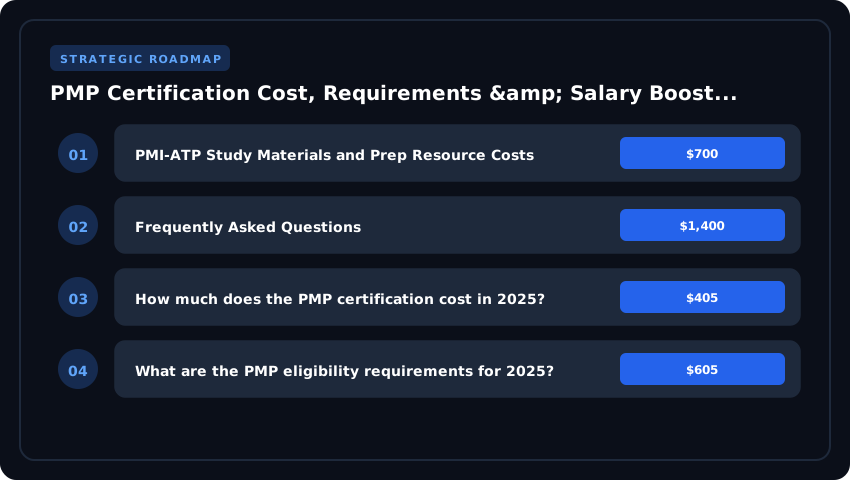
Understanding the true financial commitment for the Project Management Professional (PMP) certification requires looking well beyond the advertised exam price. While most candidates initially focus on the headline figure from the Project Management Institute (PMI), the realistic investment typically ranges from $700 to over $1,400 once you account for membership dues, study materials, and preparation courses. For American professionals evaluating this credential as a career investment, mapping out every dollar ahead of time prevents budget surprises and ensures a smoother path to certification.
The foundation of your investment begins with PMI membership status. PMI offers two primary pricing tiers for the certification exam itself. PMI members pay $405 for the computer-based exam, while non-members pay $605. This $200 differential is one of the most overlooked savings opportunities in the certification process. Since PMI membership costs $139 annually plus a one-time $10 application fee (totaling $149 for new members), joining PMI before applying for the exam effectively saves you $51 upfront. For most serious candidates, this membership also unlocks access to the PMBOK Guide, free webinars, local chapter networking events, and discounts on continuing education—all of which directly support your exam preparation journey.
However, the exam fee represents only one slice of your total certification investment. Study materials constitute the second major expense category, and quality preparation resources are non-negotiable for passing this notoriously rigorous exam. Most successful candidates invest between $300 and $500 on comprehensive study materials, which typically include:
- The PMBOK Guide (7th Edition), available free with PMI membership or priced around $60 for non-members through the PMI bookstore or major retailers like Amazon.
- Rita Mulcahy’s PMP Exam Prep, a widely recommended reference book retailing between $40 and $60.
- PMI’s Authorized PMP Exam Prep course materials and practice exams, often bundled with training packages.
- Third-party practice question banks and simulated exams, which range from $30 to $150 depending on depth and quality.
Beyond printed materials, many candidates enroll in formal preparation courses. A 35-contact-hour PMP prep course—which is actually a mandatory prerequisite for the exam application—costs anywhere from $300 to $1,500 depending on the format. Self-paced online courses from providers like Simplilearn, Udemy, or PMI’s own authorized training partners typically fall on the lower end, while instructor-led boot camps and university-affiliated programs command premium pricing. Since this training requirement is mandatory before you can even submit your exam application, budget for it as a core expense rather than an optional add-on.
PMI also enforces a strict reexamination policy that financially impacts candidates who do not pass on the first attempt. If you fail the exam, you may retake it up to three times within your one-year eligibility window. Reexamination fees follow the same pricing structure as the initial attempt—$405 for members and $605 for non-members—meaning a single retake could cost you an additional $600 or more. After the third attempt, candidates must wait one full year before reapplying and paying the full exam fee again. This policy underscores why thorough preparation is both a financial and strategic imperative.
Hidden expenses can quietly inflate your total investment if you are not careful. Consider budgeting for travel costs if your nearest Pearson VUE testing center requires transportation, time off work for exam day and preparation, and potential renewal fees down the road. PMP certification is valid for three years, and maintaining it requires earning 60 professional development units (PDUs), which often involves additional courses or conference attendance ranging from $200 to $800 per renewal cycle.
For a comprehensive budget planning perspective, here is a realistic breakdown of the total first-year investment:
- Budget-conscious path (Member route): $149 membership + $405 exam + $300 study materials + $400 prep course = approximately $1,254.
- Comprehensive preparation path: $149 membership + $405 exam + $500 study materials + $1,200 premium boot camp = approximately $2,254.
- Non-member minimum route: $605 exam + $300 study materials + $400 prep course = approximately $1,305.
The smartest financial move for nearly every American candidate is to join PMI first, then apply for the exam. This single decision saves money, grants access to essential study resources, and connects you with a professional network that supports long-term career growth well beyond the certification itself.
PMI Eligibility Criteria and 2025 Application Standards
Navigating the Project Management Professional (PMP) credential begins with a clear understanding of the eligibility architecture established by the Project Management Institute (PMI). For the 2025 application cycle, PMI has maintained its rigorous two-track system while continuously aligning the exam content with the evolving realities of predictive, agile, and hybrid project environments. Whether you are a recent graduate evaluating your first professional credential or a seasoned program manager seeking formal validation of your expertise, mastering these eligibility standards is the foundational step toward a successful application.
The first track, often called the 36-month experience pathway, is engineered for candidates who already hold a four-year degree from an accredited United States university or an equivalent global institution. Applicants under this route must demonstrate a minimum of 36 months—roughly three years—of professional project management experience within the last eight years. PMI is highly specific about what qualifies as project management experience: the candidate must have been responsible for leading and directing projects across the five process groups (Initiating, Planning, Executing, Monitoring & Controlling, and Closing). Simply participating in projects or acting as a subject matter expert is generally insufficient; the candidate must hold a leadership role with documented accountability for deliverables, budgets, and stakeholder outcomes.
The second track, the 60-month experience pathway, accommodates candidates who possess a secondary degree, such as a high school diploma, an associate degree, or a global equivalent. For these applicants, PMI requires a more extensive professional history of 60 months—approximately five years—of progressive project management responsibility within the preceding eight years. This extended requirement acknowledges the broader professional maturity expected from candidates who enter the workforce without the benefit of a bachelor’s degree, ensuring that they have accumulated substantial real-world exposure to complex project challenges.
Regardless of which educational and experience track you pursue, every candidate must complete 35 contact hours of formal project management education. This is a non-negotiable prerequisite, and PMI has tightened its verification process considerably in recent years. The 35 hours must be completed before you submit your application, and the training must align with PMI’s Talent Triangle and the updated Exam Content Outline. Acceptable providers include PMI Authorized Training Partners (ATPs), which carry the official Registered Education Provider (R.E.P.) or the newer Authorized Training Partner designation, as well as accredited universities offering continuing education programs, community college certificates, and corporate training departments that have undergone PMI audits.
Importantly, not every training certificate is accepted. Courses must clearly outline their instructional hours, learning objectives, and instructor credentials. PMI reserves the right to audit applications and reject submissions if the educational documentation does not meet their published standards. To avoid delays, candidates should retain certificates, syllabi, and instructor résumés for at least one year following their application submission. Many aspiring project managers in the United States find that investing in a reputable bootcamp or university extension program not only satisfies the 35-hour requirement but also provides structured preparation for the exam itself, which has become increasingly weighted toward agile methodologies, business acumen, and cross-functional leadership.
- 36-Month Track: Requires a four-year degree (ABET, AACSB, regionally accredited US institutions accepted) plus 36 months of project leadership experience within the last eight years.
- 60-Month Track: Requires a high school diploma or associate degree plus 60 months of qualifying project management experience within the last eight years.
- Education Prerequisite: All candidates must complete 35 contact hours of project management education before applying.
- Approved Providers: PMI Authorized Training Partners, accredited universities, and certified corporate training programs are the most reliable sources.
- Exam Content Alignment: Ensure your coursework reflects the current PMI Exam Content Outline, emphasizing predictive, agile, and hybrid approaches.
Understanding these eligibility standards empowers you to map out a strategic timeline. For many professionals, the credential represents not only a financial investment of several thousand dollars but also a career-defining milestone that opens doors to senior program management, consulting, and executive leadership roles across American industries ranging from information technology to healthcare and federal contracting.
Real Salary Impact and Compensation Data for PMP Holders
When evaluating the true return on investment for the Project Management Professional (PMP) certification, the most compelling evidence comes directly from the Project Management Institute’s (PMI) 2024 Earning Power Report. This authoritative analysis, which surveyed more than 25,000 project management professionals globally, demonstrates that PMP-certified practitioners in the United States command a median salary that is approximately 16 percent higher than their non-certified peers performing comparable roles. For a professional earning a baseline salary of $90,000, this differential translates to roughly $14,400 in additional annual compensation, effectively recouping the entire certification investment within the first year of holding the credential.
The compensation advantage extends beyond simple base salary figures. According to PMI’s findings, PMP holders consistently report higher total compensation packages, including performance bonuses, profit-sharing distributions, and equity grants. The median total compensation for PMP-certified professionals in the United States reached approximately $115,000 in 2024, while non-certified counterparts in similar roles averaged closer to $99,000. This gap widens further at the senior leadership level, where directors and program managers with PMP credentials report earning upwards of $145,000 annually.
Regional variations across major American metropolitan areas reveal fascinating patterns that aspiring PMP holders should consider when planning their career trajectories:
- San Francisco Bay Area and Silicon Valley: Median PMP salaries exceed $140,000, reflecting the premium placed on certified project leadership in technology-driven economies where competition for talent is fierce.
- Washington, D.C. Metropolitan Area: With its concentration of federal contractors, defense firms, and consulting agencies, PMP holders average approximately $128,000, benefiting from the region’s heavy reliance on contract deliverables and compliance-driven projects.
- New York City and Boston: Financial services and healthcare organizations drive PMP compensation to roughly $122,000, particularly for those managing regulatory compliance initiatives and digital transformation programs.
- Midwest Industrial Corridor (Chicago, Detroit, Cleveland): Manufacturing sector demand sustains PMP salaries around $108,000, with steady growth tied to supply chain modernization efforts.
- Sun Belt Cities (Dallas, Atlanta, Phoenix, Charlotte): Rapid corporate relocations and infrastructure investments have pushed PMP compensation to approximately $105,000, representing one of the fastest-growing regional markets for certified project leaders.
Industry-specific pay differentials further illustrate the versatility of the PMP credential. Technology and software development sectors offer the highest premiums, with PMP-certified technical project managers earning median salaries approaching $135,000 due to the complexity of Agile transformations and product lifecycle management. Healthcare organizations, navigating electronic health record implementations and HIPAA compliance mandates, compensate PMP holders at approximately $118,000. Financial services firms, particularly those pursuing digital banking initiatives, average $125,000 for certified project professionals, while aerospace and defense contractors consistently offer among the highest pay premiums in recognition of the credential’s alignment with earned value management and federal contracting standards.
Perhaps most encouraging for career planners is the longitudinal trajectory PMI documented. Professionals who maintained their PMP certification for ten or more years reported median compensation gains exceeding 40 percent above entry-level certified salaries, suggesting that the credential functions not merely as a salary booster but as a compounding career asset. Combined with the requirement to earn 60 Professional Development Units (PDUs) every three years, the certification creates a continuous learning loop that keeps holders positioned for advancement into senior program management, portfolio management, and executive leadership roles, where compensation frequently surpasses $160,000 annually in major U.S. markets.
PMI-ATP Study Materials and Prep Resource Costs
Securing the right study materials is arguably the most controllable expense within your overall PMP certification budget. While PMI membership and retake fees can fluctuate based on personal circumstances, your choice of training provider, textbooks, and practice exams is entirely within your command. Understanding the full landscape of Authorized Training Partner (ATP), Registered Education Provider (R.E.P.) institutions, and supplementary resources allows you to assemble a high-quality preparation package without overspending or cutting corners that could compromise your first-attempt success rate.
For candidates pursuing the 35 contact hours prerequisite required for PMP eligibility, ATP and R.E.P. institutions remain the gold standard. Bootcamp formats, typically delivered over four to five intensive days or spread across eight to ten evening sessions, generally range from $1,200 to $2,500 for comprehensive live instruction. Premium providers like Project Management Academy, Velociteach, and Simplilearn sit at the upper end of this spectrum, often including exam simulators, course manuals, and post-class mentorship. Mid-tier options from institutions such as University of California Irvine Continuing Education or George Washington University’s professional studies division hover closer to the $1,400 to $1,800 mark while still delivering PMI-aligned curricula and instructors holding active PMP credentials.
Budget-conscious professionals frequently overlook university extension programs affiliated with R.E.P. status. Schools like Stanford Center for Professional Development, NYU School of Professional Studies, and Boston University Metropolitan College offer PMP prep courses at competitive rates, often between $900 and $1,500, with the added prestige of academic credentials and access to extensive alumni networking circles. These programs are particularly attractive for working professionals whose employers offer tuition reimbursement benefits under IRS Section 127, allowing up to $5,250 in annual tax-free educational assistance.
Beyond formal classroom instruction, textbook bundles represent a meaningful line item. The PMBOK Guide Seventh Edition, currently bundled with the Agile Practice Guide, retails at approximately $70 to $95 through PMI.org, Amazon, or Barnes & Noble. Rita Mulcahy’s PMP Exam Prep textbook, widely regarded as the most reader-friendly companion volume, runs between $50 and $70 for the physical edition or roughly $40 for the Kindle version. Many candidates discover that purchasing both the PMBOK Guide and Rita Mulcahy creates redundancy, so selecting one primary text supplemented with targeted practice questions is often the most cost-effective route.
Practice exam subscriptions deserve special attention because they correlate strongly with first-attempt pass rates. Reputable platforms including PrepCast PM Simulator, PMTraining, and Oliver Lehmann’s 175-Question Simulator charge between $30 and $150 for subscriptions lasting 30 to 90 days. The PM Simulator premium package, which generates thousands of randomized questions aligned with the current exam content outline, costs around $139 and is frequently cited by successful candidates as the single most valuable resource outside formal instruction. Free alternatives exist, including PMI’s own 50-question practice exam accessible to members and a rotating selection of sample questions published in the PMI member’s website knowledge base.
PMI itself offers several free and low-cost resources that meaningfully reduce total preparation spending. The organization’s Project Management Body of Knowledge (PMBOK) Guided Learning curriculum, available through the PMI website, provides foundational content at no charge to members. Additionally, the free PMIstandards+ digital subscription grants access to foundational standards, while members receive complimentary downloads of select practice frameworks. Local PMI chapter events, often priced between $15 and $40 for non-members, feature half-day study sessions and exam-taking strategy workshops that effectively substitute for portions of commercial prep courses.
- Bootcamp tier (live instruction): $1,200 to $2,500, including exam simulators and course manuals.
- University extension programs: $900 to $1,500, eligible for employer tuition reimbursement.
- Core textbooks (PMBOK Guide + companion): $70 to $165 depending on bundle selections.
- Practice exam subscriptions: $30 to $150 for 30 to 90-day access windows.
- Free PMI resources: Practice questions, chapter events, and member-exclusive content.
By strategically combining a mid-priced R.E.P. bootcamp, one authoritative textbook, and a robust practice exam subscription, most candidates can complete the 35-hour prerequisite and exam readiness preparation for a combined investment ranging from $1,500 to $3,000, excluding the certification application fee itself. This balanced approach maximizes instructional quality, content retention, and exam-day confidence without straining professional development budgets.
Employer Reimbursement Programs and Corporate Sponsorship
When analyzing the total investment required for the Project Management Professional (PMP) certification, many professionals overlook one of the most lucrative funding avenues available: their own employer. Across the United States, forward-thinking organizations recognize that investing in project management talent directly correlates with improved operational efficiency and higher project success rates. Consequently, employer reimbursement programs and corporate sponsorships have become standard practice, particularly among Fortune 500 companies.
The financial backbone of these educational assistance programs is Section 127 of the Internal Revenue Code. Under this provision, employers can provide up to $5,250 per year in tax-free educational assistance to an employee. This $5,250 annual cap covers tuition, fees, and course materials, and it applies to both undergraduate and graduate-level coursework. Crucially for aspiring project managers, the IRS explicitly permits these funds to be used for non-degree programs and professional certifications, including the PMP. This means that the $405 exam fee for PMI members, the $555 fee for non-members, and the required 35 hours of project management education can often be fully absorbed by your company without triggering additional payroll taxes.
Major US corporations routinely leverage Section 127 to upskill their workforce. Fortune 500 giants like Boeing, Deloitte, and Apple maintain robust tuition reimbursement programs designed specifically to cultivate internal project management leadership. These organizations often view the PMP certification not as an optional credential, but as a strategic requirement for promotion into senior program management roles. In many cases, companies will pre-pay for the exam and training materials rather than requiring the employee to front the cost and wait for reimbursement.
To successfully secure corporate sponsorship, professionals must approach the conversation with a clear, mutually beneficial business case. Here is how you can position your request for enrollment in a PMP prep program:
- Align with company goals: Demonstrate how your PMP certification will directly benefit your current projects, reduce risk, and improve the company’s bottom line.
- Understand your HR policies: Review your employee handbook or speak with your HR center to determine the exact Section 127 limits your company offers. Some employers even exceed the $5,250 tax-free cap by offering taxable reimbursement beyond that threshold.
- Prepare a formal proposal: Outline the total cost, including exam fees, PMI membership, and prep courses. Present a timeline for completion that ensures minimal disruption to your daily responsibilities.
- Check for retention agreements: Be aware that many corporate sponsorships require a commitment to remain with the company for a specified period—often one to two years—following the reimbursement.
By leveraging these employer-sponsored pathways, you can effectively eliminate the out-of-pocket costs associated with the PMP certification while simultaneously signaling your long-term commitment to your organization’s growth.
Step-by-Step Roadmap From Application to Credential Maintenance
Successfully earning the Project Management Professional (PMP) credential is a multi-stage journey that typically spans six to nine months from initial PMI application to the moment you pass the computer-based exam at a Pearson VUE testing center. Understanding each phase of this roadmap helps candidates in the United States allocate study hours, budget for associated expenses, and avoid costly rescheduling fees that can exceed $70 per transfer. The process is governed by the Project Management Institute (PMI), which administers the credential, and Pearson VUE, the authorized testing partner that proctors the exam at hundreds of locations nationwide.
Phase 1: Application Submission and Eligibility Review (Weeks 1–4). Candidates begin by creating a free account on pmi.org and completing the online PMP application. PMI requires documented evidence of project management experience: 36 months if you hold a four-year US bachelor’s degree from a regionally accredited institution (such as those recognized by ABET or AACSB), or 60 months with a high school diploma or associate degree. Additionally, every applicant must complete 35 contact hours of formal project management education, which can be fulfilled through a Registered Education Provider (REP) course costing roughly $300 to $1,500. Once submitted, PMI typically reviews applications within 5 to 10 business days, though random audits can extend this window by an additional 30 days.
- Confirm degree accreditation status through the CHEA or USDE database before claiming the reduced experience requirement.
- Save digital copies of transcripts, training certificates, and project descriptions in PDF format to streamline audit responses.
- Pay the membership vs. non-membership fee strategically: PMI membership at $139 plus a $405 exam fee is cheaper than the $675 non-member rate, especially if you plan to renew.
Phase 2: Eligibility Window and Study Period (Months 2–6). After receiving your acceptance email, you have a 12-month eligibility window to schedule and sit for the exam. Most working professionals dedicate 150 to 250 study hours during this window, often enrolling in a structured prep course from a PMI Authorized Training Partner. Popular US-based options include courses bundled with exam simulators, ranging from $400 to $1,200. Recommended study materials include the PMBOK Guide (7th Edition), the Agile Practice Guide, and Rita Mulcahy’s PMP Exam Prep, which align with the current 2025 exam content outline emphasizing predictive, agile, and hybrid approaches.
Phase 3: Exam Scheduling at Pearson VUE (Weeks 12–20). Scheduling the exam is done directly through pearsonvue.com using the candidate ID provided by PMI. In the United States, Pearson VUE operates testing centers in nearly every metropolitan area, from New York to San Diego. You may choose between a center-based proctored exam or an online proctored option taken from home, though both require a reliable internet connection and a private room. Exam slots are available seven days a week, with morning, afternoon, and evening time blocks. Rescheduling more than 30 days before your appointment is free; within 30 days costs $70, and within 48 hours forfeits the entire exam fee.
Phase 4: Test Day Procedures (Exam Day). On exam day, arrive 30 minutes early with two forms of government-issued identification, one of which must contain your photo. You will store personal items in a locker, undergo a brief security check, and be escorted to your workstation. The PMP exam consists of 180 questions to be completed in 230 minutes, with two 10-minute optional breaks. Expect a mix of multiple-choice, multiple-response, drag-and-drop, and limited hotspot questions. Preliminary pass/fail results are displayed on-screen immediately, with official confirmation emailed within 10 business days.
- Eat a protein-rich breakfast and stay hydrated; mental fatigue is the primary reason candidates run out of time.
- Flag 20–30 difficult questions for review and use the scheduled breaks to stretch and reset focus.
- Maintain steady pacing at roughly one minute per question to avoid rushing the final section.
Phase 5: Credential Maintenance and the 60 PDU Cycle (Every Three Years). Earning the PMP is not the finish line; PMI requires active credential maintenance to keep your certification valid. Every three years, you must earn and report 60 Professional Development Units (PDUs), broken down into two categories: Education PDUs (focused on technical project management, leadership, or strategic/business management skills) and Giving Back PDUs (such as mentoring, creating content, or volunteering). One PDU equals one hour of qualifying activity. Many US professionals satisfy Education PDUs through free or low-cost webinars offered by PMI chapters in cities like Chicago, Atlanta, and Seattle, while Giving Back PDUs can be earned by volunteering with local PMI chapters or mentoring emerging project managers through university alumni networks.
The renewal fee is $60 for PMI members or $150 for non-members, and PDUs must be reported through the Continuing Certification Requirements System (CCRS) before the cycle ends. Failing to meet the deadline places your credential in a suspended status, and a 12-month reinstatement window applies if you still owe fewer than 30 PDUs. After that, you would need to retake the full exam. Building a sustainable professional development plan from day one, including quarterly PDU goals of roughly 5 units, eliminates end-of-cycle scrambling and protects the long-term salary boost the PMP delivers, which the PMI Salary Survey consistently places in the $20,000 to $30,000 annual range for US-based credential holders.
| Metric | PMP Certification | CAPM Certification | MBA (Project Mgmt Focus) | PRINCE2 Practitioner |
|---|---|---|---|---|
| Total Investment Range (USD) | $700 – $1,400 | $400 – $750 | $25,000 – $70,000+ | $800 – $1,300 |
| PMI Member Exam Fee | $405 | $225 | N/A | N/A |
| Non-Member Exam Fee | $575 | $300 | N/A | $432 (Practitioner) |
| Experience Requirement | 36–60 months + 35 hrs PM training | 1,500 hrs or HS diploma | Bachelor’s degree + GMAT | None (Foundation/Practitioner path) |
| Preparation Timeline | 3 – 6 months | 1 – 3 months | 18 – 24 months | 2 – 4 months |
| Avg. Salary (US, 2025) | $112,000 – $135,000 | $72,000 – $88,000 | $95,000 – $130,000 | $80,000 – $105,000 |
| Salary Boost vs. Uncertified | +22% to +33% | +8% to +12% | +25% to +40% | +10% to +18% |
| Recertification Cycle | 3 yrs / 60 PDUs | 5 yrs / 15 PDUs | None | 5 yrs (re-registration) |
| Payback Period (ROI) | 3 – 8 months | 6 – 12 months | 5 – 10 years | 6 – 12 months |
| Industry Recognition (US) | Gold Standard | Entry-Level | High (General Mgmt) | Moderate (UK/Intl.) |
Frequently Asked Questions
How much does the PMP certification cost in 2025?
The PMP exam costs $405 for PMI members and $575 for non-members. However, the realistic total investment ranges from $700 to $1,400 when including mandatory 35-hour training courses ($200–$600), study materials ($50–$200), and optional retake fees. PMI membership adds $139 annually plus a one-time $10 application fee.
What are the PMP eligibility requirements for 2025?
Candidates need either a four-year degree with 36 months of project management experience, or a high school diploma with 60 months. All applicants must complete 35 hours of formal PM training or hold a CAPM certification. The application requires documented project details, contact hours, and references from a current PMI member or supervisor.
How much does PMP certification increase salary in the US?
PMP-certified professionals earn an average salary of $112,000–$135,000 in the US, representing a 22%–33% increase over non-certified peers. According to PMI's 2024 Earning Power Report, PMP holders consistently out-earn uncertified project managers by approximately $25,000 annually, with even greater premiums in tech, finance, and healthcare sectors.
How long does it take to prepare for the PMP exam?
Most candidates require 3 to 6 months of structured preparation to pass the PMP exam. Recommended study time is 150–200 hours total, using PMBOK Guide 7th Edition, Agile Practice Guide, and reputable prep platforms. Key study components include memorizing formulas, completing 1,000+ practice questions, and reviewing agile, hybrid, and predictive methodologies.
Strategic Final Takeaway
Success in evaluating PMP Certification Cost, Requirements & Salary Boost in 2025 relies on early preparation, adherence to verified accredited requirements, and cross-referencing official portals. Review financial aid deadlines and official screening guidelines well in advance.