
Decoding the 2026 FUD Student Handbook on Cultism and Misconduct
Navigating the Federal University Dutse (FUD) Student Handbook in 2026 requires a clear understanding that the university has shifted from a reactive to a proactive disciplinary stance. Following the latest National Universities Commission (NUC) Core Curriculum and Minimum Academic Standards (CCMAS) updates, FUD has tightened the legal definitions of misconduct to ensure campus safety and academic integrity.

Updated Definitions of Secret Cult Activities (2026 Standards)
In 2026, the definition of “cultism” at FUD has expanded beyond the traditional physical gathering. According to the updated handbook, secret cult activities now encompass a broader spectrum of behaviors. This includes:
- Digital Affiliation: Membership in encrypted WhatsApp, Telegram, or Discord groups dedicated to cult activities is now treated as primary evidence of membership.
- Symbolic Possession: The display of coded signs, specific color combinations, or graffiti on university property is classified as “incitement” and “affiliation.”
- Indirect Sponsorship: Providing financial or logistical support to known cult elements, even without being an initiated member, is now a punishable offense.
Immediate Disciplinary Triggers for Expulsion
FUD maintains a zero-tolerance policy where certain triggers bypass preliminary warnings and lead directly to a recommendation for expulsion. Students should be aware that the following actions result in immediate removal from the university registry:
- Possession of firearms, knives, or improvised explosive devices on campus.
- Organizing or participating in “initiation” ceremonies within the university hostels or surrounding communities.
- Threatening university staff or fellow students through digital or physical means in the name of a secret society.
- Coercing other students to join a cult, regardless of whether the coercion was successful.
The Role of the Student Disciplinary Committee (SDC)
The Student Disciplinary Committee (SDC) serves as the quasi-judicial body responsible for evidence gathering and adjudication. In 2026, the SDC’s process has been streamlined to prevent prolonged academic disruptions. The committee now utilizes a multi-pronged evidence-gathering approach, incorporating:
- Digital Forensics: Reviewing screenshots and metadata from social media platforms to establish links between suspects.
- Intelligence Reports: Collaborating with the university security unit and external law enforcement agencies.
- Witness Testimony: Conducting closed-door hearings where witnesses are protected under the university’s whistleblower policy.
Once the SDC concludes its findings, the recommendation is forwarded to the University Senate for final ratification, making the expulsion legally binding and reflected in the student’s permanent record.
Step-by-Step FUD Cultism Expulsion Appeal Process for 2026
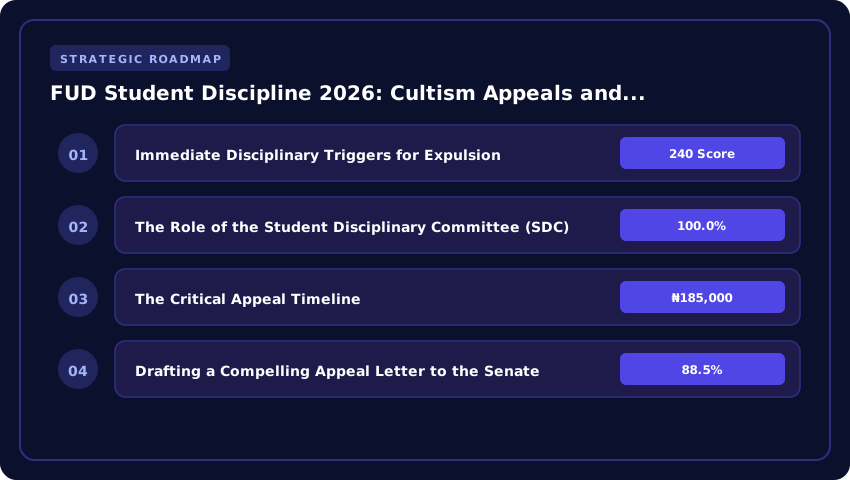
Facing expulsion for cultism at Federal University Dutse (FUD) in 2026 is a grave academic crisis, but the university’s disciplinary framework allows for a structured appeal process. Once the Student Disciplinary Committee (SDC) delivers its verdict, the clock starts ticking. You cannot afford delays; the 2026 guidelines are rigid regarding timelines and procedural adherence.
The Critical Appeal Timeline
Under the current academic calendar, a student has exactly 14 working days from the date of receipt of the official expulsion letter to file a formal appeal. This window is non-negotiable. If the 14-day limit expires without a submission to the Registrar’s office, the expulsion is deemed final and irrevocable, and the student’s record will be updated on the university portal to reflect “Expelled for Gross Misconduct.”
Drafting a Compelling Appeal Letter to the Senate
The University Senate is the final arbiter of discipline at FUD. Your appeal letter should not be an emotional plea but a tactical legal and academic document. To be effective, the letter must include:
- Case Reference: Clearly state your Matriculation Number and the SDC case file number.
- Procedural Errors: Highlight any breach of “Fair Hearing” (Audi Alteram Partem). For example, if you were denied the right to cross-examine a witness or if the evidence presented was purely circumstantial.
- Evidence of Reformation: Provide documented proof of character references from recognized community leaders or religious heads, demonstrating a departure from the alleged affiliation.
- Mitigating Circumstances: Explain any coercion or threats that may have led to the alleged digital affiliation or possession of symbols.
Required Documentation and Legal Rights
A naked letter is rarely successful. Your appeal package must be supported by a comprehensive dossier. Required documents include a certified copy of the SDC verdict, a formal affidavit of good conduct sworn at a High Court, and any digital forensics (if applicable) that disprove the university’s claims of coded affiliation.
Regarding legal representation, FUD students in 2026 maintain the right to legal counsel. While lawyers are generally not permitted to argue the case inside the SDC hearing room, they are essential for drafting the appeal memorandum and ensuring that the university adheres to the Nigerian Constitution’s guarantee of fair hearing. If the Senate rejects the appeal, the student’s final recourse is a judicial review via a writ of certiorari in a Federal High Court to quash the decision based on procedural irregularity.
Eligibility Criteria for Re-Admission After Disciplinary Action
Returning to Federal University Dutse (FUD) after an expulsion for disciplinary reasons—particularly those involving cultism or severe misconduct—is not an automatic right, but a rigorous discretionary process. Under the 2026 academic guidelines, the university has tightened the pathway to re-entry to ensure that only truly reformed students return to the campus community. If you are eyeing a 2027 return, you must meet three non-negotiable benchmarks.
The Mandatory ‘Cooling-Off’ Period
FUD enforces a strict “cooling-off” period before any application for re-admission can be entertained. For students expelled due to cult-related activities or violent misconduct, this period is typically a minimum of two academic sessions. This duration is designed to remove the student from the immediate influence of peer pressure and illicit networks. Applications submitted before the expiration of this window are summarily rejected by the Senate Committee on Admissions. For the 2027 intake, only those who have completed their mandatory hiatus as stipulated in their expulsion letter will be eligible to apply via the official FUD portal.
Character Attestation and Community Vetting
The university no longer accepts generic reference letters. To prove a genuine change in character, the applicant must provide formal character attestations from recognized community leaders. These must include:
- A sworn affidavit from a High Court confirming the student’s conduct during the suspension period.
- A signed letter of recommendation from a traditional ruler or a recognized religious leader within the student’s local government area.
- Evidence of community service or engagement in a recognized vocational program during the cooling-off period.
Psychological Evaluation and Rehabilitation Benchmarks
Given the 2026 focus on mental health and campus security, FUD now requires a comprehensive psychological evaluation. Before a re-admission offer is finalized for 2027, the candidate must undergo a psychiatric assessment conducted by a government-approved hospital or the university’s medical center. The evaluation focuses on:
- Behavioral Stability: Assessing the risk of recidivism and the student’s ability to adhere to the NUC’s code of conduct.
- Rehabilitation Proof: Documentation showing the student has participated in certified counseling or deradicalization programs.
- Commitment Pledge: A signed, legally binding undertaking that any further breach of the Student Handbook will result in a permanent, irrevocable ban from all Nigerian tertiary institutions.
Navigating the FUD Senate Review and Final Verdict Phase
Once a disciplinary committee has submitted its findings, the case moves to the Federal University Dutse (FUD) Senate for the final verdict. It is critical for students and guardians to understand that the Senate holds absolute discretionary power. In 2026, the Senate does not merely rubber-stamp committee recommendations; it reviews the evidence against the current security climate of the Jigawa State campus and the broader NUC mandates on campus safety.
The Senate’s discretion means that even if a student has a strong academic record, a proven link to a banned secret society—whether through physical presence or digital footprints—can lead to a summary expulsion. The university’s primary objective in the 2026 session is the total eradication of cultism, meaning leniency is rare and heavily scrutinized.
Common Reasons for Appeal Rejection in 2026
Many students attempt to appeal an expulsion, but the 2026 Senate review board has become increasingly stringent. Appeals are frequently rejected based on the following grounds:
- Digital Evidence: Submission of screenshots from encrypted apps (Telegram, WhatsApp) showing affiliation or coordination of cult activities.
- Contradictory Statements: Discrepancies between the student’s initial interrogation statement and their written appeal.
- Lack of Genuine Remorse: Appeals that focus on “unfairness” rather than an admission of guilt and a plea for rehabilitation.
- Recidivism: Any prior record of misconduct, even minor infractions, that suggests a pattern of instability.
Handling a ‘Non-Re-admittable’ Status
The most severe outcome is a verdict of “Expulsion with Non-Re-admittability.” This status is a permanent black mark on a student’s academic record at FUD. Unlike a standard suspension, a non-re-admittable status means the student is barred from ever returning to the institution, regardless of how much time has passed or whether they have “renounced” their affiliation.
If you receive this final verdict, you must accept that the internal administrative route is exhausted. Attempting to force a return through unofficial channels often leads to legal complications or security interventions. At this stage, students should focus on the following:
- Transcript Retrieval: Requesting official transcripts for any completed semesters to see if credits can be transferred to a different institution (though some universities may reject transfers from students expelled for cultism).
- Legal Consultation: Engaging a legal practitioner to ensure that due process was followed according to the FUD Student Handbook 2026, though overturning a Senate decision in court is historically difficult.
- Alternative Pathways: Exploring vocational training or non-degree certifications to pivot their career trajectory.
Financial and Academic Implications of Disciplinary Gaps
A disciplinary gap resulting from expulsion or suspension at Federal University Dutse (FUD) is not merely a pause in learning; it is a financial and academic shock. In 2026, the integration of university databases with national funding portals means that a “disciplinary exit” triggers immediate repercussions across the Nigerian educational ecosystem.
NELFUND Loans and Immediate Repayment
For students funded via the Nigerian Education Loan Fund (NELFUND), a disciplinary expulsion for cultism or gross misconduct is catastrophic. Under the 2026 NELFUND recovery guidelines, the “grace period” for loan repayment is strictly tied to active student status. Once FUD updates the student’s status to “Expelled” on the portal, the loan is flagged for immediate recovery.
- Loan Acceleration: The moratorium on repayment is lifted, and the student (or their guarantor) may be required to begin repayments immediately.
- Blacklisting: A disciplinary exit for cultism typically renders a student ineligible for future NELFUND disbursements at any other Nigerian tertiary institution.
Credit Transferability and Academic Loss
Students often assume they can simply move their earned credits to another university. However, the NUC’s 2026 framework on credit transfers is stringent regarding disciplinary records. While academic units earned in 100 or 200 level are technically valid, the “Transfer of Credit” process requires a clean disciplinary clearance from the sending institution.
If a student is expelled for cultism, FUD is mandated to report this to the NUC. Consequently, other Nigerian universities are likely to reject credit transfer requests, forcing the student to start from 100 Level (Freshman year) if they are ever granted admission elsewhere, effectively wasting years of tuition and effort.
Costs of Re-admission for the 2026/2027 Session
For those who successfully navigate the appeals process and are granted a conditional return for the 2026/2027 academic session, the financial burden is significant. Re-admission is not free; it involves a series of administrative levies designed to act as a deterrent.
- Re-admission Processing Fee: Current 2026 estimates place the administrative processing fee between ₦25,000 and ₦50,000, depending on the severity of the offense.
- Penalty Levies: Students may be required to pay “lost seat” penalties to cover the administrative cost of the vacancy created during their absence.
- Mandatory Counseling Fees: Re-admitted students must often pay for mandatory psychological evaluation and behavioral reform workshops before returning to the lecture halls.
Legal Recourse and External Options Beyond FUD Internal Appeals
When internal appeals at Federal University Dutse (FUD) are exhausted or denied, students facing expulsion for cultism-related offenses often find themselves at a crossroads. While the university maintains strict disciplinary authority, it does not operate in a vacuum. The Nigerian legal system provides a mechanism for students to challenge decisions that they believe were reached through a breach of fair hearing or a violation of the 2026 FUD Student Handbook’s own protocols.
Approaching the Federal High Court
A student may approach the Federal High Court to seek a judicial review of their expulsion. This is typically viable when there is evidence of “procedural impropriety”—for instance, if the disciplinary committee failed to provide the student with the specific evidence used to link them to a cult group or denied them the right to cross-examine witnesses. In 2026, the courts are increasingly scrutinizing “digital evidence” (such as WhatsApp group memberships or social media affiliations) to ensure such evidence was obtained legally and is not circumstantial.
University Autonomy vs. Fundamental Rights
There is a delicate balance between the university’s autonomy to maintain a cult-free campus and the student’s fundamental right to education and fair trial as enshrined in the Nigerian Constitution. While the NUC grants FUD significant leeway in enforcing the Core Curriculum and Minimum Academic Standards (CCMAS) and disciplinary codes, the court can nullify an expulsion if the punishment is deemed disproportionate to the offense or if the university bypassed its own internal due process.
Alternative Pathways for Degree Completion
For students whose expulsions are upheld, the road to a degree does not necessarily end. Depending on the severity of the conviction and the nature of the dismissal, several external options exist:
- Transfer to Private Institutions: Some private universities in Nigeria may accept students with a “withdrawal” status, provided the student can prove rehabilitation and the offense did not involve violent crime.
- Cross-Border Enrollment: Students may explore degree completion programs in other West African jurisdictions, such as Ghana or Benin Republic, where admission criteria for transfer students differ from the rigid JAMB CAPS requirements of Nigerian federal universities.
- Professional Certifications: In cases where academic re-entry is blocked, pivoting to professional bodies (e.g., ICAN, NIM, or tech certifications) allows students to gain employable skills while seeking legal clearance to resume formal education in 2027 or beyond.
| Disciplinary Category | 2026 Trigger/Criteria | Immediate Action | Appeal Window (2026/2027) | Re-Admission Potential |
|---|---|---|---|---|
| Traditional Cultism | Initiation rites or physical gathering | Immediate Expulsion | 14 Working Days | Zero/Permanent Ban |
| Digital Affiliation | Coded symbols or online group membership | Suspension/Expulsion | 14 Working Days | Conditional (Case-by-Case) |
| Possession of Symbols | Coded items found in hostel/campus | Expulsion Proceedings | 14 Working Days | Zero/Permanent Ban |
| Minor Misconduct | Violation of CCMAS guidelines | Warning/Suspension | 7 Working Days | High (Post-Sanction) |
Frequently Asked Questions
What are the 2026 FUD guidelines on digital cultism affiliation?
Under the 2026 FUD Student Handbook, digital affiliation—including membership in secret society chat groups or the use of coded symbols on social media—is classified as cultism. Such actions trigger immediate expulsion proceedings, aligning with the updated NUC CCMAS safety standards to proactively eliminate campus insecurity.
Can a student expelled for cultism at FUD apply for re-admission in 2027?
Students expelled for traditional cultism or possession of coded symbols under 2026 regulations face a permanent ban from Federal University Dutse. Re-admission is generally prohibited for these offenses; however, those penalized for minor digital affiliations may apply for a review during the 2027 academic session.
How do I file a disciplinary appeal at FUD for the 2026/2027 session?
To appeal a disciplinary action in 2026, students must submit a formal written petition to the University Senate within 14 working days of the expulsion notice. The appeal must provide verifiable evidence contradicting the charges of cultism or misconduct to be considered for a hearing.
What is the impact of the NUC CCMAS updates on FUD student discipline in 2026?
The 2026 NUC CCMAS updates have shifted FUD's disciplinary approach from reactive to proactive. This includes expanded legal definitions of misconduct, where the mere possession of secret society symbols now constitutes a grave offense, ensuring a safer academic environment through stricter enforcement and immediate sanctions.
Strategic Final Takeaway
When evaluating Federal University Dutse FUD Student Disciplinary Guidelines Cultism Expulsion Appeal Process And Re Admission Rules in 2026 and beyond, base your decisions on accredited institutional standards, verified return on investment (ROI), and up-to-date official guidelines. Always verify specific dates and requirements through official regulatory portals.


