
2026 LASBCA Mandatory Registration Portal Walkthrough for AEB Professionals
Navigating the Lagos State Building Control Agency (LASBCA) portal in 2026 requires more than just filling out a form; it is now a rigorous digital verification process. For Architects, Engineers, and Builders (AEB), the updated portal integrates directly with federal regulatory databases to eliminate fraudulent certifications. If you are registering for the first time or renewing your professional standing, following this precise workflow is the only way to ensure your application isn’t flagged for manual review.
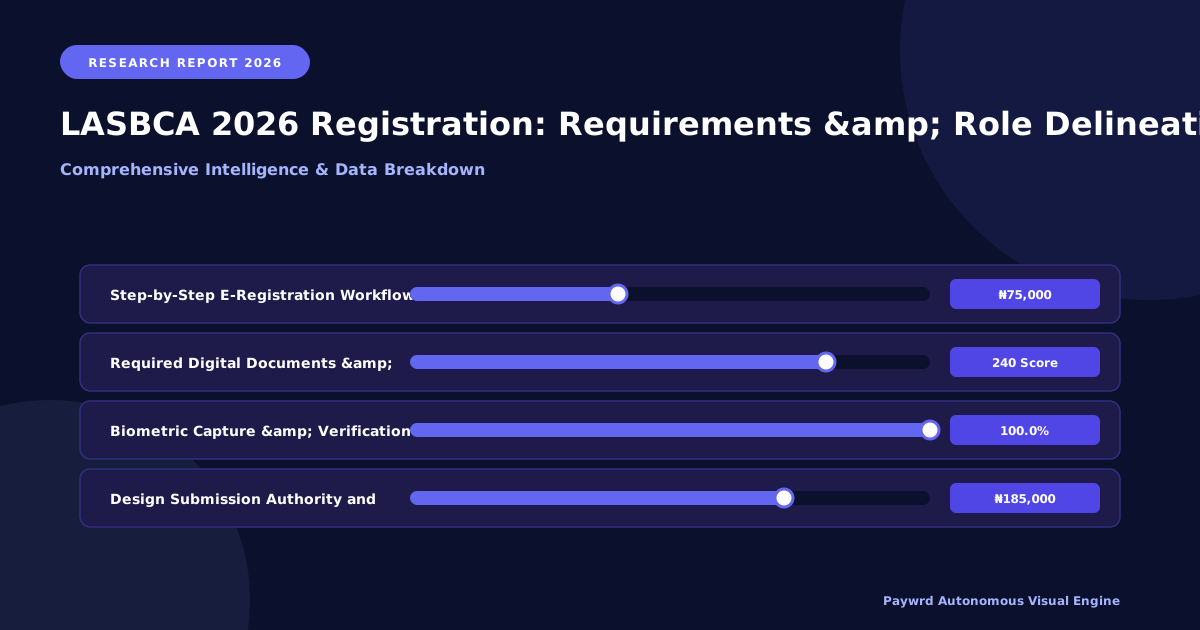
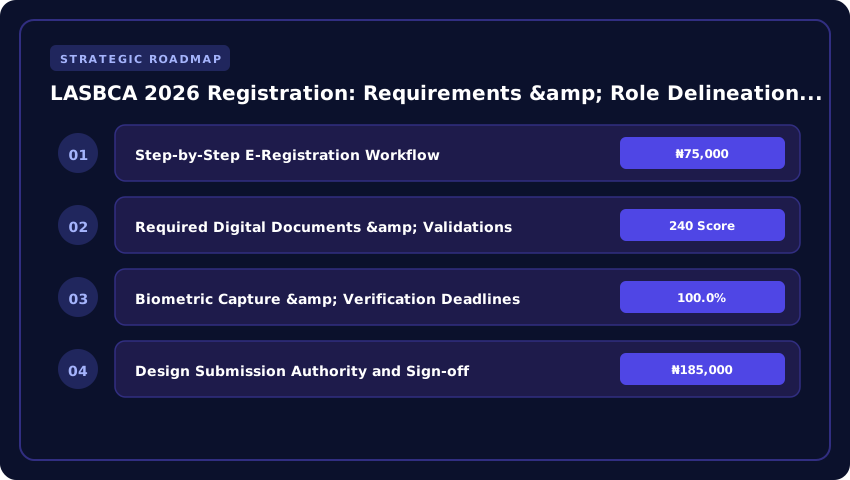
Step-by-Step E-Registration Workflow
The 2026 registration cycle is strictly digital. To begin, visit the official LASBCA professional portal and follow these stages:
- Account Creation: Register using a valid email address and your NIN (National Identification Number). The system now uses NIN as the primary key for identity management.
- Professional Profiling: Select your specific category (Architect, Civil/Structural Engineer, or Builder). This selection triggers the specific document requirements for your discipline.
- Credential Upload: Upload your current practicing license and professional certificates.
- Payment Integration: Pay the mandatory registration fees via the Remita gateway. Ensure you save the RRR (Remita Retrieval Reference) number for your records.
- Submission & Tracking: Once submitted, your application enters the “Verification Queue.” You can track the status via your dashboard.
Required Digital Documents & Validations
The 2026 portal employs an automated API check. If the numbers you provide do not match the federal registries, your application will be rejected instantly. You must have the following ready:
- Professional License Numbers: Valid COREN (for Engineers), ARCON (for Architects), or CORBON (for Builders) registration numbers.
- Tax Clearance Certificate (TCC): A scanned copy of your current tax clearance from the Lagos State Internal Revenue Service (LIRS).
- Corporate Affairs Commission (CAC) Docs: For those registering under a firm, a valid CAC certificate is mandatory.
- Valid ID: A digital copy of your International Passport or Driver’s License.
2026 Biometric Capture & Verification Deadlines
In a major shift for 2026, LASBCA has introduced mandatory biometric verification to curb “ghost” professionals. After your digital documents are approved, you will receive an invitation via email and SMS to visit a designated LASBCA verification center for fingerprint and facial capture.
Critical Deadline: All AEB professionals must complete their biometric capture by September 30, 2026. Professionals who fail to verify their identity by this date will be blocked from signing off on building plans or supervising sites within Lagos State for the 2027 calendar year.
Role Delineation Matrix: Architect vs Engineer vs Builder Scope Limits
In the 2026 regulatory landscape, the Lagos State Building Control Agency (LASBCA) has tightened the boundaries between the “AEB” triad—Architects, Engineers, and Builders. To prevent the frequent “Professional Overlap” disputes that plague Lagos construction sites, it is critical to understand that your registration on the 2026 portal is tied to a specific scope of practice. Crossing these lines is no longer viewed as a mere administrative error; it is now classified as professional negligence under the updated 2026 Lagos Building Control Law.
Design Submission Authority and Sign-off
The authority to sign off on project documentation is strictly bifurcated to ensure structural integrity and aesthetic compliance. The delineation is as follows:
- Architects (ARCON Certified): Hold sole authority over architectural drawings, spatial planning, and aesthetic specifications. They sign off on the conceptual and detailed design phases.
- Engineers (COREN Certified): Structural, Mechanical, and Electrical engineers hold the exclusive mandate for structural calculations and technical drawings. A project cannot proceed to the “Foundation Stage” approval without a COREN-stamped structural integrity report.
- Builders (CORBON Certified): While they do not design the structural skeleton, Builders are the primary authority for the construction methodology and the execution plan.
Site Supervision Hierarchy and Legal Liability
Under the 2026 legal framework, liability is no longer shared vaguely; it is pinpointed. The Architect oversees the design intent, but the Builder is legally responsible for the quality of materials and workmanship on-site. The Structural Engineer remains liable for any failure in the load-bearing elements of the building. If a collapse occurs, LASBCA now utilizes the 2026 Digital Project Log to trace exactly which professional signed off on the specific phase of failure, leading to immediate license revocation and potential criminal prosecution.
Penalties for Role Encroachment
Role encroachment—such as an Architect attempting to certify structural stability or a Builder altering structural beams without an Engineer’s written consent—carries severe penalties in 2026. Unapproved design variations discovered during LASBCA site inspections will trigger an immediate “Stop-Work Order.”
- Financial Penalties: Fines ranging from ₦500,000 to ₦5,000,000 depending on the scale of the encroachment.
- Administrative Sanctions: Immediate suspension of the professional’s practicing license on the LASBCA portal for a period of 6 to 24 months.
- Project Impact: Mandatory demolition of any structural element implemented via an unapproved design variation.
Updated 2026 Fee Schedule & NELFUND Loan Eligibility for Certification Costs
Budgeting for LASBCA compliance in 2026 requires a clear understanding of the tiered pricing structure implemented to streamline professional oversight in Lagos State. Whether you are an independent consultant or a corporate entity, these fees are mandatory for legal practice and the stamping of architectural and engineering drawings.
2026 Fee Breakdown (Naira ₦)
The current fee schedule distinguishes between initial entry and the maintenance of professional standing. All payments must be processed via the official LASBCA payment gateway to generate a valid Transaction Reference Number.
- New Professional Registration: ₦75,000 (One-time entry fee including biometric capturing).
- Annual License Renewal: ₦45,000 (Due every January to maintain active status).
- Stamp Duty/Certification Fee: ₦15,000 per project submission (Variable based on project scale).
- Late Registration Penalty: 20% surcharge on the base renewal fee if paid after the Q2 deadline.
Corporate vs. Individual Registration Costs
For AEB professionals, the choice between registering as an individual practitioner or a corporate entity significantly impacts the overhead. Corporate registration offers broader liability coverage but comes with a higher premium.
- Individual Firm: Focuses on the practitioner’s personal license. Total annual compliance cost averages ₦60,000 to ₦90,000 depending on project volume.
- Corporate Entity: Requires a company-wide registration fee of ₦250,000, plus individual licensing for each lead professional. This is recommended for firms handling large-scale commercial developments in Lagos.
Leveraging NELFUND for Upskilling and CPD
Recognizing the rising cost of professional development, the Nigerian Education Loan Fund (NELFUND) has expanded its mandate for 2026 to include “Professional Upskilling Loans.” This is a game-changer for young AEB professionals struggling with the costs of mandatory Continuing Professional Development (CPD) courses required for LASBCA certification.
To qualify for a NELFUND upskilling loan, applicants must provide a valid BVN, a letter of admission or enrollment from a NUC-accredited professional body, and proof of current LASBCA registration status. These loans offer a grace period aligned with the professional’s employment cycle, ensuring that financial constraints do not lead to the suspension of a practicing license. Ensure your profile is updated on the NELFUND portal to sync with your professional credentials before the 2026 mid-year disbursement window closes.
CPD Compliance Tracker: Mandatory Hours & Accredited Providers for 2026/2027
Maintaining your practicing license with the Lagos State Building Control Agency (LASBCA) is no longer a mere formality of payment; it is now strictly tied to your Continuous Professional Development (CPD) record. For the 2026/2027 cycle, the integration between LASBCA and national regulatory bodies ensures that any deficit in your learning units triggers an immediate flag on your registration status, potentially leading to a suspension of your right to sign off on building plans within Lagos State.
Minimum CPD Unit Requirements for License Renewal
To remain compliant for the 2027 renewal window, Architecture, Engineering, and Building (AEB) professionals must meet the following minimum thresholds based on their primary regulatory body:
- ARCON (Architects): A minimum of 30 CPD units per year, with a specific focus on sustainable urban design and the updated 2026 National Building Code.
- COREN (Engineers): 20 to 30 mandatory units depending on the grade of registration (Graduate, Registered, or Fellow), emphasizing structural integrity and climate-resilient infrastructure.
- CORBON (Builders): 25 mandatory units focusing on advanced materials science and site safety management protocols.
LASBCA-Approved Training Providers for Lagos Building Codes
While national units are essential, LASBCA now mandates at least 5 units of “Local Context Training.” These units must be earned from accredited providers specializing in the Lagos State Urban and Regional Planning and Development Law. Approved providers for 2026 include the Lagos State Professional Development Institute and certified partner firms recognized by the Ministry of Physical Planning and Urban Development. Training focusing on the “Lagos Drainage Masterplan 2026” and “High-Rise Safety Compliance” is highly recommended to fast-track your approval process.
Digital Logbook Submission Format for 2027
The era of physical certificates and stamped letters is over. For the 2027 renewal window, all CPD evidence must be uploaded via the LASBCA Digital Logbook. The portal now requires a standardized JSON or PDF-A format. Your submission must include:
- Course ID: The unique alphanumeric code provided by the accredited trainer.
- Verification QR Code: A scannable link that validates the certificate against the provider’s database.
- Reflective Summary: A 150-word brief on how the training applies to current Lagos State building regulations.
Failure to synchronize your digital logbook by the December 2026 cutoff will result in a “Compliance Deficit” status, rendering your 2027 license application ineligible for processing.
Navigating LASBCA Enforcement: Site Inspection Protocols & Seal-Up Triggers
In 2026, the Lagos State Building Control Agency (LASBCA) has transitioned from sporadic manual checks to a data-driven enforcement model. For Architecture, Engineering, and Building (AEB) professionals, understanding the new “trigger” mechanisms is the only way to prevent costly project delays and protect your professional indemnity standing. The agency now integrates real-time surveillance with site-level audits to ensure strict adherence to the National Building Code and the NUC CCMAS-aligned professional standards.
2026 Drone Surveillance & Remote Monitoring Triggers
The most significant shift this year is the deployment of AI-powered drone monitoring across high-density development corridors in Ikeja, Lekki, and Epe. LASBCA now utilizes remote sensing to detect “unauthorized vertical expansion”—where a building exceeds the approved number of floors in the permit. If a drone scan detects a slab casting that deviates from the approved architectural drawings uploaded to the portal, an automatic “Red Flag” is triggered. This often leads to an immediate site visit and a potential seal-up order without prior written warning.
Documentation Checklist for Stage Certification
To avoid the dreaded “Stop Work” order, professionals must secure stage certification before proceeding to the next phase of construction. Ensure the following documentation is physically available on-site and digitally synced with the LASBCA portal:
- Foundation Stage: Soil test report, approved foundation plan, and the signed-off reinforcement inspection certificate.
- Lintel/Beam Stage: Concrete strength test results (cube tests) and evidence of structural stability verification by a COREN-registered engineer.
- Roofing Stage: Final structural integrity report and confirmation that all setbacks and easements have been maintained as per the original planning permit.
Contesting Seal-Up Orders & Professional Indemnity
A “Seal-Up” order in 2026 is no longer a simple administrative hurdle; it is a legal marker that can trigger professional indemnity claims. If your site is sealed due to a contested interpretation of the building code, you must initiate the formal appeal process within 72 hours. This involves filing a “Notice of Contest” via the LASBCA portal, supported by a technical rebuttal signed by a Fellow of the relevant professional body (NIA, NSE, or NIOB).
Failure to resolve these orders promptly can lead to the suspension of your practicing license and may void your professional indemnity insurance, leaving you personally liable for damages. Always ensure your professional indemnity cover is updated to reflect 2026 valuation rates to mitigate these regulatory risks.
Digital Seal & E-Signature Standards for 2026 Drawing Submissions
As Lagos State accelerates its Smart City initiative, the Lagos State Building Control Agency (LASBCA) has transitioned from physical stamps to a mandatory Digital Seal framework for all 2026 submissions. For Architecture, Engineering, and Building (AEB) professionals, a “scanned image” of a physical signature is no longer legally binding. To prevent immediate application rejection, all drawings must now feature cryptographically secure e-signatures that verify the professional’s identity and the integrity of the document.
Accepted Platforms & Encryption Standards
LASBCA now recognizes only specific high-encryption platforms that align with the Nigerian Data Protection Act and global ISO standards. To ensure your submission passes the automated validation gate, utilize the following:
- Approved Platforms: DocuSign, Adobe Sign, and the integrated ARCON/COREN digital credentialing portals.
- Encryption Level: All digital seals must utilize AES 256-bit encryption.
- Verification: Each seal must contain a time-stamp and a unique Transaction ID that can be cross-referenced with the professional’s current 2026 practicing license.
Integrating BIM Models with E-Approval Workflows
The 2026 workflow prioritizes Building Information Modeling (BIM) over traditional 2D PDFs. LASBCA now requires the submission of IFC (Industry Foundation Classes) files alongside signed PDFs. The integration process requires professionals to embed their digital seal directly into the BIM metadata. This allows LASBCA reviewers to verify that the signed 2D export is a true representation of the 3D model, eliminating the “Design Drift” that previously led to site failures and demolition orders in Lagos.
Rejection Codes & Re-submission Timelines
The 2026 portal utilizes an AI-driven pre-screening tool that issues instant rejection codes if the digital seal is non-compliant. Understanding these codes is critical for rapid turnaround:
- Code ERR-SIG-01: Invalid Digital Certificate (The signature is a flat image, not a cryptographic seal).
- Code ERR-SIG-04: License Mismatch (The seal is valid, but the professional’s 2026 LASBCA registration has expired).
- Code ERR-BIM-09: Metadata Discrepancy (The signed PDF does not match the uploaded BIM model).
Once a rejection code is issued, professionals have a strict 72-hour window for re-submission. Failure to correct the digital seal within this timeframe results in the application being archived, requiring a fresh filing fee of ₦25,000 to ₦50,000 depending on the project category.
Strategic Compliance Checklist: Pre-Registration Audit for 2027 Practice Renewal
Securing your 2026 registration is the immediate priority, but for Architecture, Engineering, and Building (AEB) professionals, the window for 2027 continuity opens the moment you submit your current application. To prevent the dreaded “License Pending” status that often halts project approvals in Lagos, you must conduct a proactive audit of your professional standing and corporate documentation.
Inter-Agency Database Synchronization
The Lagos State Building Control Agency (LASBCA) has tightened its integration with national regulatory bodies. A common point of failure during renewal is the mismatch between your LASBCA profile and your primary professional board. Before the 2027 cycle, ensure your status is “Active” and “In Good Standing” across the following portals:
- ARCON: Verify that your current practicing license is updated on the Architects Registration Council of Nigeria database.
- COREN: Ensure your annual dues are paid and your registration number is synced with the Council for the Regulation of Engineering in Nigeria.
- CORBON: Confirm your current certification status with the Council of Registered Builders of Nigeria.
Any discrepancy in name spelling or registration numbers between these boards and the LASBCA database will trigger an automatic flag, delaying your 2027 renewal by several weeks.
Professional Indemnity Insurance (PII) Thresholds
For 2027, LASBCA is expected to raise the minimum Professional Indemnity Insurance (PII) coverage to reflect current inflation and construction costs in the Lagos metropolis. While 2026 requirements were baseline, firms bidding for high-rise or public-sector projects should aim for a minimum coverage threshold of ₦50 million to ₦100 million, depending on the project scale.
Audit your current policy to ensure it specifically covers “Professional Negligence” and “Design Errors,” as generic corporate insurance is no longer accepted for the 2027 practice renewal audit.
CAC Alignment and Corporate Identity
If your firm has undergone a rebranding or a change in ownership structure, your Corporate Affairs Commission (CAC) documents must be perfectly aligned with your LASBCA registration. A mismatch between the “Company Name” on your CAC certificate and the “Practicing Entity” on the LASBCA portal is a primary cause of registration rejection.
- Update your CAC Form CAC 1.1 or the updated 2026 status reports.
- Ensure the designated “Principal Partner” or “Lead Consultant” on the CAC filing matches the professional license holder registered with LASBCA.
- Submit any name change notifications to the agency at least 60 days before the 2027 renewal window opens.
| Professional Category | Primary Certification | 2026 Registration Fee (Est.) | 2026/2027 Renewal Deadline | Critical Requirement |
|---|---|---|---|---|
| Architects | ARCON | ₦75,000 – ₦120,000 | Q3 2026 | High-Res PDF Certification (<2MB) |
| Engineers | COREN | ₦75,000 – ₦120,000 | Q3 2026 | Biometric Data Synchronization |
| Builders | CORBON | ₦75,000 – ₦120,000 | Q3 2026 | Federal Database Verification |
Frequently Asked Questions
What are the LASBCA registration requirements for AEB professionals in 2026?
For 2026, Architects, Engineers, and Builders must provide a high-resolution PDF of their ARCON or COREN certification under 2MB. Mandatory requirements include biometric data synchronization via the LASBCA portal and verification through federal regulatory databases to prevent document mismatch errors and ensure professional licensing validity within Lagos State.
How do I avoid the 'Document Mismatch' error on the 2026 LASBCA portal?
To prevent the 'Document Mismatch' error during 2026 registration, ensure all professional certifications are uploaded as clear, high-resolution PDFs not exceeding 2MB. Ensure that the name and registration number on your COREN or ARCON certificate exactly match the details entered into the digital verification portal.
What happens if I miss the Q3 2026 LASBCA biometric sync deadline?
Failure to synchronize your biometric data by the Q3 2026 deadline will result in an automatic suspension of your practicing license in Lagos State. This measure is part of the 2026 digital verification overhaul to eliminate fraudulent certifications and ensure only verified AEB professionals operate.
Is the 2026 LASBCA registration process different for first-time applicants?
Yes, the 2026 process is a rigorous digital verification system. First-time applicants must undergo direct integration with federal regulatory databases. Unlike previous years, the 2026 portal requires immediate biometric synchronization and strict adherence to PDF upload specifications to secure a valid practicing license for the 2026/2027 cycle.
Strategic Final Takeaway
When evaluating LASBCA Building Professionals Registration Requirements And Role Delineation For Architects Engineers Builders in 2026 and beyond, base your decisions on accredited institutional standards, verified return on investment (ROI), and up-to-date official guidelines. Always verify specific dates and requirements through official regulatory portals.


