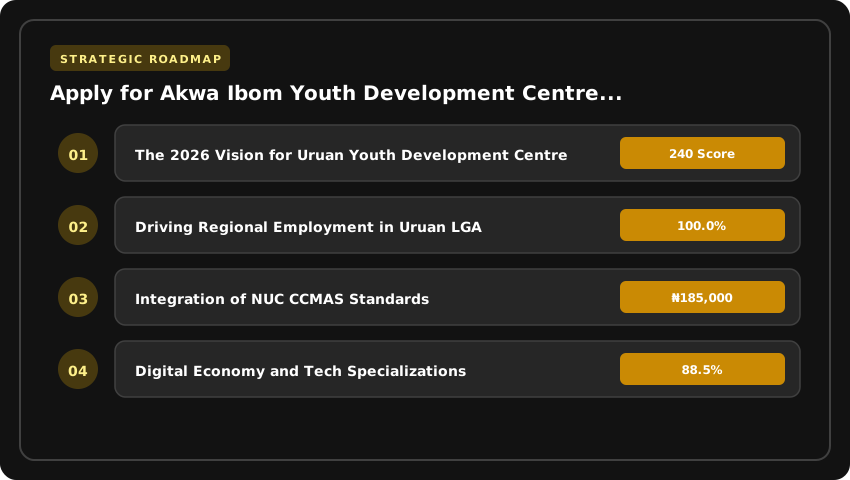
The 2026 Vision for Uruan Youth Development Centre
The Uruan Youth Development Centre has evolved into the cornerstone of Governor Umo Eno’s strategic mandate for youth empowerment. In 2026, the vision has shifted from basic skill acquisition to “Industrialized Competence.” The state government is leveraging this facility to bridge the gap between traditional classroom learning and the actual demands of the Nigerian corporate landscape, ensuring that graduates are not just certified, but employable in high-growth sectors like renewable energy, agribusiness tech, and advanced manufacturing.
Driving Regional Employment in Uruan LGA
The impact of the Uruan facility extends far beyond the classroom. By positioning a world-class training hub within the Uruan Local Government Area, the state is decentralizing economic opportunity. This strategic placement has triggered a localized economic boom, reducing the rural-to-urban migration trend toward Uyo. The centre now serves as an incubator for SMEs, where trainees transition directly into startup grants and micro-loans facilitated by the state’s partnership with regional development banks.
For the 2026 cohort, the focus is on measurable outcomes. The centre is targeting a 40% increase in direct regional employment by integrating “Industry-Ready” modules that align with the current needs of the Akwa Ibom industrial zones.

Integration of NUC CCMAS Standards
Perhaps the most significant upgrade for the 2026 session is the integration of the National Universities Commission (NUC) Core Curriculum and Minimum Academic Standards (CCMAS). By aligning vocational training with CCMAS, the Uruan Youth Development Centre ensures that its certifications carry academic weight and professional legitimacy.
- Standardized Learning: Training modules are now mapped to national benchmarks, making it easier for trainees to pursue further degrees or professional certifications.
- Competency-Based Assessment: Moving away from rote learning, the 2026 curriculum emphasizes practical application and project-based evaluations.
- Interdisciplinary Approach: Students in technical tracks now receive mandatory training in digital literacy and entrepreneurship, mirroring the holistic approach of the NUC’s modern academic framework.
This alignment ensures that whether a youth is training in mechatronics or sustainable farming, their skill set is recognized across all Nigerian tertiary institutions and corporate bodies, providing a seamless pathway to professional growth in 2027 and beyond.
Available Vocational and Entrepreneurship Tracks for 2026
For the 2026 intake, the Akwa Ibom Youth Development Centre has restructured its curriculum to align with the current demands of the global market and the Nigerian National Employment Policy. Rather than offering generic certificates, the centre now provides specialized tracks that blend theoretical knowledge with rigorous industrial practice. Each track is designed to ensure that graduates are not just “skilled” but are “market-ready” for immediate employment or business startup.
Digital Economy and Tech Specializations
As Nigeria pushes toward a fully digitized economy, the centre has expanded its ICT wing to focus on high-income technical roles. These tracks are ideal for youth looking to enter the remote work economy or launch tech startups.
- Software Development: Intensive training in Full-Stack development, focusing on Python, JavaScript, and React, tailored for building scalable enterprise applications.
- Data Analytics: Mastering Big Data, SQL, and PowerBI to help Nigerian firms make data-driven decisions in a volatile market.
Technical Trades and Industrial Engineering
To support the industrialization of Akwa Ibom state, the technical tracks now emphasize green energy and heavy-duty infrastructure, moving beyond basic repairs to advanced engineering.
- Solar Installation & Renewable Energy: Comprehensive training on photovoltaic system design, battery storage management, and smart-grid installation to solve local power challenges.
- Advanced Welding & Fabrication: Specialized certification in TIG and MIG welding, essential for the oil and gas sector and large-scale construction projects.
Agri-preneurship and Food Security
Moving away from subsistence farming, the 2026 Agri-preneurship track focuses on the business of agriculture, ensuring students understand the entire value chain from seed to shelf.
- Modern Smart Farming: Implementation of hydroponics, automated irrigation, and climate-smart agriculture to increase crop yields.
- Value-Chain Processing: Training on food preservation, packaging, and branding to transform raw farm produce into high-value export goods.
Creative Arts and Professional Design
The creative economy is a significant GDP contributor. This track provides the technical tools and business acumen needed to monetize artistic talent professionally.
- Fashion Design & Garment Production: Advanced tailoring, textile science, and digital pattern making, with a focus on creating export-ready Nigerian apparel.
- Digital Arts & Multimedia: Professional certification in graphic design, 3D animation, and UI/UX design for the modern corporate landscape.
Step-by-Step Application Process for Akwa Ibom Residents
The application gateway for the 2026 Uruan Youth Development Centre intake is hosted exclusively on the official Akwa Ibom State Government portal. Do not rely on third-party links circulating on WhatsApp or Telegram; they are frequently phishing traps designed to harvest BVN data. Start by visiting akwaibomstate.gov.ng and navigating to the “Youth Empowerment” or “Ministry of Youth & Sports” tab. From there, select the “Uruan Youth Development Centre 2026 Registration” banner. The portal is optimized for mobile browsers, but a desktop view offers better visibility for document uploads. Ensure you have an active MTN, Airtel, or Glo line for the mandatory OTP verification—VoIP numbers are rejected by the system.
Creating a Verified Profile on the Youth Empowerment Dashboard
Once on the registration page, click “New Applicant” to generate your unique Applicant ID. You will need your National Identification Number (NIN) ready; the system cross-references the NIMC database in real-time to prevent duplicate entries. Fill in your bio-data exactly as it appears on your NIN slip—discrepancies in date of birth or name spelling will trigger an automatic flag requiring a physical visit to the Ministry in Uyo for resolution. Upload clear, coloured scans (PDF or JPEG, max 2MB each) of your NIN slip, LGA Certificate of Origin, and highest educational certificate (WAEC/NECO, ND, HND, or B.Sc). The dashboard requires a recent passport photograph with a white background; selfies or filtered images will cause rejection during the automated QC check. After submission, you will receive a “Profile Verification Pending” status. This usually resolves within 48 hours; check your dashboard daily rather than waiting for SMS alerts, as network delays are common.
Submission Timelines for the 2026 Intake Cycles
The 2026 programme operates on two distinct intake cycles to manage capacity at the Uruan facility. Cycle 1 (Batch A) opened on January 15, 2026 and closes strictly at 11:59 PM WAT on March 31, 2026. Orientation for successful Batch A candidates commences the second week of April. Cycle 2 (Batch B) opens immediately after on April 15, 2026, closing on June 30, 2026, with orientation in July. There is no “late registration” window; the portal shuts down automatically at the deadline. After submitting your final application, download and print the Acknowledgement Slip containing your QR code. This slip is your only entry ticket for the mandatory Computer-Based Test (CBT) screening held at designated centres across Uyo, Eket, and Ikot Ekpene. Missing the CBT date disqualifies you automatically, regardless of profile completeness.
- Pro Tip: Use a stable internet connection (preferably Spectranet, FibreOne, or strong 4G) during the final “Submit” click to avoid session timeouts.
- Document Check: Ensure your LGA Certificate of Origin is issued within the last 12 months; older certificates are flagged as expired.
- Support: For technical portal issues, email
ictsupport@akwaibomstate.gov.ngwith your Applicant ID in the subject line.
Mandatory Application Checklist and Eligibility Criteria
Before you even click “Apply” on the Akwa Ibom State Ministry of Youth and Sports portal for the 2026 Uruan Youth Development Centre intake, understand this: incomplete documentation is the single biggest killer of applications. The screening committee uses an automated first-pass filter; if your uploads do not match the backend verification parameters, a human never sees your file. Here is the non-negotiable checklist for 2026.
Core Documentation: The Verification Trinity
- National Identification Number (NIN): This is your primary key. The portal cross-references your NIN directly with the NIMC database in real-time. Ensure your phone number is linked and active for OTP verification. A printed NIN slip without the QR code scan capability will trigger a manual review delay.
- Local Government Area (LGA) Certificate of Indigene: You must upload a valid, signed certificate from your LGA Secretariat (Uruan, Ibesikpo Asutan, Nsit Ibom, etc.). Certificates older than 12 months are automatically flagged. The document must carry the official LGA stamp and the Chairman/Secretary’s signature—photocopies of photocopies are rejected instantly.
- WAEC/NECO/NABTEB Results: Minimum of five (5) credits including Mathematics and English Language at not more than two sittings. You must upload the original certificate or a verified WAEC e-Statement of Result (accessible via the WAEC Request Management System). “Awaiting Result” status disqualifies you for the 2026 technical certification tracks aligned with NUC CCMAS standards.
Age and Residency Verification
The programme targets the “youth demographic” as defined by the National Youth Policy: applicants must be aged 18 to 35 years as of the application closing date in Q3 2026. Your Date of Birth on the NIN must match your WAEC/NECO records. Discrepancies trigger an automatic disqualification flag.
Residency is verified via your LGA Certificate and a recent utility bill (electricity or water) or tenancy agreement bearing your name or your parent’s name within Akwa Ibom State. Non-indigenes resident in the state for over five years may apply under the “Resident Quota” but must provide a sworn Affidavit of Residency from a Magistrate Court in Uyo, not a Commissioner for Oaths.
Common Mistakes That Guarantee Rejection
- Blurry or Cropped Uploads: The portal requires PDF or high-res JPEG (max 2MB). Photos taken at an angle, missing corners, or with glare on the LGA stamp are auto-rejected by the OCR scanner.
- Name Mismatch Across Documents: “Uduak Friday Ekpo” on NIN vs “Uduak F. Ekpo” on WAEC vs “Friday Uduak” on LGA Cert. Standardize your name order before applying. Affidavits for name changes must be uploaded if discrepancies exist.
- Using Cyber Cafe “Agents”: Agents often reuse email addresses or phone numbers for multiple applicants. The system detects duplicate contact credentials and bans the entire cluster. Register your own Gmail/Outlook account and keep the login credentials.
- Ignoring the Medical Fitness Certificate: For 2026, trades like Welding, Autotronics, and Heavy Equipment Operation require a Government Hospital Fitness Certificate (Form M). Uploading a private clinic note voids the application for those specific high-risk tracks.
Pro Tip: Create a dedicated folder on your phone/PC labeled AKYDC_2026_Docs. Rename files logically: NIN_Uduak_Ekpo.pdf, LGA_Cert_Uruan.pdf. This prevents uploading the wrong file during the 15-minute session timeout window. Accuracy beats speed every time.
Post-Training Support and Financial Empowerment
The 2026 programme architecture refuses to abandon trainees at the certification finish line. Governor Umo Eno’s administration has hardwired a transition pipeline that converts technical competence into bankable enterprise. For the first time in the centre’s history, graduation triggers immediate access to a structured financial ecosystem designed to fund tools, working capital, and market entry.
Accessing NELFUND Loans for Startup Equipment
Graduates holding the new NUC-aligned CCMAS certifications now qualify for the NELFUND Skills Acquisition Window, a dedicated product line distinct from standard student loans. In the 2026 cycle, approved trainees can access up to ₦2.5 million at a single-digit interest rate (currently 6% per annum) with a 12-month moratorium. The application is integrated directly into the centre’s exit portal—no separate bank visits required. You simply upload your certified competency transcript, a vetted business plan for your trade (welding, mechatronics, agro-processing), and a proforma invoice for equipment. NELFUND disburses funds directly to verified vendors, eliminating cash diversion risks. This is not theoretical; the pilot batch in Q1 2026 saw 112 Uruan alumni secure CNC machines and diagnostic kits within 30 days of certification.
Connecting with State-Backed Micro-Credit Schemes
Beyond federal loans, the Akwa Ibom State Ministry of Labour and Manpower Planning operates the Ibom Micro-Credit Agency (IMCA) “Graduate Starter Pack.” This scheme targets trainees who may not need heavy machinery but require working capital—think fashion designers needing fabric stock or ICT specialists needing software licences. Key features for the 2026/2027 cycle include:
- Ticket Size: ₦300,000 to ₦750,000 unsecured.
- Collateral: Your trade certificate and guarantor (civil servant Level 10+ or registered business owner).
- Repayment: 18 months, deducted at source if you secure placement via the state job portal.
- Fast-Track: Applications processed within 14 working days if submitted through the Centre’s Industry Liaison Officer.
Crucially, IMCA now mandates a mandatory 3-day “Financial Literacy for Artisans” module before disbursement, covering bookkeeping, tax compliance (FIRS TIN registration), and digital payment integration (Moniepoint/Opay merchant codes).
Job Placement Services and Industry Internship Opportunities
The Centre’s Industry Advisory Board—comprising representatives from Dangote Refinery, Flour Mills Nigeria, and local oil servicing firms like Nestoil—has committed to a minimum 40% absorption quota for the 2026 cohort. The placement mechanism operates on three tracks:
- Industrial Attachment (6 Months): Paid internships (₦60,000–₦90,000/month) with partner firms, converted to full-time contracts upon competency sign-off by the site supervisor.
- Direct Recruitment Drives: Quarterly “Talent Match” events held at the Uruan campus where HR managers conduct on-the-spot technical assessments.
- Entrepreneurship Incubation: For those choosing self-employment, the Centre provides 12 months of subsidized workshop space at the new Ibom Innovation Hub, shared CNC/ fabrication bays, and legal support for CAC registration and NSITF compliance.
This tripartite model—federal loan, state micro-credit, and guaranteed industry demand—transforms the Uruan certificate from a wall hanging into a liquid asset. The message is clear: the state has underwritten your risk; your only variable is execution.
Frequently Asked Questions on the 2026 Training Cycle
Is the training completely free for all Akwa Ibom youth?
Yes, the 2026 cycle is fully funded by the Akwa Ibom State Government under the Ministry of Youth and Sports Development. There are no tuition fees, no hidden registration charges, and no costs for the mandatory certification examinations administered by partner bodies like NABTEB or the Manufacturing Skills Council. The state covers the cost of training materials, personal protective equipment (PPE) for technical trades, and the stipend for the industrial attachment phase. However, applicants must be bonafide indigenes or verified residents with a valid Local Government Area (LGA) identification letter. Non-indigenes residing in the state may apply but are placed on a secondary waitlist pending slot availability after indigenes have been accommodated.
What is the duration of the certification programs?
Programme length varies by trade cluster, but the 2026 curriculum is structured around a six-month intensive bootcamp model followed by a compulsory three-month Industrial Attachment (SIWES/IT) placement. Here is the breakdown:
- Advanced Manufacturing & Welding: 6 months in-centre + 3 months attachment (NABTEB Modular/Advanced Certificate).
- ICT & Digital Economy (Software Dev, Data Analysis, Cybersecurity): 6 months hybrid (physical/virtual labs) + 3 months capstone project/internship (Google/Meta/CompTIA aligned certs).
- Agri-Tech & Food Processing: 5 months seasonal cycle training + 4 months cooperative enterprise incubation.
- Creative Arts & Media Production: 6 months studio-based + 3 months portfolio apprenticeship.
Attendance is biometrically tracked; falling below 85% attendance automatically disqualifies a trainee from the final certification exam and stipend payout.
How do I track my application status via the government portal?
Once you submit your application via the official www.akwaibomstate.gov.ng/youthdev portal (or the dedicated subdomain uruanydc.aksg.gov.ng), you receive a unique Application Reference Number (ARN) via SMS and email. Do not lose this code. To check your status:
- Log in to the portal using your registered phone number and the OTP sent to that line.
- Navigate to the “My Applications” dashboard.
- Statuses update in real-time: Submitted → Document Verification → CBT Aptitude Test Scheduled → Shortlisted → Medical Screening → Admitted.
Critical tip: The portal is zero-rated on MTN and Airtel networks within Akwa Ibom, meaning you can check your status without active data bundles. If your status stalls at “Document Verification” for more than 14 working days, visit the Centre’s ICT Help Desk at the Uruan Secretariat with your ARN and original credentials for manual resolution. The final admission list is also published on the Akwa Ibom State Government notice boards at the State Secretariat, Uyo, and all LGA headquarters.
Strategic Final Takeaway
When evaluating How To Apply For Akwa Ibom Youth Development Centre Skills Training in 2026 and beyond, base your decisions on accredited institutional standards, verified return on investment (ROI), and up-to-date official guidelines. Always verify specific dates and requirements through official regulatory portals.