NUC-Accredited Universities Offering AI & ML Degrees for 2026/2027 Session
The race to study Artificial Intelligence and Machine Learning in Nigeria is hotter than ever, but the stakes are real. With JAMB UTME registration now open for the 2026/2027 cycle, candidates must be strategic. Picking the wrong institution or an unapproved programme option can cost you an entire admission cycle. The good news is that several universities have received full NUC accreditation for B.Sc. Computer Science with AI/ML specialisation, and more are launching programmes under the new CCMAS 2026 framework.

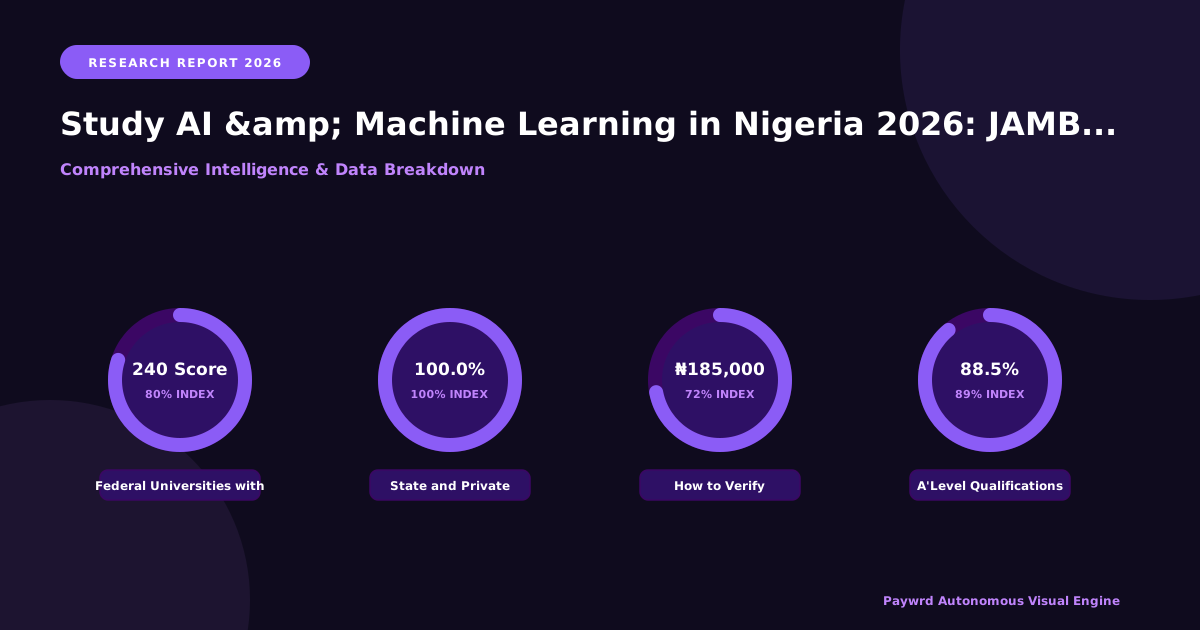
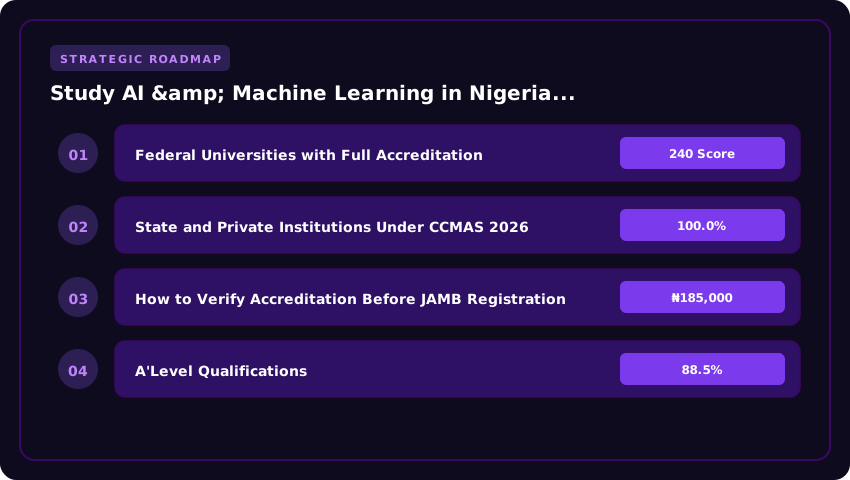
Federal Universities with Full Accreditation
Federal universities remain the most trusted route for accredited AI and ML degrees. The University of Lagos (UNILAG) and Ahmadu Bello University (ABU) Zaria have long-standing NUC-accredited Computer Science programmes with AI/ML concentration options. The Federal University of Technology, Minna (FUT Minna), and Federal University of Agriculture, Abeokuta (FUNAAB), have also received programme-level accreditation covering emerging technologies tracks. Covenant University, Ota, though private, holds full NUC accreditation and has invested heavily in AI research infrastructure for its 2026/2027 intake.
State and Private Institutions Under CCMAS 2026
The NUC’s Centre for Commercialisation and Monitoring of Academic Standards (CCMAS) has approved new AI-focused programmes for several state and private universities for the upcoming session. Institutions like Lagos State University (LASU), Rivers State University (RSU), and Babcock University are among those launching B.Sc. programmes incorporating AI, Data Science, and Machine Learning modules. However, approval status changes frequently, which is exactly why verification matters.
How to Verify Accreditation Before JAMB Registration
This is the step most candidates skip, and it is the most critical. Before you lock in your JAMB choices, follow these steps:
- Visit the official NUC CCMAS portal at ccmas.nuc.edu.ng and search for the specific programme name and institution.
- Confirm the programme is listed under the 2026/2027 approved catalogue, not a previous session’s listing.
- Cross-check the institution’s JAMB profile on jamb.org.ng to ensure the course code matches the NUC record.
- Contact the university’s admissions office directly to confirm programme status if anything appears unclear on the portal.
Do not rely on university websites or social media promotions alone. Accreditation is the only document that guarantees your qualification will be recognised by employers, professional bodies, and for postgraduate admission in Nigeria and abroad. For the 2026/2027 session, treat verification as part of your application strategy, not an afterthought. Your shortlist should include at least two fully accredited federal institutions and one backup state or private option with confirmed CCMAS approval.
2026 JAMB UTME Subject Combination & Minimum Cut-Off Marks for AI/ML
Getting your subject combination wrong is the fastest way to waste a year. For every NUC-accredited AI and Machine Learning programme in 2026, the compulsory UTME quartet is non-negotiable: English Language, Mathematics, Physics, and one of Chemistry, Biology, or Economics. Most faculties of Computing or Engineering insist on Chemistry as that fourth subject; Economics is typically only accepted where the programme sits under a Faculty of Science or Data Science rather than Engineering. Do not assume—check the specific faculty brochure on the JAMB IBASS portal before you register.
Institutional vs. Departmental Cut-Offs: The Real Numbers
JAMB sets the national minimum benchmark—usually 140 for universities—but for AI/ML, that number is irrelevant. You are fighting for departmental merit slots. For the 2026/2027 cycle, treat these as your realistic score targets to clear both the university’s POST-UTME screening and the departmental merit list:
- University of Lagos (UNILAG): Aim for 260+. The Department of Computer Science (AI option) historically posts departmental cut-offs between 255–270. Anything below 250 puts you on the supplementary list at best.
- Obafemi Awolowo University (OAU): Target 250+. OAU’s Computer Science with AI bias is fiercely competitive; merit cut-offs often hover around 245–255.
- Federal University of Technology, Akure (FUTA): Target 230–240+. As a specialised tech university, FUTA’s departmental cut-off for AI/ML usually sits higher than its general institutional mark of 180.
- Ahmadu Bello University (ABU), Zaria: Target 220–235+. Catchment area (Northern states) provides a slight buffer, but merit lists for Computing programmes rarely dip below 215.
- University of Nigeria, Nsukka (UNN): Target 240+. UNN’s departmental cut-offs are notoriously high; scoring below 235 makes admission via merit extremely difficult.
Pro tip: If your UTME score lands between 200–220, do not force these top-five schools as first choice. Look at emerging accredited programmes at FUTO, LAUTECH, or UNILORIN where departmental cut-offs may settle around 200–215, preserving your first-choice advantage.
2026 Profile Code & NIN Linkage: Registration Validity
The 2026 registration cycle enforces strict NIN-to-Profile Code binding. If you generated a profile code in 2026 or earlier, it is not valid for 2026 UTME. You must generate a fresh code by sending NIN [space] Your11DigitNIN to 55019 or 66019 using the exact SIM linked to your NIN. JAMB’s 2026 update flags duplicate NIN submissions instantly—if your NIN is tied to a different phone number or a previous candidate’s record, your registration will stall at the CBT centre. Resolve NIMC data mismatches (name arrangement, date of birth) before you attempt profile code generation; the CBT centre cannot override a NIN mismatch error.
Direct Entry (DE) Requirements: A’Levels, ND, JUPEB & NCE for 2026 Admission
If you are a non-UTME candidate aiming for 200 or 300-level entry into an AI and Machine Learning programme in Nigeria for the 2026/2027 session, understanding Direct Entry requirements is critical. The rules differ significantly from standard UTME candidates, and getting your qualifications wrong before JAMB CAPS registration can cost you a full admission cycle. Here is exactly what you need to know.
A’Level Qualifications
The most straightforward DE route requires at least two Advanced Level passes in relevant subjects. For AI programmes, universities typically demand passes in Mathematics and Physics. Some institutions also accept a third relevant subject such as Further Mathematics, Chemistry, or Biology at A’Level. These qualifications must be from a recognised examining body, and results must be available before you complete your DE registration on JAMB CAPS.
ND and HND Pathways
Candidates holding a National Diploma (ND) or Higher National Diploma (HND) can also qualify for direct entry, but the bar is high. You need at least an Upper Credit classification in a closely related programme such as Computer Science, Computer Engineering, Electrical Engineering, or Software Engineering. A lower classification may not earn you consideration for competitive AI programmes, especially at first-choice universities.
JUPEB and IJMB Programmes
JUPEB and IJMB advanced foundation programmes are increasingly popular DE routes. For competitive DE entry into AI degrees in 2026, candidates generally need a minimum of 10 to 13 points, depending on the institution. The typical JUPEB subject combination includes Mathematics, Physics, Chemistry, Biology, and English Language. Points are calculated across your best three or four subjects, so prioritise the ones that carry the heaviest weight toward your target university’s cutoff.
O’Level Credit Passes
Regardless of your DE qualification, universities require a minimum of five O’Level credit passes at not more than two sittings. The mandatory subjects are Mathematics, English Language, Physics, Chemistry, and Biology. Some institutions accept NECO, WAEC, or NABTEB results, but always confirm with the specific university’s admissions office before listing them on your JAMB CAPS profile.
DE Registration Timeline on JAMB CAPS
DE candidates must complete their CAPS registration after UTME candidates. In 2026, JAMB typically opens DE registration a few weeks after the main UTME registration window closes. Monitor the official JAMB website and CAPS portal closely. Missing the DE registration window means you forfeit your chance for 200-level admission and may be forced into 100-level entry through UTME instead.
- Two A’Level passes in Mathematics and Physics remain the gold standard for DE entry.
- Upper Credit ND in Computer Science or Engineering is widely accepted.
- JUPEB/IJMB candidates should target 10 to 13 points for competitive programmes.
- Five O’Level credits including Maths, English, Physics, Chemistry, and Biology are non-negotiable.
- Always verify NUC accreditation of your chosen AI programme before finalising JAMB choices.
Post-UTME Screening Formats & Preparation Strategy for Top AI Departments
Scoring 300+ in JAMB UTME is only half the battle for 2026 AI aspirants. The Post-UTME screening is where departments separate the mathematically mature from the merely lucky. For the 2026/2027 cycle, the top four destinations—UNILAG, OAU, FUTA, and Covenant University—run distinct screening architectures. Knowing the format cold is your competitive edge.
Screening Formats: CBT vs. Physical Verification
- University of Lagos (UNILAG): Strictly Computer-Based Test (CBT) at designated campus centres. The 2026 format retains 50 questions in 40 minutes—Mathematics (20), Physics (15), English/Logic (15). No calculators allowed; rough sheets provided. Physical credential verification happens after merit list release, not before the exam.
- Obafemi Awolowo University (OAU): Hybrid model. CBT Pre-screening (Post-UTME) determines eligibility for the departmental cut-off. Expect 40 questions in 30 minutes—heavy on Further Mathematics concepts (Complex Numbers, Mechanics) and Physics (Electromagnetism, Modern Physics). Successful candidates proceed to physical document screening at the Faculty of Technology.
- Federal University of Technology, Akure (FUTA): Fully online CBT accessible via the FUTA portal (often remote-proctored). 50 questions, 60 minutes. Syllabus leans heavily on JAMB Advanced Mathematics topics—Statistics, Permutation/Combination, and Calculus applications. FUTA publishes a specific “Post-UTME Syllabus PDF” annually; download the 2026 version from
admissions.futa.edu.ngimmediately after JAMB results. - Covenant University: Unique “Total Man” assessment. CBT (Mathematics, Physics, English, General Aptitude) followed by a mandatory Programming Aptitude Test (PAT) for Computer Science/AI streams. The PAT tests logic flow, pseudocode interpretation, and basic Python syntax (variables, loops, conditionals). It is pass/fail but weighs heavily on final ranking.
High-Yield Syllabus Focus for 2026
Stop reading generic “JAMB Past Questions” cover-to-cover. AI departments test application, not recall. Prioritize these clusters:
- Advanced Mathematics: Matrices/Determinants (Eigenvalues basics), Differential/Integral Calculus (optimization problems), Vectors (dot/cross product in 3D), and Probability Distributions (Binomial, Normal).
- Physics: Semiconductor Physics (PN junctions, Logic gates—crucial for ML hardware context), Waves/Optics (fibre optics comms), and Modern Physics (Photoelectric effect, Quantum numbers).
- Logic & Abstract Reasoning: Truth tables, Propositional logic, Pattern recognition (number/figural series), and Algorithmic thinking (flowchart interpretation).
- Basic Programming Aptitude: For Covenant and increasingly UNILAG/OAU, understand: Variables/Data types, Control structures (If/Else, For/While loops), Functions, Basic Arrays/Lists, and Input/Output operations. Python is the de facto standard.
Verified Resources & Mock Platforms
Do not rely on random WhatsApp forwards. Use these verified 2026 channels:
- Official Portals:
postutme.unilag.edu.ng,admission.oauife.edu.ng,admissions.futa.edu.ng,admissions.covenantuniversity.edu.ng. Download the official “Information Brochure” or “Syllabus” PDFs directly. - Mock CBT Platforms: PrepClass (Nigerian curriculum specific), Myschool.ng CBT App (offline mode available), and UTME.ng (timed simulations). For Programming Aptitude, use HackerRank “Python Basics” and CodeSignal “Intro to Programming” tracks—filter for “Easy” tags only.
- Past Papers: Purchase the “Post-UTME Past Questions for Engineering/Computing” booklets from reputable campus bookshops (e.g., UNILAG Bookshop, OAU Great Ife Bookshop). Verify the year stamp reads “2026–2026 Sessions” to ensure relevance to current CCMAS curriculum shifts.
Pro Tip: Simulate exam conditions daily for two weeks prior. 40 minutes, no phone, no calculator, rough paper only. Train your brain to derive the quadratic formula or resolve vector components under pressure. That speed-accuracy trade-off is what pushes your aggregate over the departmental cut-off.
NELFUND Student Loan Eligibility & Tuition Fees Breakdown for AI Programmes 2026
If you are budgeting for AI and Machine Learning admission in 2026, two financial realities dominate your planning: how much the programme costs per session and whether you qualify for a NELFUND student loan. Here is the honest breakdown families need before committing funds.
Confirming Institution Eligibility on the NELFUND Portal
Not every university offering AI programmes qualifies for NELFUND funding. The first step is visiting the official NELFUND portal and using the institution search tool to confirm your chosen university is listed. Federal universities like the University of Lagos, Ahmadu Bello University, and the University of Nigeria Nsukka typically appear on the approved list. State universities vary by state—Lagos State University and Rivers State University are commonly approved, but this changes annually. Private universities must hold NUC accreditation and meet NELFUND partnership criteria; institutions like Covenant University and Babcock University frequently feature among approved private institutions.
Do not assume admission equals loan approval. If your institution is absent from the NELFUND database, your application will be rejected regardless of your JAMB score. Always cross-check using your JAMB registration number before proceeding.
Estimated Total Cost Per Session
AI and ML programmes fall across multiple faculty structures, so costs range widely. Here is a realistic estimate for the 2026/2027 academic year:
- Tuition: ₦45,000 at some state universities up to ₦250,000 at private institutions per session.
- Acceptance/Registration Fees: Typically ₦10,000–₦35,000, paid once upon admission confirmation.
- ICT Levies: Most universities charging AI programmes now impose ₦5,000–₦15,000 per session for computing infrastructure access.
- Lab and Studio Charges: AI-specific practical sessions attract ₦10,000–₦25,000 per session for GPU cluster and software licensing usage.
Budget a total range of approximately ₦70,000 to ₦325,000 per session depending on institution type. Over a typical four-year degree, families should plan for ₦280,000 to ₦1.3 million before accommodation and living expenses.
Step-by-Step NELFUND Application via SLAP
Accessing funding requires navigating the Student Loan Application Portal (SLAP) correctly. Follow these steps:
- Step 1: Visit the NELFUND SLAP portal and create an account using your valid email and phone number.
- Step 2: Enter your JAMB registration number when prompted—this links your application to your admission records automatically.
- Step 3: Select your institution from the verified list and choose the loan category (tuition-only or tuition plus upkeep).
- Step 4: Upload required documents: JAMB admission letter, institution fee schedule, and a valid means of identification.
- Step 5: Review, submit, and print your application reference number. Processing typically takes two to four weeks.
NELFUND loans for the 2026 cycle carry a one percent interest rate for beneficiaries and are repayable after graduation. Early application is critical because funding slots are limited per institution. Do not wait for admission confirmation to start—begin your SLAP application the moment JAMB registration is complete.
Career ROI: Entry-Level Salaries (₦) & Tech Industry Demand in Nigeria 2026
Let’s talk numbers. You are not studying AI to chase buzzwords; you are doing it because the Nigerian market pays a premium for this skillset in 2026. If you graduate from an NUC-accredited programme with a solid portfolio, the financial return starts immediately—often during your NYSC year. The gap between a generic Computer Science graduate and an AI specialist is visible in the first offer letter.
Graduate Trainee Salary Bands (Monthly Gross)
These figures reflect what top-tier employers in Lagos, Abuja, and Port Harcourt are offering fresh graduates (0–1 year experience) in the current 2026 hiring cycle. Note that “total package” often includes HMO, pension, and transport allowances.
- Fintech (Flutterwave, Moniepoint, Opay, Kuda, TeamApt): ₦250,000 – ₦400,000. Fintechs lead the pack because fraud detection, credit scoring models, and transaction anomaly detection are revenue-critical. They hire for Python, SQL, and model deployment speed.
- Telcos & Big Tech (MTN, Airtel, Google Nigeria, Microsoft ADC): ₦200,000 – ₦350,000. These roles lean heavily into network optimization, churn prediction, and large-scale data engineering. The ceiling is higher here for pure research tracks.
- Oil & Gas AI Labs (Shell, TotalEnergies, Seplat, NNPC JVs): ₦300,000+. The highest entry floor. They need Computer Vision for pipeline inspection, predictive maintenance on rigs, and reservoir simulation. Security clearance and relocation to Port Harcourt or Warri are often prerequisites.
- Traditional Banks & Conglomerates (GTBank, Access, Dangote, BUA): ₦180,000 – ₦280,000. Heavy on regulatory reporting automation and customer segmentation. Good stability, slower model iteration cycles.
High-Demand Skills Aligned with CCMAS 2026
The NUC’s Core Curriculum Minimum Academic Standards (CCMAS) for AI/ML now mandates practical competency, not just theory. Employers verify these specific stacks during technical interviews:
- Python Ecosystem: Advanced Pandas/NumPy, Polars for speed, and
scikit-learnfor classical baselines. - Deep Learning Frameworks: PyTorch is the industry standard over TensorFlow/Keras in 2026 for research and production. Know
torch.compileand distributed training (DDP/FSDP). - NLP & LLMs: Fine-tuning open-source models (Llama 3, Gemma, Aya) using LoRA/QLoRA on Nigerian languages (Yoruba, Igbo, Hausa, Pidgin). RAG (Retrieval-Augmented Generation) implementation is a must-have.
- Computer Vision: YOLOv10/NAS, segmentation (SAM), and edge deployment (TensorRT, ONNX Runtime) for low-power devices.
- MLOps (The Differentiator): Docker, Kubernetes (Kubeflow), MLflow/DVC for experiment tracking, CI/CD for ML (GitHub Actions/GitLab CI), and monitoring (Evidently, Prometheus/Grafana). Universities teaching CCMAS-compliant MLOps modules produce hires who ship on day one.
NYSC Placement Strategy: Hack Your Posting
Do not leave your Primary Place of Assignment (PPA) to chance. In 2026, the “Posting Letter” is a negotiation tool. Target these hubs deliberately:
- Lagos (Yaba, Ikeja, Victoria Island, Lekki): Highest density of Fintechs and Startups. Apply directly to HR departments of target companies before camp, citing your NYSC availability. Many have structured “Corper-to-Full-Time” pipelines paying ₦100k–₦150k stipend plus conversion paths.
- Abuja (Garki, Wuse, Maitama, Kubwa): Regulatory bodies (NITDA, CBN, NCC), Telco HQs, and Government AI initiatives (3MTT, NAIRS). Remote-first companies often prefer Abuja-based corpers for timezone overlap.
- Port Harcourt (GRA, Trans-Amadi, Rumuola): The Oil & Gas AI niche. Target IOCs (International Oil Companies) and local service firms (SLB, Baker Hughes, Weatherford). Accommodation is cheaper than Lagos; savings rate is higher.
Pro Tip: Register on the NELFUND portal if you need upskilling capital post-NYSC. But honestly, a 2026 AI graduate with a deployed GitHub project and a Fintech internship rarely needs a loan—they need a salary account.
Step-by-Step Application Timeline: JAMB Registration to Matriculation 2026/2027
The timeline below is your chronological master checklist. Miss one window, and your dream of studying AI and Machine Learning in Nigeria slips further away. Mark these dates now.
February 2026: JAMB Registration Opens
JAMB UTME registration for the 2026/2027 session is already live. Head to the official JAMB website, create your profile, and complete your registration before the deadline. You will need your NIN, a valid phone number, and a working email. The JAMB registration fee is ₦5,000. Do not wait until the last week; portal crashes are real and they cost you nothing but time.
Late March 2026: JAMB Mock UTME
JAMB typically schedules the mock examination between late March and early April. This is your dry run. Use it to test your CBT stamina, confirm your exam centre, and identify weak areas. The mock result does not count toward your final score, but the intelligence it gives you is completely free.
May 2026: Main UTME
The main UTME runs across selected dates in May. For AI and ML programmes, target a score of 250 and above to remain competitive. Some top-tier universities set cut-off marks at 270 or higher for their Computer Science and emerging technology faculties. After the exam, resist the urge to obsessively check unofficial result portals.
June 2026: Result Release and Change of Course
JAMB releases results within six to eight weeks after the examination. Once your score is confirmed, log into your profile and use the Change of Course or Change of Institution option if your score qualifies for a different programme or school. This window is short, usually lasting two to three weeks. Act decisively.
July-August 2026: Post-UTME Registration
Target universities open their Post-UTME portals during this period. You will need to upload specific documents: your O’Level results, JAMB result printout, passport photograph, birth certificate, and proof of O’Level registration on the WAEC or NECO portal. Each university has its own deadline, so check their admissions pages weekly. Post-UTME screening fees range from ₦2,000 to ₦7,500 depending on the institution.
August-September 2026: JAMB CAPS Admission Status
Monitor your admission status daily on the JAMB CAPS portal. When you receive an admission offer, accept it within the stipulated timeframe. Failure to accept leads to automatic forfeiture. The acceptance fee for most federal and state universities is between ₦10,000 and ₦25,000. Pay within the designated window, usually seven to fourteen days after confirmation.
October 2026: Physical Clearance and Matriculation
Report to your institution for physical clearance. Bring your JAMB admission letter, O’Level certificates, transfer documents if applicable, and your NELFUND clearance letter if you are applying for student loans. Complete biometric verification, collect your student ID, and attend the matriculation ceremony. You are now officially a Nigerian university student studying AI and Machine Learning.
| University | Ownership | Programme Title (2026/2027) | Projected JAMB Cutoff 2026 | Est. Annual Fees (₦) | NUC Accreditation Status | Duration |
|---|---|---|---|---|---|---|
| University of Lagos (UNILAG) | Federal | B.Sc. Computer Science (AI & ML Option) | 260+ | ₦126,325 (Freshers) | Full Accreditation | 4 Years |
| Obafemi Awolowo Univ. (OAU) | Federal | B.Sc. Computer Science (Intelligent Systems) | 250+ | ₦151,200 (Freshers) | Full Accreditation | 4 Years |
| Fed. Univ. of Tech, Akure (FUTA) | Federal | B.Sc. Artificial Intelligence | 240+ | ₦135,000 (Freshers) | Full Accreditation | 4 Years |
| Ladoke Akintola Univ. (LAUTECH) | State | B.Sc. Computer Science (AI Specialization) | 220+ | ₦200,000 – ₦250,000 | Full Accreditation | 4 Years |
| American Univ. of Nigeria (AUN) | Private | B.Sc. Data Science & Analytics / AI | 180+ | ₦2,800,000+ | Full Accreditation | 4 Years |
| Pan-Atlantic University (PAU) | Private | B.Sc. Computer Science (AI Concentration) | 190+ | ₦2,500,000+ | Full Accreditation | 4 Years |
| Nile University of Nigeria | Private | B.Sc. Artificial Intelligence & Machine Learning | 180+ | ₦2,400,000+ | Full Accreditation | 4 Years |
Frequently Asked Questions
Which Nigerian universities have full NUC accreditation for Artificial Intelligence degrees in 2026?
As of the 2026/2027 session, fully NUC-accredited standalone AI or AI-specialized Computer Science programmes exist at UNILAG, OAU, FUTA, LAUTECH, AUN, Pan-Atlantic University, and Nile University. Always verify the specific programme code on the JAMB IBASS portal before selecting it to avoid unapproved courses.
What is the expected JAMB cutoff mark for AI and Machine Learning courses in 2026?
For 2026 admission, Federal universities like UNILAG and OAU require 250–260+, while FUTA sets a benchmark around 240. State universities such as LAUTECH typically accept 220+. Private institutions (AUN, Nile, PAU) often admit at the national minimum of 180–190 but enforce higher internal screening averages.
How much does it cost to study Artificial Intelligence in Nigerian universities for the 2026/2027 session?
Federal universities (UNILAG, OAU, FUTA) charge approximately ₦120,000–₦150,000 for freshers in 2026. State universities like LAUTECH range ₦200,000–₦250,000. Private universities (AUN, Nile, PAU) cost significantly higher, between ₦2.4 million and ₦3 million annually, covering tuition, accommodation, and ICT levies.
What are the correct JAMB subject combinations for AI and Machine Learning in 2026?
The mandatory JAMB UTME subjects for AI/ML in 2026 are English Language, Mathematics, Physics, and Chemistry. Some universities accept Biology in place of Chemistry for Computer Science-based AI options, but Physics and Mathematics are non-negotiable for all NUC-accredited Engineering and Computing faculties.
What is the difference between a B.Sc. Artificial Intelligence and B.Sc. Computer Science with AI option in Nigeria?
A standalone B.Sc. Artificial Intelligence (e.g., FUTA, Nile) focuses curriculum entirely on ML algorithms, robotics, and neural networks from Year 1. A B.Sc. Computer Science with AI Option (e.g., UNILAG, OAU) covers core CS fundamentals first, allowing specialization in AI/ML only in the final two years. Both hold equal NUC recognition if accredited.
Strategic Final Takeaway
When evaluating How To Apply For Artificial Intelligence And Machine Learning Degree In Nigerian Universities 2026 JAMB Requirements in 2026 and beyond, base your decisions on accredited institutional standards, verified return on investment (ROI), and up-to-date official guidelines. Always verify specific dates and requirements through official regulatory portals.