
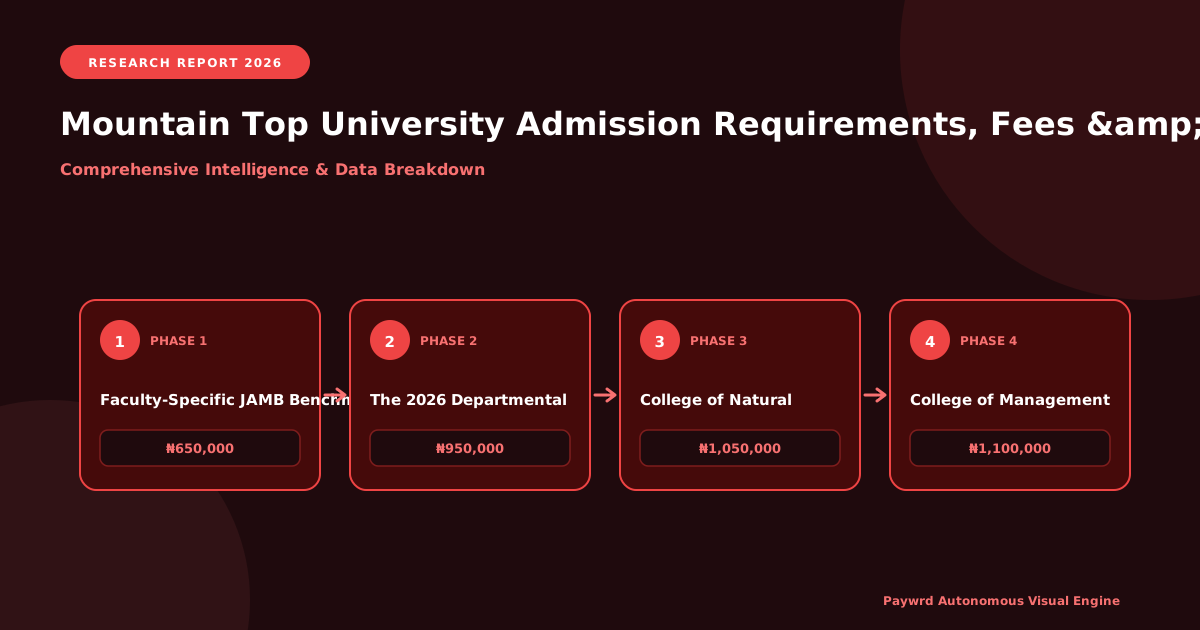
2026/2027 UTME & Direct Entry Admission Cut-Off Marks
Mountain Top University has officially pegged the general minimum UTME score for the 2026/2027 admission cycle at 160. This aligns with the typical baseline for private universities in Nigeria as approved by JAMB policy meetings. However, treating 160 as a “safe” target is a strategic error. Faculty-level cut-offs are significantly higher and fluctuate yearly based on application volume and the quality of the applicant pool.

Faculty-Specific JAMB Benchmarks (Projected 2026/2027)
Based on historical trends from the 2026/2027 and 2026/2027 cycles, and the current capacity constraints for professional programmes, candidates should target these realistic minimums to stand a competitive chance during the departmental screening:
- College of Health Sciences (Nursing, Medical Lab Science, Public Health): 220 – 240+. Nursing Science remains the most competitive; scores below 220 rarely clear the departmental aggregate even with a perfect Post-UTME.
- Faculty of Law: 210 – 230+. The quota is tight; a high UTME score is your primary leverage.
- Faculty of Engineering & Technology (All Programmes): 190 – 210+. Computer Engineering and Electrical/Electronics typically sit at the higher end of this band.
- Faculty of Basic Medical Sciences (Anatomy, Physiology): 190 – 200+.
- Faculty of Natural & Applied Sciences, Humanities, Management & Social Sciences: 160 – 180+. Courses like Microbiology, Biochemistry, and Mass Communication often trend toward 180+ due to popularity.
Direct Entry (DE) Candidates: You require a minimum of Upper Credit (for ND/HND) or a Second Class Lower (for Bachelor’s degrees) in a relevant discipline, alongside five O’Level credits at not more than two sittings. DE applicants do not sit for Post-UTME but are screened via credential verification on the MTU portal.

The 2026 Departmental Aggregate Calculation Formula
MTU utilizes a transparent 50:50 weighting system for UTME candidates. There are no extra points for O’Level grades (A1, B2, etc.) in the aggregate calculation—O’Level results are strictly for eligibility verification (five credits including Math & English).
The formula is:
- Aggregate Score = (JAMB Score / 8) + (Post-UTME Score / 2)
Breakdown:
- JAMB Component (Max 50%): Your raw UTME score (max 400) is divided by 8. A score of 320 yields the full 50 marks; 200 yields 25 marks.
- Post-UTME Component (Max 50%): The CBT screening is scored over 100%. Your percentage score is halved. Scoring 80% in the screening yields 40 marks.
Practical Example: A candidate with JAMB 240 (30 pts) and Post-UTME 70% (35 pts) gets an Aggregate of 65/100. For Nursing (cut-off often ~70+), this candidate falls short. They would need roughly JAMB 260 + Post-UTME 80% to hit the 75+ aggregate safety zone. Prepare for the CBT screening using the MTU past questions portal; the exam focuses heavily on English, Mathematics, and General Paper/Current Affairs regardless of course choice.
Faculty-Specific Subject Combinations & O’Level Requirements

Mountain Top University (MTU) maintains a strict five-credit benchmark at O’Level (WAEC, NECO, or NABTEB) for all programmes, but the specific subject mix shifts dramatically depending on your target faculty. For the 2026/2027 cycle, the university continues to enforce a two-sittings maximum policy. You may combine results from two different exam years or two different bodies (e.g., WAEC May/June 2026 + NECO June/July 2026), but a third sitting automatically disqualifies the application during the screening phase on the JAMB CAPS portal.
College of Natural & Applied Sciences
Every science programme—from Microbiology and Biochemistry to Computer Science and Industrial Chemistry—demands the classic “Big Five”: English Language, Mathematics, Physics, Chemistry, and Biology. There is zero flexibility here; a pass (D7/E8) in Physics or Chemistry kills an application for Physical Sciences, while a missing Biology credit shuts the door on Life Sciences. For Computer Science and Software Engineering, the university accepts a credit in Further Mathematics or Technical Drawing in place of Biology, but Physics and Chemistry remain non-negotiable. Agricultural Economics and Extension require the standard science five, though a credit in Agricultural Science can substitute for Biology if you also hold a pass in Biology.
College of Management & Social Sciences
Accounting, Banking & Finance, Business Administration, and Economics share a core requirement: English, Mathematics, Economics, and any two relevant Social Science or Commercial subjects (Commerce, Government, Geography, Accounting, or Civic Education). A credit in Commerce cannot replace Economics for the Economics degree programme—Economics is mandatory. For Mass Communication, the combination shifts to English, Mathematics, Literature-in-English, Government/History, and any other Arts/Social Science subject. Political Science and International Relations require Government or History plus two other Arts/Social Science credits. Crucially, a D7 in Mathematics is not accepted for any programme in this college, regardless of your JAMB score.
College of Humanities
English Language and Literature-in-English are the twin pillars for English & Literary Studies, History & International Studies, and Religious Studies. You need three additional credits from Government, History, CRS/IRS, Yoruba/Igbo/Hausa, French, or Fine Arts. For Languages (French, Yoruba), a credit in the specific target language is mandatory. Philosophy requires the standard five credits including Mathematics—a detail many applicants miss. The university does not accept Civic Education or Data Processing as core substitutes for Literature or Government in this college.
College of Law
Law remains the most prescriptive: English, Literature-in-English, Mathematics, Government/History, and CRS/IRS. MTU does not accept Commerce, Economics, or Civic Education in place of Literature or Government for the LL.B programme. This combination must be obtained in a maximum of two sittings; the admissions office has consistently rejected combined results spanning three sittings since the 2026/2027 session.
College of Basic Medical Sciences & Nursing
Nursing Science, Medical Laboratory Science, and Public Health require the standard science five (English, Maths, Physics, Chemistry, Biology) in not more than two sittings. Given the competitive 200+ JAMB floor for these programmes, the O’Level screening is ruthless—any “awaiting result” status at the point of Post-UTME registration usually results in disqualification unless the result is uploaded and verified before the screening deadline.
Pro Tip: Before paying for the MTU Post-UTME form (₦2,000), cross-check your specific departmental requirements on the MTU Admissions Portal or the JAMB IBASS brochure. The university uploads the finalized 2026/2027 departmental cut-offs and subject maps there by mid-May 2026.
Complete School Fees Schedule for Fresh & Returning Students
Budgeting for Mountain Top University (MTU) in the 2026/2027 session requires looking past the headline tuition figure. The institution operates a transparent, itemized billing structure, but the “hidden” line items—Medical, ICT, and Development levies—often catch families off guard. For the current session, the university has maintained relative stability in its fee regime, though a marginal adjustment reflects current economic realities.
Fresh Students (100 Level & Direct Entry) Fee Breakdown
New entrants bear the heaviest upfront cost due to one-time acceptance and matriculation charges. Below is the verified schedule for non-science programmes (Humanities, Management, Social Sciences). Science, Engineering, and Nursing students should add a laboratory surcharge of approximately ₦50,000–₦75,000.
- Tuition Fee: ₦450,000
- Acceptance Fee (Non-refundable, paid once): ₦100,000
- Accommodation (Standard Hostel, per session): ₦150,000
- Medical Services Levy: ₦30,000
- ICT & E-Learning Infrastructure: ₦40,000
- Development Levy: ₦50,000
- Library & ID Card: ₦15,000
- Matriculation & Orientation: ₦20,000
- Sports & Recreation: ₦10,000
- Examination & Verification: ₦15,000
Estimated Total (Non-Science, with Hostel): ₦880,000 – ₦900,000. Estimated Total (Day Student): ₦730,000 – ₦750,000.
Returning Students (200 Level – Final Year) Fee Breakdown
Returning students enjoy a significant drop in payable fees because Acceptance and Matriculation fees are removed. However, the Development and ICT levies remain recurring costs.
- Tuition Fee: ₦450,000
- Accommodation (Optional): ₦150,000
- Medical Services Levy: ₦30,000
- ICT & E-Learning Infrastructure: ₦40,000
- Development Levy: ₦50,000
- Library & Examination: ₦25,000
- Sports & Recreation: ₦10,000
Estimated Total (With Hostel): ₦755,000. Estimated Total (Day Student): ₦605,000.
Payment Portal Deadlines & Installment Eligibility
MTU strictly enforces payment via its student portal (portal.mtu.edu.ng) using Remita or Paystack gateways; cash payments at bursary windows are no longer accepted. For the 2026/2027 session, the calendar is firm:
- Freshers’ Full Payment Deadline: Before Matriculation Ceremony (typically late October 2026). No installment option exists for 100 Level students; the Acceptance Fee alone (₦100,000) is due immediately upon admission offer acceptance on JAMB CAPS to secure your spot.
- Returning Students Deadline: End of Week 4 of the First Semester (usually mid-October 2026).
- Installment Plan (Returning Students Only): Eligible students (CGPA 3.0+ and zero disciplinary record) may apply for a 60/40 split via the Dean of Student Affairs. First tranche (60%) due by resumption; balance (40%) due before Second Semester exams. A ₦10,000 administrative fee applies.
Pro Tip: NELFUND loan recipients must upload their approval letter to the portal before the deadline; the system does not auto-verify funding status. Late payment attracts a ₦20,000 penalty and blocks access to the E-Exam platform and hostel allocation.
Accredited Undergraduate Programmes & NUC Status Update
For the 2026/2027 academic session, Mountain Top University (MTU) operates a fully compliant curriculum aligned with the National Universities Commission’s Core Curriculum Minimum Academic Standards (CCMAS). This shift from the old BMAS framework means every programme now features a 70% core curriculum and 30% institutional uniqueness, directly impacting course codes, credit loads, and graduation requirements. Prospective candidates must verify their intended course against the JAMB IBASS portal and the MTU admission portal before registration, as programme titles and codes have been updated to reflect the new taxonomy.
College of Basic & Applied Sciences
- Biochemistry (Revised CCMAS curriculum)
- Biotechnology (Newly accredited for 2026 entry)
- Chemistry (Industrial & Pure Options)
- Computer Science (Core)
- Cybersecurity (New Programme – Full Accreditation Secured 2026)
- Data Science (New Programme – Full Accreditation Secured 2026)
- Software Engineering (New Programme – Full Accreditation Secured 2026)
- Mathematics (Pure/Applied/Statistics Options)
- Microbiology
- Physics with Electronics
College of Engineering & Technology
- Civil Engineering
- Computer Engineering
- Electrical/Electronics Engineering
- Mechanical Engineering
- Mechatronics Engineering (New Programme – Interim Accreditation, Resource Verification Completed 2026)
- Chemical Engineering (Phased Out for 2026 Intake – Awaiting Re-accreditation)
College of Humanities, Management & Social Sciences
- Accounting (Renamed from B.Sc. Accounting to B.Sc. Accountancy per CCMAS)
- Banking & Finance
- Business Administration
- Economics
- English Language
- History & International Studies
- Mass Communication Unbundled into: Journalism & Media Studies, Public Relations & Advertising, Broadcasting & Film Production (Old generic Mass Comm code retired on JAMB portal)
- Political Science
- Psychology
- Sociology
College of Law & College of Health Sciences
- Law (LL.B.) – Full Accreditation (Council of Legal Education & NUC)
- Nursing Science (B.N.Sc.) (New Programme – Full NUC & NMCN Accreditation Secured for 2026/2027)
- Medical Laboratory Science (B.MLS) (New Programme – Interim Accreditation Granted)
- Public Health (New Programme – Full Accreditation)
Critical Advisory: The former Library & Information Science and Philosophy programmes have been phased out effective the 2026/2027 session and will not appear on the 2026 JAMB brochure for MTU. Candidates who selected these in error during UTME registration must effect a Change of Course/Institution on the JAMB CAPS portal immediately. Always cross-reference the final list on the MTU official website or the NUC CCMAS dashboard before sitting for the Post-UTME screening.
Post-UTME Screening Registration Steps & Deadline Tracker
Missing the Post-UTME window at Mountain Top University (MTU) is an automatic disqualification—there are no appeals for late registration. For the 2026/2027 cycle, the university has migrated fully to the MTU Admission Portal (admissions.mtu.edu.ng), eliminating physical scratch cards. You need your JAMB Registration Number, a valid email, and an active phone number to begin. The screening fee remains ₦2,000 (exclusive of bank charges), payable via Remita or the portal’s integrated Paystack gateway.
Step-by-Step Portal Registration Workflow
- Create Profile: Visit the portal and click “New Application.” Enter your JAMB Reg Number. The system auto-fetches your UTME score and bio-data. Verify the spelling of your names against your JAMB slip—mismatches trigger manual verification delays.
- Generate RRR & Pay: Select “Post-UTME Screening.” A Remita Retrieval Reference (RRR) generates instantly. Pay via bank branch, USSD (*737*50# for GTB, *901*11# for Access, etc.), or card. Screenshot reference: Save the “Payment Successful” page showing the RRR and Transaction ID; you will upload this if the portal fails to auto-verify within 30 minutes.
- Complete Bio-data & O’Level Upload: After payment confirmation, return to the portal. Fill in your LGA, State of Origin, and Next of Kin. Upload clear, legible scans of your WAEC/NECO/NABTEB results (max 500KB each, JPEG/PDF). MTU does not accept “Awaiting Results” for 2026; you must have at least five credits including English and Mathematics at one sitting or two sittings.
- Select Screening Venue & Time: The 2026 screening is Computer-Based Test (CBT) only. Choose from the accredited centres: MTU Main Campus (Prayer City), Lagos ICT Centre (Ikeja), Abuja Centre (Garki), or Port Harcourt Centre. Slots are first-come, first-served.
- Print Examination Slip: This is your entry ticket. It contains your unique Screening Number, Venue Address, Seat Number, and Exam Time. Print two copies—one for the exam hall, one for your file.
Critical 2026 Deadlines & Timetable
Mark these dates in your calendar; the portal locks automatically at 11:59 PM WAT on the closure date. No extensions are granted for “network issues.”
- Portal Opens: Monday, August 4, 2026 (Immediately after JAMB releases 2026 UTME results).
- Registration Closes: Friday, September 18, 2026.
- CBT Screening Examination Window: Monday, September 22 – Saturday, September 27, 2026.
- Mock/Familiarization Test (Optional but Recommended): Opens September 15, 2026 on the portal dashboard. Use this to test your browser compatibility (Chrome/Firefox latest versions only) and webcam functionality.
- Results Release: Expected October 7, 2026 on the portal and JAMB CAPS.
Pro Tip: If you are targeting Nursing, Law, or Engineering, register within the first 72 hours (by August 7). High-demand centres at the Main Campus and Lagos fill up fast, forcing late registrants to distant venues. Ensure your JAMB profile phone number is active; MTU sends the screening schedule via SMS and email—missing that notification is not a valid excuse for absence.
Funding Options: NELFUND Loan Application & MTU Scholarships
Financing a private university education in Nigeria no longer means relying solely on family savings. For the 2026/2027 session, Mountain Top University (MTU) students have two robust, structured pathways to fund their degrees: the Federal Government’s NELFUND interest-free loan and the institution’s internal merit and faith-based awards. Understanding the mechanics of each is critical for freshers looking to secure funding before matriculation deadlines hit.
Accessing the Federal Student Loan (NELFUND) at MTU
The Student Loans (Access to Higher Education) Act, 2026, is fully operational for the 2026 academic year, and MTU is a fully accredited participating institution on the NELFUND portal. This is not a grant; it is a zero-interest loan repayable two years after NYSC completion, deducted at source at 10% of your salary. For MTU freshers, the eligibility gatekeepers are specific and non-negotiable:
- Admission Status: You must have a verified admission letter on JAMB CAPS for a full-time undergraduate programme at MTU. Part-time or diploma programmes do not qualify.
- Income Threshold: Combined parental/guardian annual income must not exceed ₦500,000. You will need to upload tax clearance certificates or a sworn affidavit for informal sector parents during the application.
- Guarantor Requirement: Two civil servants (Level 12 and above), a lawyer with 10+ years post-call experience, a judicial officer, or a Justice of the Peace must sign off digitally on the portal.
- NIN & BVN Sync: Your National Identification Number (NIN) must be linked to your Bank Verification Number (BVN) and the phone number used for registration. Mismatches are the number one cause of rejection in 2026.
Pro Tip: Apply via the official nelf.gov.ng portal immediately you accept your admission on CAPS. Do not wait for resumption. The loan covers tuition (paid directly to MTU) and a maintenance stipend (paid to your student account) per session.
MTU Internal Scholarships: Vice-Chancellor & Faith-Based Awards
Beyond federal support, MTU runs a transparent internal scholarship ecosystem managed by the Student Affairs Division. For 2026 freshers, two categories stand out:
1. Vice-Chancellor’s Academic Excellence Scholarship
This is strictly merit-based. It targets the top 5% of the incoming class based on the Post-UTME aggregate score (the 50:50 UTME/Post-UTME weighting discussed earlier). If your composite score places you in the top tier of your faculty—say, 280+ for Engineering or 260+ for Humanities—you are automatically flagged. No separate application form is required; the Registry generates the list after clearance. The award typically covers 50% to 100% of tuition for the first year, renewable annually with a minimum 4.50/5.00 CGPA.
2. MFM Faith-Based & Indigent Student Grants
As a faith-based institution owned by the Mountain of Fire and Miracles Ministries (MFM), MTU administers the MFM General Overseer’s Scholarship and the Indigent Student Bursary.
- MFM Members: Active, registered MFM members with a Pastor’s recommendation letter and proof of consistent attendance (minimum 12 months) can apply for tuition remission ranging from 25% to 75%. Applications open on the student portal (
portal.mtu.edu.ng) usually two weeks after matriculation. - Indigent Bursary: Open to all students regardless of denomination. Requires a detailed socioeconomic survey, LGA letter of identification, and parents’ tax/sworn affidavit. Awards are fixed sums (typically ₦100,000 – ₦200,000 per session) credited to the student’s fee account.
Action Plan: Secure your NELFUND loan first—it guarantees fee payment. Then, monitor the MTU student portal “Scholarships” tab religiously in your first semester for the VC and MFM application windows. Missing the internal deadline means waiting a full year for the next cycle.
Campus Life: Hostel Allocation, Dress Code & Transport Logistics
Transitioning into Mountain Top University (MTU) requires more than just academic readiness; it demands an understanding of the institution’s structured lifestyle. Unlike many public universities, MTU operates a highly regulated campus environment designed to foster discipline and spiritual growth. For the 2026/2027 session, new students must prioritize their housing and compliance strategies early to avoid first-semester stress.
Hostel Allocation and Housing Costs
Accommodation at MTU is primarily managed through a digital balloting process via the student portal. While the university encourages on-campus residency for freshmen to ensure security and academic integration, space is competitive. To secure a spot, students must complete their payment of acceptance fees and hostel levies immediately upon admission.
- On-Campus Costs: Depending on the room category (Standard vs. Premium), hostel fees for the 2026 session range between ₦120,000 and ₦250,000 per session.
- Off-Campus Alternatives: For returning students or those opting out, the Ibafo/Mowe axis offers various self-contain apartments. Average rents for decent student housing in this corridor currently fluctuate between ₦250,000 and ₦450,000 per annum, excluding agency and legal fees.
- Strategy: We recommend early payment; once the portal closes for the first wave of balloting, securing a room becomes significantly harder.
Mandatory Dress Code Enforcement
MTU is renowned for its strict adherence to a corporate and modest dress code. This is not a suggestion but a mandatory requirement for campus access. The university administration employs security personnel at the gates to enforce these rules daily.
Students are prohibited from wearing sleeveless tops, short skirts, ripped jeans, or overly casual beachwear. For the 2026/2027 academic year, the “Corporate-Casual” standard remains the benchmark. Failure to comply often results in denial of entry to lecture halls or disciplinary queries. Investing in a wardrobe of modest, professional attire is an essential part of your admission budget.
Transport Logistics and Commuting
Navigating the campus and the surrounding Mowe/Ibafo environment requires a clear transport plan. The university operates an internal shuttle service that connects the main administrative blocks, lecture theaters, and residential hostels.
- Internal Shuttles: These are free for students with valid ID cards and run on a fixed schedule aligned with lecture hours.
- External Commuting: Students living off-campus typically rely on commercial motorcycles (okadas) or mini-buses. Budget approximately ₦500 to ₦1,200 daily for round-trip commuting from nearby residential estates to the campus gate.
- Traffic Alert: Be mindful of the heavy traffic congestion common along the Lagos-Ibadan Expressway axis, especially during morning peak hours.
| Faculty / Programme Cluster | 2026/2027 JAMB Cut-Off Mark | Aggregate Calculation Formula | Estimated Annual Tuition Range (₦) | Standard Duration |
|---|---|---|---|---|
| General Programmes (Arts, Mgt, Sci, Edu) | 160 | 50% UTME (Scaled) + 50% Post-UTME | ₦650,000 – ₦850,000 | 4 Years |
| College of Engineering & Technology | 200+ | 50% UTME (Scaled) + 50% Post-UTME | ₦950,000 – ₦1,150,000 | 5 Years |
| College of Law (LL.B) | 220+ | 50% UTME (Scaled) + 50% Post-UTME | ₦1,050,000 – ₦1,250,000 | 5 Years |
| College of Health Sciences (Nursing, MLS) | 220+ | 50% UTME (Scaled) + 50% Post-UTME | ₦1,100,000 – ₦1,300,000 | 5 Years |
| Direct Entry (All Colleges) | Upper Credit / Merit + JAMB DE Reg | Screening + Credentials Verification | Same as Programme Level | 3–4 Years |
Frequently Asked Questions
What is the Mountain Top University JAMB cut-off mark for 2026/2027?
Mountain Top University (MTU) has set the general minimum JAMB cut-off mark for the 2026/2027 session at 160. However, competitive programmes like Law, Nursing, and Engineering require significantly higher scores, typically 200 to 220+, depending on applicant volume and departmental capacity.
How is the MTU Post-UTME aggregate score calculated for 2026 admission?
For the 2026/2027 admission cycle, MTU calculates the merit score using a strict 50:50 weighting formula: 50% of your JAMB UTME score (scaled down) plus 50% of your Post-UTME screening score. There are no O'Level bonus points added to the aggregate; O'Level results are used only for eligibility verification.
How much are Mountain Top University school fees for 2026/2027?
Estimated tuition for the 2026/2027 session ranges from ₦650,000 to ₦850,000 for general programmes (Arts, Sciences, Management). Professional courses like Engineering, Law, and Health Sciences attract higher fees, estimated between ₦950,000 and ₦1,300,000 per annum, excluding acceptance, accommodation, and clinical levies.
When will MTU Post-UTME registration start for 2026/2027?
Based on the university's historical calendar, MTU Post-UTME registration for the 2026/2027 session is projected to commence in July 2026, immediately following the release of JAMB results. Candidates must monitor the official MTU portal (mtu.edu.ng) for the exact start date, eligibility checker, and screening timetable.
Does Mountain Top University accept Direct Entry for 2026/2027?
Yes, MTU accepts Direct Entry (DE) candidates for the 2026/2027 session. Applicants must possess a minimum of Upper Credit (ND/HND), Merit (NCE), or two A-Level passes in relevant subjects, alongside five O'Level credits including English and Mathematics. DE candidates must register via JAMB and participate in the university's screening exercise.
Strategic Final Takeaway
When evaluating Mountain Top University Admission Requirements Fees And Courses For 2026 2027 Session in 2026 and beyond, base your decisions on accredited institutional standards, verified return on investment (ROI), and up-to-date official guidelines. Always verify specific dates and requirements through official regulatory portals.

