

Decoding NAEYC Accreditation & State Licensure Alignment for Associate Graduates
If you are investing $6,000 to $15,000 in a community college Early Childhood Education (ECE) associate degree, accreditation isn’t a bureaucratic checkbox—it is your career insurance policy. The National Association for the Education of Young Children (NAEYC) Early Childhood Associate Degree Accreditation (ECADA) is the sole specialized accreditor recognized by the Council for Higher Education Accreditation (CHEA) for two-year programs. When a program holds ECADA status, its curriculum has been rigorously mapped to the Professional Standards and Competencies for Early Childhood Educators. This mapping is the bridge that connects your transcript directly to your state Department of Education teacher certification standards.

Why ECADA Trumps Regional Accreditation Alone
Your college likely holds regional accreditation (e.g., HLC, MSCHE, WASC), which unlocks federal financial aid via FAFSA. However, regional accreditation does not verify that your specific ECE coursework meets state pedagogical competencies. Without ECADA, you risk completing 60 credits only to discover your state licensure board requires additional practicum hours, specific special education modules, or a standalone child development capstone that your program skipped. ECADA programs undergo a self-study and peer review every seven years, ensuring course syllabi, field placements, and faculty qualifications stay locked to current state mandates.
CDA Credential vs. Associate Degree: The Head Start Compliance Gap
A common point of confusion is the Child Development Associate (CDA) Credential. While the CDA is a valuable entry-level stepping stone—often requiring just 120 clock hours of training and 480 hours of experience—it does not satisfy the federal Head Start Act requirement for lead teachers. Since 2013, Head Start has mandated that at least 50% of lead teachers nationwide hold a bachelor’s degree, but the baseline for assistant teachers and many lead roles in Early Head Start is an associate degree in ECE or a related field.
- CDA Coursework: Often articulates for 6–9 credits toward an associate degree, but lacks the general education core (English, Math, Science) required for licensure transfer.
- Associate Degree (ECADA): Includes the full 60-credit scope: general education, 30+ ECE credits, and supervised field experience—meeting both Head Start compliance and state certification prerequisites.
Instant Verification: Check Your State Registry Before You Enroll
Do not rely solely on a college’s marketing brochure. Verify program approval in real-time through your state’s professional development registry. These registries are the authoritative source for licensing bodies and employers:
- California: Search the California ECE Registry for “Approved Programs” aligned with the Child Development Permit Matrix.
- New York: Use New York Aspire to confirm the program meets NYSED certification pathway requirements.
- Texas: Check the Texas Early Childhood Professional Development System (TECPDS).
If a program does not appear on your state registry’s approved list, walk away. The cost of retaking non-transferable credits far exceeds the due diligence of a five-minute registry search.
Navigating Guaranteed Transfer Agreements: CSU, SUNY, CUNY & Statewide Articulation Models
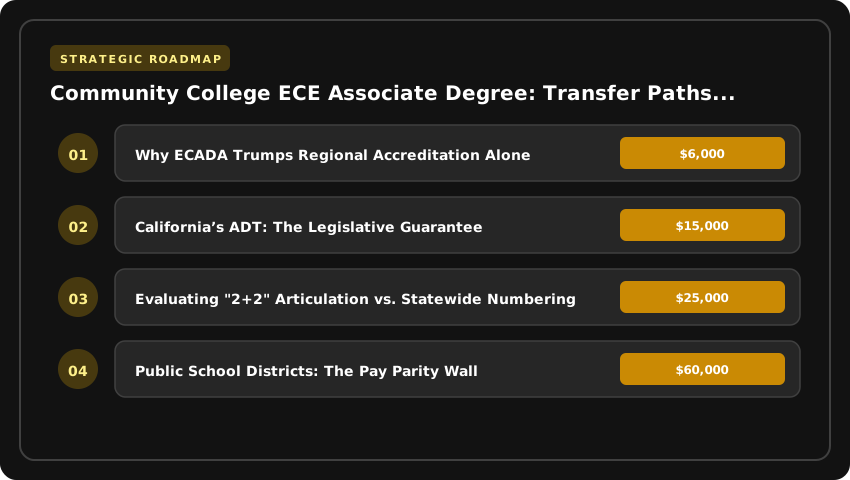
You have your NAEYC-accredited associate degree in hand. Now comes the strategic pivot: converting those 60 credits into a bachelor’s degree with zero waste. In the U.S. public higher education ecosystem, three massive systems—California’s CSU, New York’s SUNY, and CUNY—offer the most structured “insurance policies” against credit loss. Understanding the mechanical differences between a legislated guarantee and a bilateral handshake agreement protects your FAFSA eligibility and your wallet.
California’s ADT: The Legislative Guarantee
California’s Associate Degree for Transfer (ADT) in Early Childhood Education (often labeled AS-T in Early Childhood Education) is the gold standard for statutory protection. Authorized by SB 1440, this degree legally binds the California State University (CSU) system to admit you with junior standing (60 semester units) and a guaranteed pathway to a similar baccalaureate major—typically Child Development or Human Development with a Birth-Grade 2 focus.
- The Mechanism: You complete 60 semester units (including ~24–27 major prep units aligned to the C-ID Course Identification Numbering System).
- The Guarantee: Priority admission consideration to your local CSU campus and a “similar” major. You cannot be forced to repeat lower-division courses.
- Financial Aid Safety: Because you enter as a junior, you preserve your remaining Pell Grant lifetime eligibility (600%) and Federal Direct Loan annual limits for upper-division work.
Watch the trap: The ADT guarantees system admission, not admission to San Diego State or Cal Poly SLO specifically. Competitive campuses may require a higher GPA (often 2.8–3.0+) for the major.
SUNY Transfer Paths & CUNY Pathways: The Common Core Architecture
New York operates on a Common Course Numbering philosophy rather than a single legislated degree type. SUNY Transfer Paths define the specific lower-division courses required for Early Childhood/Childhood Education (Birth–Grade 2) majors across all 64 campuses. If you follow the Path at any SUNY community college (or CUNY college), those courses are guaranteed to satisfy major requirements at the receiving university.
- SUNY Gen Ed + Major Path: Complete the 30-credit SUNY General Education Framework plus the designated Path courses (typically Child Development, Foundations of Education, and Field Experience I/II).
- CUNY Pathways: Mirrors SUNY structure. The Common Core (30 credits) plus College Option (6–12 credits) transfers seamlessly between CUNY colleges. For Birth-Grade 2 certification, ensure your associate program includes the NYSED-mandated pedagogical core (Students with Disabilities, ELL instruction).
- Credit Loss Prevention: Unlike “2+2” bilateral deals, these are system-wide. A course taken at Westchester Community College carries the same weight as one taken at Borough of Manhattan Community College when transferring to Hunter College or SUNY New Paltz.
Evaluating “2+2” Articulation vs. Statewide Numbering
Many community colleges market “2+2 Articulation Agreements” with specific four-year partners. While valuable, they are contractual, not statutory. A leadership change at the university can sunset the agreement mid-stream. Always verify:
- Expiration Date: Is the MOU current? (Look for renewal within the last 2 years).
- Course-to-Course Equivalency: Does the agreement map specific course codes (e.g.,
ECE 101 = EDU 205), or just vague “elective blocks”? - Residency Requirements: Does the bachelor’s program require 30+ upper-division credits in residence, potentially forcing summer enrollment?
Strategic Verdict: Prioritize statewide common course numbering (C-ID, SUNY Paths, CUNY Common Core) over bilateral 2+2s. They offer portable, auditable credit protection that survives institutional politics. If you must use a 2+2, treat it as a supplement to—never a replacement for—a statewide transfer framework.
Employer Recognition Reality Check: Public Pre-K, Head Start & Private Center Hiring Policies
Let’s cut through the marketing brochures. You are earning this degree to get hired and paid, so you need to know exactly where an associate degree opens doors—and where it hits a glass ceiling. The landscape splits sharply into three distinct hiring ecosystems: state-funded public Pre-K, federal Head Start, and the major private chains. They do not play by the same rules.
Public School Districts: The Pay Parity Wall
If your goal is a lead teacher role in a state-funded public Pre-K program housed in an elementary school, the associate degree is increasingly a support credential, not a lead credential. Most state salary schedules—think Georgia’s Pre-K, New Jersey’s Abbott districts, or Oklahoma’s universal program—tie the “lead teacher” pay band to a Bachelor’s degree and state teaching licensure.
An associate holder typically slots in as a “Paraprofessional,” “Teacher Assistant,” or “Associate Teacher.” The dollar gap is real: BLS data consistently shows a $15,000 to $25,000 annual spread between a licensed Pre-K lead (median ~$60,000+) and an assistant (median ~$35,000). Some districts offer “career lattice” stipends—maybe an extra $2,000–$3,000 annually for the associate—but it rarely bridges the licensure gap. If you want the public school pension and salary schedule, budget for the Bachelor’s completion from day one.
Head Start: The Federal Floor (HSPPS)
Head Start is friendlier territory, governed by the Head Start Program Performance Standards (HSPPS) 1302.91. The federal baseline requires center-based teachers to hold at minimum an associate degree in ECE or a related field. This is your sweet spot: the associate meets the federal “floor” for a lead teacher role.
However, the “floor” is rising. The 2016 reauthorization pushed for 50% of teachers nationally to hold Bachelor’s degrees; that target has been met and exceeded in many regions. While you can be a lead teacher with an associate, competitive grantees (like Community Action Agencies or large school districts running delegate agencies) often prefer or require the BA for new hires. The associate gets you in the door; the BA keeps you competitive for promotion to Education Coordinator or Coach roles.
Private Chains: Tuition Reimbursement as Retention Strategy
This is where the associate degree shines as a terminal credential with a built-in ladder. Major chains—Bright Horizons, KinderCare Learning Companies, and Learning Care Group (Childtime, Tutor Time, La Petite)—structure hiring around “Career Pathways” designed to reduce turnover.
- Bright Horizons: Hires associate holders as “Teachers” (lead role in many centers). Offers 100% tuition coverage (up to $5,250/yr tax-free, plus additional support) for Bachelor’s completion through partners like Rasmussen or Walden. They pay for your CDA renewal, too.
- KinderCare: “Teacher” role accessible with associate. Their Education Assistance Program covers up to $5,250 annually for degree completion. They explicitly map associate → BA → Center Director pipeline.
- Learning Care Group: Similar structure; associate qualifies for “Lead Teacher.” Tuition reimbursement caps at $5,250/yr with GPA requirements.
The catch: These benefits usually require 6–12 months tenure and often claw back funds if you leave within a year of reimbursement. Salaries for associate leads in these chains typically range $38,000–$48,000 depending on metro area—higher than independent centers, lower than public school leads.
Bottom Line: Public Pre-K treats the associate as a stepping stone to licensure. Head Start treats it as a compliant baseline. Private chains treat it as a retention asset they will pay to upgrade. Know which game you are playing before you enroll.
US Salary Benchmarks: Median Wages for Associate-Holding ECE Professionals by State & Metro
Let’s talk brass tacks. You are weighing a $6,000 to $15,000 investment against a paycheck, and the Bureau of Labor Statistics (BLS) Occupational Employment and Wage Statistics (OEWS) data draws a sharp line between surviving and building a career. The most critical distinction? The gap between Preschool Teachers (SOC 25-2011) and Childcare Workers (SOC 39-9011). Nationally, the median annual wage for preschool teachers sits at roughly $37,130, while childcare workers median out at $28,520. That $8,600 spread is essentially the “associate degree premium”—but only if your credential unlocks the teacher classification.
Metro Muscle: Where the Jobs (and Raises) Live
Employment volume concentrates in major metros, but wages don’t always scale linearly with rent. In the New York-Newark-Jersey City metro—the #1 employer for this occupation—preschool teachers pull a median near $50,400. Head to Los Angeles-Long Beach-Anaheim and you’re looking at roughly $43,500. Chicago-Naperville-Elgin comes in around $41,200. However, the Washington-Arlington-Alexandria (DC Metro) area consistently punches above its weight, posting medians exceeding $55,000 for preschool teachers, driven heavily by universal Pre-K initiatives and federal Head Start funding floors. If you are in the Dallas-Fort Worth or Houston metros, expect medians closer to the national average ($36k–$38k), but with a significantly lower cost-of-living multiplier.
State-by-State: High Cost vs. Real Value
Raw numbers lie without context. District of Columbia leads the nation with a median annual wage over $58,000 for preschool teachers, followed by New York (~$50k), Massachusetts (~$48k), and California (~$45k). But adjust for the Regional Price Parities (RPP) from the BEA, and the picture shifts. That $58k in DC has the purchasing power of roughly $46k in average America. Conversely, Mississippi (~$29k), Arkansas (~$31k), and Alabama (~$30k) post the lowest nominal medians. Yet, adjusted for cost of living, an Alabama median of $30k carries roughly $34k in purchasing power—narrowing the “real wage gap” considerably. The takeaway: a $45k salary in rural California often stretches further than $55k in the Bay Area.
The “Steps and Lanes” Multiplier: Unionized Public Pre-K
This is where the associate degree pays dividends over a 20-year horizon. In unionized public Pre-K systems—think New York City DOE, Boston Public Schools, DC Public Schools, or New Jersey Abbott Districts—salary schedules operate on “Steps and Lanes.”
- Steps: Automatic annual raises for tenure (typically 1–15 years).
- Lanes: Salary jumps for educational attainment (CDA → Associate → Bachelor’s → Master’s).
An associate degree holder typically enters on “Lane 2” or “Lane 3.” In NYC, a starting salary with an associate can exceed $61,000; hit Step 8 and you’re clearing $85,000 without a bachelor’s. In non-union private centers? You likely cap out near $45k regardless of tenure. The ROI calculation isn’t just your first paycheck—it’s whether your employer offers a ladder you can actually climb.
Funding the Pathway: Pell Grants, WIOA Workforce Funds & T.E.A.C.H. Scholarships
You have identified a NAEYC-accredited program. Now comes the part where most prospective students leave money on the table: assembling a financial aid stack that covers tuition, books, and—critically for working adults—lost wages. The goal isn’t just “aid”; it is a zero-debt associate degree. In the 2024–25 award year, the maximum Federal Pell Grant sits at $7,395. Because community college ECE tuition often ranges between $3,500 and $6,000 annually for in-district students, a full Pell award can theoretically cover tuition entirely, leaving a refund for living expenses. But you have to protect that eligibility.
Maximizing Pell for Part-Time Study & Protecting SAP
Many ECE students work in childcare centers while studying, necessitating part-time enrollment. Pell Grants are prorated for enrollment intensity (less than half-time, half-time, three-quarter-time, full-time), but you still receive funding. The trap is Satisfactory Academic Progress (SAP). Federal rules require a minimum 2.0 GPA and a 67% completion rate (credits earned vs. attempted). Withdrawing from a single 3-credit course mid-semester because a shift changed can tank your completion ratio, triggering a financial aid warning or suspension. Strategy: Register for a manageable load (often 9–12 credits) and use the “drop/add” period aggressively. If a work conflict arises, drop before the census date—it vanishes from your transcript and SAP calculation. Always file the FAFSA the moment it opens (October 1) using the IRS Data Retrieval Tool to avoid verification delays that stall disbursement.
Unlocking WIOA Individual Training Accounts (ITAs)
This is the most underutilized resource in the ECE sector. The Workforce Innovation and Opportunity Act (WIOA) funds “Individual Training Accounts” (ITAs) for in-demand occupations—and Early Childhood Education qualifies in nearly every state labor market analysis. You access this through your local American Job Center (often branded as CareerOneStop partners). Unlike Pell, WIOA funds are not first-come, first-served entitlements; they are voucher-based. You must demonstrate “need” and that the program leads to a recognized credential (your NAEYC-accredited associate degree checks this box).
- Eligibility: Priority goes to dislocated workers, low-income adults, and out-of-school youth, but “underemployed” incumbent workers (e.g., a teacher’s aide earning under the self-sufficiency standard) often qualify.
- Coverage: ITAs typically cover tuition, books, uniforms, background check fees, and certification exam costs (like the CDA assessment fee), often up to $5,000–$10,000 depending on the local workforce board cap.
- Action Item: Visit your American Job Center before enrolling. Ask for the “Eligible Training Provider List” (ETPL). Ensure your community college’s ECE program code is on that list. If it isn’t, ask the college’s workforce coordinator to petition for inclusion—it happens routinely.
Leveraging T.E.A.C.H. Early Childhood® Scholarships
If you are currently employed in a licensed childcare center or family childcare home, the T.E.A.C.H. Early Childhood® Scholarship program (active in over 20 states and D.C.) is the sector’s gold standard for debt-free completion. It operates on a cost-sharing model: the scholarship covers a large percentage of tuition and books, the employer contributes a small portion (often 5–10%), and you commit to staying with that employer for a set period (usually one year) post-graduation.
- Unique Value: Most T.E.A.C.H. contracts include paid release time (typically 3–4 hours/week) to attend class or study. This solves the “I can’t afford to cut my hours” problem.
- Stackability: T.E.A.C.H. funds are applied after Pell and state grants. If Pell covers tuition, T.E.A.C.H. often converts to a stipend for books, travel, or a completion bonus (frequently $300–$500 per semester).
- Models: Look for the “Associate Degree Scholarship Model” or “CDA Assessment Model” if you need the credential first. Contact your state’s T.E.A.C.H. administering agency (often a state AEYC affiliate or Child Care Resource & Referral network) to start the contract paperwork—it takes 4–6 weeks.
The Zero-Debt Stack in Action: File FAFSA for Pell ($7,395 max). Enroll in an ETPL-listed program. Apply for WIOA ITA to cover gaps, books, and fees. Simultaneously execute a T.E.A.C.H. contract for release time and completion bonuses. This three-legged stool—federal entitlement, workforce voucher, sector-specific scholarship—turns a $12,000 degree into a $0 out-of-pocket investment while protecting your paycheck.
Stackable Credentials Strategy: Embedding CDA, Director Credentials & Special Needs Endorsements
The most strategic ECE students don’t just chase a diploma; they build a credential portfolio. In the current US labor market, an Associate degree is your foundation, but “stackable credentials” are the accelerators that move you from a general classroom teacher to a specialized lead or administrator. By intentionally mapping your community college coursework, you can graduate with three or four distinct professional certifications without spending a dime in extra tuition.
The CDA Fast-Track: Mapping the 8 Domains
The Child Development Associate (CDA) is the gold standard for entry-level professional recognition. Rather than pursuing the CDA separately, look for programs that align their curriculum with the CDA Council’s eight subject areas. When your Associate degree coursework mirrors these domains—covering everything from physical and intellectual development to social-emotional growth—you can often apply for your CDA credential upon graduation. This eliminates redundant study and ensures you meet federal Head Start mandates immediately, making you an instant asset to federally funded centers.
Integrating Leadership: The Director’s Path
If your goal is to move into management, don’t waste your elective credits on generic courses. Instead, integrate state-specific administrator requirements into your degree plan. Whether it is the Florida Director Credential or the Texas Director Credential, these certifications require specific training in facility management, budgeting, and state law. By selecting electives that satisfy these state-mandated hours, you transition from a teacher to a Director-eligible candidate the moment you walk across the stage. This shift can significantly impact your earning potential, moving you from a typical teacher’s salary toward administrative brackets that often exceed $45,000 to $60,000 annually depending on the region.
High-Demand Endorsements for Market Edge
To truly insulate your career against market fluctuations, add a specialized endorsement. Generalists are common; specialists are coveted. Focus your final semesters on one of these high-growth niches:
- Infant/Toddler Specialization: Addresses the critical shortage of qualified providers for the 0-3 age group.
- Special Needs & Inclusion: Provides the tools to manage IEPs (Individualized Education Programs) and inclusive classrooms, a top priority for the US Dept of Education.
- Dual Language Learner (DLL) Certificates: Essential for urban centers with high immigrant populations, allowing you to command higher pay in bilingual settings.
By treating your Associate degree as a chassis for these certifications, you maximize the ROI of your FAFSA funding and enter the workforce not as a novice, but as a multi-certified professional.
Strategic Final Takeaway
When evaluating Community College Early Childhood Education Associate Degree Articulation Transfer And Employer Recognition, base your decisions on accredited institutional standards, measurable return on investment (ROI), and up-to-date official guidelines. Always verify specific dates and requirements through official regulatory portals.


