
Why Community College Baccalaureate (CCB) Programs Are Reshaping the ECE Degree Pipeline
The American early childhood education (ECE) workforce is quietly undergoing the most significant structural shift in two decades, and most professionals have not yet caught on. Community College Baccalaureate programs are rewriting the rules of how a Bachelor of Science in Early Childhood Education gets delivered, funded, and completed. For the first time, states like Washington, Florida, and Texas are greenlighting community colleges to confer full four-year degrees in high-demand fields, and early childhood education sits near the top of every approved list.

According to the U.S. Bureau of Labor Statistics (BLS), employment of preschool teachers is projected to grow 8% through 2032, adding roughly 38,600 new positions nationally. Yet the pipeline producing credentialed educators has not kept pace. State legislatures, recognizing the bottleneck, have begun approving CCB pathways to fast-track qualified teachers into classrooms without forcing them through the traditional university enrollment model.
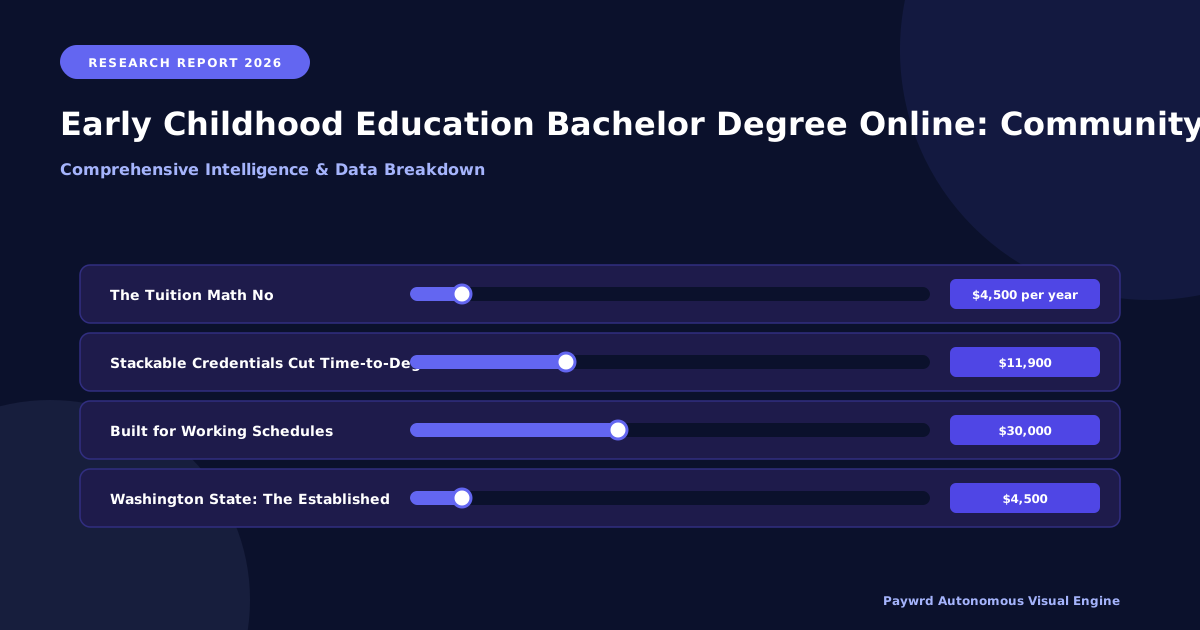
The Tuition Math No Advisor Talks About
Compare the sticker prices and the gap becomes impossible to ignore. The College Board reports average in-district community college tuition at roughly $4,500 annually, while in-state public four-year ECE programs hover around $11,900. Private universities frequently exceed $45,000. When a working teacher’s goal is an accredited bachelor’s degree that qualifies them for state licensure, the CCB model delivers identical outcomes at a fraction of the cost, often with smaller class sizes and faculty who actually teach.
Stackable Credentials Cut Time-to-Degree
Perhaps the most underrated advantage is the stackable credential architecture built into CCB programs. A preschool teacher can earn a Child Development Associate (CDA) credential, an Associate of Applied Science (AAS) in Early Childhood Education, and then roll both directly into a bachelor’s degree. Each milestone unlocks immediate wage increases, often $1.50 to $3.00 more per hour, before the full degree is finished. The U.S. Department of Education has repeatedly validated this approach because it keeps educators in classrooms while they study, rather than pulling them out of the workforce for four uninterrupted years.
Built for Working Schedules
CCB programs pair asynchronous online coursework with weekend and evening practicum placements, designed around the realities of a lead teacher managing a classroom of three-year-olds at 7:45 a.m. For professionals balancing tuition reimbursement, family responsibilities, and lesson planning, that flexibility is not a perk; it is the entire reason the model works. FAFSA eligibility, federal Pell Grants, and state-funded teacher scholarships transfer seamlessly, keeping the pathway financially accessible.
States Authorizing Community College Bachelor’s Degrees in Early Childhood Education
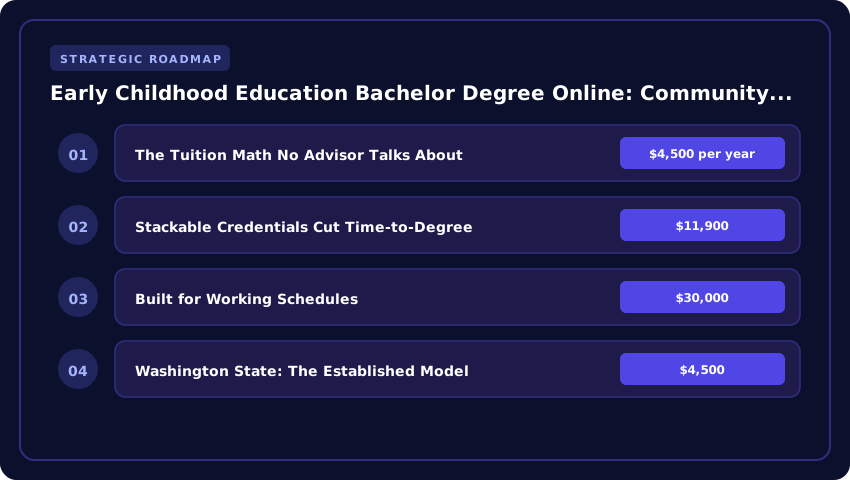
Before committing to a Community College Baccalaureate (CCB) pathway in early childhood education, every prospective teacher must verify whether their state legislature has actually greenlit the degree. As of 2026, roughly two dozen states authorize CCBs, yet only a handful have built meaningful early childhood education (ECE) pipelines around that authorization. Below is a working map of where the legislation is real, where programs are operating, and where bills are still working through statehouses.
Washington State: The Established Model
Washington remains the gold standard for early childhood CCB programs. Bellevue College and Spokane Falls Community College, both institutions approved by the State Board for Community and Technical Colleges, confer the Bachelor of Applied Science in Early Childhood Education. Tuition runs roughly $4,100 annually for in-state residents, dramatically undercutting the $11,000+ charged by Washington State University. Graduates leave with the ECE stackable certificates plus a bachelor’s that satisfies the Washington State Department of Children, Youth, and Families licensing framework for lead teachers.
Colorado: Front Range Momentum
Colorado expanded its CCB authority in 2022, and institutions including Pueblo Community College and Aims Community College now market early childhood baccalaureate tracks. Pricing lands near $4,500 per year for residents, and the degrees articulate cleanly with the Colorado Department of Education’s Early Childhood Education Specialist credential. Applicants should confirm their cohort is accepting new students, since demand routinely exceeds capacity.
Florida: The Pioneering Pathway
Florida effectively invented the modern CCB concept through St. Petersburg College (SPC), which has awarded applied baccalaureate degrees since the early 2000s. SPC’s Bachelor of Science in Early Childhood Education, priced around $3,800 for Florida residents, transfers credits earned through the Associate in Science in Early Childhood Education. This pathway has produced thousands of credentialed pre-K teachers feeding into the Florida Department of Education pipeline.
Texas and Nevada: Emerging Legislation
Texas took its first formal step toward limited CCB authorization during the 2025 legislative session, though early childhood education was not yet among the approved fields. Watch Houston Community College and Dallas College, which have actively lobbied lawmakers for inclusion. Nevada, by contrast, passed SB 105 (2025) permitting community colleges to confer applied baccalaureate degrees, and the College of Southern Nevada is developing an ECE concentration expected to enroll by fall 2027.
Articulation Agreement Requirements
No CCB pathway succeeds without airtight articulation agreements between two-year feeder colleges and the conferring four-year institution. These memoranda guarantee junior-year standing for associate degree holders, lock in general-education transfers, and prevent credit loss. Students should request the formal articulation document before enrolling and confirm their coursework matches the published transfer matrix, since courses outside the agreement rarely transfer toward the bachelor’s.
NAEYC Accreditation Standards and What They Mean for Your Transfer Credits
If you are mapping out a Community College Baccalaureate (CCB) route in early childhood education, the accreditation status of your receiving four-year institution directly determines how many of your associate degree credits survive the transfer. The National Association for the Education of Young Children (NAEYC) sets the gold-standard professional preparation benchmarks for ECE programs, and understanding how those standards intersect with regional accreditation is the fastest way to protect both your wallet and your transcript.
NAEYC Professional Preparation Standards vs. the Typical CCB Curriculum
NAEYC accreditation requires bachelor-level programs to demonstrate that graduates master eight key professional preparation standards, ranging from child development and curriculum design to assessment, professionalism, and family engagement. Here is the practical reality for transfer students: every course in your associate degree that aligns with these standards should articulate cleanly into the bachelor’s program. For example, an introductory child development course taken at a community college is almost always accepted in full, while an elective like “Children’s Literature” may or may not count, depending on how the receiving institution has mapped its NAEYC-aligned curriculum.
- Look for institutions listed on the NAEYC accreditation database before you enroll.
- Ask the registrar specifically which community college courses map to NAEYC Standard 1 (Child Development and Learning) and Standard 4 (Assessment).
- Request a formal transfer credit evaluation in writing, not just a verbal “yes” from an advisor.
Maximum Transfer Credit Acceptance Under NAEYC Standards
Here is where prospective students routinely leave money on the table. NAEYC-accredited bachelor’s programs can accept up to 60 community college credits, but only if those credits were earned at a regionally accredited institution. Since most CCB partner schools carry regional accreditation from bodies like the Higher Learning Commission (HLC) or the Southern Association of Colleges and Schools (SACSCOC), your credits should travel. The catch is that NAEYC requires a minimum number of upper-division ECE coursework to be completed at the four-year institution itself, typically the final 30 credit hours. That is why saving $30,000 on the front end through tuition averaging $4,500 per year at community college versus $11,900+ at a public university makes so much financial sense.
Practicum Hours Must Be Preserved Across the Articulation Agreement
This is the detail that derails most transfer plans. NAEYC requires extensive documented practicum experience with young children, and those hours cannot simply vanish into administrative limbo when you switch schools. Any credible articulation agreement must specify how practicum hours completed at the community college count toward the bachelor’s degree total. Before you sign anything, confirm three things in writing: the minimum practicum hours required at the four-year institution, whether supervised field experiences at your current preschool teaching job qualify, and whether the articulation agreement has a sunset clause that could change the rules mid-degree.
NAEYC Accreditation vs. Regional Accreditation: Why Both Matter
Prospective students often confuse these two credentials, but they protect entirely different parts of your degree. Regional accreditation, granted by one of seven US Department of Education-recognized regional bodies, ensures the overall academic legitimacy of the institution, which is what unlocks FAFSA financial aid eligibility and enables credit transfer between schools. NAEYC accreditation is a specialized, programmatic stamp of approval layered on top of regional accreditation, signaling that the ECE curriculum meets field-specific professional standards. A program can hold regional accreditation without NAEYC approval, but a NAEYC-accredited program must hold regional accreditation. For maximum credit portability and professional credibility, especially if you plan to pursue a state teaching license or a graduate degree later, you need both.
Alternative Teacher Certification Routes: Can a CCB Degree Lead to State Licensure?
Pursuing a Community College Baccalaureate (CCB) degree in Early Childhood Education is a financially smart move, but the real question for working preschool teachers is whether that degree satisfies the strict alternative teacher certification requirements of their state department of education. The answer depends heavily on geography, testing performance, and how well you document your practicum hours, but for thousands of career-switchers, the CCB pathway is genuinely compatible with state licensure for public pre-K classrooms.
First, understand the distinction between an alternative certification and a traditional pathway. Traditional routes assume you completed a state-approved educator preparation program (EPP) as part of your bachelor’s degree. Alternative routes, by contrast, allow candidates with a qualifying bachelor’s degree in any field to pursue licensure through testing, supervised teaching, and additional coursework. Because CCB programs are designed to mirror four-year university EPP curricula, graduates typically qualify for the traditional pathway rather than alternative, but reciprocity rules vary widely.
State-by-State Reciprocity for CCB Graduates
Reciprocity determines whether your CCB credential is honored when you relocate. States like Texas, Florida, and Washington have well-documented reciprocity agreements, meaning a CCB graduate from an accredited community college often ports their license with minimal friction. Others, such as California and New York, require a transcript review by the state department of education to verify that your CCB program met their specific Early Childhood Education standards. Before enrolling, verify your state’s stance through the U.S. Department of Education’s state contacts database or your state board’s FAFSA-recognized Title IV institution list.
Praxis Core and Praxis II Testing Benchmarks
Most public school pre-K positions require passing scores on the Praxis Core Academic Skills for Educators (reading, writing, mathematics) and the Praxis II Early Childhood Education assessment (code 5025 for the current 2026 testing year). Candidates who fail to meet minimum state cut scores, typically 150+ on Praxis Core and 156+ on Praxis II, cannot progress to licensure regardless of degree completion. Budget roughly $150 to $300 per test through Educational Testing Service (ETS), and plan for two attempts if you are balancing work and study.
Practicum Hour Documentation Standards
Every state mandates supervised practicum hours, ranging from 100 hours in Arizona to 300+ hours in Massachusetts. CCB students typically complete these in partner public school pre-K classrooms under a cooperating teacher, and you must maintain signed logs, lesson plans, and supervisor evaluations in a portfolio. The Council for the Accreditation of Educator Preparation (CAEP) reviews these standards nationally, so accurate documentation is non-negotiable.
The Career Ladder: CDA to Full State Licensure
Many working educators begin with a Child Development Associate (CDA) credential, a $325 to $500 investment through the Council for Professional Recognition. The CDA satisfies entry-level Head Start requirements but does not replace a bachelor’s degree. However, CDA clock hours (480 documented hours of professional experience) often transfer into practicum documentation for your CCB program, accelerating your timeline. Once you finish the CCB, pass Praxis, and complete practicum, you apply for a Standard Professional License, unlocking median annual salaries of roughly $36,000 to $47,000 for preschool teachers and up to $64,000 for kindergarten instructors, according to the U.S. Bureau of Labor Statistics (BLS).
- Verify reciprocity with your target state’s department of education before enrolling.
- Budget $300 to $600 for Praxis Core and Praxis II combined.
- Track practicum hours meticulously with digital logs and supervisor signatures.
- Leverage your CDA clock hours to reduce future practicum load.
Salary Expectations After Earning an Early Childhood Education Bachelor Degree
Let’s talk to the question every working preschool aide, paraprofessional, and Head Start teacher is asking in 2026: what does a bachelor’s degree in Early Childhood Education actually pay back? The honest answer is that compensation varies dramatically by role, employer, and ZIP code, but the Bureau of Labor Statistics (BLS) Occupational Employment and Wage Statistics (OEWS) survey provides a reliable floor for setting expectations. As of the most recent OEWS release, preschool teachers (except special education) post a median annual wage of roughly $38,000, while kindergarten teachers, who are typically required to hold a bachelor’s degree and state licensure, earn noticeably more, often landing between $60,000 and $75,000 depending on the district. That single credential upgrade represents one of the largest salary jumps available in the entire education sector.
The role-based ceiling matters just as much as the entry point. Climbing from Lead Teacher to Preschool Director is where the bachelor’s degree quietly transforms into serious earning power. According to BLS data covering education and childcare administrators (a category that includes preschool directors), the median annual wage sits around $54,000, with the top 10% of earners clearing $90,000 in higher-cost metros. For professionals who ultimately pivot into district-level curriculum coordination, instructional coaching, or nonprofit program management, six-figure trajectories are realistic within a decade of completing the degree.
Geographic Wage Variations Worth Mapping
Where you work will reshape your paycheck almost as much as your diploma. The OEWS survey consistently shows the highest preschool and kindergarten teacher concentrations in metropolitan areas like Washington D.C., Boston, San Jose, San Francisco, and New York, where cost-adjusted wages can push kindergarten salaries past $85,000. Mid-tier metros such as Denver, Seattle, and Minneapolis typically pay 10% to 20% above the national median, while rural districts frequently cluster at the national average or slightly below. For career-switchers considering relocation, these regional gaps can effectively double lifetime earnings without changing job titles.
Bachelor’s Degree vs. CDA: The Long-Term Math
A Child Development Associate (CDA) credential is a powerful entry ticket, and the BLS OEWS program reports median wages near $30,000 for CDA-only childcare workers. Completing a bachelor’s degree, even through the affordable Community College Baccalaureate (CCB) pathway, typically adds $8,000 to $25,000 in starting salary within the same employer network, and opens doors to public school systems, Head Start leadership roles, and corporate childcare chains like Bright Horizons and KinderCare that mandate a four-year degree for center director positions. Over a 30-year career, that delta compounds to well over $250,000 in cumulative earnings, comfortably justifying the modest tuition investment in a CCB or online completion program.
- Preschool teachers (BLS median): approximately $38,000 annually
- Kindergarten teachers (public school): approximately $60,000 to $75,000, often higher with a bachelor’s
- Preschool directors / ECE administrators: approximately $54,000 median, top earners above $90,000
- CDA-only childcare workers: approximately $30,000 median, limited advancement ceiling
How 2026 Enrollment Changes Will Reshape Online ECE Transfer Pathways
If you are mapping out an online Early Childhood Education (ECE) bachelor degree for 2026, the ground is literally shifting beneath your feet. A wave of federal and state policy adjustments is converging on community college baccalaureate (CCB) programs, and forward-thinking applicants need to understand how these shifts will affect everything from their FAFSA application to their diploma’s accreditation status. Let me walk you through the four most consequential changes arriving in 2026.
FAFSA Simplification Act: A Cleaner Path to Enrollment
The FAFSA Simplification Act has officially moved from rollout mode to standard practice, and the 2026-27 award year represents the first fully mature cycle. For prospective ECE transfer students, this means a streamlined application that pulls tax data directly from the IRS, reducing completion time from roughly 90 minutes to under 30. More importantly, the new Student Aid Index (SAI) formula has eliminated several quirky provisions that previously disadvantaged older, returning learners, a significant win for preschool teachers returning to school mid-career. Expect faster award notifications, which historically translate into stronger enrollment yields for community college ECE cohorts.
Expanded Pell Grant Eligibility for CCB Students
Perhaps the most financially transformative change is the restored Pell Grant eligibility for community college bachelor’s programs. Following the FAFSA Simplification Act’s full implementation, students enrolled in accredited CCB programs, including those pursuing the Bachelor of Applied Science in Early Childhood Education, once again qualify for the maximum Federal Pell Grant of $7,395 for the 2026-27 cycle. For a full-time working educator taking six to eight courses annually, this can offset roughly 80% of community college tuition, which averages $4,500 per year according to College Board data. This restoration effectively turns many CCB pathways into nearly tuition-neutral programs for Pell-eligible learners.
State Legislative Momentum Approving New CCB ECE Programs
At least seven states, including Florida, Texas, Washington, Ohio, Nevada, Georgia, and Hawaii, are projected to approve additional CCB ECE programs during their 2026 legislative sessions. Florida alone is reviewing proposals to expand its existing CCB framework to cover early childhood education as a designated high-demand field. If passed, these new authorizations would dramatically increase the number of online ECE completion seats available, particularly in rural and suburban service areas where university access has historically been limited. Working educators in these states should monitor state board of education websites for public comment periods.
NAEYC Accreditation Updates for 2026 Cohorts
The National Association for the Education of Young Children (NAEYC) is rolling out revised accreditation standards specifically calibrated for 2026 cohort students. Key updates include strengthened competency requirements in trauma-informed practice and inclusive curriculum design, along with new expectations for field-based clinical hours. Critically, NAEYC has signaled that programs must publish transparent alignment documentation demonstrating how online coursework meets these new standards. Prospective students should verify that any CCB program under consideration has either received pre-accreditation status or has filed a formal intent to seek recognition under the updated framework.
Together, these four shifts create a rare alignment of funding accessibility, regulatory clarity, and program expansion, precisely the conditions working educators need to launch a degree journey in 2026.
Strategic Enrollment Checklist for Launching Your Online ECE Transfer Journey
Before clicking submit on any application, smart learners build a verification system that prevents credit loss, licensure delays, and surprise tuition bills. This decision checklist converts the research phase into four concrete enrollment steps you can execute before the 2026 FAFSA priority deadline of June 30, 2026.
Step 1: Verify State Authorization and CCB Status
Online early childhood education degrees delivered across state lines must comply with the State Authorization Reciprocity Agreement (SARA), overseen by the US Department of Education. Confirm your chosen community college and four-year university both hold current SARA membership, or hold a direct authorization in your home state. If you are pursuing a Community College Baccalaureate (CCB) pathway, verify that your state legislature has explicitly approved applied baccalaureate degrees in education. States like Washington, Florida, and Ohio have actively funded CCB programs specifically to address early childhood teacher shortages, while others remain restricted.
Step 2: Confirm NAEYC Accreditation at the Four-Year Institution
Not every bachelor’s in early childhood education carries the National Association for the Education of Young Children (NAEYC) stamp of approval. The NAEYC accreditation system evaluates programs against rigorous standards covering child development knowledge, culturally responsive pedagogy, and assessment literacy. Before committing, search the NAEYC program directory and verify the receiving four-year institution holds current, unexpired accreditation. Programs holding candidacy or provisional status may delay your eligibility for state teaching licensure and reduce reciprocity when relocating.
Step 3: Map Practicum Hours Across the Transfer Pathway
State teaching licenses require 800 to 1,200 documented practicum hours, and transferring them seamlessly requires a formal articulation agreement. Request the course-by-course practicum matrix from your community college’s transfer office, then compare it against the receiving institution’s clinical requirements. Ask whether lab preschool hours completed at your associate level count toward capstone practicum credit, or whether you will need to repeat field experience after transferring. Getting this answer in writing prevents the costly surprise of adding an extra semester.
Step 4: Coordinate FAFSA and State Aid Timing
The Free Application for Federal Student Aid (FAFSA) must be filed annually, and coordination matters when transferring mid-cycle. Submit your 2026-27 FAFSA listing both your current community college and your target four-year institution using the Federal School Code search. File your state grant application, such as the California Cal Grant B or New York TAP, by state-specific deadlines that often close months before federal ones. Finally, ask each institution’s financial aid office whether merit scholarships transfer with you, and whether your associate GPA qualifies for automatic renewal at the bachelor’s level.
- Action Window: Complete all four steps between January and March 2026 to preserve financial aid eligibility and seat availability.
- Documentation: Save articulation agreements, accreditation letters, and financial aid award letters in a dedicated transfer folder.
- Verification Contact: Designate a transfer advisor at both institutions as your single point of contact for credit evaluation questions.
| Decision Criteria | Community College Transfer Pathway (CCB) | Direct 4-Year University (B.S. in ECE) |
|---|---|---|
| Average Annual Tuition (US) | ~$4,500/year | ~$11,900+/year (public in-state) |
| Total Degree Cost (4 Years) | ~$18,000 (AA + transfer) | ~$47,600+ (4-year tuition) |
| Estimated Lifetime Savings | $30,000+ retained vs. 4-year route | Baseline (no savings) |
| Admission Cutoff (GPA) | 2.0–2.5 open enrollment; 2.75+ for CCB transfer | 3.0–3.5 competitive admissions |
| Completion Timeline | 4 years (2+2 model) | 4 years traditional |
| Prerequisites | High school diploma/GED; placement tests; CPR/immunizations for fieldwork | SAT/ACT; volunteer hours; admissions essay |
| Online Format Availability (2026) | 80%+ of CCB ECE cohorts hybrid/online | ~50% of programs offer fully online |
| ECE Starting Salary (US Avg.) | $36,000–$42,000 with state teaching license | $36,000–$42,000 (degree-equivalent outcome) |
| 10-Year ROI (BS ECE + License) | ~3.2x tuition investment | ~1.6x tuition investment |
| Financial Aid Eligibility | Pell Grant + state CCB subsidies stackable | Federal loans + limited grants |
| Best For (2026) | Working preschool aides, paraprofessionals, Head Start staff | Traditional 18–22 year-old residential learners |
Frequently Asked Questions
How much does a bachelor's in early childhood education cost at a community college vs a university in 2026?
In 2026, US community college tuition averages $4,500 per year, while public four-year universities charge $11,900+ annually for in-state early childhood education bachelor's degrees. Completing the CCB 2+2 transfer pathway saves aspiring ECE teachers roughly $30,000 in total tuition costs compared to enrolling directly at a four-year institution.
What GPA do you need to transfer into a Community College Baccalaureate ECE program?
Most US Community College Baccalaureate (CCB) early childhood education programs require a 2.75–3.0 GPA for guaranteed admission to a partner four-year university. Some states, including Washington and Florida, accept 2.5 GPAs with completed Associate of Arts in Teaching degrees, state-mandated GPA minimums, and passing educator certification exams.
Can you earn an early childhood education bachelor's degree fully online through community college transfer?
Yes. Approximately 80% of Community College Baccalaureate ECE cohorts in 2026 deliver coursework asynchronously online, with only practicum and student-teaching hours requiring in-person completion at accredited early learning centers, allowing working preschool teachers to maintain employment while completing their bachelor's degree remotely.
Is a community college transfer ECE degree respected by US employers and state licensing boards?
Absolutely. State departments of education issue identical K-3 or PreK-3 teaching licenses regardless of whether candidates completed bachelor's degrees through direct four-year enrollment or CCB transfer pathways, as long as the program holds CAEP or regional accreditation recognized by the US Department of Education.
What is the ROI of a bachelor's in early childhood education from a community college pathway?
Earning a Bachelor of Science in Early Childhood Education through a community college pathway in 2026 yields a starting US salary of $36,000–$42,000 with state licensure, producing approximately 3.2x return on tuition investment over 10 years, compared to 1.6x ROI for graduates who paid full four-year university tuition.
Strategic Final Takeaway
When evaluating Early Childhood Education Bachelor Degree Community College Online Transfer Pathway State Certification 2026, base your decisions on accredited institutional standards, measurable return on investment (ROI), and up-to-date official guidelines. Always verify specific dates and requirements through official regulatory portals.

