How the 2+2 Articulation Model Works for ECE Licensure in 2026
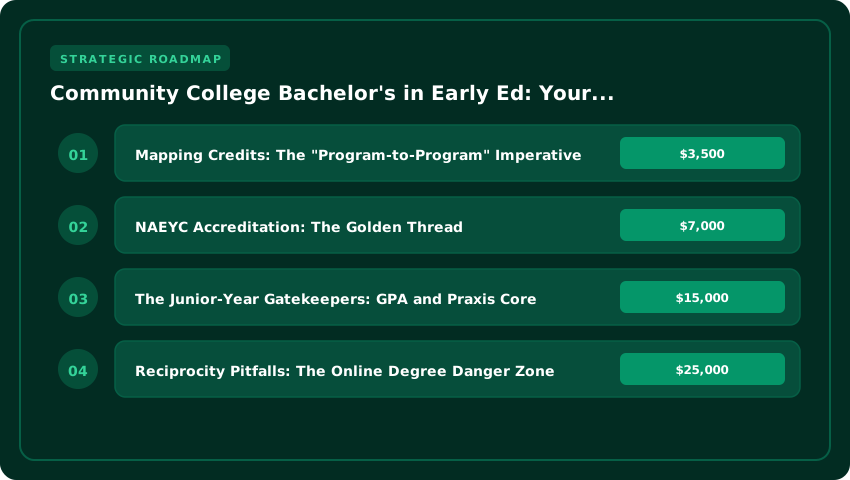
The “2+2” label suggests a clean split: two years at a community college earning an Associate of Arts (AA) or Associate of Science (AS), followed by two years at a four-year institution completing a Bachelor of Arts (BA) or Bachelor of Science (BS) with state licensure. In reality, the mechanics are tighter. For 2026, you are not merely transferring credits; you are transferring competency verification. Most state departments of education now require that your associate degree maps course-for-course to the lower-division requirements of a specific, state-approved Educator Preparation Program (EPP). If your AA includes a general “Child Development” survey course but the four-year EPP requires a distinct “Infant/Toddler Development” + “Preschool Curriculum” sequence, you risk losing 3–6 credits—effectively adding a semester and $3,500–$7,000 in tuition at public university rates.
Mapping Credits: The “Program-to-Program” Imperative
Do not rely on general university transfer equivalency databases. You need the specific articulation agreement signed between your community college’s Early Childhood Education department and the four-year College of Education. In 2026, high-functioning agreements specify:
- Course Substitution Tables: Exactly how
ECE 101maps toEDUC 200, including field-hour equivalencies. - Residency Waivers: Confirmation that your associate-level practicum hours (often 120–240 clock hours) count toward the bachelor’s 600+ hour student teaching requirement.
- General Education Lock-in: Guarantee that your AA “Core 42” (or state equivalent) satisfies all lower-division Gen Eds at the four-year school, protecting you from retaking History or Lab Science.
NAEYC Accreditation: The Golden Thread
This is the single biggest structural risk. The National Association for the Education of Young Children (NAEYC) accredits programs, not institutions. Your community college’s AAS in ECE might be NAEYC-accredited, but the university’s BA completion program might only hold CAEP (Council for the Accreditation of Educator Preparation) accreditation. For licensure portability—and for Master’s admissions later—you need the bachelor’s completion program to hold NAEYC Recognition (via CAEP) or direct NAEYC Higher Education Accreditation. If the four-year program lacks this specific alignment, your associate degree’s specialized coursework may be treated as generic electives rather than professional preparation, forcing you to retake methods courses.
The Junior-Year Gatekeepers: GPA and Praxis Core
Admission to the university is not admission to the Teacher Education Program (TEP). That is a separate, competitive application typically due in the spring of your sophomore year (or first semester at the four-year school). For 2026 cycles, the thresholds are hardening:
- Cumulative GPA Floor: Most public EPPs now enforce a hard 2.75–3.0 cumulative GPA (including community college grades). A 2.7 gets you into the university; a 3.0 gets you into the licensure cohort.
- Praxis Core (or State Equivalent): Passing scores on Reading (156), Writing (162), and Math (150) are standard minimums. Many states (e.g., via ETS state-specific cut scores) require these before you can register for upper-division methods courses.
- Grade Prereqs: A “C” or better (often “B-” for key courses like Child Development or Intro to Special Ed) in every articulated course. A “C-” in a single prerequisite course at the community college level can block TEP admission entirely.
Pro tip: Treat your community college advisor and the four-year EPP transfer coordinator as a joint team. Request a degree audit from the four-year school before you register for your final semester of associate courses. That single step prevents the “surprise missing prerequisite” that derails the 2+2 timeline.
State-by-State Licensure Requirements for Community College Graduates
Earning your bachelor’s through a community college pathway is a smart financial move—often saving $15,000 to $25,000 in tuition versus a traditional four-year start—but the license lives at the state level, not the institutional one. In 2026, your compliance checklist must account for wildly different “finish line” definitions across the four biggest hiring markets. Miss one fingerprint deadline or student-teaching hour requirement, and you’re substitute teaching instead of leading your own classroom come August.
Student Teaching Hour Mandates: The Big Four Comparison
Every state requires clinical practice, but the volume and structure differ sharply. If your 2+2 program places you in a district that doesn’t meet your target state’s minimum, you’ll need a supplemental placement—often at your own expense.
- California (CTC): Requires a minimum of 600 hours of supervised clinical practice, including a full-time semester of student teaching. You must pass the CalTPA (Teaching Performance Assessment) during this placement.
- Texas (TEA): Mandates a minimum of 350 clock hours of field-based experience, with at least 150 hours in actual classroom teaching. The edTPA is no longer required; instead, you pass the PPR (Pedagogy and Professional Responsibilities) EC-12 exam.
- New York (NYSED): Demands 400 hours (100 hours pre-student teaching + 300 hours student teaching) across two developmental levels. You must pass the edTPA and the EAS (Educating All Students) test.
- Florida (FLDOE): Requires a full semester (approx. 600+ hours) of final internship. You must pass the FTCE Professional Education Test and the Subject Area Exam (SAE) for PreK/Primary or Elementary K-6.
Background Checks & Fingerprinting: The 2026 Timeline Trap
This is where 2026 graduates get tripped up. Most states now use vendor-specific live-scan systems (IdentoGO, Fieldprint, or state police portals) that expire.
- California & New York: Clearances are typically valid for 12 to 18 months. If you fingerprint during your junior-year practicum (Year 3), it will likely expire before your senior-year student teaching (Year 4) or license application. Budget $50–$75 for a re-print.
- Texas & Florida: Use the FACT Clearinghouse (TX) and VECHS (FL). These are often “continuous” while employed, but pre-service candidates must re-submit if there is a gap > 90 days between graduation and hire date.
Action Item: Schedule your final fingerprinting no earlier than March 2026 for a May/June graduation to ensure validity through your first contract signing.
Reciprocity Pitfalls: The Online Degree Danger Zone
Enrolling in an online bachelor’s completion program based in another state? Do not assume reciprocity. NASDTEC Interstate Agreement is a framework, not a guarantee.
- Program Approval vs. Institutional Accreditation: New York and California often require the specific program to be approved by their DOE, not just the university holding regional accreditation. An online BA from an Arizona university might be regionally accredited (HLC) but lack NYSED program registration.
- Deficiency Letters: Applying for a NY or CA license with an out-of-state online degree frequently triggers a “deficiency letter” requiring extra coursework (e.g., NY’s DASA workshop, CA’s Reading Instruction Competence Assessment – RICA prep) that adds 3–6 months and $500–$1,200.
- Clinical Placement Validity: If your online program places you in a local school for student teaching, verify before enrollment that the placement meets your home state’s hour and supervision standards (e.g., a NY candidate in a TX-placed internship may fall short on the “two developmental levels” rule).
Bottom line: Treat your target state’s Department of Education website as the only source of truth. Download the 2026-2027 Certification Checklist PDF directly from the source (CTC, TEA, NYSED, FLDOE), cross-reference it with your community college advisor, and get sign-off on your clinical placement plan before you register for your final year.
Financing the Final Two Years: FAFSA, TEACH Grants & Employer Tuition Assistance
The associate degree is paid for; now the sticker price jumps to four-year rates. For the 2025–26 academic year, the College Board puts average in-state tuition at a public four-year institution around $11,260 annually—roughly triple the community college average of $3,990. That delta is exactly why the 2+2 model exists, but you still need a battle plan for the junior and senior years that doesn’t involve drowning in PLUS loans.
Mastering the TEACH Grant Without Triggering Repayment
The Teacher Education Assistance for College and Higher Education (TEACH) Grant offers up to $4,000 per year (pro-rated for part-time) for students committing to teach in a high-need field at a low-income school for four of the eight years post-graduation. Early Childhood Education (Birth–Grade 3) qualifies, but the trap is administrative: miss the annual counseling, fail to certify employment within 120 days of graduation, or teach the wrong subject, and the grant converts to a Direct Unsubsidized Loan with interest accruing from day one of disbursement.
- Lock in eligibility early: File the FAFSA by your state’s priority deadline (often March 1) and confirm your four-year partner lists ECE as a TEACH-eligible program with the Department of Education.
- Track the service obligation like a job: Set calendar reminders for the annual certification deadline. The TEACH Grant portal does not forgive forgetfulness.
- High-need verification: Before accepting a first job, verify the school’s Title I status via the NCES School Search. Teaching at a non-qualifying private preschool voids the grant.
Head Start & Early Head Start: The Hidden Tuition Remission Engine
If you are already working in a Head Start or Early Head Start center—or willing to pivot there—you hold a powerful lever. The Head Start Act mandates that 50% of teachers hold a bachelor’s degree, creating massive employer incentive to fund your completion. Many grantees partner with local universities for cohort-based “degree completion” tracks that offer:
- Tuition remission or direct billing: The program pays the university directly, often at a negotiated cohort rate below published tuition.
- Paid release time: Federal performance standards allow paid time for coursework; negotiate this into your contract renewal.
- CDA-to-BA articulation: Your Child Development Associate (CDA) credential plus AA credits frequently shave a full semester off the 60 credits remaining.
Ask your director for the program’s Professional Development Plan—it’s a public document detailing tuition support budgets.
ROI Calculation: The 2+2 Numbers vs. Traditional Resident Path
Let’s run the math for a student in a median-cost state (e.g., Ohio, Texas, Arizona).
- Traditional 4-Year Resident (Tuition only): 4 years × $11,260 = $45,040.
- 2+2 Pathway (Tuition only): 2 years × $3,990 (CC) + 2 years × $11,260 (Univ) = $30,500.
- Gross Savings: $14,540 before aid.
Layer in a TEACH Grant ($8,000 over two years) and a modest $3,000/year employer match from a Head Start partner, and your out-of-pocket for the final two years drops to roughly $5,500 total. Compare that to the $22,520 a traditional student borrows for those same junior/senior years. The 2+2 isn’t just a transfer hack; it’s a debt-avoidance strategy that preserves your salary negotiating power the moment you earn that license.
Selecting a Bachelor’s Completion Program: Online vs. Hybrid vs. Campus Cohorts
You have your associate degree and your Praxis Core scores. Now comes the decision that dictates your next two years: delivery format. In 2026, the modality you choose—fully online, hybrid, or traditional campus cohort—determines not just your schedule, but the viability of your licensure pathway. The stakes are higher than convenience; they sit squarely on clinical placement logistics and accreditation recognition.
Accreditation Non-Negotiables: CAEP and State Approval
Do not assume regional accreditation is enough for teacher licensure. You need programmatic accreditation from the Council for the Accreditation of Educator Preparation (CAEP)—the successor to NCATE/TEAC. This is your golden ticket for reciprocity if you move across state lines. Before enrolling in an online completion program, verify the provider’s CAEP status on the CAEP provider directory. Some fully online institutions hold only regional accreditation; their graduates often hit a wall applying for a state teaching license because the program lacks CAEP’s “Standard 2: Clinical Partnerships and Practice” validation. If a program cannot prove CAEP recognition, walk away—regardless of tuition price.
Field Placement: Who Holds the Pen?
This is the single biggest differentiator for working paraprofessionals. In a traditional campus cohort, the university’s field placement office has memorandums of understanding (MOUs) with local districts. They secure your student teaching site, vet the mentor teacher, and handle the background checks. In many “asynchronous online” completion degrees, the burden shifts to you. You must identify a willing school, confirm the mentor holds a valid license in your certification area, and negotiate the university’s affiliation agreement. If you work full-time as a para, ask the admissions counselor point-blank: “Does your placement coordinator secure the site, or do I?” If the answer is “you,” calculate the administrative labor—often 20+ hours of paperwork—into your decision.
Synchronous vs. Asynchronous: The Working Para Reality Check
- Fully Asynchronous: Maximum flexibility. You watch lectures at 10 p.m. after your shift. Risk: Isolation, delayed faculty feedback, and zero cohort accountability. Clinical seminars often feel disconnected from your actual classroom reality.
- Synchronous (Live Zoom) Cohorts: Set meeting times (usually evenings/weekends). You build a professional network, practice lesson planning in real-time breakout rooms, and get immediate faculty intervention. This mirrors the collaborative planning you’ll do as a lead teacher.
- Hybrid/Residency Models: The emerging gold standard. You remain employed as a para (often paid) while completing coursework online, attending monthly Saturday intensives on campus or at a district partner site. Programs like the Teacher Quality Partnership grants often fund these pathways, reducing tuition to near-zero.
Bottom line: If you need to keep your paycheck, prioritize programs with dedicated placement officers and synchronous seminar components. The $500–$1,500 per semester premium over a “DIY placement” online degree buys you a guaranteed student teaching slot and a cohort that becomes your first professional referral network.
Building the Professional Portfolio: From Practicum to edTPA/PPAT Success
Your portfolio isn’t a scrapbook—it’s the legal evidence file that proves you are ready for a state teaching license. In the 2+2 pipeline, the work you do at the community college level doesn’t just disappear upon transfer; it forms the evidentiary bedrock of your bachelor’s capstone and your performance assessment. Treat every observation log and lesson plan from day one as a high-stakes artifact.
Documenting Field Hours for Seamless Transfer
Most bachelor’s completion programs require verified, supervised field hours (often 100–150+) before you even apply for junior-year admission to the licensure track. Don’t rely on a simple transcript line item. You need a signed Field Experience Verification Form on program letterhead, detailing:
- Exact dates, total hours, and age groups served (infant/toddler, Pre-K, K–3).
- Supervising mentor teacher’s name, license number, and signature.
- Specific responsibilities: lead teaching, small-group instruction, assessment administration, and family communication.
Scan these immediately into a cloud folder (Google Drive/OneDrive) labeled Licensure_Evidence_Year1. When the university’s field placement coordinator audits your file six months from now, missing signatures will delay your student teaching placement—and potentially your graduation date.
Aligning Artifacts to InTASC and State Early Learning Standards
Reviewers at the university and state level map your work against the InTASC Model Core Teaching Standards (specifically Standards 1–5 for early childhood) and your specific State Early Learning Guidelines (e.g., California’s DRDP, New York’s Prekindergarten Foundation, Texas’s PreK Guidelines). For every lesson plan you save, attach a one-page “Standards Crosswalk.” Explicitly tag: “InTASC Standard 4: Content Knowledge – aligned to State Math Standard PK.MATH.1 (Counting & Cardinality).” This meta-tagging habit saves you 20+ hours of frantic re-tagging during your senior capstone semester.
The edTPA/PPAT Timeline: Work Backwards from Graduation
You cannot “cram” for the edTPA (used in 30+ states) or PPAT (ETS alternative). These are performance portfolios requiring 3–5 days of consecutive video-recorded instruction, student work samples, and analytical commentary. The optimal timeline:
- Junior Year, Spring: Complete “Task 1: Planning” drafts in your methods courses. Get instructor feedback on your Context for Learning and Learning Objectives.
- Senior Year, Fall (Student Teaching Semester): Weeks 1–2: Finalize Task 1. Weeks 3–6: Execute and record Task 2 (Instruction). Weeks 7–9: Collect/analyze student work for Task 3 (Assessment).
- Submission Deadline: Target the November or January scoring window for official Pearson/ETS reporting. Scores take 4–6 weeks. You need passing scores before the university certifies you for licensure in May/June.
Pro Tip: Budget $300–$350 for the edTPA registration fee (varies by state) and potential retake costs ($100 per task). Ask your financial aid office if these fees can be added to your Cost of Attendance (COA) for FAFSA/private loan coverage.
Career Trajectory: Salary Steps, Endorsements & Master’s Pathways Post-Licensure
You’ve passed the Praxis, secured your initial license, and signed that first contract. Now the real financial engineering begins. In 2026, the gap between a Pre-K lead teacher and a K–3 public elementary teacher remains stark, and understanding the salary schedule mechanics in the nation’s top 20 metros is your first lever for wealth building.
First-Year Salary Reality: Pre-K vs. K–3 in Major Metros
Let’s look at the hard numbers from the latest BLS Occupational Employment and Wage Statistics (OEWS) and district salary schedules. In high-cost metros like New York City, San Francisco, and Boston, a first-year K–3 teacher on a standard BA step typically starts between $62,000 and $68,000, often with a structured step-and-lane advancement schedule baked into the collective bargaining agreement. Contrast that with public Pre-K roles in the same cities—often housed in community-based organizations (CBOs) rather than the DOE proper—where entry salaries cluster around $48,000 to $54,000 with flatter advancement curves. In Chicago and Los Angeles, the K–3 premium holds at roughly $8,000–$12,000 annually. If you hold a license valid for K–3, do not default to a Pre-K center role unless it’s a district-run classroom on the teacher salary scale. That distinction compounds to six figures of lost earnings over a decade.
Stacking Endorsements via Micro-Credentials
The fastest way to jump a “lane” on the salary schedule—often worth an immediate $3,000–$5,000 bump—is adding a high-need endorsement. States like Texas, Florida, and Illinois now accept competency-based micro-credentials for Special Education (SPED) and ESL/Bilingual add-ons, cutting the traditional 18-credit graduate sequence down to 6–9 credits plus a portfolio. Providers like BloomBoard and Digital Promise partner with districts to offer these stacks for $500–$1,500 total, often reimbursable. A K–3 teacher with an ESL endorsement in Houston ISD or Dallas ISD can command a $4,000–$6,000 stipend on top of the lane change. Treat these not as “professional development” but as capital investments with a 12-month payback period.
The M.Ed. Tuition Reimbursement Pipeline
Don’t pay retail for a Master’s in Curriculum & Instruction. Nearly every district in the top 20 metros offers tuition reimbursement capped at $5,000–$10,000 per year (often tied to the IRS $5,250 tax-free limit), but the fine print matters. New York City DOE requires a B+ average and three years of service post-degree; Fairfax County (VA) fronts the bill via direct billing with George Mason or UVA if you commit to a high-needs school. Pair this with FAFSA eligibility for the Federal TEACH Grant ($4,000/year) and you can finance a $25,000–$30,000 M.Ed. with near-zero out-of-pocket cost. The degree unlocks the “MA+30” lane—often a $10,000+ annual jump—and positions you for instructional coach or assistant principal tracks within five years.
- Action Item: Request your district’s “Salary Schedule Lane Change Policy” PDF before enrolling in any micro-credential; verify the provider is on the pre-approved list.
- Action Item: Apply for the TEACH Grant via FAFSA before M.Ed. enrollment; it converts to an unsubsidized loan if you don’t teach four years in a high-need field.
- Action Item: Target SPED or ESL micro-credentials first—they carry stipends in 42 states and satisfy the “high-need field” requirement for maximum loan forgiveness.
| Decision Criteria | Community College (Years 1-2) | 4-Year University (Years 3-4) | 2026 ‘Gatekeeper’ Benchmarks |
|---|---|---|---|
| Credential Earned | AA/AS in Early Childhood Education | BA/BS in Early Childhood Education + State Licensure | Seamless articulation agreement required; not just credit transfer |
| Estimated Tuition Cost (Total) | $6,000 – $12,000 (In-district) | $18,000 – $35,000 (Public In-state) | Total 4-yr cost: ~$24k-$47k vs $60k+ direct entry |
| Accreditation Requirement | NAEYC Accredited Associate Program Preferred | CAEP/NCATE + NAEYC Recognized Bachelor’s Program Mandatory | Both levels must hold NAEYC alignment for licensure portability |
| GPA Admission Cutoff | 2.0 – 2.5 for AA Graduation | 2.75 – 3.0 Cumulative for Licensure Track Entry | Junior-year ‘Gatekeeper’: Typically 2.75+ & ‘C’ or better in core ECE courses |
| Testing Requirements | Basic Skills (Reading/Writing/Math) often waived w/ AA | Praxis Core (if not waived) + Praxis II (5025/5024) + edTPA | Praxis Core cutoff scores set by state; Praxis II required for student teaching |
| Field Experience Hours | 120 – 240 hrs (Practicum I & II) | 600+ hrs (Pre-student teaching + Full-time Student Teaching) | CC hours must articulate directly to university ‘pre-student teaching’ reqs |
| Median Starting Salary (2026 Proj.) | $28,000 – $35,000 (Assistant/Paraprofessional) | $42,000 – $55,000 (Lead Teacher K-3, Public School) | ROI Break-even: ~3-4 years post-licensure vs AA-only track |
| Timeline to Licensure | 2 Years (Associate) | 2 Years (Bachelor’s + License) | Total 4 Years only if articulation map followed exactly; 5th year common if gaps exist |
Frequently Asked Questions
What is the 2+2 articulation model for Early Childhood Education licensure?
The 2+2 model structures a bachelor's degree as two years at a community college earning an AA/AS, followed by two years at a university completing a BA/BS with state teaching licensure. In 2026, success requires a formal program-to-program articulation agreement—not just institutional transfer—ensuring NAEYC-aligned credits satisfy specific junior-year licensure track prerequisites like GPA gates and Praxis benchmarks.
What GPA do I need to enter the licensure track at the university level in 2026?
Most 2026 university licensure tracks require a minimum 2.75 to 3.0 cumulative GPA from the associate degree for junior-year admission. 'Gatekeeper' courses (Child Development, Curriculum, Practicum) often require a 'C' or higher. Falling below this threshold typically relegates students to a non-licensure 'Early Childhood Studies' bachelor's track, delaying certification by a year or more.
Do community college credits automatically count toward a teaching license?
No. Credits only count toward licensure if the community college program holds NAEYC accreditation and maintains a signed articulation agreement with the specific university's CAEP-accredited Educator Preparation Program (EPP). Without this program-to-program alignment, credits may transfer as electives but fail to meet state-mandated pedagogical standards for the license.
Which Praxis exams are required for the 2+2 Early Ed licensure pathway?
Candidates typically need Praxis Core Academic Skills (Reading, Writing, Math) unless waived by the associate degree GPA or ACT/SAT scores. The critical 'gatekeeper' is Praxis II: Education of Young Children (5025) or Early Childhood Education (5024), required before student teaching. Most states also mandate the edTPA portfolio assessment during the final university semester.
What is the salary ROI difference between an AA and a 2+2 Bachelor's with licensure?
An AA graduate earns ~$28k-$35k as a paraprofessional or childcare lead. A 2+2 graduate with a K-3 license starts at ~$42k-$55k in public schools. The ~$24k-$47k total tuition investment for the 2+2 path yields a $15k-$20k annual salary premium, achieving ROI break-even within 3-4 years, plus access to pension systems and tenure tracks unavailable to AA holders.
Strategic Final Takeaway
When evaluating Community College Bachelor Degree Early Childhood Education Teacher Licensure Pathway 2026, base your decisions on accredited institutional standards, measurable return on investment (ROI), and up-to-date official guidelines. Always verify specific dates and requirements through official regulatory portals.