

Why a Bachelor’s in Early Childhood Education from a US Community College Changes the 2026 Career Trajectory
For decades, the standard route to a teaching credential meant enrolling directly into a four-year university and taking on substantial student debt. However, the landscape of American educator preparation is shifting. Earning a Bachelor’s in Early Childhood Education (ECE) through a community college system is no longer a compromise; it is a strategic financial and career maneuver. According to the College Board, the average tuition gap between public community colleges and four-year state universities ranges from $8,000 to $12,000 per year. By utilizing FAFSA to cover these lower baseline costs, students can drastically reduce their reliance on high-interest student loans while still earning a highly marketable degree.
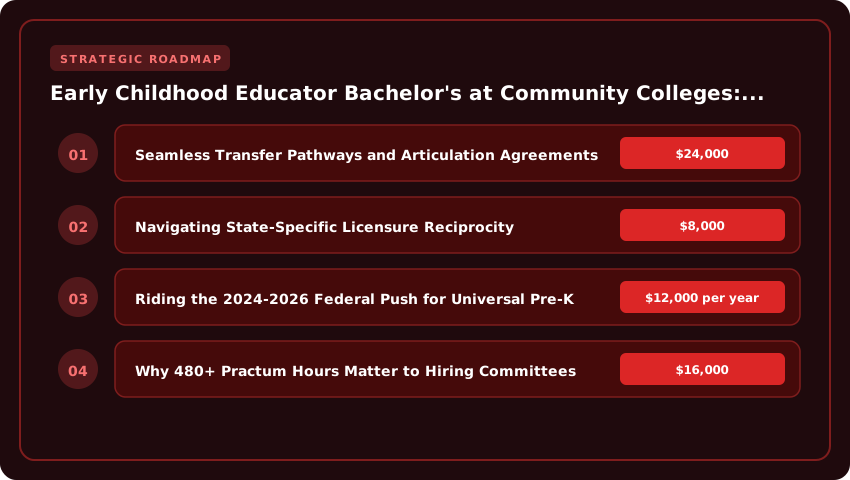
Seamless Transfer Pathways and Articulation Agreements
One of the most powerful structural advantages of starting at a community college is the network of articulation agreements. These formal partnerships between local community colleges and public state universities guarantee that your associate degree credits transfer seamlessly, ensuring you do not lose time or money retaking core classes. The US Department of Education heavily supports these transfer pipelines to combat the national teacher shortage. Many community colleges now offer direct bachelor’s completion programs, or “2+2” pathways, allowing students to earn a four-year university credential without ever leaving their local community college campus.
Navigating State-Specific Licensure Reciprocity
Securing your teaching license is the ultimate goal, and community college ECE bachelor’s programs are specifically designed to meet rigorous state standards. While reciprocity agreements vary by state, most community colleges align their curricula with state Department of Education requirements, ensuring graduates are immediately eligible for initial licensure. If you plan to move across state lines, it is crucial to verify reciprocity through resources like the NASDTEC (National Association of State Directors of Teacher Education and Certification) interstate agreement, which streamlines license recognition for qualified educators.
Riding the 2024-2026 Federal Push for Universal Pre-K
The timing for entering this field could not be better. The 2024-2026 federal push for universal pre-K has triggered a massive expansion in early learning infrastructure across the country. As states increase funding to expand access to early childhood programs, the demand for degreed educators is skyrocketing. The Bureau of Labor Statistics (BLS) projects steady growth for preschool teachers, but the real advantage goes to those holding a bachelor’s degree, who often qualify for higher pay scales and leadership roles within public school districts.
- Maximized ROI: Save $16,000 to $24,000 over two years compared to traditional university tuition.
- Guaranteed Credit Transfer: Articulation agreements prevent credit loss when moving to a state university.
- High Market Demand: Federal universal pre-K initiatives create a surge in hiring for degreed ECE professionals.
- Licensure Readiness: Programs are tightly aligned with state Department of Education certification standards.
Accreditation and Program Quality Markers US Employers Actually Look For
Choosing an early childhood education (ECE) bachelor’s program at a US community college is a financially smart move, but the degree is only as valuable as the credentials backing it. Before enrolling, working professionals need a clear framework to separate legitimate, employer-recognized programs from those that simply look affordable on a tuition sheet. School district HR departments, Head Start grantees, and state childcare licensing boards evaluate candidates through a very specific lens, and missing one of these markers can stall a career before it begins.
NAEYC Standards vs. Regional HLC or SACSCOC Institutional Accreditation
Two distinct layers of accreditation matter here, and confusing them is a common mistake. The first is institutional accreditation, typically granted by regional bodies like the Higher Learning Commission (HLC) or the Southern Association of Colleges and Schools Commission on Colleges (SACSCOC). This validates that the community college itself meets baseline academic quality and is eligible for Title IV federal aid via FAFSA. Without it, credits generally will not transfer, and employers will not recognize the degree.
The second layer is programmatic accreditation, specifically the National Association for the Education of Young Children (NAEYC) standards. NAEYC accreditation signals that the curriculum covers child development, curriculum design, observation, and assessment in ways that align with what districts actually expect in a PreK-3 classroom. Programs that hold both HLC or SACSCOC institutional accreditation and NAEYC alignment are the gold standard, and they tend to produce graduates who move through the state licensure process without transcript deficiencies.
Why 480+ Practum Hours Matter to Hiring Committees
Most state departments of education require a minimum of 480 supervised field experience hours before issuing an initial teaching license, and many community college bachelor’s programs now embed this practicum directly into upper-division coursework. Hiring managers at public school districts view this requirement as a proxy for classroom readiness. A candidate who has logged over 480 hours with a cooperating teacher in a real PreK setting is rarely rejected at the interview stage for “lack of experience.” This is one of the strongest practical quality markers a working professional can verify before signing an enrollment agreement.
CAEP Recognition and Hiring Bias in Public Schools
The Council for the Accreditation of Educator Preparation (CAEP) is the national accreditor that consolidates specialized recognition across teacher prep programs. When a community college ECE bachelor’s carries CAEP recognition, it signals alignment with nationally vetted standards covering everything from diversity training to assessment literacy. Public school districts, particularly larger urban systems, increasingly prefer or require CAEP-recognized transcripts during the credentialing process. This recognition reduces friction at hiring and protects licensure portability if a graduate later moves across state lines.
Stacking a CDA Credential Into the Bachelor’s Track
For professionals already working in childcare, stacking a Child Development Associate (CDA) credential offers a powerful shortcut. Many HLC-accredited community colleges award between 9 and 18 credit hours for an active CDA, letting students apply those credits directly toward the bachelor’s. This stackable model means a working early childhood assistant earning roughly $31,000 annually can move into a lead teacher role at $48,000 to $54,000 once the bachelor’s is complete, without losing wages during the transition.
- Verify both institutional (HLC, SACSCOC, etc.) and programmatic (NAEYC, CAEP) accreditation before enrolling.
- Confirm the program includes at least 480 supervised practicum hours to meet state licensure floors.
- Ask whether an existing CDA credential can transfer as credit, shortening time-to-degree and cutting out-of-pocket cost.
2026 Salary Outlook for Early Childhood Educators Holding a Bachelor’s Degree
If you are weighing the return on investment of a bachelor’s degree in early childhood education, the numbers heading into 2026 paint an encouraging picture. The Bureau of Labor Statistics projects roughly 5% job growth for preschool teachers through 2032, which outpaces the average for all US occupations. More importantly, that growth pairs with a meaningful wage premium for educators who hold a four-year degree rather than a Child Development Associate (CDA) credential alone.
Where the Median Wages Actually Land in 2024-2025
According to the most recent BLS Occupational Employment and Wage Statistics, preschool teachers across the United States earn a median annual salary of $47,310, translating to roughly $22.75 per hour. Kindergarten and elementary special education teachers, who are required to hold a bachelor’s degree in nearly every state, report a slightly higher median of $48,140. Head Start educators, who typically work in publicly funded programs, command a median around $51,000 because of federal salary guidelines tied to the Department of Health and Human Services. By contrast, corporate childcare chains like KinderCare and Bright Horizons often anchor their pay scales to local market rates, which means educators in those settings can see starting wages anywhere from $16 to $22 per hour depending on the metro area.
Public Versus Private Sector Pay Differentials
The pay gap between public and private employers remains one of the most important variables in your earnings model. Public school pre-K programs funded through state universal pre-K initiatives in states like California, New York, and Washington tend to follow K-12 teacher salary schedules, which means a bachelor’s-credentialed educator can realistically start in the $48,000 to $55,000 range with annual step increases. Head Start programs, while federally regulated, typically offer a slightly higher median ($51,000) because of mandated qualifications. Corporate childcare centers, meanwhile, compete on convenience and tuition revenue, but their wage scales usually trail public programs by 10% to 15% unless you move into a center director role.
State-by-State Salary Leaders to Watch
Geography will be one of the biggest drivers of your paycheck. BLS data consistently ranks the following states and districts at the top of the pay scale for early childhood educators:
- California: Mean annual wage of approximately $58,400, with the strongest demand in the San Francisco Bay Area, San Jose, and Los Angeles metros.
- Massachusetts: Mean annual wage around $56,200, fueled by Boston’s high cost of living and the state’s universal pre-K expansion.
- New York: Mean annual wage near $55,800, with the highest concentration of six-figure director roles in the New York City metropolitan area.
- Washington DC: The District tops the list with a mean annual wage approaching $65,000, reflecting both federal contracting dollars and a heavily unionized workforce.
The Degree Premium: Quantifying the Bump
Perhaps the most actionable insight is the dollar value attached to your credential. Industry compensation studies consistently show that early childhood educators with a bachelor’s degree earn $1.50 to $3.00 more per hour than colleagues holding only a CDA. Over a 40-hour workweek and 52 weeks of the year, that premium adds between $3,120 and $6,240 annually, effectively recouping the cost of community college tuition within the first year of full-time employment in most regions. For professionals already working in the field, this is a compelling argument for leveraging an articulation agreement to convert an associate degree into a fully accredited bachelor’s without pausing their career.
When you stack these factors together, the 2026 outlook supports a clear thesis: a bachelor’s degree earned through a community college pathway delivers measurable wage gains, access to public sector salary schedules, and positioning in states where universal pre-K funding is reshaping demand.
Job Prospects Beyond the Preschool Classroom: Alternative Career Paths for ECE Bachelor’s Holders
Earning a Bachelor of Science in Early Childhood Education (ECE) from a US community college does not lock you into a Pre-K classroom for the next forty years. In fact, some of the fastest-growing career opportunities for 2026 sit just outside the traditional schoolhouse. Employers across the nonprofit, corporate, and public sectors are actively recruiting ECE-trained professionals because they understand child development in a way that general marketers and administrators simply cannot. If you love the rigor of early learning but crave a different daily environment, here are five alternative career paths worth exploring right now.
Curriculum Coordinator at Museums, Libraries, and Children’s Media
Cultural institutions and media companies like the Smithsonian, Nickelodeon, and public library systems are aggressively hiring curriculum coordinators to design age-appropriate programming. These roles typically demand a bachelor’s in education or child development plus two to three years of classroom experience. Coordinators earn roughly $52,000 to $68,000 annually, and the work is a creative blend of instructional design, exhibit curation, and partnership building with local school districts.
Early Intervention Specialist
Early intervention (EI) specialists work with infants and toddlers who have developmental delays or disabilities, usually through state-funded programs administered under Part C of the Individuals with Disabilities Education Act (IDEA). Beyond the ECE bachelor’s, you will need state-specific certification and frequently a credential in speech, occupational, or behavioral therapy support. According to the Bureau of Labor Statistics (BLS), this specialty is projected to grow 15% through 2032, with median salaries hovering near $66,000 per year.
Family Services and Head Start Management
If management appeals to you, climbing the ladder at a Head Start agency offers strong compensation and meaningful community impact. Program managers in this space earned an average annual salary of $58,400 in 2024, per the National Head Start Association. Responsibilities include supervising family advocates, overseeing federal grant compliance, and coordinating social services for at-risk families. Many agencies reimburse tuition for employees pursuing a master’s in social work or educational leadership.
Nonprofit Program Director Trajectories
Large humanitarian organizations such as UNICEF USA, Save the Children, and local literacy nonprofits like Reading Is Fundamental recruit ECE graduates to direct early-literacy campaigns, teacher-training initiatives, and parent-engagement workshops. Entry-level program coordinators start near $50,000, while senior directors with five-plus years of experience can command six-figure salaries, especially in organizations managing multimillion-dollar federal or foundation grants.
Corporate Sector: Educational Content Development
Companies like Scholastic, LeapFrog, Houghton Mifflin Harcourt, and PBS Kids employ curriculum writers and product developers to ensure every worksheet, app, and toy aligns with early-learning standards. These hybrid roles blend classroom expertise with product development and pay between $65,000 and $90,000, plus performance bonuses. A community college ECE background combined with a portfolio of classroom-tested lesson ideas is often more valuable to these hiring teams than a traditional teaching credential.
Across every one of these adjacent careers, the through-line is the same: an ECE bachelor’s signals that you can translate child-development theory into measurable outcomes. Whether your next chapter is a museum floor, a corporate cubicle, or a Head Start boardroom, the credential travels with you.
Federal Funding and Scholarship Opportunities for Community College ECE Students in 2025-2026
Financing a bachelor’s in Early Childhood Education (ECE) at a community college is far more manageable than most prospective students realize, especially when federal grants, state stipends, and employer benefits are stacked strategically. The average annual tuition at a public two-year college sits around $3,900 for in-district students, according to the College Board, meaning a four-year degree pathway often costs less than a single year at a private university. The trick is knowing exactly which dollars you can claim before signing an enrollment agreement.
TEACH Grant: The Most Underused Federal Resource
The Teacher Education Assistance for College and Higher Education (TEACH) Grant provides up to $4,000 per year for students who commit to teaching in a high-need field at a low-income school for at least four years after graduation. Early childhood qualifies as a high-need subject in nearly every U.S. state. To stay compliant, recipients must submit an Agreement to Serve each year through the U.S. Department of Education’s portal. Failure to meet the service obligation converts the grant into an unsubsidized federal loan with retroactive interest, so documentation matters.
Pell Grant Eligibility at Community Colleges
The Federal Pell Grant remains the backbone of undergraduate aid. The maximum award for the 2024-2025 award year is $7,395, and the 2025-2026 figure is expected to climb slightly once the Department of Education publishes the official chart. Because community college sticker prices are lower, Pell dollars typically wipe out tuition entirely for low-income learners, leaving refundable cash for textbooks, transportation, and childcare. Submitting the FAFSA early, ideally by the priority deadline at your home institution, maximizes your chances of receiving the full amount alongside state need-based supplements.
State-Funded ECE Workforce Stipends
Several states have created targeted stipends to address severe early childhood workforce shortages:
- Texas: The Texas Workforce Commission offers the Early Childhood Apprenticeship Stipend, paying up to $3,000 per semester to apprentices working in regulated child care programs.
- Illinois: The Gateways to Opportunity Scholarship covers tuition, fees, and books for early childhood educators pursuing credentials, with priority given to bilingual candidates.
- California: The Child Care Retention and Expansion Stipend provides $1,000 to $2,500 monthly for educators pursuing a degree while employed at a licensed provider, funded through the Department of Social Services.
Employer Tuition Reimbursement Programs
Major child care chains understand that degreed teachers reduce staff turnover and improve program quality. Bright Horizons reimburses 100% of tuition for coursework leading to a bachelor’s in ECE or child development. KinderCare Education offers its Degree Pursuit Program, which partners with select community colleges to cover costs upfront rather than through post-completion reimbursement. Primrose Schools provides up to $5,250 annually for full-time teachers pursuing relevant degrees, aligning with IRS Section 127 educational assistance limits.
Workforce Innovation and Opportunity Act (WIOA) Funding
Adult career changers aged 18 and older may qualify for Workforce Innovation and Opportunity Act (WIOA) dollars administered through their local American Job Center. WIOA can cover tuition, required textbooks, certification exams, and even childcare during class hours. Funding is income-sensitive, with priority given to low-income individuals, public assistance recipients, and those displaced from prior employment.
When you combine a TEACH Grant ($16,000 total), a maximum Pell Grant ($7,395 annually), state stipends, and employer reimbursement, the net cost of a community college ECE bachelor’s can realistically approach zero for the right candidate. Run the numbers through your college’s financial aid office before assuming out-of-pocket expenses are inevitable.
How AI and EdTech Integration Are Reshaping Early Childhood Educator Roles
Walk into any Head Start classroom in 2026, and you will see something that would have looked alien a decade ago: a tablet mounted on a low charging station, children narrating stories into voice-recording apps, and educators scrolling through dashboards that track developmental milestones in real time. Artificial intelligence and educational technology are no longer optional add-ons in pre-kindergarten through second-grade settings. They are becoming baseline expectations, and the National Association for the Education of Young Children (NAEYC) has folded digital literacy directly into its revised professional standards. For bachelor’s-credentialed educators, this shift is creating both a competitive moat and a learning curve that cannot be ignored.
AI Literacy Is Now a Hiring Differentiator
The updated NAEYC standards explicitly call for educators to demonstrate competency in digital documentation tools and assessment platforms. Districts and early childhood center directors are taking that language seriously. Hiring managers increasingly screen candidates on their ability to use platforms like Teaching Strategies Gold, Tadika, and emerging AI-powered observation tools that auto-tag children’s developmental behaviors during video footage. A candidate who can walk into an interview and discuss how they have used adaptive learning software to differentiate instruction for a four-year-old learning English as a second language is going to outrank one who cannot.
The Adoption Numbers Tell the Real Story
Technology is not theoretical in this field anymore. According to recent industry surveys, 67% of US early childhood centers used digital portfolios to document student progress in 2024, up from roughly 31% just five years earlier. That kind of adoption curve signals a permanent change in workflow expectations. Bachelor’s-holding educators who can evaluate, select, and implement these tools are positioned to step into lead teacher and curriculum coordinator roles rather than being passed over for them.
Micro-Credentials as the Smart Up-Skilling Route
For working educators looking to stay ahead, micro-credentials have become the most flexible pathway. Community colleges and organizations like the Early Childhood Technology Collaborative now offer stackable badges in AI-assisted lesson planning, data privacy compliance for child records, and adaptive learning tool integration. These typically cost between $150 and $600 per credential and can be completed in a weekend, making them far cheaper than graduate coursework and far more current with employer needs.
Technology Augments, It Does Not Replace
There is a legitimate concern circulating among veteran educators about whether smart classrooms will eventually deskill the profession. The honest answer is that technology is augmenting the bachelor’s-credentialed educator rather than replacing them. AI can flag that a child has missed developmental markers in phonological awareness, but it takes a trained professional to interpret what that data means in the context of family dynamics, cultural background, and individual temperament. Employers understand this distinction, which is why credentialed judgment, combined with tech fluency, is becoming the gold standard combination.
The Rise of the EdTech Coach for Pre-K Through Grade 2
One emerging role worth watching closely is the educational technology coach specializing in early childhood settings. These specialists typically earn between $58,000 and $74,000 annually, depending on district size and region, and they spend their days training fellow teachers, vetting new platforms, and troubleshooting integration issues. Several school districts have begun creating these positions specifically to support universal pre-K expansion, and they almost always require a bachelor’s degree in early childhood education plus demonstrated technology leadership, often validated through those same micro-credentials mentioned above. For career planners, this represents a tangible promotion track that did not exist on previous career maps.
Strategic Next Steps: Building a Competitive ECE Career Profile Before Graduation
Graduating with an Early Childhood Education (ECE) bachelor’s degree from a US community college is genuinely just the starting line. The moves you make in your final two semesters and the six months immediately following commencement largely determine whether you land a competitive $48,000-plus starting salary or settle into an underpaid aide position. The Bureau of Labor Statistics projects roughly 60,000 average annual openings for preschool and childcare center directors through 2033, yet top-tier public pre-K programs and federally funded centers still reject a striking percentage of qualified applicants each spring. Treat your final year like a full-time job search in disguise, because it absolutely is one.
Pursue Internships Where Federal Funding Creates Hiring Bias
When selecting your practicum and student-teaching placements, strategically target Title I schools and Head Start programs. These federally supported sites not only provide intensive mentorship but also feed directly into a candidate pool that receives preference under federal hiring guidelines. Many Head Start grantees convert high-performing interns into permanent staff before posting openings publicly, meaning the strongest roles often never appear on standard job boards.
- Request placements through your college’s Title V workforce development coordinator.
- Document specific outcomes from your practicum, such as child progress metrics and family engagement hours, for your professional portfolio.
- Ask supervisors whether your internship site anticipates fall openings and how to formally apply.
Build Networks That Actually Move Hiring Decisions
Joining professional associations transforms an unknown graduate into a referred candidate. The National Association for the Education of Young Children (NAEYC) offers a student membership tier under $75 annually and provides access to state chapter job fairs that frequently fill positions before public posting. The American Educational Research Association (AERA) connects research-oriented students with policy and curriculum development positions that pay 15% to 20% above standard classroom roles. Supplement these national memberships with your state-level early childhood coalition, where hiring directors often serve as board members and informally recruit from the membership roster.
Assemble a Portfolio That Quantifies Your Impact
Recruiters in 2026 increasingly expect tangible proof rather than polished narratives. Assemble a digital portfolio containing three to five fully developed lesson plans aligned to your state’s early learning standards, anonymized child assessment data demonstrating measurable growth, and documentation of family engagement events you coordinated. Supplement this with a one-page summary of your data-driven classroom outcomes, which distinguishes ECE candidates from competing elementary education graduates.
Evaluate Graduate School ROI Before Committing
A master’s degree in early childhood education or educational leadership is not automatic. According to the US Department of Education’s College Scorecard, ECE master’s graduates earn a median salary approximately $11,500 higher than bachelor’s holders, but the typical program costs between $18,000 and $32,000. Calculate your break-even point: if your program costs $25,000 and your salary increase is $11,500 annually, you recoup the investment in roughly 26 months. Online programs accredited by regional bodies such as the Higher Learning Commission often deliver the best ROI because they preserve full-time employment during study.
Time Your Job Search Around Peak US Hiring Seasons
Early childhood hiring follows two distinct peaks each year. The primary window runs from April through July, when districts finalize budgets and fill positions for the upcoming academic year. A secondary surge occurs from October through November, driven by mid-year expansions of state-funded pre-K programs and winter enrollment cycles at childcare centers. Submitting applications six to eight weeks before these peaks positions you among the first reviewed, rather than competing in the late-summer surge when roughly 40% of all applications concentrate. Mark your calendar now and plan your reference letters, transcripts, and portfolio submissions accordingly.
| Decision Criteria | Community College ECE Pathway | Traditional 4-Year University ECE Program |
|---|---|---|
| Estimated Total Tuition Cost (2 Years) | $8,000 – $12,000 | $28,000 – $40,000 |
| Average Annual Net Price | $3,500 – $5,500 | $14,000 – $20,000 |
| Program Duration to Bachelor’s | 2+2 model (2 yrs CC + 2 yrs university) | 4 years (direct enrollment) |
| Median Starting Salary (2026 Projected) | $42,500 – $48,000 | $43,000 – $49,000 |
| 10-Year ROI Estimate | ~$380,000 (lower debt, faster entry) | ~$320,000 (higher debt offset) |
| Admission Cutoff (GPA) | 2.0+ (Open enrollment / test-optional) | 3.0+ (Competitive, SAT/ACT required) |
| Prerequisites | High school diploma; placement tests | High school diploma; essays; recommendations |
| Articulation Agreement Availability | Yes (seamless credit transfer) | N/A (institutional credits only) |
| Federal Loan Debt Upon Graduation | $15,000 – $20,000 | $35,000 – $55,000 |
| Credential Earned | B.Ed. + State Teaching License | B.Ed. + State Teaching License |
Frequently Asked Questions
How much does a bachelor's in early childhood education at a community college cost?
Earning a bachelor's in early childhood education through a community college in the US costs approximately $8,000 to $12,000 for the first two years. Following the 2+2 articulation model, students save up to $24,000 in total tuition compared to a traditional four-year university program.
What is the 2026 salary outlook for early childhood educators with a bachelor's degree?
The 2026 median salary for early childhood educators holding a bachelor's degree ranges from $42,500 to $49,000 annually. Driven by federal universal pre-K expansion, demand is projected to grow 8% through 2032, with lead teachers earning up to $58,000 in high-cost states.
Can you get a bachelor's degree in early childhood education at a community college?
Yes, students can earn a bachelor's degree in early childhood education via US community colleges through 2+2 articulation agreements. You complete two years of foundational coursework at the community college, then seamlessly transfer to a partnering four-year university to finish the degree.
What are the admission requirements for an ECE program at a community college?
Admission to a community college early childhood education program typically requires only a high school diploma or GED with a minimum 2.0 GPA. Most programs feature open enrollment, test-optional placement, and no prerequisite SAT or ACT scores, unlike competitive four-year universities.
Is a community college early childhood education degree respected by employers?
Yes, community college ECE degrees are fully respected because articulation agreements guarantee the same accredited bachelor's credential as four-year universities. Graduates earn identical state teaching licenses, ensuring equal hiring eligibility and salary scales in public and private early learning settings.
Strategic Final Takeaway
When evaluating Early Childhood Educator Bachelor Degree At Community Colleges Salary Outlook And Job Prospects 2026, base your decisions on accredited institutional standards, measurable return on investment (ROI), and up-to-date official guidelines. Always verify specific dates and requirements through official regulatory portals.

