

Why an Associate Degree in Early Childhood Education Is a Smart 2026 Investment
When evaluating career pathways in the United States, practicality and return on investment (ROI) are more critical than ever. For aspiring educators, the math is increasingly clear. According to the US Bureau of Labor Statistics (BLS), employment of preschool teachers is projected to grow steadily through 2032, driven by a continued emphasis on early childhood development and the expansion of pre-kindergarten programs nationwide. While the median annual wage for preschool teachers currently hovers near $35,000, this figure often serves as a stepping stone. With an associate degree, you can quickly transition into higher-paying roles such as preschool director or childcare center administrator, where salaries scale up significantly.
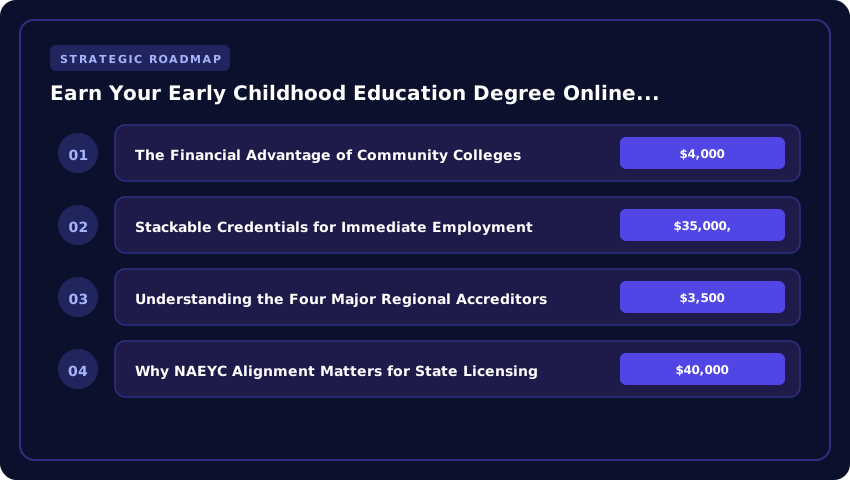
The Financial Advantage of Community Colleges
The tuition math makes the decision even more compelling. The College Board reports that the average annual tuition and fees for a public two-year community college are roughly $3,500 for in-district students. Compare that to the staggering $40,000 average annual tuition at private four-year universities, and the financial advantage is undeniable. By starting your degree online at a community college, you can drastically reduce student loan debt. Filing your FAFSA early can further offset these already low costs, often qualifying you for federal grants that cover the entirety of your community college tuition. This low-barrier entry allows you to invest your money where it matters: gaining practical, classroom-ready skills.
Stackable Credentials for Immediate Employment
One of the most strategic elements of an online associate degree in early childhood education is the concept of stackable credentials. You do not have to wait four years to enter the workforce. An associate degree meets the federal educational requirements to work as a teacher in Head Start programs, which serve over a million children across the US. This means you can start earning a steady paycheck and building real-world experience after just two years of study.

- Immediate ROI: Begin working in federally funded Head Start programs right after graduation.
- Seamless Transferability: Many community colleges have articulation agreements with state universities, allowing your credits to transfer smoothly toward a bachelor’s degree.
- Earn While You Learn: Gain valuable classroom experience and seniority while pursuing further education.
Ultimately, this pathway is not just about saving money; it is about building a sustainable career. By leveraging an affordable online associate degree, you can enter the workforce quickly, gain invaluable experience, and pursue a bachelor’s degree on your own terms—without the crushing weight of debt.
Navigating Regional Accreditation for Online Early Childhood Programs
Before you fall in love with a program’s course catalog or its promise of a flexible weekend schedule, you need to confirm one critical detail: regional accreditation. In the United States, this designation is the gold standard for academic legitimacy and the ultimate gatekeeper for credit transferability. If a program lacks it, your hard-earned credits will likely be rejected by state universities, and your degree may not satisfy employer requirements. Think of regional accreditation as your first and most important verification checkpoint in avoiding diploma mills.
Understanding the Four Major Regional Accreditors
The U.S. Department of Education recognizes seven regional accrediting bodies, but the vast majority of community colleges fall under four main organizations. Understanding which one oversees your state is essential for a smooth academic journey.
- Higher Learning Commission (HLC): If you are enrolling in a community college across the Midwest or Western-Central states—such as Ohio, Illinois, Minnesota, or Colorado—your institution is likely accredited by the HLC.
- Southern Association of Colleges and Schools Commission on Colleges (SACSCOC): Responsible for institutions throughout the Southeast. If you are studying in Texas, Florida, Georgia, or the Carolinas, look for SACSCOC accreditation on the school’s profile.
- Middle States Commission on Higher Education (MSCHE): Oversees colleges in the Mid-Atlantic and Northeast regions, including New York, Pennsylvania, Maryland, and New Jersey.
- WASC Senior College and University Commission (WSCUC): Governs higher education institutions in California, Hawaii, and the Pacific territories.
You can easily verify any school’s standing by searching the institution directly in the U.S. Department of Education’s Database of Accredited Postsecondary Institutions and Programs. If a school is missing from this database, consider it a massive red flag.
Why NAEYC Alignment Matters for State Licensing
Beyond basic regional accreditation, look for programs that align with the National Association for the Education of Young Children (NAEYC) standards. While NAEYC accreditation is often associated with childcare centers, program alignment ensures your coursework meets recognized professional competencies. More importantly, when you eventually pursue state licensing reciprocity—whether moving from a Head Start classroom in Arizona to a preschool in Oregon—NAEYC-aligned credits are much easier to transfer and recognize. State licensing boards frequently look for these standardized frameworks to evaluate out-of-state credentials.
Leveraging State Articulation Agreements
One of the hidden financial advantages of the community college system is the existence of state articulation agreements. These are formal, state-level guarantees ensuring that if you earn an Associate of Applied Science (AAS) or Associate of Arts (AA) in Early Childhood Education from a regionally accredited community college, your credits will transfer seamlessly to a participating state university. This protects your tuition investment, allows you to start at the $4,000-per-year price point, and guarantees a clear pathway toward a bachelor’s degree and a higher average salary of roughly $47,000 reported by the U.S. Bureau of Labor Statistics for preschool teachers.
Top Accredited Community Colleges Offering Online ECE Programs for 2026 Cohorts
Choosing the right online Early Childhood Education (ECE) program can feel overwhelming when you are balancing shift work, childcare duties, and a tight budget. Three community colleges consistently rise to the top of every working parent’s shortlist for 2026 because they pair respected regional accreditation with online flexibility, in-state tuition under $4,000 annually, and clear transfer pathways toward a bachelor’s degree.
Miami Dade College (FL)
Miami Dade College (MDC) offers a fully online Associate in Science in Early Childhood Education that prepares graduates for the Florida Child Care Professional Credential (FCCPC) and immediate employment in Head Start and VPK classrooms. Tuition for Florida residents runs roughly $112 per credit hour, placing the entire 60-credit degree at approximately $2,400 before fees. Out-of-state students pay closer to $380 per credit hour, but MDC partners with the Academic Common Market to waive the surcharge for residents of participating southern states. Cohorts start every eight weeks, and the curriculum includes a 45-hour field experience that MDC advisors help you arrange near your home.
Lone Star College (TX)
Lone Star College in Texas delivers an Associate of Applied Science in Early Childhood Education through its online campus, with asynchronous lecture capture and optional Saturday Zoom seminars for students who prefer live interaction. Texas residents pay about $95 per credit hour, totaling roughly $5,700 for the full 60-credit AAS track. However, students from Western Undergraduate Exchange (WUE) partner regions can access a reduced out-of-state rate near $143 per credit hour, trimming the total to roughly $8,500. Lone Star also stacks stackable credentials, including the CDA (Child Development Associate) certificate, so you can begin earning a paycheck after just nine credit hours.
Northern Virginia Community College (VA)
Northern Virginia Community College (NOVA) provides an Associate of Applied Science in Early Childhood Education entirely online, designed for transfer to George Mason University and other Virginia four-year institutions. Virginia residents pay roughly $180 per credit hour, bringing the 63-credit degree to about $11,340. Out-of-state learners through WUE pay closer to $270 per credit hour. NOVA’s program stands out for its hybrid synchronous option: live evening classes meet via Zoom once a week, giving paraprofessionals face-to-face mentoring without sacrificing flexibility.
Synchronous vs. Asynchronous Delivery for Working Parents
Most online ECE programs use asynchronous delivery, meaning you watch recorded lectures and submit assignments on your own schedule, a strong fit for nannies and overnight shift workers. Synchronous programs require scheduled Zoom meetings, typically one or two evenings per week. The trade-off is meaningful: synchronous cohorts build stronger faculty relationships and faster practicum placement, while asynchronous formats let you pause, rewind, and study during nap time. When choosing, audit a sample lecture and map your weekly work schedule before committing.
Tuition Savings Through Reciprocity Agreements
If you live outside Florida, Texas, or Virginia, do not assume you must pay full out-of-state rates. The Academic Common Market covers most southern regional states for select teacher-preparation programs, while the Western Undergraduate Exchange extends discounted tuition across 16 western states, including Arizona, Colorado, and Nevada. Submit your residency documentation early and confirm your chosen ECE program is part of the exchange before enrolling.
FAFSA, Pell Grants, and State Aid Strategies for Aspiring Preschool Teachers
Financing an online early childhood education degree does not have to feel like solving a tax puzzle blindfolded. For adult learners returning to school in 2026, the federal student aid system offers several predictable pathways to keep out-of-pocket costs remarkably low, especially when stacked with state-level incentives and employer benefits.
Understanding the Maximum Pell Grant for 2026
The Federal Pell Grant remains the single most powerful tool for low-income and middle-income students pursuing an associate degree at a community college. For the 2026 award year, the maximum Pell Grant award is projected to reach $7,695, up modestly from prior cycles. Eligibility is determined by your Expected Family Contribution (EFC), which the U.S. Department of Education has streamlined into the new Student Aid Index (SAI). Most full-time community college students with an SAI below $7,500 qualify for the maximum award, while a sliding scale extends partial grants to households with an SAI up to roughly $25,000.
Because tuition is lower, the Pell Grant frequently covers more than the full cost of an online associate program, leaving a refund check for textbooks, childcare, or transportation. Submitting the FAFSA as early as October 1 of the prior year is critical, since several state grant programs draw from the same application and operate on a first-come, first-served basis.
TEACH Grants and Loan Forgiveness for High-Need Educators
Aspiring preschool teachers willing to serve in low-income school districts or designated teacher shortage areas should explore the federal TEACH Grant Program, which provides up to $4,000 per year in exchange for a four-year teaching commitment. For those who already carry student debt, the Public Service Loan Forgiveness (PSLF) program forgives remaining federal loan balances after 120 qualifying monthly payments while working full-time for a qualifying employer, including most Head Start agencies, public preschools, and nonprofit childcare centers.
Many states layer their own incentives on top of these federal options. States such as California, Texas, Illinois, and New York operate scholarship and loan repayment assistance programs specifically targeting early childhood educators working in high-need zip codes, often awarding between $2,000 and $10,000 annually. These programs rarely require a separate application beyond your FAFSA and a short service agreement.
Stacking Childcare Worker Tax Benefits with Employer Tuition Reimbursement
Working childcare professionals can legally combine multiple benefits to dramatically reduce education costs. The Child and Dependent Care Credit allows eligible workers to claim up to $1,050 in tax credits for one qualifying child, reducing your taxable income while you study. Simultaneously, many large childcare chains, Head Start grantees, and school districts offer tuition reimbursement programs ranging from $1,500 to $5,250 per year, with the latter amount mirroring the IRS Section 127 tax-free educational assistance limit.
To stack these benefits legally, maintain clear documentation separating employer reimbursements from federal aid. Employer assistance typically does not reduce Pell Grant eligibility when reported correctly on the FAFSA, allowing you to pursue both without penalty. Consult a financial aid counselor at your community college to map out a personalized aid package that aligns Pell funds, state scholarships, TEACH Grants, and employer support into a single, manageable path toward your degree.
Curriculum Breakdown: What You Will Actually Learn in an Online ECE Associate Program
If you have been comparing early childhood education programs, you have probably noticed that course catalogs can feel intentionally vague. Community colleges do not want to scare prospective students with dense academic language, but you deserve to know exactly what your semesters will look like before you commit. An online Associate of Applied Science (A.A.S.) or Associate of Arts (A.A.) in Early Childhood Education typically requires 60 to 64 credit hours, split between general education, core ECE theory, and hands-on practicum work. Expect a balanced schedule of two to three classes per eight-week term.
Core Classes That Anchor Every ECE Degree
The academic spine of every accredited ECE program rests on three foundational courses. Child Development covers cognitive, physical, and socio-emotional growth from prenatal stages through age eight, often drawing on the National Association for the Education of Young Children (NAEYC) developmental milestones. Curriculum Planning teaches you how to design lesson plans aligned with state early learning standards, integrate play-based learning, and assess classroom environments for safety and engagement. Observation and Assessment Practicums round out the core, training you to document child behavior using authentic assessment methods like portfolios and anecdotal records rather than high-stakes testing.
Field Experience Hours and How Online Students Complete Them
Here is the part most online brochures gloss over: every legitimate ECE associate degree requires between 180 and 300 documented field experience hours, regardless of delivery format. Community colleges solve this for distance learners by partnering with NAEYC-accredited preschool centers, Head Start programs, and licensed family childcare homes in your local ZIP code. Your college will pre-approve a site near your home, assign a mentor teacher, and require you to submit weekly reflective journals plus video evidence of your teaching. Plan to complete these hours on evenings or weekends while managing your asynchronous coursework. FAFSA recognizes these practicum expenses as eligible educational costs, so remember to factor them into your financial aid budget.
Specialized Elective Tracks That Sharpen Your Career Focus
Once your core classes are squared away, most programs let you choose two or three electives that act like a minor concentration. Popular tracks include infant-toddler care (ideal if you want to work in daycare settings serving children from six weeks to three years), special needs inclusion (training you to support children with IEPs alongside typically developing peers), and family engagement coaching (preparing you to lead parent workshops and conduct home visits for early intervention programs). Picking an elective track early helps you stand out when applying for promoted roles, since the U.S. Bureau of Labor Statistics projects preschool teacher employment to grow 8 percent through 2032.
State Licensing Pathways and Career Outcomes After Graduation
Earning an online associate degree in early childhood education from a US community college is more than an academic milestone—it is a direct pipeline to regulated employment. Because early childhood roles in public schools, Head Start, and private centers are state-licensed, graduates must map their certification route before they accept their first paycheck. Understanding the four most common pathways—paraprofessional certification, Lead Teacher qualifications, public-school PreK endorsements, and corporate center management—helps you turn your associate credential into a stable, upwardly mobile career.
Paraprofessional Certification in California, Texas, Illinois, and New York
Paraprofessional (teacher aide) permits are the fastest way to enter a public-school classroom, but each state sets its own bar:
- California requires a Child Development Associate (CDA) Permit, which stacks neatly onto an associate degree. Holders typically earn $34,000–$42,000 annually, with automatic salary bumps in districts aligned with the Standard Reimbursement Project.
- Texas issues the Educational Aide I/II certificate through the Texas Education Agency. An associate degree plus passing the paraprofessional exam qualifies you for Title I school placements averaging $32,500 per year.
- Illinois uses the Paraprofessional Educator License (PEL) administered by the Illinois State Board of Education (ISBE). Endorsement costs run roughly $75, plus a $50–$100 test fee, and salaries hover near $36,000.
- New York offers the Level I Teaching Assistant Certificate through the NY State Education Department (NYSED). Fingerprint clearance plus an associate degree unlocks K–6 classroom roles paying about $35,000–$40,000.
Lead Teacher Qualification Timelines and CDA Stacking
Most states let you stack the national Child Development Associate (CDA) credential—a $425 portfolio-based award issued by the Council for Professional Recognition—on top of your associate degree to qualify for Lead Teacher status in licensed childcare centers. Expect this process to take roughly 6–9 months after graduation. Compensation typically jumps from $16 to $22–$26 per hour once the CDA is verified, pushing annual earnings into the $45,000–$55,000 range according to the US Bureau of Labor Statistics (BLS).
Career Ladder to Public-School PreK and Head Start
An associate degree already meets the federal Head Start Act requirement for lead teachers in center-based programs (45 CFR §1302.91), meaning you can apply immediately upon graduation. Within 3–5 years, many graduates ladder into public-school PreK, where states like Georgia, Florida, and Oklahoma now fund universal PreK classrooms. Median PreK teacher wages sit around $48,000, and adding a bachelor’s later through an articulation agreement can lift pay past $60,000.
Corporate Early Learning Center Management
For professionals eyeing corporate America, the same credential opens doors to management roles at Bright Horizons, KinderCare, and on-site employer-sponsored centers. Operations managers commonly earn $55,000–$75,000, and regional directors exceed $90,000. Filing the Free Application for Federal Student Aid (FAFSA) can offset remaining tuition, while professional associations such as NAEYC offer scholarships that accelerate the climb from classroom to corner office.
Application Deadlines and Enrollment Windows for Fall 2026 Online Cohorts
Smart timing separates students who secure maximum funding from those who leave thousands of dollars on the table. If you are targeting a Fall 2026 online cohort in early childhood education, your calendar should already be working for you. Community colleges across the United States follow distinct enrollment calendars that blend priority FAFSA windows, fixed cohort start dates, and rolling admissions policies. Understanding how these mechanics function in tandem lets you lock in financial aid, secure your seat, and sidestep the bottlenecks that delay working professionals.
Priority FAFSA Submission Window: January Through April 2026
The U.S. Department of Education opens the 2026-27 FAFSA cycle on January 1, 2026, and many state grant programs operate on a strict first-come, first-served basis. Submitting your FAFSA no later than April 15, 2026 is widely regarded as the benchmark for maximizing eligibility for state-level grants such as the California College Promise Grant, the Florida Student Assistance Grant, and the Texas Public Educational Grant. Several states, including Illinois and New York, distribute funds until depleted, meaning a February submission can be the difference between a full award and a waitlisted application. Federal Pell Grant eligibility for the 2026-27 award year can reach $7,395, and many community colleges automatically package this with tuition waivers that bring your out-of-pocket cost close to zero.
Rolling Admissions Versus Fixed Cohort Start Dates
Fully online early childhood education programs typically operate under one of two enrollment structures. Rolling admissions programs accept applications continuously and allow students to begin asynchronous coursework every 4 to 8 weeks, which offers flexibility for working adults juggling childcare shifts. Fixed cohort programs, by contrast, enroll students into lockstep groups that progress through coursework using scheduled synchronous Zoom sessions, often on Tuesday and Thursday evenings. For Fall 2026, most fixed cohorts have an application deadline of July 15, 2026, though several institutions close their virtual seats by mid-June once enrollment caps are met.
Required Documentation Checklist
Before you click submit, assemble these core documents to prevent processing delays:
- Official high school transcripts or verified GED scores sent directly from the issuing institution
- Government-issued photo identification for identity verification per federal financial aid rules
- FAFSA confirmation summary including your Student Aid Index (SAI)
- State-mandated background check clearance, typically a Level 2 fingerprint screening required for any field placement in a licensed childcare facility
- Immunization records, including MMR, Tdap, varicella, and a current TB test, mandated by most Head Start and state Pre-K partners hosting practicum students
- Residency documentation such as a utility bill or lease agreement if you are seeking in-state tuition rates under $4,000 annually
Submitting all six items at least 30 days before your intended start date ensures your financial aid package is finalized, your background check clears, and your practicum placement is confirmed before orientation. In this competitive landscape, the students who move in January, not August, are the ones who enroll without a hitch.
Frequently Asked Questions
How much does an online associate degree in early childhood education cost?
At a US community college, an online associate degree in early childhood education typically costs under $4,000 per year for in-state students. Over two years, total tuition can range from $8,000 to $10,000, making it a highly affordable option compared to four-year university programs.
Can I teach Head Start with an online associate degree in early childhood education?
Yes, federal guidelines require Head Start teachers to hold at least an associate degree in early childhood education or a related field. An online associate degree from a regionally accredited community college meets this requirement, allowing graduates to immediately qualify for teaching positions.
What is the average salary for preschool teachers with an associate degree?
According to the US Bureau of Labor Statistics, preschool teachers earn a median annual salary of approximately $35,000. However, those with an associate degree working in Head Start programs or specialized childcare centers can earn up to $45,000 depending on location and experience.
How long does it take to complete an online associate degree in early childhood education?
An online associate degree in early childhood education generally takes two years of full-time study to complete. Most community college programs require around 60 credit hours, though some accelerated online tracks allow motivated students to finish in as few as 18 months.
What are the prerequisites for an online early childhood education associate degree?
Prerequisites for admission typically include a high school diploma or GED equivalent. Some community colleges may require placement tests in math and English. Additionally, a background check is generally required before students can participate in the mandatory practicum hours at local childcare centers or preschools.
Strategic Final Takeaway
When evaluating Early Childhood Education Degree Online Community College Accredited 2026, base your decisions on accredited institutional standards, measurable return on investment (ROI), and up-to-date official guidelines. Always verify specific dates and requirements through official regulatory portals.

