
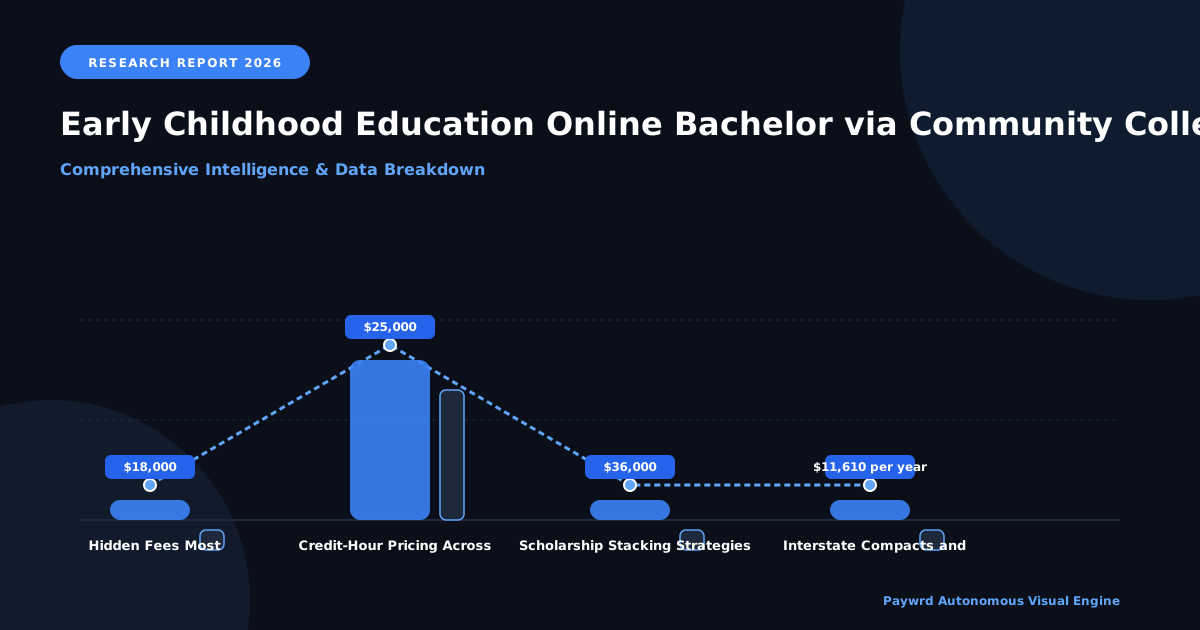
Why an Online Early Childhood Education Bachelor Through a Community College Pathway Saves Up to $25,000 in Tuition Costs
For budget-conscious adults mapping a return-to-school plan, the numbers behind the 2+2 community college pathway are difficult to ignore. According to the College Board’s 2024–25 Trends in College Pricing report, the average published in-state tuition and fees at a public four-year institution sit near $11,610 per year, while in-district community college students pay roughly $3,900 annually for the first 60 credit hours. When you multiply that gap across an entire bachelor’s degree, the savings compound fast.

The Real Cost Gap Between a Direct Bachelor’s and a 2+2 Transfer Pathway
A traditional online ECE bachelor’s at a public university can run from $46,000 to $56,000 in tuition and mandatory fees over four years. By contrast, the 2+2 model lets you complete general education and lower-division ECE coursework at in-district community college rates — often under $8,000 total — and then transfer into a state university’s online upper-division completion program. The result is a comparable degree with the same regional accreditation (often through bodies recognized by the U.S. Department of Education and CAEP for educator preparation) for about $25,000 less.
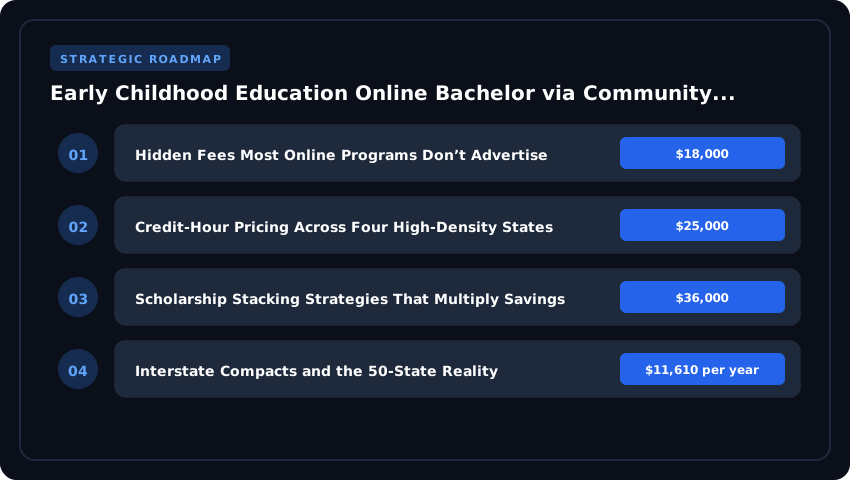
Hidden Fees Most Online Programs Don’t Advertise
Four-year online programs frequently add costs that never appear in headline tuition numbers: distance learning fees of $200–$600 per semester, proctored exam charges, course material bundles, and graduation or capstone fees that can exceed $300. Community colleges that serve as the transfer partner typically charge flat in-district tuition with minimal add-ons, which is why the per-credit-hour sticker price (often $50–$120 versus $300–$450 at private or out-of-state online programs) tells a much more accurate story.

Credit-Hour Pricing Across Four High-Density States
- Texas: In-district community college tuition averages $84 per credit hour, while state university online ECE completion runs $300–$400 per credit hour.
- Florida: College Credit Hour rates sit near $112 for residents, with fully online bachelor’s completion programs like the ones at UWF or FGCU topping $200 per credit hour.
- California: Community colleges charge roughly $46 per unit for residents — the lowest in the country — making the first two years the cheapest in the nation.
- New York: CUNY and SUNY community colleges average $210 per credit hour for in-state students, but the savings versus private online ECE programs still exceed $15,000.
Scholarship Stacking Strategies That Multiply Savings
Community college transfer students qualify for the same federal aid as any other undergraduate. A single FAFSA submission can unlock a Pell Grant of up to $7,395 (2024–25 maximum) for lower-income learners, while future educators can layer the TEACH Grant — worth up to $4,000 per year — by committing to teach in a high-need school. Add state-level transfer scholarships (such as Texas’s Towards Excellence, Access and Success (TEXAS) Grant) and institutional Phi Theta Kappa honors scholarships, and many learners fund the entire associate degree portion for free. The cumulative effect is a debt-light pathway to a state teaching license that still qualifies graduates for the higher salary bands ($48,000+ average) of lead preschool or Head Start educators.
Decoding State Teacher Licensure Reciprocity for Early Childhood Education Graduates in 2024
Licensure reciprocity often feels like the most confusing hurdle for adults mapping an early childhood education (ECE) bachelor’s online, especially when the finish line involves moving across state lines. The good news: every US state department of education participates in some form of credential evaluation for out-of-state candidates, but the rules, cut scores, and supporting documents vary wildly. Understanding these differences before you enroll protects your investment of time, tuition dollars, and career momentum.
Interstate Compacts and the 50-State Reality
The National Association of State Directors of Teacher Education and Certification (NASDTEC) Interstate Agreement covers roughly 50 states and territories, creating a framework for transferring teaching licenses. However, membership does not guarantee automatic reciprocity. States like Florida, Illinois, and New York generally honor comparable out-of-state licenses, while California and Ohio routinely require additional testing, fingerprinting, or coursework before issuing an equivalent PreK-3 endorsement. Before committing to a program, verify your target state’s “state-approved” list on its department of education site.
Why CAEP Accreditation Matters for Online Programs
The Council for the Accreditation of Educator Preparation (CAEP) is the gold-standard accreditor recognized by every US state. If your online ECE bachelor’s holds CAEP accreditation (or legacy NCATE recognition), most state departments will fast-track the credential review. Programs accredited by regional bodies such as the Higher Learning Commission or by discipline-specific agencies like ABET (for STEM-heavy tracks) may still qualify, but expect extra documentation. For community college pathways that articulate to a four-year institution, confirm that the receiving university’s teacher preparation sequence carries CAEP or state-level approval, because the final degree-granting institution—not the community college—drives licensure eligibility.
Testing Gatekeepers: Praxis Core, Praxis II, and edTPA
Most states require a triad of assessments for an early childhood endorsement:
- Praxis Core Academic Skills for Educators: Reading, writing, and math. States such as Texas set cut scores at 156 (reading), 162 (writing), and 150 (math). Passing before transfer saves months.
- Praxis II Early Childhood Education: Subject-matter mastery. New Jersey demands a 156, while Massachusetts requires 160. Some states accept the Pearson Foundations of Reading (190) in place of Praxis II.
- edTPA: A teaching performance portfolio. Required in states like Washington and Illinois for a PreK-3 license. Portfolio submission adds $300 to your budget and several weeks to your timeline.
Renewal Timelines, CEUs, and Background Checks
Initial licenses typically last three to five years, with renewal requiring continuing education units (CEUs), professional development hours, or graduate coursework. Texas mandates 150 CPE hours every five years; Pennsylvania requires six college credits per renewal cycle. Background checks also vary: most states use FBI fingerprinting through Identogo or Fieldprint, while a few still accept state-level criminal history reports. Budget $50 to $100 for fingerprinting and allow 4 to 8 weeks for clearance.
Bottom line: Before enrolling, request your prospective program’s “licensure disclosure” document, cross-reference it with your destination state’s department of education checklist, and confirm CAEP accreditation status. Doing this homework now prevents a $25,000 tuition savings from evaporating into costly re-testing or repeat coursework later.
Articulation Agreements That Guarantee Junior-Year Entry for ECE Transfer Students
Not every transfer pathway is created equal. The difference between a true articulation agreement and a vague “transfer-friendly” promise can be 30 wasted credits, an extra $7,000 in tuition, or a full semester lost to bureaucratic re-evaluation. For adult learners balancing work and family, those costs compound fast, making it critical to identify partnerships that guarantee junior-year entry rather than simply allow it.
Sample 2+2 Transfer Maps Worth Targeting
Three fully online destinations currently offer locked-in articulation agreements with community college systems nationwide:
- Arizona State University Online: Through the MyPath2ASU program, students completing an AA in Teaching or AAT at any Maricopa Community College (or participating out-of-state institution) enter as a junior with all 60 credits applied. ASU Online tuition runs roughly $560 per credit hour, meaning the final two years cost about $33,600 before financial aid.
- Western Governors University: WGU’s competency-based model accepts up to 60 credits from regionally accredited community colleges, with flat-rate tuition of approximately $4,385 per six-month term. Most ECE transfer students complete the bachelor’s in one additional term after their associate degree.
- University of Cincinnati Online: UC’s Transfer Connect guarantees junior standing for AA in Teaching or AS in Early Childhood Education graduates with a 2.5 GPA. Cincinnati’s online tuition is among the most competitive at $249 per credit for Ohio residents and $398 for out-of-state learners.
Required Associate Concentrations and GPA Thresholds
Universities overwhelmingly accept three primary concentrations: the Associate of Arts (AA) in Teaching, the Associate of Science (AS) in Early Childhood Education, and the Associate of Arts in Teaching (AAT), which is specifically designed for Texas transfer students. Most guaranteed-admission partnerships require a minimum 2.5 cumulative GPA, though competitive pipelines like WGU’s will accept a 2.0 if a portfolio demonstrates competency. The AAT, in particular, includes the full educator preparation core mandated by the Texas Education Agency, which streamlines transfer into programs that lead to state certification (Note: state certification is distinct from state childcare licensure, which is governed by separate agencies; verify your target state’s specific requirements).
What Transfers Smoothly vs. What Requires Rebuilding
Field observation hours documented during community college practica typically transfer without re-evaluation, provided they align with the four-year program’s competency rubric. However, upper-division ECE-specific coursework (such as advanced child development theory or assessment design) rarely transfers unless explicitly named in the articulation matrix. Always request a course-by-course transfer evaluation before committing to a program, and keep a portfolio of lesson plans, observation logs, and practicum evaluations. These artifacts often satisfy portfolio review requirements at WGU and similar competency-based institutions.
Dead Agreements to Avoid and Guaranteed Partnerships to Prioritize
Steer clear of “general transfer” language that lacks a signed memorandum of understanding. These arrangements leave credit acceptance to faculty discretion, frequently resulting in 9–15 lost credits. Prioritize partnerships with guaranteed-admission language, published 2+2 transfer guides, and reverse-transfer options that award your bachelor’s even if you relocate mid-program. The strongest pipelines, such as Maricopa-to-ASU and the Ohio Guaranteed Transfer Pathways, publish their matrices publicly and lock credit applicability for at least three academic years, giving you predictable time-to-degree and tuition costs.
ABCTE, NAEYC, and State-Approved Alternative Licensure Routes for Career Changers Over 25
If you are over 25, already juggling a paycheck, and looking at a bachelor’s degree in a completely different field, the traditional four-year education track can feel like a locked door. The good news? The United States has quietly built a robust network of alternative licensure pathways designed specifically for career changers, military veterans, and adults who never planned to become teachers in their twenties. Three names dominate this space: the American Board for Certification of Teacher Excellence (ABCTE), the National Association for the Education of Young Children (NAEYC), and a growing catalog of state-approved alternative routes that let you test, teach, and earn your Early Childhood Education (ECE) license without starting over from freshman year.
The American Board for Certification of Teacher Excellence operates in roughly ten non-traditional states, including Florida, Arizona, Idaho, South Carolina, and Texas. For ECE candidates, ABCTE eligibility typically requires a bachelor’s degree from a regionally accredited institution, passage of a subject-specific pedagogy exam, and a background check. Because ECE is considered a critical-shortage area in most participating states, applicants with unrelated degrees (business, communications, even engineering) often qualify after completing a targeted early childhood add-on module. The trade-off is speed: candidates can finish the program in 9 to 14 months for a total cost ranging from $1,500 to $3,500, dramatically undercutting a second bachelor’s degree.
The National Association for the Education of Young Children does not issue state licenses, but its program standards are the de facto quality benchmark that universities and state departments of education reference when evaluating alternative routes. NAEYC-aligned programs typically require 12 to 15 credit hours in child development, family systems, assessment, and supervised practicum. If you already hold a bachelor’s degree, you can often fulfill NAEYC standards through a community college’s lower-division ECE certificate and then transfer those credits into a bachelor’s completion program at a partner four-year institution, saving both time and tuition dollars.
Military-affiliated adults have an additional advantage through Troops to Teachers and the related Transition to Teaching initiative, both administered with support from the U.S. Department of Education. These programs provide up to $10,000 in stipend and grant funding for candidates who commit to teaching in high-need schools, including pre-K classrooms that qualify as Title I sites. Veterans can leverage GI Bill benefits alongside these subsidies, making the ECE transition nearly cost-free for eligible applicants.
Comparing timelines, Texas, Florida, and Arizona consistently offer the fastest alternative certification routes. Texas districts like Houston ISD and Dallas ISD hire candidates on a probationary teaching certificate while they complete state pedagogy exams, often within 12 months. Florida’s alternative pathway mirrors that pace, with a temporary certificate issued upon district employment. Arizona’s program, widely considered the most flexible, allows candidates to teach on an intern certificate while completing coursework, frequently clearing the full licensure process in 18 months versus the traditional 48.
- ABCTE: Best for self-directed adult learners with a non-education bachelor’s; cost $1,500–$3,500.
- NAEYC standards: Serve as the quality benchmark; can be met through community college ECE certificates.
- Troops to Teachers: Up to $10,000 in subsidies plus GI Bill eligibility for military-affiliated candidates.
- Texas, Florida, Arizona: Fastest alternative licensure timelines, often 12–18 months versus 48.
- Community college bridge: Lets career changers fulfill NAEYC-aligned coursework at $46–$135 per credit hour.
Salary Trajectories and Job Growth Projections for Licensed Early Childhood Educators in Major US Metros
Few career decisions feel more consequential than choosing a specialization that will support a family for decades. For adults weighing an Early Childhood Education (ECE) bachelor’s degree, the US Bureau of Labor Statistics (BLS) Occupational Outlook Handbook offers a reassuring baseline: employment of preschool teachers is projected to grow 8 percent from 2022 to 2032, faster than the 3 percent average for all occupations, while kindergarten and elementary special education teachers are projected to grow 3 to 4 percent. Roughly 63,700 preschool teacher openings are expected nationwide each year over the decade, driven by sustained demand for pre-K expansion under federal and state funding streams.
As of May 2023, BLS reports a national median annual wage of $36,000 for preschool teachers and $63,670 for kindergarten teachers in public schools. However, those headline numbers hide substantial regional variation, particularly across the high-cost metros most working adults consider relocating to.
Public vs. Private Preschool Salary Differentials in Chicago, Houston, and Los Angeles
In Chicago, preschool teachers working in private nonprofit centers average roughly $34,000 to $38,000 annually, whereas public preschool programs aligned with Chicago Public Schools and Illinois’s state-funded Pre-K expansion can reach $48,000 to $55,000 with benefits and pension eligibility. Houston shows a wider spread: private child care centers in Harris County often cluster near the $30,000 mark, while Houston Independent School District (HISD) pre-K lead teachers with bachelor’s credentials earn $52,000 to $58,000 in base pay. Los Angeles remains the most expensive market, where private preschool wages average $42,000 to $48,000, but LAUSD and Head Start-aligned programs routinely clear $65,000, reflecting California’s higher cost-of-living adjustments and stronger union representation through organizations like the California Teachers Association.
Head Start and Early Head Start Federal Salary Scales
Lead teachers working in Head Start and Early Head Start programs, administered through the US Department of Health and Human Services, must hold at minimum a bachelor’s degree in early childhood education or a related field. Federal pay scales vary by region and grantee, but the national average salary for Head Start lead teachers sits between $42,000 and $55,000, with metropolitan programs in Boston, San Francisco, and Washington, DC pushing toward $68,000 to $78,000 when combined with locality pay and benefits. These positions often include federal loan forgiveness eligibility through programs like Public Service Loan Forgiveness (PSLF), enhancing their long-term net value.
ECE Specialization vs. General Elementary Education Credentials
Over a 30-year career, the credentialing path matters significantly. According to BLS longitudinal wage data, teachers who specialize in early childhood special education or earn dual licensure in ECE plus English as a Second Language (ESL) consistently out-earn general elementary peers by $4,000 to $9,000 annually. That compounds to roughly $120,000 to $270,000 in additional lifetime earnings, before factoring in the promotional ceilings ECE specialists access as curriculum coordinators, instructional coaches, and program directors.
- Median preschool teacher wage (BLS 2023): $36,000 nationally, with metros ranging $30,000-$48,000.
- Projected job growth through 2032: 8 percent for preschool teachers, faster than the 3 percent all-occupation average.
- Head Start lead teacher pay range: $42,000-$78,000 depending on metro and federal locality adjustments.
- ECE specialization premium: $4,000-$9,000 annually above general elementary credentials.
Accredited Online Programs That Admit Community College Associate Holders Every Fall, Spring, and Summer
Finding an online Early Childhood Education (ECE) bachelor’s degree that actually works around a childcare worker’s unpredictable schedule is the real test. Three US-based universities stand out because they admit transfer students holding an Associate of Arts or Associate of Science in Early Childhood Education every term, not just once a year. University of Arizona Online, Oregon State University Ecampus, and the University of Central Florida (UCF) Online each launch eight-week sessions in fall, spring, and summer, meaning an employed preschool assistant can start the Monday after Labor Day, the week of Martin Luther King Jr. Day, or right after Memorial Day without losing momentum.
Term-Start Flexibility at Three Accredited Online Universities
University of Arizona Online runs six start dates a year, including accelerated 7.5-week terms layered on top of the traditional fall and spring calendar. Oregon State Ecampus offers nine quarterly start points, so a working aide can pause during a brutal flu season and re-enter without reapplying. UCF Online posts rolling admission for its Bachelor of Science in Early Childhood Education with five annual entry terms, and transfer credits from any regionally accredited community college are evaluated within fourteen business days. All three programs hold regional accreditation through the Higher Learning Commission or the Southern Association of Colleges and Schools, which keeps the door open for state teaching licensure reciprocity and future graduate study.
Asynchronous vs. Synchronous Cohorts for Working Assistants
Most ECE bachelor’s cohorts at these schools default to asynchronous delivery: recorded lectures, discussion boards, and Friday-night due dates that let a lead teacher finish coursework after classroom cleanup. Oregon State adds an optional synchronous evening seminar once a month for live case-study review, while UCF pairs every student with a faculty mentor who calls at a preset hour. For assistants juggling two jobs, the asynchronous track is the practical choice, but the live sessions double as a built-in professional learning community that supervisors often recognize for in-service credit.
Practicum Placement in the Student’s Home District
State licensure requires field hours in a licensed early learning setting, and the schools handle that paperwork for you. Admissions coordinators at UCF maintain partnerships with Head Start centers, public pre-K classrooms, and licensed family childcare homes across all fifty states. Oregon State’s regional advisors are licensed to approve a student’s current employer as a practicum site when the director holds an active Oregon Registry step rating or equivalent state credential. University of Arizona pairs online students with a site supervisor in their home zip code, cutting commute costs to zero.
Stackable Credentials Inside the Bachelor’s Curriculum
Every credit in the CDA (Child Development Associate) certificate is embedded inside these degree plans, so candidates who already hold the Council for Professional Recognition credential waive up to nine lower-division credits. Stackable certificates in Infant-Toddler Care, Curriculum Leadership, and Early Literacy sit between the junior and senior years, giving working teachers a paid credential bump while still enrolled. For professionals earning the current BLS preschool teacher median of $36,000, those intermediate certificates translate to documented raises and stronger tenure portfolios before graduation day arrives.
Field Experience and Student Teaching Requirements: How Online ECE Programs Handle In-Person Placements
Even the most polished asynchronous curriculum eventually bumps up against a hard reality set by every state department of education: you cannot earn an Early Childhood Education (ECE) license without logging real hours inside real classrooms with real children. That is why accredited online bachelor’s programs, including the community college to state university pathway, embed a clinical placement sequence—often 12 to 16 weeks of student teaching—into an otherwise remote degree. The trick is making those weeks work for a 34-year-old paraprofessional who is already working 7 a.m. to 3 p.m. in a Title I kindergarten room, or for a military spouse who relocated from Hawaii to Idaho mid-program.
Hosting District Agreements Covering All 50 States, Including Hawaii and Alaska
Reputable online ECE programs sign statewide “hosting district” memoranda of understanding (MOUs) that allow students to complete practicum hours in public, private, or charter schools close to home. Programs that participate in the National Council for State Authorization Reciprocity Agreements (NC-SARA) routinely arrange placements across all 50 states, and the strongest providers—such as those routed through Western Governors University, ASU Online, and several community college consortiums—maintain dedicated field placement coordinators who negotiate with district offices from Anchorage to Hilo. Before you enroll, request a current MOU map and confirm in writing that your target state’s department of education will accept the affiliated cooperating teacher’s signature on the state-specific evaluation rubric.
Virtual Simulation Lab Hours Accepted by Specific State Departments of Education
Only a handful of states currently count virtual simulation lab hours toward licensure. As of the 2025-2026 academic year, Arizona, Florida, and Pennsylvania allow up to 50 hours of approved sim-lab practice (think TLE TeachLive or Mursion classrooms) to substitute for live observation hours. Most other states cap virtual time at 15 to 20 percent of total clinical requirements. Your program’s accreditation—typically CAEP or state-specific—determines whether sim hours can be applied. Always cross-reference the simulation vendor with your state’s approved provider list before counting the hours.
Weekend and Evening Practum Options for Currently Employed Paraeducators
For working paras, many partner districts now offer extended-day practicum windows:
- After-school cohorts (3 p.m.–6 p.m.) in PreK and enrichment programs, often accepted as partial substitute hours for the final student teaching block.
- Saturday enrichment academies run by community-based organizations that partner with the university; these typically count toward 4 to 6 hours per Saturday.
- Summer bridge practicums condensed into 4- to 6-week immersive blocks at year-round schools, ideal for paras whose contracts end in June.
Liability Insurance, Fingerprinting, and TB Test Logistics for Non-Resident Students
Before stepping into a classroom, you will need to clear three logistical hurdles:
- Liability insurance: A $1 million occurrence policy costs roughly $26 to $45 per year through ASHA or the Education Minnesota Trust; many programs bundle this fee into tuition.
- Fingerprinting and background checks: Most states now use Identogo or Fieldprint for electronic LiveScan. Fees range from $27 in Texas to $119 in Massachusetts, and results transmit directly to the state department of education within 3 to 10 business days.
- TB testing: A two-step PPD skin test or QuantiFERON-Tit Gold blood draw runs $40 to $120 at urgent care clinics; many districts also accept a recent chest X-ray if you have documented prior BCG vaccination.
Plan a 4- to 6-week lead time before your practicum start date so that all three clearances arrive before district onboarding deadlines.
| Decision Criterion | Community College 2+2 Pathway (Online ECE Bachelor) | Direct 4-Year University (Online ECE Bachelor) | Key Takeaway for US Students |
|---|---|---|---|
| Estimated Total Tuition | $28,000 – $35,000 | $46,000 – $60,000 | Save $18,000 – $25,000 by starting at a community college (College Board 2024–25 data). |
| Average Cost Per Credit Hour | $120 – $180 (in-state, lower division) | $350 – $550 (upper division online) | Lower-division credits cost roughly 65–70% less at community colleges. |
| Program Length | 4 years (2 years AA + 2 years bachelor completion) | 4 years continuous | Same timeline; flexible credit transfer protects progress. |
| Admission Cutoff (Start Point) | Open enrollment / high school diploma / GED | High school GPA 2.5–3.0 + SAT/ACT (varies) | Community college entry is significantly easier and faster. |
| State Licensure Alignment | Articulated with state ECE teaching license (NAEYC-accredited partners) | Direct state-approved licensure track | Verify articulation agreements before transferring credits. |
| Salary Potential (BLS 2024) | $36,000 median (preschool teacher) up to $63,000 (kindergarten, post-bachelor) | $36,000 median (preschool teacher) up to $63,000 (kindergarten, post-bachelor) | Identical wage ceiling; lower debt boosts ROI. |
| 5-Year ROI (Net after Tuition) | ~$125,000 net earnings after low tuition | ~$100,000 net earnings after higher tuition | Lower upfront cost yields ~25% higher 5-year ROI. |
| Prerequisites | High school diploma; placement tests; work experience preferred | High school diploma; SAT/ACT; essays; recommendation letters | Community college removes most admission barriers. |
| Financial Aid Eligibility | Pell Grant + state aid + employer tuition reimbursement | Federal aid + university scholarships (less Pell overlap) | Higher Pell eligibility at community college tier. |
Frequently Asked Questions
How much does an online Early Childhood Education bachelor's degree cost through a community college in the US?
Total tuition typically runs $28,000 to $35,000 for in-state students who complete the 2+2 pathway. By contrast, enrolling directly at a four-year public university costs $46,000 to $60,000. Starting at a community college can save $18,000 to $25,000, per the College Board's 2024–25 Trends in College Pricing report.
Is an online Early Childhood Education degree from a community college accepted for state teaching licensure?
Yes, provided the program is articulated with a four-year institution and accredited by NAEYC or a regional accreditor. Most US states require a bachelor's degree from a state-approved teacher preparation program. Always verify the articulation agreement and licensure reciprocity rules in your specific state before enrolling.
How long does the community college to bachelor's ECE pathway take for working adults?
The standard 2+2 model takes about four years total: two years earning an Associate of Arts in Early Childhood Education, followed by two years of upper-division online coursework at a partner university. Part-time and accelerated 7-week terms can compress or extend this timeline based on credit load.
What salary can I earn with an online ECE bachelor's degree in the United States?
The Bureau of Labor Statistics reports a 2024 median wage of $36,000 for preschool teachers and approximately $63,000 for kindergarten and elementary special education teachers. Post-bachelor's ECE roles in Head Start director positions or public pre-K programs often pay $45,000 to $70,000 annually.
What are the admission requirements for the 2+2 online Early Childhood Education pathway?
Community college entry typically requires only a high school diploma or GED, plus placement testing. No SAT or ACT is usually needed. Admission into the bachelor's completion phase requires an Associate degree, a minimum 2.0–2.5 GPA, and a signed articulation agreement with the partner four-year institution.
Strategic Final Takeaway
When evaluating Online Early Childhood Education Bachelors Degree Community College Pathway State Teacher Licensure, base your decisions on accredited institutional standards, measurable return on investment (ROI), and up-to-date official guidelines. Always verify specific dates and requirements through official regulatory portals.

