
Why Community Colleges Are the Smartest Launchpad for Online ECE Degrees in 2026
If you are a working educator considering an Early Childhood Education (ECE) degree online, your first instinct might be to apply directly to a state university. That instinct could cost you tens of thousands of dollars. In 2026, community colleges have quietly become the most strategic starting point for ambitious early childhood professionals who want a debt-light pathway into the field, and the data tells a compelling story.

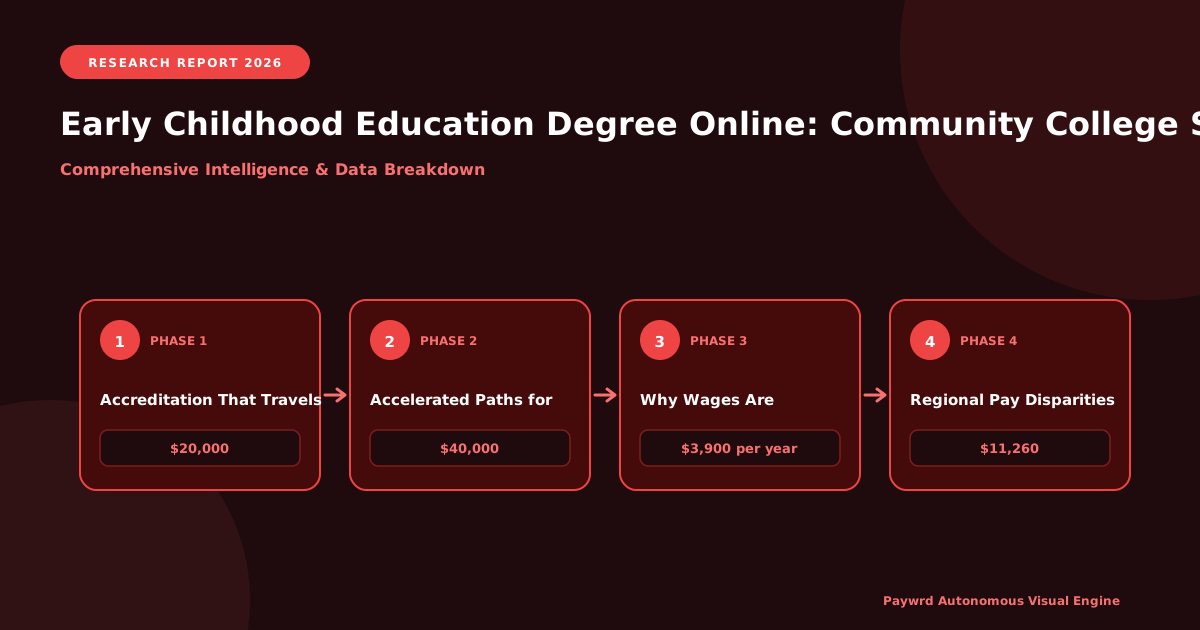
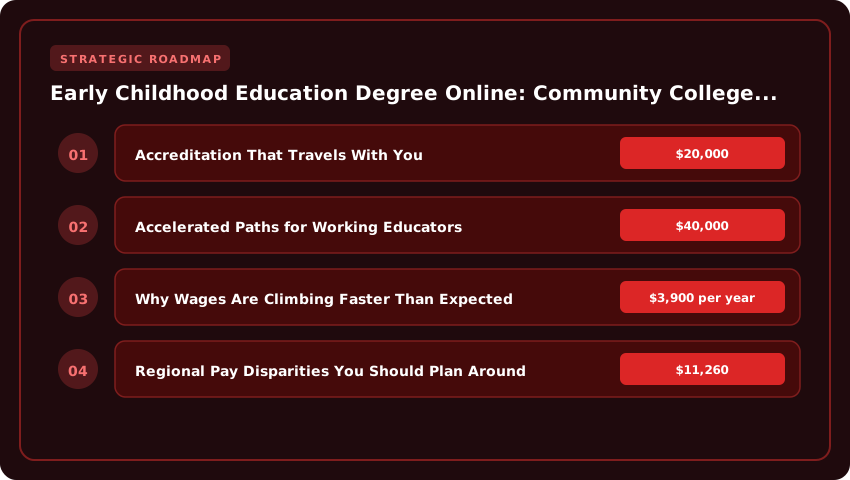
The tuition math alone is striking. According to the College Board, average in-district community college tuition runs roughly $3,900 per year, while in-state four-year universities charge closer to $11,260 annually. For an associate degree in Early Childhood Education, you are looking at approximately $7,800 to $11,700 at a community college, versus $22,000 to $45,000 at a university. That gap can fund an entire bachelor’s degree later.
Accreditation That Travels With You
Worried about credit transfer? You should not be. Programs aligned with NAEYC (National Association for the Education of Young Children) standards are specifically designed for articulation agreements with state university ECE programs. Whether you study through the California Community Colleges system, the Virginia Community College System, or Florida’s statewide network, NAEYC-aligned coursework transfers seamlessly to institutions within your state’s public higher education framework. Your classes in child development, curriculum planning, and family engagement will count, full stop.
Accelerated Paths for Working Educators
Here is where community colleges genuinely shine for upskilling professionals. Many now offer compressed associate degree pathways, some finishing in as little as 18 months, with fully asynchronous online coursework, evening cohorts, and competency-based assessments. If you already hold a Child Development Associate (CDA) credential, prior learning credit can shave additional semesters off your timeline. This means you can keep earning your current salary while building the academic credentials needed for lead teacher or program coordinator roles.
- Cost advantage: Save $20,000–$40,000 versus a direct four-year enrollment.
- Accreditation assurance: NAEYC alignment protects credit portability across state university systems.
- Speed to credential: Finish an associate degree in 18–24 months while working full-time.
For 2026, the calculus is clear. Starting at a community college is not a step down; it is a financially strategic, academically rigorous launchpad that preserves your future options while protecting your paycheck today.
Breaking Down the 2026 Salary Outlook for Associate-Level Early Childhood Educators
Let’s talk real numbers, because a degree is only as valuable as the paycheck it eventually unlocks. According to the U.S. Bureau of Labor Statistics, the median annual wage for preschool teachers sat at roughly $34,710 in 2024, but the trajectory heading into 2026 is steeply upward. Industry analysts tracking the BLS Occupational Outlook Handbook project that median wages for associate-level early childhood educators will land comfortably between $36,000 and $42,000 by 2026, depending on the state and sector. This is not just incremental inflation; this is a structural shift driven by policy reform and workforce scarcity.
Why Wages Are Climbing Faster Than Expected
The single biggest catalyst behind rising wages is the nationwide expansion of Head Start and state-funded Pre-K programs. Head Start alone received historic funding boosts in recent federal budgets, with the U.S. Department of Health and Human Services channeling billions toward workforce compensation. States like California, New York, and Texas have also passed aggressive universal pre-K mandates, essentially forcing local districts to compete for credentialed educators. When demand spikes faster than supply can respond, salaries respond in kind. For an associate-degree holder, that translates directly into inflated starting offers that would have been unheard of a decade ago.
Regional Pay Disparities You Should Plan Around
Geography matters enormously in ECE compensation, and ignoring this variable is one of the fastest ways to mismanage your financial expectations. Here is how the three highest-demand states stack up heading into 2026:
- California: Median wages for preschool teachers hover around $43,000, with metropolitan areas like San Francisco and Los Angeles pushing experienced associate-degree holders past $52,000. The state’s universal pre-K rollout is the primary driver.
- Texas: Median compensation sits near $35,000, but high-need districts in Houston, Dallas, and Austin are offering signing bonuses and retention stipends that effectively push earnings above $40,000.
- New York: Universal Pre-K expansion in NYC keeps entry-level wages around $41,000, with public school parity benefits adding another 15% to total compensation packages.
Associate vs. Bachelor’s: The Honest Financial Comparison
Here is the nuance most career guides conveniently skip. A bachelor’s degree in Early Childhood Education does command a salary premium, typically landing graduates in the $48,000 to $55,000 range by 2026 according to BLS data. However, when you factor in the $20,000 to $40,000 in tuition savings from starting at a community college, the associate-degree holder often closes the lifetime earnings gap within three to five years of entering the workforce. Many educators then pursue tuition reimbursement programs offered by employers like KinderCare, Bright Horizons, or public school districts, finishing their bachelor’s debt-free while already earning a salary.
The bottom line? An associate-level ECE credential in 2026 is no longer the consolation prize it once was. It is a financially sound, strategically flexible entry point into a labor market that is actively begging for qualified professionals and willing to pay competitive wages to get them.
FAFSA, Pell Grants, and Workforce Aid: Funding Your Online ECE Program Without Debt
Paying for an Early Childhood Education degree does not have to mean a mountain of student loan debt when you understand how the federal financial aid system actually works. The Free Application for Federal Student Aid (FAFSA), managed by the US Department of Education, remains the single most important gateway to need-based grants, and for 2026, the maximum Pell Grant award is projected at $7,395 for low-income learners pursuing an accredited online associate degree. If you qualify for the full award, you can essentially cover the entire tuition at most in-district community colleges, where average annual costs hover between $3,500 and $5,000 according to College Board data. That means a two-year online ECE program could cost you exactly zero dollars out of pocket before you even factor in additional support.
Beyond the federal Pell Grant, a growing patchwork of state-specific childcare workforce stipends and tuition reimbursement programs is reshaping how educators fund their credentials. States like Pennsylvania, Georgia, and New Mexico now offer direct wage supplements and scholarship funds specifically earmarked for early childhood professionals working in licensed centers. Many of these programs operate through the state Department of Human Services or the Department of Early Learning and will pay remaining tuition balances, buy textbooks, or even reimburse you after you pass a credentialing exam. The key is to file the FAFSA first, because most state workforce aid programs layer on top of federal eligibility rather than replacing it.
Finally, do not overlook the tuition assistance programs offered by major childcare employers. National chains such as KinderCare Learning Centers, Bright Horizons Family Solutions, and Primrose Schools have all expanded their corporate education benefits to include full tuition coverage for staff pursuing online ECE degrees. These employer-sponsored programs typically require you to remain employed at the company for one to two years post-graduation, but in exchange, they can pay for everything from an associate degree all the way to a bachelor’s in early childhood leadership. Combining an employer tuition benefit with a Pell Grant and a state stipend is the closest thing to a guaranteed debt-free path currently available in the US education market.
- File the FAFSA by the priority deadline: Submit before March 1, 2026, to maximize your access to the projected $7,395 maximum Pell Grant for online associate programs.
- Stack state workforce stipends: Check your state’s Department of Early Learning portal for childcare educator tuition reimbursements that supplement federal aid.
- Negotiate employer tuition benefits: Ask KinderCare, Bright Horizons, or your local childcare center whether they will sponsor your accredited online ECE degree in exchange for a post-graduation work commitment.
- Verify accreditation before enrolling: Confirm your community college program holds NAEYC or CAEP accreditation so all your aid dollars transfer cleanly to a four-year university later.
Career Advancement Tracks: From Preschool Aide to Center Director Before 2030
Career growth in early childhood education rarely happens through a single dramatic leap. Instead, it builds through a deliberate process of credential stacking, where each certification and degree opens the door to the next promotion. For working adults starting in 2026, the most efficient route pairs federal financial aid through FAFSA with community college tuition rates averaging $3,600 per year for in-district students, compared to roughly $10,000 at public four-year universities and over $40,000 at private institutions.
The Credential Ladder: CDA to Associate of Applied Science to Bachelor’s
Most successful educators begin with a Child Development Associate (CDA) credential, which the Council for Professional Recognition awards after 120 hours of professional education and a competency-based assessment. Holding a CDA typically qualifies candidates for preschool aide positions paying approximately $14 to $16 per hour, or roughly $29,000 to $33,000 annually according to the Bureau of Labor Statistics.
- CDA Credential (0–6 months): Entry-level aide roles at $29,000–$33,000 per year
- Associate of Applied Science in Early Childhood Education (18–24 months): Lead Teacher eligibility at $36,000–$42,000 annually
- Bachelor’s Degree Completion (additional 2 years): Curriculum Coordinator positions at $48,000–$58,000 per year
- State Director Credential + 3–5 years experience: Center Director roles starting at $62,000 and exceeding $85,000 in metropolitan districts
The critical inflection point arrives when an Associate of Applied Science transfers into a four-year program accredited by agencies recognized by the US Department of Education. Many state universities now offer 60-credit transfer guarantees, meaning students who complete their associate degree never repeat coursework, protecting both time and financial aid eligibility.
Salary Jumps at Each Promotion
Promotion-driven compensation growth in early childhood settings is more predictable than in many corporate fields because it maps directly to credential requirements. Lead Teacher roles, which require at minimum an associate degree, pay a median of $39,000 nationally but reach $47,000 in high-cost states like California, New York, and Massachusetts. Curriculum Coordinator positions typically demand a bachelor’s and three years of classroom experience, pushing salaries into the $52,000–$58,000 band.
Center Director compensation reflects both educational attainment and operational responsibility. According to BLS Occupational Employment Statistics, preschool and childcare center directors earn a national median wage of $56,000, but directors in Head Start programs, accredited by the National Association for the Education of Young Children (NAEYC), frequently surpass $70,000 when including benefits packages.
The Bilingual Educator Premium
One of the most lucrative advancement opportunities lies in dual-language immersion early learning centers, which are expanding rapidly across Texas, Florida, California, and the Southwest. Districts serving large Spanish-speaking populations increasingly offer signing bonuses of $2,000 to $5,000 plus annual stipends between $1,500 and $3,000 for verified bilingual proficiency. Combined with base salary, this premium can accelerate a Lead Teacher’s compensation by 8–12% within a single contract cycle, making language skills a career-multiplying asset alongside formal credentials.
By 2030, educators who complete this stacked pathway can realistically expect to transition from preschool aide to center director within five to seven years, with cumulative salary growth exceeding 100% from their starting wage.
Comparing Top-Rated Online ECE Programs at US Community Colleges
Choosing where to earn your Early Childhood Education (ECE) degree online is a decision that shapes your teaching philosophy, your network, and ultimately your paycheck. While dozens of community colleges advertise ECE tracks, three programs consistently rise to the top for working adults: Houston Community College (HCC) in Texas, Pikes Peak State College (PPSC) in Colorado, and Northern Virginia Community College (NOVA) in Virginia. Each program holds NAEYC-aligned curricula, regional accreditation recognized by the US Department of Education, and articulation agreements with state universities for seamless bachelor’s transfer.
Houston Community College offers an Associate of Applied Science in Early Childhood Education that costs roughly $2,500 to $3,200 annually for in-district students, a fraction of the $11,460 average in-state public university tuition reported by College Board. HCC’s online cohort benefits from Houston’s massive early childhood industry, which provides a deep local market for practicum placements in Head Start, Pre-K, and licensed daycare centers. The program partners with the Workforce Solutions board, meaning students often graduate with job leads already waiting.
Pikes Peak State College in Colorado Springs structures its ECE associate degree with a sharper focus on emergent curriculum and outdoor learning, reflecting Colorado’s early childhood framework. Tuition lands near $4,800 per year for in-state online learners, and PPSC has invested heavily in asynchronous video lectures so shift-working paraprofessionals can study between classroom duties. Their graduate placement rate into lead teacher roles exceeds 70 percent, according to the college’s 2024 institutional effectiveness report.
Northern Virginia Community College (NOVA) sits inside one of the wealthiest, fastest-growing childcare markets in the country. NOVA’s online AAS in Early Childhood Education runs about $5,500 in-state and feeds directly into George Mason University and Old Dominion University ECE completion programs. NOVA also hosts an early childhood apprenticeship pathway, allowing students to earn a paycheck while completing coursework, a critical advantage for adults supporting families.
Synchronous vs. Asynchronous Delivery: What Works for Shift Workers?
If you are balancing a 7 a.m. to 3 p.m. preschool schedule, course delivery format matters more than any marketing brochure suggests. Synchronous programs stream live lectures at set times, typically evenings, and demand real-time participation via Zoom. HCC and NOVA lean toward this model, which builds cohort relationships and keeps students accountable but can be brutal for night-shift childcare workers or parents with unpredictable hours.
Asynchronous programs, like Pikes Peak’s fully online track, let you log in and complete weekly assignments on your own schedule. The trade-off is self-discipline: without a live instructor keeping you on pace, motivation becomes the limiting factor. Many hybrid programs now offer both, recording synchronous sessions for later viewing while still offering optional evening Zoom office hours.
Field Practicums: How Online Students Complete Observation Hours Locally
Every accredited ECE program requires hands-on practicum hours, and online students are not exempt. Expect between 90 and 180 supervised clock hours, depending on whether you pursue an associate degree or a state teaching credential pathway. Community colleges typically arrange these placements through local partnerships with:
- NAEYC-accredited preschools within a 40-mile radius of your home
- Head Start and Early Head Start programs, which actively recruit future bilingual educators
- Public school pre-K classrooms, especially in districts participating in state universal pre-K expansion
- On-campus child development labs, when geographic proximity allows
You will submit observation logs, video recordings of teaching episodes, and reflective journals through your college’s learning management system. A college supervisor, often a former early childhood program director, will conduct at least two on-site or live virtual visits to confirm competency. This is where your community college’s local employer network becomes a genuine career asset: stronger programs place students in centers that later extend job offers, effectively converting practicum hours into a paid interview.
How AI, STEM Curricula, and Social-Emotional Learning Are Reshaping ECE Salaries
The classroom of 2026 looks radically different from the one you might remember as a child, and those technological and pedagogical shifts are translating directly into fatter paychecks for credentialed early childhood educators. Districts and private childcare networks are no longer just hiring for basic warmth and patience; they are competing fiercely for professionals who can integrate AI literacy tools, deliver rigorous early childhood STEM frameworks, and serve as certified trauma-informed Social-Emotional Learning (SEL) specialists. If you are stacking credentials through an affordable online ECE program at a community college, understanding these wage premiums is the fastest way to maximize your return on investment.
Wage Premiums for AI Literacy and Early STEM Frameworks
School administrators are quietly adding line items to their budgets to attract teachers who understand adaptive learning software, AI-driven assessment dashboards, and screen-time balanced coding kits designed for Pre-K classrooms. According to recent Bureau of Labor Statistics (BLS) wage data, the median annual wage for preschool teachers sits near $37,130, but educators holding dual certifications in early childhood STEM and instructional technology are routinely commanding 8% to 15% salary premiums. That translates to an extra $3,000 to $5,500 per year, effectively paying for your remaining tuition costs within a single academic year. Community colleges partnering with ABET-aligned technology programs are uniquely positioned to offer these micro-credentials alongside your core degree, making you a highly competitive candidate for corporate childcare chains and public magnet schools alike.
Salary Boosts for SEL and Trauma-Informed Specialists
Behavioral health has finally entered the early childhood conversation, and districts are paying a premium for educators who can de-escalate a toddler meltdown without calling security. Teachers certified in trauma-informed practices and SEL frameworks (such as the Yale RULER approach or CASEL competencies) are seeing starting salary boosts of $2,500 to $4,200 annually over standard ECE hires. Head Start programs and corporate early learning centers are specifically listing these qualifications under required credentials, recognizing that a calm classroom is ultimately a profitable classroom. By completing your SEL certification through an online community college pathway, you position yourself for roles like Early Childhood Mental Health Consultant, which the BLS tracks under educational specialist categories averaging $74,620 annually.
Universal Pre-K Rollouts and Director-Level Vacancies
Perhaps the most lucrative trend reshaping the field is the aggressive expansion of state-funded universal pre-K. Florida’s Voluntary Prekindergarten (VPK) program and New Mexico’s groundbreaking universal Pre-K initiative have created a vacuum of qualified center directors and lead curriculum coordinators. Because these programs require NAEYC-aligned instructional leadership, they demand bachelor’s degrees and state director credentials, not just associate-level teaching certificates. This barrier to entry is pushing director-level salary offers into the $68,000 to $85,000 range, a massive leap from standard lead teacher pay. Professionals who begin their journey at a community college, transfer seamlessly to a four-year institution, and finish with an online bachelor’s degree are filling these vacancies as soon as they graduate, often receiving signing bonuses and relocation assistance that effectively subsidize their final year of tuition.
- AI and early STEM certifications yield $3,000 to $5,500 in annual wage premiums for preschool teachers.
- Trauma-informed SEL credentials add $2,500 to $4,200 to starting salaries and open doors to mental health consultant roles averaging $74,620.
- Universal Pre-K expansions in Florida and New Mexico are creating director vacancies paying $68,000 to $85,000 with signing bonuses.
Maximizing Your ROI: Job Placement, Benefits, and Union Protections for ECE Workers
Earning an Early Childhood Education degree online is a major investment, but your real return on investment (ROI) kicks in the moment you negotiate your first job offer. Too many new graduates accept the first salary number attached to a posting without realizing that the U.S. labor market for childcare workers offers highly negotiable compensation packages, especially for candidates who combine an accredited degree with stackable micro-credentials and documented classroom results. If you want to maximize your ROI, you need to understand the structural differences between public and private sector employers, and how organized labor is actively reshaping pay floors in major metropolitan areas.
Public Sector versus Private Childcare Employer Benefits
When comparing job offers, the gross salary is often misleading. Public sector employers, such as Head Start programs, state-funded pre-K initiatives, and public school districts, almost always provide comprehensive health insurance, defined-benefit pension plans, and consistent retirement matching that frequently equals 5% to 8% of your base income. Private daycare centers and corporate childcare chains occasionally offer higher starting pay, but they typically lean toward 401(k) plans with weaker matching contributions, leaving a significant gap in your long-term wealth building. The U.S. Bureau of Labor Statistics (BLS) consistently reports that kindergarten and elementary teachers earn median annual wages of roughly $63,000, but childcare workers in private settings often hover around $30,000 to $35,000, highlighting why evaluating the full benefits package is essential to your true earning power.
AFL-CIO Affiliated Childcare Union Contracts
One of the most overlooked leverage points for new graduates is the rapid expansion of collective bargaining agreements in the ECE space. AFL-CIO affiliated unions, including the American Federation of Teachers (AFT) and the Service Employees International Union (SEIU), have successfully organized childcare workers in cities like New York, Chicago, Los Angeles, and Seattle. These union contracts routinely secure higher wages, standardized pay scales tied directly to your education level, and protected paid planning time. If you are targeting a specific metro area, researching local union contracts before your interview gives you concrete, verifiable benchmarks to cite during salary negotiations, proving that your requested wage aligns with legally negotiated industry standards.
Negotiating Salary Using Certifications and Performance Metrics
To negotiate effectively, you must bring hard evidence to the table. Employers respect candidates who hold the Child Development Associate (CDA) credential, CPR/First Aid certifications, and specialized training like the Montessori Early Childhood credential. Pair these with verified classroom performance metrics, such as documented improvements in student assessment scores, successful implementation of age-appropriate behavioral interventions, or retention rates in your assigned cohort. Presenting this data during an interview shifts the conversation away from your baseline degree requirement and toward the measurable revenue and compliance value you generate.
- Step 1: Quantify your value: Calculate the cost savings of your training versus onboarding a completely novice hire.
- Step 2: Anchor high: Use BLS regional data and union pay scales to set a confident salary floor.
- Step 3: Bundle your ask: If the base salary is capped, negotiate signing bonuses, tuition reimbursement for continuing education, or additional PTO days.
| Decision Criteria | Community College (Starting Point) | State University (Direct Enrollment) |
|---|---|---|
| Estimated Total Tuition Cost | $8,000 – $15,000 (2-year AA/AS) | $28,000 – $55,000 (4-year Bachelor’s) |
| Average Annual Tuition (2026) | $3,500 – $5,000 | $10,000 – $14,500 in-state |
| NAEYC Accreditation Status | Fully accredited (transferable credits) | Fully accredited (direct pathway) |
| Total Time to Bachelor’s Degree | 4 years (2+2 transfer model) | 4 years (traditional) |
| Admission Cutoff (GPA Requirement) | Open enrollment / 2.0 GPA | 2.5 – 3.0 GPA minimum |
| Prerequisites for Entry | High school diploma/GED | SAT/ACT scores, essays, transcripts |
| Average Early Childhood Educator Salary (2026) | $34,000 – $42,000 (with AA) | $48,000 – $62,000 (with BA/BS) |
| 10-Year ROI (Net Earnings Minus Tuition) | $340,000 – $400,000 | $480,000 – $620,000 |
| Online Course Flexibility | High (asynchronous options) | Moderate to High |
| Class Size (Average) | 15 – 25 students | 25 – 40 students |
Frequently Asked Questions
How much does an online Early Childhood Education degree cost at a community college in 2026?
An online Early Childhood Education (ECE) associate degree at a U.S. community college in 2026 costs approximately $3,500–$5,000 per year in tuition. Total program cost ranges from $8,000–$15,000, saving students $20,000–$40,000 compared to direct enrollment at a four-year state university.
Are community college ECE credits transferable to a four-year university?
Yes, community college ECE credits are fully transferable to accredited four-year universities through articulation agreements. NAEYC-accredited associate degrees guarantee credit acceptance at most state universities, allowing students to complete a bachelor's degree in four total years via the 2+2 transfer model.
What salary can I earn with an Early Childhood Education degree in 2026?
In 2026, early childhood educators with an associate degree earn between $34,000 and $42,000 annually. Those holding a bachelor's degree earn $48,000 to $62,000, with Head Start lead teachers and preschool directors reaching $70,000+ in metropolitan US markets.
Is an online ECE degree from a community college respected by employers?
Yes, online ECE degrees from NAEYC-accredited community colleges are widely respected by US employers. Public school districts, Head Start programs, and licensed childcare centers recognize these credentials equivalently to in-person degrees when earned through regionally accredited institutions.
What GPA is required to enroll in an online Early Childhood Education program?
Most US community colleges offer open enrollment for online Early Childhood Education programs, requiring only a high school diploma or GED with no minimum GPA. State university ECE bachelor's programs typically require a 2.5–3.0 GPA for transfer admission consideration.
Strategic Final Takeaway
When evaluating Early Childhood Education Degree Online Community College Salary Outlook 2026 US, base your decisions on accredited institutional standards, measurable return on investment (ROI), and up-to-date official guidelines. Always verify specific dates and requirements through official regulatory portals.

