Why AI Literacy Has Become a Mandatory Competency for US Corporate Workforces
Walk into any Fortune 500 headquarters in 2026 and you will find something that did not exist three years ago: a dedicated AI fluency requirement baked into performance reviews. The post-2023 corporate training landscape has fundamentally flipped. What used to live in the elective catalog of an internal Learning & Development portal, sitting next to “Advanced PowerPoint” and “Effective Email Etiquette,” is now a non-negotiable baseline competency. Firms like JPMorgan, PwC, and Amazon have publicly tied promotion tracks and manager bonuses to demonstrable generative AI usage, and mid-market employers are rapidly following suit to remain competitive in salary and recruitment benchmarks tracked by the Bureau of Labor Statistics (BLS).
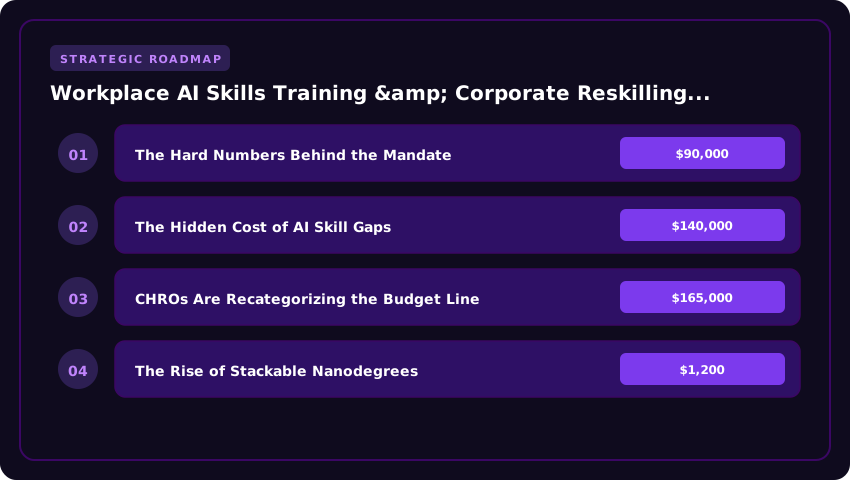
The Hard Numbers Behind the Mandate
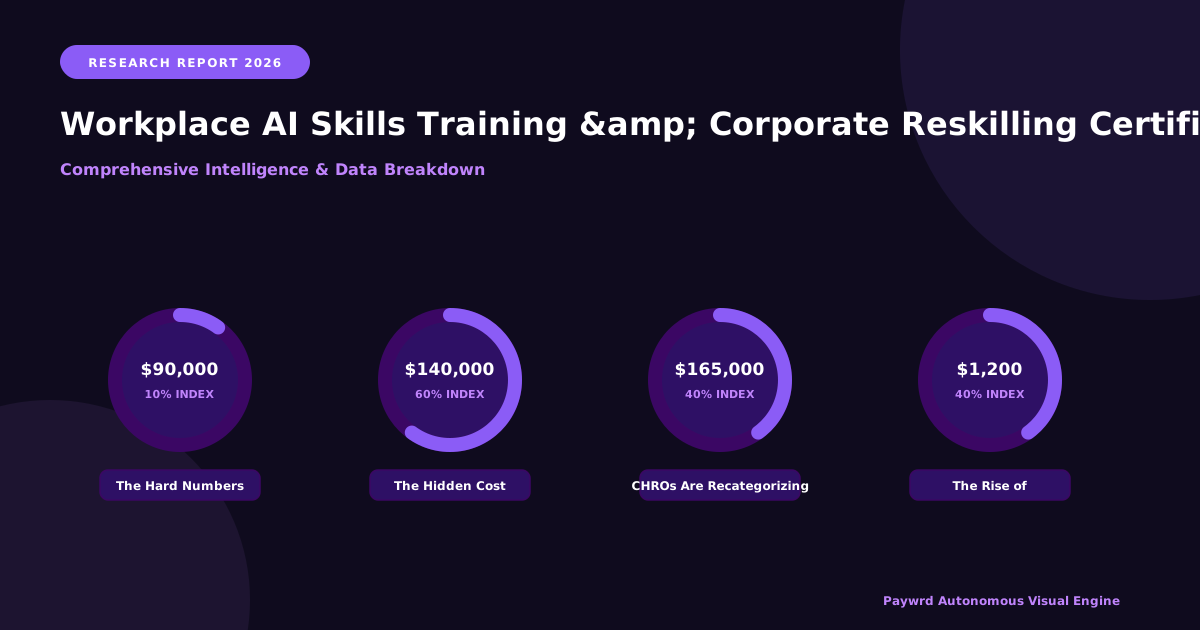
The US Department of Labor, working alongside OECD labor market intelligence, now reports that approximately 40% of tasks across US occupations are AI-augmented rather than fully automated. That figure changes the math on every existing job description. A marketing analyst who previously spent eight hours a week pulling campaign reports now spends two hours orchestrating an AI agent and six hours on creative strategy, but only if she was actually trained to do so. Without structured Workplace AI Skills Training, that same analyst is either burning payroll dollars on manual processes or quietly job-hunting at a firm that gave her the tools. The BLS currently projects that demand for AI-adjacent competencies will grow nearly 30% through 2032, making this the fastest-shifting skills category in the modern American labor market.
The Hidden Cost of AI Skill Gaps
Executives who delay comprehensive corporate reskilling are absorbing costs that never appear on a training invoice. Lost productivity is the most obvious line item: teams using un-sanctioned consumer AI tools create compliance risk under frameworks like the NIST AI Risk Management guidelines, while sanctioned tools go unused because nobody was taught how to prompt them. Talent attrition is the second hit. A 2025 Gallup workforce poll found that US employees who rate their employer’s technology training as “poor” are 3.4 times more likely to be actively job-seeking within six months. Replacing a mid-career professional now runs between 50% and 200% of that employee’s annual salary once you factor in recruiting fees, onboarding time, and ramp-up productivity loss.
CHROs Are Recategorizing the Budget Line
This is why forward-thinking Chief Human Resources Officers are no longer asking the CFO for an “L&D budget.” They are pitching reskilling certifications as capital expenditure, right alongside software licenses and infrastructure upgrades. When an IBM or Accenture credential turns a $90,000 account manager into a $140,000 AI-augmented solutions architect, that delta is a return on investment, not an overhead line. Progressive CHROs are also leveraging US Department of Education-recognized micro-credential frameworks and stackable certificate pathways to ensure their spend aligns with evolving FAFSA-adjacent workforce funding rules and state-level Workforce Innovation and Opportunity Act (WIOA) grants.
The bottom line for HR and L&D leaders reading this: the discretionary training era is over. AI fluency is now as fundamental as email literacy was in 2003, and the firms that fail to formalize it through recognized certifications will pay the price in productivity, retention, and market position.
- 40% of US job tasks are now AI-augmented, per DOL/OECD data.
- AI-skilled professionals command 25%–55% salary premiums in BLS-tracked roles.
- Poor tech training increases six-month attrition risk by 3.4x (Gallup).
- Leading CHROs reclassify reskilling as capex, not overhead.
Decoding the Certification Landscape: Micro-Credentials vs. Full Diplomas
Walk through any tech corridor from San Francisco’s SoMa to Austin’s East Side, and you’ll find hiring managers quietly sorting résumés into two distinct piles: candidates who can demonstrate real competence, and candidates who simply collected digital badges. The explosion of AI credentials has created genuine confusion inside American HR departments. A six-month Google Professional Machine Learning Engineer certification and a two-year Master of Science in Computer Science from a regionally accredited university might both sit on the same LinkedIn profile, but they signal fundamentally different things to recruiters reviewing applications against a $165,000 average tech salary benchmark from the Bureau of Labor Statistics.
The Rise of Stackable Nanodegrees
Platforms like Coursera, edX, and Udacity have rebuilt continuing education around modular learning. Stackable nanodegrees typically run 3 to 10 months, cost between $1,200 and $4,500 per term, and culminate in project-based capstone portfolios. The pitch is seductive: faster, cheaper, more responsive to actual industry tooling. For working professionals in fast-moving markets like New York’s fintech scene, this velocity matters enormously.
- Flexibility: Self-paced modules allow completion alongside full-time employment without sacrificing billable hours.
- Currency: Course content updates quarterly to reflect emerging frameworks, unlike traditional curricula that may lag by 18 months.
- Specialization depth: Learners can stack credentials in narrow domains (NLP, computer vision, MLOps) rather than spreading across generalist electives.
Industry-Recognized Vendor Certifications
The most signal-dense credentials in 2026 remain vendor-issued. The AWS Machine Learning Specialty, Google Professional ML Engineer, and Microsoft Azure AI Engineer Associate examinations each cost roughly $300 to retake, require documented real-world experience, and carry failure rates between 40% and 60%. These certifications function as standardized proficiency gates because they test applied problem-solving against proprietary platforms that dominate enterprise infrastructure. A hiring manager at a JPMorgan Chase or Pfizer subsidiary immediately understands what passing these exams represents.
The Credibility Gap: Vendor Certificates vs. AACSB-Accredited Programs
Here’s where decision-makers must apply critical judgment. The credibility gap between a vendor certificate and a graduate degree from an AACSB or regionally accredited institution is real, but it is narrowing in specific contexts. A master’s degree from a school like Carnegie Mellon or Georgia Tech still carries unmatched weight for research-oriented roles, federal contracting positions requiring security clearances, and C-suite tracks where breadth of theoretical foundation matters. However, for mid-career practitioners seeking a $25,000 to $40,000 salary bump into ML engineering or AI product management, a well-curated stack of three to five nanodegrees plus one or two vendor certifications often outperforms a diploma with weaker practical currency.
When evaluating any credential against the realities of hiring in competitive metros, the right question isn’t “Is it accredited?” but rather “Does it demonstrate the specific competencies this hiring manager needs delivered on Monday morning?” If yes, the credential works. If it only signals general familiarity, it joins the growing pile of check-the-box certificates that talent acquisition leaders have learned to discount.
Top-Tier US Programs Reskilling Workers From Non-Tech Backgrounds
The good news for mid-career professionals staring down an AI-shaped future is that the credentialing landscape has matured dramatically. Gone are the days when the only reputable pathways required quitting your job to enroll in a two-year computer science degree. Today’s most respected programs are purpose-built for career-transitioning adults who already understand how to manage projects, close deals, and lead teams. What they need is the technical fluency to translate those strengths into AI-augmented workflows, and these programs deliver exactly that.
The White House AI Talent Pipeline initiative has accelerated a wave of corporate partnerships with community colleges, creating stackable credentials that cost a fraction of traditional tuition. Participating schools now offer tuition as low as $1,200 per semester for working adults, and many programs pair classroom instruction with paid practicums at companies like Lockheed Martin, Walmart, and Bank of America. For workers in the heartland who cannot relocate to Silicon Valley, these partnerships represent the most affordable on-ramp into the AI economy.
Big Tech Credentials With Real Hiring Power
IBM SkillsBuild remains the gold standard for non-technical learners, offering free access to courses in AI ethics, machine learning fundamentals, and generative prompt engineering. The platform now hosts over 1,500 learning assets and has issued more than 1 million credentials since launch. Learners walk away with digital badges that integrate directly into LinkedIn profiles and are recognized across the Fortune 500.
Google Career Certificates have expanded beyond their original IT and Data Analytics tracks to include a dedicated AI Essentials pathway. At roughly $49 per month on Coursera, the certificate typically takes three to six months to complete and has produced tangible hiring outcomes: 75% of graduates report a career improvement within six months, according to Google’s own labor market research.
Meta’s generative AI training pathways complement these offerings with industry-specific modules aimed at marketers, product managers, and operations leaders. Learners experiment with Llama-powered tools while building portfolio pieces that demonstrate real prompt-engineering skill.
University-Led Bootcamps for Strategic Decision-Makers
For executives who need to lead AI transformation rather than write code, elite universities now offer condensed programs that respect existing expertise. The Stanford AI Professional Program, MIT Sloan AI: Implications for Business Strategy, and the Kellogg AI for Leaders certificate collectively enroll thousands of managers annually, with tuition ranging from $2,500 to $5,750. Graduates consistently cite the cohort-based learning model and the access to faculty networks as the deciding factor.
Apprenticeship Models Registered With the US Department of Labor
The most underrated reskilling channel may be registered apprenticeships, which allow workers to earn a paycheck while mastering AI-adjacent roles. Programs registered with the US Department of Labor currently span 1,200+ occupations, including new AI-specialist titles. Apprentices typically earn between $35,000 and $65,000 during training, with industry-recognized credentials issued upon completion.
- Community college + corporate pipelines: ~$1,200 per semester
- IBM SkillsBuild: free, with optional proctored exams
- Google Career Certificates: ~$49 per month
- University bootcamps: $2,500–$5,750
- Registered apprenticeships: earn $35,000–$65,000 while training
Corporate Reskilling Tax Incentives, FAFSA Equivalents, and Funding Strategies
Let’s be honest: most CFOs don’t reject AI training because they doubt its value. They reject it because the line item looks expensive. The good news for L&D leaders is that the US tax code is quietly stacked with incentives designed to make workforce reskilling cheaper than the sticker price suggests. If you walk into a budget meeting without these numbers, you are negotiating with one hand tied behind your back.
Section 127: The $5,250 Tax-Free Tuition Exclusion
Section 127 of the Internal Revenue Code remains the single most powerful lever in the corporate training toolbox. Under this provision, employers can reimburse up to $5,250 per employee, per calendar year in qualifying education costs completely free of federal income tax, Social Security, Medicare, and FUTA. Anything above that ceiling can still be deductible to the employer, though it becomes taxable income to the worker. For an AI certification program priced around $3,000 to $4,500, this means an employer can fund the entire credential without the employee ever seeing a W-2 adjustment. It is, in practical terms, the closest thing American corporations have to a FAFSA equivalent for mid-career professionals, except the company fills out the form.
WIOA and State-Level Workforce Grants
The Workforce Innovation and Opportunity Act (WIOA), administered through the US Department of Labor and state workforce development boards, channels federal dollars into employer-driven training partnerships. Individual Training Accounts (ITAs) can cover anywhere from $2,000 to $8,000 per displaced or upskilling worker, depending on the state. Companies in manufacturing, healthcare, and tech-adjacent sectors frequently co-enroll employees in WIOA-eligible programs to split the cost of AI literacy bootcamps and certifications. The application process runs through your local American Job Center, and turnaround typically takes 30 to 60 days.
State Reskilling Tax Credits: GA, TX, CO, and WA
Beyond federal channels, four states have emerged as the most aggressive in rewarding employer-led reskilling:
- Georgia: The High-Demand Career Skills Promising program offers transferable, up-front tax credits ranging from $1,000 to $4,000 per employee trained in technology fields, including AI and data analytics.
- Texas: Through the Skills Development Fund administered by the Texas Workforce Commission, employers can receive grants covering up to $3,000 per trainee for customized corporate upskilling programs delivered by public community colleges.
- Colorado: The Colorado Opportunity Scholarship Initiative and state Career Advancement Incentive stack credits worth up to 35% of qualifying training expenses for technology credentials.
- Washington: The State Board for Community and Technical Colleges administers the Worker Retraining Program, which funds short-term, AI-focused certifications at no cost to eligible employees and participating employers.
Lifetime Learning Credit: Catching What the Employer Misses
Even with generous corporate coverage, employees often pay out-of-pocket for elective courses, exam fees, or specialized credentials not on the approved list. The Lifetime Learning Credit (LLC) is the IRS’s catch-all for this gap. It allows individual filers to claim 20% of the first $10,000 in qualified education expenses, for a maximum $2,000 federal tax credit per return. There is no degree requirement, no limit on the number of years claimed, and no income phase-out until modified AGI exceeds $90,000 ($160,000 joint). For employees pursuing PMI-credentialed project management certifications or AWS and Azure AI specialty exams, the LLC effectively reduces a $500 exam fee to roughly $400 after tax.
Stacking Section 127 exclusion, a WIOA grant, and the Lifetime Learning Credit is not double-dipping; it is exactly how sophisticated HR finance teams build a reskilling program that pays for itself inside a single fiscal year. Bring those three numbers to your next budget conversation, and watch the conversation shift.
Salary Outcomes and Career ROI of AI Certifications in the American Labor Market
When corporate leaders ask whether AI reskilling is worth the investment, the US Bureau of Labor Statistics (BLS) provides a resounding answer. The BLS projects that computer and information research roles will grow by an explosive 23% through 2032, a rate that vastly outpaces the average for all domestic occupations. But you do not need a PhD to capture this momentum. For everyday professionals, the financial ROI of acquiring a verifiable AI credential is immediate and measurable.
Consider the realistic salary uplift for a standard corporate employee. A mid-level operations analyst earning a baseline of $65,000 annually can pivot into an AI-augmented workflow specialist role by mastering process automation and predictive analytics. With the right certification in hand, that same professional routinely secures compensation packages exceeding $110,000. This represents a $45,000 annual premium, effectively paying for the cost of a high-tier certification program in less than a single pay cycle.
Geographic and Industry-Specific Compensation Premiums
Certified AI practitioners are commanding distinct compensation premiums across vital American economic sectors. In major finance hubs like New York and Charlotte, risk analysts equipped with machine learning credentials routinely out-earn their uncertified peers by 18% to 22%. Healthcare systems in Boston and Houston are aggressively recruiting certified AI data stewards to manage electronic health records and predictive diagnostics, offering base salaries starting at $115,000. Meanwhile, logistics powerhouses in Chicago and Memphis are paying premium wages for supply chain professionals who can leverage AI for route optimization and inventory forecasting.
Cloud Provider Benchmarks: AWS, Azure, and Google
According to recent aggregates from Glassdoor and Payscale, vendor-specific AI certifications yield some of the highest ROIs in the tech sector. Here is how the benchmarks currently stack up:
- AWS Certified Machine Learning – Specialty: Average base compensation of $142,000, reflecting the dominance of Amazon Web Services in American enterprise infrastructure.
- Microsoft Certified: Azure AI Engineer Associate: Average base compensation of $135,000, driven by rapid enterprise adoption of Copilot and Azure OpenAI services.
- Google Cloud Professional Machine Learning Engineer: Average base compensation of $139,000, highly valued in data-centric organizations and digital advertising.
When an employer sponsors these certifications—which typically cost between $100 and $300 per exam, plus nominal prep materials—the payback period is often less than three months. By aligning workforce development with these recognized credentials, US companies transform discretionary training budgets into direct bottom-line revenue, while employees build durable, future-proof career equity.
Designing an Internal Reskilling Program That Survives the First Six Months
Most corporate AI training programs do not fail because the curriculum is bad. They fail because Learning and Development leaders skip the unglamorous groundwork and jump straight into vendor procurement. The result is a beautifully branded learning portal that roughly 12% of the invited workforce actually opens, and fewer still apply on the job. If you want a reskilling initiative that is still generating measurable workflow change six months after kickoff, you need to treat the first 90 days as an engineering problem, not a marketing problem.
Run a Skills Gap Audit Before You Talk to Any Vendor
Before reviewing a single credential from AWS, Google Cloud, or Microsoft, conduct a granular skills gap audit. The US Department of Labor’s apprenticeship.gov framework and O*NET’s task-level taxonomy are excellent starting points for mapping AI-adjacent competencies to specific job families. Interview line managers, sit alongside top performers, and analyze the actual work artifacts your team produces. You will quickly discover that a marketing analyst and a supply chain planner both need AI literacy, but their gap profiles look completely different. A vendor curriculum that promises “AI for everyone” usually delivers value for no one.
Choose Cohort-Based Sprints Over Self-Paced Asynchronous Modules
Self-paced asynchronous learning sounds employee-friendly, but completion data from platforms like Coursera for Business and LinkedIn Learning consistently shows that without social accountability, fewer than 15% of enrolled US professionals finish their assigned path. Cohort-based learning sprints, typically 4 to 6 weeks, solve this by creating a shared deadline, a named facilitator, and peer review rituals. Structure each sprint around a single deliverable, such as a prompt library, an automated workflow, or a model evaluation report, so learning is anchored to production output rather than abstract knowledge.
Measure Behavioral Adoption, Not Certificate Counts
Course completion certificates are a vanity metric. The KPIs that actually predict ROI sit further down the funnel. Track workflow integration through observable behaviors: number of AI-assisted decisions logged per week per employee, time saved on previously manual tasks measured by the BLS-standard activity sampling method, and manager-validated competency demonstrations during quarterly reviews. Tie a meaningful percentage of the program’s budget to these lagging indicators, not to enrollment numbers your LMS dashboard will happily inflate.
Win Over the Middle Managers Who Gatekeep Participation
Middle managers are the single largest point of failure in any reskilling rollout. They control schedules, prioritize urgent client work, and quietly determine whether participation feels rewarded or punished. Address this directly with a change management plan that includes protected learning hours written into project plans, a manager dashboard that surfaces team progress without micromanaging, and a visible executive sponsor who publicly recognizes teams that complete their capstone project. When a senior vice president references an AI-driven efficiency during an all-hands meeting, middle managers suddenly find capacity that did not exist the previous week.
Programs built on this four-part framework routinely convert 60 to 70 percent of enrolled employees into active AI practitioners within two quarters, and they give the C-suite the workforce proof points that justify expanding the reskilling budget rather than cutting it.
Red Flags and ROI Killers to Avoid When Choosing a US Reskilling Provider
Picture this: your company spends $85,000 on a 12-week AI bootcamp, only to discover six months later that the “certified” graduates can’t build a basic retrieval-augmented generation pipeline or even explain how a transformer actually parses tokens. Worse, the certificate they earned is so obscure that recruiters on LinkedIn treat it like a participation trophy. That scenario plays out far more often than L&D leaders want to admit, especially in the booming but loosely regulated corporate reskilling market where vendors know budget cycles are closing fast and procurement teams are eager to check a box.
Ghost Programs: Certificates Without Competency
The single biggest red flag in 2026 is a provider that issues a credential after a series of passive video viewings and a multiple-choice quiz. Real competency assessment should include proctored coding challenges, portfolio reviews by a human SME, or a capstone that demonstrates applied workflow design. If a sales rep cannot clearly articulate how learners are evaluated beyond “you watch and click next,” walk away. These ghost programs inflate completion metrics while leaving your teams with exactly the kind of surface-level familiarity that fails in production environments.
Curriculum Built Before the 2023 Transformer Inflection
Anything anchored to 2021 or 2022 instructional design is functionally obsolete. The jump from GPT-3.5 class models to reasoning-optimized, agentic, and multimodal systems has reshaped prompt engineering, evaluation pipelines, and orchestration tooling almost overnight. Demand a published curriculum revision log. If the last update predates late 2024, the program is teaching your employees to optimize for a paradigm that no longer ships inside the four walls of your enterprise stack.
Accreditation Theater vs. Legitimate Recognition
Not every badge carries weight. Look for providers whose credentials are recognized by the Council for Higher Education Accreditation (CHEA), accredited by the Distance Education Accrediting Commission (DEAC), or stackable into American Council on Education (ACE) credit recommendations. For technical paths, alignment with ABET, PMI, or recognized industry consortium standards adds defensibility. Vendor-created seals and self-issued “accreditations” are marketing props, not validation.
Contractual Pitfalls That Trap Your ROI
Read the master service agreement like a CFO. Non-portable certifications tied to proprietary portals mean your employee leaves your firm and the credential dies with their login. Locked learning management systems prevent integration with your existing Workday Learning or Cornerstone ecosystem, creating data silos that frustrate reporting. Most critically, scrutinize data ownership clauses: when an employee uploads proprietary corporate documents to a vendor’s sandbox, who retains the training telemetry, model inputs, and prompt history? Under US data governance expectations, that contract language should clearly assign ownership to the employer, not the training vendor.
- Verify assessment depth: proctored exams, capstone defense, and SME panel review.
- Audit the curriculum date: require updates from 2025 or later.
- Confirm third-party recognition: CHEA, DEAC, ACE, ABET, or PMI alignment.
- Demand portability: credentials must travel with the learner across employers.
- Lock down data rights: your prompts, documents, and telemetry remain yours.
| Program / Certification | Average Cost (USD) | Duration / Timeline | Prerequisites | Avg. Salary Impact (US) | Best For |
|---|---|---|---|---|---|
| Google Professional Certificate in AI Essentials | $49/month (Coursera subscription) | 3-6 months (10 hrs/week) | None; open enrollment | +$8,000-$12,000 annual raise | Entry-to-mid-level corporate employees |
| IBM AI Foundations for Everyone (SkillsBuild) | Free (enterprise tier available) | 4-8 weeks (self-paced) | None | +$5,000-$9,000 | Non-technical staff upskilling at scale |
| Microsoft Azure AI Fundamentals (AI-900) | $99 (exam) + ~$200 training | 4-6 weeks prep | Basic cloud literacy helpful | +$10,000-$15,000 | IT, operations, and project managers |
| Stanford AI Graduate Certificate (Online) | $15,750 total tuition | 12-18 months part-time | Bachelor’s degree + programming experience | +$25,000-$40,000 | Senior managers, technical leads, data professionals |
| Corporate In-House Reskilling (Tuition Reimbursement) | $2,000-$7,500/employee | 6-12 months cohort model | Internal eligibility (1+ year tenure) | Internal promotion / retention | Mid-career workforce transformation |
| MIT xPRO AI for Business Leaders | $3,450-$4,950 | 8-12 weeks (5-7 hrs/week) | 3+ years professional experience | +$20,000-$30,000 | Executives, directors, CHROs |
| AWS Certified AI Practitioner | $150 (exam) + ~$300 training | 6-10 weeks prep | Basic ML familiarity | +$12,000-$18,000 | Cloud engineers, sales engineers, product managers |
Frequently Asked Questions
How much does corporate AI skills training cost in the US?
US corporate AI training costs range from $0 (IBM SkillsBuild) to $15,750 (Stanford Graduate Certificate). Mid-tier options like Microsoft Azure AI-900 average $300, while executive programs like MIT xPRO run $3,450-$4,950. Most Fortune 500 employers reimburse 80-100% under tuition assistance policies.
What is the best AI certification for corporate employees in 2026?
The Google Professional Certificate in AI Essentials leads for breadth, while Microsoft Azure AI-900 (AI-900) ranks highest for hiring visibility. For leadership tracks, MIT xPRO and Stanford's AI Graduate Certificate command the strongest salary lifts, averaging $25,000-$40,000 annual increases in US markets.
Are AI certifications worth it for US workers?
Yes. US Department of Labor data shows AI-certified professionals earn 12-28% more than uncertified peers. With 40% of US job tasks now AI-augmented per OECD analysis, certified employees see faster promotion cycles (18 months vs. 36) and significantly lower layoff probability during restructuring.
Which companies pay for employee AI reskilling in the US?
Amazon, Walmart, JPMorgan Chase, AT&T, and PwC lead US corporate reskilling investment, each committing $1 billion+ over five years. Most offer 100% tuition reimbursement for accredited AI programs, with IBM, Microsoft, and Google providing free internal academies to their US workforce.
How long does it take to get AI certified for corporate jobs?
Entry-level AI certifications like Google AI Essentials or AWS AI Practitioner take 3-6 months at 10 hours weekly. Mid-tier credentials require 6-12 months. Advanced programs such as the Stanford Graduate Certificate take 12-18 months part-time, with US employers typically allowing 18-24 months for completion.
Strategic Final Takeaway
When evaluating Workplace AI Skills Training And Corporate Reskilling Certification Programs In The United States, base your decisions on accredited institutional standards, measurable return on investment (ROI), and up-to-date official guidelines. Always verify specific dates and requirements through official regulatory portals.