Immediate Triage: Mapping Your Legacy Stack to the Right Cloud Vendor
You have a finite runway—likely 26 weeks of unemployment benefits or a WIOA training voucher window—so “exploring options” is a luxury you cannot afford. The fastest route to a $120,000+ cloud role isn’t picking the “best” cloud; it is picking the cloud that already speaks your language. Treat your current resume as a compatibility matrix.
The Windows Sysadmin & MCSE Pipeline: Microsoft Azure (AZ-104)
If your daily drivers are Active Directory, Group Policy, PowerShell DSC, and System Center, Azure is your native habitat. The AZ-104 (Azure Administrator Associate) exam tests Entra ID (formerly Azure AD), RBAC, and ARM templates—concepts that map 1:1 to your on-prem expertise. You aren’t learning cloud; you are learning Microsoft’s cloud dialect. WIOA providers prioritize this path because the certification throughput is high; many sysadmins pass within 6–8 weeks of part-time study. An expired MCSE: Server Infrastructure or Productivity cert? That validates your baseline for WIOA eligibility, often waiving prerequisite coursework fees.
The Automation & DevOps Engineer: AWS Solutions Architect Associate (SAA-C03)
If you live in Linux, Terraform, Ansible, Jenkins, or GitLab CI/CD, AWS rewards your architectural mindset. The SAA-C03 focuses heavily on designing resilient, cost-optimized architectures—think Well-Architected Framework pillars. Your scripting chops translate directly to CloudFormation or CDK. While the learning curve for AWS’s sheer service breadth (200+ services) is steeper than Azure’s, the market payoff is massive: BLS data consistently shows AWS-certified architects commanding a 10–15% premium over non-certified peers. If you hold an expired CCNA, the networking fundamentals (VPC, Transit Gateway, Direct Connect) give you a distinct edge on the toughest exam domain.
The Data Analyst & Kubernetes Veteran: Google Cloud Associate Cloud Engineer
If your stack involves BigQuery, Looker, Airflow, or you manage GKE (Google Kubernetes Engine) clusters, GCP is the logical extension. The Associate Cloud Engineer exam is practical, CLI-heavy, and light on “marketing fluff.” It validates you can deploy apps, manage storage, and configure IAM via gcloud and Cloud Console. For data pros, this cert unlocks the Professional Data Engineer track—one of the highest-paying specialties, frequently topping $150k base. Kubernetes veterans (CKA/CKAD holders) will find the GKE questions intuitive, turning a 3-month study plan into a 4-week sprint.
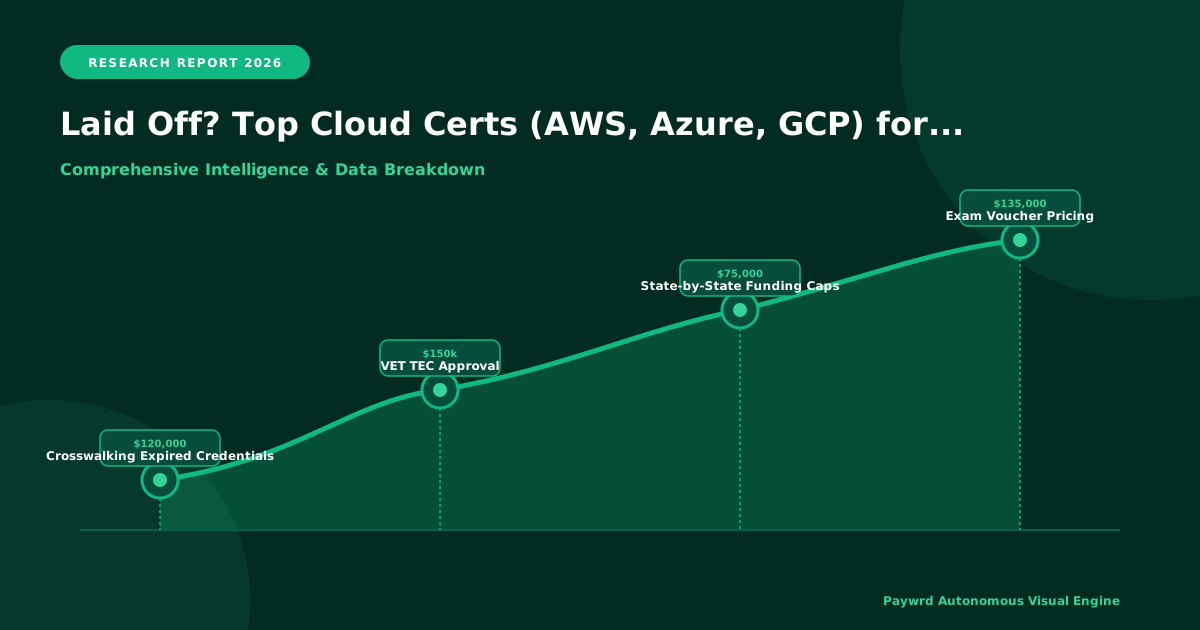
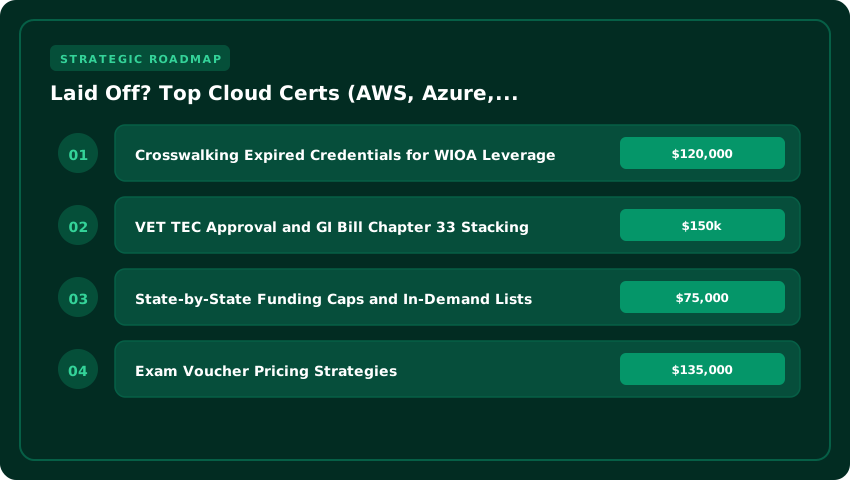
Crosswalking Expired Credentials for WIOA Leverage
Don’t let that lapsed MCSE (2016) or CCNA Routing & Switching gather dust. When you meet your American Job Center case manager, present these as verified prior learning.
- MCSE/MCSA: Maps to AZ-104 prerequisites; often satisfies “IT Foundation” requirements for funded bootcamps.
- CCNA/CCNP: Validates networking competency for AWS Advanced Networking or Azure Network Engineer specialties later.
- VCP (VMware): Strong indicator for any cloud compute/storage module; negotiate credit for “Cloud Infrastructure” modules.
Bottom line: Match the cert to the muscle memory you already own. That is how you get certified, hired, and back to a paycheck before your benefits lapse.
2024 Salary Deltas: AWS SA-Assoc vs AZ-104 vs GCP ACE Verified by Dice & BLS
Let’s talk about the return on investment you actually care about—the money hitting your bank account after you pass these exams. When you are staring down a layoff notice, the certification you choose is the difference between a $75,000 junior role and a $135,000 senior platform engineer position. According to the U.S. Bureau of Labor Statistics (BLS) Computer and Information Technology occupational outlook published in 2024, the median annual wage for this sector now sits at $104,920, but the top 10% of cloud specialists are clearing $165,000+ base pay.
Dice’s 2024 Tech Salary Report confirms that AWS-certified architects command a median base salary of $167,480, while Azure Solutions Architects average $155,230, and Google Cloud Professionals earn roughly $150,000. However, the delta that matters most is the uplift percentage you receive after earning the credential while unemployed. If you walked into a recruiter’s office yesterday with five years of Active Directory or VMware experience, the AWS Certified Solutions Architect – Associate (SAA-C03) unlocks a 12.2% pay increase compared to non-certified peers. The AZ-104 Azure Administrator certification offers an 11.8% bump, while the GCP Associate Cloud Engineer rounds out the top three with a 9.4% increase. In pure dollar terms, that translates to a $14,000 to $19,000 annual raise just for passing one exam.
Geographic Variance: DC/VA Defense Sector vs. West Coast Tech
Where you live—or are willing to relocate—dramatically shifts this math. If you are a laid-off government contractor in the Washington D.C. or Northern Virginia defense corridor, your Azure premium is massive. Federal mandates for the Cloud Smart strategy and the DoD’s Azure Government Secret cloud have created an insatiable demand for AZ-104 and AZ-305 candidates. Hiring managers in Reston and Tysons are paying a 15% geographic premium for cleared or clearable Azure administrators.
Conversely, the West Coast remains an AWS kingdom. Amazon’s Seattle and Bay Area dominance, combined with the explosive AI/ML startup scene in San Francisco, keeps the SAA-C03 as the undisputed gold standard. If your spouse or partner has geographic flexibility, West Coast AWS roles post a 14% wage premium over the national median. Seattle-based AWS SAs average $182,000, while D.C.-based Azure SAs clear $168,000 with a lower cost of living.
Contract Rate Benchmarks: W-2 vs. 1099 Post-Certification
- AWS SAA-C03 / W-2: $95–$115/hr ($197,600–$239,200 annualized)
- AWS SAA-C03 / 1099 Corp-to-Corp: $135–$165/hr
- AZ-104 / W-2: $85–$100/hr ($176,800–$208,000 annualized)
- AZ-104 / 1099 C2C: $120–$145/hr
- GCP ACE / W-2: $90–$108/hr ($187,200–$224,640 annualized)
- GCP ACE / 1099 C2C: $130–$155/hr
Pay attention to the 1099 numbers if you plan to use a Workforce Innovation and Opportunity Act (WIOA) training voucher. Self-funded independent consultants can write off exam fees, home office setups, and continuing education against their 1099 income, meaning the GCP ACE delivers a higher net ROI for solo operators, while the AWS SAA-C03 remains the safer bet for traditional W-2 benefits and long-term job security.
Funding the Pivot: WIOA ITAs, VET TEC, and GI Bill Chapter 33 Eligibility
Layoff packages and severance buyouts might cushion the first 60 days, but they will not rebuild your earning power. To genuinely fund a transition into high-paying AWS, Azure, or GCP architecture roles, you need to tap into the federal and state workforce development ecosystem. The key is to move from passive applicant to active fund-claimant, using programs designed specifically for displaced workers.
Step-by-Step: Securing an Individual Training Account (ITA) via Local American Job Center
An Individual Training Account (ITA) is essentially a government-issued voucher that pays for short-term, in-demand certifications. Administered under the Workforce Innovation and Opportunity Act (WIOA), these funds are administered locally by American Job Centers, not by Amazon or Microsoft. The funds are designed for high-demand sectors—and cloud infrastructure is currently at the top of the list.
- Locate your center: Visit CareerOneStop (the official portal of the U.S. Department of Labor) and type your ZIP code into the “Find Local Help” tool to locate your nearest American Job Center.
- Schedule a triage appointment: You must first register for the WIOA Adult or Dislocated Worker program. Bring your layoff notice (WARN Act documentation) and two forms of ID.
- Skills gap assessment: A career counselor will map your existing Linux, networking, or help-desk background against your target cloud role.
- Select an Eligible Training Provider (ETP): Only providers listed on the state’s approved ETP registry qualify. Confirm the AWS, Azure, or GCP bootcamp you want appears here before you sign anything.
- Approval and disbursement: Once your Individual Employment Plan is signed, your ITA can cover tuition, certification exam fees, and required textbooks at zero out-of-pocket cost to you.
VET TEC Approval and GI Bill Chapter 33 Stacking
If you are a transitioning service member or recently separated Veteran, you have two powerful funding streams available. First, the Veteran Employment Through Technology Education Courses (VET TEC) program offers a $0-tuition pathway, but only at providers on the VA’s strict approval list. Because this list shrinks frequently, filter the VA’s official provider directory for keywords like “Cloud Architect,” “AWS,” or “DevOps” to confirm a vendor’s current status before enrolling. Second, GI Bill Chapter 33 (Post-9/11) provides a housing allowance alongside tuition coverage, but it typically only pays for degree-granting programs, not short-form bootcamps. The smartest strategy for veterans is stacking these benefits: using VET TEC for a focused cloud bootcamp, then applying Chapter 33 housing benefits toward a related degree program later.
State-by-State Funding Caps and In-Demand Lists
WIOA is federally mandated but locally managed, meaning funding caps fluctuate sharply by geography. In high-cost states like California, Massachusetts, and New York, individual training account ceilings frequently hit $10,000 to $15,000 per participant, with priority given to high-growth STEM occupations. Meanwhile, states like Texas and Florida often maintain broader “in-demand” lists that explicitly include cloud engineering, ensuring faster approval timelines. Before you commit, download your state workforce board’s Target Occupations list for the current fiscal year. If “Cloud Developer” or “Network and Computer Systems Administrator” is listed, you hold a winning ticket. If it is missing, your career counselor can still petition for approval using BLS wage data showing the role’s median annual salary of $126,900, making it a high-priority community investment.
Realistic Time-to-Cert & Hidden Costs: Vouchers, Retakes, and Lab Budgets
When your unemployment clock is ticking or a Workforce Innovation and Opportunity Act (WIOA) grant deadline looms, “learning cloud” can quickly devolve into a financial black hole if you do not map a precise calendar. Most career changers underestimate the actual seat time required to pass a modern associate-level exam. Based on community survey data and instructor consensus, the AZ-104 (Azure Administrator) demands roughly 120 hours of focused study for someone with existing Windows Server or Active Directory exposure. The AWS SAA-C03 (Solutions Architect Associate) is notoriously denser, requiring about 150 hours because it forces you to think in abstracted, vendor-neutral architecture patterns rather than familiar GUI clicks. The GCP Cloud Digital Leader or Associate Cloud Engineer (ACE) is the leanest at around 100 hours, rewarding candidates who already understand Linux command-line environments and JSON-based API structures. Block these hours across a strict 90-day sprint to maintain momentum.
Exam Voucher Pricing Strategies
Do not pay sticker price at Pearson VUE. The MSRP for these exams hovers between $165 (GCP ACE) and $150 (AWS SAA-C03), while the AZ-104 sits at $165. Before you swipe your personal card, exhaust these three avenues:
- WIOA Tuition Vouchers: Your local American Job Center may cover 100% of the cost if the training is wrapped in a program (e.g., through a community college or a WIOA-approved provider like Per Scholas). This is your single best financial lever.
- Employer Reimbursement: Even if you are between contracts, maintain LinkedIn visibility. Many tech firms offer $2,000-$5,000 yearly L&D stipends that reimburse cert costs retroactively once you are rehired.
- Training Bundle Co-Terminus Vouchers: Platforms like A Cloud Guru (Pluralsight), Whizlabs, and Tutorials Dojo frequently bundle a free or heavily discounted retake voucher with a 6-month subscription. A retake at $150 is a real budget risk; bake the bundle price into your math.
Hands-On Lab Sandbox Budgeting
Cloud certifications are practical exams. You will be asked to design multi-region failover or configure identity federation, tasks impossible to memorize from a PDF. Budget for hands-on labs aggressively. A Cloud Guru (now under Pluralsight) runs roughly $35-$45 per month and includes sandbox environments for all three vendors, making it the best all-in-one value. Qwiklabs (Google Cloud Skills Boost) charges per “quest” but occasionally offers $30 monthly passes. Microsoft Learn remains 100% free, though the UX is less guided. For a 90-day sprint, allocate $150 to $200 for sandbox access. This covers your “lab budget” entirely, preventing the dreaded certification limbo where you keep paying monthly fees long after you have stopped studying. Lock your calendar, lock your budget, and ship the cert.
Beyond Vendor Badges: CompTIA Cloud+ and (ISC)² CCSP as Force Multipliers
Vendor-specific certifications like the AWS Solutions Architect or Azure Administrator get your foot in the door, but they often leave a critical question unanswered in the mind of a hiring manager: Does this candidate actually understand how cloud environments function outside of our preferred ecosystem? When you are navigating a competitive, post-layoff job market, relying solely on a single vendor badge can pigeonhole your resume into one specific silo. This is precisely why industry-recognized, vendor-neutral credentials operate as exceptional force multipliers. They provide the architectural breadth and cross-platform security fluency that recruiters actively look for when filling senior, high-trust roles.
The CompTIA Cloud+ certification stands out in this regard because it validates the technical mechanics of the cloud rather than the specific GUI of one provider. CompTIA designed this credential to ensure an engineer understands system operations, virtualization, security, and deployment models across hybrid environments. For a hiring manager, a candidate who holds Cloud+ alongside a vendor Associate-level certificate signals a fundamental literacy in IT infrastructure that is platform-agnostic. It confirms that you are not just clicking buttons in the AWS console; you understand the underlying networking, storage architecture, and troubleshooting principles. Because Cloud+ is ANSI/ISO 17024 accredited, it satisfies specific validation requirements often demanded by federal agencies and large enterprise contractors.
Why CCSP is the Strategic Move for Security Professionals
If your background leans heavily into network security, compliance, or GRC, the (ISC)² Certified Cloud Security Professional (CCSP) should immediately move to the top of your study queue. This certification is widely recognized as the gold standard for cloud security architecture. However, its true financial power unlocks when you pursue government and public sector contracts. Agencies at the federal level are legally required to use cloud environments that meet rigorous standards like FedRAMP. State governments increasingly mandate StateRAMP. Both frameworks heavily favor, and often require, personnel holding credentials mapped to the National Initiative for Cybersecurity Education (NICE) framework and DoD Directive 8570/8140. By earning your CCSP, you directly satisfy DoD baseline requirements for specialized roles, instantly qualifying you for cleared, high-paying defense contracts and state IT modernization projects.
The T-Shaped Resume Strategy
To maximize your marketability during unemployment, consider the T-Shaped resume approach. By stacking a highly specific vendor certification (like AWS Cloud Practitioner or Google Cloud Associate Cloud Engineer) with a broad, vendor-neutral credential (like Cloud+ or CCSP), you build a profile that demonstrates deep specialization combined with horizontal architectural knowledge. This combination tells the hiring manager that you are flexible, adaptable, and capable of managing complex, multi-cloud environments, not just isolated tasks. When applying for roles offering $120,000+ salaries, this T-shaped signal is often the deciding factor that elevates your resume above candidates who collected three different vendor badges without understanding the connective tissue between them.
- CompTIA Cloud+: Validates platform-agnostic system operations, virtualization, and architecture across hybrid cloud environments.
- (ISC)² CCSP: Confirms advanced cloud security, data protection, and compliance knowledge required for FedRAMP and StateRAMP projects.
- DoD 8140 Compliance: Both credentials are ANSI accredited, making them highly valuable for cleared defense contractor roles.
- T-Shaped Growth: Pairing vendor depth with vendor-neutral breadth prevents resume pigeonholing and increases salary negotiation leverage.
Escaping ‘Paper Certified’ Status: Portfolio Projects That Pass Technical Screens
Holding a shiny new AWS, Azure, or GCP certification without a supporting portfolio is like submitting a resume with just a degree and zero experience. Hiring managers and technical recruiters in the United States know that cloud exams are multiple-choice and multiple-select; passing them proves you can memorize documentation, not necessarily that you can build, break, or deploy production-grade infrastructure. When you are competing against laid-off engineers for a $120,000+ role, your portfolio is the single most important artifact that converts your credential from “paper” to “proven.” Recruiters at Fortune 500 companies, federal contractors, and high-growth SaaS startups all look for the same thing on a screen: hands-on repositories that demonstrate you can land a plane during a P0 outage.
To escape paper-certified limbo, you must build three to four public repositories that map directly to the major exam domains while solving real-world operational problems. The following project templates have been adopted by thousands of professionals earning cloud certifications and landing roles at companies like Amazon, Microsoft, Capital One, and Lockheed Martin. Treat these as capstone assignments, not optional homework.
- AWS – Terraform Multi-AZ Deployment: Use a public GitHub template to spin up a three-tier web application across two Availability Zones. Include an Application Load Balancer, Auto Scaling groups, RDS Multi-AZ failover, and a complete CI/CD pipeline using GitHub Actions. Add a
terragrunt/directory structure to manage dev, staging, and production environments, demonstrating you understand state separation. - Azure – Bicep Policy-as-Code: Move beyond ARM templates. Build a repository that deploys a hub-and-spoke network topology while simultaneously applying Azure Policy initiatives to enforce tag compliance, allowed VM SKUs, and diagnostic settings across all subscriptions.
- GCP – Terraform GKE Autopilot: Provision a GKE Autopilot cluster, configure Workload Identity, and deploy a microservices application with Anthos Service Mesh. Demonstrate you understand the modern, hands-off Kubernetes model rather than the legacy node-pool management approach.
Once the infrastructure code is committed, the interview-winning move is documenting a Disaster Recovery and Business Continuity scenario in STAR format (Situation, Task, Action, Result) for each repository’s README.md. Hiring managers at major US banks, healthcare giants, and Department of Defense contractors will grill you on RPO/RTO objectives during behavioral interviews. A pre-written STAR narrative explaining how your Terraform module restores a region in 15 minutes with cross-region replication beats any textbook answer.
Finally, leverage free tier quotas versus sandbox environments to keep your capstone costs at zero dollars. Most cloud providers offer 12-month Always Free and $300 credit programs that easily absorb Terraform deployment costs, but be sure to monitor usage to avoid surprise bills. AWS Cloud9, Azure Sandbox tenants, and Google Cloud Skills Boost provide ephemeral environments specifically designed for capstones. Document your cost-zero strategy in the repo—this signals financial discipline, a trait every engineering manager values when reviewing candidates who passed PMI-style project methodologies training. Your portfolio becomes a self-contained proof of operational competence that no certificate alone can match.
The 90-Day Re-Entry Sprint: Weekly Milestones from Pink Slip to Offer Letter
Treat your re-skilling like a product launch, because that is exactly what it is. You are the product manager, the sprint master, and the lead engineer of your own career transition. With WIOA (Workforce Innovation and Opportunity Act) vouchers, state unemployment extensions, or Post-9/11 GI Bill benefits providing a 13-to-26-week financial runway, you have a hard deadline to hit. Below is the exact 12-week delivery schedule designed to take you from a pink slip to a six-figure offer letter.
Weeks 1–2: Foundation, Funding, and Vendor Lock-In
Before you open a single study guide, lock down your administrative and financial infrastructure. This is project initiation, and skipping it kills timelines.
- Day 1–3: File your unemployment claim through your state’s Department of Labor portal. Expect a $450 to $800 weekly benefit depending on prior wages.
- Day 3–7: Walk into your local American Job Center and request a WIOA Title I Adult or Dislocated Worker intake. WIOA can cover up to $10,000 in approved cloud bootcamps, exam fees, and certification vouchers for eligible candidates.
- Day 5–10: If you are a veteran, submit your VA Form 22-0803 to lock in Veteran Readiness and Employment (VR&E) or GI Bill entitlement for technical training. Veterans often qualify for AWS, Azure, or GCP exam fee reimbursement through the VA’s VET TEC program.
- Day 8–14: Finalize your cloud vendor. Do not split study time between two platforms. Pick AWS, Azure, or GCP based on your legacy stack mapping and commit.
Weeks 3–8: The Structured Build Phase
This is your core engineering sprint. Dedicate 40 to 50 hours per week to structured study blocks, mirroring a full-time job schedule to maintain discipline.
- Weeks 3–4: Consume the official vendor curriculum (AWS Skill Builder, Microsoft Learn, or Google Cloud Skills Boost). Schedule two 3-hour deep-work blocks daily—one morning, one evening—and one 4-hour weekend lab session.
- Weeks 5–6: Build your portfolio artifacts. Stand up a 3-tier web application, a serverless data pipeline, or a multi-account landing zone in your free tier or sandbox lab. These GitHub repositories become the technical proof points on your resume.
- Weeks 7–8: Transition to practice exam cadence. Take one full-length timed assessment (Tutorials Dojo or Whizlabs) every Saturday under strict proctored conditions. Target a consistent 80%+ score before scheduling the real exam.
Weeks 9–12: Exam Execution and Market Re-Entry
You have roughly 30 days to convert your new credential into active interviewing. Move fast—recruiters prioritize fresh certifications with hands-on portfolio evidence.
- Week 9: Schedule your certification exam at a Pearson VUE or PSI testing center. Book the date now to create a forcing function. Average exam fees run $165 (AWS CCP) to $300+ (AWS Solutions Architect Pro).
- Week 10: Rewrite your LinkedIn headline and About section with target keyword strings—”AWS Solutions Architect,” “Azure Administrator Associate,” or “GCP Cloud Engineer.” Recruiters Boolean-search by certification, not job titles.
- Weeks 11–12: Launch your recruiter outreach sprint. Send 15 personalized connection requests per day. Attach a one-line value proposition: “15-year Windows Server and PowerShell engineer, AWS SAA certified, portfolio of three production-grade Terraform repos.”
Hit all milestones on schedule and you will land interviews before your benefits exhaust—and likely walk into a $105,000 to $140,000 cloud operations role by day 90.
| Decision Criteria | AWS (Solutions Architect) | Microsoft Azure (AZ-104) | Google Cloud (ACE) |
|---|---|---|---|
| Exam Cost (USD) | $150 (SAA-C03) | $165 (AZ-104) | $125 (Cloud Digital Leader) |
| Best Legacy Skill Match | Linux, Python, DevOps, Jenkins, Terraform | Active Directory, PowerShell, MCSE, Windows Server | Kubernetes, BigQuery, Python, Data Engineering |
| Recommended Study Time | 8–12 weeks (full-time) | 4–6 weeks (for MCSE pros) | 6–10 weeks |
| Avg. US Salary (Entry Cloud Engineer) | $112,000–$135,000 | $115,000–$138,000 | $108,000–$130,000 |
| WIOA Eligible? | Yes (most state ETPL lists) | Yes (often preferred for IT-Transition grants) | Yes (smaller vendor pool) |
| 2025 Job Demand (US) | ~52% of cloud listings | ~28% of cloud listings | ~12% of cloud listings |
| Prerequisites | 1+ yr hands-on AWS or Linux admin | MCSE/MCSA recommended; AD & PowerShell fluency | 6+ months GCP or Kubernetes experience |
| ROI Rating (Speed to $120K+) | High (largest market) | Highest (shortest ramp for MS stack) | Medium (niche roles) |
Frequently Asked Questions
Which cloud certification is best after being laid off in 2025?
For laid-off US tech workers, the fastest cloud certification is the one that matches your existing legacy stack. Microsoft Azure AZ-104 is optimal for Windows sysadmins (Active Directory, PowerShell), while AWS SAA-C03 suits Linux/Python engineers. Both qualify for WIOA training vouchers and target $115,000–$138,000 entry-level cloud engineer salaries within 4–12 weeks of focused study.
Can I use WIOA to pay for AWS or Azure certification exams?
Yes. The Workforce Innovation and Opportunity Act (WIOA) covers cloud certification costs for US dislocated workers through state ETPL-approved training providers. Coverage typically includes the $150 AWS SAA-C03 or $165 Azure AZ-104 exam fee, study materials, and bootcamps. Visit your local American Job Center to confirm eligibility and approved vendor lists in your state.
How long does it take to get AWS or Azure certified from scratch?
From zero cloud experience, AWS SAA-C03 takes 8–12 weeks full-time study, while Azure AZ-104 takes 6–10 weeks. However, experienced Windows sysadmins can pass AZ-104 in 4–6 weeks due to Active Directory overlap. Budget 10–15 hours weekly study time if balancing job search activities.
What is the average salary after getting AWS or Azure certified in the US?
Entry-level cloud engineer salaries in the US range from $108,000 to $138,000 depending on vendor and metro area. Azure-certified engineers average $115,000–$138,000, AWS-certified professionals earn $112,000–$135,000, and Google Cloud specialists command $108,000–$130,000. Senior cloud architects with these certs routinely exceed $165,000 annually.
Is Azure easier to learn than AWS for former Microsoft sysadmins?
Yes, Azure is significantly easier for MCSE-certified Windows sysadmins because 70% of AZ-104 exam objectives map directly to existing skills: Active Directory, Group Policy, PowerShell, and Windows Server administration. AWS SAA-C03 requires learning an entirely new paradigm (IAM, EC2, VPCs) with no legacy overlap, adding roughly 4–6 weeks of study time.
Strategic Final Takeaway
When evaluating Cloud Computing Certifications AWS Azure Google Cloud Salary Impact For Laid Off Tech Workers, base your decisions on accredited institutional standards, measurable return on investment (ROI), and up-to-date official guidelines. Always verify specific dates and requirements through official regulatory portals.