

Do Online Degrees Qualify for FAFSA? The Eligibility Truth
If you have ever wondered whether your online degree program locks you out of federal financial aid, the short answer is reassuring: it does not. The U.S. Department of Education does not distinguish between online and on-campus enrollment when awarding Title IV funds. Whether you are logging into lectures from a apartment in Chicago or attending a hybrid program at a state university in Texas, your eligibility for federal aid hinges on the institution’s accreditation status, not the delivery method of your coursework.

This distinction matters more than ever in 2025. As online enrollment continues to surge across U.S. universities, the Department of Education has made it clear that students pursuing accredited online degrees deserve the same financial support as their on-campus peers. That means online learners can access the full spectrum of federal aid, including Pell Grants, Direct Subsidized Loans, Direct Unsubsidized Loans, and Federal Work-Study opportunities.
However, there is a critical caveat. Not every online program qualifies. To receive federal financial aid, your chosen institution must meet specific requirements:
- Institutional Accreditation: The school must be accredited by an agency recognized by the U.S. Department of Education. Regional accreditors such as the Higher Learning Commission or the Middle States Commission on Higher Education are the gold standard, while programmatic accreditors like ABET for engineering or AACSB for business add another layer of credibility.
- Title IV Participation: The institution must be listed in the Federal Student Aid provider database, confirming its eligibility to administer federal funds.
- Program Eligibility: The specific online program must lead to a recognized credential, such as an associate degree, bachelor’s degree, or graduate degree.
- Enrollment Status: You must be enrolled at least half-time to qualify for Direct Loans, though Pell Grants may be available to students enrolled less than half-time depending on financial need.
It is also worth noting that the Free Application for Federal Student Aid (FAFSA) itself does not ask whether you are studying online or in person. The form collects information about your financial situation, household size, and enrollment plans. Once submitted, your Student Aid Index (SAI) is calculated, and your chosen school’s financial aid office determines your eligibility based on the cost of attendance for your specific program.
For students considering online degrees, this means the financial playing field has leveled significantly. A student pursuing a fully online Bachelor of Science in Nursing from an accredited public university is just as eligible for a Pell Grant as a student attending the same program on campus. The Department of Education recognizes that the quality of education and the financial need of the student are what matter, not the physical location where learning occurs.
Key takeaway: Before enrolling in any online program, verify the institution’s accreditation through the Department of Education’s database and confirm its Title IV eligibility. This single step ensures your online degree qualifies for the full range of federal financial aid, potentially saving you thousands of dollars over the course of your education.
Accreditation Is Everything: Regional vs. National and Why It Matters
When you are navigating the complex world of federal financial aid, accreditation is the absolute gatekeeper. The U.S. Department of Education (DOE) does not hand out FAFSA funds to just any institution; the school must meet rigorous quality standards. However, not all accreditation is created equal. Understanding the hierarchy is crucial to protecting your investment of both time and tuition dollars.
Regional Accreditation is the gold standard in American higher education. Agencies such as the Higher Learning Commission (HLC), the Middle States Commission on Higher Education (MSCHE), and the Western Association of Schools and Colleges (WASC) oversee academically oriented, nonprofit, and state universities. If you enroll in an online program at a regionally accredited school, your credits are highly likely to transfer to other major institutions, and your degree will carry maximum weight with employers.
National Accreditation, often granted by bodies like the Distance Education Accrediting Commission (DEAC), is typically held by vocational, technical, and for-profit online schools. While these programs do qualify for FAFSA, their credits rarely transfer to regionally accredited universities. If you plan to pivot to a traditional university later, a nationally accredited degree might leave you starting from scratch.
Beyond institutional accreditation, you must look for Programmatic Accreditation. This evaluates specific departments or degrees. For example, if you are pursuing an online engineering degree, look for ABET accreditation. Future business leaders should seek out programs accredited by the AACSB. Nursing students must prioritize CCNE accreditation. These specialized seals of approval ensure your curriculum meets industry standards and often dictate whether you can sit for professional licensure exams.
So, how do you verify a school’s claims before submitting your FAFSA? You must independently verify their status using the DOE’s Database of Accredited Postsecondary Institutions and Programs (DAPIP). Here is your step-by-step method:
- Step 1: Navigate to the official DAPIP website hosted by the U.S. Department of Education.
- Step 2: Enter the exact name of the online institution in the search bar. Avoid abbreviations to ensure accurate results.
- Step 3: Review the institution’s profile to confirm the specific accrediting agency (e.g., HLC or DEAC) and check the current accreditation status. Ensure it says “Accredited” and not “Probation” or “Withdrawn.”
- Step 4: Scroll down to the specialized programmatic accreditations section to verify ABET, AACSB, or CCNE listings if applicable to your major.
- Step 5: Cross-reference the accreditation expiration date to ensure the school remains in good standing throughout your enrollment period.
By taking these proactive steps, you ensure your online degree is not only eligible for federal grants and loans but also respected by future employers and academic institutions. Never take a school’s word at face value; always verify through DAPIP to protect your educational journey.
Types of Federal Aid Available to Online Students in 2025
Online learners in the United States have access to the same foundational federal financial aid programs as their on-campus peers, provided they attend a school that is regionally accredited and has been certified by the Department of Education to participate in Title IV programs. For the 2024-25 award year, the U.S. Department of Education has confirmed that distance education students may receive Federal Pell Grants, William D. Ford Federal Direct Loans (both Subsidized and Unsubsidized), Parent PLUS Loans, Graduate PLUS Loans, and Federal Work-Study (FWS) funds. Understanding the nuances of each program, especially how award limits and Cost of Attendance calculations apply to a laptop-and-kitchen-table learning model, empowers you to plan strategically and minimize debt.
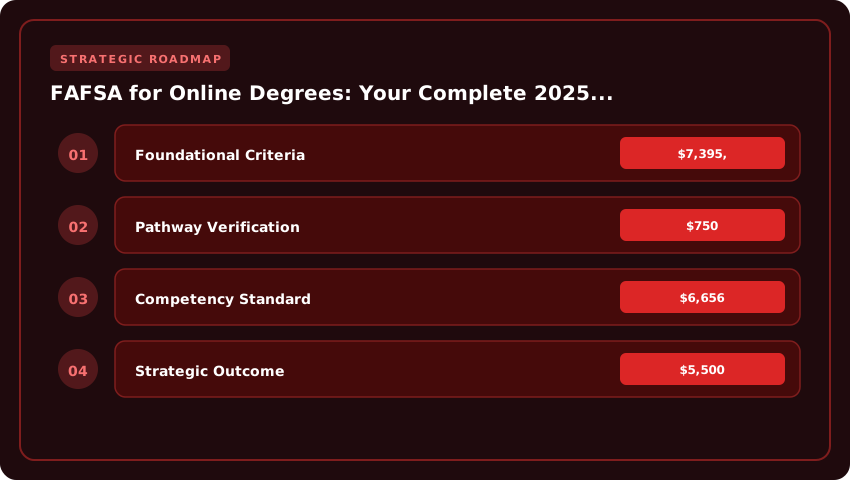
The Federal Pell Grant remains the cornerstone of need-based undergraduate aid. For the 2024-25 award year, the maximum scheduled award is $7,395, with a minimum award of $750. Your Expected Family Contribution (EFC) has been replaced by the Student Aid Index (SAI) under the FAFSA Simplification Act, but the underlying principle remains: the lower your SAI, the higher your Pell eligibility. Critically, online students enrolled full-time at a participating institution can receive the full $7,395, provided their SAI falls within the qualifying range (typically up to $6,656 for the maximum award in 2024-25). Pell Grants do not require repayment, making them the most valuable form of aid available to undergraduates pursuing accredited online bachelor’s or associate degrees.
When grant funds fall short, Federal Direct Loans bridge the gap. For dependent undergraduates, annual borrowing limits under the Direct Subsidized and Unsubsidized Loan programs are tiered:
- First-year undergraduates: up to $5,500 (with no more than $3,500 in subsidized loans)
- Second-year undergraduates: up to $6,500 (with no more than $4,500 in subsidized loans)
- Third-year and beyond undergraduates: up to $7,500 (with no more than $5,500 in subsidized loans)
For independent undergraduates, or dependent students whose parents cannot borrow a PLUS Loan, the annual limits rise significantly. An independent first-year student may borrow up to $9,500 in combined Direct Loans, while a junior or senior may borrow up to $12,500. Graduate students may borrow up to $20,500 per academic year through the Direct Unsubsidized Loan program. Interest rates for the 2024-25 award year are set at 6.53% for undergraduate Direct Loans and 8.08% for Graduate Direct Loans. A key distinction: the U.S. Department of Education pays the interest on Direct Subsidized Loans while you are enrolled at least half-time, but interest accrues immediately on Direct Unsubsidized Loans.
The Direct PLUS Loan program serves two distinct populations. Parent PLUS Loans enable parents of dependent undergraduates to borrow up to the full Cost of Attendance (COA) minus any other financial aid received. A mandatory credit check applies, though adverse credit history can be overcome with an endorser or by documenting extenuating circumstances. For graduate or professional students, the Graduate PLUS Loan offers similar COA-based borrowing capacity but requires a separate credit review and carries a 9.08% interest rate for 2024-25. Both PLUS Loans feature a 4.228% origination fee deducted from disbursements. Online graduate students pursuing degrees at institutions holding AACSB, ABET, or other programmatic accreditations frequently rely on Graduate PLUS Loans to finance tuition that exceeds the standard $20,500 unsubsidized cap.
Federal Work-Study (FWS) provides part-time employment earnings for students with demonstrated financial need. Unlike loans, FWS wages do not need to be repaid. For online learners, FWS opportunities have expanded beyond traditional campus roles to include remote positions such as virtual tutoring, research assistance, and administrative support. Your school’s financial aid office will calculate your FWS award based on your remaining need after grants and loans are applied, and earnings are typically capped at the amount listed on your award letter. While FWS is not guaranteed at every institution, it is worth requesting during the financial aid appeal process.
Understanding how your school calculates the Cost of Attendance (COA) is essential, as every federal aid program is ultimately capped by this figure. For online students, the COA typically includes:
- Tuition and required fees (often a flat per-credit rate for online programs)
- Books, course materials, supplies, and equipment, which may include a required laptop or webcam
- Technology fees ranging from $100 to $500 per semester, covering learning management system access, proctoring services, and digital courseware
- Transportation, calculated using a modest allowance since commute costs are reduced
- Living expenses, which are dramatically lower because room and board for students living at home is often excluded or significantly reduced
This reduced living cost calculation can actually limit the total aid package for online learners living with family. However, if you maintain a separate residence for school purposes, your school may approve an allowance for modest room and board expenses. Always review your COA itemization carefully; if you believe the figures do not accurately reflect your circumstances, such as childcare costs or a required high-speed internet upgrade for your coursework, you have the right to request a professional judgment review from your financial aid administrator. Submitting documentation of these additional expenses can result in a revised COA and a corresponding increase in your eligibility for loans, FWS, or institutional aid.
The FAFSA Application Process for Online Learners: Step by Step
Navigating the Free Application for Federal Student Aid (FAFSA) can feel like a daunting task, but breaking it down into manageable steps makes the process highly approachable. For the 2025-26 academic cycle, online learners must follow the same foundational procedures as their on-campus peers, though a few specific nuances require careful attention. The journey begins by creating your FSA ID, a personalized username and password that serves as your legal signature. Both the student and, if applicable, a dependent student’s parent must create their own separate FSA IDs through the StudentAid.gov portal.
Once your FSA ID is active, you will gather the necessary financial documentation. For the 2025-26 FAFSA, you will use 2023 tax return information due to the prior-prior year rule. This seamless data transfer is largely automated through the IRS Direct Data Exchange, but having your 2023 W-2s and 1040 forms on hand is still a smart best practice. As you progress through the application, you will be prompted to list the schools you are considering. A major improvement in recent years allows applicants to list up to 20 schools directly on the FAFSA form. Ensure that the fully online programs or hybrid programs you are eyeing are accredited by recognized bodies like the ABET or AACSB, as institutional accreditation is mandatory for federal aid eligibility.
After submission, the Department of Education calculates your Student Aid Index (SAI). The SAI replaces the legacy Expected Family Contribution (EFC) and uses a more streamlined formula to evaluate your family’s financial strength. Your SAI determines your eligibility for Pell Grants (up to $7,395 for the 2024-25 award year, with slight adjustments expected for 2025-26) and direct subsidized or unsubsidized loans. However, online students must pay close attention to how their enrollment intensity impacts these awards.
Here is where online-specific considerations come into play. To maintain eligibility for federal student loans, you must be enrolled at least half-time. Typically, this means taking a minimum of six credit hours per semester for undergraduate programs. Whether your courses are synchronous (live, scheduled sessions) or asynchronous (self-paced, on-demand) does not inherently change your federal aid eligibility, provided the program meets standard accreditation and credit-hour requirements. However, your university’s financial aid office must accurately report your enrollment intensity to the National Student Loan Data System (NSLDS). If you drop an asynchronous course mid-term or fail to log into a synchronous session, your school may adjust your enrollment status. This adjustment can trigger a return of Title IV funds, potentially leaving you with an unexpected balance.
Red Flags: Online Programs That Will Leave You Without Aid
Not every program advertising itself as an “online degree” can legally hand you a FAFSA and put federal dollars behind your education. The U.S. Department of Education tightly controls which institutions participate in Title IV programs, and thousands of would-be schools sit firmly outside that perimeter. Before you enter a credit card number, sign an enrollment agreement, or quit your job to pursue an online program, you need a clear-eyed view of the warning signs that separate legitimate distance-learning opportunities from financial dead ends.
Federal student aid flows almost exclusively through schools that have been granted Title IV eligibility, meaning they have signed a Program Participation Agreement with the Department of Education and meet ongoing standards for administrative capability, financial responsibility, and accreditation. If any link in that chain is broken, your FAFSA submission will either be rejected outright or quietly return an Expected Family Contribution (EFC) without any aid attached. The result is the same: you pay tuition out of pocket, often with loans that carry none of the consumer protections of federal Direct Loans.
- Unaccredited institutions: If a school lacks regional or national accreditation recognized by the Department of Education, it cannot award federal aid. National accreditation through agencies not recognized by the Council for Higher Education Accreditation (CHEA) or the Department is a common trap in the for-profit space.
- Schools in the process of losing Title IV status: The Department may place institutions on Heightened Cash Monitoring (HCM1 or HCM2) or Reimbursement payment status while reviewing their finances. Federal aid can still flow, but disbursement is delayed, and the school is one bad audit away from losing access entirely.
- For-profit colleges failing the 90/10 Rule: For-profit institutions must derive at least 10 percent of revenue from sources other than federal student aid. Schools that fail this calculation for two consecutive years lose Title IV eligibility, leaving currently enrolled students scrambling to transfer credits.
- Bootcamps and certificate mills posing as degree programs: Coding bootcamps, “microcredential” platforms, and unaccredited certificate providers cannot award federal aid, even if they call their track a “degree.” If you do not see a six-digit FAFSA school code (a six-character OPE ID), the program is not eligible.
- Aggressive enrollment tactics: High-pressure sales scripts, promises of guaranteed employment, and demands for upfront payment before transcripts are reviewed are textbook signs of predatory operators. The FTC and state attorneys general have pursued enforcement actions against multiple programs using these tactics.
The 90/10 Rule deserves special attention because it directly affects program longevity. A for-profit college calculates the ratio of federal aid dollars to non-federal revenue (private loans, employer tuition reimbursement, cash payments, scholarships). If federal funds exceed 90 percent in one year, the school is flagged; if it exceeds 90 percent for two consecutive years, Title IV participation is terminated. When that happens, currently enrolled students are typically given a teach-out period, but new applicants are cut off. Researching a school’s most recent 90/10 disclosure on the Department of Education’s College Scorecard or in audited financial statements is a smart pre-enrollment move.
Use this quick checklist before submitting any enrollment paperwork. If two or more items apply, walk away:
- You cannot find a FAFSA school code (Federal School Code) in the Department’s database.
- Accreditation is from an agency that does not appear on the CHEA or Department of Education directories.
- The school is on Heightened Cash Monitoring or subject to a current program review.
- Recruiters pressure you to enroll immediately or to sign before reviewing sample syllabi and graduation outcomes.
- Tuition is quoted only in monthly installments without a clear total cost of attendance figure.
- The “degree” is actually a certificate of completion or a non-credit professional credential.
- There are no public graduation rates, median loan debt figures, or transfer-credit policies listed on the school’s website.
Spotting these red flags early protects both your wallet and your transcript. A legitimate online degree from a regionally accredited university, whether nonprofit or properly credentialed for-profit, will always disclose its accreditation status, FAFSA code, and Title IV participation openly. If that information is buried or missing, treat it as the warning it is.
Maximizing Your Aid Package: Beyond FAFSA for Online Students
Submitting the Free Application for Federal Student Aid (FAFSA) is the essential first step, but it is rarely the final word on funding your online education. Most learners who secure a truly manageable debt load combine their federal Pell Grant, federal student loans, or Federal Supplemental Educational Opportunity Grant (FSEOG) with at least one other source of non-loan money. Understanding how these supplemental layers work, and how they interact with one another, can mean the difference between graduating with a $4,000 bill and graduating with a $30,000 loan balance.
Start with your home state. Many state agencies require a completely separate application, often on their own portal, and many impose early deadlines that close weeks before the federal cycle feels urgent. California’s Cal Grant, for example, requires students to submit both the FAFSA and a certified Grade Point Average (GPA) verification form by March 2 (or September 2 for community college students). New York’s Tuition Assistance Program (TAP) uses a separate online application that walks you through a linked FAFSA and asks about New York State residency, prior awards, and program of study. Pennsylvania State Grant, Florida’s Bright Futures, and Washington’s College Bound Scholarship each operate with their own rules and timelines. If you skip these secondary applications, you effectively leave free money on the table. Even if your state grant seems modest, $1,000 to $5,500 per academic year adds up across four semesters and never has to be repaid.
Next, look closely at the online institution itself. Distance learning programs often extend institutional scholarships that are specifically earmarked for fully remote learners, which means less competition than the general freshman merit pool. Schools accredited by regional bodies such as the Higher Learning Commission (HLC), the Southern Association of Colleges and Schools Commission on Colleges (SACSCOC), or programmatic accreditors like ABET and AACSB frequently publish dedicated scholarship databases for online Bachelor of Science in Nursing (BSN), Master of Business Administration (MBA), and Master of Science in Information Technology (MSIT) cohorts. Examples worth searching include the Western Governors University (WGU) Scholarships, Southern New Hampshire University (SNHU) Online Scholarship, and University of Arizona Global Campus Military and Spouse scholarships. Awards can range from a one-time $500 book stipend to renewable $5,000 annual tuition scholarships, and many can be stacked with federal aid as long as your total funding does not exceed your Cost of Attendance (COA).
Employer tuition assistance is the third major lever, and it is the most misunderstood. Under Section 127 of the Internal Revenue Code, employers can pay up to $5,250 per calendar year toward undergraduate tuition tax-free, and many Fortune 500 companies, healthcare systems, and public agencies offer even higher caps for graduate study. Companies like Amazon, Walmart, Starbucks, Chipotle, and Boeing advertise 100% tuition coverage for select online programs through partnerships with Western Governors University, Southern New Hampshire University, Purdue University Global, and others. Critically, employer assistance reduces your federal financial aid dollar-for-dollar because financial aid administrators are required to count any tuition paid by a third party as a resource that lowers your demonstrated COA. This is rarely bad news; it simply means the school will adjust your package, often reducing loans before reducing grants. To take advantage of this benefit, ask your human resources department for a tuition reimbursement policy document, confirm whether grades of C or better are required for repayment, and submit grades promptly each term.
Veterans, active-duty service members, and qualifying family members should also explore the Post-9/11 GI Bill and Yellow Ribbon Program. The GI Bill covers up to 36 months of education benefits, including a tuition payment that is capped at the in-state maximum for public schools and a flat rate for private institutions. The Yellow Ribbon Program, offered by participating schools like Arizona State University Online, University of Southern California (USC) Online, and Syracuse University, can close the gap between the GI Bill cap and full tuition for out-of-state or private online learners. GI Bill benefits generally do not reduce federal Pell eligibility in most cases, so stacking is often possible. Verify your entitlement status through the U.S. Department of Veterans Affairs (VA) portal and submit your Certificate of Eligibility (COE) to the school’s veterans services office at least 60 days before your first term.
Finally, build a scholarship calendar that aligns with the FAFSA’s October 1 opening. Treat October 1 as your personal kickoff: submit the FAFSA the same week, then immediately research institutional, state, and private scholarships with November and December deadlines. Many private foundations, including the Dell Scholars Program, Jack Kent Cooke Foundation, and community Rotary clubs, open applications between December and February. Spend an hour each weekend writing tailored essays, requesting recommendation letters, and tracking submissions in a spreadsheet. When you stack Pell, state grants, institutional scholarships, employer aid, and military benefits strategically, the net price of your online degree often drops well below the published sticker rate.
- Apply to state grants through your state’s higher education agency portal on the same day you submit the FAFSA.
- Search your chosen online university’s scholarship database for distance-learner-specific awards and renewal rules.
- Confirm employer tuition reimbursement policies and clarify how they interact with federal aid before each enrollment.
- Veterans should request a Certificate of Eligibility and ask schools about Yellow Ribbon participation.
- Build a scholarship calendar starting October 1 to capture every early-cycle deadline through March.
| FAFSA Factor | Online Degree (Accredited) | On-Campus Degree (Accredited) | Unaccredited / Non-Title IV Program |
|---|---|---|---|
| FAFSA Eligibility | Yes — fully eligible | Yes — fully eligible | No — federally disqualified |
| Maximum Pell Grant (2024–25) | Up to $7,395/yr | Up to $7,395/yr | $0 |
| Maximum Federal Direct Loan (Undergrad Dependent) | Up to $5,500/yr (freshman) to $7,500/yr (senior) | Up to $5,500–$7,500/yr | $0 |
| Annual Cost Range (Tuition Only, US Avg.) | $10,000 – $30,000 | $10,000 – $40,000 (public); $40,000 – $60,000+ (private) | Highly variable, no federal cap |
| SAT/ACT Requirement | Rarely required; placement-based | Common for freshmen admission | N/A |
| FAFSA Priority Deadline | June 30, 2025 (federal); state deadlines earlier (often Feb–Mar 2025) | June 30, 2025 (federal); state deadlines earlier | N/A |
| Enrollment Status for Aid | Must be ≥ half-time (6 credits undergrad / 4.5 grad) | Must be ≥ half-time | Ineligible |
| Application Timeline | FAFSA opens Oct 1, 2024 for 2025–26 award year | FAFSA opens Oct 1, 2024 | Cannot file federal FAFSA aid |
| Expected ROI (10-Yr Median, BLS Data) | $50K – $90K salary lift vs. HS diploma | $50K – $90K salary lift vs. HS diploma | Unverified; employer recognition not guaranteed |
| Work-Study Availability | Yes, if enrolled half-time at participating school | Yes | No |
Frequently Asked Questions
Does FAFSA give money for online degree programs?
Yes. The U.S. Department of Education treats accredited online programs identically to in-person instruction for Title IV aid. Students enrolled at least half-time at a school-listed online program can receive Pell Grants (up to $7,395 for 2024–25), federal Direct Loans, and work-study funds without penalty or reduced award.
What accreditation is required for FAFSA-eligible online schools?
An online school must hold regional or national accreditation recognized by the U.S. Department of Education, and the specific degree program must be Title IV approved. Unaccredited institutions and diploma mills are automatically disqualified, meaning students cannot legally receive federal grants or subsidized loans there.
Can I get a Pell Grant for an online bachelor's degree in 2025?
Yes. Pell Grants are need-based and awarded based on your Expected Family Contribution, not your learning format. For the 2024–25 award year the maximum is $7,395, and the FAFSA priority deadline for 2025–26 aid is June 30, 2025, though many states require submission by February or March.
Do employers accept online degrees the same as traditional degrees?
Most U.S. employers do not differentiate, particularly when the degree is earned from a regionally accredited institution. A 2023 survey by the Society for Human Resource Management found 71% of recruiters view online and on-campus degrees equivalently, provided the school holds proper accreditation and the candidate demonstrates competency.
Strategic Final Takeaway
Success in evaluating FAFSA for Online Degrees: Your Complete 2025 Eligibility Guide relies on early preparation, adherence to verified accredited requirements, and cross-referencing official portals. Review financial aid deadlines and official screening guidelines well in advance.


