PMP vs CAPM: The Core Difference That Changes Your 2026 Career Path
The decision between the Project Management Professional (PMP) and Certified Associate in Project Management (CAPM) credentials is fundamentally a question of where you stand on the experience curve, and that single variable ripples through everything from your exam preparation timeline to your salary ceiling and the kind of roles US employers will consider you for in 2026. The PMP, administered by the Project Management Institute (PMI), is engineered for practitioners who are already neck-deep in delivering complex initiatives. To even sit for the exam, you need a four-year degree plus 36 months of leading and directing projects, or a high school diploma paired with 60 months of qualifying experience, plus 35 contact hours of formal project management education. The CAPM, by contrast, was redesigned in 2024 to be genuinely accessible: a secondary diploma (high school or global equivalent) and 23 contact hours of project management education are the only gates between you and the exam window. No professional experience is required. This structural gap means the PMP certifies that you have already survived the trenches of stakeholder management, risk burn, and schedule slippage, while the CAPM certifies that you understand the language and frameworks of project management well enough to operate inside one.

What makes 2026 different from any prior application cycle is the PMI Exam Content Outline refresh that took effect in 2024 and now governs every seat you can book through Pearson VUE testing centers across the United States. PMI retired the old five-process-group structure and replaced it with a three-domain model that mirrors how organizations actually measure project success. The new weighting is: People at 42%, Process at 50%, and Business Environment at 8%. For PMP candidates, People-domain questions now dominate roughly 90 of the 180 scored items, meaning PMI is explicitly testing whether you can build a team, resolve conflict, lead without authority, and coach across a matrixed organization. Process remains the largest slice, covering planning, delivery, and adaptive/agile execution. The Business Environment domain, though smallest, is the most strategically important for US professionals because it directly tests benefits realization, compliance with organizational strategy, and the business case artifacts that Fortune 500 hiring panels actually want to see. CAPM candidates sit a shorter 150-question exam covering the same three domains but calibrated to foundational recall rather than situational judgment, which is why the credential functions more like a vocabulary card than a license to lead a $40 million program.
Why does this distinction matter to US hiring managers? Because contract language and RFPs in America treat PMP and CAPM as functionally different assets. A 2024 review of federal procurement postings on SAM.gov and the GSA Schedule shows that PMP appears as a baseline requirement in thousands of solicitations issued under the Federal Acquisition Regulation (FAR), particularly in IT, construction, and defense-adjacent work. CAPM essentially never satisfies that clause. Major defense contractors, the Big Four consulting firms, Amazon Web Services project-delivery teams, and most Fortune 500 PMO postings on LinkedIn list PMP as a non-negotiable filter in their applicant tracking systems, meaning a CAPM-only resume will be screened out by automated keyword filters before a human ever reviews your background. Tech firms in San Francisco, Austin, and Seattle have softened the requirement for early-career associate product or program coordinator roles, but the moment a posting crosses the six-figure salary threshold, PMP becomes the unspoken gatekeeper. Practically speaking, if you are targeting federal contractor work, defense programs cleared under CMMC, or a Fortune 500 PMO director track, the CAPM will be ignored; if you are targeting a coordinator or junior PM analyst role at a regional healthcare system, a fintech startup, or a state-level agency, the CAPM can absolutely move your application forward and earn back its $405 PMI member exam fee (or $525 for non-members) within a single pay-cycle negotiation.

- PMP eligibility baseline: 36 months of project leadership experience with a bachelor’s, or 60 months with a high school diploma, plus 35 contact hours of education.
- CAPM eligibility baseline: Secondary diploma plus 23 contact hours of project management education, with zero experience required.
- 2024+ PMP exam structure: 180 questions across People (42%), Process (50%), and Business Environment (8%), with a heavy emphasis on agile, hybrid, and leadership scenarios.
- 2024+ CAPM exam structure: 150 questions across the same three domains, but weighted toward terminology, predictive/agile frameworks, and foundational tools.
- Federal and Fortune 500 signal: PMP satisfies baseline RFP language under FAR and clears ATS keyword filters; CAPM rarely does.
- 2026 salary context: PMI’s most recent Earning Power Salary Survey reports PMP holders in the US earn a median premium of roughly 22% over non-credentialed peers, while CAPM holders see a smaller but meaningful 8–10% lift in their first three years.
Real Cost Breakdown: PMP vs CAPM Exam Fees, Prep Materials, and Hidden Expenses
Understanding the true financial commitment of each credential is essential before you commit your time and energy. While the headline exam fees might seem straightforward, the total investment includes study materials, preparation courses, PMI membership, and ongoing professional development tracking. Below is a transparent, line-by-line breakdown of what PMP and CAPM candidates should realistically budget for in 2026.
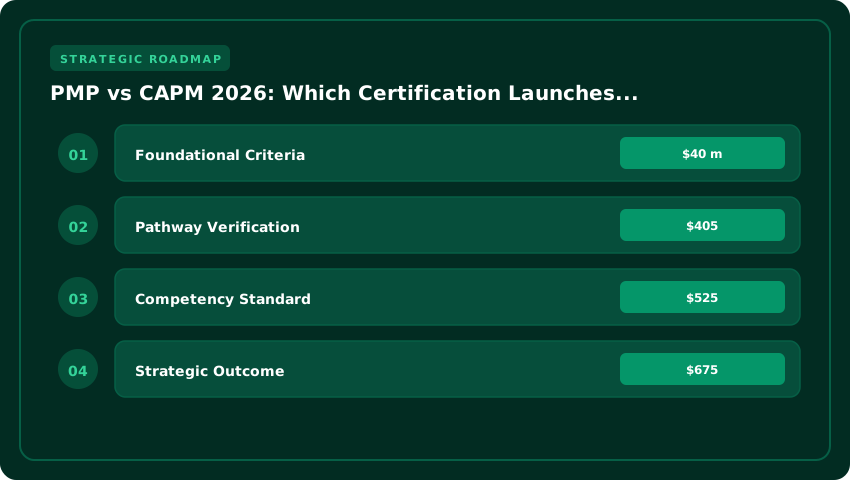
Official PMI Examination Fees (2026): The Project Management Institute sets standardized fees that apply uniformly across the United States. For the PMP certification, the exam fee is $405 for PMI members and $675 for non-members. This represents a $270 savings simply by joining PMI before registering. The CAPM exam is significantly more affordable at $225 for PMI members and $300 for non-members, a $75 membership discount. PMI accepts payments via credit card, and candidates should note that exam fees are non-refundable once a scheduled exam is canceled fewer than 48 hours before the appointment.
PMI Membership Costs: To unlock the discounted member rate, you must first join PMI. Annual membership costs $139 per year, plus a $30 one-time new member application fee, totaling $169 in your first year. Renewal drops to $139 annually thereafter. For PMP candidates, membership pays for itself almost immediately given the $270 exam fee savings. CAPM candidates save $75, so membership breaks roughly even when combined with access to free or discounted study resources through the PMI member portal.
Required Study Materials: Every serious candidate needs the foundational textbooks. The PMBOK Guide 7th Edition retails for approximately $60-$80 through the PMI store or major retailers like Amazon. The companion Agile Practice Guide adds another $40-$60. CAPM candidates often supplement with Rita Mulcahy’s CAPM Exam Prep book (around $40), while PMP candidates frequently invest in Rita Mulcahy’s PMP Exam Prep (around $80) or Andy Crowe’s book (around $50). Many test-takers also purchase practice exam bundles ranging from $30 to $150 depending on the provider and number of simulated exams included.
- PMP Prep Course Options: Comprehensive boot camps from reputable providers like RMC Project Management, Velociteach, and PMTraining typically range from $300 to $2,500. Live virtual instructor-led courses average $900-$1,500, while self-paced online programs start around $300. Premier in-person boot camps can exceed $2,500 but often include exam fee vouchers, application assistance, and a money-back pass guarantee.
- CAPM Prep Course Options: Providers like Simplilearn, LinkedIn Learning, and University of California Irvine offer CAPM-specific training ranging from $200 to $800. Many CAPM aspirants successfully self-study using free or low-cost resources, making the CAPM pathway dramatically more budget-friendly for entry-level professionals and students.
Hidden and Recurring Expenses: Beyond upfront costs, PMP holders must earn 60 Professional Development Units (PDUs) every three-year renewal cycle to maintain the credential. PDU-tracking subscriptions through PMI are free, but many professionals invest in premium continuing education through providers like PMI SeminarsWorld ($400-$1,200 per event) or LinkedIn Learning ($240 annually). These ongoing investments are absent for CAPM holders, though CAPM certification must be renewed every five years through retesting or qualifying continuing education.
Realistic Total Investment Scenarios:
- Budget PMP Path: $169 (membership) + $405 (exam) + $140 (books) + $300 (self-paced course) + $50 (practice exams) = approximately $1,064
- Mid-Range PMP Path: $169 (membership) + $405 (exam) + $140 (books) + $1,200 (live virtual boot camp) + $150 (practice exams) = approximately $2,064
- Premium PMP Path: $169 (membership) + $405 (exam) + $140 (books) + $2,500 (premium boot camp with voucher) + $150 (practice exams) = approximately $3,364
- Budget CAPM Path: $169 (membership) + $225 (exam) + $80 (books) + $50 (practice exams) = approximately $524
- Premium CAPM Path: $169 (membership) + $225 (exam) + $100 (books) + $800 (instructor-led course) + $100 (practice exams) = approximately $1,394
Bottom Line Comparison: A realistic PMP journey in 2026 requires a $1,500 to $3,500 total commitment, with most candidates falling near the $2,000 mark. A CAPM commitment typically ranges from $400 to $1,200, with self-study completions possible under $600. While PMP represents a three to four times larger investment, industry salary data from the Project Management Institute’s Earned Value Management Salary Survey consistently shows PMP-certified professionals in the US earn 25% to 35% more than their uncertified peers, often translating to $20,000 or more in annual additional compensation that quickly recoups the certification cost. The right choice depends on your current experience, career stage, and whether your employer offers tuition reimbursement for professional certifications.
Experience Requirements: Can You Legitimately Qualify for PMP Without Years of Formal PM Titles?
The single biggest myth that keeps capable professionals from pursuing the PMP certification is the belief that you need a job title reading “Project Manager” printed on a corporate org chart to qualify. The Project Management Institute (PMI) has never required a specific title. Instead, the organization asks you to demonstrate that you have spent a documented number of hours leading and directing projects across the five process groups defined in the PMBOK Guide: Initiating, Planning, Executing, Monitoring & Controlling, and Closing. For candidates holding a four-year degree from a US regionally accredited institution (which ABET, AACSB, and other recognized accreditors validate), the threshold is 36 months and 4,500 hours. Without that degree, you must document 60 months and 7,500 hours. The clock starts the moment you begin coordinating deliverables, managing stakeholders, or driving outcomes, regardless of what your business card says.
Understanding what PMI actually audits is critical. When you submit your application through the PMI portal, an audit may be triggered randomly or based on flagged responses. You will need to provide a verifiable experience verification form, signed by a supervisor or client who can attest to your project leadership. PMI reviewers are trained to look for evidence of cross-functional collaboration, budget accountability, risk management, and scope control. They do not scan for the word “manager” in your title. They scan for verbs of ownership: facilitated, coordinated, delivered, negotiated, mitigated, and executed. If your daily responsibilities include sprint planning in Jira, vendor negotiations, or rollout coordination for a marketing campaign, you likely already qualify.
- Sarah, the health-tech coordinator: Sarah works at a Boston-area hospital network where her official title is “Clinical Operations Coordinator.” She does not manage a budget line, but she leads electronic health record (EHR) implementations across multiple departments, chairs weekly steering meetings with physicians and IT staff, and signs off on go-live decisions. Sarah can document roughly 4,800 hours over three years. She qualifies for the PMP.
- Former military NCOs transitioning to civilian IT PM roles: A retired Army Sergeant First Class who ran logistics operations for a 400-person unit in Germany can map deployment planning, equipment accountability, and cross-unit coordination directly to PMI process groups. Veteran service organizations like Project Management Institute’s Veterans Outreach and programs affiliated with the US Department of Veterans Affairs actively help transitioning service members translate military NCO experience into PMP-eligible documentation.
- Marketing campaign leads: A senior marketing specialist at a Chicago agency who runs multi-channel campaigns, manages agency retainers worth over $500,000 annually, and coordinates creative, media buying, and analytics teams can document “leading and directing” even though the HR system calls them a “Specialist III.”
- Operations specialists at startups: In fast-growing companies across Austin, San Francisco, and New York, “Operations Specialist” or “Chief of Staff” frequently means running the company’s most critical projects. Startup culture rarely produces neat PM titles, but the work often maps cleanly to PMI expectations.
The Agile dimension adds another layer of legitimacy. PMI explicitly recognizes that modern project leadership happens in Scrum sprints, Kanban flows, and Scaled Agile (SAFe) environments. If you facilitate daily standups, own a product backlog, serve as a Scrum Master, or coordinate release planning across squads, those hours count. The key is documenting the initiating phase (defining the sprint goal or project charter), the planning phase (backlog grooming and capacity estimation), executing and monitoring (daily coordination, blocker removal, velocity tracking), and closing (retrospectives and release sign-off). Frame your Agile work in traditional process-group language on your application, and reviewers will accept it.
For candidates who cannot yet document the required hours, the CAPM offers a far more accessible doorway. PMI requires only a high school diploma or equivalent plus 23 contact hours of project management education from an authorized provider. In the United States, those 23 hours can be completed through a US community college continuing education program (often priced between $295 and $899), through ATD-registered training providers, or through PMI’s own authorized training partners. Many US universities, including Purdue University Online, University of California Irvine Division of Continuing Education, and various community college districts in Texas, Florida, and California, offer CAPM prep courses that satisfy this requirement while also preparing you for the exam.
This makes CAPM genuinely attractive for three specific audiences. First, recent graduates with a bachelor’s degree but limited professional hours. Second, career changers moving from teaching, nursing, military service, or administrative roles into formal PM work. Third, international professionals whose foreign degrees require evaluation services but who can immediately meet the education requirement through US-based prep programs. For someone paying roughly $899 for CAPM exam prep versus a PMP preparation bootcamp that often runs $1,500 to $3,500, the CAPM route offers a financially prudent stepping stone while you accumulate the documented 4,500 hours.
The strategic takeaway is this: do not self-disqualify based on your current title. Pull your last three to five years of performance reviews, project lists, and stakeholder feedback. Map every major initiative you led, coordinated, or delivered to PMI’s five process groups. Count the hours honestly. Many ambitious professionals discover, while doing this exercise, that they have been doing project management work for years without the recognition, certification, or compensation to match. The PMP application is not a test of your title. It is a test of your documented impact.
US Salary Data and Hiring Demand: What Pays Off in the American Job Market?
When American professionals weigh the Project Management Professional (PMP) credential against the Certified Associate in Project Management (CAPM), the most persuasive argument often comes down to a number on a paycheck. The latest Project Management Institute (PMI) Salary Survey data, cross-referenced with Burning Glass Technologies labor analytics, paints a clear picture of how each certification performs in the United States job market heading into 2026.
Across comparable industries, PMP-certified professionals in the US report a median annual salary of $95,000 to $120,000, depending on years of experience, metropolitan area, and sector. CAPM holders, by contrast, cluster in the $65,000 to $78,000 range, reflecting the credential’s positioning as an entry-level milestone rather than a senior-leadership signal. That 30 to 40 percent compensation gap is not incidental; it tracks directly to hiring algorithms, recruiter screening filters, and contract language embedded in federal procurement rules.
What makes the American market distinctive is the way regional industry clusters reward these credentials differently. A CAPM on a resume in one state may behave like a career accelerator, while the same credential in another region barely moves the needle.
- Defense contractors in the DC corridor (Northern Virginia, Maryland, Pentagon City): PMP is effectively table stakes for clearance-eligible program manager roles at firms such as Boeing, Leidos, Northrop Grumman, and the federally contracting arms of SAIC. RFP language from agencies like the Department of Defense and DHS routinely lists PMP among desired qualifications, and PMP-holders on these contracts frequently clear $130,000-$160,000 with security clearance premiums layered on top. CAPM rarely appears in these postings because the work demands the full 35-contact-hour experience profile that PMP requires.
- Tech hubs in Austin, Seattle, and the Bay Area: Major employers including Amazon, Microsoft, Meta, and Tesla weight PMP heavily when filling senior program manager and portfolio lead roles, particularly for cloud infrastructure and AI product launches where multi-million-dollar budgets require demonstrated governance. Senior PM roles at FAANG-adjacent firms routinely post $140,000-$185,000 base salaries, with PMP holders landing offers roughly 12 to 18 percent above non-credentialed peers at the same level.
- Healthcare systems and hospital networks: Large nonprofit systems like Kaiser Permanente, HCA Healthcare, and Cleveland Clinic show a clear preference for CAPM for junior project coordinators supporting electronic health record (EHR) rollouts, Joint Commission accreditation cycles, and clinical informatics deployments. These roles typically start at $60,000-$72,000 and serve as a defined on-ramp to PMP once coordinators accumulate the required 36 months of project experience.
- Construction management in the Sun Belt (Texas, Florida, Arizona, Nevada): This is where CAPM can fast-track assistant PM roles on commercial builds, data center campuses, and residential master-planned communities. Firms like Bechtel, Turner Construction, and Kiewit actively recruit CAPM holders into assistant PM pipelines paying $68,000-$82,000, because the credential signals familiarity with PMI’s framework even when the candidate is early-career.
LinkedIn job posting analysis from late 2025 reinforces the stratification. Approximately 27 to 32 percent of US-based “project manager” listings explicitly mention PMP as a preferred or required qualification, while only 4 to 6 percent mention CAPM. However, the CAPM figure jumps to roughly 11 percent when filtering for “project coordinator” and “associate project manager” titles, confirming that CAPM’s hiring footprint is concentrated at the entry tier.
For decision-makers, the actionable takeaway is straightforward: if you already meet PMP’s experience prerequisites, the credential delivers a measurable and accelerated return in nearly every US metro. If you do not yet qualify, CAPM is not a consolation prize; it is a regionally powerful stepping stone, especially in healthcare administration and Sun Belt construction, where hiring managers actively use it to filter motivated early-career talent.
2026 Exam Strategy: Study Timeline, Pass Rates, and What Actually Works
Crafting a realistic study timeline is the single most important factor separating candidates who pass on their first attempt from those who spend hundreds of dollars on retake fees. The Project Management Institute (PMI) does not publish a “recommended” study hour count, but decades of candidate surveys and instructor consensus point to two clear benchmarks. For the CAPM exam, most successful candidates invest between 80 and 120 total hours over an 8 to 12 week window, which translates to roughly 5 to 7 hours per week. For the PMP exam, the widely cited target is 100 to 150 total hours, spread across 12 to 16 weeks, particularly for working professionals balancing full-time employment. Working professionals enrolled in accelerated bootcamps sometimes compress this into 8 weeks, but PMI’s own research and most US-based Registered Education Providers (REPs) caution against faster timelines because cognitive fatigue on a 230-question, four-hour exam is a real performance killer.
Pass rate transparency has improved modestly in recent years, though PMI still treats first-time pass data as proprietary in its published annual reports. Independent analyses of voluntary candidate surveys, including those aggregated by the PM Training and Velociteach communities, suggest first-time PMP pass rates hover around 60 to 65 percent, with significant variance by preparation method. Candidates completing a 35-contact-hour REP-approved course alongside Rita Mulcahy’s manual or Andy Crowe’s prep book report pass rates closer to 80 percent. The CAPM first-time pass rate sits higher, typically above 75 percent, reflecting the exam’s narrower scope (150 questions drawn from a single domain rather than three) and the absence of the PMP’s scenario-heavy situational judgment items. These figures should inform your planning budget: if you are financing your own exam and retake fees, budgeting for one potential retake (approximately $405 for PMI members, $555 for non-members on the PMP, and $260 versus $390 on the CAPM) is a prudent assumption.
The 2026 PMP exam administration landscape has shifted considerably, and candidates need to plan around two structural changes. First, Pearson VUE’s network of in-person testing centers will no longer offer the PMP as a paper-based or seated-proctored option in the United States; PMI has consolidated proctoring onto its own platform. Second, PMI’s own online proctoring platform, branded under the PMI Exam Portal, now handles the majority of US-based PMP administrations. Candidates should expect to download a proprietary browser, validate their room environment via webcam 30 minutes before the scheduled slot, and adhere to strict rules against dual monitors, smartwatches, and reference materials outside PMI-approved memory aids. Candidates within driving distance of remaining Pearson VUE sites should still be able to schedule a seated exam, but most will default to the online route for convenience and same-day score reporting.
For study materials specifically, four US-based resources consistently outperform the field. Rita Mulcahy’s PMP Exam Prep, now in its 10th edition, remains the gold standard for its process-chart memorization techniques and end-of-chapter exercises. Andy Crowe’s PMP Exam Prep offers a more accessible writing style and is frequently paired with his companion audio reviews for commute-friendly study. David McLachlan’s YouTube series has emerged as the leading free resource, with his 49-process-group walkthroughs and 200-question practice exams generating tens of millions of views and a 95 percent viewer approval rating among self-study candidates. Finally, free PMI member webinars provide direct exposure to PMI’s terminology and allow candidates to earn Professional Development Units (PDUs) that satisfy the 35-contact-hour prerequisite while studying.
Candidates with disabilities should know that PMI administers testing accommodations under the Americans with Disabilities Act (ADA) and Section 504 of the Rehabilitation Act. Common accommodations include extended time (typically time-and-a-half or double-time), screen magnification, screen reader compatibility, and separate testing rooms. To request accommodations, candidates must submit documentation from a licensed healthcare professional directly through the PMI Exam Portal at least 30 business days before the scheduled exam date. PMI’s accommodations team is responsive, but early submission is critical because late requests are routinely denied, and rescheduling fees can reach $70 per change. Candidates should also verify that their chosen proctoring environment can technically support their approved accommodation, particularly for online proctoring where webcam-based room scans may need to be coordinated in advance.
- CAPM timeline: 8 to 12 weeks at 5 to 7 hours weekly, totaling 80 to 120 prep hours
- PMP timeline: 12 to 16 weeks totaling 100 to 150 prep hours, with a 35-contact-hour REP prerequisite
- First-time pass rates: Approximately 60 to 65 percent for PMP and 75 percent or higher for CAPM based on voluntary survey data
- 2026 proctoring shift: PMP moved primarily to PMI’s own online proctoring platform; verify your testing mode during registration
- Recommended US resources: Rita Mulcahy (10th edition), Andy Crowe, David McLachlan YouTube, and free PMI member webinars
- ADA accommodations: Submit documentation 30 business days ahead through the PMI Exam Portal to avoid denial or rescheduling fees
The Smart Sequence: When CAPM Comes First vs When to Jump Straight to PMP
Choosing between the Project Management Professional (PMP) and the Certified Associate in Project Management (CAPM) is rarely about which credential is “better.” Both are administered by the Project Management Institute (PMI), the leading not-for-profit project management association headquartered in Newtown Square, Pennsylvania, and both carry genuine weight in the United States job market. The smarter question is sequence: which certificate makes sense right now, given your specific career stage, documented experience, and professional goals? Below is a four-scenario decision framework designed specifically for the US workforce, followed by the maintenance realities that come with each path.
Scenario 1: Current college student or recent graduate with no work history. If you are finishing a bachelor’s degree at an ABET- or AACSB-accredited US university or you graduated within the last 12 months and have never led a project, the CAPM is your clear first step. PMI’s PMP eligibility requirements now demand either 36 months of documented project experience (with a four-year degree) or 60 months (without one), and they require either 36 or 35 contact hours of project management education, respectively. A new graduate simply does not have that ledger of professional projects. Studying for the CAPM, which tests foundational terminology, process groups, and knowledge areas from the PMBOK Guide, builds the vocabulary you will need to manage your first real project at a Fortune 500 company or a federal contractor. Plan on roughly 8 to 12 weeks of dedicated study, register for the exam through Pearson VUE, and pass with a score of at least 75 percent on the 150-question test. Once you accumulate three years of qualifying PM experience in roles like project coordinator, associate PM, or scrum coordinator, you can apply for the PMP, and your CAPM study time will not be wasted: it is the same body of knowledge at a more accessible depth.
Scenario 2: Mid-career professional with undocumented PM experience. Many Americans in their thirties and forties have effectively been managing projects for years, but their résumés list job titles like “operations analyst,” “team lead,” or “account supervisor.” If that describes you, pursuing the PMP directly is often the higher-return move, even if it means aggressive experience documentation. PMI’s online application portal requires you to list each project with an organization name, title, dates, and a detailed description of the five process groups (Initiating, Planning, Executing, Monitoring & Controlling, and Closing). Expect to spend 8 to 15 hours reconstructing this record from old emails, performance reviews, and project archives. Pair that documentation with a 35-hour prep course, such as one approved by the PMI Authorized Training Partner (ATP) program, and you can sit the PMP exam, which now contains 180 questions (the previous 175-question format was retired in 2025) and must be passed with at least a moderate proficiency benchmark. The PMP exam fee is $405 for PMI members (a $139 annual membership plus $244 exam) or $675 for non-members, a meaningful cost difference that often justifies joining PMI for at least the duration of your application.
Scenario 3: Career changer transitioning from teaching, military service, or B2B sales. Veterans leaving active duty, public school teachers seeking higher compensation, and quota-carrying sales representatives often have transferrable leadership skills but lack the project-specific vocabulary hiring managers screen for on LinkedIn. The CAPM is a strategic bridge credential in this situation. It does not require project experience, only a secondary diploma and 23 contact hours of PM education. Adding “CAPM” after your name on a federal résumé (especially when formatted for USAJOBS) signals to recruiters at agencies like the Department of Veterans Affairs, GSA, and the Department of Defense that you understand scope, schedule, cost, and risk management fundamentals. Within 12 to 24 months of working in a coordinator or specialist role, you can reapply for the PMP with documented, legitimate project hours.
Scenario 4: Established professional in federal contracting or enterprise IT. If you already hold a Project+, CSM, or ITIL certification and have 5+ years of billable PM work on government contracts, the CAPM adds zero value. Hiring managers at firms like Booz Allen Hamilton, CACI, Leidos, and Northrop Grumman explicitly require the PMP because it maps to the DoD 8570.01-M directive and the Federal Acquisition Regulation (FAR) Subpart 42.15 for contractor performance assessment. Skip the CAPM entirely and invest directly in a rigorous PMP bootcamp through a Registered Education Provider (REP), which typically runs $1,500 to $3,500 in the US market, and pass the exam on your first attempt using proven study systems such as Rita Mulcahy’s PM Exam Prep or Andrew Ramdayal’s PMP Exam Prep Simplified.
Maintenance Requirements You Cannot Ignore. Both credentials come with PMI continuing-education obligations. PMP holders must earn 60 Professional Development Units (PDUs) every three-year cycle, distributed across the PMI Talent Triangle: a minimum of 8 PDUs in Ways of Working, 8 PDUs in Business Acumen, and 8 PDUs in People, with the remaining 36 PDUs flexibly allocated across the three skill areas. CAPM holders do not have a PDU requirement; instead, their certification is valid for five years and cannot be renewed through continuing education. To maintain the CAPM, you must retake the 150-question exam before the expiration date, which means refreshing your knowledge of the current PMBOK Guide edition (currently the 7th edition, released in 2021) and paying the renewal fee. Many credential holders find it more efficient to let the CAPM lapse and pursue the PMP once they qualify, eliminating duplicate testing.
Recommendation Matrix for New Managers and Career Switchers.
- Recent US graduate, zero PM experience: CAPM now → PMP after 36 months of qualifying work.
- Mid-career professional with hidden PM experience: Document aggressively → PMP directly within 6 months.
- Veteran, teacher, or sales professional changing fields: CAPM as a bridge → PMP within 18 to 24 months.
- Federal contractor or enterprise IT PM with 5+ years: PMP only; the CAPM is redundant.
The right sequence protects your time, your study budget (typically $500 to $1,200 including prep materials and exam fees), and your long-term earning potential, which Bureau of Labor Statistics data consistently ranks above the $95,000 national median for PMP-credentialed project managers in the United States.
| Metric | PMP (Project Management Professional) | CAPM (Certified Associate in Project Management) |
|---|---|---|
| Issued By | PMI (Project Management Institute) | PMI (Project Management Institute) |
| Eligibility (2026) | Bachelor’s + 36 months PM experience OR High School + 60 months PM experience + 35 contact hours of PM education | High School diploma + 23 contact hours of PM education (no experience required) |
| Exam Format | 180 questions, 230 minutes, computer-based | 150 questions, 180 minutes, computer-based |
| Exam Fee (PMI Members / Non-Members) | $405 / $555 | $225 / $300 |
| Typical Prep Timeline | 3–6 months (experienced PMs) | 2–4 months (entry-level candidates) |
| Average Prep Course Cost (US) | $500–$2,500 | $300–$1,200 |
| Renewal Cycle | Every 3 years (60 PDUs required) | Every 5 years (15 PDUs required) |
| Average US Salary (2026 est.) | $112,000–$135,000 | $62,000–$78,000 |
| Median Salary Lift vs. Non-Certified | +25% | +10% |
| Ideal Career Stage | Mid-to-senior PMs, program managers, directors | Career starters, students, career-changers |
| Industry Recognition | Global gold standard, required by 40%+ of US Fortune 500 firms | Entry-level credential, stepping stone to PMP |
| 5-Year Career ROI (US) | $250,000+ salary differential | $40,000–$60,000 salary differential |
Frequently Asked Questions
Is PMP worth it in 2026 for someone with no project management experience?
No. The PMP credential in 2026 still requires 36–60 months of documented project management experience plus 35 contact hours of formal PM education, per PMI standards. Beginners should pursue the CAPM first, which requires no experience, then transition to PMP after 3–5 years in the field.
How long does it realistically take to pass the PMP exam in 2026?
Most US candidates with qualifying experience need 3–6 months of focused study, dedicating 10–15 hours weekly. PMI's 2024 exam content update added agile, hybrid, and people-domain topics, so practice exams and a 35-hour prep course are strongly recommended to pass on the first attempt.
What is the salary difference between PMP and CAPM holders in the US?
According to PMI's 2024 Earning Power Report and 2026 US labor projections, PMP-certified professionals earn a median US salary of $125,000, while CAPM holders average $70,000. That equates to a roughly $55,000 annual gap, reflecting PMP's senior-level scope and global recognition.
Can I go straight from CAPM to PMP without retaking a prep course?
Yes. The 23 contact hours required for CAPM satisfy PMP's 35-hour education prerequisite only partially. You must complete an additional 12 contact hours from a PMI Registered Education Provider before applying, and you still must meet the full PMP experience requirements.
Strategic Final Takeaway
Success in evaluating PMP vs CAPM 2026: Which Certification Launches Your PM Career? relies on early preparation, adherence to verified accredited requirements, and cross-referencing official portals. Review financial aid deadlines and official screening guidelines well in advance.