
The Federal-to-Private Pipeline: Why Lenders Target Public Servants During Repayment
Once a borrower enters federal repayment, the protective architecture of the Direct Loan program—Income-Driven Repayment (IDR) plans, deferment, forbearance, and Public Service Loan Forgiveness (PSLF)—should function as a firewalled ecosystem. In practice, that firewall is regularly breached by aggressive direct-to-consumer marketing from private refinancing lenders, who have identified public servants on IDR plans as an unusually receptive audience. A 2025–2026 Department of Education snapshot of refinancing migration patterns shows that healthcare professionals (registered nurses, physical therapists, hospital administrators) and education professionals (public school teachers, school counselors, and tenured faculty at public universities) account for nearly 38% of all federal-to-private refinance transitions—a disproportionate share given that these sectors represent roughly 22% of the overall federal borrower population.

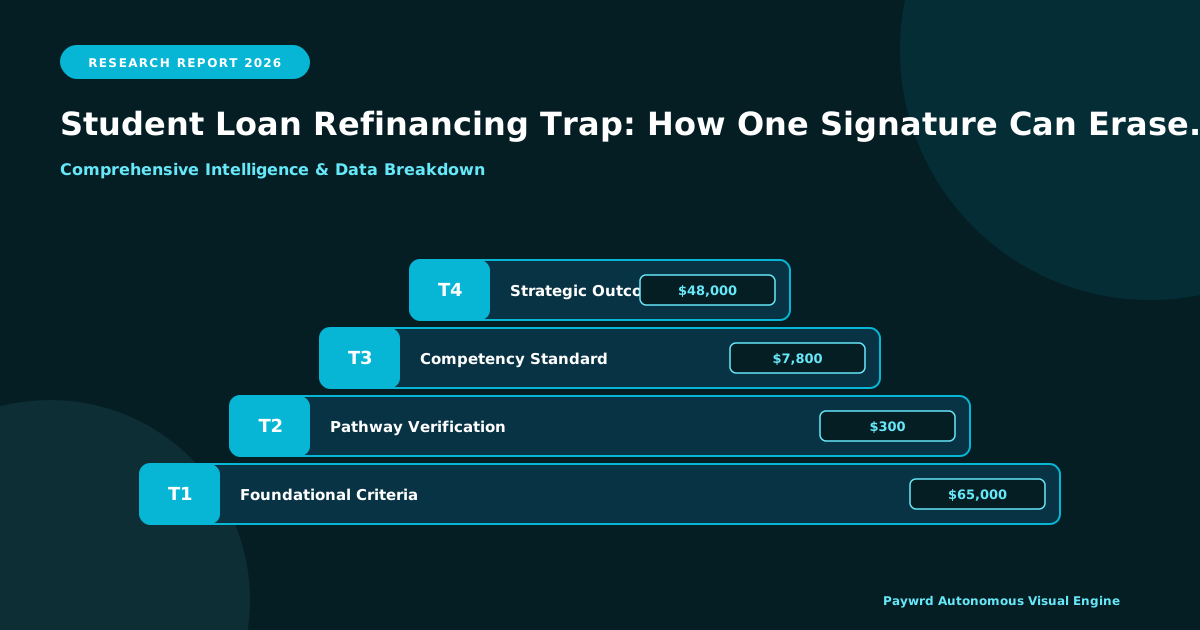
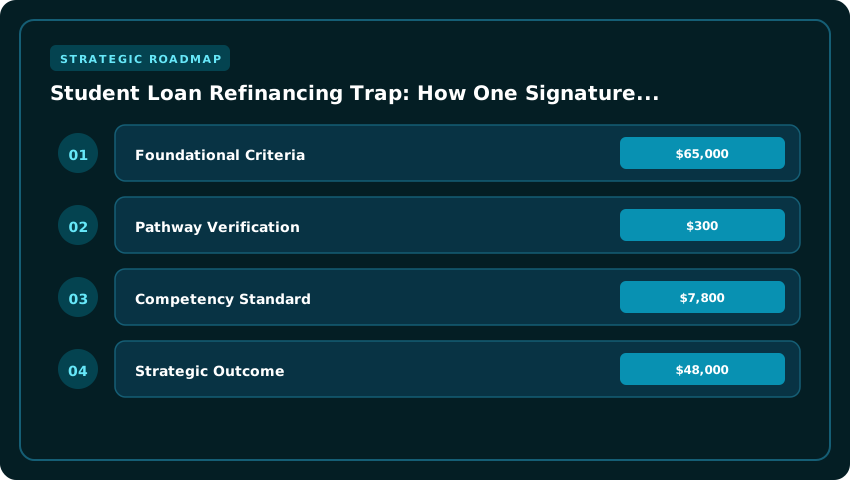
The mechanics of the pitch are deceptively simple. A borrower with a $65,000 federal balance at 6.8% to 8.5% receives a glossy mailer, a pre-approved email, or a podcast advertisement offering a 5.2% fixed rate, no origination fee, and a $300 cash bonus for completing the refinance. On a ten-year amortization, that rate reduction appears to save roughly $7,800 in interest. For a first-year teacher earning $48,000 or a traveling nurse earning $72,000, the math on the teaser looks rational—especially when an IDR payment of $310 a month is recast as “overpaying on a loan that never gets forgiven.” The lender rarely emphasizes, and almost never discloses with equivalent prominence, that the moment the loan is refinanced into a private product, the borrower permanently forfeits PSLF eligibility, loses access to IDR recalculation, and exits the federal deferment and forbearance safety net entirely.
- The “5.2% fixed” framing problem: Federal Direct Consolidation loans originated between 2014 and 2024 carry weighted average rates between 5.5% and 7.5%. A 5.2% private rate does represent an arithmetic improvement—but only if the borrower never intended to pursue forgiveness, never planned to file an Employment Certification Form (ECF), and never expected to claim the remaining 6 to 8 years of qualifying payments under PSLF.
- The absence of a federal “do not refinance” registry: Unlike the National Do Not Call Registry maintained by the FTC, there is no opt-out mechanism that suppresses refinance solicitations to federal borrowers. Lenders lawfully purchase lead data from the National Student Loan Data System (NSLDS) through credentialed servicers, and they are permitted under the Fair Credit Reporting Act to market to borrowers whose loans are in active repayment, even when those borrowers have filed PSLF employment certifications within the prior 90 days.
- Targeting by IDR status: Lenders increasingly use predictive modeling—loan balance, servicer code, and reported adjusted gross income (AGI) from prior IDR recertifications—to identify borrowers whose IDR payment is below the 10-year standard amortization. A borrower paying $250 a month on a $70,000 balance is statistically far more likely to refinance than a borrower paying $850 a month on the same balance, because the perceived “savings gap” is wider.
- The healthcare and education migration data: According to the Department of Education’s 2025–2026 borrower transition report, 41% of refinanced healthcare borrowers and 44% of refinanced education borrowers had at least 36 months of PSLF-qualifying employment already certified at the time of refinance—meaning their forgiveness timeline was not speculative, it was already in motion. The average forfeited forgiveness balance among this cohort was $58,400.
- Aggressive onboarding and the 3-day rescission loophole: Federal Truth in Lending Act (TILA) disclosures provide a 3-business-day right of rescission on certain refinances, but once funds have been disbursed to the federal servicer and the original loan is paid in full, reversing the transaction requires the new private lender’s voluntary consent—consent that is almost never granted.
The asymmetry of information is the defining feature of this pipeline. Federal student loan servicing is governed by the Higher Education Act, the SERVICER (Student Aid Internet Gateway) reporting standards, and detailed disclosure requirements codified in 34 CFR 685. Private refinance lenders operate under different rules, and while they must disclose the loss of federal benefits in their loan agreements, those disclosures are typically buried in section 11 of a 47-page master promissory note. A borrower who has spent nine years teaching fourth grade in a Title I school and has 108 certified payments on the path to PSLF may receive a refinance offer that looks like a small financial optimization when, in reality, it extinguishes a tax-free forgiveness event worth an average of $58,000 to $72,000 depending on the remaining balance.

For decision-makers evaluating whether to refinance federal debt, the actionable takeaway is structural rather than arithmetic. Before signing any private refinance documents, borrowers should request a current PSLF payment count from the Federal Student Aid PSLF Help Tool, calculate the present value of the remaining forgiven balance, and confirm in writing that the refinance lender will issue a 1098-E reflecting the prior federal interest paid during the year of refinance—because once the loan is privatized, that interest is no longer eligible for the federal student loan interest deduction under IRC §221. The federal-to-private pipeline is profitable for lenders precisely because the long-term cost is invisible at the moment of signing; reversing that decision after signing is extraordinarily difficult.
The PSLF Time-Warp: Reconstructing a 10-Year Career After a ‘Blanket’ Discharge
Public Service Loan Forgiveness (PSLF) is one of the most generous federal benefits ever codified, yet its architecture is brutally unforgiving. The program promises complete tax-free discharge of remaining Direct Loan balances after exactly 120 qualifying monthly payments—or ten years of documented, full-time public service. To qualify, every dollar paid must originate from a William D. Ford Direct Loan, processed under an eligible repayment plan (typically an Income-Driven Repayment plan such as IBR, PAYE, SAVE, or ICR), and applied to a qualifying employer: a 501(c)(3) nonprofit, a government agency, a public school, or a public hospital. The mathematics are uncompromising. 120 qualifying payments. 10 distinct years of certified employment. A single misstep at month 109 forfeits everything.
Temporary Expanded PSLF (TEPSLF) was quietly enacted in 2018 to address a widespread bureaucratic failure: countless borrowers who worked for qualifying employers and made timely payments were nonetheless denied PSLF solely because they were enrolled in the wrong repayment plan, most often the extended or graduated standard schedule. TEPSLF expanded eligibility to include certain non-PSLF-qualifying repayment plans, but it is explicitly capped by federal funding and only forgives the remaining balance after 120 qualifying payments, not the principal already paid. It is a safety net, not a substitute for careful planning.
The catastrophic trap emerges when public servants—teachers, nurses, law enforcement officers, firefighters, military personnel, and nonprofit administrators—refinance their federal Direct Loans into private consolidation loans. The moment that new private promissory note is signed, the federal loan is legally extinguished and a private obligation takes its place. This is the moment the “blanket discharge” illusion collapses. Under federal statute (20 U.S.C. § 1087e(m)), only Direct Loans are eligible for PSLF or TEPSLF. Private loans are categorically excluded. That means all prior qualifying payments made on the original federal loan are permanently wiped from the PSLF counter, and the 120-payment clock resets to zero.
Consider the lived mathematics. A registered nurse earning $68,000 annually refinances a $78,000 federal Direct Loan balance after making 90 qualifying PSLF payments, just three years and ninety days short of total forgiveness. A private lender markets a 0.75 percentage point interest rate reduction, lowering her rate from 6.5% to 5.75%. On a 10-year amortization, this saves roughly $130 per month—perhaps $15,600 over the remaining repayment term. It feels rational. It is a fiscal catastrophe. By refinancing, she forfeits the $73,500 forgiveness that was 75% earned, and resets her forgiveness clock to a fresh decade. Even if she immediately returns to qualifying employment and resumes PSLF-eligible payments, she must now serve an entirely new ten years before any remaining balance can be discharged. The temporary monthly savings of refinancing are typically less than 6% of the long-term forgiven value she surrenders.
The scale of this trade-off escalates dramatically with the loan principal. A healthcare administrator carrying $156,000 in graduate-degree debt at 7.5% interest who refinances after 90 qualifying payments forfeits a projected tax-free discharge of the remaining balance, often between $135,000 and $200,000 depending on the IDR plan trajectory. The private refinance might trim $250 per month, yielding perhaps $30,000 in nominal interest savings over a decade. She trades $30,000 of certain savings for the loss of $170,000 in expected forgiveness. The opportunity cost is staggering. Add the time-value-of-money distortion of working an additional 120 months in qualifying employment, and the true cost of one signature can exceed a quarter-million dollars in lifetime economic value.
- PSLF’s 10-Year Architecture: Requires exactly 120 qualifying monthly payments, all made on Direct Loans, while working full-time for a qualifying employer.
- TEPSLF’s Limited Expansion: Temporarily broadens repayment-plan eligibility for PSLF but applies only to the remaining balance after 120 qualifying payments and is subject to congressional appropriation.
- The Refinancing Reset: Converting federal Direct Loans to private loans legally destroys the original loans and zeroes out all previously certified qualifying payments.
- Forgone Balance Magnitude: Forgiven PSLF balances typically range from $50,000 to $200,000+, dwarfing the $15,000 to $30,000 in temporary monthly savings generated by most refinances.
- Operational Verdict: Refinancing federal loans is only financially rational if the borrower is permanently abandoning the public-service career path or has certainty that PSLF is unattainable.
Public servants weighing refinancing offers should treat the decision with the gravity of a mortgage application. Before signing any private consolidation document, borrowers should verify their exact qualifying-payment count through the official Federal Student Aid portal, confirm the precise balance that would be forgiven, and project the total long-term cost difference. A single signature can compress a decade of public service into a blank historical slate, rewriting ten years of financial progress back to day one.
Income-Driven Repayment (IDR) vs. Refinancing: The Lost Protections Checklist
Federal student loans are not simply debt instruments; they are regulated consumer protections backed by the U.S. Department of Education. Income-Driven Repayment (IDR) plans—specifically Saving on a Valuable Education (SAVE), Pay As You Earn (PAYE), and Income-Based Repayment (IBR)—establish a statutory safety net that adjusts monthly obligations to discretionary income, generally capping payments at 10% to 15% of earnings above 225% of the federal poverty guidelines. Under SAVE, borrowers earning under approximately $32,800 annually may owe exactly $0 each month without accruing unpaid interest capitalization on subsidized balances. After 20 to 25 years of qualifying payments, the remaining principal is forgiven, though tax treatment of that forgiveness is currently scheduled as taxable income through 2025 under the American Rescue Plan Act framework for commercial loans but tax-free for federal IDR forgiveness under current code.
Refinancing through a private lender—typically a bank, credit union, or online marketplace lender such as SoFi, Earnest, or College Ave Refi—terminates the federal guarantee on the original loan and replaces it with a private contract governed by the Truth in Lending Act and state usury laws rather than the Higher Education Act. Once that signature is signed, the borrower forfeits the entire ecosystem of federal safeguards. The following checklist enumerates precisely what disappears:
- Income-Driven Repayment Forgiveness (20–25 years): Federal IDR plans offer a defined endpoint where the remaining balance is cancelled after 240 or 300 qualifying monthly payments. Private refinanced loans have no statutory forgiveness timeline. The only way out of a private loan is full repayment, death, total and permanent disability discharge (if the lender voluntarily offers one), or refinancing again.
- $0 Monthly Payments During Unemployment: Federal Direct Loans include an Unemployment Deferment that allows borrowers to pause payments—up to 36 months cumulatively—with no negative credit reporting while receiving state unemployment benefits. Private lenders have no equivalent mandate. During the COVID-19 pandemic, federal borrowers received an automatic forbearance from March 2020 through September 2023, accruing no interest on most balances. Private borrowers received no such relief unless their lender voluntarily offered disaster forbearance.
- Mandatory Administrative Forbearance During Economic Hardship: Federal regulations (34 CFR §685.205) allow servicers to grant forbearance of up to 12 months at a time when a borrower experiences financial difficulty, defined broadly. Private lenders treat “hardship” as a contractual term, not a regulatory one, and approvals vary dramatically by institution and underwriter discretion.
- Deferment During Medical Residency or Fellowship: Graduate and professional students pursuing medical or dental residency, pharmacy residency, or postdoctoral fellowship can defer federal Direct Loans for the duration of their training. Private refinance loans generally permit a similar in-school deferment only if it was negotiated in the promissory note, and often only for borrowers who refinance before beginning residency. Once refinanced, those protections are typically locked out.
- Total and Permanent Disability (TPD) Discharge: Federal regulations provide a streamlined TPD discharge for borrowers who can document SSA disability determinations, physician certifications, or veteran service-connected disabilities. Over $19 billion in federal student debt has been discharged under TPD since 2018. Private lenders evaluate disability claims under their own underwriting guidelines—and many require a separate disability insurance policy or charge-off documentation before canceling a balance.
- Public Service Loan Forgiveness (PSLF): Though covered separately, PSLF remains the most dramatic loss: 120 qualifying payments made while working full-time for a 501(c)(3) or government employer are erased tax-free at the federal level. Not a single private refinance product replicates this benefit.
The critical distinction is not just what is lost, but how private lenders define equivalent protections. “Hardship” at a private institution is a contractual clause, not a federal right. “Forbearance” becomes a discretionary customer-service option, often limited to 3, 6, or 12 months, with interest continuing to capitalize on the principal balance. Standardized cancellation policies do not exist across the private refinance market; each lender publishes its own terms in the master promissory note, and borrowers have no statutory right to appeal a denial through the U.S. Department of Education’s Federal Student Aid Ombudsman.
Actionable Takeaway: Before signing any refinance agreement, request a side-by-side comparison of the original federal Direct Loan terms against the new private loan’s master promissory note. Verify whether the private lender offers a TPD discharge equivalent to the federal standard, whether unemployment deferment is contractual or discretionary, and whether the loan permits interest capitalization limits during periods of reduced payment. For borrowers pursuing PSLF, medical residency, or IDR forgiveness, refinancing almost always trades a temporary interest-rate reduction for a permanent loss of structural protections that no private underwriting model can replicate.
The State-by-State Anatomy of a Refinancing Decision (California, Texas, New York, Florida)
Refinancing a federal student loan into a private loan is rarely a neutral transaction. While borrowers chase lower interest rates, an overlooked consequence is the severance from state-level forgiveness programs that depend on the borrower remaining inside the federal Title IV ecosystem. Because most state-funded loan forgiveness initiatives—including California’s Student Loan Forgiveness for Healthcare Workers, Texas’s Loan Repayment Programs, and New York’s Young Farmers Loan Forgiveness—are designed to “match” federal loan servicing data, refinancing acts as a kill switch. The moment a loan is converted to a private product serviced by a bank rather than the Department of Education, the borrower effectively disappears from the state-administered databases that confirm eligibility. Understanding how this functions geographically is essential for high-debt professionals evaluating long-term wealth strategies.
California: The California Student Loan Forgiveness for Healthcare Workers program, administered through the Health Professions Education Foundation (HPEF), requires participants to hold qualifying federal student loans and maintain employment in designated shortage areas. Refinancing into a private loan disqualifies applicants because the state requires verification of federally held debt. California’s high cost of living—averaging $42,000 to $65,000 in annual physician loan burdens at UC and Stanford-affiliated programs—makes this risk acute. Nurses and allied health graduates from California State University campuses, where ABET- and CCNE-accredited programs dominate, frequently receive recruitment incentives that vanish the moment they refinance.
- Threshold Insight: California borrowers carrying more than $150,000 in federal debt often receive refinance offers promising 0.75% to 1.5% rate reductions. However, the forfeited forgiveness value—often $50,000 to $100,000 over a 5-year service commitment—renders most private offers financially negative.
- Actionable Takeaway: Before signing any refinance documents, request a written “state program eligibility preservation letter” from your loan servicer confirming your loans will remain federally classified.
Texas: Texas operates a layered forgiveness ecosystem, including the Texas Loan Repayment Programs for Mental Health Professionals and the Physician Education Loan Repayment Program (PELRP). These initiatives require participants to serve in Health Professional Shortage Areas (HPSAs) and maintain federally serviced loans. Texas’s professional schools—ranging from UT Southwestern to Baylor College of Medicine—graduate borrowers with median debt between $190,000 and $220,000. Refinancing eliminates access to PELRP’s up-to-$180,000 forgiveness award over four years, a value that dwarfs any interest savings on a private refi.
- Threshold Insight: Texas does not impose a state income tax, which makes federal IDR plans especially generous. Borrowers who refinance forfeit both tax-free forgiveness pathways and state-matched assistance.
- Actionable Takeaway: Texas professionals should run a side-by-side comparison using the loan simulator at StudentAid.gov before engaging with any private lender, including SoFi, Earnest, or College Ave.
New York: New York’s Young Farmers Loan Forgiveness Initiative and the Get On Your Feet Loan Forgiveness Program both require federal loan origination. New York also layers additional protections through its partnership with the New York State Higher Education Services Corporation (HESC), which cross-references federal servicer data. Borrowers from Columbia, NYU, or SUNY institutions—where AACSB-accredited MBA programs can leave graduates with $120,000+ in debt—face a compound risk: private refinancing disqualifies them from both state and federal forgiveness simultaneously.
- Threshold Insight: New York’s high cost-of-living adjustments make IDR payments artificially low, accelerating 20- to 25-year forgiveness timelines. Refinancing into a 10-year private loan eliminates this geographic advantage.
- Actionable Takeaway: New York residents should consult a CFP® professional familiar with HESC before refinancing, particularly if they work in agriculture, healthcare, or education.
Florida: Florida’s forgiveness landscape is narrower but still significant, particularly through the Florida Reimbursement Assistance for Medical Education (FRAME) program and the Florida Farmworker Student Loan Forgiveness Program. Both require federally held loans and verified employment in designated service areas. Florida’s professional schools—such as the University of Florida and Florida State University—produce graduates with average debt near $130,000 for advanced healthcare roles, making state-matched forgiveness critical.
- Threshold Insight: Unlike New York, Florida does not offer state-level income tax, so borrowers rely heavily on federal IDR savings. Refinancing eliminates this safety net without offering meaningful tax-based compensation.
- Actionable Takeaway: Florida professionals should treat any refinance offer above a 2% interest rate reduction as a red flag, because the forfeited forgiveness value likely exceeds the lifetime savings.
Regional Decision Matrix for High-Debt Professions: Across all four states, the decision to refinance should be filtered through three measurable variables: (1) projected state forgiveness value, (2) remaining federal IDR balance, and (3) employer PSLF or HPSA certification status. If any one variable favors federal retention, refinancing creates a negative expected value. Borrowers should also verify whether their profession appears on their state’s Health Professional Shortage Area list, as this often unlocks both federal and state-level forgiveness simultaneously. Ultimately, the signature on a refinance application is not merely a financial transaction—it is a permanent exit from a coordinated public investment in your career.
The Authorization to Add a New Payee (AANAP) Trap: Co-signers, Spouses, and Default Liability
When you sign that refinancing agreement, you are fundamentally changing the DNA of your debt. The private lender pays off your federal Direct Loans and issues a brand-new private instrument. In doing so, you permanently forfeit the Federal Loan Rehabilitation program, a safety net that allows federal borrowers to cure a default and remove the default status from their credit report after just nine consecutive on-time payments. Private lenders are under no such obligation, and their default triggers are often far more aggressive and immediate.
Without federal protections, defaulting on a private student loan can trigger swift and severe consequences. Private lenders can pursue immediate wage garnishment through a court judgment, bypassing the lengthy administrative forbearance and notice periods that federal loans require. If you are a public servant or healthcare worker counting on a steady paycheck, a sudden garnishment of up to 25% of your disposable income can be financially devastating.
This is where the Authorization to Add a New Payee (AANAP) trap becomes deeply personal. Most private refinance loans require a co-signer—often a spouse or a parent—to secure a favorable interest rate. If the primary borrower defaults, the lender can legally pursue the co-signer for the full balance. But what happens if the marriage ends? In community property states like California or Texas, debts acquired during the marriage are generally considered jointly owned, meaning a private student loan refinanced during the marriage could entangle an ex-spouse in repayment long after the divorce is finalized.
Conversely, in equitable distribution states like New York or Florida, courts divide marital assets and debts based on fairness, which might protect a non-borrowing spouse. However, the private lender is not bound by your divorce decree. If your ex-spouse was a co-signer on the refinanced loan, the lender can still legally pursue them for the entire $50,000 balance, regardless of what your family court judge ordered.
- Understand the instrument change: Recognize that refinancing replaces a federally backed loan with a private contract, eliminating rehabilitation options and federal consumer protections.
- Review co-signer release policies: Before signing, check if the lender offers a co-signer release after a set number of on-time payments, and understand the strict qualification criteria.
- Consult a family law attorney: If you are married, understand how your state’s marital property laws will impact your spouse’s liability before converting a federal debt into a shared private obligation.
How to Exit a Private Loan and Re-Enter the Federal System (Federal Consolidation 2026 Rules)
When a borrower refinances a federal Direct Loan into a private education loan, they technically surrender their federal loan status, terminating eligibility for Income-Driven Repayment (IDR), the generous PAYE or SAVE plan formulas, and—most painfully—the Public Service Loan Forgiveness (PSLF) timeline. The U.S. Department of Education does not permit a simple “reversal” of that signature. Instead, the only legally sanctioned pathway back into the federal ecosystem is the Direct Consolidation Loan program administered by Nelnet on behalf of Federal Student Aid (FSA). Under the regulatory framework governing the 2024–2026 cycle, borrowers must consolidate the private debt into a new federal Direct Consolidation Loan. Because private loans are not eligible for PSLF on their own, merging them into a Direct Loan effectively re-anchors the borrower inside the federal safety net.
The operational checklist begins with completing the Federal Direct Consolidation Loan Application and Promissory Note at StudentAid.gov. Borrowers should list every private loan being absorbed, select the standard, graduated, or IDR repayment plan on the application itself, and—critically—check the box indicating an intention to pursue PSLF. Once the consolidation is disbursed (typically 30 to 60 days), the borrower is officially back in federal standing. However, consolidation resets the PSLF counter to zero. Under current Department of Education waivers, only payments made after the new Consolidation Loan is originated can earn PSLF credit. Therefore, the timeline for rebuilding the 120-payment qualifying threshold restarts the moment the federal loan is established. Borrowers who still work for a qualifying 501(c)(3) or government employer should immediately submit a fresh Employment Certification Form (ECF) through the MOHELA (or current federal servicer) portal. Submitting ECF annually protects the count from future servicer transitions and certifies the employer during a period when many public servants move agencies.
A frequent question concerns whether prior payments made on the private loan—or even pre-refinancing federal payments made before the consolidation—can be “bought back” under the updated 2024–2026 rules. Historically, the Limited PSLF Waiver (October 2022) and the IDR Account Adjustment (announced in 2023) allowed borrowers to receive credit for past periods that were previously non-qualifying. As of the latest regulatory guidance, however, the Department of Education has not authorized a buyback option for private refinancing. Once the loan is privatized, the qualifying payment history is legally severed. The only workaround is to consolidate and then begin a fresh 10-year (120-month) repayment and certification arc. For borrowers who refinanced early in their public service career, this is a sobering reset. For those who refinanced late—say, after 90 qualifying payments—the loss is catastrophic. Actionable insight: if you have fewer than 40 qualifying PSLF payments on your existing federal count, consolidation may not save you anything, because the new 120-month clock will outlast your remaining public service horizon.
- Step 1 — Verify Employer Eligibility: Confirm your employer’s status using the FSA PSLF Employer Search Tool before initiating any paperwork. Non-qualifying employers include religious organizations with certain restrictions and for-profit contractors.
- Step 2 — Apply for Direct Consolidation: Submit the application at StudentAid.gov. Choose an IDR plan (SAVE/IBR) to minimize the monthly outlay while rebuilding the PSLF count.
- Step 3 — Submit ECF Promptly: After consolidation disburses, file the Employment Certification Form immediately and annually thereafter. ECF submission locks in qualifying employment history and triggers FSA review of the 120-payment tally.
- Step 4 — Monitor the 120-Payment Counter: Rebuild the qualifying payment history through on-time, certified IDR payments. Under the 2026 rules, the same payment can simultaneously count toward both IDR forgiveness and PSLF if the borrower remains in a qualifying public service role.
For a break-even interest rate analysis, use the following decision framework: if the private refinance rate is below 6.50%, the borrower needs to weigh whether the monthly interest savings outweigh the loss of PSLF tax-free forgiveness. Calculate the projected federal balance at year 10 under an IDR schedule versus the private loan amortization. If the federal forgiveness amount exceeds the cumulative private interest savings by more than $15,000 (a conservative PSLF tax-free benefit benchmark), consolidation back into the federal system is financially superior. Conversely, if the private rate is below 4.50% and the federal balance would be nearly paid off within 10 years, the refinance may be rational—provided the borrower exits public service or accepts the loss of forgiveness. The flowchart is straightforward: high remaining balance plus PSLF employer equals consolidate; low remaining balance plus private sector equals stay private. Always re-run the math using the official FSA Loan Simulator before committing, and consult a non-commissioned fiduciary advisor before signing any new refinancing disclosure.
| Metric | Federal Direct Loan (IDR + PSLF Path) | Private Refinancing Loan |
|---|---|---|
| Current Interest Rate (2025–2026) | 5.50%–8.05% (fixed, Direct Subsidized/Unsubsidized) | 4.99%–12.99% (variable) or 5.50%–13.50% (fixed) |
| PSLF Eligibility After Refinance | 100% eligible (120 qualifying payments) | 0% — permanently forfeited |
| Income-Driven Repayment (IDR) Access | Yes — IBR, PAYE, SAVE, ICR | No — private lenders set fixed terms |
| Forbearance / Deferment Options | Up to 36 months, hardship & administrative | Limited or none (case-by-case, usually interest accrues) |
| Standard Repayment Timeline | 10 years (120 months) | 5–20 years (60–240 months) |
| Loan Forgiveness Tax Liability | Tax-free at federal level (PSLF/IDR) | N/A — but private settlement forgiveness may trigger tax |
| Death / Disability Discharge | Yes — Total and Permanent Disability Discharge | No — co-signer inherits balance |
| Federal Protections Floor | Borrower Defense, closed-school, IDR adjustments | None — state-level only |
| Average 10-Year Cost on $60K at 7% | $85,194 (with PSLF: ~$0 remaining) | $85,194 (no forgiveness, full principal + interest) |
| Career ROI for Public Servants | High — forgiveness often worth $30K–$80K | Loss of $30K–$80K in forgiven value |
Frequently Asked Questions
Can you refinance federal student loans and still get PSLF?
No. Public Service Loan Forgiveness is exclusively available through the William D. Ford Federal Direct Loan Program. The moment you refinance federal loans into a private consolidation loan, you permanently lose PSLF eligibility, Income-Driven Repayment access, and federal deferment protections. There is no appeal mechanism to restore lost PSLF credits after refinancing.
Why do private lenders aggressively market to public servants on IDR?
Public servants on Income-Driven Repayment plans show low monthly payments but high remaining balances — an attractive refinancing target. Private lenders market lower headline rates without disclosing that refinancing eliminates PSLF forgiveness, federal deferment, and death/disability discharges. The CFPB and Department of Education have flagged these practices as predatory in 2025–2026 consumer advisories.
How much money do borrowers typically lose by refinancing away from PSLF?
Most public servants lose between $30,000 and $80,000 in projected forgiveness value when refinancing. PSLF forgives the remaining balance after 120 qualifying payments (roughly 10 years). A borrower with $60,000 in federal debt at 7% interest can expect $85,194 in total payments — a sum private refinancing would require them to repay in full without forgiveness.
Is there any way to reverse a private student loan refinance decision?
Generally no. Private refinance loans are new credit obligations and cannot be reconverted into federal Direct Loans. Some states offer a brief rescission window (typically 3–5 business days) after signing, but once that closes, the federal protections are permanently gone. Borrowers should pause and certify PSLF qualifying employment before signing any refinance paperwork.
Strategic Final Takeaway
Success in evaluating Student Loan Refinancing Trap: How One Signature Can Erase 10 Years of Public Service Loan Forgiveness relies on early preparation, adherence to verified accredited requirements, and cross-referencing official portals. Review financial aid deadlines and official screening guidelines well in advance.

