How Graduate FAFSA Fundamentally Differs From Undergraduate Aid
Filing the Free Application for Federal Student Aid (FAFSA) as a graduate student feels remarkably similar to the process you may have navigated as an undergraduate, but the financial logic operating behind the scenes shifts dramatically. The federal government classifies virtually all master’s-level students as independent for aid purposes, a designation that fundamentally rewires the entire aid calculation. This single status change triggers a cascade of consequences that every prospective graduate student must understand before committing to a program.
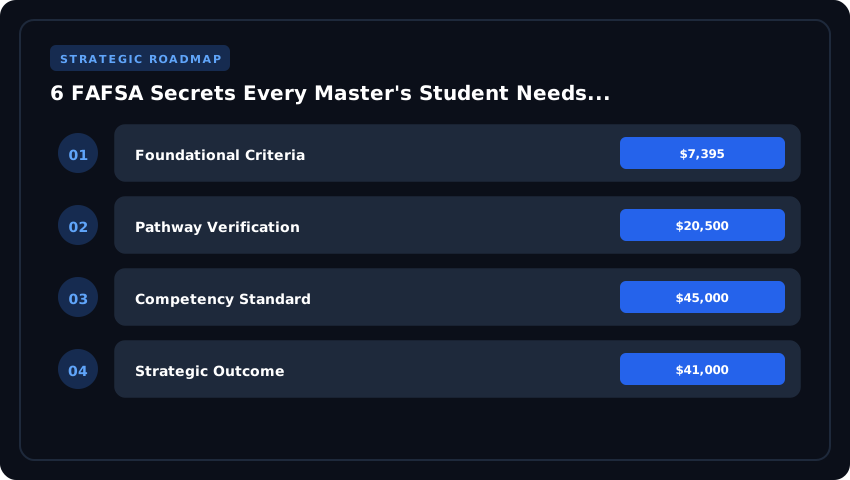
Perhaps the most painful adjustment is the loss of the Federal Pell Grant. For undergraduates demonstrating exceptional financial need, Pell Grants can deliver up to $7,395 during the 2024-25 award year, money that never needs to be repaid. Once you enroll in a master’s degree program, this funding source disappears entirely, regardless of your income or circumstances. The Department of Education assumes that a graduate student pursuing an advanced degree has either accumulated savings, secured employer sponsorship, or possesses the earning potential to finance their education differently than a traditional college freshman.
Undergraduate borrowers also enjoy access to Direct Subsidized Loans, where the federal government covers interest accrual while you remain enrolled at least half-time. Graduate students lose this benefit completely. Instead, your primary federal borrowing option becomes the Direct Unsubsidized Loan, which begins accumulating interest the moment disbursement occurs. For the 2024-25 award year, this loan carries a fixed interest rate of 5.50%, with graduate students permitted to borrow up to $20,500 annually. Every dollar borrowed starts growing immediately, adding to your principal balance even before graduation.
When unsubsidized borrowing reaches its ceiling and your budget still falls short, the Graduate PLUS Loan enters the picture. This credit-checked federal loan allows graduate students to borrow up to the full cost of attendance minus any other aid received. For 2024-25, the Grad PLUS interest rate sits at 8.05%, considerably higher than its unsubsidized counterpart, and it carries an origination fee that effectively reduces the net disbursement. These two federal loans become the financial backbone of most graduate financing packages, but they also represent substantially more debt exposure than many students anticipate.
The Expected Family Contribution (EFC) calculation undergoes a parallel transformation. For dependent undergraduates, FAFSA scrutinizes parental income, assets, and household size, often resulting in aid packages that reflect family wealth. Graduate students, conversely, submit financial data exclusively about themselves and, if applicable, their spouse. This shift can actually benefit lower-income graduate applicants whose independent status shelters them from parental financial scrutiny, but it simultaneously means that affluent family backgrounds no longer reduce personal aid eligibility.
The practical implication is striking. A 28-year-old master’s candidate earning $45,000 annually with no dependents will likely demonstrate higher financial need on paper than an undergraduate sibling still living at home, simply because the formula excludes parental resources. However, the absence of need-based grants like the Pell means this demonstrated need primarily translates into loan eligibility rather than free money, fundamentally changing what “aid” actually looks like at the graduate level.
- Independence Status: All graduate students are automatically classified as independent, removing parental financial data from the calculation entirely.
- Pell Grant Ineligibility: The federal need-based grant program ends at the undergraduate level, eliminating up to $7,395 in potential free aid per year.
- Subsidized Loan Loss: Direct Subsidized Loans vanish for graduate borrowers, meaning interest accrues from day one on all federal undergraduate-style loans.
- Unsubsidized Primary Borrowing: Direct Unsubsidized Loans at 5.50% (2024-25) become the baseline federal option, capped at $20,500 annually.
- Grad PLUS as Gap Filler: The 8.05% Grad PLUS loan covers remaining costs but requires a credit check and carries an origination fee that reduces actual disbursement amounts.
- EFC Recalculation: Only the student’s (and spouse’s) income and assets count, potentially increasing demonstrated need but channeling that need toward loans rather than grants.
Understanding this architecture before you file matters enormously. Graduate school financial planning cannot rely on the same mental models that worked during your bachelor’s degree, because the federal aid system treats advanced-degree seekers as financially self-sufficient adults expected to shoulder substantially more borrowing responsibility.
Federal vs. Private Loans: The Real Cost Breakdown for Master’s Borrowers
Choosing between federal and private loans is the single most consequential financial decision a master’s student will make before signing an enrollment agreement. While both sources of capital can fund a graduate degree, the difference in long-term cost, flexibility, and borrower protection is measured in tens of thousands of dollars. Understanding this breakdown empowers you to borrow strategically rather than reactively.
The federal Direct Unsubsidized Loan is the workhorse of graduate borrowing. For the 2024–2025 academic year, the Department of Education caps this loan at $20,500 per academic year, and unlike undergraduate subsidized loans, interest begins accruing the moment funds are disbursed. That interest capitalizes when you enter repayment, meaning any unpaid interest gets added to your principal balance. For a typical two-year master’s program, a student borrowing the maximum $20,500 annually would accumulate roughly $41,000 in principal. At the current federal rate of approximately 7.5%, a standard 10-year repayment plan would cost about $490 per month, totaling roughly $58,800 over the life of the loan. Stretching that same balance across a 20-year term lowers the monthly bill to about $335, but you would repay closer to $80,400, illustrating how time dramatically amplifies total cost.
Grad PLUS Loans fill the gap when federal unsubsidized borrowing falls short of your cost of attendance. These loans cover up to the full certified cost of attendance minus any other financial aid, making them attractive for students enrolled in high-tuition programs at private or out-of-state institutions. However, Grad PLUS carries a credit check, a slightly higher interest rate (around 8.5% in 2024–2025), and a 4.228% origination fee that is deducted from each disbursement. A borrower taking $30,000 in Grad PLUS funding at 8.5% over 10 years would face roughly $372 monthly and repay about $44,640. Over 20 years, that climbs to nearly $72,000.
Private graduate loans, offered by banks, credit unions, and fintech lenders like SoFi, Earnest, and College Ave, typically feature two structural choices: fixed rates that mirror federal stability or variable rates that may start lower but can rise with the market. Variable rates often begin around 5% to 6% during periods of low interest rates but can escalate over a 10 to 15 year repayment horizon. A $50,000 private loan at a 6% fixed rate over 10 years costs about $555 per month, totaling $66,600. A variable rate starting at 5.5% could end up costing significantly more if the index climbs by just two percentage points.
The most overlooked advantage of federal loans is the safety net they provide. Federal Direct Loans qualify for economic hardship deferment, administrative forbearance, and the full suite of income-driven repayment (IDR) plans, including SAVE, PAYE, IBR, and ICR. Public Service Loan Forgiveness (PSLF) is exclusive to federal Direct Loans. Private lenders, by contrast, offer deferment only in narrow circumstances, rarely provide IDR options, and never permit PSLF. For master’s students pursuing careers in government, nonprofit administration, healthcare, or education, this federal-only protection can translate into $20,000 to $100,000 in forgiven balances after 120 qualifying payments.
Capitalization frequency also matters more than most borrowers realize. Federal loans capitalize unpaid interest at repayment entry, while private lenders often capitalize monthly or quarterly, accelerating balance growth. Always pay accruing interest before capitalization whenever possible.
- Federal Direct Unsubsidized: $20,500 annual cap, 7.5% rate, flexible IDR, PSLF eligible.
- Grad PLUS: Up to full cost of attendance, 8.5% rate, credit check required, PSLF eligible.
- Private Loans: Variable or fixed rates from 4% to 12%, limited deferment, no forgiveness.
- 10-year total on $41,000 federal: approximately $58,800 repaid.
- 20-year total on $41,000 federal: approximately $80,400 repaid.
Actionable takeaway: Exhaust federal Direct Unsubsidized eligibility first, then evaluate Grad PLUS only if your program’s sticker price exceeds federal limits. Reserve private loans as a final bridge, and always run amortization calculations for both 10-year and 20-year horizons before signing a master promissory note.
Income-Driven Repayment Plans: Which Plan Actually Saves You Money
For Master’s graduates carrying significant federal debt, choosing the right Income-Driven Repayment (IDR) plan can mean the difference between a manageable monthly bill and a decades-long financial burden. Four IDR plans remain available to graduate borrowers: Pay As You Earn (PAYE), Revised Pay As You Earn (REPAYE)—now known as the Saving on a Valuable Education (SAVE) Plan, Income-Based Repayment (IBR), and Income-Contingent Repayment (ICR). Each calculates your payment differently, treats your spouse’s income uniquely, and offers a distinct path to loan forgiveness. Understanding these mechanics is essential before you sign up for the first option a loan servicer suggests.
The newest plan, SAVE, fundamentally restructured how discretionary income is calculated. Beginning in 2024, the SAVE Plan caps undergraduate loan payments at 5% of discretionary income and graduate loan payments at 10%—a meaningful reduction from the previous 10% standard across the board. Discretionary income under SAVE is also defined as the amount above 225% of the federal poverty line, rather than the traditional 150% threshold, which shields more of your earnings from repayment calculations. Additionally, SAVE shortened the forgiveness timeline to 20 years for borrowers with only undergraduate loans and 20 to 25 years for those with graduate debt, down from the 20-to-25-year window under older plans.
PAYE remains a strong option for newer borrowers (those with loans disbursed after October 2011), capping payments at 10% of discretionary income with forgiveness after 20 years. IBR offers the same 10% cap but only for those who took out loans after July 2014; borrowers with older loans pay 15% with forgiveness after 25 years. ICR, the oldest and least generous option, sets payments at 20% of discretionary income or a 12-year amortization schedule—whichever is lower—with forgiveness at 25 years. Spousal income is generally excluded from PAYE and ICR calculations when filing separately, while SAVE and IBR typically include it regardless of filing status.
Consider a realistic scenario: a Master’s graduate earning $65,000 annually with $47,000 in federal graduate loans, single filer in a state without special IDR carve-outs. Under SAVE, the discretionary income calculation removes income above 225% of the poverty line (roughly $31,200 in 2024 for a single household), leaving about $33,800 in discretionary income. The graduate portion caps at 10%, producing a monthly payment near $280, with eligibility for forgiveness in 25 years. Under PAYE, the same borrower would pay roughly $325 monthly (10% of income above 150% of the poverty line), with forgiveness at 20 years. IBR produces a similar $325 payment but extends forgiveness to 25 years, while ICR would generate the highest monthly obligation—approximately $400—because of its 20% discretionary income formula or 12-year amortization floor.
Projected total repayment and forgiveness figures reveal the trade-offs clearly. On SAVE, this borrower might pay roughly $84,000 over 25 years before the remaining $60,000-plus balance is forgiven—though a tax bomb may apply to the forgiven amount depending on current legislation. PAYE delivers forgiveness faster (20 years) at a similar payment level, but accrues less interest during the shorter term. ICR results in the highest lifetime cost, often paying off the entire balance without ever reaching forgiveness. The optimal choice depends on your career trajectory: borrowers in public service should still pursue Public Service Loan Forgiveness (PSLF) alongside any IDR plan, while those in private-sector or nonprofit roles should weigh how long they can sustain lower payments while interest capitalizes.
Actionable takeaways: First, run the Federal Student Aid Loan Simulator at studentaid.gov with your exact figures before committing. Second, recertify your income annually—failing to do so removes the income-based cap and reverts your payment to the standard 10-year amortization amount, which for $47,000 at 6.5% would exceed $530 monthly. Third, if you expect substantial salary growth, compare the forgiven balance under SAVE against simply paying the loan aggressively, because IDR forgiveness is taxable as ordinary income at the federal level unless Congress extends existing exclusions. Finally, document every employment certification for PSLF and keep records of your income-driven plan enrollment for at least seven years after forgiveness.
Public Service Loan Forgiveness and Employer-Driven Debt Strategies
For Master’s graduates who pursue careers in government, education, healthcare nonprofits, or other mission-driven sectors, the Public Service Loan Forgiveness (PSLF) program remains one of the most powerful federal debt-relief tools available. Administered by the U.S. Department of Education, PSLF forgives the remaining balance on your Direct Loans after you complete 120 qualifying monthly payments while working full-time for a qualifying employer. That equates to roughly ten years of dedicated service, and the forgiven balance is entirely non-taxable at the federal level, a benefit that distinguishes PSLF from most other forgiveness pathways.
Qualifying employment includes full-time roles (typically 30+ hours per week) at any U.S. federal, state, local, or tribal government agency, as well as tax-exempt organizations operating under Section 501(c)(3) of the Internal Revenue Code. This covers public schools, most universities, public hospitals, AmeriCorps and Peace Corps assignments, and a broad range of nonprofit social-service agencies. Private nonprofits that are not 501(c)(3) generally do not qualify, though AmeriCorps and certain other enumerated roles can still count toward your 120 payments.
The single most important administrative step you can take is filing the PSLF & Employer Certification Form (ECF) annually, or whenever you change employers. Submitting the ECF while you are still employed allows the Department of Education to confirm your qualifying employment in real time, eliminating the risk of discovering an eligibility problem after a decade of payments. Many borrowers who were denied PSLF in 2022 or 2023 lost their qualifying-payment credit because their loans were not on the correct repayment plan, often because they had been steered into long-term forbearance by loan servicers. The SAVE Plan, Income-Based Repayment (IBR), Pay As You Earn (PAYE), and Income-Contingent Repayment (ICR) are qualifying repayment plans; the standard 10-year repayment plan technically qualifies but eliminates any remaining balance to forgive, so most PSLF candidates should enroll in an income-driven plan instead.
- Consolidate carefully: Only Direct Loans qualify for PSLF. If you hold older Federal Family Education Loans (FFEL) or Perkins Loans, you must consolidate them into a Direct Consolidation Loan before payments count.
- Recertify income annually: Your IDR payment recalculates each year based on your Adjusted Gross Income. Missing the recertification deadline can spike your monthly bill dramatically and, in rare cases, affect your PSLF qualifying status.
- Track with the official tool: Use the Federal Student Aid “PSLF Help Tool” to upload your ECF and monitor qualifying payment counts through your FSA Dashboard.
Beyond PSLF, Master’s graduates should investigate state-based Loan Repayment Assistance Programs (LRAPs). These programs, funded by state legislatures and sometimes matched by philanthropic dollars, typically offer $5,000 to $60,000 in loan repayment assistance over two to five years for graduates who work in high-need fields such as primary-care medicine, behavioral health, legal aid, public-interest law, K-12 teaching in shortage subjects, or social work. Eligibility is generally restricted to residents of the sponsoring state, and many LRAPs require participants to carry a minimum debt-to-income ratio (often 1:1 or higher) to qualify. Examples include the New York State Young Farmers Loan Forgiveness Incentive Program, the California State Loan Repayment Program for health professionals, and the Massachusetts Loan Repayment Program for Health Professionals. Because funding cycles vary, applicants should apply in every eligible cycle, even if they have previously been denied.
Finally, take full advantage of employer student loan repayment benefits. Under the CARES Act provision extended by the Consolidated Appropriations Act, employers can contribute up to $5,250 per calendar year toward an employee’s student loans, and that contribution remains excluded from federal taxable income through December 31, 2025. Some forward-thinking employers, including major hospital systems, state governments, and Fortune 500 corporations, now offer this benefit alongside traditional 401(k) matching. Unlike a signing bonus, this is recurring annual value: a $5,250 employer contribution applied directly to your principal balance can shave thousands of dollars and several years off your repayment timeline.
Actionable Takeaway: Within your first 30 days of any qualifying public-service or 501(c)(3) job, download the PSLF Employment Certification Form, complete Sections 1 and 2, route it to your HR director, and upload it through the FSA Help Tool. Then research whether your state offers an LRAP in your field and ask your HR department whether they provide the $5,250 tax-free student loan benefit. Each step compounds the next, and the cumulative savings can easily exceed $50,000 over the life of your loans.
Assistantships, Fellowships, and Funding Sources Hidden in Plain Sight
One of the most underutilized financial strategies in American graduate education is the assistantship, a university-funded position that frequently covers the bulk of tuition while paying a tax-exempt or tax-deferred monthly stipend. Unlike undergraduate scholarships, which are often packaged as automatic awards, assistantships are competitive, role-based, and tied directly to the department you enter. Understanding how they work is the single fastest way to transform a six-figure master’s degree into a debt-free credential.
A teaching assistantship (TA) places you inside a classroom, lab, or discussion section, typically supporting a faculty member with grading, recitations, and office hours. A research assistantship (RA), by contrast, funds you to work on a sponsored faculty project, often in STEM, public health, or the social sciences. Both roles almost always include a full or partial tuition remission (ranging from 60% at large public flagships to 100% at private institutions like MIT, Stanford, or Johns Hopkins), plus a stipend that, in 2025–26, generally falls between $1,800 and $3,400 per month depending on the institution and cost-of-living index. Because tuition remission is a benefit rather than taxable income, the effective value of a typical package frequently exceeds $45,000 per academic year.
The first secret most master’s students never learn is that assistantships are not advertised in the same place as the application portal. Departmental websites usually list them under “graduate funding opportunities,” and many are filled through internal nomination once you are admitted. For this reason, your admissions essay, statement of purpose, and letters of recommendation should explicitly mention your interest in teaching or research support. Faculty committees awarding TA or RA lines want to see that you intend to contribute, not just collect a check.
Fellowships represent the second, often more lucrative, funding tier. University-specific fellowships such as the Knight-Hennessy Scholars program at Stanford, the McNair Scholars fellowship network, or the University of Michigan’s Rackham Graduate School awards are institutional grants that carry no work obligation and may include a stipend, full tuition, health insurance, and a research budget. Because they are decoupled from employment, they allow you to focus entirely on coursework and thesis work, a significant quality-of-life advantage over a 20-hour-per-week TA contract.
External fellowships dramatically expand the funding universe beyond a single campus. The National Science Foundation Graduate Research Fellowship Program (NSF GRFP) provides a $37,000 annual stipend plus a $16,000 cost-of-education allowance for up to three years to graduate students in STEM fields. The Fulbright U.S. Student Program funds master’s and research projects in over 140 countries, while the Department of Energy (DOE) Office of Science Graduate Student Research (SCGSR) Fellowship supports PhD and master’s students pursuing energy-related research at national laboratories. Foundation-funded awards such as the Paul & Daisy Soros Fellowships for New Americans, the AAUW Selected Professions Fellowships, and the American Association of University Women (AAUW) Career Development Grants are additional, frequently overlooked sources that collectively disperse tens of millions of dollars each year.
Departmental grants round out the picture. Many master’s programs in business, public policy, and education administer named scholarships funded by alumni endowments. Because these awards often have lower applicant pools than institutional scholarships, your probability of winning one is meaningfully higher. A quick email to the director of graduate studies or the department’s financial aid coordinator asking, “Are there any donor-funded awards I should be considered for?” frequently surfaces opportunities that never appear in public databases.
The final, and least exploited, funding strategy is negotiation. Most American graduate students treat an admissions offer as final, but the data tell a different story. Departments routinely hold discretionary funds, and admissions committees expect competitive applicants to leverage competing offers. The process is straightforward: once you receive an award letter from one program, share the offer details with competing programs and politely ask whether they can match or improve the package. A respectful email to the graduate program director stating, “I have been offered a full tuition waiver plus a $28,000 stipend at [Peer Institution]. Would the department be able to offer a comparable package?” frequently yields additional aid, a higher stipend, or even a named fellowship.
Internal surveys across AAU-member institutions consistently suggest that fewer than 10% of admitted master’s students ever initiate this conversation, which means the negotiating pool is small and the upside is enormous. The worst-case outcome is a polite “no,” the best-case outcome is tens of thousands of additional dollars in funding.
Actionable takeaways to put this strategy into motion today:
- Audit your target programs for TA/RA postings the moment you apply; mention your interest in the statement of purpose.
- Bookmark and set calendar reminders for the NSF GRFP (October deadline), Fulbright (October deadline), and DOE SCGSR (May and November windows) application cycles.
- Request a meeting with the graduate program director during the admissions window to ask about discretionary funding.
- Never accept your first award letter as final if you hold competing offers; written, courteous negotiation is expected, not rude.
- Ask every department you contact about alumni-funded and named scholarships, which have dramatically higher win rates than university-wide pools.
When these funding layers are stacked strategically, a master’s degree at a top American university can be financed almost entirely without loans, leaving you to graduate with a credential, a network, and a clean balance sheet.
Strategic Borrowing: Calculating Your True Return on Investment Before Signing
The single most consequential decision you will make as a prospective Master’s student is not where you enroll, but whether the financial commitment actually pays off once you graduate. Too many candidates evaluate programs based on rankings, campus aesthetics, or the emotional pull of a particular school without ever running the numbers on what their degree will realistically produce in lifetime earnings. Before you sign a Master Promissory Note for a principal balance that could easily climb past $60,000 at a private institution or $40,000 at a public flagship, you need a disciplined framework that compares what you will owe against what you will actually earn, adjusted for the metro area where you intend to work.
Start with hard data from the U.S. Bureau of Labor Statistics, which publishes median annual wages by detailed occupation. For instance, the BLS reports that computer and information research scientists earn a median of around $145,000 per year, while mental health counselors earn closer to $53,000. That gap of nearly $92,000 in expected first-year earnings dramatically changes which degree programs make mathematical sense to finance with federal loans. Pull the BLS Occupational Outlook Handbook entry for your intended career, note the median wage, then multiply by 1.25 to estimate a realistic entry-level salary for someone holding a Master’s rather than a Bachelor’s.
Next, apply the widely accepted debt-to-income benchmark: total borrowing should not exceed your expected first-year gross salary. If you anticipate earning $70,000 in your first post-graduation role, your cumulative federal and private student debt at repayment should stay near or below $70,000. Anything beyond that creates a repayment burden exceeding 10% of gross income even on a standard 10-year plan, before you account for taxes, rent, and retirement contributions. This is the “1:1 rule” that financial advisors consistently emphasize for graduate borrowers.
Geography matters enormously. A $65,000 starting salary in San Francisco, where the cost of living index hovers near 180% of the national average, leaves you with dramatically less discretionary income than a $58,000 salary in Indianapolis, where the index sits closer to 90%. The MIT Living Wage Calculator and the Economic Policy Institute’s Family Budget Calculator let you translate a metro’s cost-of-living into a real hourly wage requirement, giving you a far more accurate picture of what your post-tax income will actually support in loan repayment.
Run this decision matrix before committing:
- Defer enrollment if your projected debt-to-income ratio exceeds 1.5:1 and you have fewer than two years of relevant work experience. Spending 18 to 24 months building savings, gaining industry exposure, and potentially earning employer tuition benefits is almost always wiser than borrowing under unfavorable conditions.
- Choose a lower-cost program if a regionally accredited public university or an online program from an institution such as the University of Illinois Springfield or Southern New Hampshire University delivers the same curriculum for 40% to 60% less. Confirm the school holds recognized programmatic accreditation, such as AACSB for business, ABET for engineering, or CSWE for social work, so employers will respect the credential.
- Pursue employer tuition reimbursement if you are currently employed. Under IRC Section 127, your employer can contribute up to $5,250 per year in tax-free educational assistance. Major employers including Amazon, Walmart, Chipotle, and many hospital systems offer pathways that let you earn a degree debt-free, provided you remain employed through graduation.
- Negotiate assistantships or fellowships before declining admission. Many programs offer research or teaching assistantships that waive tuition and provide a $15,000 to $30,000 stipend, effectively converting a $50,000 program into a break-even opportunity.
Finally, remember that strategic borrowing is not about minimizing debt at all costs. It is about ensuring the debt you take on generates a measurable, positive return within a defined time horizon. If your calculations show that your expected post-graduation salary will exceed your total borrowing by a factor of at least 2:1 within five years of repayment, you have a financially sound investment. If not, the most profitable move may be postponing enrollment until the math works in your favor.
| Metric | Undergraduate FAFSA | Graduate FAFSA | |
|---|---|---|---|
| Dependency Status | Dependent (parents’ income counted) | Independent (only your income/assets) | |
| Maximum Federal Pell Grant | Up to $7,395/year (2024-25) | $0 (not eligible) | |
| Federal Direct Unsubsidized Loan Limit | $5,500-$12,500/year | $20,500/year (fixed) | |
| Expected Family Contribution (EFC/SAI) | Includes parental data | Based solely on student income | |
| Need-Based Work-Study | Available | Available (limited) | |
| State Aid Eligibility | Most states offer grants | Limited (varies by state) | |
| Institutional Aid | Sizable for undergrads | Highly competitive | |
| Filing Deadline (Federal) | June 30, 2025 | June 30, 2025 | |
| Priority Deadlines (Common) | Feb 1 – March 1 | Dec 1 – March 1 | |
| Graduate PLUS Loan | N/A | Available (credit-based, up to COA) | |
| Credit Check Required | No | Yes (for Grad PLUS) | |
| Average Master’s Debt at Graduation | N/A | $50,000-$75,000 | |
| Lifetime ROI (Master’s vs. Bachelor’s) | N/A | ~$400,000-$900,000 additional earnings | |
| Loan Repayment Timeline | 10 years standard | 10 years standard (PSLF: 10 years) |
Frequently Asked Questions
Is graduate school FAFSA different from undergraduate FAFSA?
Yes. Graduate students are automatically classified as independent, meaning parental income is excluded from the Student Aid Index calculation. While the application process looks identical, graduate students lose Pell Grant eligibility but gain access to the $20,500 Direct Unsubsidized Loan plus the credit-based Grad PLUS Loan up to full cost of attendance.
How much financial aid can master's students get from FAFSA?
Master's students qualify for up to $20,500 annually in Federal Direct Unsubsidized Loans regardless of financial need. Need-based aid includes Federal Work-Study and limited institutional grants. The Federal Grad PLUS Loan covers remaining costs up to attendance, but requires a satisfactory credit check and carries a 9.08% interest rate (2024-25).
Do graduate students qualify for Pell Grants through FAFSA?
No. Federal Pell Grants are exclusively restricted to undergraduate students, capping at $7,395 for the 2024-25 award year. Graduate and professional students cannot receive Pell Grants under any circumstance, which is why master's candidates typically rely heavily on unsubsidized federal loans, assistantships, and merit scholarships.
What is the FAFSA deadline for graduate students in 2025?
The federal FAFSA deadline for the 2024-25 academic year is June 30, 2025, but graduate program priority deadlines fall earlier, typically between December 1 and March 1. Many competitive master's programs award limited funds on a first-come, first-served basis, making early submission—ideally October—critically advantageous.
Strategic Final Takeaway
Success in evaluating 6 FAFSA Secrets Every Master's Student Needs to Know Now relies on early preparation, adherence to verified accredited requirements, and cross-referencing official portals. Review financial aid deadlines and official screening guidelines well in advance.