
Decoding Placement Algorithms: How Universities Assign High-Need Sites
Behind every online nursing, teaching, or counseling degree sits a hidden logistics engine: the clinical placement algorithm. These proprietary software systems, often built on platforms like E*Value, Typhon, or Medatrax, do not simply shuffle names and zip codes. They reconcile student preference with federal mandates, accreditation site quotas, and preceptor availability in real time. For programs accredited by the CCNE (Commission on Collegiate Nursing Education), CAEP (Council for the Accreditation of Educator Preparation), or CACREP (Council for Accreditation of Counseling and Related Educational Programs), the weighting is rarely transparent, but the outcomes are profoundly life-altering.

Across the United States, roughly 78% of accredited online programs now participate in centralized placement consortia. Within these systems, student preference typically carries only a 20–30% weighting, according to data published by the American Association of Colleges of Nursing and internal audits from state boards of higher education. The remaining 70–80% is dictated by Health Professional Shortage Area (HPSA) scoring, site capacity, and preceptor-to-student ratios. A HPSA score of 14 or higher, for example, signals severe primary care or mental health provider shortages and frequently triggers mandatory placement routing for CCNE and CACREP candidates. This is not a regional quirk; it is a federally incentivized algorithm. Programs that fail to demonstrate HPSA-aligned placements risk losing Title VII and Title VIII funding streams worth millions of dollars annually.
The weighting architecture generally follows this hierarchy:

- Accreditation Compliance (35–40%): CCNE requires 675–800 clinical hours depending on the degree track; CAEP mandates at least 100 hours of diverse K–12 fieldwork; CACREP enforces 700 total practicum hours with at least 280 in a community setting. Algorithms prioritize sites that satisfy these thresholds first.
- HPSA / Medically Underserved Area (MUA) Score (25–30%): Rural counties in Mississippi, West Virginia, and the Dakotas consistently register scores above 18, pulling candidates away from preferred metros.
- Preceptor Capacity & Liability Coverage (15–20%): Sites without active malpractice insurance or with capped cohort sizes are deprioritized automatically.
- Student Preference (20–25%): Ranked preferences are honored only after the algorithmic hard constraints are satisfied.
- Safety & Background Vetting (5–10%): Sites flagged in the National Sex Offender Public Registry or carrying elevated OSHA citations may be downgraded.
When a student receives a placement that conflicts with caregiving responsibilities, medical needs, or financial constraints, the hardship appeal process becomes critical. National data aggregated from 2022–2024 by the National Council for State Authorization Reciprocity Agreements (NC-SARA) shows that approximately 31% of hardship appeals are granted, though success rates vary dramatically by discipline. Nursing appeals succeed at roughly 28%, driven by acute staffing shortages that limit site substitution flexibility. Teaching appeals fare better at 36%, especially when supported by documentation of dependent care or documented ADA accommodations under Section 504. Counseling appeals post the highest success rate at 42%, largely because CACREP’s 60-credit standard allows programs more clinical site partners per cohort.
The most successful appeals share three characteristics: (1) they are filed within the institution’s stated 10-to-15 business day window post-assignment; (2) they include physician letters, court documentation, or DD-214 military discharge papers; and (3) they propose an alternative site that still meets the HPSA threshold, rather than requesting urban relocation. Students who frame their request as a partnership in solving the shortage, rather than an exemption from it, statistically see approval rates climb by nearly 15 percentage points.
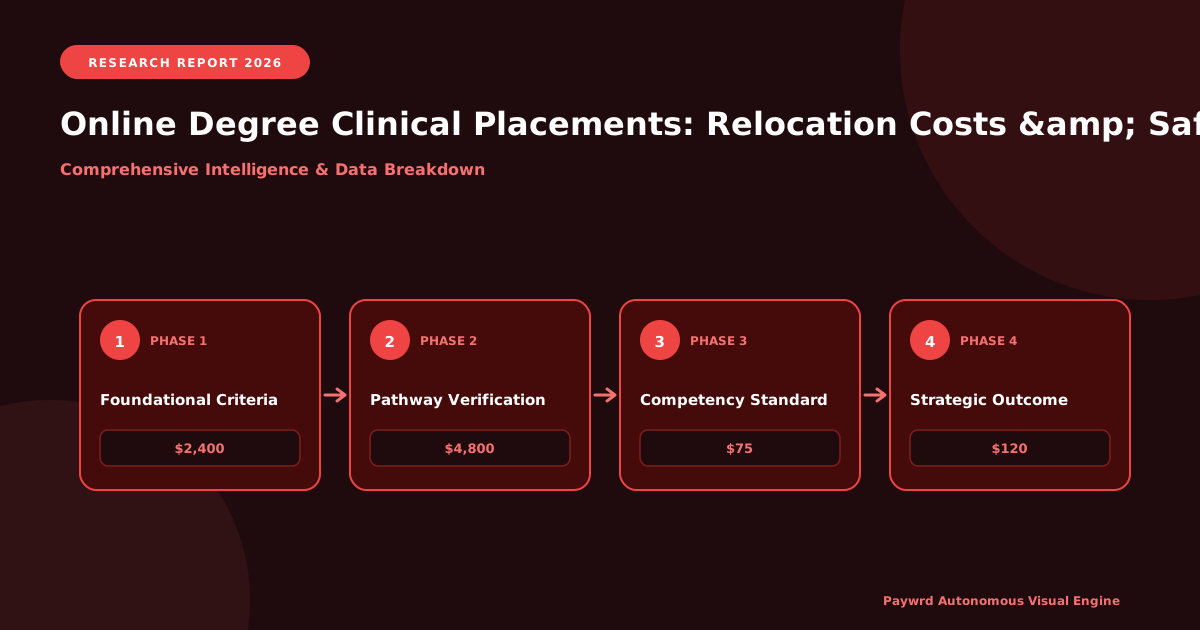
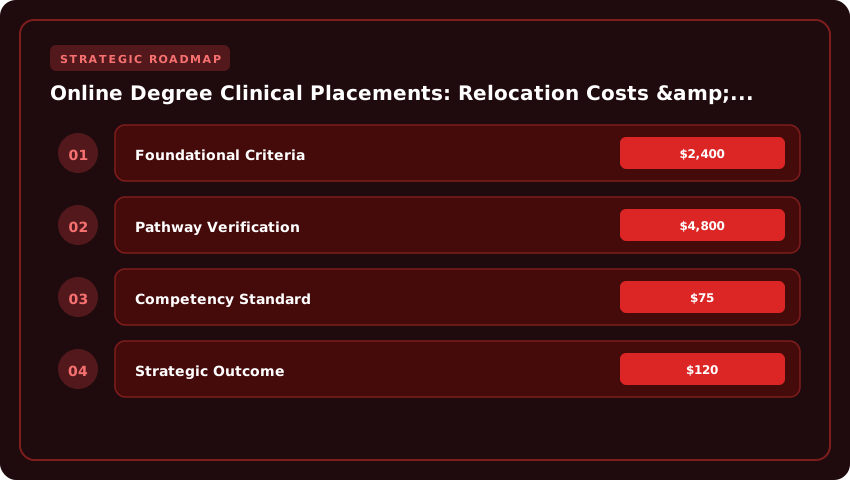
Understanding this weighting is not academic. A student in Texas might enter an online MSN program expecting a Houston-area placement, only to be routed to a HPSA-designated county three hours away. Relocation costs for these assignments typically run $2,400–$4,800 per semester, covering temporary housing, fuel, and background-check re-verification fees that average $75–$120 per state. By decoding the algorithm before enrollment, prospective students can negotiate realistic financial buffers, request hardship contingency language in their enrollment agreements, and avoid the shock of a 60-day-out reassignment notice. The placement system is designed to serve federal workforce policy first. Your strategy must be designed to serve your household second, with documentation that satisfies both.
The True Cost of Relocation: Stipends, Tax Implications & FAFSA Gaps
For most online degree candidates in nursing, counseling, social work, and teacher preparation, the hidden sticker shock of clinical rotations is the relocation itself. Industry benchmarking from the American Association of Colleges of Nursing (AACN) and recent student surveys consistently show that learners spend between $3,000 and $8,000 out of pocket for a single 12-to-16-week placement, especially when the assigned site is more than 100 miles from their permanent address. This figure is rarely disclosed during the admissions pitch, yet it sits squarely in the path of degree completion. Understanding the moving-parts—from per diem stipends to IRS code and FAFSA appeals—is essential for protecting your financial future while honoring your academic commitment.
First, let us address stipends. Some high-need rural sites and Federally Qualified Health Centers (FQHCs) offer modest relocation subsidies ranging from $500 to $1,500, often structured as taxable fellowship income. Many hospital systems and partner universities provide housing stipends paid through the financial aid office, but these frequently count against your Cost of Attendance (COA) and can actually reduce your unmet need. Before accepting any stipend, students should request a written breakdown from the Office of Student Financial Aid clarifying whether the payment is classified as a scholarship, a fellowship, or wage income, as each carries distinct downstream tax consequences.
Now to the IRS rules. Under the Tax Cuts and Jobs Act (TCJA) of 2017, the long-standing moving expense deduction was suspended for tax years 2018 through 2025. Unless Congress acts to extend it, most working Americans—including graduate students—cannot deduct relocation costs for clinical rotations on their federal return. There is one notable exception: active-duty members of the Armed Forces moving pursuant to military orders. For everyone else, those $3,000 to $8,000 in moving costs are paid with after-tax dollars. However, if you itemize and the move meets the “distance test” of 50-plus miles, certain unreimbursed moving expenses may still qualify as a deductible adjustment to income for specific categories of workers, so consult a CPA familiar with education-based relocations.
The FAFSA gap is where the most painful surprises occur. Your Free Application for Federal Student Aid establishes your Cost of Attendance, which is the cap on how much aid—federal, institutional, and private—you can receive in a given academic year. The COA includes tuition, fees, books, room, board, transportation, and miscellaneous personal expenses, but the standard figure assigned by most financial aid offices rarely accounts for the reality of a multi-month relocation to a distant clinical site. Fortunately, there is a formal process to address this.
Students can submit a Professional Judgment (PJ) appeal to their financial aid administrator, documenting the specific out-of-pocket expenses: mileage, temporary housing deposits, state licensure fees for the host state, and background-check costs. Under Section 479A of the Higher Education Act, aid officers have discretionary authority to adjust the COA upward for documented education-related expenses. If approved, this increase can unlock additional Federal Work-Study (FWS) funding at a host institution—some placement sites participate in cross-institutional work-study agreements—or expand your eligibility for the Federal Direct Graduate PLUS Loan. Be aware that Grad PLUS carries a 7.54% interest rate for the 2024–2025 award year, plus a 4.228% origination fee, making it a tool of last resort rather than first choice.
Actionable takeaway: Build a relocation ledger before you accept your placement assignment. List every anticipated cost—travel, lodging, deposits, licensure, childcare, and lost wages—and submit it with your PJ appeal in the same semester you receive your placement. This single act has the highest ROI of any financial planning step in the clinical year, routinely closing $2,000 to $5,000 of unfunded need.
Vetting Neighborhood Safety: Beyond Campus Crime Stats (Clery Act Limits)
For online degree students juggling asynchronous coursework with hands-on clinical rotations, the neighborhood surrounding a hospital, school district, or counseling center is just as important as the campus itself. Yet most learners default to the Clery Act Crime Statistics published by college and university campus safety offices, overlooking the fact that these federally mandated reports only cover crimes occurring on institutionally owned or controlled property and adjacent public spaces. A clinical placement site located fifteen minutes off-campus falls entirely outside this reporting perimeter, meaning a neighborhood can appear statistically safe while concealing serious localized risks like aggravated assault, drug-related offenses, or vehicular theft.
To build a truly accurate safety profile for housing near your assigned clinical site, you must triangulate data from three independent sources. Begin with the FBI’s Uniform Crime Reporting (UCR) Program and its modern successor, the National Incident-Based Reporting System (NIBRS), which provide offense counts down to the city and county level. Pair that quantitative foundation with the local police department’s interactive crime map, a tool now offered by approximately 80 percent of municipal agencies serving populations over 50,000. Finally, overlay qualitative sentiment pulled from community-driven platforms like Reddit neighborhood subreddits and Nextdoor, where residents candidly discuss recurring nuisances, lighting gaps, and slow emergency response times that official statistics often obscure.
- Step 1: Pull FBI UCR/NIBRS Data. Navigate to the FBI Crime Data Explorer at cde.ucr.cjis.gov and filter by the specific city or county where your clinical site resides. Pay particular attention to Part I offenses like homicide, rape, robbery, and burglary, and compare the most recent three-year trend against the national median. A 30 percent year-over-year spike in motor vehicle theft, for instance, is a critical warning sign if you plan to commute by car and rely on street parking.
- Step 2: Cross-Reference Local PD Heat Maps. Most municipal agencies publish weekly or monthly blotter maps. Search “[City Name] police crime map” and bookmark the interactive portal. Investigate the half-mile radius around your clinical address, looking for crime clusters near convenience stores, transit stops, and underpasses. Document specific dates, times, and offense types, because a single hot block can distort an entire ZIP code’s reputation.
- Step 3: Mine Reddit and Nextdoor for Ground Truth. Subscribe to the relevant city subreddit (such as r/Austin, r/Houston, or r/Philadelphia) and search the neighborhood name. Archive posts from the past twelve months mentioning safety, sidewalks, and street lighting. On Nextdoor, set a custom radius alert around your prospective address to monitor real-time resident discussions about break-ins, package theft, or harassment incidents.
- Step 4: Evaluate the 15-Minute Commute Corridor. Use Google Maps’ typical-traffic feature to define your daily route. Audit that exact corridor during morning and evening rush hours if possible. Note the presence of isolated walking paths, vacant lots, and poorly lit intersections. A neighborhood scoring well on paper can still harbor danger along the specific streets you will traverse five days a week.
Once your safety audit is complete, the second line of defense is your lease agreement. Standard twelve-month rental contracts rarely accommodate the volatility of a clinical placement that may shift across health systems mid-rotation. Before signing, negotiate for an early termination clause triggered by documented safety incidents. The strongest provisions allow cancellation without penalty if a violent felony occurs within one-quarter mile of the rental unit, if the property receives repeated police responses for domestic disturbances, or if the landlord fails to repair critical safety infrastructure like deadbolts, exterior lighting, or security cameras within 72 hours of written notice.
Insist on language that references objective triggers rather than subjective “neighborhood decline” language, which is notoriously difficult to enforce. Phrases like “a documented and verified crime incident resulting in area-wide safety advisories from the hosting clinical institution” carry far more legal weight than vague terms like “unsafe environment.” If the property is managed by a large corporate landlord, review their corporate early-termination policy; many national operators, including major single-family rental REITs, already offer transfer-friendly clauses for students and relocating professionals. Pair this contractual protection with renters insurance that includes loss-of-use coverage, ensuring that an emergency relocation does not bankrupt your clinical semester budget.
Interstate Compact Compliance: SARA, Licensure Portability & Remote Supervision
When a student enrolled in an online clinical degree crosses state lines for a practicum, internship, or residency, three regulatory frameworks collide simultaneously: federal-state authorization reciprocity, professional licensure portability, and scope-of-practice rules governing remote supervision. Understanding how the State Authorization Reciprocity Agreements (SARA), the Nurse Licensure Compact (NLC), and the Psychology Interjurisdiction Compact (PSYPACT) interlock is the difference between counting every supervised hour toward graduation and discovering, too late, that a semester’s worth of work cannot be legally certified.
SARA, administered by the National Council for State Authorization Reciprocity Agreements (NC-SARA) and recognized by the U.S. Department of Education, streamlines distance-education authorization across 49 member states, the District of Columbia, Puerto Rico, and the U.S. Virgin Islands. California remains the only non-member state as of 2026. For institutions holding SARA approval, out-of-state clinical placements that are integral to a degree program are treated as distance-learning activities, not as a separate physical presence, provided the placement is supervised by a properly credentialed preceptor and tied directly to a credit-bearing course. This means a University of Phoenix or Southern New Hampshire University student completing a rotation in Texas does not trigger a separate Texas proprietary school authorization filing, dramatically compressing relocation timelines and reducing legal exposure for the institution.
However, SARA does not override professional licensure. The compact specifically excludes courses and programs leading to licensure in fields where state boards reserve exclusive authority. For Registered Nurses (RNs) and Licensed Practical Nurses (LPNs), the Nurse Licensure Compact (NLC), now operating as the enhanced Nurse Licensure Compact (eNLC), allows a nurse holding a multistate license in a compact state to practice physically or remotely across all other compact states without obtaining additional authorization. As of 2026, 39 jurisdictions participate, with non-compact states such as California, New York, and Oregon requiring traditional single-state licensure or telemedicine-specific registration. For students, the practical takeaway is that a preceptor must hold an active multistate license issued from a compact member state, and the student must either hold their own multistate license (for RN-to-BSN students already licensed) or apply for a single-state license in the placement state before the first clinical hour.
For counseling and psychology trainees, PSYPACT governs the Authorized Interjurisdictional Practice (AIP) and the Temporary Authorization to Practice (TAP), enabling supervised telepsychology and temporary in-person practice across 42 participating jurisdictions. Under the PSYPACT Commission rules, practicum hours supervised by an authorized telepsychologist located in a different state may count toward graduation if both the supervisor and the trainee hold valid PSYPACT credentials, the client is located in a PSYPACT member state, and the supervision occurs via HIPAA-compliant video. This is a structural shift from older models that required the supervisor to be physically present in the same jurisdiction as the client.
Counting hours supervised by a remote preceptor, whether under the eNLC or PSYPACT, requires meticulous documentation. Students should verify three preconditions before accruing a single hour:
- Preceptor Compact Status: Confirm the supervisor’s license is multistate (eNLC) or that they hold a current Interjurisdictional Practice Certificate (PSYPACT) covering the state where the client or patient is physically located at the time of service.
- Student Authorization: Ensure your own license, compact privilege, or temporary authorization is active in the placement state. For unlicensed trainees in psychology, a PSYPACT E.Passport is required before the first remote session.
- Institutional SARA Alignment: Confirm with the university’s authorization office that the placement state is an active SARA member and that the practicum site has a current affiliation agreement on file, including a signed attestation of compliance with local scope-of-practice laws.
Students should also budget for compact privilege fees, which range from $50 to $200 per state depending on the profession, and for the administrative processing time, typically 10 to 15 business days, required by state boards to issue practice authorizations. Building a two-week buffer into relocation plans prevents last-minute delays that can disrupt financial aid disbursements, which are tied to verified enrollment in credit-bearing clinical coursework. By verifying SARA membership, compact privilege status, and remote supervision allowances in advance, students protect both their academic progression and their professional standing before stepping into the first clinical setting.
Emergency Protocols: Active Threat, Natural Disaster & Clinical Site Closure
Clinical placements in the United States can shift from routine to high-risk in a matter of minutes, whether due to an active shooter scenario, a hurricane making a hospital inaccessible, or a sudden institutional lockdown. For online degree students balancing tuition costs that often exceed $35,000 per year, losing a single clinical rotation is not just an inconvenience; it can delay graduation, jeopardize federal FAFSA-backed financial aid, and disrupt carefully planned College Board-aligned prerequisite sequencing. Building a proactive emergency protocol is therefore non-negotiable. The two most actionable components every student should master are a physical Go-Bag and a verified digital backup of all compliance records, paired with a clear petition strategy for simulation substitution under recognized accreditor percentage limits.
Your personal Go-Bag should be a small, weather-resistant backpack you can grab within fifteen seconds. Pack a 72-hour supply of water and calorie-dense food, a charged mobile power bank rated for at least 20,000 mAh, a laminated copy of your student ID and clinical site badge, and a printed emergency contact sheet that includes your program director, the campus Office of Student Affairs, and the local non-emergency dispatch number. Include a compact first-aid kit, N95 respirators, and a change of professional scrubs so that if a natural disaster forces an overnight shelter stay, you remain compliant with dress code if the site reopens unexpectedly. Place the bag at the foot of your workspace, never packed away in a closet.
For digital readiness, every clinical compliance document must live in at least two encrypted cloud locations. Platforms like CastleBranch and Complio are the industry standards used by the vast majority of ABET-aligned allied health programs and AACSB-accredited healthcare administration tracks. Download every immunization record, TB skin test result, BLS or ACLS certification card, and background check clearance as a PDF the moment it is uploaded. Store copies in an encrypted folder within Google Drive, Dropbox, or OneDrive, and email a secondary copy to a trusted family member using a password-protected attachment. If a server outage or cyberattack takes the primary tracking system offline, you can present verified documentation to a new preceptor within hours rather than weeks.
When a site becomes truly inaccessible, the critical step is petitioning your program director for alternative simulation hours. Major US accreditors permit a defined percentage of total clinical hours to be fulfilled through high-fidelity simulation. For example, many CCNE-accredited nursing programs allow up to 25% of direct patient care hours to be replaced with approved simulation, while certain CACREP counseling programs cap substitute hours at 20%. Your petition must include the exact accreditor language, a calendar of missed days, a proposed simulation schedule with specific manikin-based competencies, and a written endorsement from a faculty member. Submit the petition within 48 hours of the closure to maintain the strongest possible standing for financial aid disbursement and to keep your expected graduation term intact.
- Pack a 15-second Go-Bag: Include a 20,000 mAh power bank, 72-hour water and rations, N95 masks, a printed emergency contact list, and one full set of clinical scrubs.
- Encrypt and duplicate all records: Maintain verified PDF copies of every CastleBranch or Complio document in two cloud locations plus a password-protected email backup.
- Know your accreditor cap: Identify whether your program falls under the 25% nursing or 20% counseling simulation ceiling before an emergency strikes.
- File the petition within 48 hours: Reference the specific accreditor clause, attach a simulation competency calendar, and secure a faculty co-signer to protect federal aid eligibility.
Leveraging Placement for Residency Match & Job Offers: Strategic Networking
The final practicum is not merely a graduation requirement; it is the single most valuable recruiting event in your entire academic career. For students in online nursing, teaching, and counseling programs, the clinical placement site functions as a 12-to-16-week extended interview where preceptors, unit managers, and district administrators evaluate your clinical judgment, cultural fit, and work ethic in real time. According to the National Council of State Boards of Nursing (NCSBN) longitudinal workforce data, approximately 68% of new graduate nurses who accept a position do so at the organization where they completed their final capstone practicum. For Title I schools—those serving large populations of low-income students—district hiring data from the U.S. Department of Education shows a comparable pattern, with roughly 55% to 60% of graduating teachers receiving offers from their host campuses before state certification results arrive in late summer. Critical Access Hospitals (CAHs), the rural lifelines certified by the Centers for Medicare & Medicaid Services (CMS), report even higher conversion rates, often exceeding 75%, because the preceptor pipeline in rural America is shallow and recruitment costs average $25,000 per vacancy.
Understanding these conversion mechanics is the foundation of strategic networking during your practicum. The goal is to convert informal impressions into a formal letter of intent or a transition-to-practice contract well before graduation. For nursing students, transition-to-practice residency contracts typically range from $45,000 to $65,000 in starting annualized compensation, with the higher end clustered in critical shortage facilities across the Midwest, Mountain West, and Deep South. These agreements commonly include sign-on bonuses between $5,000 and $15,000, relocation stipends of $2,500 to $10,000, and—critically—student loan repayment assistance of up to $10,000 through programs like NURSE Corps. To secure these packages, you must initiate the conversation early, ideally during week eight of your practicum.
Here are actionable scripts and tactics that work in real American clinical environments:
- The Preceptor Check-In Script: During your midterm evaluation, say: “I have really valued the workflow here, and I am hoping to stay on full-time once I pass the NCLEX. Could we walk through what the transition-to-practice residency looks like for new grads hired into this unit?” This phrasing signals commitment without presumption and invites the preceptor to advocate for you with the unit manager.
- The Unit Manager Negotiation Frame: When the offer arrives, respond within 48 hours with: “Thank you for the offer. I am genuinely excited about joining the team. Could we revisit the sign-on bonus structure or the relocation reimbursement, given the timeline I need to coordinate for board testing and licensure in this state?” Facilities expect a counter; silence reads as disinterest.
- The Title I District Approach: For teaching candidates, request an informational interview with the principal during week six using: “I am planning my certification timeline around the state testing window. If a vacancy opens in this grade level or content area, I would love to be considered as a candidate before the broader job fair cycle.” Title I schools frequently fill positions internally before posting publicly, and early signaling can move you to the front of that list.
- The Critical Access Hospital Playbook: CAHs operate on lean staffing models, so demonstrate flexibility. Volunteer for one extra shift per month during your practicum and express willingness to pursue cross-training in emergency or long-term care. Administrators reward adaptability with faster conversion to benefited status—often within 30 days of licensure rather than the standard 90-day probationary window.
- The Counselor Licensure Bridge: For counseling practicum students, ask your site supervisor: “If I complete my residency requirement here, is there a pathway to a fully licensed counselor role once I hit the 3,000-hour post-master’s threshold?” Many community mental health centers, especially those funded by HRSA Behavioral Health Workforce grants, will pre-commit to a $52,000 to $58,000 starting salary plus supervision hours paid at the master’s-level rate.
The financial arithmetic reinforces why this networking matters. Student loan debt for online graduate nursing students now averages $55,000 to $75,000 according to the most recent American Association of Colleges of Nursing (AACN) survey data, while teaching candidates carry an average of $40,000 per the National Center for Education Statistics (NCES). Securing a transition-to-practice contract that bundles loan repayment, sign-on bonuses, and relocation assistance can effectively neutralize $20,000 to $35,000 of that burden within the first 18 months of employment—turning your practicum placement into the highest-return investment of your degree. Document every conversation, follow up with a thank-you email within 24 hours of any site interaction, and treat the final semester as the beginning of your career, not its conclusion.
| Metric | In-State Public University (e.g., SUNY, UC System) | Private Non-Profit University (e.g., NYU, USC) | Out-of-State Public University (e.g., University of Phoenix, WGU) | For-Profit Online University |
|---|---|---|---|---|
| Tuition Per Credit Hour | $350 – $550 | $1,200 – $1,800 | $450 – $700 | $300 – $600 |
| Total Program Cost (BSN/MSN) | $40,000 – $60,000 | $90,000 – $150,000 | $50,000 – $75,000 | $35,000 – $65,000 |
| Relocation & Travel Cost (Avg.) | $1,500 – $3,000 | $2,500 – $5,000 | $3,000 – $6,000 | $2,000 – $4,000 |
| Clinical Placement Cut-off (GPA) | 3.0 (Minimum) | 3.25 – 3.5 (Competitive) | 2.75 – 3.0 | 2.5 – 2.75 |
| Safety Vetting Requirements | Background check, drug screen, BLS/CPR, site-specific compliance (Joint Commission) | Federal background check, drug screen, immunizations, liability insurance ($1M-$3M) | State-specific background check, drug screen, liability insurance, electronic health record (EHR) training | Basic background check, drug screen, school-mandated compliance |
| Program Timeline (Months) | 36 – 48 months | 24 – 36 months (Accelerated) | 36 – 60 months (Flexible) | 24 – 36 months (Self-Paced) |
| Clinical Hours Required | 700 – 800 hours | 800 – 1,000+ hours | 600 – 800 hours | 500 – 700 hours |
| NCLEX-RN Pass Rate (First Attempt) | 85% – 92% | 88% – 95% | 80% – 88% | 70% – 82% |
| Career ROI (5-Year Net) | High ($250K+ projected earnings) | Very High ($300K+ projected earnings, prestigious network) | Moderate-High ($220K+ projected earnings) | Low-Moderate ($150K-$200K projected earnings, limited mobility) |
Frequently Asked Questions
What is the average relocation cost for online degree clinical placements in the US?
Relocation costs for clinical placements typically range from $1,500 to $6,000, depending on the institution type and distance traveled. Public in-state universities average $1,500–$3,000, while private and out-of-state programs may cost $3,000–$6,000. Budget for housing deposits, transportation, background checks, drug screenings, and liability insurance premiums.
How do universities assign high-need clinical placement sites to online students?
Universities use proprietary placement algorithms on platforms like E*Value, Typhon, and Medatrax to match students with sites. These systems reconcile student geographic preferences, GPA cut-offs (typically 3.0+), preceptor availability, accreditation quotas, and federal Title VIII mandates to ensure compliant, high-quality clinical experiences aligned with program accreditation standards.
What safety vetting is required for nursing clinical placements in high-risk states?
Safety vetting for high-risk state placements typically includes a federal criminal background check, 10-panel drug screen, immunization verification (MMR, Tdap, Hepatitis B, COVID-19), BLS/CPR certification, and liability insurance ($1M–$3M coverage). Some sites also require Joint Commission compliance training and electronic health record (EHR) proficiency verification before student clearance.
What GPA do you need to qualify for competitive clinical placements?
Most nursing programs require a minimum 3.0 GPA for clinical placement eligibility, though competitive programs at private universities often mandate 3.25–3.5. Out-of-state and for-profit programs may accept 2.5–2.75. Exceeding the cut-off improves your probability of securing preferred sites, especially in metropolitan areas with limited preceptor availability.
Strategic Final Takeaway
Success in evaluating Online Degree Clinical Placements: Relocation Costs & Safety Vetting Guide relies on early preparation, adherence to verified accredited requirements, and cross-referencing official portals. Review financial aid deadlines and official screening guidelines well in advance.

