Why NAEP Score Declines Are Forcing Districts to Adopt Science of Reading Software
When the US Department of Education released the 2024 National Assessment of Educational Progress (NAEP) results, the data painted a stark picture for American middle schools. Eighth-grade reading scores experienced a noticeable decline, continuing a downward trajectory that has district administrators deeply concerned. For grades 6 through 8, this isn’t just a temporary blip; it represents a fundamental fracture in literacy development. Middle school is the critical juncture where students transition from “learning to read” to “reading to learn.” When adolescents lack foundational decoding and comprehension skills, they simply cannot access complex content in science, social studies, or mathematics.
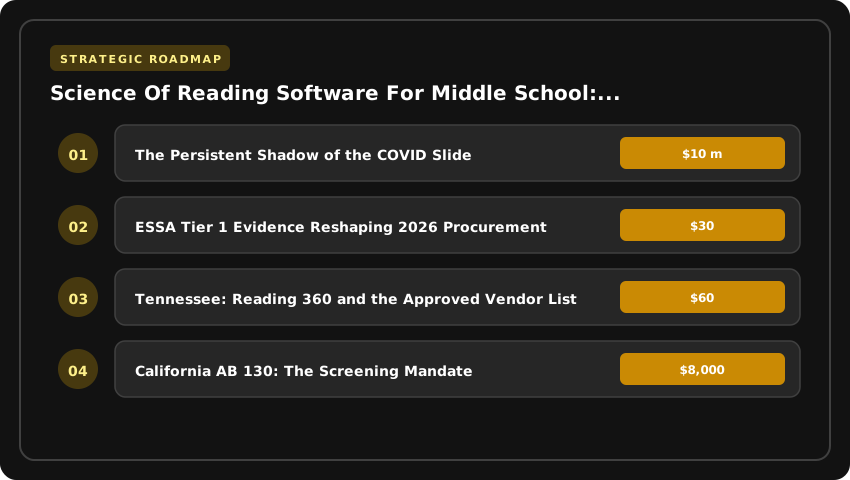
The Persistent Shadow of the COVID Slide
While elementary schools have aggressively tackled early literacy, middle schoolers are still grappling with the lingering effects of the post-pandemic “COVID slide.” Recent analyses of standardized test data reveal that the average middle school student lost roughly three months of learning in reading alone. For historically marginalized students, that loss was even steeper. As these students advance through the grades, the deficit compounds. Traditional remediation methods—like generic reading labs or static workbooks—are proving insufficient to bridge these multi-year gaps. Districts are realizing they need dynamic, personalized interventions that can diagnose specific phonics or comprehension deficits instantly and adapt to a student’s exact instructional level.
ESSA Tier 1 Evidence Reshaping 2026 Procurement
As we look toward the 2026 procurement cycles, district technology directors and curriculum coordinators are radically overhauling their purchasing checklists. The Every Student Succeeds Act (ESSA) has long emphasized evidence-based interventions, but the urgency of the NAEP data is forcing a stricter adherence to Tier 1 evidence requirements. Tier 1 demands “strong evidence” from at least one well-designed, well-implemented experimental study. Districts can no longer justify purchasing literacy platforms based on flashy interfaces or vague promises of student engagement. They need AI adaptive intervention platforms backed by rigorous, peer-reviewed research.
This shift means vendors must prove their software genuinely moves the needle on adolescent literacy. AI-driven Science of Reading platforms are uniquely positioned to meet these demands. By leveraging machine learning to continuously assess and adjust to student performance in real time, these tools provide the targeted, intensive intervention that middle schoolers desperately need. For procurement directors navigating tightening budgets and mounting accountability, investing in ESSA-aligned, AI-adaptive literacy software is no longer just an option—it is a strategic imperative to reverse the NAEP decline.
- NAEP Declines: 2024 data shows significant drops in 8th-grade reading proficiency, highlighting severe gaps in grades 6-8.
- COVID Slide Impact: Middle schoolers lost an average of 3 months of reading instruction, compounding comprehension deficits.
- 2026 Procurement Shift: Strict ESSA Tier 1 evidence requirements are forcing districts to prioritize AI adaptive platforms backed by strong experimental research.
Decoding the 5 Pillars: How AI Tools Address Phonemic Awareness Through Comprehension
Buying Science of Reading software for older students is not simply about digitizing flashcards. The most effective AI-driven adaptive literacy tools are engineered around Scarborough’s Reading Rope, a foundational framework that weaves together word recognition (decoding, phonemic awareness, sight recognition) and language comprehension (vocabulary, syntax, background knowledge). For struggling middle schoolers in 6th through 8th grade, AI algorithms dynamically map to these five pillars, targeting specific gaps rather than forcing students through rigid, grade-level material. This is why platforms aligned with structured literacy are replacing traditional whole-language readers in classrooms from Texas to Ohio.
Mapping Adaptive Algorithms to Scarborough’s Reading Rope
Adaptive algorithms function as the digital brain behind modern literacy platforms. When a 7th grader opens the software, an initial diagnostic runs them through exercises assessing phonological processing, decoding speed, and reading comprehension. Based on real-time performance, the AI maps the student’s specific deficits to strands of the Reading Rope. If the data shows a student still struggles with multisyllabic word decoding, the engine routes them through morphology and syllable-type lessons instead of pushing comprehension passages. This is a massive shift from the old model where a 12-year-old reading at a 3rd-grade level would simply be handed a younger student’s textbook.
Diagnostic Assessments: Screening for Dyslexia and Specific Learning Disabilities
Because dyslexia and other specific learning disabilities (SLD) often go unidentified until middle school, AI tools now embed universal screeners directly into the curriculum. According to the US Department of Education’s National Center on Improving Literacy, roughly 20% of students struggle with reading, and a significant portion of those have dyslexia. AI diagnostics analyze response latency, error patterns, and oral reading fluency to flag students who exhibit hallmark signs of dyslexia, such as inconsistent phoneme manipulation or trouble with orthographic mapping. District leaders appreciate this automation because it provides actionable, data-rich reports for Response to Intervention (RTI) teams without requiring a full psychoeducational evaluation just to get started.
Why Vocabulary and Morphology Are Critical for 6th-8th Graders
Once students reach middle school, the academic vocabulary demands in science and social studies texts skyrocket. Even if a child can decode a word like photosynthesis, they cannot understand it without explicit morphology instruction. AI software addresses this by breaking down Greek and Latin roots, prefixes, and suffixes, teaching students that bio means life and syn means together. To meet strict state mandates, such as those under the California Code of Regulations or Mississippi’s Literacy-Based Promotion Act, AI platforms tier vocabulary exercises. Tier 1 words get quick recognition drills, while Tier 2 and Tier 3 academic vocabulary receives deep, contextualized practice. This targeted approach ensures 6th through 8th graders build the background knowledge and syntax skills required to meet grade-level comprehension benchmarks before transitioning to high school.
- The Algorithm Advantage: AI tools continuously adjust text complexity using Lexile measures, keeping students in their optimal learning zone.
- Specific to Older Learners: Unlike early elementary tools, middle school platforms emphasize morphology, complex syntax, and academic vocabulary.
- Compliance Ready: Built-in screeners help districts meet state dyslexia screening laws and structured literacy curriculum requirements.
State Literacy Mandates Driving Middle School Software Purchases: MS, TN, CO, and CA
When the 2024 NAEP scores sent shockwaves through American school districts, state legislatures weren’t waiting around for local boards to catch up. Across the country, lawmakers in Mississippi, Tennessee, Colorado, and California have codified specific literacy requirements that now dictate exactly what adaptive software districts can purchase. For administrators evaluating AI-driven Science of Reading tools, understanding these state-specific mandates isn’t optional anymore. It’s the difference between getting a purchase order approved in six weeks versus getting flagged in an audit.
Mississippi: The Literacy-Based Promotion Act Expands to Grades 6-8
The state that essentially launched the modern Science of Reading movement isn’t resting on its laurels. Mississippi’s Literacy-Based Promotion Act, originally focused on third-grade retention, has expanded its scope to include middle grades. Districts must now demonstrate that any reading intervention software targeting grades 6 through 8 aligns with structured literacy principles, meaning phonemic awareness, decoding, morphology, and syntax instruction must be baked into the platform’s core architecture. Software that relies primarily on comprehension strategies or leveled readers without explicit phonics components will get rejected at the district review stage.
- Vendors must provide documentation showing alignment with structured literacy frameworks
- Progress monitoring data must be exportable for state reporting requirements
- Screening tools must identify students reading two or more grade levels below benchmark
Tennessee: Reading 360 and the Approved Vendor List
Tennessee’s Department of Education has taken an unusually direct approach through its Reading 360 initiative. The state maintains an approved vendor list for AI adaptive literacy software, and districts purchasing outside that list face significant Title I compliance friction. Tennessee specifically requires adaptive tools to include diagnostic assessments that identify foundational skill gaps, not just comprehension difficulties. Platforms like Lexia Core5, Imagine Learning, and select others have cleared the state’s evidence review, while newer entrants must submit efficacy data before gaining approval.
California AB 130: The Screening Mandate
California’s AB 130 transformed how middle schools approach literacy intervention by requiring universal screening for students reading below grade proficiency. For software purchasers, this means any adaptive platform must produce screening reports that satisfy California’s specific criteria, including risk stratification levels and progress monitoring at six-week intervals. Districts are increasingly looking for tools that integrate directly with the California School Dashboard reporting framework.
Colorado READ Act: Evidence-Based Requirements
Colorado’s READ Act (Reading to Ensure Academic Development) requires districts to adopt only evidence-based intervention programs, with software vendors needing to demonstrate efficacy through peer-reviewed research or large-scale implementation data. The state’s approved program list is updated annually, and middle school tools must show measurable growth in foundational reading skills, not just vocabulary exposure or fluency alone.
ESSER III and ARP Funding Deadlines: Maximizing Budgets Before the September 2024 Cliff
For district procurement officers staring at bloated software budgets and widening literacy gaps, the clock is ticking. The American Rescue Plan (ARP) and ESSER III funding delivered an unprecedented windfall to K-12 schools, but those dollars carry a strict liquidation deadline that could leave millions of unspent funds stranded on the table. With the federal obligation deadline of September 30, 2024, firmly in the rearview mirror for most states, administrators must now navigate a tight window of state-specific grace periods to invest in AI-driven Science of Reading software before the money evaporates entirely.
Calculating Allowable Expenses for AI Literacy Software
Procurement officers often ask whether adaptive literacy platforms actually qualify under ESSER III guidelines. The short answer is yes, provided schools align their purchases with the grant’s core pillars. Under the ARP Act, ESSER III funds can be used for evidence-based interventions designed to address learning loss, specifically targeting subgroups most impacted by the pandemic. AI-driven Science of Reading software that uses diagnostic algorithms, phonics-based sequencing, and personalized pathways directly satisfies these requirements.
However, allowable expenses must be tracked meticulously. Districts can allocate funds toward:
- Software licensing fees for adaptive literacy platforms covering grades 6 through 8.
- Professional development and teacher training modules bundled with the AI tool.
- Implementation support, including data migration and integration with existing Learning Management Systems (LMS).
- Hardware stipends if devices are explicitly required to access the licensed platform.
Under ESSER III guidelines, districts must document how every dollar connects to learning recovery. A solid paper trail that explicitly references the Science of Reading framework and NAEP score recovery will satisfy any future federal audit from the US Department of Education.
State-Specific Liquidation Deadlines You Cannot Ignore
While the federal obligation deadline passed on September 30, 2024, states granted districts varying liquidation extensions to actually spend down remaining funds. Procurement teams operating in major hubs need to track these dates carefully:
- Texas: The Texas Education Agency (TEA) extended the liquidation deadline to January 31, 2025, giving districts a narrow window to finalize contracts and submit reimbursements.
- New York: New York State Education Department (NYSED) extended its deadline to January 31, 2025, aligning closely with federal closeout timelines.
- California: The California Department of Education (CDE) pushed its deadline to March 15, 2025, offering the longest runway for procurement officers on the West Coast.
Missing these liquidation dates means returning unspent federal stimulus money. With ESSER III allocations ranging from hundreds of thousands to over $10 million per district, even a modest slice of forfeitable funds represents a massive missed opportunity for middle school literacy intervention.
Building a Multi-Year Sustainability Model After the Cliff
Beyond September 2024, smart administrators are treating ESSER III dollars as a launching pad rather than a long-term crutch. A successful sustainability model typically braids funding sources together. Districts should leverage Title I, Title II-A, and Title IV-A budgets to continue adaptive software subscriptions once federal stimulus funds dry up. Additionally, calculating the true return on investment (ROI), measured in reduced remediation costs and improved NAEP outcomes, helps justify ongoing expenditures to school boards. By acting now, procurement officers can lock in competitive pricing for AI adaptive literacy tools while ensuring middle schoolers get the reading intervention they desperately need.
Pricing Models Decoded: Per-Student vs. Site Licenses for AI Literacy Platforms
For US district administrators balancing tight Title I budgets against urgent literacy demands, deciphering the pricing structures of AI-driven Science of Reading platforms often feels like reading fine print in dim light. Vendors typically offer two primary models: per-student subscriptions ranging from $30 to $60 per student annually, or unlimited building-wide licenses that generally fall between $8,000 and $25,000 per middle school per year. Understanding the long-term financial implications of each contract type is essential for maximizing return on investment while serving every struggling reader.
Per-Student Pricing: Flexible but Scaling Quickly
Per-seat licensing remains the most common entry point for mid-sized districts testing adaptive literacy software. Platforms like Lexia Core5 and Imagine Learning structure costs around individual access, which works beautifully for pilot programs. However, when a 600-student middle school commits to full deployment, the math escalates rapidly. At the midpoint of the pricing range, that single building faces a $27,000 annual commitment, a figure that often excludes the premium analytics dashboards administrators actually need to demonstrate student growth to school boards.
- Typical range: $30-$60 per student per year
- Best suited for: Pilot programs, Title I targeted interventions, or schools under 300 students
- Hidden markup: Progress monitoring dashboards frequently add 15-25% to base pricing
Site Licenses: Predictable Costs for Larger Campuses
Building-wide unlimited licenses flip the economic equation for larger middle schools. Once enrollment crosses approximately 400 students, flat-fee site licensing almost always delivers stronger value. A district paying $18,000 annually for an unlimited building license secures the same adaptive AI literacy tools that would cost over $36,000 under a per-student model. More importantly, site licenses typically bundle professional development modules, teacher coaching dashboards, and parent reporting portals without triggering additional line-item charges.
Hidden Costs That Derail Budgets
The sticker price rarely tells the complete financial story. Districts frequently underestimate the true cost of ownership by overlooking four critical expense categories:
- Professional development packages: Often $2,500-$5,000 per building annually, covering live coaching sessions and on-demand training libraries
- Progress monitoring dashboards: Administrative analytics tiers that track student growth against NAEP benchmarks typically command a 25% premium
- Teacher coaching modules: AI-driven instructional feedback tools for educators, frequently priced as $15-$20 per teacher annually
- Implementation support: Onboarding fees ranging from $1,500 to $4,000, particularly common with platforms requiring LMS integration through Canvas or Schoology
Subscription vs. Perpetual Licensing for Rural Districts
Budget-constrained rural districts face unique procurement challenges where every dollar travels further. While perpetual licensing—where a district owns the software outright—sounds appealing, it has become nearly extinct in the adaptive literacy market. Most AI platforms require cloud-based algorithms that continuously update based on student performance data, making annual subscriptions the only viable option. For rural campuses, the smartest financial move typically involves negotiating three-year subscription contracts with price-lock guarantees, often securing 10-15% discounts while protecting against mid-year budget cuts.
FERPA, COPPA, and Student Data Privacy: Vetting AI Vendors for Compliance
Adopting adaptive literacy software without a rigorous privacy review is a liability waiting to happen. When a Science of Reading platform ingests student voice recordings, keystroke dynamics, and error patterns to train its large language models, it creates a data footprint far deeper than traditional edtech. District technology directors must treat vendor vetting with the same scrutiny applied to curriculum adoption—because a FERPA violation or COPPA misstep can derail an implementation faster than a low usage rate.
Interrogate the Training Pipeline
Generative AI features—think automated essay feedback or dynamic passage generation—introduce a critical question: Is student PII (Personally Identifiable Information) touching the model’s training weights? Demand a written Data Processing Addendum (DPA) that explicitly prohibits the use of student inputs for foundational model training or product improvement across the vendor’s broader customer base. Ask point-blank: “Does de-identified data leave our tenant to fine-tune your base model?” If the answer is yes, or if the vendor hedges, walk away. Under FERPA, “directory information” exceptions do not cover behavioral metadata used to refine proprietary algorithms.
Demand the Receipts: SOC 2 Type II and State Agreements
A SOC 2 Type I report is a snapshot; a SOC 2 Type II report proves operational effectiveness over a minimum six-month audit window. Insist on the full report, not just the summary, and verify the Trust Services Criteria cover Security, Availability, and Confidentiality. But federal standards are the floor, not the ceiling. If you operate in New York, the vendor must sign a riders compliant with Education Law 2-d and Part 121 regulations, including a Parents’ Bill of Rights for Data Privacy. California districts need CCPA/CPRA alignment; Illinois requires SOPPA compliance. Do not accept a generic “we comply with all laws” clause—require the signed exhibit.
Close the COPPA Loopholes
The Children’s Online Privacy Protection Act (COPPA) draws a hard line at age 13, but middle school straddles that boundary. For students under 13, the school can consent in loco parentis only if the tool is used strictly for educational purposes and the vendor provides direct notice to parents. Verify the vendor’s COPPA Safe Harbor certification (e.g., iKeepSafe, TRUSTe). For students 13 and older, the “gray area” expands: vendors often switch to “general audience” terms of service, enabling behavioral advertising profiles or third-party data sharing that FERPA doesn’t explicitly block. Your contract must mandate that FERPA-level protections persist regardless of student age, effectively extending COPPA guardrails district-wide.
- Contractual Kill Switch: Include a 30-day data destruction clause upon contract termination.
- Sub-processor Transparency: Require notification and opt-out rights for any new sub-processors handling PII.
- Breach Liability: Cap vendor liability at a multiple of annual fees, but carve out unlimited liability for willful privacy violations.
Privacy compliance isn’t a checkbox—it’s a governance framework. Build a cross-functional review board (IT, Legal, Curriculum, Parent Rep) to sign off before any pilot launches. The cost of due diligence is negligible compared to the $1.5 million average cost of a K-12 data breach reported by IBM, not to mention the erosion of community trust that sinks literacy initiatives before they start.
Procurement Checklist: Evaluating AI Adaptive Literacy Software for Grades 6-8
You have the budget approved and the urgency is real—now you need to separate the platforms that actually move the needle from the ones that just demo well. Middle school literacy intervention leaves zero margin for error; a wasted semester costs a student their high school trajectory. Use this rubric to turn vendor pitches into a defensible RFP.
Demand ESSA Tier 1 Evidence—Not “Alignment”
Vendors love to claim “ESSA alignment,” but Tier 1 (Strong Evidence) requires a well-designed, well-implemented experimental study (RCT) showing statistically significant positive effects on student outcomes. Ask for the specific What Works Clearinghouse (WWC) review or the independent study PDF. If they hand you a “logic model” or a correlational study comparing users vs. non-users without random assignment, that is Tier 4 at best. Insist on effect sizes (Cohen’s d) for your specific demographic subgroups—English Learners, students with IEPs, and Tier 2/3 intervention populations. If the study sample was affluent suburban elementary students, it does not validate efficacy for your urban eighth graders reading three grades below level.
Stress-Test LMS Interoperability Before Signing
A beautiful dashboard that requires manual CSV uploads is a shelf-ware guarantee. Your RFP must mandate LTI 1.3 Advantage certification and OneRoster compliance for real-time roster syncing. Test these three non-negotiables in a sandbox environment:
- Canvas: Does the tool pass back mastery scores to the Canvas Gradebook as LTI Assignment and Grade Services? Can teachers launch the adaptive lesson directly from a Module without a second login?
- Schoology: Verify support for Schoology’s Assessment Management Platform (AMP) integration so district-wide benchmark data flows into the student mastery profile automatically.
- Google Classroom: Confirm Classroom add-on support (not just “sign in with Google”) so teachers can assign adaptive practice streams and view progress inside the Classwork stream.
Require a dedicated integration engineer on the vendor side for the first 90 days—budget $15,000–$25,000 of your implementation fees for this support.
Red Flags That Kill the Deal
Walk away immediately if you spot these during the demo or contract review:
- “Auto-magic” marketing claims: Phrases like “AI teaches reading” or “replaces teacher judgment.” The Science of Reading requires explicit, systematic instruction; software scaffolds practice—it does not replace the certified specialist.
- Zero peer-reviewed research: If the only “research” page hosts white papers authored by the vendor’s Chief Learning Officer, you have no external validity.
- Shallow adaptive branching: Ask to see the decision tree. If a student misses a vocabulary item and the system only serves “easier vocabulary” rather than diagnosing a missing morphology or background knowledge gap, the engine is rule-based, not adaptive. Demand transparency on the knowledge graph granularity—how many discrete skills are mapped?
- Data privacy gaps: No Student Data Privacy Agreement (SDPA) signed for your specific state (e.g., CA NDPA, IL SOPPA, NY Ed Law 2-d) is an automatic disqualifier.
Attach this checklist as Appendix A to your RFP. Score every vendor on a 1–5 scale across Evidence, Integration, Pedagogical Fidelity, and Data Governance. Only vendors scoring 18+ out of 20 advance to the pilot phase. That is how you protect your students and your Title I funds.
| Platform | Est. Annual Cost (Per Student) | Target Grades | Adaptive Engine Type | ESSA Evidence Tier | Implementation Model | Key Differentiator for MS |
|---|---|---|---|---|---|---|
| Lexia PowerUp Literacy | $30–$45 | 6–12 | Rule-based + AI Branching | Tier 1 (Strong) | Blended (Teacher-led + Online) | Explicit morphology & academic vocabulary strands |
| Amplify Reading (formerly Amplify CKLA) | $25–$40 | K–8 | Algorithmic Mastery Paths | Tier 2 (Moderate) | Core Curriculum Integrated | Knowledge-building units aligned to Science of Reading |
| DreamBox Reading (Reading Plus) | $20–$35 | 3–12 | Real-time Cognitive Modeling | Tier 1 (Strong) | Supplemental Silent Reading Fluency | Guided Window scaffold for fluency/stamina |
| HMH Read 180 Universal | $50–$70+ | 4–12 | Adaptive Learning Pathways (FASTT) | Tier 1 (Strong) | Intensive Intervention (Tier 2/3) | Brain-based learning zones (Explore, Learn, Succeed) |
| Renaissance Lalilo | $15–$25 | K–5+ (MS Remediation) | Phonics/Comprehension Decision Trees | Tier 3 (Promising) | Supplemental Foundational Skills | Low-cost phonics gap closure for older strivers |
Frequently Asked Questions
How much does Science of Reading software cost per student for middle schools?
Middle school Science of Reading platforms typically range from $15 to $70 per student annually. Supplemental tools like Renaissance Lalilo average $15–$25, while comprehensive intervention suites like HMH Read 180 cost $50–$70+. Most core adaptive platforms (Lexia PowerUp, Amplify, DreamBox) cluster in the $25–$45 range for district volume licenses.
Which Science of Reading software has the strongest ESSA evidence rating for grades 6–8?
Lexia PowerUp Literacy, DreamBox Reading (Reading Plus), and HMH Read 180 Universal all hold ESSA Tier 1 (Strong) evidence ratings specifically for middle school efficacy. These platforms demonstrate statistically significant positive effects on standardized reading assessments (e.g., MAP, SBAC) in randomized control trials meeting What Works Clearinghouse standards.
How long does it take to implement AI adaptive literacy software district-wide?
Full district-wide deployment for grades 6–8 typically requires 8–12 weeks. This includes 2–3 weeks for rostering/SSO integration (Clever/ClassLink), 1–2 weeks for initial diagnostic placement testing, and 4–6 weeks for teacher professional development on data protocols. Pilot-to-scale models often add a 9-week pilot semester before full rollout.
Can AI reading software replace reading intervention teachers in middle school?
No. ESSA guidelines and vendors explicitly classify these tools as Tier 1 core supplements or Tier 2/3 intervention accelerators, not teacher replacements. Effective models use AI for real-time skill diagnosis and independent practice (30–45 min/day), freeing specialists for small-group explicit instruction targeting the 'Science of Reading' components: phonology, orthography, and morphology.
What is the average ROI timeline for middle school literacy software adoption?
Districts typically observe measurable ROI within 18–24 months (2–3 assessment cycles). Early indicators include 15–25% reduction in Tier 3 referrals by mid-year. Full ROI—calculated as cost-per-proficiency-point-gained versus traditional pull-out models—usually breaks even in Year 2 when license renewal costs drop 10–15% and teacher PD overhead stabilizes.
Strategic Final Takeaway
When evaluating Science Of Reading Intervention Software Middle School AI Adaptive Literacy Tools, base your decisions on accredited institutional standards, measurable return on investment (ROI), and up-to-date official guidelines. Always verify specific dates and requirements through official regulatory portals.