Defining Tier 1 Alignment: What Middle School Leaders Must Require
Let’s cut through the noise. In the middle school ecosystem, “Tier 1” is frequently misused as a synonym for “good software.” Under the Multi-Tiered System of Supports (MTSS) and Response to Intervention (RTI) frameworks—backed by the Individuals with Disabilities Education Act (IDEA) and the Every Student Succeeds Act (ESSA)—Tier 1 has a rigid, legal definition: high-quality, evidence-based core instruction delivered to all students in the general education setting. If an AI reading tool pulls students out of class, serves only the bottom quartile, or lacks a research base meeting ESSA evidence tiers, it is functionally a Tier 2 or 3 intervention, regardless of the vendor’s sales deck.
The ESSA Evidence Tiers: Your Non-Negotiable Filter
ESSA Section 8101(21)(A) establishes four evidence tiers. For a core Tier 1 curriculum purchase using federal Title I or IDEA funds, you are legally steered toward the top two tiers:
- Tier 1 – Strong Evidence: At least one well-designed, well-implemented experimental study (RCT) showing statistically significant positive effects on reading outcomes for the relevant grade band (Grades 6–8).
- Tier 2 – Moderate Evidence: At least one well-designed quasi-experimental study (QED) with similar positive findings.
- Tier 3 – Promising Evidence: Correlational studies with statistical controls for selection bias. Acceptable for supplementary tools, risky for core adoption.
- Tier 4 – Demonstrates a Rationale: Logic model only. Insufficient for Tier 1 core instruction.
Demand the What Works Clearinghouse (WWC) rating or the independent study PDF. If the vendor sends a “case study” PDF with no control group, you are looking at Tier 4 marketing collateral, not Tier 1 evidence.
MTSS/RTI Compliance Checklist for Core Curriculum
Before signing a purchase order, verify the platform meets these structural requirements for the general education block:
- Universal Design for Learning (UDL) Integration: The AI must scaffold complexity (Lexile adjustment, text-to-speech, translation) within the grade-level text, not replace it with below-grade content.
- Explicit Scope & Sequence: Alignment to your state’s specific standards (e.g., TEKS, Common Core, B.E.S.T. Standards) for vocabulary, comprehension, and fluency—not just generic “reading practice.”
- Teacher Agency: The algorithm recommends; the certified teacher decides. The software cannot automate instructional decision-making for the core block.
- Data Interoperability: Must export via OneRoster or LTI Advantage into your Student Information System (SIS) and MTSS dashboard (e.g., Branching Minds, Panorama, Illuminate) without manual CSV uploads.
Universal Screening vs. Progress Monitoring: The Data Divide
This distinction trips up more districts than any other. Universal Screening happens three times a year (BOY, MOY, EOY) on all students to identify risk status. Your Tier 1 AI tool must ingest this data (e.g., NWEA MAP Growth, Renaissance Star, Acadience) to auto-differentiate daily lessons.
Progress Monitoring is weekly or bi-weekly for students already flagged for Tier 2/3. A true Tier 1 platform provides embedded formative data (daily comprehension checks, fluency rates, vocabulary mastery) so teachers can adjust Tier 1 instruction in real-time—preventing the need for Tier 2 referrals. If the software only spits out a “proficiency prediction” once a month, it is a testing engine, not an instructional ally.
Bottom line: Tier 1 alignment means the software proves it can move the needle for the entire cohort—English Learners, students with IEPs, and advanced readers—simultaneously, inside the 45-to-60-minute ELA block, backed by Tier 1 or 2 ESSA evidence. Anything less is a supplement masquerading as a solution.
Head-to-Head: AI Adaptive Engines vs. Scripted Digital Curricula
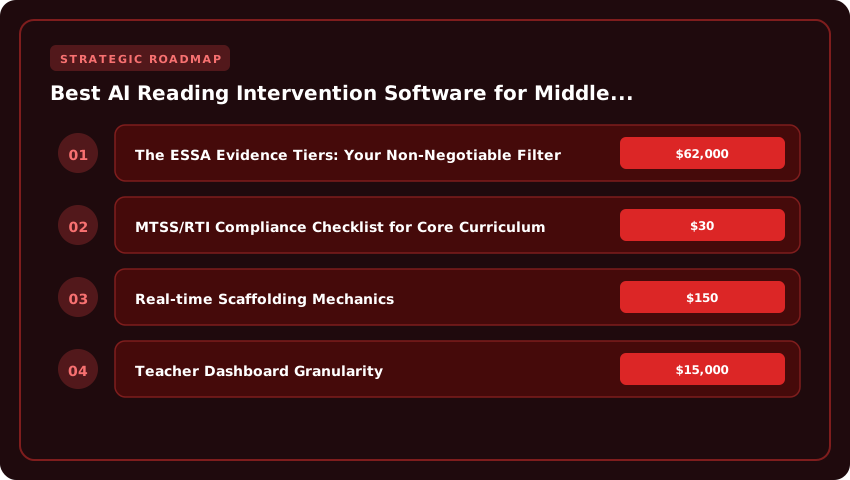
When middle‑school leaders evaluate reading‑intervention tools, the decision often hinges on two contrasting pedagogical engines: AI‑adaptive systems that continuously infer a learner’s knowledge state and scripted digital curricula that follow preset branching rules. Understanding the mechanics behind each approach helps buyers match technology to their instructional model, ESSA evidence requirements, and budget realities.
Real‑time Scaffolding Mechanics
AI‑adaptive platforms such as Amira Learning and Lexia PowerUp Literacy employ knowledge‑tracing algorithms (often Bayesian or deep‑learning models) that update a student’s mastery probability after every response. This enables micro‑level scaffolding: if a learner struggles with a specific phoneme, the engine instantly inserts a targeted mini‑lesson, adjusts text complexity, or offers a hint—all without teacher intervention. The underlying model is continuously refined using anonymized data streams, a practice that aligns with the U.S. Department of Education’s emphasis on evidence‑based improvement cycles.
In contrast, scripted products like Reading Plus and Scholastic F.I.R.S.T. rely on rule‑based branching. Authors pre‑define decision trees (e.g., “if score < 70 % on comprehension quiz → go to remedial passage A”). While transparent and easy to audit, these pathways can feel rigid; a student who masters a concept early may still traverse unnecessary review loops, wasting instructional minutes. The trade‑off is predictability: districts can precisely map each script to state standards, simplifying ESSA documentation.
Teacher Dashboard Granularity
AI‑adaptive engines surface standards‑mastery heatmaps** that display, by strand (e.g., RL.6.2, RI.6.4), the probability that each student has achieved proficiency. Clicking a cell reveals the exact items that contributed to the estimate, allowing teachers to plan small‑group interventions with laser focus. Some dashboards also predict the likelihood of meeting end‑of‑year benchmarks, a feature increasingly requested in federal grant proposals.
Scripted curricula typically report usage minutes and completion percentages**—metrics that are easy to collect but less diagnostic. A teacher might see that a class logged 120 minutes on “Vocabulary Builder” yet remain unaware which specific word families caused difficulty. To bridge this gap, many vendors now overlay lightweight skill tags onto their usage reports, though the granularity still lags behind the probabilistic traces offered by AI systems.
Content Validity and State Alignment
All four platforms claim Lexile‑measured text complexity, but the depth of alignment varies. Amira partners with MetaMetrics to embed Lexile scores directly into each adaptive passage, and its efficacy studies have been reviewed by the What Works Clearinghouse (WWC) for SBAC and PARCC alignment. Lexia conducts annual internal audits against state‑specific item banks (e.g., Texas STAAR, Florida FSA) and publishes alignment matrices that districts can attach to ESSA evidence packages.
Reading Plus uses a fixed library of passages calibrated to Lexile bands; its strength lies in the breadth of texts vetted for PARCC‑style question stems. Scholastic F.I.R.S.T. leans on its longstanding trade‑book catalog, offering Lexile‑rated titles that map to state‑adopted reading lists, though the adaptive component is less pronounced.
From a fiscal standpoint, the average middle‑school teacher salary in 2023 was $62,000 (BLS). Licensing costs for these platforms typically range from $30 to $150 per student per year**, a fraction of personnel expenses but still a line item that must be justified through Title I, ESSER, or state literacy grants—funds often accessed via FAFSA‑linked state aid programs. Districts seeking to leverage Ivy League research pedigrees may point to Lexia’s collaboration with Columbia University’s Teachers College or Amira’s roots in Stanford’s AI lab, while others highlight vendor accreditations such as ABET‑aligned STEM pathways or AACSB‑recognized business‑education partnerships that signal rigorous instructional design.
Ultimately, the choice hinges on whether a district values dynamic, data‑driven scaffolding (AI adaptive) or transparent, rule‑guided progression with straightforward reporting (scripted). Matching the engine to the school’s instructional model, ESSA evidence strategy, and budget constraints will determine whether the tool truly earns its Tier 1 badge.
Integration Reality Check: Clever, ClassLink, LMS, and SIS Interoperability
You have vetted the pedagogy and confirmed the ESSA evidence tier. Now comes the step where most pilots quietly die: the technical handshake between your AI reading platform and the district’s existing tech stack. If the vendor cannot prove—via current certification logs, not sales decks—that they play nice with Clever, ClassLink, Canvas, Schoology, PowerSchool, Infinite Campus, and Skyward simultaneously, you are signing up for a manual data-entry nightmare that will burn through your IT team’s bandwidth by October.
Certification Non-Negotiables: OneRoster and LTI Advantage
Stop asking “Do you integrate?” Start asking “Show me your 1EdTech Certified Product Directory listing.” For middle school deployments where students rotate through six to eight periods daily, OneRoster 1.1 or 1.2 certification is the baseline for automated roster provisioning. Anything less means your staff is manually uploading CSVs every time a schedule changes—and in middle school, schedules change weekly.
Equally critical is LTI Advantage (LTI 1.3 + Deep Linking + Names and Role Provisioning Services). This isn’t just about single sign-on (SSO); it ensures the AI tool launches contextually inside Canvas or Schoology, passes the correct student identity without exposing PII, and allows teachers to deep-link specific intervention modules into their LMS course modules. If a vendor only supports LTI 1.1, they are technically legacy software. Walk away.
Nightly Sync Reliability and Student Data Privacy
Automated rostering via Clever or ClassLink is only as good as its error handling. Demand the vendor’s SLA for sync success rates—specifically, how they handle “orphaned records” when a student drops a reading intervention block but remains in the homeroom SIS record. You need a dashboard showing sync logs, not a ticketing system where you discover 200 kids lost access three days ago.
On the compliance front, verify the vendor has a signed Student Data Privacy Agreement (SDPA) aligned with your state’s specific laws (e.g., California NDPA, Illinois SOPPA, New York Ed Law 2-d) and explicit FERPA/COPPA compliance documentation. Ask for their SOC 2 Type II report. If they store audio recordings of fluency practice—a common AI reading feature—confirm exactly where that biometric data lives, who encrypts it, and the retention/deletion policy. “We’re compliant” is not an answer; a shared drive folder with the executed agreements is.
Grade Passback: The “Last Mile” Failure Point
This is where 80% of implementations fracture. You need LTI Assignment and Grade Services (AGS) certified passback directly into the teacher of record’s gradebook in PowerSchool, Infinite Campus, or Skyward.
- PowerSchool: Requires LTI Advantage AGS support for the PowerSchool Unified Classroom or traditional SIS gradebook write-back.
- Infinite Campus: Demands OneRoster Gradebook sync or LTI AGS; verify the vendor supports Campus Learning LMS integration specifically.
- Skyward: Often requires the Skyward API connector or LTI AGS; confirm the vendor has a live reference district currently passing scores into Skyward Gradebook.
Insist on a sandbox demo showing a student completing an AI fluency passage, the score calculating against your district rubric, and that score appearing in the target SIS gradebook without teacher intervention. If they cannot demo this live against your specific SIS version during the RFP process, budget $15,000–$25,000 in internal dev time to build the bridge yourself—or choose a vendor who already built it.
Cost Modeling: Per-Student Licensing vs. Site Licenses for Grades 6-8
Let’s talk brass tacks. A middle school principal staring at a $12,000 quote for a reading platform needs to know exactly what drives that number—and how to shrink it without gutting implementation fidelity. The sticker price is rarely the full story; the Total Cost of Ownership (TCO) for Grades 6–8 typically lands 30–45% higher than the license line item once you bake in professional development (PD), device refresh cycles, and the administrative drag of rostering 600+ adolescents across rotating block schedules.
Per-Student vs. Site License: The Enrollment Tipping Point
Vendors love per-student pricing ($18–$35/student/year) because it scales with your enrollment. But do the math: a 750-student building at $28/student hits $21,000 annually. A flat site license—often capped around $15,000–$18,000—becomes the smarter play once you clear roughly 550–600 students. The catch? Site licenses frequently lock PD hours or data-dashboard seats behind add-ons. Always negotiate unlimited teacher accounts and on-site coaching days into the base site fee; otherwise, you’re buying a Ferrari with a lawn-mower engine.
Hidden TCO Line Items You Can’t Ignore
- Professional Development: Budget $2,500–$5,000 for initial on-site training plus $1,200/year for refresher cycles. Virtual-only PD saves cash but kills fidelity in Year 2.
- Hardware & Bandwidth: If your 1:1 fleet is aging Chromebooks, factor in $150/device for refreshes every 4 years. AI speech-recognition engines demand low latency—upgrade your Wi-Fi 6 access points now or watch intervention blocks stall.
- Admin Time: Rostering via Clever or ClassLink costs ~15 hours of tech-director time per semester. Value that at $65/hr; it’s real money.
Federal Funding Map: Title I, IDEA, ESSER, CLSD
Don’t leave federal dollars on the table. Title I, Part A covers supplemental licenses for schools above 40% poverty—use it for the per-student delta above your site-license cap. IDEA, Part B funds flow if the platform demonstrates Strong or Moderate ESSA evidence for students with IEPs; document the alignment in your LEA’s CEIS plan. ESSER III carryover (obligation deadline Sept 2024, liquidation Jan 2025) is perfect for multi-year pre-pays—vendors will discount 10–15% for three-year commitments paid upfront. Finally, the Comprehensive Literacy State Development (CLSD) grant prioritizes evidence-based Tier 1 cores; write the software into your district’s literacy plan narrative to unlock competitive sub-grants.
Negotiation Levers: Pilot-to-Scale Clauses
Never sign a five-year deal blind. Demand a paid pilot clause: 60 days, two grade levels, full data access, with a guaranteed opt-out and prorated refund. Lock in price-cap escalators at CPI + 1% max. Require data-portability guarantees (CSV/IMS Global Caliper export) so you own the growth metrics if you switch vendors. And insist on co-termination rights—if the district adopts a new core curriculum, you walk away without penalty. Procurement isn’t purchasing; it’s risk engineering.
Efficacy in Diverse Populations: Multilingual Learners and Dyslexia Profiles
Selecting the right AI reading intervention software for middle school Tier 1 alignment demands more than a quick demo. With roughly 5.3 million English learners attending US public schools—over 60% of whom speak Spanish as their home language, according to the US Department of Education—platforms must demonstrate clinical accuracy across diverse linguistic backgrounds. A tool that performs beautifully on General American English but stumbles on Spanish-influenced phonology or Arabic non-linear script patterns will silently widen achievement gaps rather than close them.
Speech Recognition Accuracy Across Home Languages
Middle school leaders evaluating platforms should demand published accuracy benchmarks broken down by language profile. The top tier of AI reading tools now reports Automatic Speech Recognition (ASR) accuracy rates of 92–96% for Spanish-influenced English, compared to 98%+ for monolingual speakers. The gap matters because misheard phonemes cascade into mis-scored fluency metrics, which then trigger inappropriate intervention pathways.
- Spanish home language: Look for platforms trained on corpora like the L2U corpus or those leveraging Whisper/Wav2Vec fine-tuned on Mexican-American and Caribbean Spanish dialects.
- Arabic home language: Prioritize systems handling pharyngeal and glottal distinctions without flagging them as errors. Accuracy rates above 88% indicate mature acoustic modeling.
- Mandarin home language: Tone-recognition transfer to English prosody remains the weakest link; only 2–3 vendors currently publish Mandarin-piloted data.
If a vendor cannot supply disaggregated accuracy data by home language, that is a Tier 2 disqualifier under ESSA’s “strong evidence” tier.
Orton-Gillingham and Structured Literacy Certification Crosswalks
For students with dyslexia profiles—roughly 20% of the US population according to the Yale Center for Dyslexia & Creativity—alignment to evidence-based structured literacy frameworks is non-negotiable. Ask vendors to map their instructional sequence against the International Dyslexia Association’s Knowledge and Practice Standards, and verify whether the logic engine mirrors an Orton-Gillingham scope-and-sequence (phonology → syllable types → morphology → syntax).
Crosswalk documentation should explicitly reference alignment with:
- IDA Knowledge & Practice Standards (structured literacy certification competencies).
- NCERT foundational reading skills as adopted by state ESSA plans in 25+ states.
- Section 504 and IEP accommodation triggers, including text-to-speech universal design layers built into the core product (not sold as a $40/student/year add-on).
Disaggregated Growth Data: Effect Sizes for Students 2+ Years Below Grade Level
The most revealing equity metric is whether vendors report effect sizes—Cohen’s d—specifically for the lowest-quartile readers. Under ESSA Tier 1 evidence requirements, platforms should demonstrate effect sizes above 0.40 (moderate) for students entering two or more grade levels below. Anything below 0.25 for this subgroup signals the platform is calibrated to mid-range readers and will leave your most vulnerable Tier 1 students stranded.
Insist on seeing the n-size, the comparison condition (business-as-usual vs. control curriculum), and whether the study was independently randomized. A vendor showing a 1.2 effect size on 40 students without a control group is selling hope, not compliance.
Implementation Fidelity: Professional Learning Models That Actually Stick
You can purchase the most sophisticated AI reading platform on the market—complete with Strong ESSA evidence and perfect standards alignment—but if your teachers treat it like a digital babysitter, your NAEP scores will not budge. The research is unambiguous: software effect sizes evaporate without sustained, job-embedded professional learning. For middle school leaders, the budget conversation must shift from per-student license fees to cost-per-teacher-hour of coaching. That is where the return on investment actually lives.
Coaching Cycles: What Your Base Price Actually Buys
Most vendors bundle a “launch day” and maybe a handful of virtual office hours into the base subscription. That is insufficient for Tier 1 fidelity. You need to model the total cost of ownership over a three-year horizon. A robust implementation plan typically requires 12 to 15 coaching touchpoints per teacher annually—a mix of lesson modeling, co-planning, and data review cycles.
- Virtual Coaching: Typically $1,800–$2,500 per day. Efficient for data dives and planning, but weak on classroom management nuances specific to adolescent literacy.
- On-Site Coaching: Runs $3,000–$4,500 per day inclusive of travel. Non-negotiable for the first semester. You need eyes in the room to calibrate the AI’s “off-track” alerts with the reality of a 7th-grade classroom.
- Hybrid Sweet Spot: Negotiate a contract that guarantees four on-site days (launch, mid-year calibration, spring push, year-end review) supplemented by monthly virtual cycles. Budget roughly $18,000–$22,000 per building per year for this cadence.
Teacher Agency: Scripted Fidelity vs. Professional Judgment Triggers
Middle school educators reject “teacher-proof” scripts—and rightly so. Adolescent literacy demands responsiveness. High-fidelity implementations define “professional judgment triggers” explicitly in the PD plan. For example: “If the AI flags a student for ‘decoding deficit’ but the teacher observes strong oral vocabulary, the teacher overrides the phonics pathway and assigns the fluency module.” Your PD must teach teachers how to read the dashboard, not just that they must read it. Vendors who cannot articulate these decision rules during the RFP process will leave your staff paralyzed or non-compliant.
Building Internal Capacity: The Train-the-Trainer ROI
By Year 3, external coaching costs should plummet. Insist on a Train-the-Trainer (T3) certification pathway included in your multi-year contract. Look for programs accredited by bodies like Learning Forward or aligned with the PMI standards for project management, ensuring your internal coaches can sustain the model. A typical T3 pathway costs $5,000–$8,000 per candidate but certifies them to onboard new hires indefinitely—critical given the 15–20% annual teacher turnover rate in many middle schools. Without this, you are buying a subscription, not building a system. With it, you protect your Tier 1 investment against the inevitable staffing churn.
Decision Matrix: Selecting the Right Platform for Your District Profile
Securing ESSA-compliant software is only half the battle. The true test of a platform’s viability lies in how well it maps to your district’s specific operational realities. A sprawling urban district in Texas faces fundamentally different hurdles than a rural district in Montana. To build a sustainable Tier 1 framework, curriculum directors must evaluate AI reading platforms through a localized decision matrix that weighs infrastructure, positioning, and procurement priorities.
Infrastructure Realities: Rural Bandwidth vs. Urban Privacy
In rural districts, bandwidth constraints dictate functionality. If your middle schools still rely on spotty broadband connections, a fully cloud-dependent AI platform will crash during a 45-minute instructional block. Look for vendors offering offline caching or hybrid local-hosting capabilities to ensure uninterrupted Tier 1 instruction. Conversely, urban districts often grapple with complex data privacy agreements. Large metropolitan school systems must ensure any AI tool processing student data strictly complies with FERPA, COPPA, and stringent state-level privacy laws like New York’s Education Law 2-d or California’s SOPIPA. Your vendor must sign off on a Student Data Privacy Agreement (SDPA) without requiring legal gymnastics that delay deployment.
Strategic Positioning: Core Replacement vs. Supplemental Enrichment
How you position the software dictates your budget and implementation strategy. A core replacement strategy requires a comprehensive platform deeply aligned with your state standards (like TEKS or Common Core) and capable of driving daily Tier 1 instruction. These robust systems typically cost between $35 and $55 per student, requiring significant professional development investments. Alternatively, a supplemental enrichment positioning strategy leverages AI for targeted skill gaps, often costing $15 to $25 per student. If you choose the supplemental route, do not let it cannibalize your core ELA block; reserve it for designated intervention periods or homeroom to maintain Tier 1 integrity.
RFP/RFI Evaluation Rubric for Tier 1 Priorities
To finalize procurement, your Request for Proposal (RFP) or Request for Information (RFI) must include a weighted scoring rubric that filters out Tier 2 and Tier 3 tools masquerading as core solutions. Use the following framework to score vendors out of 100 points:
- ESSA Evidence Base (30 points): Does the vendor provide Strong or Moderate ESSA evidence specifically for middle school reading outcomes?
- Interoperability & Integration (20 points): Does the platform seamlessly integrate with your existing Student Information System (SIS) via Clever or ClassLink, reducing administrative overhead?
- Infrastructure & Privacy Alignment (20 points): Does the tool meet your district’s bandwidth realities and sign your required data privacy agreements without redlining critical protections?
- Standards Alignment & Adaptability (15 points): Can the AI dynamically adjust text complexity to serve both struggling readers and advanced learners in the same Tier 1 classroom?
- Professional Development & Support (15 points): Does the vendor include robust onboarding and ongoing coaching, or do they charge exorbitant add-on fees for teacher training?
By applying this matrix, district leaders can cut through vendor marketing and select an AI reading intervention platform that genuinely serves every student in the general education classroom.
| Platform Category | Typical Annual Cost (Per Student) | ESSA Evidence Tier | Primary MTSS Tier Alignment | Implementation Timeline | Core Data Reporting | Key Prerequisite |
|---|---|---|---|---|---|---|
| Adaptive Core Curriculum (e.g., Amplify Reading, HMH Into Literature w/ Waggle) | $45–$75 | Strong (Tier 1) | Tier 1 (Core Instruction) | 6–12 Weeks (Full Rollout) | Standards mastery, growth percentiles, usage fidelity | 1:1 Devices; 90-min ELA block |
| Supplemental Adaptive Practice (e.g., Lexia PowerUp, Reading Plus) | $30–$55 | Moderate (Tier 2) | Tier 2/3 (Intervention) | 2–4 Weeks (Pilot to Scale) | Skill gap closure, Lexile growth, minutes met | Scheduled intervention block (20–30 min) |
| Assessment-First Platforms (e.g., NWEA MAP Reading Fluency + Coach) | $12–$20 (Assess) + $15–$25 (Coach) | Promising (Tier 3) | Tier 1 Screening → Tier 2 Action | 1–2 Weeks (Rostering/Testing) | Diagnostic profiles, ORF norms, risk indicators | Headsets w/ mics; stable bandwidth |
| Comprehensive MTSS Suites (e.g., Renaissance, Illuminate/FastBridge) | $18–$35 (Suite License) | Moderate to Strong | Tier 1, 2, & 3 (Unified) | 8–16 Weeks (System Config) | Unified dashboards, ROI modeling, equity audits | District-level data interoperability (OneRoster/Ed-Fi) |
Frequently Asked Questions
What legally defines Tier 1 reading instruction under ESSA and IDEA?
Tier 1 is legally defined as high-quality, evidence-based core instruction provided to all students in the general education classroom. Under ESSA, materials must demonstrate 'Strong' or 'Moderate' evidence tiers. If an AI tool lacks this proof, it legally functions as Tier 2/3 intervention and cannot replace core curriculum.
Which AI reading platforms have Strong ESSA evidence for Middle School Tier 1?
As of 2024, platforms like Amplify Reading and specific HMH core programs integrated with Waggle hold 'Strong' ESSA ratings (Tier 1) for grades 6–8. Most adaptive practice tools (Lexia PowerUp, Reading Plus) hold 'Moderate' (Tier 2) ratings, legally restricting them to supplemental intervention blocks.
How much does Tier 1 aligned AI reading software cost per middle school student?
True Tier 1 core curriculum platforms average $45–$75 per student annually. Supplemental Tier 2 tools range $30–$55. Assessment suites add $12–$20. Total cost of ownership requires budgeting for 1:1 devices, headsets, and dedicated 90-minute ELA block scheduling.
Can supplemental AI software like Lexia or Reading Plus be used for Tier 1 core instruction?
No. Supplemental platforms typically hold 'Moderate' (Tier 2) ESSA evidence. Federal guidance (IDEA/ESSA) prohibits using Tier 2 intervention tools as a substitute for Tier 1 core instruction. They must supplement—not supplant—a Strong-evidence core curriculum during the universal instruction block.
What implementation timeline is required for Tier 1 AI reading fidelity?
Full Tier 1 implementation requires 6–12 weeks for rostering, teacher PD on pedagogical shifts, schedule alignment (90-min blocks), and calibration of adaptive placement. Pilot phases (2–4 weeks) are insufficient for Tier 1; they only validate Tier 2 supplemental usage fidelity.
Strategic Final Takeaway
When evaluating Best AI Reading Intervention Software For Middle School Students Tier 1 Instruction Alignment, base your decisions on accredited institutional standards, measurable return on investment (ROI), and up-to-date official guidelines. Always verify specific dates and requirements through official regulatory portals.