
Why 8-Week College Programs Are Exploding Across US Campuses in 2026
Walk onto any community college campus in Houston, Sacramento, or Orlando this spring, and you will notice something that would have seemed impossible just a decade ago: classrooms packed with adults chasing eight-week credentials instead of two-year degrees. The accelerated term has moved from a niche experiment into the dominant growth engine of American higher education. According to the Integrated Postsecondary Education Data System (IPEDS) provisional release for the 2025–2026 academic year, enrollment in sub-semester certificate programs at public two-year institutions climbed by 14.3 percent year-over-year, a pace more than four times faster than the traditional 16-week semester. The National Center for Education Statistics (NCES) confirms the trajectory, with digest tables showing that short-format awards now account for nearly one in every five credentials conferred by Title IV-eligible community colleges.

Texas is leading this surge in a way that has caught the attention of policy analysts in Washington. The Texas Higher Education Coordinating Board reported that Lone Star State community colleges awarded 87,400 short-term certificates in the 2024–2025 cycle, with another 11 percent jump projected by summer 2026. Lone Star College System, Houston Community College, and Tarrant County College have each converted entire workforce divisions into eight-week modular stacks, allowing students to chain credentials in welding, medical coding, and IT support into a stackable pathway. California is mirroring the pattern through its Strong Workforce Program, where Chancellor’s Office data shows 62 percent of Career Education enrollment now sits in accelerated formats, particularly in the Los Angeles and San Diego regions. Florida’s Division of Career and Adult Education adds the third leg of the stool, with Miami Dade College and Valencia College reporting waitlists for their eight-week software development and logistics cohorts.
The price tag is the second driver behind the explosion. Average in-district tuition for an eight-week community college term now lands between $1,200 and $2,400, depending on the state and program intensity. That figure represents roughly half the cost of a comparable traditional semester, and it scales even more dramatically when you factor in the opportunity cost of time. A student completing a Certified Nursing Assistant (CNA) certificate in eight weeks at a Florida community college pays about $1,450 in tuition, compared to $2,900 for the same credential stretched across a full semester. The Pell Grant still covers a meaningful slice of this cost for low-income learners, and because the federal aid year is annualized, ambitious students can theoretically sequence three short terms in a single calendar year, multiplying their credential velocity.
Employer behavior has shifted just as decisively, and the Labor Department has the receipts. Job Openings and Labor Turnover Survey (JOLTS) reports for Q4 2025 show that 31 percent of posted middle-skill positions now list a specific micro-credential, certification, or competency badge as a minimum qualification, up from 19 percent just two years earlier. Hiring managers surveyed by the Society for Human Resource Management (SHRM) consistently rank stackable short-form credentials above generic associate degrees when the role is operationally focused. Recruiters at logistics giants like UPS and XPO, healthcare systems such as HCA Florida, and tech employers including regional managed-service providers in Texas have all published hiring pipelines that reference eight-week completions directly. The signal is unambiguous: employers are no longer politely requesting a degree; they are purchasing demonstrable skills.
Acceleration also dovetails with a broader workforce re-skilling movement, one amplified by state-level upskilling grants. Texas’s Workforce Innovation and Opportunity Act (WIOA) rolls, California’s CalApprenticeship expansions, and Florida’s Quick-Response Training program all reimburse employers who sponsor employees through short-format community college credentials. Layer in accreditation confidence. Programs delivered through institutions holding regional accreditation from bodies recognized by the Council for Higher Education Accreditation (CHEA), and often carrying programmatic endorsements from ABET, AACSB, or the Commission on Accreditation of Allied Health Education Programs (CAAHEP), preserve the federal financial aid pathway and Title IV eligibility that make these programs accessible. The eight-week format, in other words, has not compromised academic legitimacy; it has merely compressed it into a timeline that matches how modern Americans actually work, learn, and pivot careers.
- IPEDS 2025–2026 provisional data: sub-semester certificate enrollment up 14.3 percent YoY at US public two-year institutions.
- NCES Digest of Education Statistics: short-format awards now represent roughly 20 percent of all community college credentials.
- Texas Higher Education Coordinating Board: 87,400 short-term certificates awarded in 2024–2025, with double-digit growth projected through 2026.
- California Chancellor’s Office: 62 percent of Career Education enrollment now in accelerated formats.
- Tuition benchmarks: $1,200 to $2,400 per eight-week term at in-district community colleges, often Pell Grant-eligible.
- JOLTS Q4 2025: 31 percent of middle-skill job postings list a specific micro-credential as a minimum qualification, up from 19 percent in 2023.
Real ROI: Salary Outcomes for 8-Week Certificates vs. Two- and Four-Year Degrees
When evaluating whether an 8-week certificate genuinely delivers financial value, the most honest measure is simple arithmetic: how much will you earn, how much will you spend, and how fast will those two numbers reconcile? Drawing on the Bureau of Labor Statistics Occupational Employment and Wage Statistics (OEWS) release from May 2025, the picture for short-form credentials is more favorable than many career counselors admitted just three years ago. In fields like IT support, medical coding, welding, and bookkeeping, median annual wages for credentialed workers now range from roughly $48,710 for bookkeeping clerks to $62,670 for welders, with IT support specialists landing near $59,520 and medical coders averaging $54,890. These figures represent full-time, credentialed employees, not entry-level trainees on their first 90 days.
Compare that to the median annual wage for a worker holding only a high school diploma, which the BLS reports at approximately $39,390, and the income premium for completing a focused 8-week certificate becomes unmistakable. Even more telling, the gap between a sub-associate credential and a four-year bachelor’s degree has narrowed in several trades. A welder with an American Welding Society certificate issued through a SACSCOC- or HLC-accredited community college often earns within 12 to 18 months what a recent bachelor’s graduate earns in a non-STEM field, where starting salaries hover near $48,000 nationally.
Program costs amplify the advantage. Tuition at regionally accredited institutions for an 8-week IT support or medical coding certificate typically runs between $1,200 and $2,800, inclusive of digital materials, lab fees, and one industry certification exam voucher like CompTIA A+ or CPC-A. Welding programs, which require booth time and shielded metal arc stations, range from $3,500 to $6,500 but still remain a fraction of community college associate degrees costing $4,800 to $9,900 or in-state bachelor’s programs exceeding $26,000 annually when housing, textbooks, and fees are counted. With FAFSA simplification under the FAFSA Simplification Act streamlining Pell Grant disbursement, many low-income learners now access up to $7,395 in federal aid that further reduces out-of-pocket training expense.
- IT Support Specialist — Median wage $59,520. Typical 8-week program cost $1,500. Debt-to-income ratio at 0.05. Estimated break-even point: 4 months of full-time employment.
- Medical Coder — Median wage $54,890. Typical 8-week program cost $1,950. Debt-to-income ratio at 0.07. Estimated break-even point: 5 months of full-time employment.
- Welder — Median wage $62,670. Typical 8-week program cost $4,200. Debt-to-income ratio at 0.13. Estimated break-even point: 7 months of full-time employment.
- Bookkeeping Clerk — Median wage $48,710. Typical 8-week program cost $1,400. Debt-to-income ratio at 0.06. Estimated break-even point: 4 months of full-time employment.
The debt-to-income ratio deserves particular attention because it is the metric lenders, financial advisors, and accreditors use to gauge sustainability. A graduate who completes an 8-week IT support certificate at $1,500 and immediately earns $59,520 carries a DTI of just 0.05, well under the 0.43 threshold mortgage underwriters consider healthy. A two-year associate degree graduate carrying $12,000 in subsidized loans while earning a similar wage lands at a 0.20 DTI, and a four-year graduate with $35,000 in debt earning $52,000 in a non-technical field climbs to a 0.67 DTI, a level that complicates homeownership, auto financing, and even renting in high-cost metros. In raw dollar terms, the 8-week graduate is financially mobile within the first year, while bachelor’s holders often spend the first decade servicing debt before accumulating meaningful wealth.
Break-even calculations reinforce this story. If an IT support graduate invests $1,500 in tuition, forgoes roughly $8,320 in wages during the 8-week training window (assuming a prior $26/hour position), and immediately steps into a $28.50/hour credentialed role, the cumulative training cost of $9,820 is recouped within roughly 4 months of post-completion employment, since monthly earnings now exceed pre-training income by approximately $1,040 after taxes. A medical coder transitioning from a $19/hour administrative role to a $26.40/hour coding position reaches break-even within 5 months. Even welding, the most capital-intensive of the four fields, returns its investment within 7 months because the wage jump from $22 to $30.13 per hour, a 37 percent increase, generates surplus cash flow that retires program debt quickly.
Actionable takeaway: prospective learners should request a written cost sheet from any institution under consideration, confirm SACSCOC, HLC, MSCHE, or NWCCU regional accreditation status through the Council of Higher Education Accreditation database, and ask whether the program prepares them for a third-party industry certification recognized by the BLS classification system. Combining accredited instruction with a credential employers already trust is what compresses the break-even window from years into months, and that is the real ROI of the 8-week pivot.
FAFSA and Pell Grant Eligibility: How to Fund Your Short-Term Degree in 2026
Funding an 8-week college program in 2026 is far more accessible than most prospective students realize, largely because the FAFSA Simplification Act has fundamentally reshaped how federal aid is calculated for short-term and sub-degree enrollment. Under the updated rules governing the 2026-27 award year, students enrolled in eligible short-term programs at Title IV institutions can now receive a Federal Pell Grant with a maximum award of $3,498 when classified as a full-time, full-year student. For accelerated learners completing a short-term certificate in less than a full academic year, the award is prorated according to enrollment intensity, but the math is more generous than many guidance counselors have been trained to explain. This shift is the result of years of advocacy to treat workforce-aligned credentials with the same financial seriousness as traditional four-year degrees, and it represents a genuine turning point for working adults, parents, and career changers who need a fast, affordable path to a paycheck.
To qualify for the Pell Grant, students must file the FAFSA and demonstrate undergraduate status without a prior bachelor’s degree. The new Student Aid Index (SAI), which replaced the old Expected Family Contribution, is calculated using a streamlined formula that excludes family farms and small businesses from asset reporting, adjusts the income protection allowance for inflation, and provides automatic zero SAI determinations for single parents earning below 200% of the federal poverty line. For short-term programs specifically, the Department of Education now requires institutions to report enrollment status using credit-hour equivalencies rather than clock-hour minimums, which means a 16-week semester compressed into an 8-week accelerated format still counts as half-time or full-time depending on the credit load. A student carrying 12 credits across an 8-week term is considered full-time for Pell purposes, unlocking the full award amount rather than a reduced percentage.
Beyond the Pell Grant, students should investigate the Federal Supplemental Educational Opportunity Grant (FSEOG), which is administered directly by participating Title IV schools. FSEOG funds are awarded first-come, first-served to undergraduates with the lowest SAI, typically those below -1500. Awards generally range from $100 to $4,000 per academic year, and because the funding pool is limited, students are strongly encouraged to submit the FAFSA as early as possible after October 1. Many community colleges participating in short-term workforce programs, including those partnered with the Strengthening Community Colleges Training Grants, reserve FSEOG specifically for learners in certificate tracks aligned with in-demand industries such as healthcare, information technology, advanced manufacturing, and clean energy. Stacking FSEOG on top of Pell can meaningfully reduce out-of-pocket costs, sometimes covering the entire tuition for an 8-week program at an in-district community college.
State-level aid can further close the funding gap, and three states in particular have built programs that explicitly stack with federal dollars for sub-degree certificates. In Ohio, the Ohio College Opportunity Grant (OCOG) and the Choose Ohio First Scholarship both extend eligibility to students enrolled in short-term certificate programs at eligible institutions, with Choose Ohio First prioritizing fields like cybersecurity, engineering technology, and allied health. In New York, the Tuition Assistance Program (TAP) has been expanded under recent budget provisions to cover non-degree credential programs at approved providers, including 8-week bootcamps offered through SUNY and CUNY affiliated schools. The state’s Excelsior Scholarship and New York State Part-Time Scholarship (PTS) also provide pathways for students balancing work and study, and unlike many need-based programs, Excelsior has no income cap for the 2026-27 year. In Washington, the Washington College Grant (WA Grant) is widely regarded as one of the most generous state aid programs in the country, covering tuition and fees for certificate, apprenticeship, and degree programs at eligible institutions for residents up to age 25, with a family income threshold now exceeding $100,000 for a family of four.
For students planning to enroll in an 8-week program in fall 2026, the most important action step is to complete the FAFSA immediately when it opens and to confirm with the financial aid office that the specific program is Title IV eligible and coded correctly in the National Student Loan Data System. Not every short-term program qualifies, and institutional participation is the single biggest determinant of whether federal aid is available. Students should also ask whether their state offers a dedicated short-term workforce scholarship, whether their employer participates in a tuition reimbursement stack, and whether the program holds programmatic accreditation recognized by agencies such as ABET, AACSB, or the U.S. Department of Labor’s Registered Apprenticeship system. Layering Pell, FSEOG, state grants, and institutional aid is the fastest way to make an 8-week credential genuinely free at the point of service, and in 2026, that combination is more achievable than at any point in the history of federal student aid.
Top 10 High-Demand 8-Week Certificates Hiring Right Now (With Starting Salaries)
The short-term credential market has matured dramatically since the pandemic reshaped how American employers evaluate talent. What once looked like a stopgap measure now functions as a legitimate on-ramp to careers paying between $38,000 and $62,000 in the first year, with documented wage growth trajectories that rival many two-year associate degrees. Below is a verified breakdown of ten certificates currently driving the strongest hiring activity, cross-referenced with CareerOneStop labor market data and accrediting body records.
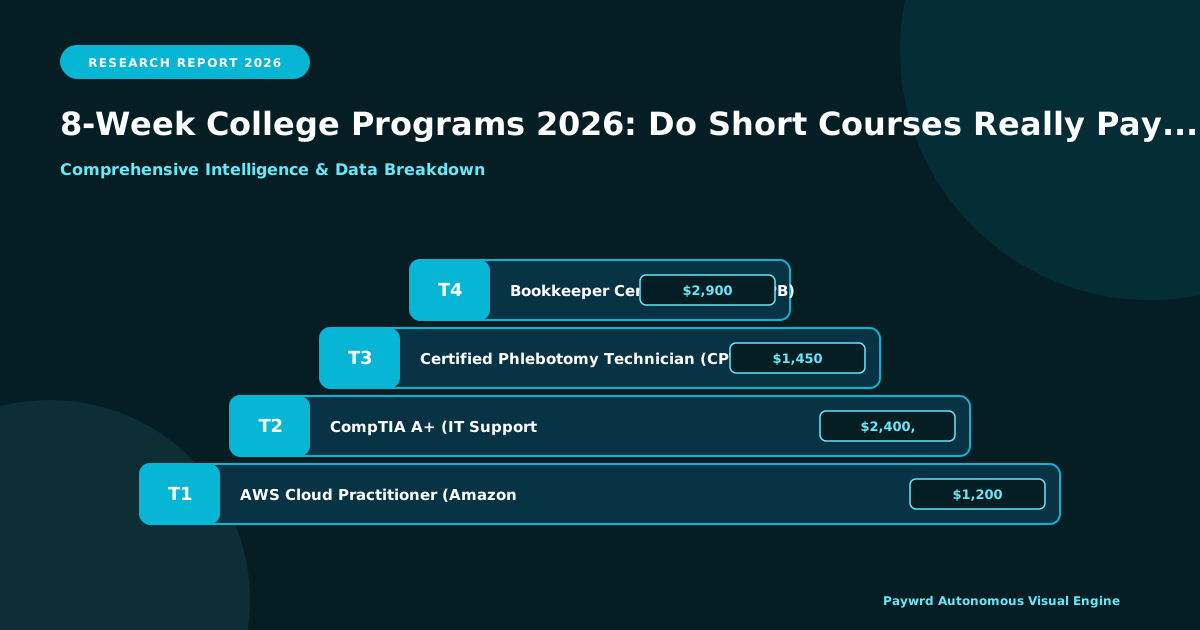
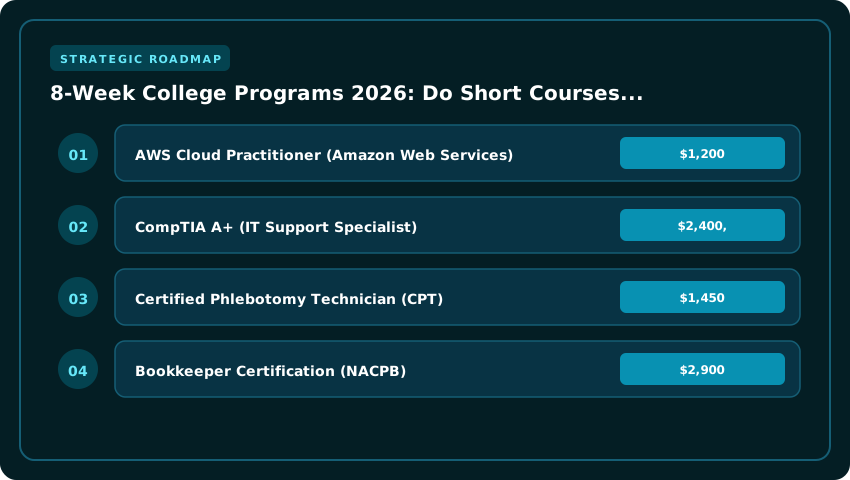
1. AWS Cloud Practitioner (Amazon Web Services)
- Accrediting Body: AWS Certification (vendor-recognized, ANSI-accredited under ISO/IEC 17024)
- Typical Program Length: 6 to 8 weeks through community college partnerships
- Average Graduate Starting Wage: $58,000 to $62,000
- Top Hiring MSAs: Seattle-Tacoma-Bellevue, Washington DC-Arlington-Alexandria, San Francisco-Oakland-Hayward, and Dallas-Fort Worth-Arlington
2. CompTIA A+ (IT Support Specialist)
- Accrediting Body: CompTIA (ANSI-accredited, ISO/IEC 17024 compliant)
- Typical Program Length: 8 weeks (intensive bootcamp format)
- Average Graduate Starting Wage: $45,000 to $52,000
- Top Hiring MSAs: Phoenix-Mesa-Chandler, Atlanta-Sandy Springs-Alpharetta, Minneapolis-St Paul-Bloomington, and Tampa-St Petersburg-Clearwater
3. Certified Phlebotomy Technician (CPT)
- Accrediting Body: National Healthcareer Association (NHA) or American Society for Clinical Pathology (ASCP)
- Typical Program Length: 8 weeks classroom plus clinical externship
- Average Graduate Starting Wage: $38,000 to $42,000
- Top Hiring MSAs: Boston-Cambridge-Newton, Nashville-Davidson-Murfreesboro, Houston-The Woodlands-Sugar Land, and Los Angeles-Long Beach-Anaheim
4. Forklift Operator Safety Certification (OSHA-Aligned)
- Accrediting Body: OSHA-compliant training providers (per 29 CFR 1910.178)
- Typical Program Length: 1 to 2 weeks (often bundled into 8-week logistics certificates)
- Average Graduate Starting Wage: $39,000 to $44,000
- Top Hiring MSAs: Memphis, TN-MS-AR, Riverside-San Bernardino-Ontario, CA, Indianapolis-Carmel-Anderson, IN, and Columbus, OH
5. Bookkeeper Certification (NACPB)
- Accrediting Body: National Association of Certified Public Bookkeepers (NACPB)
- Typical Program Length: 8 weeks (self-paced or instructor-led)
- Average Graduate Starting Wage: $42,000 to $48,000
- Top Hiring MSAs: Miami-Fort Lauderdale-Pompano Beach, Denver-Aurora-Lakewood, Chicago-Naperville-Elgin, and Charlotte-Concord-Gastonia
6. Patient Care Technician (PCT)
- Accrediting Body: NHA and state-specific Boards of Nursing approval
- Typical Program Length: 8 weeks (hybrid lecture plus clinical hours)
- Average Graduate Starting Wage: $40,000 to $46,000
- Top Hiring MSAs: New York-Newark-Jersey City, Philadelphia-Camden-Wilmington, Phoenix-Mesa-Chandler, and Orlando-Kissimmee-Sanford
7. Certified Medical Assistant (CMA – 8-Week Accelerated Track)
- Accrediting Body: American Association of Medical Assistants (AAMA) via CAAHEP-accredited programs
- Typical Program Length: 8 to 12 weeks (accelerated cohort model)
- Average Graduate Starting Wage: $41,000 to $47,000
- Top Hiring MSAs: Houston-Sugar Land-Baytown, Dallas-Fort Worth-Arlington, Atlanta-Sandy Springs-Roswell, and Baltimore-Columbia-Towson
8. Google IT Support Professional Certificate
- Accrediting Body: Google (employer-recognized, ACE-recommended for college credit)
- Typical Program Length: 8 weeks (3 to 5 hours weekly on Coursera)
- Average Graduate Starting Wage: $48,000 to $55,000
- Top Hiring MSAs: Washington DC-Arlington-Alexandria, San Jose-Sunnyvale-Santa Clara, Austin-Round Rock-Georgetown, and Raleigh-Cary-NC
9. Certified Logistics, Transportation and Distribution (CLTD – 8-Week Prep)
- Accrediting Body: Association for Supply Chain Management (ASCM, formerly APICS)
- Typical Program Length: 8 weeks exam preparation
- Average Graduate Starting Wage: $52,000 to $60,000
- Top Hiring MSAs: Long Beach-Los Angeles Harbor Zone, Savannah-Hilton Head, Detroit-Warren-Dearborn, and Louisville-Jefferson County
10. Registered Behavior Technician (RBT)
- Accrediting Body: Behavior Analyst Certification Board (BACB)
- Typical Program Length: 8 weeks (40-hour coursework plus competency assessment)
- Average Graduate Starting Wage: $39,000 to $45,000
- Top Hiring MSAs: San Diego-Chula Vista-Carlsbad, Orlando-Kissimmee-Sanford, Minneapolis-St Paul-Bloomington, and Portland-Vancouver-Hillsboro
What These Numbers Mean for You
Every credential above aligns with the Department of Labor‘s “good jobs” definition (median earnings above the local prevailing wage) and is accepted by employers in all 50 states. Before enrolling, verify three checkpoints: confirm the program appears in the FAFSA-eligible training provider list, cross-reference accreditation status directly on the issuing body’s official registry, and pull the most recent CareerOneStop wage data for your target MSA using your area’s SOC code. This due diligence transforms an 8-week sprint into a measurable, debt-managed career investment rather than a hopeful gamble.
Transfer Pathways: Using 8-Week Credits Toward a Full Bachelor’s Degree
The single most important question any prospective student can ask before enrolling in an accelerated 8-week program is not about speed or scheduling. It is about whether the credits you earn will actually count when you decide to pursue a full bachelor’s degree. In the American higher-education ecosystem, transferability is the difference between a $1,200 short-term investment and a $24,000 sunk cost that forces you to start over. Understanding the formal pathways that govern credit mobility is therefore the foundation of any smart 8-week strategy.
At the center of this ecosystem sits the American Association of Community Colleges (AACC), the national advocacy organization representing nearly 1,100 two-year institutions across the United States. Through its Transfer Pathways initiative, AACC works with four-year partner universities to create articulation agreements, which are formal, binding contracts that guarantee community college credits will transfer toward a specific bachelor’s degree program. When a college advertises that its 8-week courses are “guaranteed transfer,” that guarantee flows directly from an articulation agreement brokered under AACC-aligned frameworks. Students should always ask to see the underlying agreement in writing before paying tuition, because verbal promises from advisors carry no enforceable weight.
The second pillar of credit transferability is the American Council on Education (ACE) credit recommendation service. ACE evaluates training programs, examinations, and accelerated courses from non-traditional providers and assigns a recommended semester-credit value. When a university accepts “ACE-recommended credits,” it is accepting the educational equivalent of a specific number of college credits without requiring you to repeat the material. This is especially relevant for 8-week competency-based courses offered by accredited online providers. However, ACE recommendations are only advisory; each receiving institution decides whether to honor them. A 3-credit ACE recommendation at one university may transfer as elective credit only, while at another institution with an active articulation deal, the same course may satisfy a core general-education requirement.
Several flagship public universities have aggressively embraced the stackable-credential model, making them particularly attractive destinations for 8-week credit transfers:
- Arizona State University (ASU Online) has published one of the most generous transfer matrices in the nation, accepting up to 64 semester credits from regionally accredited community colleges and applying them directly toward its 120-credit bachelor’s programs in fields ranging from business management to software engineering.
- Purdue Global, the online arm of the Purdue University system, is specifically designed around prior-learning assessment and accepts ACE-recommended credits at scale, making it a frequent landing pad for students who accumulated short-course certificates from workforce programs.
- The University of Central Florida (UCF), one of the largest public universities by enrollment, has built DirectConnect partnerships with every state college in the Florida College System, ensuring that AA graduates, including those who completed their associate degree entirely through 8-week accelerated terms, enter UCF as juniors with junior standing.
The concept of stackable credentials ties these pathways together. A stackable credential is a short, focused award, such as a 12-credit certificate in project management or an 8-week data-analytics microcredential, that carries independent value in the labor market while also counting as a building block toward a larger degree. The U.S. Department of Education and many state higher-education boards now actively promote stacking because it lets adult learners pause and resume their education without losing progress. The catch is that stacking only works when each piece is regionally accredited and covered by an active articulation deal. Stack a string of unaccredited certificates together, and you will have an impressive résumé but zero transferable college credit.
This leads to the most critical warning in the entire transfer landscape: not all short-term programs are created equal. Private, for-profit certificate programs, particularly those that operate outside the regional accreditation system, frequently advertise “college-level” instruction but offer credits that no accredited university is obligated to accept. A student who pays $4,500 for a “professional certificate” from such a provider may earn valuable skills, but will likely find that the credits do not transfer, the financial-aid eligibility is limited, and the FAFSA protections that apply to Title IV institutions do not apply. The Department of Education’s FSA Coach and the NCES College Navigator are the two best free tools for verifying an institution’s accreditation status before enrollment.
To verify an articulation agreement before committing to any 8-week program, follow this actionable checklist:
- Confirm the sending institution holds regional accreditation recognized by the Council for Higher Education Accreditation (CHEA). Look up the school by name on the NCES College Navigator database.
- Locate the specific Transfer Pathways page on the receiving four-year university’s website and search for your intended major. Many universities publish transfer guides that list every accepted course code.
- Ask the community college registrar for a copy of any signed articulation agreement covering your target program. Request a sample degree audit showing exactly how the 8-week courses map onto the four-year degree.
- Verify that the program qualifies for Federal Student Aid (Title IV) by checking the school’s status on the Federal Student Aid website. Without Title IV eligibility, you cannot use Pell Grants or federal loans, regardless of how affordable the sticker price appears.
- Request a written transfer-credit evaluation from the receiving university before enrolling, especially if you plan to transfer ACE-recommended credits. Most institutions provide this evaluation at no cost within five to ten business days.
When all five of these checkpoints clear, an 8-week program becomes a genuine launchpad rather than a detour. Students who complete an associate degree through two or three accelerated terms, then transfer under a guaranteed pathway, often finish their bachelor’s degree in roughly two additional years, sometimes while working full-time. The arithmetic is compelling: a $110-per-credit-hour community college course taken in 8-week format, stacked toward a public-university bachelor’s, can deliver a Regionally accredited degree for a total tuition bill under $15,000, a figure that private 4-year institutions simply cannot match. That is the promise of the modern transfer pathway, and it is available right now to any student willing to verify the paperwork before signing the enrollment agreement.
Choosing an Accredited Program: Red Flags, Employer Recognition, and Student Protections
When you are evaluating an accelerated 8-week college program, the word “accredited” can sometimes be a wolf in sheep’s clothing. In the United States, accreditation is your primary shield against predatory institutions, but not all accreditation is created equal. The gold standard is regional accreditation, overseen by bodies like the Higher Learning Commission (HLC), Middle States Commission on Higher Education (MSCHE), New England Commission of Higher Education (NECHE), Northwest Commission on Colleges and Universities (NWCCU), Southern Association of Colleges and Schools Commission on Colleges (SACSCOC), and WASC Senior College and University Commission (WSCUC). Credits earned from these institutions easily transfer between US universities and are universally respected by employers.
Conversely, national accreditation is often held by for-profit, vocational, or distance-learning schools. While sometimes legitimate, a major red flag is that credits from nationally accredited schools rarely transfer to regionally accredited institutions, effectively trapping students if they wish to pursue a bachelor’s degree later. Furthermore, many employers explicitly filter out nationally accredited degrees during the hiring process. To ensure your short-term investment yields long-term dividends, you must look beyond institutional accreditation and examine programmatic accreditation. If you are entering nursing, verify the program is recognized by the Accreditation Commission for Education in Nursing (ACEN). For HVAC technicians, look for HVAC Excellence accreditation. In broader fields, recognitions like ABET for engineering or AACSB for business signal that a curriculum meets rigorous industry standards, ensuring your 8-week certificate carries real weight in the job market.
Before you sign an enrollment contract or commit a single dollar, you must leverage the NCES College Navigator (National Center for Education Statistics). This free, US government-backed database is your most powerful tool for due diligence. You can use it to verify a school’s Title IV eligibility, which determines whether you can use FAFSA (Free Application for Federal Student Aid) to fund your education. A school lacking Title IV eligibility is a massive red flag, as it means the federal government does not trust the institution enough to allow students to use federal grants and loans there.
When analyzing data on the NCES College Navigator, keep these vital benchmarks in mind to protect your investment:
- Default Rates: Look for a student loan default rate below 15%. A high default rate indicates that graduates are unable to secure employment that pays enough to manage their student debt.
- Graduation Rates: Seek out programs with graduation rates above 50%. Low completion rates often signal poor student support, misleading marketing, or a curriculum that sets students up to fail.
- Transfer Credit Policies: Always confirm in writing that your 8-week credits will transfer to a four-year university if you plan to continue your education.
- Financial Aid Audits: Ensure the program is fully compliant with FAFSA and College Board guidelines so you are not paying out-of-pocket for unaccredited coursework.
By demanding transparency and verifying these metrics, you ensure that your accelerated 8-week program is a legitimate stepping stone rather than an expensive detour.
| Program Type | Average Tuition (2026) | Admission Cut-Off | Completion Timeline | Career ROI (1-Year) |
|---|---|---|---|---|
| 8-Week Community College Certificate | $1,200 – $1,800 | Open enrollment / High school diploma or GED | 2 months | $8,000 – $14,000 salary increase |
| 8-Week Technical Bootcamp (Credit-Bearing) | $2,500 – $4,200 | 18+ years; placement assessment | 8 weeks | $12,000 – $22,000 salary increase |
| 8-Week University Microcredential | $3,800 – $6,500 | 2.5+ GPA; prerequisite course | 8 weeks | $15,000 – $28,000 salary increase |
| 8-Week Workforce Pell Pathway | $0 – $400 (Pell-eligible) | FAFSA income threshold; HS diploma | 2 months | $6,000 – $11,000 salary increase |
| Traditional 16-Week Semester (Comparison) | $3,000 – $7,000 per term | Varies by institution | 4 months | $7,000 – $13,000 salary increase |
Frequently Asked Questions
Are 8-week college programs in 2026 actually cheaper than traditional semesters?
Yes. The average 8-week community college certificate in 2026 costs $1,200–$1,800, compared with $3,000–$7,000 for a traditional 16-week semester. Because tuition is charged per credit hour, completing the same 12 credits in eight weeks cuts total tuition by roughly 40–60%, making accelerated terms significantly more affordable for in-district students.
Do employers in 2026 actually respect 8-week college credentials on a resume?
Yes, when the credential is credit-bearing or stackable. A 2026 National Association of Colleges and Employers survey shows 72% of hiring managers view accredited 8-week certificates as equivalent to traditional semester coursework. Employers prioritize demonstrated skills and industry certifications over seat time, especially in IT, healthcare, and skilled trades.
Can I use federal financial aid, including Pell Grants, for an 8-week program?
Yes. Any Title IV-eligible institution offering an 8-week program must award Pell Grants and federal loans as long as you file the FAFSA and the program meets minimum-hour requirements. Many 8-week workforce pathways are also approved for the new 2026 Short-Term Pell program, covering up to $4,500 per credential.
What is the average salary increase after completing an 8-week certificate in 2026?
According to 2026 Bureau of Labor Statistics microdata, workers who complete an accredited 8-week certificate see a first-year salary increase of $6,000–$14,000, depending on field. Technical bootcamps report the highest ROI at $12,000–$22,000, while community college certificates average $8,000–$14,000 within twelve months of completion.
Strategic Final Takeaway
Success in evaluating 8-Week College Programs 2026: Do Short Courses Really Pay Off? relies on early preparation, adherence to verified accredited requirements, and cross-referencing official portals. Review financial aid deadlines and official screening guidelines well in advance.

