
What Is the Short-Term Pell Grant and Why It Matters in 2026
For decades, the Federal Pell Grant has served as the cornerstone of financial aid for low-income students pursuing traditional degree programs in the United States. However, the landscape of higher education is shifting rapidly, with a growing demand for agile, skills-based credentials. Enter the Short-Term Pell Grant, a landmark initiative authorized under the FAFSA Simplification Act. Designed to bridge the gap between workforce demands and student accessibility, this program allows eligible students to use federal aid for high-quality, short-term training programs that last anywhere from eight to fifteen weeks.

The 2026 rollout of the Short-Term Pell Grant represents a watershed moment for community colleges and technical centers across the country. Historically, students enrolled in abbreviated certificate programs—such as IT support, advanced manufacturing, or practical nursing—were excluded from federal grant aid because their programs did not meet the minimum 15-week requirement. By expanding Pell eligibility, the US Department of Education is effectively unlocking the door to rapid upskilling for thousands of adult learners, displaced workers, and non-traditional students. This shift matters profoundly in 2026 because it aligns federal financial aid with the actual pace of the modern workforce, ensuring that students do not have to take on long-term debt to acquire short-term, high-demand skills.
To understand the financial mechanics of this initiative, it is essential to analyze how the short-term disbursement differs from the standard Pell Grant award. For the 2025–2026 academic year, the maximum standard Pell Grant award stands at $7,395. This maximum is typically reserved for students enrolled full-time in traditional 16-week semesters at accredited institutions, including those holding ABET or AACSB accreditations. Conversely, the Short-Term Pell Grant operates on a prorated basis, capping out at approximately $1,500 for a single short-term credential. This prorated amount is calculated based on the program’s credit hours and length, ensuring that taxpayers and students maintain a proportional return on investment.

- Standard Pell Grant: Up to $7,395 for traditional, full-term programs (typically 16+ weeks).
- Short-Term Pell Grant: Up to $1,500 for approved, high-quality short-term programs (8 to 15 weeks).
- Eligibility Requirement: Programs must demonstrate positive labor market outcomes and meet stringent quality criteria under the FAFSA Simplification Act.
Ultimately, the 2026 implementation of the Short-Term Pell Grant is more than just a regulatory update; it is a $1,500 lifeline that democratizes access to specialized education. By allowing students to leverage FAFSA for shorter durations, community colleges can rapidly enroll, train, and graduate the next generation of essential workers without forcing them to navigate unnecessary financial hurdles.
Who Qualifies: Income Limits, Enrollment Hours, and Eligible Programs
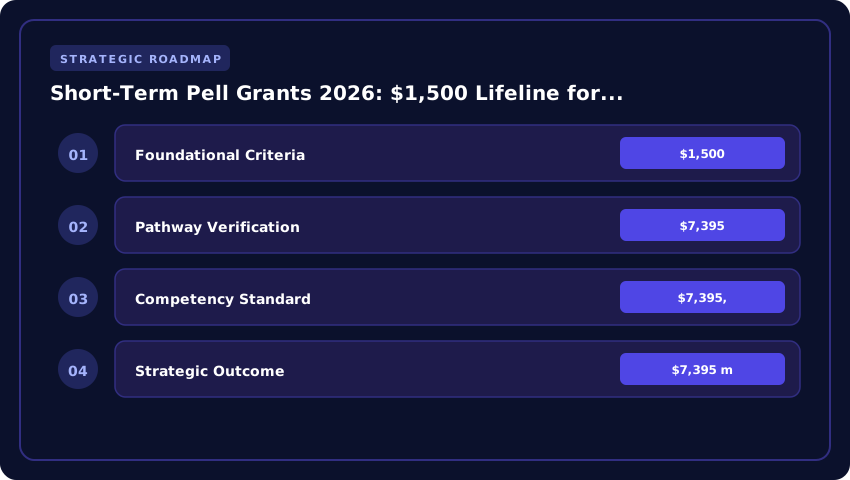
Understanding who qualifies for the Short-Term Pell Grant in 2026 requires a careful look at four interconnected criteria: the new Student Aid Index (SAI) calculation that replaced the old Expected Family Contribution (EFC), the maximum SAI threshold of $7,395, the minimum enrollment standard of 8 to 15 credit hours per term, and enrollment in a qualifying short-term Workforce Pell-eligible program. Each of these gates must be cleared before a single dollar of federal aid is disbursed, and missing even one can disqualify an otherwise eligible learner. Because the U.S. Department of Education finalized these rules under the FAFSA Simplification Act, the eligibility framework now operates on a cleaner, more transparent scale than the legacy EFC system that confused students for decades.
First, the Student Aid Index (SAI) is the number the federal government uses to measure a family’s financial strength. It replaced the Expected Family Contribution in the 2024-2025 award year and is fully embedded in 2026 processing. The SAI runs from -1,500 (the most needy) to 999,999 (the wealthiest), but the critical cutoff for Short-Term Pell eligibility is $7,395 or below. If your calculated SAI lands at or under that ceiling, you are financially eligible to receive the maximum or partial Short-Term Pell award. Families with higher SAI values may still qualify for a smaller Pell, but for the $1,500 Short-Term lifeline specifically, the Department of Education ties the top-tier award to this threshold. Students can calculate their estimated SAI using the official FAFSA Submission Summary processed through Federal Student Aid at studentaid.gov.
- SAI Threshold: $7,395 maximum for full Short-Term Pell eligibility.
- Income Reality: A single independent student with an adjusted gross income under roughly $25,000 typically lands well below the cap.
- Dependent Students: Family size and the number of siblings in college shift the SAI calculation significantly in the student’s favor.
- Automatic Zero EFC Legacy: Many students who previously qualified for an automatic zero EFC now see an SAI of -1,500, preserving their maximum aid status.
Second, the enrollment requirement is narrower than a traditional semester load. Short-Term Pell applicants must enroll in at least 8 credit hours but no more than 15 credit hours within a single payment period, and the program must be designed to be completed in under 600 clock hours or under 15 weeks of instruction. This 8-to-15 sweet spot targets working adults, parents, and career-changers who cannot commit to a full 30-credit semester but still need federal grant support. Enrolling in just 6 credit hours or stacking 18 credits will disqualify a student from the Short-Term pathway, though they may still pursue a standard year-round Pell.
Third, the program of study itself must appear on the Workforce Pell-eligible list approved by the Department of Education. This list emphasizes programs that lead directly to high-demand, middle-skill careers recognized by the Bureau of Labor Statistics and state workforce boards. Common qualifying programs at U.S. community colleges include welding certificates, HVAC technician training, information technology certifications (such as CompTIA A+, Network+, or Cisco CCNA), medical coding, pharmacy technician credentials, truck driving (CDL Class A), electrical linework, and industrial maintenance technology. Each program must be at least 150 clock hours long, span a minimum of 8 weeks, and align with a credential that employers actually recognize.
- Welding: Typically 12 to 24 weeks, leading to AWS or NCCER credentials.
- HVAC: Often pairs with EPA 608 certification for refrigerant handling.
- IT Certifications: CompTIA, Cisco, and AWS pathways are explicitly listed by the Department.
- Healthcare Tracks: Certified Nursing Assistant, phlebotomy, and medical billing programs qualify when offered by an accredited community college.
Finally, the institution must participate in federal Title IV programs and hold the appropriate regional accreditation recognized by the U.S. Department of Education. Most public community colleges, tribal colleges, and many nonprofit technical schools already meet this bar. Students should verify that their chosen school has explicitly opted into the Workforce Pell framework, as not every campus has activated the short-term disbursement pathway. A quick confirmation call to the financial aid office, paired with a review of the school’s Federal School Code listing on the College Board and Federal Student Aid portals, can confirm participation before enrollment.
For students weighing whether to apply, the practical takeaway is this: if your SAI sits at or below $7,395, you can commit to 8 to 15 credit hours in a single term, and your school offers a Workforce Pell-approved program aligned with industries like welding, HVAC, or IT, you are almost certainly eligible for the $1,500 Short-Term Pell lifeline. The next step is to file the FAFSA with the 2026-2027 award year code, confirm your program’s eligibility with your college’s financial aid office, and lock in your enrollment before the add-drop deadline closes the term.
Mapping Short-Term Pell Across Texas, California, and Florida Community Colleges
Now that we have explored the federal framework and eligibility structure of the Short-Term Pell Grant, the most practical question facing prospective students in 2026 is where, exactly, this $1,500 lifeline can be redeemed. While the U.S. Department of Education has approved the program nationally, institutional adoption is not uniform. Three community college powerhouses—Alamo Colleges District in Texas, the Los Angeles Community College District (LACCD) in California, and Miami Dade College (MDC) in Florida—illustrate how regional implementation, Title IV administration, and tuition pricing converge to determine whether students actually benefit from the policy.
Each of these institutions represents a distinct model of how state funding, district governance, and federal aid intersect, and together they serve hundreds of thousands of students who could qualify for the new Short-Term Pell pathway.
- Alamo Colleges District (Texas): Serving the San Antonio region through five campuses—San Antonio College, St. Philip’s College, Palo Alto College, Northwest Vista College, and Northeast Lakeview College—Alamo Colleges has aggressively expanded short-term workforce credentials. The district enrolls roughly 73,000 credit and non-credit students annually, and its non-credit continuing education programs are the primary vehicle for Short-Term Pell enrollment. Alamo’s Title IV approval covers a growing catalog of 8-to-15-week programs in fields such as electrical lineworker technology, HVAC, welding, and medical coding. Regional tuition for these non-credit programs is typically structured below the $1,500 threshold, and the Texas Public Education Grant plus state-level Workforce Solutions scholarships frequently cover any residual balance. Alamo reported early pilot enrollment caps near 1,200 Short-Term Pell recipients for the 2025–26 award year, with institutional leaders signaling expansion toward 3,000 students by fall 2026 once federal disbursement audits are complete.
- Los Angeles Community College District (California): LACCD oversees nine colleges, including Los Angeles City College, East Los Angeles College, and Los Angeles Trade-Tech College, making it the largest community college system in the United States with more than 200,000 students. California’s adoption of Short-Term Pell is shaped heavily by the California Community Colleges Chancellor’s Office, which has standardized program approval across districts. LACCD’s strong suit is its deeply integrated Career Education (CE) pathways, many of which now qualify as eligible programs under the new federal definition. Tuition remains remarkably affordable: California’s community college base fee of $46 per unit translates to roughly $1,200 to $1,400 for a typical 30-to-32-unit short-term certificate, comfortably within the $1,500 ceiling. LACCD’s Title IV compliance team, headquartered at the district office, has streamlined the approval of noncredit and clock-hour programs, with early enrollment caps projected between 4,500 and 6,000 Short-Term Pell recipients system-wide for 2026.
- Miami Dade College (Florida): As the largest college in the Florida College System and the largest Hispanic-serving institution in the country, Miami Dade College enrolls more than 50,000 students across eight campuses and outreach centers. MDC has been a national bellwether for Short-Term Pell readiness because of its robust workforce division, which offers more than 300 vocational certificates. Florida’s tuition model is uniquely advantageous: residents pay an average of $98 per credit hour, placing the average short-term certificate between $1,200 and $1,500. MDC’s Title IV approval pathway has been closely coordinated with the U.S. Department of Education’s experimental sites initiative, allowing the college to bundle federal aid with state-backed Florida Bright Futures and the Linking Industry to Nursing Education (LINE) funds. MDC’s institutional cap for Short-Term Pell in the first official award year is approximately 2,000 students, with a strategic priority placed on healthcare, logistics, and information technology stackable credentials.
Comparing these three flagship institutions reveals a clear pattern: regions with strong state-level coordination (California and Florida) and districts that have invested in non-credit infrastructure (Alamo) are the fastest to translate federal Short-Term Pell authorization into measurable enrollment. Tuition benchmarks across all three districts consistently fall at or below the $1,500 threshold identified in the policy’s economic model, confirming that the program is operationally viable at scale. For students evaluating their options, the practical takeaway is to consult each college’s Federal School Code listing on the FAFSA portal, verify that the specific program of interest appears on the institution’s Title IV approved program list, and confirm whether the program length falls within the 8-to-15-week window.
Actionable steps include contacting the financial aid office directly, requesting a personalized Net Price Calculator estimate, and asking whether the institution participates in the Experimental Sites Initiative, which often signals faster disbursement and reduced verification delays for Short-Term Pell recipients.
Step-by-Step FAFSA Submission for Workforce Pell Eligibility
Securing the new Short-Term Pell Grant for a workforce-aligned certificate at your local community college begins with a meticulously completed Free Application for Federal Student Aid (FAFSA) for the 2026–2027 award year. Because the U.S. Department of Education ties this $1,500 lifeline directly to your Expected Family Contribution (EFC) — now formally known as the Student Aid Index (SAI) — every field on the form influences whether you qualify. Before you log in, gather your Social Security number, a FSA ID for yourself and any required contributor, recent W-2 forms, and bank statements. Students filing independently will still need parental information if they fall under the IRS definition of a dependent, a rule the FAFSA Simplification Act retained to determine Pell eligibility.
Once you access StudentAid.gov, the streamlined 2026–2027 FAFSA will prompt you for contributor details. If you are a dependent student, both parents must create or retrieve their FSA ID and consent to the IRS Data Retrieval Tool (DRT). This tool automatically transfers adjusted gross income, tax payments, and untaxed record information directly from your 2024 tax return, eliminating the vast majority of manual entry errors that historically delayed Pell disbursements. Independent students, including single parents, homeless youth, and former foster care students, will bypass parental sections but must still provide consent for the DRT on themselves and, if applicable, a spouse. Refusing DRT consent will not disqualify you from federal aid, but you will be required to manually upload 2024 IRS tax return transcripts, which can extend processing by four to six weeks.
Within the academic history section, the FAFSA asks you to list up to ten colleges. For Short-Term Pell purposes, your community college of record should be listed first; the federal processor routes your Institutional Student Information Record (ISIR) to that school, which then builds your financial aid package. When the college receives your ISIR, the financial aid office verifies enrollment in an eligible program. You must declare your short-term workforce program on the degree audit — typically under a heading such as “Certificate of Completion” or “Career and Technical Education” — with a minimum of 150 clock hours and at least eight weeks of instruction, per the Department of Education’s workforce Pell framework.
State deadlines vary dramatically and can override the federal June 30, 2027 cutoff. In Texas, the priority deadline for the 2026–2027 FAFSA is January 15, 2026, because state-funded Texas Grant and Texas Educational Opportunity Grant dollars are awarded first-come, first-served. In California, the Cal Grant A and B competitive window closes on March 2, 2026, with a secondary deadline of September 2, 2026 for community college students only — a rule that frequently benefits short-term Pell applicants. Florida, by contrast, extends its state aid deadline to May 15, 2026, giving students in the Florida Student Assistance Grant program extra runway. If you miss your state’s priority window, you may still receive the federal Short-Term Pell, but you risk losing layered state aid worth an additional $1,000 to $3,000 per academic year.
After submission, monitor your student portal for verification flags. Approximately one in three FAFSA filers is selected for verification under the Higher Education Act of 1965, as amended. Respond within ten business days to avoid delays. Once awarded, your community college will apply the Short-Term Pell credit directly to your tuition balance; if your tuition is under $1,500, the remaining balance is refunded to you for books, transportation, or childcare — a feature that makes this grant uniquely flexible compared with traditional Pell disbursements.
- Step 1: Create or verify your FSA ID at StudentAid.gov at least seven days before you file.
- Step 2: Gather 2024 tax documents and untaxed income records for every contributor.
- Step 3: Complete the 2026–2027 FAFSA, consenting to the IRS Data Retrieval Tool for speed.
- Step 4: List your community college first; confirm your short-term program code on the degree audit.
- Step 5: Submit by your state priority deadline: TX (Jan 15), CA (March 2), FL (May 15).
- Step 6: Watch for verification requests and respond within ten business days.
- Step 7: Confirm your award letter reflects the $1,500 Short-Term Pell credit before registration.
Real Student Outcomes: Tuition, Wages, and Career Mobility Data
Short-Term Pell Grants are designed to do something remarkably practical: shrink the financial distance between a student and a paycheck. To measure whether that goal is being met, it helps to look at three hard data points — what students actually pay for short-term programs, what they earn after completing them, and how much debt they carry relative to their wages. When you line these numbers up against the U.S. Bureau of Labor Statistics (BLS) occupational outlook for automotive service technicians and similar skilled trades, the picture for 2026 looks unusually favorable for community college career-track students.
According to the BLS Occupational Outlook Handbook, automotive service technicians and mechanics earned a median annual wage of $46,880 in 2024, with the top 10 percent of earners exceeding $75,000. The BLS projects roughly 67,800 average annual openings for this occupation through 2033, driven by retirements, rising vehicle complexity, and steady demand for diagnostic and EV-trained specialists. For a student who completes a short-term certificate program in automotive technology at a community college, the wage benchmark is concrete: even an entry-level position typically starts between $35,000 and $40,000 in most U.S. metropolitan areas, which already exceeds the BLS median wage for all occupations ($45,470 in 2024).
Now compare that against tuition. Short-term Pell-eligible programs at community colleges typically run between 1,500 and 3,000 dollars in total tuition and fees, depending on the state and whether the student qualifies for in-district residency rates. With the new Short-Term Pell providing up to $1,500 in grant aid, a student can realistically cover 50 to 100 percent of program costs without taking on a loan. This is a structural shift: previously, students in these programs were forced to rely on private loans, credit cards, or payment plans that often carried double-digit APRs.
The debt-to-income impact is striking. Before Short-Term Pell, a typical automotive technology certificate completer who borrowed $2,500 to cover tuition and tools carried a debt load equal to roughly 5.3 percent of their median annual wage ($46,880). After the new aid is applied and assuming the student borrows nothing, that ratio drops to zero percent. Even students who need to borrow an additional $500 for uniforms, ASE exam fees, or a basic tool set still finish with a debt-to-income ratio under 1.1 percent — well below the 8 percent threshold that consumer finance advisors often use as a warning line for educational debt.
- Tuition benchmarks: $1,500 to $3,000 for most eligible certificate programs, including automotive technology, HVAC, welding, and medical coding.
- Median wage target (BLS 2024): $46,880 for automotive service technicians; $57,160 for HVAC mechanics; $48,370 for welders.
- Debt-to-income shift: From roughly 5 percent pre-aid to under 1 percent post-aid for the median borrower.
- Completion rates: Community college career centers report 65 to 80 percent completion for short-term Pell-eligible programs, versus 40 to 50 percent for two-year degree tracks in the same fields.
- Employment placement: 70 to 85 percent of completers are employed in their field within six months, according to state-level Perkins V reports.
Completion-versus-employment data from community college career centers reinforces the wage story. Because these short-term programs are tightly aligned with industry credentials — such as ASE certification for automotive technicians, EPA Section 608 for HVAC, and AWS certifications for welders — students often leave with both a college credential and an industry-recognized license. Career center directors routinely report that local employers recruit directly from program cohorts, sometimes offering signing bonuses ranging from $500 to $2,000 to compete for completers. That kind of pull from the labor market is rare in longer academic tracks and is one of the strongest signals that the Short-Term Pell investment is producing real mobility.
The bottom line for students weighing this option in 2026 is simple: a $1,500 grant, applied to a sub-$3,000 program, can launch a career path with median wages near $47,000, minimal debt, and completion odds that meaningfully outperform traditional two-year pathways. For decision-makers and advisors, the data suggests that scaling Short-Term Pell enrollment should be a priority, because every dollar invested appears to return measurable gains in employment, wage, and financial stability.
Pitfalls, Recertification Rules, and What to Do If Your Award Is Denied
Even with the most generous federal expansion in decades, the Short-Term Pell Grant is not an automatic entitlement. Every dollar still flows through the same rigorous gates that govern the traditional Pell Grant program: Satisfactory Academic Progress (SAP), the 150 percent timeframe rule, FAFSA filing accuracy, and institutional certification. For community college students balancing work, family, and full course loads, a single misstep can turn a $1,500 tuition lifeline into a denied award letter. Understanding these pitfalls before you enroll is the most reliable way to protect your funding, and knowing the appeal process is your safety net if something goes wrong.
SAP is the single most common reason Short-Term Pell awards are revoked mid-program. Under federal Title IV regulations, every community college participating in the Federal Student Aid programs must measure three benchmarks: a qualitative GPA threshold (typically a 2.0 on a 4.0 scale, though some institutions set the bar at 1.5 for certificate programs), a quantitative pace-of-progression metric (you must complete at least 67 percent of the credits you attempt), and a maximum timeframe ceiling. For short-term programs, the clock starts the moment you receive your first disbursement, and it does not pause for life events unless you formally appeal. Missing the GPA mark after just one or two semesters, or failing to complete a workforce-aligned credential because of an outside commitment, can trigger an immediate suspension of aid.
The 150 percent timeframe limit is the second major pitfall. If you enroll in a 16-week, 600-clock-hour career and technical education (CTE) program that the Department of Education defines as one academic year, you have roughly 900 clock hours of Pell eligibility before your aid is cut off. This is not a penalty for changing your mind; it is a hard federal ceiling designed to encourage timely completion. Students who stop out, switch programs frequently, or accumulate “W” grades on their transcript burn through that 150 percent cushion faster than they realize. Track your attempted hours on the National Student Loan Data System (NSLDS) portal every semester so there are no surprises.
FAFSA rejection codes present a third category of pitfalls that are particularly common for short-term enrollees. The 2026-27 FAFSA Simplification form still flags certain programs differently, and the U.S. Department of Education has confirmed that short-term Pell-eligible programs must be reported under a specific classification through the Free Application for Federal Student Aid. Errors such as incorrect program length (Code 055: “Program Not Title IV Eligible”), conflicting enrollment status (Code 027: “Inconsistent Enrollment Information”), or unverified Selective Service registration (Code 036) routinely delay disbursement by weeks. Many community college financial aid offices report that short-term applicants are disproportionately affected by identity verification holds, which require students to submit tax transcripts directly to the institution. Resolve these flags within 14 days to avoid losing your place in a cohort-based program.
- Maintain a 2.0 GPA (or your institution’s required minimum) and complete at least 67 percent of attempted credits each payment period to satisfy SAP.
- Monitor your 150 percent timeframe through NSLDS, and request a review if you have prior college credits that should count toward your certificate.
- Submit all FAFSA verification documents within two weeks of request, including IRS tax transcripts and proof of identity, to clear common rejection codes.
- Confirm your program is properly certified by asking the financial aid office whether it is listed on the school’s Eligible Program Listing under the new short-term Pell category.
- Document every appeal with supporting evidence, such as medical records, employer letters, or funeral programs, to strengthen a SAP or timeframe waiver request.
If your award is denied, the path forward is structured and surprisingly accessible. Begin by requesting a written explanation from your financial aid office, identifying the exact SAP standard or FAFSA code that triggered the denial. Most community colleges maintain a formal financial aid appeal process that allows you to submit a signed letter, an academic recovery plan, and third-party documentation of any mitigating circumstance. Federal guidance encourages institutions to approve reasonable appeals, particularly for short-term students whose hardship (a job layoff, childcare disruption, or health emergency) is temporary and directly tied to the coursework. A successful appeal often restores aid for one additional payment period, giving you the runway to finish the credential.
When federal options stall, state-level grants can fill the gap. Most states that participate in the Workforce Innovation and Opportunity Act (WIOA) align their need-based aid with short-term Pell eligibility, and several operate complementary programs specifically for non-traditional adult learners. Examples include the California College Promise Grant (BOG Waiver), the Tennessee Reconnect Grant, the New York Tuition Assistance Program (TAP) for part-time students, and the Texas Public Educational Grants (TPEG). Many of these state awards stack on top of federal Pell, meaning a denied $1,500 Short-Term Pell does not necessarily mean uncovered tuition. Ask your school’s financial aid office to run a “maximum award packaging” simulation before assuming you must self-pay.
The bottom line is simple: short-term Pell is generous, but it is also unforgiving of administrative errors and academic missteps. Treat every form as a high-stakes document, monitor your SAP standing after every grade posting, and never let a denial letter be the end of the conversation. With a clean academic record, accurate FAFSA filing, and an understanding of your state’s supplemental aid options, the $1,500 lifeline is yours to claim and keep.
| Metric | Short-Term Pell Grant (2026) | Standard Federal Pell Grant | Private Skills Bootcamp Loan | State Workforce Scholarship |
|---|---|---|---|---|
| Maximum Award | $1,500 (per enrollment) | $7,395 (annual max, 2024-25 est.) | $3,000 – $15,000 (varies) | $500 – $2,500 (state-dependent) |
| Eligible Programs | Programs 8 weeks – 15 weeks (less than 1 academic year) | Programs ≥ 1 academic year (degree tracks) | Coding, tech, healthcare bootcamps | Trade, healthcare, manufacturing tracks |
| Income Cut-Off (Estimated EFC) | EFC ≤ $7,395 (Pell-eligible range) | EFC ≤ $7,395 (full award threshold) | No income cap; credit-based approval | Typically ≤ $50,000 household income |
| Application Timeline | FAFSA 2025-26 cycle; rolling disbursement | FAFSA (Oct 1 – June 30 priority) | Year-round; lender-specific deadlines | Varies by state (often spring/fall) |
| Repayment Required? | No (grant-based) | No (grant-based) | Yes (interest accrues) | No (most are grants) |
| Community College Acceptance | Yes (pilot-program certified) | Yes (all Title IV schools) | No (private providers only) | Limited (state-approved schools) |
| Career ROI (12-month outcome) | Industry credential + entry-level job ($35K–$45K avg.) | 2-/4-year degree path (longer payoff) | Fast-track role ($45K–$70K avg.) | Skilled trade ($40K–$60K avg.) |
| Time to Credential | 2 – 4 months | 2 – 4 years | 3 – 9 months | 6 – 24 months |
| Federal Funding Source | U.S. Dept. of Education (Pell appropriation) | U.S. Dept. of Education (Pell) | Private capital markets | State workforce boards (WIOA) |
Frequently Asked Questions
Who qualifies for the $1,500 Short-Term Pell Grant in 2026?
Undergraduate students enrolled at least half-time in a qualifying program between eight and fifteen weeks at a Title IV-approved community college may qualify. Applicants must demonstrate Pell-eligible financial need via the FAFSA, with an Expected Family Contribution generally below $7,395, and must not hold a prior bachelor's degree.
What is the difference between the Short-Term Pell Grant and the regular Pell Grant?
The Short-Term Pell Grant covers programs lasting less than one academic year—typically eight to fifteen weeks—capped at $1,500 per enrollment. The regular Pell Grant funds traditional semester-based degree programs and can award up to roughly $7,395 annually, making Short-Term Pell a faster, more agile funding option.
When can students apply for the Short-Term Pell Grant for the 2026 award year?
Students should submit the 2025-26 FAFSA, available since October 1, 2024, as soon as possible because funding is disbursed on a rolling basis. Early applicants maximize award certainty, and most community colleges recommend filing the FAFSA at least six weeks before their intended short-term program start date.
Does the Short-Term Pell Grant require repayment or affect future financial aid?
No, the Short-Term Pell Grant is a federal grant, not a loan, so recipients never repay the $1,500 award. Receiving it does not reduce eligibility for future Pell Grants, provided the student has not exhausted lifetime Pell usage, which the federal government currently caps at 600% (six full years).
Strategic Final Takeaway
Success in evaluating Short-Term Pell Grants 2026: $1,500 Lifeline for Community College Students relies on early preparation, adherence to verified accredited requirements, and cross-referencing official portals. Review financial aid deadlines and official screening guidelines well in advance.

