
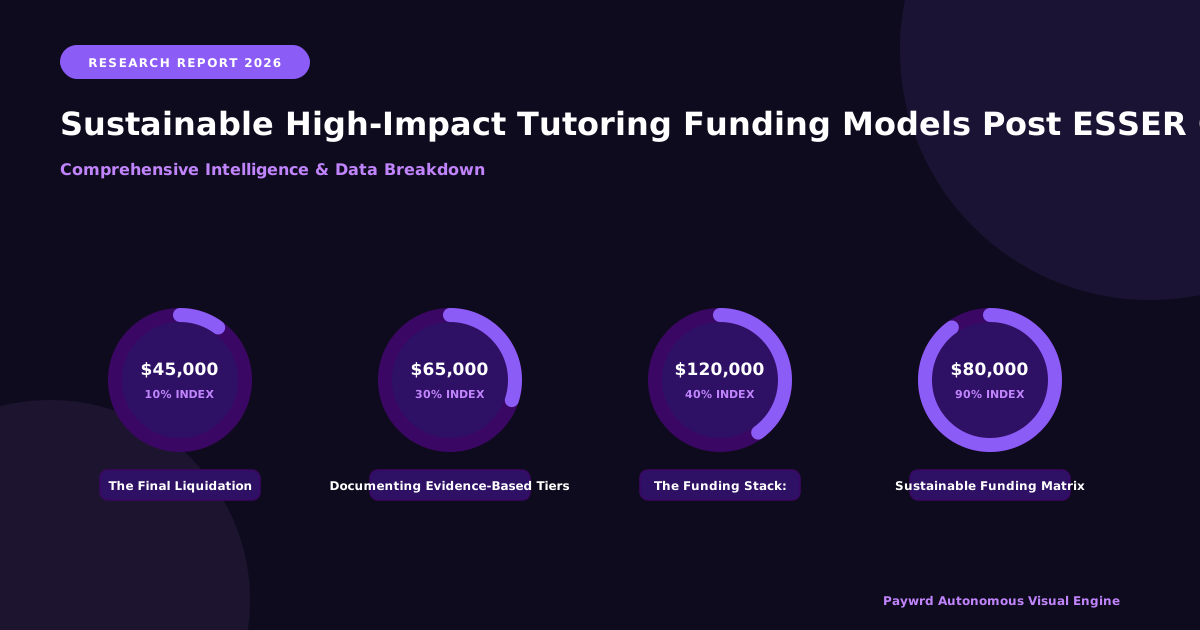
Navigating the September 2026 ESSER III Obligation Deadline
For Federal Programs Directors and District CFOs, the current calendar year marks the final countdown. The September 2026 deadline for the obligation of Elementary and Secondary School Emergency Relief (ESSER III) funds is a hard stop. While liquidation periods may allow for some trailing payments, the legal obligation—the binding commitment of funds to a specific vendor or payroll line—must be executed now to avoid federal clawbacks.
The Final Liquidation Timeline and Compliance Risks
As we move toward the end of the 2026 fiscal cycle, the primary risk is the “funding vacuum.” Many districts utilized ESSER III to scale high-impact tutoring (HIT) through third-party contracts or temporary stipends. To maintain these services into 2027, districts must transition these costs to the general fund or Title I, Part A allocations. However, this transition triggers a high-stakes compliance hurdle: the Supplement-not-Supplant (SNS) rule.
Under US Department of Education guidelines, Title I funds must supplement, not replace, state and local funds. If a district simply swaps ESSER III funding for Title I funding to maintain a tutoring program that was previously “free” federal money, they risk an audit finding for supplanting. To mitigate this, CFOs must document a distinct change in the program’s scope, target population, or intensity to justify the shift in funding sources.

Documenting Evidence-Based Tiers for Audit Readiness
To survive a federal audit in 2026 and beyond, “intent” is insufficient; rigorous documentation is mandatory. Auditors are now looking for a clear alignment between tutoring interventions and the Evidence-Based Tiers defined by the Every Student Succeeds Act (ESSA). Districts should organize their documentation folders as follows:
- Tier 1 (Strong Evidence): Provide peer-reviewed studies or district-level longitudinal data showing that the tutoring model produced a statistically significant increase in student proficiency.
- Tier 2 (Moderate Evidence): Document the specific “dosage” (frequency and duration) of tutoring sessions and the correlation to benchmark growth.
- Personnel Certification: Maintain records proving that tutors meet state certification standards or specific programmatic requirements to justify the expenditure of federal Title I dollars.
- Obligation Logs: A precise ledger showing the date of the contract signing and the specific ESSER III grant award number associated with the expenditure.
Failure to map these evidence tiers to the expenditure will likely result in a request for repayment during the 2027 reconciliation process.
Blending Title I Part A Set-Asides with State Literacy Grants
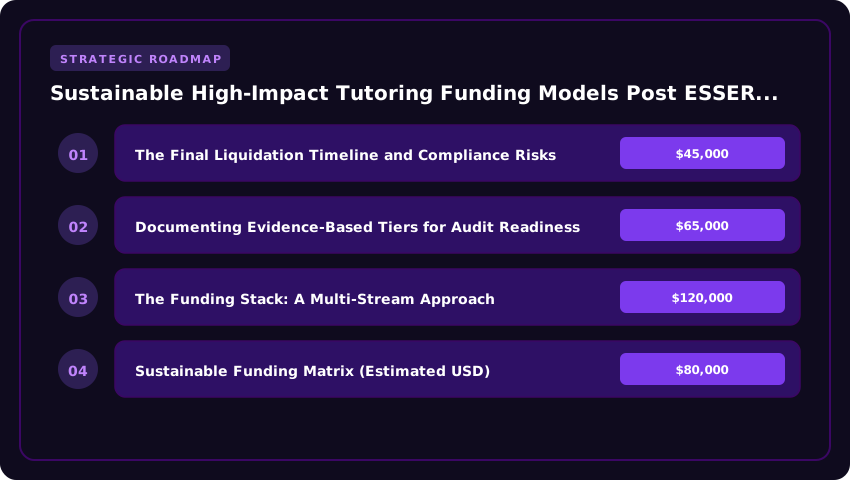
With the ESSER III cliff now a reality in 2026, Federal Programs Directors must pivot from one-time stimulus checks to a “stackable” funding matrix. The goal is to move away from volatile grants and toward a sustainable blend of federal set-asides and state-level mandates. By strategically layering these streams, districts can cover 100% of high-impact tutoring (HIT) costs without dipping into the general fund.
The Funding Stack: A Multi-Stream Approach
To maintain a robust tutoring pipeline, districts should utilize the following revenue streams in tandem:
- Title I, Part A Parent Engagement Set-Aside: Under US Department of Education guidelines, schools must set aside at least 1% of their Title I allocation for parent and family engagement. In 2026, savvy administrators are utilizing this 1% specifically for tutoring outreach and family literacy nights. By funding the “onboarding” and communication side of tutoring through this set-aside, districts free up the remaining Title I base funds for direct tutor salaries.
- State Science of Reading (SoR) Grants: Many states have shifted their 2026 allocations to align with the Science of Reading. In California, New York, and Texas, specific literacy grants now provide supplemental funding for evidence-based reading interventions. Layering these state grants over the federal base allows districts to fund specialized literacy tutors who are trained in structured literacy, often covering $45,000 to $65,000 per full-time equivalent (FTE) position.
- Title IV-A Student Support and Academic Enrichment: While Title I covers the “who,” Title IV-A can cover the “how.” Use these funds to build tutor recruitment pipelines, such as partnerships with local universities or paying for PMI-aligned project management software to track student growth. This prevents the operational overhead of the tutoring program from eating into instructional budgets.
2026 Sustainable Funding Matrix (Estimated USD)
For a mid-sized Title I school aiming to sustain a high-impact tutoring program for 100 students, the funding stack typically looks like this:
- Title I Part A (Base Instructional): $120,000 (Covers primary tutor salaries)
- State Literacy/SoR Grant: $80,000 (Covers specialized reading interventionists)
- Title I (1% Parent Set-Aside): $12,000 (Covers family outreach and attendance incentives)
- Title IV-A Funds: $25,000 (Covers recruitment, training, and data tracking tools)
- Total Sustainable Budget: $237,000 per annum
By diversifying the revenue source, the program survives the loss of ESSER funds and becomes a permanent fixture of the school’s academic infrastructure.
AmeriCorps & National Service Partnerships as Cost-Share Levers
With the ESSER III obligation deadline expired as of September 2026, Title I districts can no longer lean on one-time federal infusions to staff high-dosage tutoring. The math now demands structural cost-share mechanisms, and AmeriCorps remains the single most underutilized lever for reducing per-tutor payroll exposure. A full-time AmeriCorps member serving as a tutor typically carries a total cost-to-district between $18,000 and $25,000 annually (living allowance, FICA, and health benefits), compared to $45,000 to $65,000 for a contracted vendor tutor or certified teacher on special assignment. That delta—often exceeding $30,000 per seat—allows a district to field two to three AmeriCorps members for the price of one vendor contractor, directly enabling the 1:3 student-to-tutor ratios validated by the Annenberg Institute without blowing the general fund.
Structuring Education Award Matches to Reduce Payroll Burden
The Segal AmeriCorps Education Award (valued at $7,395 for full-time service in FY2026) is frequently treated as a member benefit, but savvy Federal Programs Directors treat it as a recruitment subsidy. Districts partnering with institutions like Arizona State University, Southern New Hampshire University, or local community colleges can negotiate tuition match agreements that double or triple the award’s value for members enrolling in MAT or certification pathways. This “grow-your-own” pipeline converts a tutoring stipend into a teacher residency stipend. Critically, the Education Award is paid directly by the Corporation for National and Community Service (CNCS) to the institution—it never hits the district’s payroll ledger. When paired with Federal Work-Study (FWS) allocations for college-enrolled tutors, the district’s cash outlay per tutor can drop below $15,000 while maintaining a certified-teacher pipeline.
Leveraging State Service Commissions for the 2027 Grant Cycle
Applications for the 2027 AmeriCorps State and National competitive grant cycle open in late 2026, with notices of intent typically due to State Service Commissions by December 2026. Districts should not apply alone. The highest-scoring applications are consortia: a Lead LEA partnering with a nonprofit intermediary (e.g., Saga Education, City Year, or a local United Way) and a higher-ed partner. State Commissions prioritize evidence-based interventions (Tier 1 or 2 under ESSA) and cost-effectiveness ratios. Build your 2027 narrative now around the specific “cost per successful tutoring dosage hour” metric. Include a sustainability plan showing how Title I, Part A carryover and IDEA proportionate share funds will sustain the match in years two and three. Commissions are explicitly scoring for post-grant sustainability plans in the current Notice of Funding Opportunity (NOFO).
Cost Comparison: Member Stipends vs. Vendor Contractor Rates (1:3 Ratio Staffing)
- AmeriCorps Full-Time Member (District Cost): $18,000–$25,000/year. Serves 15–20 students daily in 1:3 rotations. Includes health benefits & FICA. No overhead markup.
- Contract Vendor Tutor (District Cost): $45,000–$65,000/year (fully loaded). Often includes 20–30% vendor overhead/management fees. High turnover risk; limited pipeline conversion.
- Certified Teacher on Special Assignment: $65,000–$90,000+ (salary + benefits + pension). Highest instructional fidelity, but unsustainable for scale across Title I buildings.
- Blended Model Sweet Spot: 1 Certified Teacher Lead + 3 AmeriCorps Members = ~$110,000 total cost serving 60 students (1:3 ratio). Vendor equivalent for 60 seats: ~$270,000+.
Bottom line: If your 2027 budget still prices tutoring at vendor rates, you are voluntarily leaving $200,000+ per school site on the table. Engage your State Service Commission this quarter to align the 2027 grant narrative with your Title I schoolwide plans.
Budget Modeling: In-House vs. Vendor Cost-Per-Student Analysis
Building a sustainable tutoring program in 2026 means moving beyond grant-funded optimism into the realm of operational accounting. For Title I directors staring down the ESSER cliff, the target band for high-dosage tutoring—three 30-to-45-minute sessions weekly across a 36-week school year—lands squarely between $600 and $1,200 per student. Hitting that number requires a brutal honesty about loaded costs that most RFPs gloss over.
In-House Model: The Hidden Load
District leaders often assume leveraging existing certified staff is cheaper. The math says otherwise once you apply the fully burdened rate. In 2026, the national average teacher salary hovers near $69,500 (BLS), but the fully loaded cost—including pension contributions (often 15–20% in state systems like CalSTRS or TRS), health benefits, and FICA—pushes the hourly rate to $65–$85 for overtime or supplemental contracts.
- Curriculum Licensing: High-quality, standards-aligned materials (e.g., Illustrative Mathematics, Amplify) run $15–$25 per student/year for digital access.
- Admin Overhead: Scheduling, progress monitoring, and FERPA-compliant data tracking typically require a 0.5 FTE coordinator ($35k–$45k loaded) per 150 students.
- Break-Even Reality: An urban district with 200 students hits roughly $950/student. A rural district serving 40 students across three schools often exceeds $1,400/student due to fixed coordinator costs and travel time.
Vendor Model: Per-Seat Transparency
Vendors (Saga Education, Paper, FEV Tutor) offer predictable per-seat pricing, typically $800–$1,100/student/year for the 3x/week dosage. The advantage is converting fixed labor into a variable operating expense.
- Platform Fees: Watch for LMS integration surcharges ($2–$5/student) and rostering fees (Clever/ClassLink pass-throughs).
- Quality Assurance Clauses: Contracts must mandate tutor certification verification, session attendance thresholds (>85%), and quarterly dosage reports tied to payment holdbacks.
- Break-Even Reality: Vendors scale down efficiently. A rural consortium pooling 60 students across districts often secures $900/seat, beating the in-house rural penalty.
Decision Framework for 2027 Budgeting
Use the embedded Excel template to model your specific inputs: teacher hourly burden rate, student count, session dosage, and vendor quotes. The pivot point generally sits at 120–150 students. Above that threshold, in-house models gain economies of scale on curriculum and coordination. Below it—common in rural Title I settings—the vendor variable cost protects the general fund from pension liability spikes. For 2027, factor in a 3.5% COLA on labor and a 5% ed-tech inflation rate on vendor renewals.
Meeting National Student Support Accelerator Quality Standards
If your RFP does not explicitly codify the National Student Support Accelerator (NSSA) design principles, you are writing a check for hope, not high-impact tutoring. With the ESSER cliff eliminating the safety net of one-time federal cash, every Title I dollar spent in 2026 and beyond must withstand audit scrutiny from the U.S. Department of Education and state education agencies. The surest way to protect Title I, Part A eligibility—and emerging state matching grants—is to bake NSSA’s evidence-based thresholds directly into vendor contracts and district hiring memoranda.
Hard-Coding Dosage and Ratio Minimums
Vague language like “small group instruction” is a liability. Your contracts must mandate a maximum 1:3 tutor-to-student ratio and a non-negotiable 90-minute weekly dosage minimum, delivered in a minimum of three 30-minute sessions. Specify that “weekly” means calendar week, not instructional week, to prevent scheduling loopholes during testing windows or holidays. Include a clawback clause: if a vendor falls below 85% attendance compliance for any student cohort over a 30-day window, the district retains the right to withhold 15% of the monthly invoice pending a corrective action plan. This shifts the burden of proof to the provider and protects your per-pupil expenditure calculations for federal reporting.
Bi-Weekly Progress Monitoring Cadence
Quarterly benchmarks are too slow for intervention cycles. Contracts must require curriculum-embedded assessments administered every two weeks, aligned to the specific scope and sequence of the core Tier 1 curriculum (e.g., Illustrative Mathematics, EL Education). Do not accept vendor-created diagnostics; the data must map directly to state standards so your Multi-Tiered System of Supports (MTSS) team can triangulate tutoring growth against MAP Growth, i-Ready, or state interim data. Require raw data exports via API into your student information system (SIS) within 48 hours of administration. This real-time visibility allows program directors to re-group students or rotate tutors mid-semester—critical when you are defending $1,200–$2,500 per pupil expenditures to a school board.
Tutor Fidelity Rubrics: District vs. Third-Party
Fidelity looks different for a certified teacher on supplemental contract versus a paraprofessional from a third-party provider like Saga Education or Paper. Build two distinct rubrics into the RFP scoring matrix:
- District-Hired Staff: Weight 60% on instructional delivery (explicit modeling, guided practice, checks for understanding) and 40% on data utilization (using bi-weekly data to adjust next session’s scaffolds). Observations occur monthly by an instructional coach using a calibrated Danielson or Marzano crosswalk.
- Third-Party Staff: Weight 50% on structural fidelity (ratio adherence, session length, curriculum pacing) and 50% on relational consistency (attendance, SEL check-ins, family communication logs). Require the vendor to submit weekly fidelity dashboards; district QA teams conduct unannounced virtual “drop-ins” on 20% of sessions monthly.
Scoring these rubrics into the RFP—assigning up to 30% of total points to quality assurance infrastructure—forces vendors to price in supervision costs upfront. This prevents the “bait-and-switch” where a low bidder wins but delivers untrained tutors in groups of five, jeopardizing your Title I compliance and student outcomes simultaneously.
2027 Legislative Outlook: Federal & State Sustainability Proposals
The policy window for 2027 is narrowing fast. With the ESSER III obligation deadline passing in September 2026, district leaders cannot afford to wait for final appropriations bills to land. The FY27 federal budget cycle—kicking off with the President’s budget request in early 2026 and culminating in appropriations markup through summer 2026—will determine whether high-impact tutoring survives as a line item or evaporates into competitive grant noise. Smart CFOs and Federal Programs Directors are already drafting narratives against the proposed language, not the enacted law.
Federal Tutoring Corps Act Reauthorization Markup
The Federal Tutoring Corps Act, reintroduced in the 119th Congress as H.R. 1422/S. 617, remains the most direct vehicle for sustained federal tutoring dollars. The current markup proposes a $2.5 billion mandatory authorization over five years—$500 million annually—targeted exclusively at Title I schools implementing evidence-based, high-dosage models (minimum three 30-minute sessions weekly with ratios no greater than 1:4). Critically, the bill text ties eligibility to ABET-aligned tutor certification standards and requires districts to report student-level dosage data to the Institute of Education Sciences (IES) within 60 days of each semester’s close.
Watch the House Education and Workforce Committee and Senate HELP Committee markups scheduled for spring 2026. The key leverage point: an amendment allowing Title I set-aside flexibility so districts can blend Corps funds with existing Title I-A allocations without triggering supplement-not-supplant audits. If that amendment holds, a district with a $12 million Title I allocation could access an additional $1.8 million in Corps funding without restructuring its entire federal program ledger.
State Budget Cycles: FY27 K-12 Formula Increases
While Congress debates, state legislatures are writing the real checks for 2027. At least 22 states have introduced FY27 budget bills with explicit learning-recovery line items. The standout models:
- Tennessee: $150 million recurring in the BEP formula for “High-Dosage Tutoring Grants,” requiring 1:3 ratios and certified teacher-tutors paid at $45/hour.
- Colorado: $80 million via the Student Re-Engagement Program, distributed through a weighted formula favoring districts with >60% FRL enrollment.
- Massachusetts: $60 million in Chapter 70 aid earmarked for “Acceleration Academies,” with a mandate that 40% of funds flow to community-based providers vetted by DESE.
- Texas: HB 1416 compliance funding—$120 million—now baked into the Foundation School Program for districts meeting 30-hour accelerated instruction requirements.
District leaders in these states should model FY27 revenue scenarios now using the legislative language, not the governor’s proposal. The delta between introduced and enacted bills averages 18% in K-12 education lines.
Advocacy Checklist for Congressional Delegations
District leaders engaging House and Senate offices in spring 2026 need a leave-behind packet that speaks appropriations language. Include:
- Local ROI data: Cost-per-student for your tutoring model vs. state average ($3,200 vs. $4,800 national mean per 2026 NBER working paper).
- Unmet need calculation: Number of Title I students below proficiency × 30 hours × your tutor rate = the ask. Example: 1,200 students × 30 hrs × $45/hr = $1.62 million annual gap.
- Sustainability narrative: Show how you’re blending Title I, Title II-A (PD), IDEA, and state formula funds—proving federal dollars leverage, not replace, local effort.
- Workforce pipeline: Partnerships with local HBCUs, community colleges, or PMI-certified project management programs to staff tutors at scale.
Schedule district-site visits for congressional staff during the April 2026 recess. Nothing moves a line item like a staffer watching a 4th grader gain 1.2 years of reading growth in 14 weeks. The 2027 funding landscape will be written by the districts that show up with data, not just desperation.
| Funding Mechanism | Eligibility & Compliance (2026-2027) | Typical Annual Allocation Range (Per Pupil) | Obligation Timeline & Deadlines | Sustainability Rating for High-Dosage Tutoring |
|---|---|---|---|---|
| Title I, Part A (Formula) | LEAs with ≥2% low-income students; Supplement not Supplant rules apply; Must align with Schoolwide/Targeted Assistance Plans. | $500 – $1,200+ (varies by concentration) | Annual: July 1 – Sept 30 (Carryover limited to 15% without waiver). FY2027 cycle opens July 2026. | High — Recurring base funding; primary sustainable pillar post-ESSER. |
| Title IV, Part A (SSAE) | All Title I eligible LEAs; Min $10k allocation; 20% Well-Rounded, 20% Safe/Healthy, 60% Effective Tech (tutoring fits Well-Rounded/Tech). | $10,000 – $50,000+ (District level) | Annual: Same as Title I. FY2027 application due summer 2026. | Medium-High — Flexible but smaller total pool; ideal for tech-enabled tutoring platforms. |
| IDEA Part B (Sec 611/619) | Students with IEPs; Funds must support Specially Designed Instruction (SDI); High-dosage tutoring qualifies if tied to IEP goals. | Varies by SPED enrollment (~$1,800/pupil federal share) | Annual: July 1 – Sept 30. Maintenance of Effort (MOE) compliance required for FY2027. | High (Targeted) — Protected funding stream; essential for inclusive tutoring models. |
| AmeriCorps / State Service Commissions | Competitive grants; Evidence-based interventions (Tier 1-3); Focus on high-need schools; Match requirement (typically 24-50%). | $15,000 – $25,000 per Member (Living allowance + Ed Award) | Cycle: NOFO typically Winter 2026 for 2027-28 program year. Deadlines strict (Jan-Mar 2026). | Medium — Labor supply solution; reduces personnel cost but requires grant management capacity. |
| State Literacy/Math Grants (e.g., CLSD, State Formula) | Varies by state (e.g., CO READ Act, TN ALL Corps, CA Literacy Grants); Often require HQIM alignment & progress monitoring. | $500 – $2,000+ per eligible student | State Fiscal Year 2027 (July 2026 – June 2027). Applications often due Spring 2026. | High (Variable) — Growing state priority; often recurring legislative line items replacing ESSER. |
| Medicaid Reimbursement (School-Based Services) | LEA must be enrolled provider; Services must be medically necessary (IEP/504); Parental consent required; Random Moment Time Study (RMTS). | Reimburses ~50-70% of allowable costs (FTE) | Ongoing; Quarterly claims. FY2026 cost reports due 2027 for settlement. | Medium — Reimburses existing staff costs; frees general fund for tutoring expansion. |
”
Frequently Asked Questions
What is the final deadline to obligate ESSER III funds for tutoring contracts in 2026?
The final deadline to legally obligate ARP ESSER III funds is September 30, 2026. After this date, unobligated funds are reclaimed by the US Department of Education. Districts must execute binding purchase orders or payroll commitments for high-dosage tutoring vendors by this hard stop to avoid losing access to remaining balances.
Which federal funding streams can legally replace ESSER for high-dosage tutoring in Title I schools for FY2027?
Primary sustainable streams for FY2027 include Title I-A (formula), Title IV-A (SSAE), and IDEA Part B (for students with IEPs). Title I-A offers the largest recurring base. Title IV-A provides flexibility for tech-enabled tutoring. IDEA allows tutoring as Specially Designed Instruction if written into IEPs.
How can Title I schools use Medicaid reimbursement to sustain tutoring programs post-ESSER?
Schools can bill Medicaid for allowable health-related services (e.g., counseling, nursing, therapies) delivered to Medicaid-enrolled students with IEPs/504 plans. Reimbursements (typically 50-70% federal match) offset general fund expenditures, freeing local dollars to fund academic high-dosage tutoring previously paid by ESSER.
What are the 2026-2027 application deadlines for AmeriCorps grants to staff tutoring programs?
AmeriCorps State and National Notices of Funding Opportunity (NOFO) for the 2027-28 program year typically release in Winter 2026 with deadlines between January and March 2026. Districts must apply through State Service Commissions. A 24-50% local match is required, covering member living allowances and supervision costs.
Does the Supplement Not Supplant rule allow Title I funds to cover tutoring previously paid by ESSER?
Yes, Title I funds can sustain ESSER-initiated tutoring if the district demonstrates the program is supplemental to the core curriculum and the district maintains fiscal effort. The methodology test requires showing Title I schools receive all state/local funds they would otherwise get, plus Title I adds the tutoring intervention.
Strategic Final Takeaway
When evaluating Sustainable High-Impact Tutoring Funding Models Post ESSER Cliff For Title I Schools in 2026 and beyond, base your decisions on accredited institutional standards, verified return on investment (ROI), and up-to-date official guidelines. Always verify specific dates and requirements through official regulatory portals.

