Mapping AI Literacy to NGSS, CSTA, and Common Core Frameworks
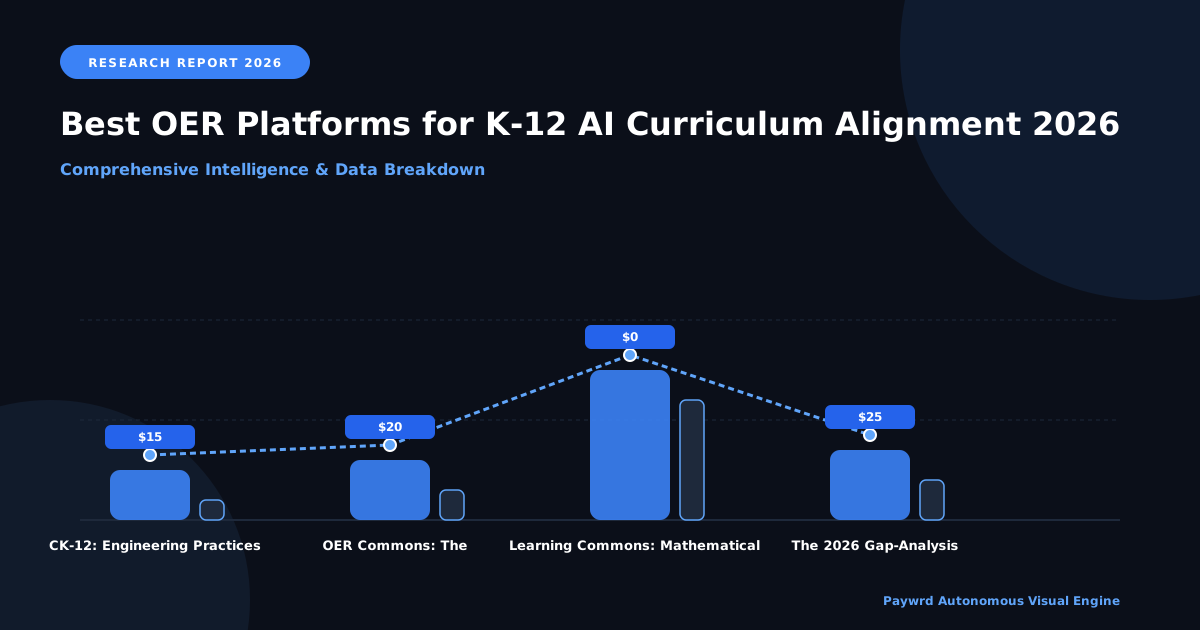
Curriculum directors facing 2026 adoption committees know the drill: a flashy AI module is useless if you cannot map it line-by-line to the NGSS Science and Engineering Practices (SEPs), CSTA K-12 Computer Science Standards, and Common Core State Standards for Mathematical Practice (SMPs). The three dominant OER platforms—CK-12, OER Commons, and Learning Commons—handle this crosswalk differently, and your gap analysis starts with understanding their native metadata architecture.
CK-12: Engineering Practices Meet Adaptive FlexBooks
CK-12 remains the strongest native fit for NGSS alignment because its FlexBook architecture was built around the Framework for K-12 Science Education. Their 2026 “AI & Machine Learning” and “Data Science” collections explicitly tag lessons to SEPs like Developing and Using Models (SEP-2) and Analyzing and Interpreting Data (SEP-4). The platform’s interactive simulations (PLIX) allow students to manipulate neural network weights or bias variables in real-time, satisfying the “hands-on” evidence reviewers demand. However, CK-12’s CSTA tagging is thinner—often limited to 1B-AP-10 (Algorithms) and 2-AP-13 (Data Analysis)—requiring manual supplementation for deeper computational thinking strands like Computing Systems or Impacts of Computing.
OER Commons: The CSTA Compliance Heavyweight
If your state has adopted the CSTA K-12 CS Standards (now mandated in 35+ states), OER Commons is your primary verification engine. Their 2026 curated collections—specifically the AI for K-12 Initiative hub and the CSforALL vetted library—feature granular metadata filtering by CSTA concept (e.g., Algorithms & Programming, Data & Analysis) and grade band (K-2, 3-5, 6-8, 9-10, 11-12). Look for the “Alignments” tab on resources like Google’s Teachable Machine curricula or MIT RAISE Day of AI lessons; they surface explicit mappings to standards like 2-DA-08 (Data Collection) and 3A-AP-15 (AI Ethics). The trade-off: NGSS and Common Core math mappings here are community-generated, not publisher-verified, so spot-check three resources before trusting the tag.

Learning Commons: Mathematical Practice Integration
Learning Commons (via the ISKME infrastructure) has carved out the niche for Common Core Mathematical Practice (SMP) integration. Their 2026 “Data Literacy & AI” pathways are explicitly designed around SMP-4 (Model with Mathematics) and SMP-5 (Use Appropriate Tools Strategically). Resources like the YouCubed Data Science units or Concord Consortium’s CODAP activities embed AI classification tasks inside statistical inquiry cycles—mean, median, standard deviation, and regression residuals. This is critical for math directors needing to justify AI units inside Algebra I or Integrated Math pathways without “crowding out” tested standards. The gap? CSTA and NGSS tags are sparse; treat this as your math-layer supplement, not your CS or Science core.
The 2026 Gap-Analysis Workflow
- Step 1: Pull the CK-12 FlexBook “Standards Report” (CSV export) for NGSS SEP coverage.
- Step 2: Filter OER Commons by your state’s adopted CSTA grade-band; export the alignment matrix.
- Step 3: Cross-reference Learning Commons SMP tags against your district’s math scope-and-sequence.
- Step 4: Build a master spreadsheet: Rows = Lessons; Columns = NGSS SEP, CSTA Standard, CCSS SMP. Highlight red cells = adoption risk.
Bottom line: No single platform delivers a clean 100% crosswalk. The 2026 winning strategy is a tri-platform stack: CK-12 for the science/engineering backbone, OER Commons for the CS compliance receipt, and Learning Commons for the math practice glue. Present that matrix to the committee, and the adoption vote shifts from “innovation risk” to “standards coverage.”
Platform Showdown: CK-12 vs OER Commons vs Learning Commons for AI Content
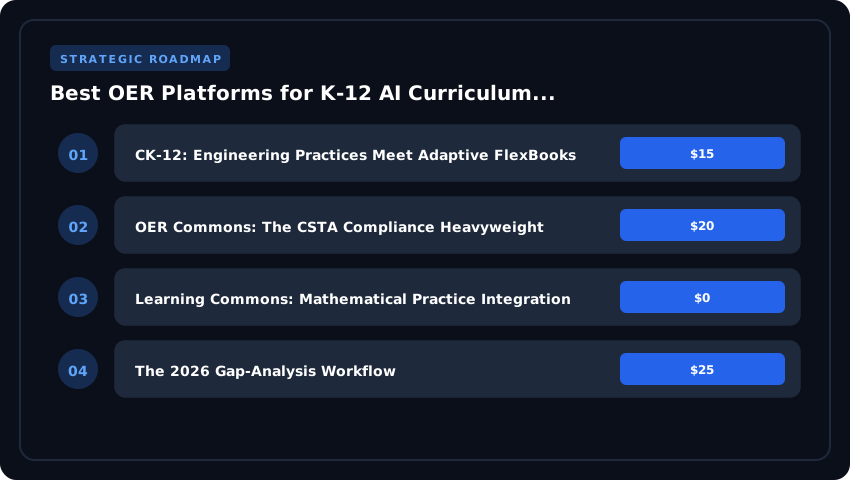
When your adoption committee asks for a side-by-side comparison in 2026, the differences between these three giants come down to authoring philosophy versus curation depth. CK-12 operates like a dynamic textbook publisher; OER Commons functions as a massive, searchable library; and Learning Commons (often via state-specific hubs like California’s or Texas’s) acts as a compliance-first repository. For AI literacy specifically, the gap in ready-to-teach generative AI ethics modules is wider than most directors expect.
Depth of Generative AI Ethics and Bias Mitigation
CK-12 leads with structured “FlexBooks” that now include dedicated chapters on LLM hallucination detection and training data bias. Their 2026 updates added interactive “Bias Audit” simulators where students prompt a sandboxed model and compare outputs across demographic personas. It is pedagogically sound but feels a bit clinical. OER Commons relies on community submissions—think MIT RAISE modules or ISTE-contributed lesson plans. The quality variance is high; you will find brilliant high school units on algorithmic redlining next to outdated 2026 “What is ChatGPT?” slide decks. Learning Commons (state portals) excels at policy alignment. Their ethics content is explicitly mapped to state AI guidance documents (like CA’s AI Toolkit or NY’s CS/DF standards), making board presentations easier, but the student-facing interactivity is often limited to PDF worksheets and discussion prompts.
Granularity of Teacher Guides and Student Simulations
- CK-12: Offers the most granular teacher dashboard. You get real-time heatmaps of student misconceptions inside the “Adaptive Practice” engine. The student simulations—like the “Neural Net Playground” visualizing backpropagation—are browser-based, require zero install, and run on district Chromebooks.
- OER Commons: Teacher guides are hit-or-miss. Some curated collections (e.g., the “AI for K-12” working group folder) include comprehensive slide decks, rubrics, and differentiation strategies. Others are just a link to a GitHub repo. No native LMS integration; you are downloading ZIP files and uploading to Canvas or Google Classroom manually.
- Learning Commons: Guides are built for compliance auditing. Expect detailed standards-crosswalk tables (NGSS SEP-8, CSTA 1B-AP-15) but thin instructional scaffolding. Simulations are rare; the platform prioritizes vetted external links (PhET, Code.org) over native tools.
Frequency of Content Updates Reflecting 2026 LLM Shifts
This is the operational differentiator. CK-12 pushes quarterly “Concept Updates.” In Q1 2026, they retrofitted their “Large Language Models” chapter to cover context-window expansion (1M+ tokens) and multimodal prompting (image/audio input), complete with new auto-graded assessments. OER Commons updates at the speed of its contributors. The “Generative AI” tag saw a 40% upload spike in late 2026, but curation lag means broken links to deprecated APIs (looking at you, pre-function calling OpenAI examples) persist for months. Learning Commons updates on legislative cycles. If your state passed an AI literacy mandate in 2026, the portal likely refreshed Summer 2026. If not, you are teaching 2026 definitions of “prompt engineering” in a 2026 classroom.
Bottom line for 2026 selection: Choose CK-12 if you need a turnkey, interactive student experience with live data. Choose OER Commons if you have curriculum writers who want to remix high-quality assets into custom units. Choose Learning Commons if your primary risk is a school board vote on standards alignment next Tuesday.
LTI 1.3 Advantage Interoperability with Canvas, Schoology, and Google Classroom
For district IT directors piloting OER-based AI curriculum in 2026, LTI 1.3 Advantage isn’t a feature checklist—it’s the difference between a sustainable integration and a manual rostering nightmare. The specification finally standardizes security (OIDC/OAuth 2.0) and data privacy, but implementation variance across Canvas, Schoology, and Google Classroom still dictates your pilot workload. You need to validate three specific service layers before signing a data processing agreement: Grade Passback reliability, Deep Linking workflow fidelity, and Names and Role Provisioning Services (NRPS) stability.
Grade Passback Reliability and Deep Linking Workflows
Canvas (Instructure) remains the gold standard for LTI 1.3 Advantage maturity. Their implementation supports AGS LineItems and Scores services natively, meaning an AI assessment module on CK-12 or Learning Commons writes grades back to the Canvas Gradebook without custom middleware. Deep Linking (Content Item Selection) works bidirectionally: teachers launch the OER picker from the Rich Content Editor, select a specific AI learning object, and the tool returns a secure launch URL with a resource link ID. Validation step: During pilot, force a grade passback failure (network interrupt) and verify Canvas retries with idempotency keys—many OER tools still mishandle the scoreMaximum vs scoreGiven payload structure.
Schoology (PowerSchool) supports LTI 1.3 Advantage, but their Grade Passback historically required the legacy “LTI 1.1 Grade Passback” toggle enabled at the district admin level for backward compatibility. In 2026, they have deprecated that toggle for new installs. Deep Linking is functional but stricter on the title and text parameters; if your OER platform sends HTML-rich descriptions, Schoology often strips them, breaking the teacher workflow. Test the “External Tool” configuration with Privacy: “Public” vs “Anonymous”—Anonymous breaks NRPS roster sync.
Google Classroom is the outlier. As of 2026, Classroom supports LTI 1.3 launch and NRPS rostering via the Classroom API add-on framework, but Grade Passback (AGS) is not supported for third-party tools outside the core Google Workspace for Education Plus “Classroom Add-ons” program (limited to ~20 certified partners like Khan Academy, Pear Deck). Most OER platforms (OER Commons, CK-12) launch via LTI 1.3 but require teachers to manually transfer scores. Deep Linking uses the Classroom Add-on attachment flow, which is distinct from standard LTI Deep Linking—your vendor must build a specific Google Classroom integration branch, not just a generic LTI cart.
NRPS Support Status and Roster Sync Troubleshooting
NRPS (Names and Role Provisioning Services) is non-negotiable for district-wide deployments. You cannot sustain manual CSV uploads for 5,000+ students across rotating AI elective sections.
- Canvas: Exposes
context_memberships.urlreliably. Sync errors usually stem from SIS ID mismatches (Canvas `sis_user_id` vs OER platform `user_id`). Enforce a district-wide unique identifier policy (State Student ID or Clever ID) before pilot. - Schoology: NRPS endpoint returns `status: Active`/`Inactive` correctly, but throttles API calls aggressively (approx 60 req/min per token). If your OER vendor’s sync job isn’t exponential-backoff aware, roster updates stall silently. Check Schoology Audit Logs for `429 Too Many Requests`.
- Google Classroom: NRPS works via the Classroom API `courses.students.list` mapped to LTI `context_memberships`. The critical failure point is Teacher vs Student role mapping. Google returns `courseWork` permissions separately. If the OER tool requests `https://purl.imsglobal.org/vocab/lis/v2/membership#Instructor` but the user is a “Co-Teacher” in Classroom, the role claim often returns `Learner`, locking teachers out of authoring dashboards.
District-Wide Deployment Checklist
Before scaling past the pilot cohort, require your OER vendor to provide: (1) A Postman collection proving AGS/NRPS/Deep Linking flows against your specific LMS staging instance; (2) SLA for grade passback latency (< 5 seconds p95); (3) A documented "Break-Glass" procedure for manual roster correction when NRPS drifts—because in 2026, drift is inevitable during semester rollovers. If they cannot demo a successful ScorePublish cycle in your Canvas/Schoology sandbox today, they won’t support it in production next fall.
Creative Commons Licensing Nuances for US Public School Commercial Use
Most district leaders assume “Open Educational Resources” means free for any use. In 2026, that assumption is a liability. US public schools operate in a quasi-commercial space the moment they print bound workbooks, host content behind a authenticated LMS like Canvas or Schoology, or bundle adapted modules into a proprietary curriculum map sold or shared across district lines. Understanding the specific Creative Commons (CC) license attached to an AI module on CK-12, OER Commons, or MIT RAISE is not bureaucratic busywork—it is risk management.
Distinguishing CC BY vs. CC BY-NC vs. CC BY-SA for District Operations
The CC BY (Attribution) license is the gold standard for district flexibility. It permits printing, LMS hosting, remixing, and even selling the adapted work, provided you credit the original author. This is the only license safe for district print shops producing thousands of student workbooks or for consortiums sharing curated AI curriculum maps across state lines.
CC BY-NC (NonCommercial) is where 2026 districts get burned. “NonCommercial” is not defined by profit motive; it is defined by the activity. A federal court precedent (Great Minds v. FedEx Office) clarified that a school district hiring a print vendor constitutes commercial use if the vendor profits. Hosting NC-licensed AI modules on a paid LMS instance (e.g., a district Canvas contract costing $15–$20 per student annually) arguably triggers the NC restriction. If the resource carries NC, you cannot legally outsource printing or host it on a subscription LMS without a separate waiver.
CC BY-SA (ShareAlike) forces your derivative work—your aligned curriculum map, your customized AI ethics unit—to carry the exact same license. If your district curriculum map integrates a BY-SA AI module, the entire map must be licensed BY-SA. This destroys proprietary claims on your local alignment work, forcing you to open-source your district’s intellectual property.
Remix Rights: Adapting OER AI Modules into Proprietary Curriculum Maps
Curriculum directors in 2026 are building “AI Literacy Scope & Sequence” documents mapped to CSTA K-12 Standards and NGSS. This is adaptation, not verbatim copying.
- CC BY & CC BY-NC: Permit adaptation. You can rewrite prompts, swap datasets for local relevance (e.g., using local census data for bias detection labs), and re-sequence lessons.
- CC BY-ND (NoDerivatives): Hard stop. You cannot translate, chunk, or integrate ND modules into a curriculum map. You must use them “as-is” or not at all. Avoid ND for any core instructional material.
- The “Collection” vs. “Adaptation” Trap: If you merely aggregate separate OER PDFs into a single LMS course shell without modifying the PDFs, it is a “Collection”—your copyright on the arrangement applies, but the individual items retain their licenses. The moment a teacher edits the Google Doc version of an AI lesson plan to align with a specific Common Core ELA standard, it becomes an “Adaptation,” triggering ShareAlike obligations if the source was BY-SA.
Attribution Compliance Workflows for Multi-Teacher Collaboration
In a PLC (Professional Learning Community) where five teachers iteratively modify an OER AI module over a semester, attribution metadata often evaporates. You need a 2026 workflow, not good intentions.
- TASL Standard: Enforce Title, Author, Source, License (TASL) metadata in your LMS content repository (e.g., Canvas Commons, Google Drive Shared Drives). Require the Source URL to the live OER Commons or CK-12 page.
- Version Control: Treat curriculum maps like code. Use a Git-based tool (GitHub Education is free for K-12) or a dedicated curriculum management platform (like Eduplanet21 or Atlas) that logs who changed what and when. This satisfies the “indicate if changes were made” requirement of CC 4.0 licenses.
- Automated Audits: Deploy a script or LTI tool quarterly to scan LMS courses for CC licenses missing attribution blocks. The US Department of Education’s #GoOpen initiative recommends this for districts receiving federal grant funds for OER development.
Bottom line: If your 2026 AI curriculum strategy relies on OER, filter your platform search by license type first. Prioritize CC BY and CC0 (Public Domain) sources for any content destined for print, LMS hosting, or proprietary mapping. Treat CC BY-NC and CC BY-SA as “read-only” reference material unless your legal counsel signs off on the specific use case.
Navigating Texas Proclamation 2026 and California CS Framework Adoption Cycles
If you are a curriculum coordinator staring down a 2026 board meeting, you already know the stakes. Texas Proclamation 2026 governs the Technology Applications TEKS adoption cycle, and the California Computer Science Strategic Implementation Plan demands evidence of equity and access—not just a list of standards codes. The bottleneck is rarely content quality; it is the documentation burden. Open Educational Resources (OER) platforms like CK-12, OER Commons, and the Learning Commons (via ISKME) offer the raw material, but they do not auto-generate the correlation matrices your state board expects.
Texas Proclamation 2026: TEKS Technology Applications Alignment
Under Proclamation 2026, the State Board of Education (SBOE) requires publishers—and districts adopting off-cycle supplemental materials—to submit a TEKS Correlation Document mapping every student expectation (SE) to specific instructional activities. For AI Literacy strands (now embedded in the 2026-adopted Tech Apps TEKS for K–8 and high school electives), you must demonstrate coverage of computational thinking, data ethics, and algorithmic bias mitigation.
- Checklist Strategy: Download the official Proclamation 2026 Breakout Documents from the TEA website. Build a spreadsheet with columns for TEKS Code, SE Text, OER Asset URL, Assessment Evidence, and Teacher Notes.
- CK-12 Advantage: Their “FlexBook” platform allows you to clone a base AI curriculum, delete non-aligned chapters, and insert custom TEKS-tagged simulations. Export the custom FlexBook as a PDF correlation package for the board packet.
- Off-Cycle Leverage: Districts requesting supplemental adoption outside the proclamation window (per TEC §31.0231) must prove the material fills a specific gap. Use OER Commons “Groups” feature to curate a private collection tagged to the missing SEs, then export the metadata as your compliance evidence.
California CS Strategic Implementation Plan: Equity & Access Evidence
California does not run a traditional textbook adoption for Computer Science; instead, the Computer Science Strategic Implementation Plan (CSSIP) requires Local Educational Agencies (LEAs) to self-certify that materials meet the California Computer Science Standards (derived from CSTA) and advance the plan’s four goals: Access, Equity, Capacity, and Leadership. In 2026, the California Department of Education (CDE) is auditing LCAP (Local Control and Accountability Plan) alignment for CS funding.
- Compliance Evidence: You need artifacts showing how your AI curriculum addresses the “Equity” pillar—specifically support for English Learners and students with disabilities. OER Commons allows filtering by “Accessibility Features” (WCAG 2.1 AA tags) and “Language.” Curate a collection filtered for these tags to attach to your LCAP supplement.
- Learning Commons Workflow: Use ISKME’s Open Author tool to remix existing AI modules. Add embedded UDL (Universal Design for Learning) supports—audio narration, sentence frames for prompt engineering, scaffolded ethics case studies. Save the remix as a new OER with a permanent URL; that URL becomes your primary evidence artifact for the board.
- Off-Cycle Supplemental Requests: California districts often need board approval for supplemental AI pilots mid-year. Prepare a Supplemental Materials Justification Form citing CSSIP Goal 2 (Equity). Attach the OER remix URL, the CSTA crosswalk, and a cost analysis showing $0 license fees versus $15–$25 per student for proprietary platforms. This financial argument accelerates consent agendas.
Bottom line: Treat OER not as “free curriculum” but as editable compliance infrastructure. The platforms give you the XML/HTML granularity to tag every asset to a specific TEKS or CSTA standard. Your job is to run the export, format the matrix, and hand the board a packet that looks like a publisher submission—because in 2026, that is the only language adoption committees speak.
Evaluating Accessibility and Data Privacy Compliance (FERPA, COPPA, VPAT)
In 2026, a platform’s pedagogical brilliance is irrelevant if it cannot survive a district security audit. Procurement officers are rejecting otherwise excellent OER tools because vendors treat accessibility and privacy as afterthoughts rather than architectural requirements. Fast-tracking a district-wide rollout means demanding evidence upfront—specifically VPAT 2.5 conformance reports, transparent data handling matrices, and readiness to execute state-specific Student Privacy Agreements (SPAs).
VPAT 2.5 Conformance for AI Chat Interfaces
Voluntary Product Accessibility Template (VPAT) 2.5 is the current benchmark for Section 508 and WCAG 2.1 AA compliance. For AI-driven platforms—especially those featuring conversational chat interfaces or generative prompt windows—standard VPATs often fall short. You need a report that explicitly tests dynamic content updates, ARIA live regions, and keyboard focus management inside the chat stream. Ask vendors: Does the screen reader announce the AI’s streaming token response without stealing focus from the input field? Can a student navigate the conversation history using heading semantics (H2/H3) rather than tabbing through every token? Platforms like CK-12’s Flexi tutor and Khanmigo have published updated VPATs in 2026 addressing these specific interaction patterns; if a vendor cannot produce a VPAT 2.5 dated within the last 12 months covering the AI module specifically, flag it as a procurement blocker.
Account Creation vs. Anonymous Access: Data Minimization Strategies
FERPA and COPPA compliance hinges on data minimization. Platforms requiring student accounts (PII: name, email, grade level, SIS ID) trigger full FERPA “School Official” designations and COPPA verifiable parental consent workflows for students under 13. Anonymous or “guest” access modes drastically reduce liability but often strip progress tracking. Your evaluation matrix must categorize every platform:
- Tier 1 – Anonymous/No Login: Zero PII collected. Ideal for supplemental exploration (e.g., PhET simulations, specific OER Commons modules). Fastest procurement path.
- Tier 2 – Rostering via SSO (Clever/ClassLink/Google): PII shared under FERPA directory exception or written agreement. Requires Data Processing Addendum (DPA) review. Standard for core curriculum platforms like CK-12 or Code.org.
- Tier 3 – Direct Account Creation: Highest friction. Vendor becomes a “School Official” requiring strict contractual controls over data deletion, retention schedules (typically 30-90 days post-enrollment), and prohibitions on model training using student inputs.
For AI tools, scrutinize the prompt data policy. Does the vendor retain student prompts to fine-tune their model? In 2026, the only acceptable answer for K-12 is a hard contractual “No.”
State-Specific SPA Negotiation Checklists
Federal law is the floor; state law is the ceiling. California (SOPIPA/CCPA), Colorado (Student Data Transparency and Security Act), New York (Education Law 2-d), and Illinois (SOPPA) all mandate specific contractual clauses that standard vendor DPAs often miss. Do not rely on the vendor’s “standard agreement.” Maintain a negotiation checklist for legal counsel covering:
- Data Breach Notification Timelines: NY Ed Law 2-d requires notification within 7 calendar days; Colorado requires “most expedient time.” Contract must specify the strictest applicable standard.
- Data Deletion & Portability: Explicit requirement for certified destruction within 30-45 days of contract termination or student withdrawal, plus machine-readable export (JSON/CSV) for the district.
- Subprocessor Disclosure: Mandatory notification and opt-out/approval rights before engaging new AI sub-processors (e.g., switching from OpenAI to Anthropic backend).
- Algorithmic Transparency: Emerging 2026 requirement (CA, WA) to disclose if AI makes high-stakes decisions (grading, placement) and the logic involved.
Pro tip: Join your state’s Student Data Privacy Consortium (SDPC) alliance. Leveraging a pre-negotiated “Exhibit E” or statewide master agreement can collapse a 6-month legal review into a 2-week administrative sign-off, saving the district an estimated $15,000–$25,000 in legal fees per platform adoption.
| Platform | Primary Alignment Strength (2026) | Metadata Granularity | AI-Specific Collections | Integration & Export | Cost Model (USD) | Board-Ready Reporting |
|---|---|---|---|---|---|---|
| CK-12 Foundation | NGSS Science & Engineering Practices (SEPs) & Math SMPs | High: Concept-level mapping to NGSS DCIs, CCCs, SEPs | Adaptive ‘FlexBooks’ with integrated AI tutors (Flexi) & simulations | LTI 1.3, Google Classroom, Canvas, Schoology; PDF/HTML export | Free (Core); District Enterprise Support ~$2,500/yr | Auto-generated standards coverage heatmaps per class |
| OER Commons | Crosswalk breadth: NGSS, CSTA, CCSS, ISTE, State Standards | Very High: User-tagged & curated alignments; Achieve OER rubric | Curated ‘AI Literacy’ & ‘CS & AI’ hubs (200+ vetted resources) | LTI Advantage, Common Cartridge, API access for LMS sync | Free (Open); ISKME Membership ~$5,000/yr for analytics | Custom alignment reports via Open Author tool |
| Learning Commons (by Learning Accelerator) | CSTA K-12 CS Standards & Emerging AI Frameworks | Medium-High: Competency-based tagging; focus on pedagogy | Strategy guides, implementation playbooks, pilot program kits | Web-based toolkit; PDF/Google Doc downloads; limited LTI | Free (Philanthropic funding); Consulting ~$15k+/engagement | Implementation fidelity rubrics & stakeholder decks |
Frequently Asked Questions
Which OER platform offers the best NGSS alignment for K-12 AI curriculum in 2026?
CK-12 provides the deepest native NGSS alignment for 2026, mapping AI modules directly to Science and Engineering Practices (SEPs), Disciplinary Core Ideas (DCIs), and Crosscutting Concepts (CCCs) at the concept level. Its Flexi AI tutor generates real-time standards coverage heatmaps required by adoption committees.
How does OER Commons handle CSTA K-12 Computer Science standards mapping for AI resources?
OER Commons uses the Achieve OER rubric and community tagging to align resources to CSTA 2026/2027 standards. In 2026, its 'AI Literacy' hub filters 200+ resources by CSTA concepts like Algorithms & Programming and Impacts of Computing, exporting Common Cartridge packages for LMS integration.
What is the cost difference between CK-12 Enterprise and OER Commons membership for district-wide AI adoption in 2026?
CK-12 Enterprise support costs approximately $2,500 per year per district for dedicated onboarding and SIS integration. OER Commons ISKME membership runs near $5,000 annually, unlocking advanced analytics dashboards and custom curation services for multi-state compliance reporting.
Can Learning Commons resources be imported into Canvas or Google Classroom for 2027 planning?
Learning Commons primarily offers PDF and Google Doc downloads for its 2026 AI strategy guides and CSTA playbooks, lacking native LTI 1.3 or Common Cartridge export. Districts must manually upload assets to Canvas or Classroom, unlike CK-12 or OER Commons which support automated LMS synchronization.
Which platform generates board-ready compliance reports for AI curriculum adoption automatically?
CK-12 automates board-ready reporting in 2026, generating standards coverage heatmaps and student proficiency dashboards aligned to NGSS, CSTA, and Common Core Math directly from the FlexBook platform. OER Commons requires manual report building via Open Author; Learning Commons provides static rubric templates only.
Strategic Final Takeaway
When evaluating Best Open Educational Resource Platforms For K12 AI Curriculum Alignment To State Standards in 2026 and beyond, base your decisions on accredited institutional standards, verified return on investment (ROI), and up-to-date official guidelines. Always verify specific dates and requirements through official regulatory portals.