
The 2026 Fiscal Cliff: Quantifying the ESSER Gap for Tutoring Programs
The “liquidation period” is the most misunderstood line item in the ESSER III playbook. While the obligation deadline passed in September 2026, the final date to draw down reimbursements for incurred costs is January 28, 2026. For CFOs, this means tutor payroll cycles—typically bi-weekly through June 30, 2026, for the 2026–25 school year—must be fully processed, audited, and submitted for reimbursement months before that January cutoff. Any program extending into the 2026–26 academic year (FY2026) must be funded entirely from local or state revenue streams starting July 1, 2026. There is no grace period for summer 2026 payroll.

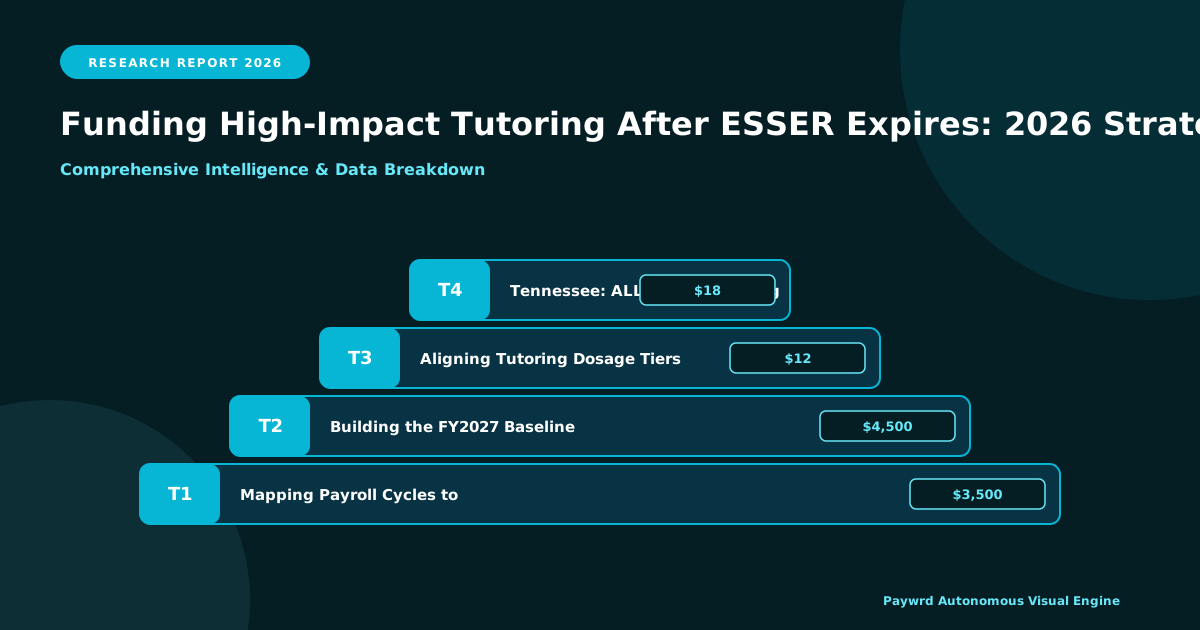
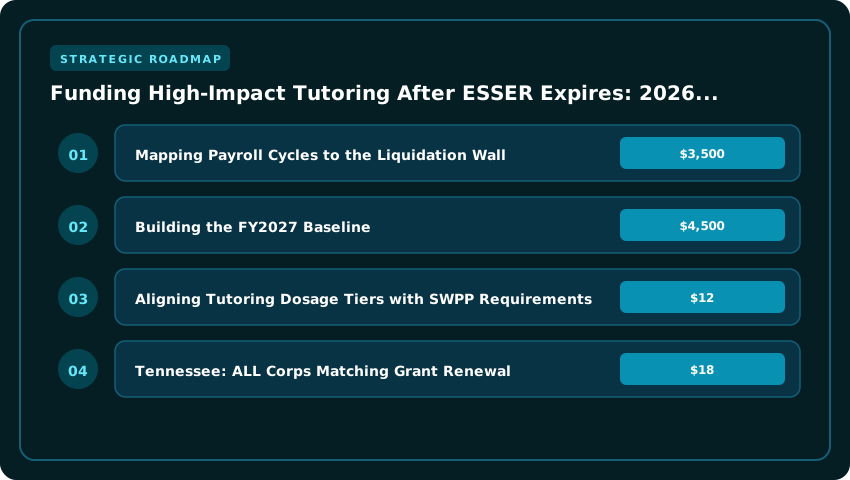
Mapping Payroll Cycles to the Liquidation Wall
Districts running high-dosage models (3+ sessions weekly, 1:1 or 1:3 ratios) typically employ tutors on 10-month contracts aligned to the school calendar. The final ESSER-eligible pay period ends June 30, 2026. However, accrued liabilities—retirement contributions (TRS/PERS), FICA, and workers’ comp for those June hours—often hit the general ledger in July and August 2026. If your business office waits until the standard August “close-out” to reconcile these fringe costs, you risk missing the January 2026 drawdown window. The strategy for 2026 is to accelerate the FY2025 year-end close to October 2026, ensuring every dollar of tutor compensation is liquidated before the holidays.
Per-Pupil Cost Differentials: High-Dosage vs. Standard Models
Justifying a new budget line item requires granular unit economics. Current market data for the 2026–26 school year reveals a stark differential that school boards must absorb:
- High-Dosage Tutoring (HDT): $3,500–$4,500 per pupil/year. This assumes certified or paraprofessional tutors at $35–$55/hour (loaded rate including benefits), 90 sessions annually, plus curriculum licensing and program management overhead (approx. 15%).
- Standard “Homework Help” / Drop-in Models: $800–$1,200 per pupil/year. Typically staffed by college students or volunteers at $18–$25/hour, unstructured attendance, minimal curriculum alignment.
- The Gap: Replacing ESSER-funded HDT for a cohort of 500 students requires a new recurring allocation of $1.75M–$2.25M annually. Scaling down to standard models saves $1.1M+ but sacrifices the effect sizes (0.3–0.4 SD gains) documented by the Annenberg Institute and NWEA.
Building the FY2027 Baseline
For the 2026–27 budget cycle (adopted spring 2026), CFOs should present a “Maintenance of Effort” scenario. Calculate the Total Cost of Ownership (TCO) for your current HDT footprint: tutor wages + employer taxes + benefits + platform fees (e.g., Saga, Paper, FEV Tutor contracts averaging $1,200/seat) + program director FTE. Contrast this against Title I, Part A carryover, IDEA proportionate share, and any new state literacy grants (e.g., Colorado’s HB24-1234 or Michigan’s Sec 35a). The delta is your “ask.” Without a dedicated line item in the General Fund by June 2026, high-dosage tutoring evaporates in 90% of districts currently reliant on ESSER.
Leveraging Title I, Part A: Shifting from Supplanting to Supplementing in 2026
With the ESSER III liquidation window closing in December 2026, districts must pivot from temporary relief funds to sustainable federal streams. Title I, Part A remains the most viable vehicle for funding high-impact tutoring, but the transition requires a surgical approach to avoid “supplanting”—the illegal practice of using federal funds to replace state or local money that would otherwise have been spent.
To legally redirect Title I funds toward recurring tutoring costs for the 2027 fiscal year, administrators must document that these interventions are “supplemental.” This means the tutoring must provide services over and above what the district typically offers all students. In 2026, the most effective strategy is to tie tutoring directly to the Schoolwide Program Plan (SWPP), framing the intervention as a targeted strategy to improve academic achievement for the lowest-performing subgroups rather than a general classroom support.
Navigating EDGAR Compliance for Evidence-Based Interventions
The US Department of Education enforces strict Education Department General Administrative Regulations (EDGAR) to ensure federal dollars drive measurable results. To pass a 2026 audit, districts must categorize their tutoring platforms under the “Evidence-Based” tiers defined by ESSA. Compliance requires:
- Strong or Moderate Evidence: Utilizing digital platforms that provide longitudinal data proving a positive impact on student growth.
- Detailed Documentation: Maintaining a clear audit trail that links Title I expenditures to specific student needs identified through diagnostic assessments.
- Fiscal Tracking: Separating tutoring payroll and software licensing from the general fund to prove that federal dollars are adding a new layer of support.
Aligning Tutoring Dosage Tiers with SWPP Requirements
High-dosage tutoring—typically defined as three or more sessions per week—is costly, often ranging from $3,500 to $4,500 per pupil. To sustain this without triggering supplanting violations, districts should align their dosage tiers with the specific goals of their Schoolwide Program Plan. Instead of a blanket tutoring mandate, implement a tiered approach:
- Tier 1 (Intensive): High-dosage tutoring for students two or more grade levels behind, funded entirely via Title I as a specialized intervention.
- Tier 2 (Targeted): Moderate-dosage support for students meeting specific “at-risk” criteria, blended between Title I and state funds.
- Tier 3 (Maintenance): Low-dosage check-ins integrated into the standard instructional day, funded by the general budget.
By structuring tutoring as a tiered, evidence-based intervention, districts can secure the necessary funding for 2027 and beyond, ensuring that the “fiscal cliff” does not result in a loss of critical student support.
Unlocking State-Level Appropriations: 2026 Legislative Wins in CA, TX, and TN
As the federal ESSER liquidation window slams shut in December 2026, the burden of funding high-dosage tutoring (HDT) has shifted from emergency federal grants to codified state appropriations. For grant managers, the strategy is no longer about “relief” but about “recurring revenue.” Three states—California, Texas, and Tennessee—have established the gold standard for transitioning tutoring from a temporary intervention to a permanent budgetary line item for the 2026-27 fiscal year.
California: Sustaining the Literacy Coach Infrastructure
California has pivoted from one-time pandemic grants to a permanent funding stream for Literacy Coaches and Reading Specialists. To capture these funds, districts must align their tutoring platforms with the state’s updated literacy framework. The 2026 appropriations focus on “continuity of care,” meaning funding is prioritized for programs that demonstrate a longitudinal impact on K-3 reading proficiency.
- Funding Mechanism: Local Control Funding Formula (LCFF) supplements.
- Key Requirement: Evidence of integrated coaching models where tutors are supervised by state-certified reading specialists.
- Strategy: Ensure your digital platform provides the data granularity required by the California Department of Education to justify recurring per-pupil expenditures.
Texas: HB 1416 and Accelerated Instruction (AI) Mechanics
Texas has aggressively codified “Accelerated Instruction” (AI) through HB 1416, ensuring that students who do not pass STAAR assessments receive mandatory tutoring. For the 2026-27 cycle, the funding mechanics have shifted toward a performance-based reimbursement model.
- Budgetary Impact: Funding is tied to the “Accelerated Instruction” mandate, moving away from discretionary spending.
- Compliance: Programs must meet strict “dosage” requirements (frequency and duration) to trigger state reimbursement.
- Focus: Prioritize platforms that automate the tracking of AI hours to ensure districts maximize their claims against state appropriations.
Tennessee: ALL Corps Matching Grant Renewal
Tennessee continues to lead with the ALL Corps initiative, but the 2026 renewal criteria are more stringent. The state is now utilizing a matching grant structure, requiring districts to leverage local funds or private partnerships to unlock state dollars.
- Application Window: The primary renewal window for the 2026-27 cycle closes in late Q3 2026.
- Renewal Criteria: Priority is given to “high-dosage” models (3+ sessions per week) that utilize a hybrid of in-person and digital delivery.
- Pro Tip: Grant managers should emphasize the “cost-per-outcome” metric in their applications to align with the Tennessee Department of Education’s focus on ROI.
Integrating IDEA & Medicaid Reimbursement for Special Population Tutoring
With the ESSER III liquidation deadline of January 28, 2026, effectively in the rearview mirror, Special Education Directors can no longer treat Medicaid and IDEA Part B as supplementary line items—they are the primary capital stack for high-dosage tutoring in FY2027 and beyond. The math is unforgiving: sustainable high-impact tutoring runs $3,500 to $4,500 per pupil annually. Without a functioning reimbursement engine, that cost falls entirely on local general funds. The most immediate lever is Medicaid Direct Service claiming for IEP-mandated tutoring, but it requires operational precision that most districts currently lack.
Billing Medicaid for IEP-Aligned Tutoring Under ‘Direct Service’ Claiming
Medicaid reimbursement for school-based services operates under the “Direct Service” claiming model, allowing districts to bill the state Medicaid agency for the federal share (FMAP)—typically 50% to 77% depending on the state—for tutoring explicitly written into a student’s Individualized Education Program (IEP). In 2026, the Centers for Medicare & Medicaid Services (CMS) continues to emphasize “free care” rule compliance: you cannot bill Medicaid for services available to all students for free. The tutoring must be a distinct, medically necessary related service—speech-language pathology, occupational therapy, or specialized academic instruction—delivered by a qualified provider (SLP, OT, or certified special educator) under a state-approved Medicaid State Plan.
- Provider Qualifications: Tutors must hold the specific state licensure or certification required by your State Plan Amendment (SPA). A general education paraprofessional rarely qualifies; a certified special education teacher or licensed therapist usually does.
- Documentation Rigor: Session notes must link every 15-minute unit to a specific IEP goal code (e.g., “Reading Fluency: Goal 3.2”). Vague logs like “tutoring session” trigger audits and recoupment.
- Parental Consent: You must secure annual, informed written consent under 34 CFR §300.154(d) to access public benefits. Treat this as a compliance gate, not a formality—missing consent forms invalidate the claim.
- Third-Party Liability (TPL): Districts must bill private insurance first where applicable. Coordinate with your Medicaid billing vendor to automate TPL avoidance codes for families without private coverage.
Structuring Extended School Year (ESY) Tutoring to Maximize Part B Flow-Through
Extended School Year (ESY) services are the most underutilized vehicle for capturing IDEA Part B Section 611 flow-through funds. Because ESY is an entitlement for students who demonstrate regression/recoupment issues, the tutoring provided during summer or extended breaks is 100% allowable under Part B—provided it meets the “supplement, not supplant” and Maintenance of Effort (MOE) tests. For FY2027 budgeting, structure your ESY tutoring blocks as intensive, high-dosage interventions (minimum 3 sessions/week, 30–45 minutes) rather than generic credit recovery.
- Data-Driven Eligibility: Use progress monitoring data from the 2026–26 school year to justify ESY necessity. Regression data protects your MOE compliance if audited by the State Educational Agency (SEA).
- Blended Funding Architecture: Code ESY tutoring staff salaries to Part B Flow-Through (Fund 240 in most state charts of accounts) for the instructional component, and Medicaid Direct Service for the related-service component (e.g., speech therapy embedded in the tutoring block). This “braiding” maximizes federal drawdown without violating supplanting rules.
- Vendor Contracts: If contracting with digital platforms (e.g., high-dosage tutoring vendors), ensure contracts specify “IEP-aligned service delivery” and provide session-level data exports compatible with your Student Information System (SIS) for Medicaid claiming.
Building this engine requires cross-departmental alignment: Special Education writes the compliant IEPs, Business Services configures the chart of accounts for braided funding, and IT ensures the SIS exports clean 837P claim files. Districts that operationalize this workflow in 2026 convert a compliance burden into a recurring revenue stream that survives the ESSER cliff.
Outcome-Based Contracting: Pay-for-Success Models with ESSA Evidence Tiers
The expiration of ESSER III forces a fundamental shift: districts can no longer afford to pay for access to tutoring; they must pay for results. Outcome-based contracting (OBC) transfers the financial risk of student growth from the district ledger to the provider’s balance sheet. In 2026, this isn’t experimental—it is a procurement necessity for any district hoping to leverage Title I, Title IV-A, or state literacy grants that now mandate ESSA evidence compliance.
Anchoring RFPs to Validated Growth Metrics
Vague “student improvement” language invites litigation and wasted budget. High-performing 2026 RFPs specify the assessment instrument, the growth norm, and the statistical threshold upfront. The industry standard remains NWEA MAP Growth and Curriculum Associates i-Ready Diagnostic because both provide vertically scaled scores, national percentile norms, and conditional growth indices (CGI) that survive audit scrutiny.
- Define the Metric: Contract for “Mean Conditional Growth Percentile ≥ 50” or “Effect Size ≥ 0.40” on MAP Reading/Math or i-Ready scale scores, not raw score gains.
- Set the Cohort: Limit the payable population to students attending ≥ 80% of scheduled sessions (minimum 30 sessions per semester) to control for dosage fidelity.
- Require Tier 1/2 Evidence: Mandate that the intervention logic model, study design, and effect sizes meet ESSA Tier 1 (Strong) or Tier 2 (Moderate) evidence as defined by the What Works Clearinghouse (WWC) standards v5.0. Vendors must submit the WWC study PDF or ERIC ID with the bid.
Structuring Milestone Payments and Clawback Clauses
A typical $3,500–$4,500 per-pupil high-dosage tutoring contract should be sliced into three tranches, aligning cash flow with verified data drops:
- Tranche 1 (30% — $1,050–$1,350): Paid on Day 1 for onboarding, rostering, and baseline assessment administration (Fall MAP/i-Ready).
- Tranche 2 (40% — $1,400–$1,800): Released after Winter benchmark confirms the cohort is on trajectory (e.g., CGI ≥ 45th percentile). If the cohort misses the gate, payment pauses; the vendor remediates at their cost.
- Tranche 3 (30% — $1,050–$1,350) + Clawback: Final payment contingent on Spring growth targets. Clawback trigger: If the cohort falls below the contracted effect size, the district recovers 15–20% of Tranche 3 via credit memo against the next invoice or direct ACH return. This is legally enforceable under UCC Article 2 as a “condition subsequent.”
Protecting Federal Funding Eligibility
The U.S. Department of Education’s 2026 Evidence-Based Practices Non-Regulatory Guidance (still operative in 2026) requires LEAs to document that federal dollars purchase interventions with “demonstrated statistically significant effects.” An OBC contract is that documentation. Attach the signed vendor agreement, the WWC evidence summary, and the assessment data-sharing addendum (FERPA-compliant under 34 CFR § 99.31) to your consolidated application. This satisfies auditors from the Office of Elementary and Secondary Education (OESE) and state monitors without supplementary narratives.
Bottom line: In the post-ESSER era, a contract without a clawback is a donation. Procurement officers who embed NWEA/i-Ready growth gates and ESSA Tier 1/2 evidence requirements into the RFP scorecard (weighting ≥ 40% of total points) shift risk, protect Title I compliance, and ensure every dollar buys measurable literacy and numeracy gains.
Blending Community Partnerships: AmeriCorps, Work-Study, and Philanthropic Match
The personnel line item consumes 70 to 80 percent of every high-dosage tutoring budget. If you are still hiring certified teachers at $45 an hour for every slot, you have already priced yourself out of FY2027. The districts keeping tutoring alive are the ones treating human capital like a supply chain: diversified, subsidized, and contracted for scale. Three federal and philanthropic levers—Federal Work-Study, AmeriCorps, and structured step-down grants—can slash tutor wage costs by 30 to 50 percent without diluting dosage or quality.
Scaling Federal Work-Study Tutor Pipelines via 2026 FWS Waiver Flexibilities
The Education Department’s 2026 guidance on Federal Work-Study (FWS) community service waivers is the single most underutilized lever in K–12 right now. Institutions of higher education (IHEs) must devote at least 7 percent of their FWS allocation to community service; tutoring qualifies automatically. The 2026 flexibility allows districts to act as the “employer of record” for payroll processing while the IHE draws down the federal 75 percent wage share. For a $17/hour tutor, the district picks up roughly $4.25. Multiply that across 50 tutors and you save $175,000 annually versus a fully district-funded model.
Tactical execution: Sign a master MOU with your local community college and state university system now. Specify that FWS students receive academic credit or micro-credentials (aligned to CAEP standards) for tutoring service. This locks in pipeline reliability—students need the hours to keep aid eligibility, giving you attendance rates north of 90 percent. Verify FAFSA verification deadlines with the financial aid office; late packaging kills fall start dates.
Leveraging AmeriCorps State/National Grants for Living Stipend Cost-Share
AmeriCorps State and National grants cover the living allowance (roughly $18,500 for a full-time member in 2026), health insurance, and the Segal Education Award ($7,395). The district’s cash match is typically limited to 24 percent of total member costs—often covered by Title I, Part A set-asides or IDEA proportionate share. A cohort of 20 AmeriCorps members delivers 34,000 tutoring hours annually for a district cash outlay near $110,000. Compare that to $600,000 for equivalent certified staff.
The 2026 competition prioritizes “evidence-based interventions” with randomized controlled trial (RCT) backing. Align your tutoring model—1:3 ratio, three sessions weekly, curriculum-aligned—to the What Works Clearinghouse standards before the January Notice of Funding Opportunity (NOFO) drops. Partner with a state service commission (e.g., Serve Illinois, Volunteer Florida) to handle grant administration; they absorb the federal reporting burden so your coordinators stay focused on instruction.
Structuring 3-Year Philanthropic Step-Down Grants to Bridge to Local Levies
Philanthropy hates perpetual operating subsidies. Foundations (Ballmer Group, Overdeck Family Foundation, local community foundations) will write large checks if the exit strategy is a voter-approved levy or general fund absorption. Structure a three-year step-down: Year 1 covers 80 percent of the philanthropic gap (tutor stipends, curriculum licenses, data platforms), Year 2 drops to 40 percent, Year 3 to 10 percent. The missing revenue is backfilled by a dedicated millage referendum timed for the November 2027 ballot.
- Year 1: Fund AmeriCorps match + FWS district share + program director salary. Total philanthropic ask: $450K for a 500-student program.
- Year 2: District absorbs program director; philanthropy covers AmeriCorps match only ($180K).
- Year 3: Philanthropy funds evaluation partner ($50K) to produce the ROI report the levy campaign needs.
Embed a “sustainability clause” in every grant agreement: if the levy fails, the foundation converts the final year into a no-interest bridge loan repayable over five years. This forces the school board to campaign seriously and gives funders downside protection. The result? A tutoring infrastructure that survives the ESSER cliff without a single new dollar from the general fund until the voters say yes.
Building the 2027+ Sustainability Dashboard: KPIs for Board Reporting
Superintendents cannot walk into a 2027 budget hearing with attendance logs and hope. The board—and eventually the voting public—needs a single, auditable metric that proves high-dosage tutoring is cheaper than remediation, retention, and dropout recovery. That metric is Cost-Per-Academic-Growth-Point (CPAGP). Unlike cost-per-pupil, which treats every seat as equal, CPAGP divides total program spend—including vendor fees, stipends, and overhead—by the aggregate scale-score gains on your state assessment or NWEA MAP. If your Title I cohort gained 4,200 RIT points at a fully loaded cost of $1.26 million, your CPAGP is $300. That number travels.
Cost-Per-Academic-Growth-Point: The Universal Denominator
Build a dashboard that slices CPAGP by funding stream so the Finance Committee sees exactly which bucket buys the most growth. A typical 2026–27 view should surface three columns:
- Federal (Title I, IDEA, ESSER carryover): Usually the highest CPAGP because compliance overhead eats 12–15% before a tutor logs on.
- State Grants (Literacy/MTSS allocations): Often the sweet spot—lower overhead, flexible vendor rules, CPAGP frequently 18–22% below federal.
- Local/General Fund: The baseline. If local CPAGP exceeds $350, you have a procurement problem, not a funding problem.
Visualize this as a stacked horizontal bar chart updated quarterly. When the bar for “Local” shortens because you shifted seats to a cheaper state grant, the board sees sustainability in real time. Tag every student record with a funding-source code in your SIS so the dashboard auto-populates—no manual spreadsheets in January.
Levy Referendum Timing: Converting ROI into Ballot Language
Political capital accrues when you translate CPAGP into the language of property-tax bills. Run a Monte Carlo simulation on your district’s assessed-valuation growth (county auditor data) and model three referendum windows: November 2026, May 2027, November 2027. Overlay the tutoring ROI narrative: “Every $100 of new levy revenue buys 0.33 scale-score points for a third-grader reading below grade level.”
- November 2026 (High Risk): Voters still associate ESSER with “free federal money.” CPAGP data is thin—only one semester post-ESSER.
- May 2027 (Optimal): You have 18 months of CPAGP trend lines. The narrative shifts from “save tutoring” to “scale what works.”
- November 2027 (Fallback): Requires a bridge fund (fund balance draw or short-term note) to avoid a program gap.
Embed the referendum-timing model directly into the dashboard as a toggle. When a board member slides the election date, the required millage rate recalculates instantly based on projected CPAGP efficiency gains. That interactivity turns a finance presentation into a decision engine—and protects the tutoring line item when the next recession hits.
Strategic Final Takeaway
When evaluating High Impact Tutoring Program Funding Strategies After ESSER Funds Expire 2026 in 2026 and beyond, base your decisions on accredited institutional standards, verified return on investment (ROI), and up-to-date official guidelines. Always verify specific dates and requirements through official regulatory portals.

