ICAN November 2026 Registration Portal and Fee Breakdown
Navigating the Institute of Chartered Accountants of Nigeria (ICAN) registration process requires precision to avoid technical glitches or payment reversals. For the November 2026 diet, the Institute has streamlined the process through its centralized student portal, integrating Remita for seamless Naira (₦) transactions. Whether you are a first-time candidate or a returning student, the portal serves as the single point of truth for course selection and payment verification.

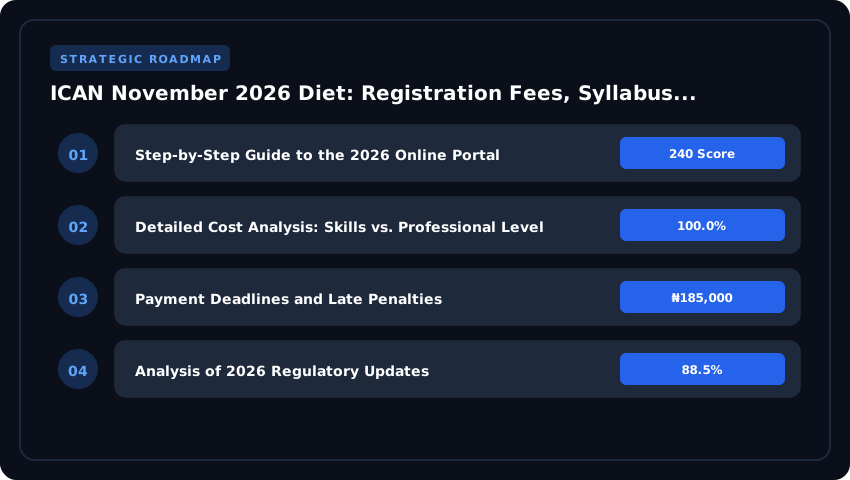
Step-by-Step Guide to the 2026 Online Portal
To secure your seat for the November exams, follow this sequence strictly:
- Portal Access: Visit the official ICAN student portal and log in using your unique registration number and password.
- Course Selection: Navigate to the “Exam Registration” tab. Select the specific papers you intend to sit for in the November 2026 diet.
- Payment Generation: Once courses are selected, the system will generate a Remita Retrieval Reference (RRR) code.
- Payment Execution: Use the RRR to pay via your commercial bank’s app, USSD, or at any physical bank branch.
- Confirmation: Return to the portal to print your registration slip. If your status does not update to “Paid” within 24 hours, contact the ICAN helpdesk immediately.
Detailed Cost Analysis: Skills vs. Professional Level
Fees for the 2026 diet are tiered based on the level of examination. While basic membership dues may vary, the core exam fees for the November diet are broken down as follows:
- Skills Level: Candidates are typically charged ₦25,000 per paper. If you are taking the full suite of Skills papers, budget for the cumulative cost plus the mandatory study pack fees.
- Professional Level: Due to the complexity and advanced nature of these papers, the fee is set at ₦30,000 per paper.
- Study Packs: Digital and hardcopy study packs for 2026 are sold separately, ranging from ₦5,000 to ₦15,000 depending on the subject.
Payment Deadlines and Late Penalties
Timing is everything in professional certifications. For the November 2026 diet, the early registration window closes in late August. Students who miss this window enter the “Late Registration” phase, which attracts a mandatory penalty of ₦10,000 added to the total exam fee. Final closure of the portal occurs six weeks before the exam date; after this point, no further registrations or course amendments are permitted under any circumstances.
Updated 2026 ICAN Syllabus: Key Changes and Focus Areas
Studying outdated materials is the fastest route to failure in the ICAN Professional examinations. For the November 2026 diet, the Institute has integrated significant updates to align with the latest International Financial Reporting Standards (IFRS) and the evolving Nigerian tax landscape. Candidates must pivot from the 2026 frameworks to the 2026 revised syllabus, which places a heavier emphasis on digital auditing and sustainable finance reporting.
Analysis of 2026 Regulatory Updates
The 2026 syllabus reflects the current volatility of the Nigerian economy and the updated directives from the Federal Inland Revenue Service (FIRS). Key regulatory shifts include:
- Digital Taxation: New modules on the taxation of digital assets and remote work arrangements within the Nigerian jurisdiction.
- ESG Reporting: The introduction of Environmental, Social, and Governance (ESG) metrics into the Financial Reporting paper, reflecting global shifts toward sustainability.
- Updated CAMA Provisions: Integration of recent amendments to the Companies and Allied Matters Act (CAMA) regarding corporate governance and insolvency.
Core Competencies for the November Diet
To pass the November 2026 exams, candidates must move beyond rote memorization. The examiners are now prioritizing “Critical Application” over “Theory.” The core competencies required for this diet include:
- Advanced Data Analytics: The ability to interpret large datasets using accounting software to drive strategic business decisions.
- Strategic Risk Management: A deeper focus on hedging strategies and managing foreign exchange volatility in a Naira-denominated environment.
- Ethical Leadership: Enhanced case studies on professional skepticism and the prevention of corporate fraud in the Nigerian public sector.
Transitioning from Skills to Professional Level
The jump from the Skills level to the Professional level is where most candidates struggle. In 2026, the transition requires a mental shift from “how to record” to “how to advise.” While the Skills level focuses on the technical execution of accounting tasks, the Professional level demands a consultancy mindset.
Candidates transitioning for the November diet should focus on the synthesis of knowledge across different papers. For instance, the ability to link a tax implication (Taxation) to a balance sheet adjustment (Financial Reporting) while considering the legal ramifications (Corporate Law) is the hallmark of a successful Professional level candidate. We strongly recommend utilizing the 2026 official ICAN Study Packs, as third-party summaries often miss these critical inter-disciplinary links.
Official Study Pack Downloads and Digital Learning Resources
Once your registration payment reflects on the ICAN student portal—usually within 24 hours of Remita clearance—the “Study Materials” tab unlocks automatically. This is your single source of truth for the November 2026 diet. Do not waste money buying physical “study packs” from third-party vendors in Marina or Ikeja; the Institute has fully migrated to a digital-first distribution model. Your tuition fees (embedded in the registration cost) already cover the 2026 edition of the ICAN Study Texts for all three levels: Foundation, Skills, and Professional. These are not summary notes; they are the complete, examinable syllabus mapped to the current CCMAS-aligned curriculum.
Accessing the ICAN E-Library for the November Diet
Log into your dashboard at students.icanig.org and navigate to the E-Library dropdown. You will see two distinct formats: Interactive Flipbooks (read-only, browser-based, great for quick mobile review) and Downloadable PDFs (DRM-free, printable, essential for annotation). I strongly advise downloading the PDFs immediately and backing them up to Google Drive or a local hard drive. Portal downtime peaks during the final revision weeks in October; relying solely on browser access is a tactical error. The e-library also hosts the Pathfinder (past questions and suggested solutions) for the last five diets—May 2026 through May 2026. Treat the Pathfinder as your exam simulator, not just a question bank.
Official Texts vs. Supplementary Materials: The Strategic Gap
Here is the reality most tutors won’t tell you: ICAN Study Texts are necessary but insufficient for a first-sitting pass at the Professional Level. The Institute writes for syllabus coverage, not exam technique. The texts explain what the standards say (IFRS, ISA, CITA, CAMA 2026), but they rarely demonstrate how to structure a 15-mark answer under time pressure. This is where supplementary providers earn their keep.
- VIVA Financial Tuition / BPP / Kaplan: Their 2026 kits condense the 600-page ICAN text into 150-page “Exam Focus Notes” with examiner-favored mnemonics (e.g., “SCORE” for Audit Reporting). Use these for revision, not learning.
- ICAN District Society Lectures: Free weekly Zoom/physical classes hosted by Lagos, Abuja, and Port Harcourt districts. The lecturers are often examiners. Their “Area of Concentration” handouts, released usually in late September, carry high predictive value.
- YouTube Channels (Naija Accountant, ACA Simplified): Excellent for visualizing complex consolidations (IFRS 10) or Tax computations (CITA vs PITA). Watch at 1.5x speed during commutes.
Pro Tip: Create a “Master Folder” on your laptop: ICAN_Nov2026 / 01_Official_Texts / 02_Pathfinder / 03_Supplementary_Notes / 04_Mock_Exams. Discipline in file management saves you 40 hours of frantic searching during the final revision sprint. The November 2026 diet rewards structured preparation, not last-minute heroics.
Strategic Study Plan for the November 2026 Exam Cycle
The difference between a pass and a refer in the ICAN November 2026 diet rarely comes down to intelligence—it comes down to calendar discipline. With roughly 12 weeks between the typical early-August registration close and the mid-November exam window, you have exactly 84 days to convert the syllabus into muscle memory. Treat this not as a study period, but as a project delivery timeline where you are the project manager, the resource, and the deliverable.
The 12-Week Countdown Calendar
Break the timeline into three distinct four-week sprints. Weeks 1–4 (Foundation): Cover the entire syllabus breadth at a high level. Do not deep-dive yet. Allocate 1.5 hours on weekdays and 4 hours each weekend day. Focus on Financial Accounting (FA), Management Accounting (MA), and Taxation (TX) core frameworks. Weeks 5–8 (Depth & Application): This is the grind. Shift to 2 hours weekdays and 6 hours weekends. Attack past questions (minimum 2026–2026 diets) by topic. Simulate exam conditions: handwritten answers, strict 3-hour blocks. Weeks 9–12 (Polish & Prediction): Full mock exams every Saturday. Sundays for marking, reviewing examiner reports, and memorizing formats (IFRS disclosure checklists, VAT computation templates). Taper new reading in Week 12; trust what you have encoded.
Balancing Full-Time Corporate Work with ICAN Studies
You cannot “find” time; you must “engineer” it. The corporate 9-to-5 (often 8-to-6 in Lagos reality) leaves cognitive residue. Do not study after 9 PM—retention plummets. Instead, deploy the “Golden Hour” protocol: wake at 4:30 AM for a 90-minute focused session before the household wakes and traffic starts. This yields 7.5 solid hours before Monday. Protect weekends aggressively: treat Saturday/Sunday as non-negotiable “exam days.” Inform your manager early; many Tier-1 firms (Big 4, major banks, FMCGs) offer study leave policies—activate yours by September. If commuting via public transport, convert transit time into audio revision (recording your own summary notes works better than passive listening).
High-Yield Topics & Priority Areas for November 2026
ICAN examiners reward format adherence and current standard application. Prioritize these “banker” zones:
- Financial Reporting (FR): Consolidation (step-by-step workings), Leases (IFRS 16 modification accounting), and Revenue Recognition (IFRS 15 five-step model). These appear every single diet.
- Strategic Financial Management (SFM): Business Valuation (DCF, Relative, Asset-based), Risk Management (Hedging calculations), and Capital Rationing. Master the Excel-style layout on paper.
- Taxation (TX): CIT computation (minimum tax vs. normal tax), VAT (output/input reconciliation, Withholding Tax credit notes), and Capital Gains Tax (rollover relief). The Finance Act 2026/2027 amendments are examinable—download the gazette.
- Audit & Assurance (AA): ISA 315 (Risk Assessment), ISA 500 (Audit Evidence), and Reporting (Modified opinions, EOM paragraphs). Memorize the exact wording for “Material but not Pervasive” vs “Pervasive.”
Final tactical note: Register for the ICAN Insight journal and the November 2026 Examiner’s Report immediately upon release—usually late September. The examiner literally tells you what they will test next. Ignoring it is voluntary failure.
Exam Day Logistics and 2026 Candidate Guidelines
Walking into the exam hall prepared operationally is just as critical as mastering the Financial Reporting or Strategic Financial Management syllabi. For the November 2026 diet, ICAN has tightened center protocols to align with global CBT standards, and understanding these nuances beforehand eliminates the morning-of friction that derails performance.
Updated 2026 Center Protocols and Identification Requirements
ICAN has mandated a strict “No ID, No Entry” policy for 2026. Acceptable identification is limited to your ICAN Student Identity Card (printed from the student portal after registration clearance) and a valid government-issued photo ID—International Passport, National ID Card (NIN slip with photo), or Driver’s License. Temporary voter’s cards or office ID badges will be rejected at the gate. Arrive at your designated center by 7:30 AM WAT for the morning session; gates typically lock at 8:30 AM once the pre-exam briefing commences. Biometric verification (fingerprint capture) is now compulsory at every sitting to authenticate candidate identity against the registration database. Leave smartwatches, fitness bands, and programmable calculators at home; only ICAN-approved non-programmable calculators (Casio fx-82MS / fx-991ES Plus series) are permitted on the desk.
Navigating the CBT vs. Paper-Based Format Split
The November 2026 diet retains a hybrid delivery model. Foundation and Skills Level papers are fully Computer-Based Tests (CBT) administered at accredited partner centers (e.g., JAMB CBT centers, Dragonfly, Sidmach hubs). Professional Level papers remain predominantly paper-based (written) at designated ICAN halls, though the Institute is piloting CBT options for Corporate Reporting and Advanced Taxation in Lagos and Abuja centers—confirm your specific venue format on your exam docket.
- CBT Candidates: Familiarize yourself with the TestNav or ExamSoft interface via the mock exams on the ICAN portal. Practice flagging questions, using the on-screen calculator, and navigating the split-screen for case study exhibits.
- Written Candidates: Use only blue or black ballpoint pens. Structure answers with clear headings; examiners mark scripts manually, so legibility and layout directly impact scores. Carry extra pens, a ruler for ledger ruling, and correction tape (liquid correction fluid is banned).
Managing Professional Level Pressure: A Tactical Approach
The Professional level is a marathon of cognitive endurance—three-hour papers demanding synthesis, not recall. Adopt the “15-150-15” rule: spend the first 15 minutes reading the entire paper, allocating marks to time (1.8 minutes per mark), and planning your answer sequence. Attack your strongest question first to build momentum and secure “banker” marks. Reserve the final 15 minutes strictly for review: check arithmetic in Financial Management computations, ensure Audit procedures reference specific ISA numbers, and verify that Tax computations reference the correct Finance Act 2026 provisions. Hydrate strategically—sip water, don’t gulp—to avoid bathroom breaks that eat into your 180 minutes. If anxiety spikes, deploy box breathing (inhale 4s, hold 4s, exhale 4s, hold 4s) for two cycles; it physiologically downregulates the sympathetic nervous system, restoring prefrontal cortex function for complex judgment.
Funding Your ICAN Certification: Loans and Employer Sponsorship
The total outlay for the November 2026 diet—registration, annual subscriptions, tuition, and study packs—can easily push past ₦350,000 for a fresh student. In this economy, that is not pocket change. The good news? You have structured funding avenues that most candidates ignore because they assume the paperwork is a nightmare. It isn’t, if you start now.
Tapping NELFUND and Professional Development Loans
The Nigerian Education Loan Fund (NELFUND) has expanded its mandate beyond university tuition. As of the 2026 guidelines, accredited professional certification programmes—ICAN included—qualify for the interest-free loan facility provided your institution (or an approved tuition centre) is listed on the NELFUND portal. You need your admission letter, a fee schedule from ICAN, and your NIN-linked BVN. The disbursement goes directly to the tuition provider, not your personal account, so align with your study centre early. Outside NELFUND, check the Bank of Industry’s (BOI) Graduate Entrepreneurship Fund and commercial bank “Career Advance” products—Access, GTBank, and First Bank all run variants with single-digit interest rates for professional exams. Compare the moratorium periods; you want at least six months post-qualification before repayment kicks in.
Drafting a Sponsorship Proposal That Gets Signed
HR budgets for 2026 are already set, but “unplanned upskilling” line items exist if you frame the ROI correctly. Do not send a text message asking for money. Build a one-pager: Cost Breakdown (itemize every naira), Timeline (show how the November diet fits your work calendar), and Return on Investment (map specific ICAN syllabus modules—like Taxation or Financial Reporting—to current gaps in your department). Explicitly offer a bond clause: a 12–24 month retention period post-qualification. Most employers will fund 100% of registration and tuition if you cover study packs; some will cover the lot if you negotiate study leave instead of a salary bump. Attach the official ICAN November 2026 timetable as an appendix—it signals seriousness.
Real-World Budgeting for the Current Economy
Build your spreadsheet with three columns: Official ICAN Fees, Tuition Centre Quotes, and Contingency (15%). For 2026, factor in:
- Registration & Subscriptions: ~₦95,000–₦110,000 depending on your entry route (ATS vs. Professional).
- Tuition (Physical/Hybrid): ₦180,000–₦300,000 for three levels at reputable centres like PwC Academy, KPMG Learning, or top-tier independents.
- Study Packs: ICAN packs are ~₦15,000 per level; supplement with Kaplan or BPP kits (~₦45,000 total) for question banks.
- Logistics & Data: ₦50,000–₦80,000 for transport, internet, and mock exams.
Total realistic envelope: ₦400,000–₦550,000. If your sponsor covers tuition and registration, your personal cash requirement drops to roughly ₦100,000–₦150,000 for materials and survival. Start a dedicated “ICAN 2026” high-yield savings pot (FairMoney, PiggyVest, or your bank’s target savings) and automate weekly transfers. The November diet waits for no one—fund it like a project, not a wish.
| Level | Papers per Level | Exam Fee per Paper (₦) | Total Exam Fees (₦) | New Student Reg Fee (₦) | Early Bird Deadline 2026 | Late Reg Surcharge (₦) |
|---|---|---|---|---|---|---|
| Foundation | 5 | 28,500 | 142,500 | 55,000 | August 15, 2026 | 10,000 |
| Skills | 6 | 32,000 | 192,000 | 55,000 | August 15, 2026 | 10,000 |
| Professional | 5 | 35,500 | 177,500 | 55,000 | August 15, 2026 | 10,000 |
Frequently Asked Questions
What is the deadline for ICAN November 2026 diet registration?
The early bird registration deadline for the ICAN November 2026 diet is August 15, 2026. Standard registration closes September 30, 2026, after which a ₦10,000 late surcharge applies until the final portal closure in mid-October 2026.
How much is the ICAN November 2026 examination fee per paper?
For the November 2026 diet, ICAN charges ₦28,500 per paper at Foundation level, ₦32,000 at Skills level, and ₦35,500 at Professional level. Fees are payable via Remita on the student portal in Naira only.
What is the penalty for late registration for ICAN November 2026?
A mandatory late registration surcharge of ₦10,000 applies to all payments cleared after the early bird deadline of August 15, 2026. This penalty is added to the standard examination and registration fees for all three levels.
How do I register for the ICAN November 2026 diet online?
Visit the official ICAN student portal, create or log into your profile, select 'November 2026 Diet', choose your level and papers, generate a Remita Retrieval Reference (RRR), and pay via bank branch, card, or USSD. Confirm payment clearance on the portal.
Are there syllabus changes for ICAN November 2026 exams?
The 2026 syllabus retains the 2026 curriculum structure. However, ICAN has updated the Financial Reporting and Taxation modules to reflect the 2026 Finance Act amendments and new IFRS standards effective January 2026. Download updated study packs from the portal.
Strategic Final Takeaway
When evaluating ICAN Professional Exams November 2026 Diet Registration Fees Syllabus Study Packs Download in 2026 and beyond, base your decisions on accredited institutional standards, verified return on investment (ROI), and up-to-date official guidelines. Always verify specific dates and requirements through official regulatory portals.