
Verified List of Non-JAMB Nursing Schools for 2026/2027 Session
Navigating the path to a nursing career in Nigeria doesn’t always require the stress of the UTME. Many accredited Schools of Nursing—particularly those focusing on the Diploma in Nursing program—operate an independent admission cycle. These institutions prioritize your WAEC/NECO results and your performance in their own internal entrance examinations over a JAMB score.

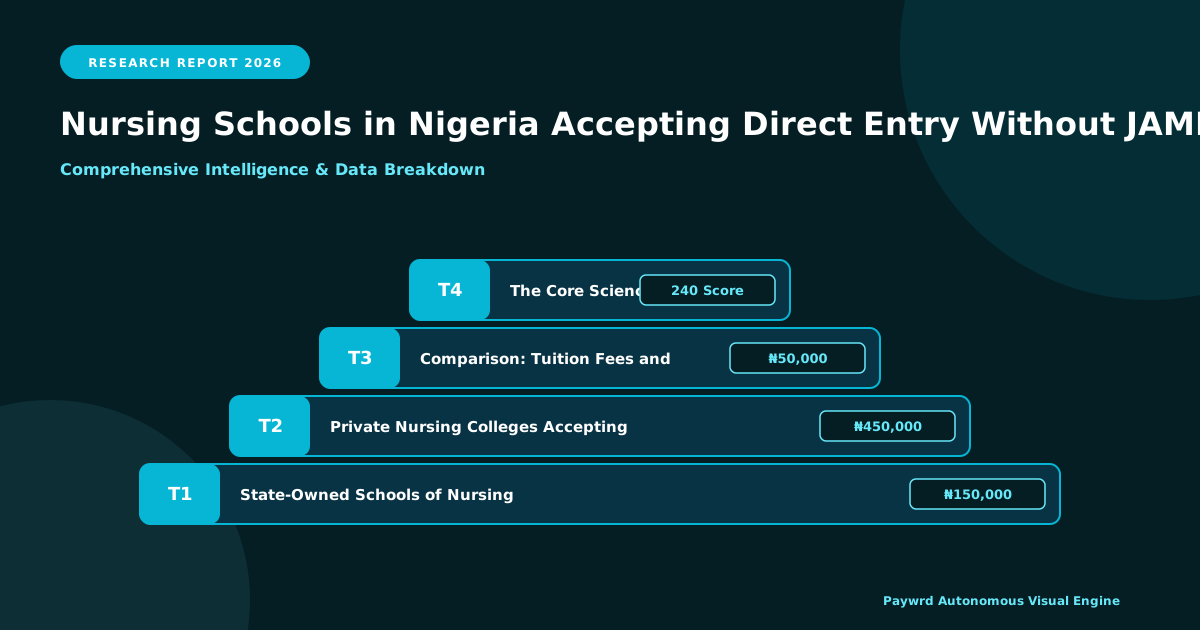
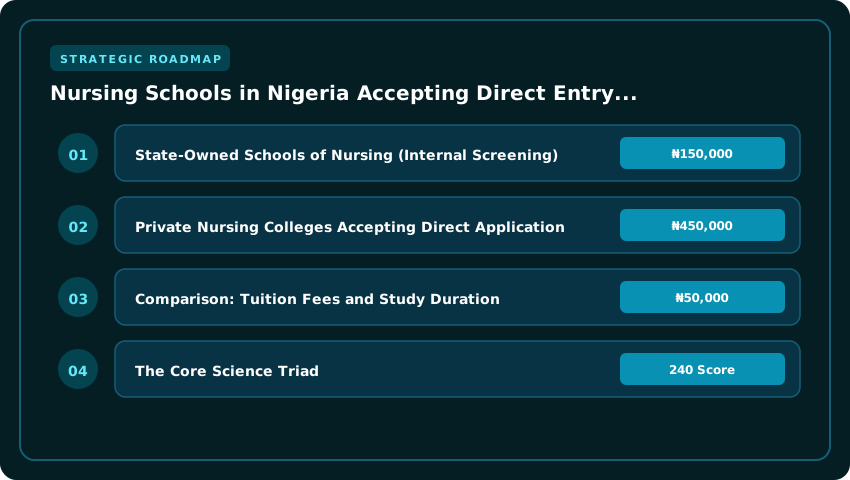
State-Owned Schools of Nursing (Internal Screening)
Most state-owned nursing schools are managed by the State Ministry of Health. They typically open portals for direct application between May and August. To secure a spot, you must meet the minimum O’Level requirements (usually 5 credits including English, Maths, Biology, Chemistry, and Physics) and pass the institutional screening.
- Lagos State College of Nursing: Known for rigorous internal testing and high competitive ratios.
- Enugu State College of Nursing: Focuses heavily on residency and state-of-origin quotas.
- Kano State College of Nursing: Offers direct entry for qualified candidates via their internal portal.
- Edo State School of Nursing: Prioritizes candidates with strong science backgrounds in their direct screening.
Private Nursing Colleges Accepting Direct Application
Private institutions often provide a more streamlined admission process. While they are still regulated by the Nursing and Midwifery Council of Nigeria (NMCN), they allow students to apply directly to the registrar’s office without a JAMB registration number.
- Evercare Nursing College: A premier private option with modern facilities and direct entry pathways.
- St. Elizabeth’s Catholic Hospital College of Nursing: Focuses on holistic care and accepts direct applications.
- Faith-Based Nursing Institutes: Various mission-led colleges across the South-West and South-East regions.
Comparison: Tuition Fees and Study Duration
Costs vary significantly between state-funded and private institutions. Below is the estimated financial breakdown for the 2026/2027 session.
<table border="1"
<trPro Tip: If you are seeking financial assistance, ensure your chosen institution is recognized by the NELFUND portal, as student loan disbursements for 2026 are now expanding to include accredited professional nursing diplomas.
Mandatory O’Level Subject Requirements for Nursing Admission
Before you begin your application for the 2026/2027 academic session, you must understand that Nursing is one of the most academically rigorous disciplines in Nigeria. Even for institutions that bypass the JAMB UTME requirement, the O’Level standards remain non-negotiable. To avoid immediate disqualification during the internal screening process, your West African Examinations Council (WAEC) or National Examinations Council (NECO) results must reflect a strong foundation in the sciences.
The Core Science Triad
Every accredited School of Nursing in Nigeria requires a minimum of credit passes in the three core sciences. These subjects form the bedrock of the Nursing curriculum and are essential for understanding anatomy, pharmacology, and biochemistry. You must possess credits in:
- Biology: Essential for understanding human physiology and pathology.
- Chemistry: Critical for mastering drug interactions and chemical compositions.
- Physics: Necessary for understanding the mechanics of medical equipment and bodily pressure systems.
Proficiency in English and Mathematics
Beyond the sciences, proficiency in communication and numeracy is mandatory. Nursing involves precise medication dosage calculations and detailed patient charting, meaning “Pass” grades are insufficient. You must secure a minimum of a Credit (C6) in:
- English Language: To ensure clear communication with medical teams and patients.
- Mathematics: To handle the quantitative demands of pharmacology and clinical data.
Combination Rules for Non-JAMB Candidates
For candidates applying via Direct Entry or internal screening for the 2026 session, the rules regarding result combinations are strict. While many private and state nursing colleges allow the combination of WAEC and NECO results, there are specific caveats you must follow:
- Consistency: You cannot use two different sittings to cover the same subject; the highest grade from the most recent sitting is typically considered.
- Validity: Ensure your certificates are verifiable on the official WAEC or NECO portals. Forged or “awaiting result” candidates must provide a valid scratch card or token for instant verification during the screening.
- The Five-Credit Rule: You must have at least five credits in not more than two sittings. If you have three sittings, most top-tier nursing schools will automatically disqualify your application.
Failure to meet these O’Level benchmarks will render your application void, regardless of your interview performance or the tuition fees paid. Double-check your certificates against these requirements before submitting your documents to any nursing college for the 2026/2027 intake.
Step-by-Step Guide to Applying via Internal Entrance Exams
Applying for a nursing program via internal screening requires a different strategy than the standard JAMB route. Since these institutions rely on their own benchmarks to maintain high academic standards for the 2026/2027 session, you must be meticulous with your documentation and timing. Follow this chronological roadmap to secure your admission.
1. Navigating School-Specific Application Portals
Unlike the centralized JAMB CAPS system, internal applications are decentralized. Each college manages its own portal. To begin, visit the official website of your chosen accredited school of nursing. Look for the “Admissions” or “Apply Now” tab. Ensure you are using a stable internet connection and a compatible browser to avoid session timeouts during the upload of your O’Level results. Double-check that the portal is specifically open for the 2026/2027 academic session before submitting any data.
2. Handling Application Fees and Payment Methods
Application forms for non-JAMB nursing schools typically range from ₦5,000 to ₦15,000, depending on whether the institution is state-owned or private. Most schools have moved away from bank tellers in favor of digital payments. You will likely be required to use:
- Remita or Interswitch: The standard for state-owned colleges to ensure government auditing.
- Direct Bank Transfers: Common in smaller private nursing schools (always save your transaction receipt as a PDF).
- Online Payment Gateways: Integrated directly into the school portal via card payment.
3. Preparing for the Internal Aptitude Test
Once your application is processed, you will be invited for a screening exercise. The internal aptitude test usually focuses on core sciences. To excel, prioritize the following areas:
- Biology and Chemistry: Focus on human anatomy, physiology, and organic chemistry.
- English Language: Emphasis on comprehension and formal grammar.
- Mathematics: Basic algebra and data interpretation.
- Current Affairs: General knowledge regarding the Nigerian healthcare system and the Nursing and Midwifery Council of Nigeria (NMCN).
4. Mastering the Oral Interview
The final hurdle is the oral interview, where the panel assesses your emotional intelligence and passion for the profession. Dress professionally—preferably in formal business attire. Be prepared to answer questions on why you chose nursing over medicine and how you handle high-pressure environments. Confidence and clarity of speech are often weighted as heavily as your test scores during this stage.
Funding Your Nursing Education: NELFUND and Scholarship Options
The cost of nursing education in Nigeria for the 2026/2027 academic session remains a significant hurdle, with tuition fees at private nursing colleges often ranging from ₦450,000 to ₦1.2 million per session. However, the financial landscape has shifted. Students entering via Direct Entry or internal screening now have more robust options to offset these costs without relying solely on personal savings.
Leveraging the NELFUND Student Loan
The Nigerian Education Loan Fund (NELFUND) has become the primary lifeline for nursing students across both federal and state-owned institutions. For the 2026 cycle, NELFUND provides comprehensive coverage that includes both tuition fees and a monthly upkeep allowance to support students during their clinical postings.
- Eligibility: You must be a Nigerian citizen with a valid National Identification Number (NIN) and be enrolled in a NUC or Nursing and Midwifery Council of Nigeria (NMCN) accredited institution.
- Application Process: Applications are handled exclusively via the official NELFUND portal. Ensure your institution has uploaded your admission status to the portal before applying.
- Repayment Terms: Loans are designed with a grace period, meaning repayment typically commences only after you have secured employment as a Registered Nurse (RN).
State Government Bursaries and Indigenous Grants
For those attending State Schools of Nursing, indigenous bursaries remain a critical funding source. Most state governments in 2026 have streamlined their bursary portals to provide direct transfers to students who are indigenes of that state. These grants are typically awarded based on a combination of state of origin and academic merit (O’Level performance). To secure these, students must provide a verified Certificate of Indigene and a current admission letter from their nursing college.
Private Healthcare Grants for Underserved Regions
There is a growing trend of private healthcare foundations providing “Service-Bonded Scholarships.” These grants target students willing to practice in underserved rural regions of West Africa after graduation. Many of these private grants cover 100% of tuition and provide a stipend for textbooks and scrubs.
- Target Areas: Focus is currently on the North-East and South-South geopolitical zones to combat the nursing brain drain.
- Requirements: Applicants often need to demonstrate a commitment to community health and maintain a high GPA throughout their nursing program.
- Bonding: Be aware that these grants usually require a signed agreement to work in a designated rural facility for 2 to 5 years post-licensure.
Comparing Nursing Council (NMCN) Accreditation and Career Paths
Entering a nursing program without a JAMB requirement does not mean you should compromise on quality. In Nigeria, the only authority that validates your training is the Nursing and Midwifery Council of Nigeria (NMCN). Without NMCN accreditation, your certificate is essentially a piece of paper, and you will be ineligible to sit for the professional licensing exams required to practice as a Registered Nurse (RN).
How to Verify NMCN Accreditation for Non-JAMB Schools
Before paying any registration fees for the 2026/2027 session, you must independently verify the institution’s status. Do not rely solely on the school’s brochure. Follow these steps:
- Visit the official NMCN portal to check the current list of accredited nursing institutions.
- Confirm if the school is accredited for the specific program you are entering (e.g., Basic Nursing or Midwifery).
- Check for “Provisional” versus “Full” accreditation; provisional status means the school is under surveillance and must meet specific benchmarks to remain open.
- Cross-reference the school’s name with the current NUC (National Universities Commission) list if they claim to offer a degree.
Transitioning from Diploma to Degree (BNSc) under CCMAS
Many students entering non-JAMB schools start with a Diploma in Nursing. However, the industry is shifting toward the Bachelor of Nursing Science (BNSc) as the gold standard. Under the current Core Curriculum and Minimum Academic Standards (CCMAS) implemented by the NUC, the pathway for “upgrading” has become more structured.
Once you complete your diploma and obtain your RN license, you can apply for a “top-up” or post-basic degree program. This transition allows you to move from a technical role to a professional clinical role, opening doors to specialized areas like Critical Care, Oncology, or Public Health Nursing.
Expected Starting Salaries for Registered Nurses in Nigeria 2027
The financial outlook for nursing in 2027 remains competitive, particularly for those who leverage their certifications for private practice or international opportunities. While government salaries are tied to the CONHESS (Consolidated Health Salary Structure) scale, private healthcare providers offer more flexibility.
- Public Sector (Federal/State): Entry-level Registered Nurses can expect a monthly gross salary ranging from ₦120,000 to ₦180,000, depending on the state’s current wage review.
- Private Hospitals (Tier 1): In urban hubs like Lagos or Abuja, starting salaries for RNs in premium private clinics range between ₦150,000 and ₦250,000.
- Specialized Roles: Nurses with additional certifications in ICU or Dialysis often command a 20% to 30% premium over basic RN pay.
| Institution Type | Admission Basis (2026/2027) | Estimated Tuition (₦) | Avg. O’Level Cutoff | Certification Path |
|---|---|---|---|---|
| State Schools of Nursing | Internal Screening/Interview | ₦150,000 – ₦350,000 | 5 Credits (incl. Bio/Chem) | RN (Diploma) |
| Private Nursing Colleges | Internal Entrance Exam | ₦450,000 – ₦800,000 | 5 Credits (incl. Bio/Chem) | RN (Diploma) |
| Federal Universities | JAMB UTME/Post-UTME | ₦50,000 – ₦120,000 | High Competitive Score | BNSc (Degree) |
Frequently Asked Questions
Which nursing schools in Nigeria accept direct entry without JAMB for 2026/2027?
For the 2026/2027 session, most State-owned Schools of Nursing and accredited Private Nursing Colleges accept direct entry without JAMB. These institutions prioritize O'Level results and internal entrance examinations over UTME scores, primarily for the Registered Nurse (RN) diploma program rather than the BNSc degree.
What are the requirements for non-JAMB nursing admission in Nigeria 2026?
Applicants for 2026 non-JAMB nursing programs must possess five O'Level credits, including English Language, Mathematics, Biology, Chemistry, and Physics. Candidates must pass the institution's internal screening test and a physical health assessment to qualify for admission into the diploma nursing track.
Can I become a Registered Nurse (RN) in Nigeria without writing JAMB in 2026?
Yes, you can become a Registered Nurse in 2026 by enrolling in an accredited School of Nursing that offers a diploma program. These schools use internal admission processes. Upon completion and passing the Nursing and Midwifery Council of Nigeria (NMCN) exams, you earn the RN certification.
How does the 2026/2027 admission process work for private nursing schools?
Private nursing schools for the 2026/2027 session typically operate independent application portals. The process involves submitting O'Level credentials, paying an application fee, and sitting for a school-specific entrance exam. Successful candidates are then invited for an oral interview before final admission is granted.
What is the difference between BNSc and RN admission paths in 2026?
The BNSc (Bachelor of Nursing Science) path requires JAMB and is offered by universities. The RN (Registered Nurse) path is available via diploma programs in state or private nursing schools, which often allow direct entry via internal screening, providing a faster route to clinical practice.
Strategic Final Takeaway
When evaluating List Of Schools Of Nursing In Nigeria That Do Not Require JAMB 2026/2027 in 2026 and beyond, base your decisions on accredited institutional standards, verified return on investment (ROI), and up-to-date official guidelines. Always verify specific dates and requirements through official regulatory portals.

