2026 Federal Almajiri Feeding Budget Allocation & Disbursement Tracking
Ensuring that no child learns on an empty stomach is the cornerstone of the 2026 formal enrollment strategy. The Federal Government has integrated the Almajiri feeding budget into a hybrid funding model, blending direct federal allocations with Universal Basic Education Commission (UBEC) matching grants. For the 2026 fiscal year, the disbursement schedule is tied to strict performance milestones, meaning funds are released only after states provide evidence of student registration and facility audits.

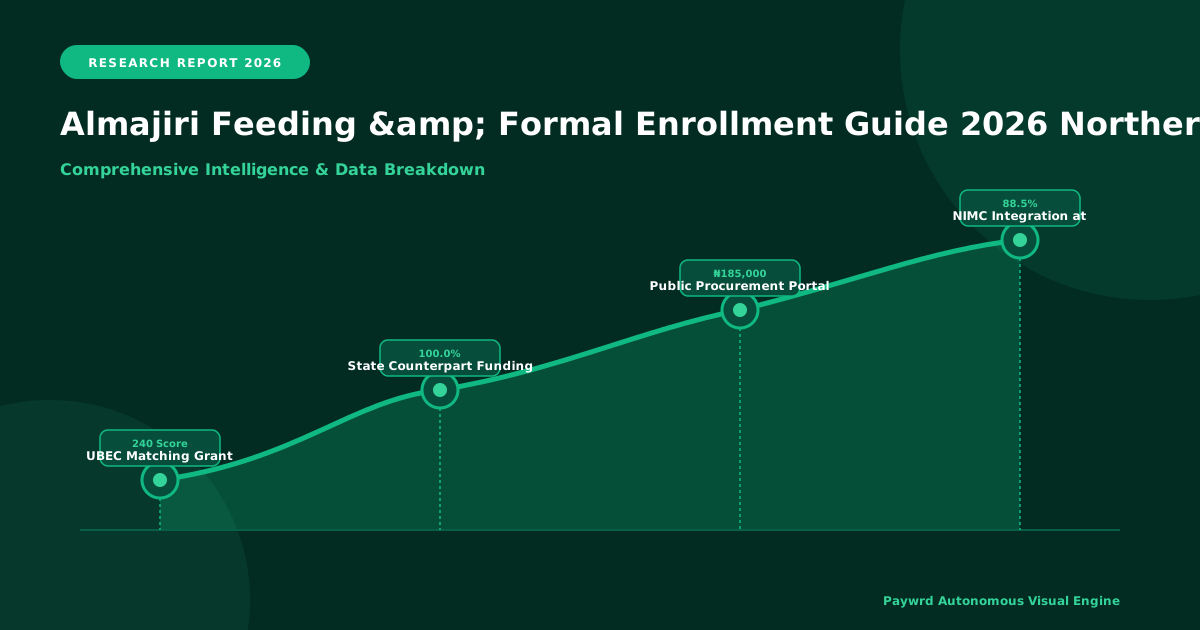
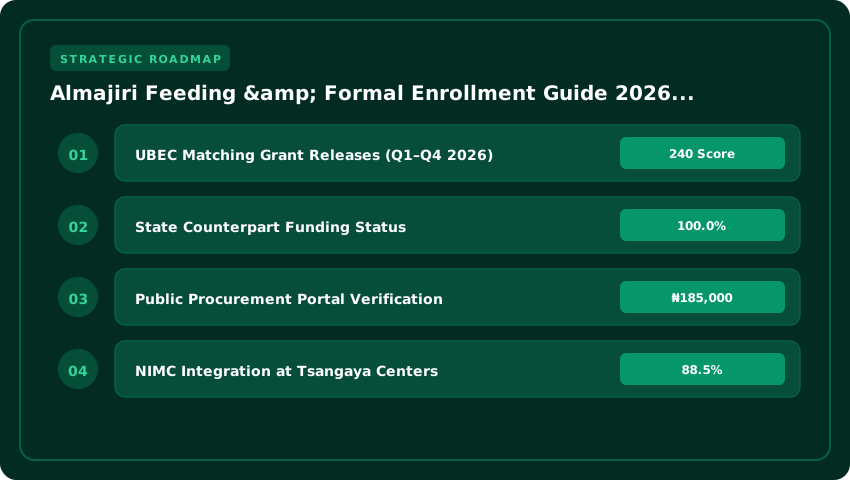
UBEC Matching Grant Releases (Q1–Q4 2026)
The 2026 UBEC disbursement cycle is designed to prevent the “end-of-year rush” that previously crippled feeding programs. The allocation is split into four strategic tranches:
- Q1 (January–March): Initial mobilization funds focused on procurement of dry rations and storage facility upgrades.
- Q2 (April–June): Mid-year disbursement tied to the verification of active enrollment numbers in integrated centers.
- Q3 (July–September): Peak funding period to support the massive enrollment drive and supplementary nutrition.
- Q4 (October–December): Final balance release and audit-based reconciliation for 2027 planning.
State Counterpart Funding Status
Federal funds remain dormant unless states provide their mandatory counterpart funding. As of mid-2026, the status across key Northern hubs varies:

- Kano State: Fully compliant; counterpart funds have been deposited into the joint treasury account, ensuring 100% fund release for Q1 and Q2.
- Sokoto State: Partial compliance; currently awaiting final legislative approval for the 2026 supplementary budget to unlock Q3 grants.
- Borno State: High priority status; receiving accelerated disbursements due to the intersection of feeding programs with emergency education initiatives in liberated areas.
Public Procurement Portal Verification
To eliminate “ghost vendors” and ensure feeding continuity, all stakeholders are urged to use the Federal Public Procurement Portal. By entering the 2026 Appropriation Act project codes, administrators can track the actual flow of Naira (₦) from the Treasury Single Account (TSA) to the approved food vendors. This transparency ensures that the budget allocated for protein and grains actually reaches the centers, preventing the hunger gaps that typically lead to student dropout during the enrollment transition.
Biometric Registration Protocol for Almajiri Learners 2026
To eliminate ghost enrollments and ensure that feeding subsidies reach actual learners, the 2026 framework mandates a rigorous biometric identity baseline. This protocol is not merely an administrative exercise; it is the technical prerequisite for any Almajiri learner seeking formal school placement or NELFUND-backed scholarships in the future. State Universal Basic Education Boards (SUBEBs) and partner NGOs must adhere to the following synchronization standards to ensure data integrity across Northern Nigeria.
NIMC Integration at Tsangaya Centers
The 2026 directive shifts registration from centralized urban hubs directly into the Tsangaya centers. Through a strategic partnership with the National Identity Management Commission (NIMC), mobile enrollment units are deployed to capture the National Identification Number (NIN) of every learner. This integration ensures that each child possesses a lifelong digital identity, preventing the duplication of records when learners migrate between different traditional schools or transition into formal primary education.
- On-site Capture: Deployment of portable biometric scanners for fingerprint and iris recognition.
- Instant NIN Generation: Real-time validation against the NIMC database to issue provisional identity slips.
- CCMAS Alignment: Data structures are pre-aligned with the NUC’s Core Curriculum Minimum Academic Standards (CCMAS) to track the learner’s journey from basic literacy to higher education.
BVN Linkage for Caregiver Consent
To prevent child trafficking and ensure legal guardianship, the 2026 protocol introduces a mandatory Bank Verification Number (BVN) linkage for caregivers and Mallams. Since feeding allowances and educational grants are disbursed via electronic transfers, the caregiver’s BVN serves as the primary verification tool for consent. This linkage ensures that financial incentives are tied to a verified adult responsible for the child’s welfare, creating a transparent audit trail for the Federal Government’s disbursement tracking.
Offline-First Mobile App Deployment
Recognizing the connectivity gaps in remote wards across states like Sokoto, Kano, and Jigawa, the 2026 registration drive utilizes an “Offline-First” mobile architecture. Field officers use a dedicated encrypted application that allows for full biometric data capture without an active internet connection.
- Local Cache Storage: Biometric templates are stored in a secure, encrypted local vault on the device.
- Asynchronous Syncing: Data automatically uploads to the central SUBEB server once the device enters a 4G or satellite-enabled zone.
- Conflict Resolution: The app employs a timestamp-based logic to resolve duplicate entries during the synchronization process, ensuring a single source of truth for the 2026 enrollment drive.
Curriculum Bridging: NCCE Accelerated Basic Education Syllabus 2026
To prevent academic shock during the transition from traditional Tsangaya schools to formal classrooms, the National Commission for Colleges of Education (NCCE) has deployed the 2026 Accelerated Basic Education (ABE) Syllabus. This framework is not a replacement for traditional learning but a strategic bridge designed to compress the primary school cycle without sacrificing core competencies. The goal is to ensure that Almajiri learners can enter Junior Secondary School (JSS1) with the same foundational literacy and numeracy levels as their peers in the formal system.
Qur’anic Literacy Mapping to NERDC Outcomes
The 2026 pedagogical approach leverages the existing cognitive strengths of learners. By mapping Qur’anic literacy—specifically the mastery of Arabic script and phonetic memorization—to the Nigerian Educational Research and Development Council (NERDC) Primary 1-3 outcomes, educators can accelerate language acquisition. Key mapping strategies include:
- Phonetic Transfer: Using the tajweed (articulation) skills from Qur’anic studies to fast-track English and Hausa phonics.
- Numerical Logic: Translating traditional counting methods into formal mathematics, focusing on basic arithmetic and place value.
- Moral Integration: Aligning Islamic ethics (Akhlaq) with the Civic Education and Social Studies components of the NERDC curriculum.
Teacher Retraining Modules for Tsangaya Facilitators
The 2026 framework recognizes that the Mallams are the primary influencers. Consequently, the NCCE has introduced specialized retraining modules for Tsangaya facilitators to act as “Bridge Educators.” These modules focus on blended pedagogy, teaching facilitators how to integrate formal lesson plans into the traditional setting. Training emphasizes learner-centered methods, the use of low-cost instructional materials, and the psychological management of learners transitioning from an unstructured to a structured academic environment.
Assessment Benchmarks for Mainstreaming into JSS1
To ensure no child is set up for failure, the 2026 guidelines mandate a strict set of assessment benchmarks before a learner is mainstreamed into JSS1. These benchmarks are verified through state-level education boards and include:
- Literacy Threshold: Ability to read and comprehend basic instructional texts in English and the local language.
- Numeracy Proficiency: Mastery of addition, subtraction, multiplication, and division of whole numbers.
- Cognitive Readiness: A standardized “Readiness Test” that evaluates critical thinking and social adaptation skills.
Learners who meet these benchmarks are granted a formal equivalence certificate, allowing them to bypass the full six-year primary cycle and enter JSS1 with full academic legitimacy.
School-Based Management Committee (SBMC) Activation Checklist 2026
For the 2026 academic session, the School-Based Management Committee (SBMC) serves as the primary watchdog ensuring that feeding programs and enrollment drives for Almajiri children are not just policies on paper, but realities in the classroom. To prevent the leakage of funds and ensure every child is registered via the 2026 enrollment portal, SBMCs must activate the following compliance frameworks immediately.
Community Accountability Framework for Feeding Logistics
Feeding logistics are the most vulnerable point of the program. To maintain transparency and avoid vendor inflation, the SBMC must implement a localized verification system. This ensures that the calories promised in the federal budget actually reach the students.
- Daily Delivery Log: Maintain a physical and digital ledger of food supplies delivered, cross-referenced with the quantities specified in the Open Procurement Portal.
- Quality Control Inspection: A designated community member must inspect the nutritional quality of meals daily to ensure compliance with 2026 health standards.
- Direct Vendor Verification: Monthly reconciliation meetings between the SBMC, the school head, and the food vendor to sign off on disbursement vouchers before the next payment cycle.
Grievance Redress Mechanism for Enrollment Discrimination
As formal enrollment scales in 2026, there is a risk of systemic bias or “hidden fees” that discourage the enrollment of Almajiri children. The SBMC is mandated to act as an independent ombudsman to protect the rights of these learners.
- Anonymous Reporting Channel: Establish a community “suggestion box” or a dedicated WhatsApp line for parents and guardians to report enrollment barriers without fear of retaliation.
- Rapid Response Protocol: A commitment to resolve enrollment disputes within 72 hours, ensuring no child is denied entry due to lack of previous documentation.
- Advocacy Liaison: Direct communication lines to the Local Government Education Authority (LGEA) to escalate cases of discrimination that cannot be solved at the school level.
Quarterly Social Audit Template for SUBEB Reporting
To secure continued funding from the State Universal Basic Education Board (SUBEB) for 2027, the SBMC must provide empirical evidence of program impact. The following audit points must be documented every quarter:
- Enrollment Delta: The exact number of new Almajiri students transitioned from informal centers to formal classrooms.
- Attendance-Feeding Correlation: Data showing the increase in daily attendance rates linked to the consistency of the feeding program.
- Budget Leakage Report: A transparent breakdown of any discrepancies between allocated feeding funds and actual meals served.
- Stakeholder Sign-off: Formal endorsement of the audit by the traditional leadership and the Parent-Teacher Association (PTA).
NELFUND & State Scholarship Pathways for Transitioned Students 2026
For students transitioning from the integrated Almajiri system into formal tertiary education or Technical and Vocational Education and Training (TVET) centers in 2026, financial barriers remain the steepest hurdle. To bridge this gap, the Nigerian Education Loan Fund (NELFUND) has expanded its mandate to specifically include students from marginalized educational backgrounds, ensuring that those who have successfully completed their formal transition are not priced out of higher learning.
Eligibility Criteria for TVET and Tertiary Enrollment
To qualify for federal and state-backed funding in the 2026/2027 academic session, transitioned students must meet specific benchmarks. While traditional JAMB cut-off marks apply for universities, TVET pathways offer more flexible entry points focusing on competency-based assessments. Key eligibility requirements include:
- Enrollment Status: Must be admitted into a NUC-accredited university, a NBTE-accredited polytechnic, or a federally recognized TVET center.
- Socio-Economic Status: Priority is given to students from low-income households, specifically those previously enrolled in the 2026 formalization feeding and schooling programs.
- Academic Progression: Possession of a valid school leaving certificate or an equivalent certification from an integrated Almajiri center recognized by the state ministry of education.
Application Timeline for the 2026/2027 Session
Timing is critical to avoid the bottlenecks common in the NELFUND portal. For the 2026/2027 cycle, the application window typically opens in August 2026 and closes in November 2026. Students are advised to complete their JAMB CAPS registration and accept their admission offers before attempting to apply for the loan, as the NELFUND system syncs directly with the JAMB database for verification.
Mandatory Documentation for Funding Approval
To prevent delays in disbursement, applicants must ensure their digital documentation is up-to-date. Incomplete profiles are the primary cause of application rejection in 2026. The following documents are non-negotiable:
- National Identification Number (NIN): A verified NIN linked to the student’s BVN is mandatory for identity authentication.
- LGA Certificate of Origin: An official document signed by the Local Government Chairman to verify residency and eligibility for state-specific scholarships.
- School Leaving Certificate: A certified copy of the transition certificate or secondary school diploma.
- Admission Letter: A digital copy of the official admission letter from the chosen tertiary or TVET institution.
By leveraging these pathways, transitioned students can move from basic literacy to professional certification without the burden of tuition debt, securing a sustainable future in Nigeria’s evolving economy.
Real-Time Monitoring Dashboard: Feeding Quality & Attendance Metrics 2026
To eliminate the historical lack of transparency in school feeding programs, the 2026 Almajiri Integration Framework has deployed a centralized Real-Time Monitoring Dashboard. This digital nerve center serves as the single source of truth for the Federal Ministry of Education and partner Civil Society Organizations (CSOs), ensuring that budget disbursements translate into actual calories and classroom hours for every enrolled child across Northern Nigeria.
NAFDAC Fortified Rice Compliance & Quality Control
Nutritional integrity is non-negotiable for the 2026 cycle. The dashboard now integrates live spot-check results from NAFDAC inspectors who monitor the supply chain of fortified rice and protein supplements. Current 2026 data indicates a 92% compliance rate across the North-West and North-East zones, with immediate “Red Flag” alerts triggered when a vendor’s batch fails to meet the mandated micronutrient thresholds. This prevents the distribution of substandard grains and ensures that the feeding program actively combats childhood stunting rather than merely providing satiety.
Geo-Fenced Attendance Tracking via USSD and IVR
Recognizing the connectivity gaps in rural areas, the 2026 monitoring system utilizes a hybrid geo-fencing model. Attendance is no longer recorded on easily manipulated paper registers. Instead, facilitators use a secure USSD/IVR (Interactive Voice Response) system to log daily attendance. This system cross-references the facilitator’s GPS coordinates with the registered location of the learning center, ensuring that feeding funds are only released for children physically present in the formal enrollment stream. This rigorous tracking has reduced “ghost student” inflation by an estimated 18% compared to previous pilot phases.
Stakeholder Access and 2027 Scale-Up Logic
Transparency is institutionalized through tiered dashboard access. While the Federal Ministry of Education manages the macro-level disbursement data, accredited CSOs have “Read-Only” access to real-time performance metrics. This allows independent auditors to verify that the ₦ amount allocated per child is reaching the plate. These metrics are critical for the 2027 planning phase; only centers demonstrating a consistent 85% attendance rate and 100% NAFDAC compliance will be eligible for the proposed 2027 capacity expansion and upgraded facility grants.
- Live Compliance Tracking: Instant visibility into NAFDAC fortification certifications for all approved vendors.
- Verification Loops: Automated reconciliation between USSD attendance logs and food quantity distributed.
- Accountability Portals: Direct API integration for CSOs to report discrepancies in meal quality or quantity.
- Data-Driven Scaling: Performance benchmarks used to determine the 2027 budget allocation for high-performing zones.
| Funding Component | 2026 Disbursement Trigger | Funding Source | Projected Impact (2026/2027) |
|---|---|---|---|
| Feeding Program | UBEC Matching Grant Verification | Federal/State Hybrid | Zero Hunger in Enrollment Centers |
| Formal Enrollment | Q3 Enrollment Drive Milestones | UBEC & State Counterpart | Increased Literacy Rates |
| Vendor Payments | Open Procurement Portal Audit | Federal Allocation | Timely Food Supply Chain |
| Infrastructure | State Counterpart Funding Proof | State Government | Modernized Learning Spaces |
Frequently Asked Questions
How is the 2026 Almajiri feeding program funded in Northern Nigeria?
The 2026 Almajiri feeding program utilizes a hybrid funding model combining direct federal allocations with Universal Basic Education Commission (UBEC) matching grants. To ensure transparency, disbursement is strictly tied to performance milestones and the verification of state counterpart funding via the Open Procurement Portal before the Q3 enrollment drive.
What are the requirements for states to receive 2026 Almajiri funding?
For the 2026 fiscal year, states must provide documented evidence of counterpart funding and meet specific performance milestones to trigger the release of UBEC matching grants. All vendor payments and disbursement tracking are now managed through the Open Procurement Portal to prevent delays in feeding programs.
When is the 2026 formal enrollment drive for Almajiri children?
The primary formal enrollment drive is scheduled for Q3 2026. This timeline is strategically synchronized with the disbursement of feeding budgets to ensure that nutritional support is active before children transition into formal classrooms, thereby increasing retention and learning outcomes across Northern Nigeria.
How can stakeholders verify 2026 Almajiri feeding budget disbursements?
Stakeholders can verify the flow of funds by accessing the Open Procurement Portal. This platform allows for real-time tracking of federal allocations and UBEC matching grants, ensuring that vendor payments for food supplies are processed and reaching the ground before the 2026/2027 academic cycle begins.
Strategic Final Takeaway
When evaluating Almajiri School Feeding Program And Formal Education Enrollment Process In Northern Nigeria in 2026 and beyond, base your decisions on accredited institutional standards, verified return on investment (ROI), and up-to-date official guidelines. Always verify specific dates and requirements through official regulatory portals.