
Decoding the 2026 Act: Recovery Timeline & Employer Mandates
The 2026 amendment to the Student Loans (Access to Higher Education) Act fundamentally rewrites when the clock starts ticking on your NELFUND obligation. Forget your convocation date; the statutory trigger is now explicitly tied to the National Youth Service Corps (NYSC) discharge certificate. You get a mandatory two-year grace period from the date on that certificate. If you passed out in July 2026, your first deduction is due July 2026. This eliminates the ambiguity where graduates lingered in “awaiting deployment” limbo for years without a clear repayment start date.

Formal Sector: The 10% At-Source Mandate
For anyone on a formal payroll—whether Federal Civil Service, state ministries, or registered private companies—the Act imposes a non-negotiable 10% gross salary deduction. Your HR or payroll unit is now a legal collection agent. They must remit this via the Central Bank of Nigeria (CBN) Treasury Single Account (TSA) framework before the 10th of the following month. Failure to deduct or remit attracts a penalty of 10% of the unpaid sum plus the prevailing Monetary Policy Rate (MPR) interest. Employers can no longer claim ignorance; the NELFUND portal now generates employer compliance certificates required for federal contract bidding and tax clearance.
Self-Employed & Informal Sector: Remita/TSA Integration
If you run a business, freelance, or work in the informal economy, the burden shifts entirely to you. The 2026 Act mandates quarterly self-assessment remittances via the Remita platform linked directly to the NELFUND TSA wallet. You are expected to declare income and remit 10% of net profits quarterly (March, June, September, December deadlines). The portal now features a “Self-Employed Dashboard” where you upload bank statements or audited accounts as proof. Defaulting here triggers a BVN-based restriction loop: you lose access to federal credit facilities, passport renewal clearance, and land transaction consents until arrears are cleared.
- Grace Period: 24 months from NYSC discharge certificate date (not call-up letter).
- Formal Deduction: 10% of gross monthly salary, remitted by employer via TSA by the 10th of next month.
- Self-Employed: 10% of declared quarterly net profit via Remita/TSA.
- Penalty: 10% of unpaid amount + MPR interest; employer sanctions include federal contract debarment.
Bottom line: The 2026 Act removes discretion. Whether you earn ₦80,000 or ₦2,000,000, the mechanism is automated, the trigger is fixed, and the enforcement teeth are sharp. Check your NYSC discharge date today—that is your financial D-Day.
Interest Rates, Default Penalties & Section-by-Section Legal Breakdown
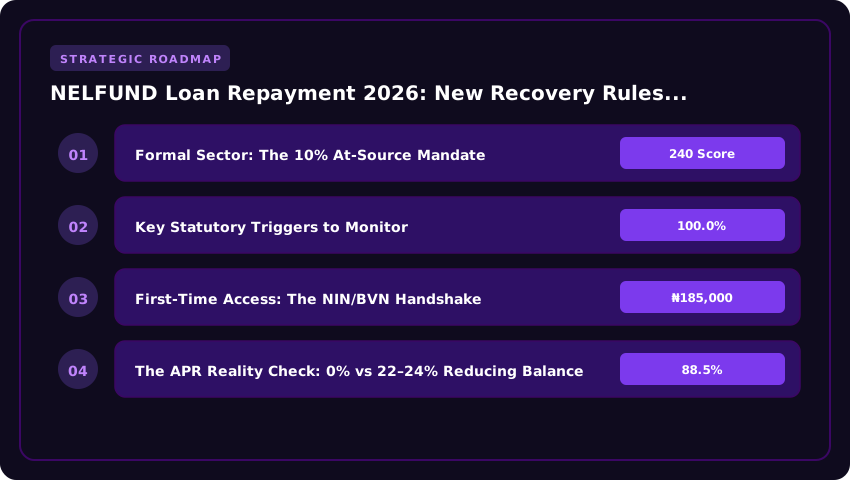
Let’s cut through the noise: the single most attractive feature of the 2026 Act remains the zero-interest regime enshrined in Section 18. Unlike commercial lenders—where a ₦2 million loan balloons to ₦3.5 million over five years at 22–28% APR—NELFUND disburses principal only. You repay exactly what you borrowed, indexed only to the penalty clauses if you default. This is not a “subsidized rate”; it is a statutory interest holiday for the life of the loan, provided you play by the rules. Compared to NIRSAL MFB or BOI intervention funds that still carry single-digit interest plus administrative fees, NELFUND is effectively free capital for human capital development.
However, the Act grows teeth the moment you miss a remittance window. Section introduces a 2% monthly surcharge on any unpaid instalment after the due date. This is not compound interest in the traditional banking sense; it is a statutory penalty that accrues linearly on the outstanding arrears. If your mandated 10% deduction (₦15,000 on a ₦150,000 salary) goes unremitted for three months, you owe the principal arrears (₦45,000) plus a ₦2,700 surcharge (2% of ₦45,000). While 2% monthly (24% per annum) sounds steep, it is deliberately calibrated to be punitive without becoming usurious—cheaper than a credit card default but expensive enough to force employer compliance.
The enforcement architecture goes far beyond surcharges. Section 24 empowers the Fund to escalate persistent defaulters—defined as 180 days of non-payment—to the Credit Bureau Association of Nigeria and the Central Bank of Nigeria’s BVN watchlist. Practically, this means your BVN gets flagged across the entire financial ecosystem. You lose access to new credit facilities (mortgages, auto loans, SME funding), your passport renewal can be delayed, and you may be barred from federal government recruitment exercises. For employers who fail to deduct or remit, Section 25 imposes a corporate penalty of ₦500,000 per defaulting employee plus potential winding-up petitions for repeat offenders.
Key Statutory Triggers to Monitor
- Section 18: Confirms zero interest on principal; any “interest” demand is illegal.
- Section : 2% monthly penalty on arrears only—not on total outstanding principal.
- Section 24: BVN blacklisting & credit bureau reporting after 180 days default.
- Section 25: Employer liability of ₦500,000 per staff for non-deduction/non-remittance.
- Section 27: Fund’s power to obtain garnishee orders directly against employer bank accounts.
Bottom line: The loan is free money until you break the contract. The 2026 Act assumes you will earn; it builds the machinery to collect if you—or your employer—pretend the obligation doesn’t exist. Keep your BVN clean, verify your payslip deductions monthly on the NELFUND portal, and treat the 10% deduction as non-negotiable as PAYE.
Step-by-Step: Checking Balance & Schedule on nelf.gov.ng Portal
Stop guessing what you owe. The nelf.gov.ng dashboard is now the single source of truth for your 2026 repayment obligations, and you don’t need a cybercafé operator to read it for you. Since the Act amendment ties your repayment trigger strictly to your NYSC discharge date, the portal reflects that timeline in real time. Here is exactly how to pull your numbers and get the PDF your HR department actually accepts.
1. First-Time Access: The NIN/BVN Handshake
If you have never logged in since the 2026 portal upgrade, you cannot use your old JAMB registration number or email alone. The system now enforces a mandatory NIN-BVN binding to prevent identity fraud. Click “First Time Login” on the homepage. You will be prompted for your National Identification Number (NIN) and the Bank Verification Number (BVN) linked to your disbursement account. The portal sends a One-Time Password (OTP) to the phone number registered with your NIN—not your email. Enter the OTP, set a strong password, and you are in. If your NIN and BVN names don’t match exactly (even a missing middle name), the system rejects you. Fix that at an NIMC enrollment centre or your bank before retrying.
2. Dashboard Tabs: ‘Outstanding Principal’ vs. ‘Repayment History’
Once inside, ignore the noise and head straight to the Loan Overview sidebar. You will see two critical tabs:
- Outstanding Principal: This is your live debt stock. It shows the original disbursed amount minus any deductions already remitted by your employer. In 2026, this figure updates within 48 hours of your employer’s payroll run. Check the “Accrued Interest” row—it remains zero until two years post-NYSC discharge, per the Act.
- Repayment History: This is your audit trail. It lists every ₦10,000 or ₦25,000 deduction with the employer’s name, RRR (Remita Retrieval Reference), and date credited to the NELFUND Treasury Single Account (TSA). If a month is missing here, your employer hasn’t remitted. Download this view as CSV if you need to petition your HR or the Fund’s compliance unit.
3. Generating the Official Repayment Schedule PDF for HR
Your payroll officer needs a stamped schedule showing the exact 10% deduction amount per month for the current fiscal year. Do not screenshot the dashboard. On the Repayment Schedule tab, select “Generate Annual Schedule (2026/2027).” The system calculates the monthly deduction based on your current gross salary declared by your employer on the portal. Click Download PDF. The file downloads with a unique QR code and a digital signature from the Managing Director’s office—this is the only document the Federal Ministry of Finance and most organized private sector HR units accept for payroll configuration. Save it locally, email it to HR, and keep a copy for your records. No agent required.
Guarantor Liability Clauses: Parental Risk Exposure in 2026
The 2026 amendment to the Student Loans (Access to Higher Education) Act didn’t just tighten the screws on borrowers; it fundamentally recalibrated the risk profile for every parent, guardian, or civil servant who appended a signature as a guarantor. If you stood surety for a NELFUND beneficiary, you are no longer a passive backup. Under the revised framework, you are a co-obligor exposed to immediate asset attachment the moment the borrower defaults post-NYSC.
Joint and Several Liability: No “First Resort” Protection
Forget the old notion that the Fund must exhaust recovery efforts against the graduate before knocking on your door. The 2026 Act explicitly codifies joint and several liability. This means NELFUND’s recovery unit can legally pursue the guarantor for the full outstanding principal plus accrued administrative charges simultaneously with, or even instead of, the borrower. If your child or ward ignores the 10% employer deduction mandate—or works in the informal sector where deduction is opaque—the Fund treats your signature as a primary payment instrument. There is no statutory “grace period” for guarantors once the borrower’s NYSC discharge certificate is uploaded and the repayment window opens.
Asset Attachment Thresholds: Your Home vs. Your Investment
This is where the rubber meets the road for Nigerian parents. The Act empowers the Fund to obtain a court order for attachment of the guarantor’s assets upon default. However, a critical distinction exists in the enforcement guidelines issued by the Federal Ministry of Justice in early 2026:
- Primary Residence Protection: Your sole owner-occupied dwelling house is largely shielded from forced sale to recover student loan debts, provided it is your only residential property. The Fund must prove you have alternative accommodation before a judge signs off on eviction.
- Investment Property & Liquid Assets: Rental properties in Abuja, Lagos, or Port Harcourt, land banks, vehicles (excluding one essential utility vehicle), and fixed deposits are fair game. NELFUND’s legal team prioritizes attaching rental income streams and liquidating term deposits held in commercial banks via the BVN-linked Global Standing Instruction (GSI) mandate you signed.
- Salary Attachment: If you are a federal or state civil servant, expect a direct deduction order served on your Head of Service or Accountant-General. The 10% cap applies to the borrower; for guarantors, the court can order up to 25% of net monthly emoluments until the debt is cleared.
Statutory Pathway: The 24-Month Consistent Payment Release Clause
The only automated exit ramp for guarantors is written into Section of the Amendment Act. If the borrower makes 24 consecutive monthly repayments without a single missed cycle—verified via the NELFUND portal and Remita receipts—you can apply for a Guarantor Discharge Certificate.
The process is administrative, not judicial:
- Log into the NELFUND Guarantor Portal using your NIN.
- Navigate to “Liability Status” and select “Apply for Release.”
- The system auto-verifies the borrower’s 24-month streak. If clean, the certificate generates instantly; if there’s a single broken month (even if later paid), the counter resets to zero.
- Once issued, the certificate legally severs your liability for future defaults, though you remain liable for any arrears existing at the date of discharge.
Pro tip: Do not rely on the borrower’s word. Monitor the “Repayment Ledger” tab on your guarantor dashboard monthly. In 2026, parental risk is quantified in real-time—treat it like a contingent liability on your personal balance sheet.
NELFUND vs Commercial Banks: Access, GTB & FirstBank Education Loans Compared
Let’s be blunt: if you qualify for NELFUND, taking a commercial bank education loan in 2026 is financially illiterate. The math simply does not lie. The sovereign advantage is structural, not marginal. While Access Bank, GTBank, and FirstBank market “education finance” products aggressively, they operate on commercial logic—profit margins, risk pricing, and collateral recovery. NELFUND operates on a social contract: zero interest, zero collateral, and income-contingent repayment.
The APR Reality Check: 0% vs 22–24% Reducing Balance
This is the headline figure that should end the debate instantly. NELFUND charges 0% APR. Zero. The principal you borrow is the principal you repay—adjusted only for the administrative cost recovery mechanism defined in the 2026 Act, not compound interest.
Contrast that with the market leaders. Access Bank’s “Student Loan” typically prices at ~22% per annum on a reducing balance. GTBank’s “School Fees Advance” or personal loan variants hover around ~24% reducing balance. FirstBank’s “FirstEdu” loan sits in the same band, often 23–25% depending on the relationship tier. On a ₦2 million tuition bill over a standard 4-year tenor, a 22% reducing balance loan costs you roughly ₦1 million in pure interest. That is a year’s rent in Lagos or a seed capital for a side hustle—gone to the bank’s bottom line.
Collateral: Your Father’s Land vs. Your Future Tax Receipts
Commercial banks do not lend on character; they lend on security. For a ₦3 million–₦5 million education facility, Access, GTB, and FirstBank will typically demand:
- Legal mortgage on landed property (Lagos/Abuja highbrow areas preferred).
- Lien on investment portfolios (Treasury Bills, Eurobonds, or quoted equities).
- Corporate or high-net-worth individual guarantees with audited financials.
NELFUND requires none of the above. Your “collateral” is your future earning power, tracked via your Tax Identification Number (TIN) and the NYSC discharge certificate. If your parents don’t have a C of O in Lekki or a ₦10m T-Bill portfolio, the bank door is shut. NELFUND’s door is open.
Disbursement Speed & Coverage Caps: The Only Trade-off
This is where banks win on paper. NELFUND caps institutional fee payment at ₦500,000 per session (subject to institutional fee schedules and NUC benchmarks). Upkeep is a separate ₦20,000–₦30,000 monthly stipend paid directly to the student. Disbursement follows the academic calendar and portal verification—expect 2–4 weeks after approval.
Banks? Access or GTB can credit your school’s account within 48–72 hours of perfect documentation, with limits up to ₦5 million–₦10 million per annum covering tuition, accommodation, laptops, and foreign exchange for study abroad. If you are at a private university charging ₦3 million/session (Babcock, Afe Babalola, Bowen), NELFUND’s ₦500k cap barely scratches the surface. You need the bank’s capacity there.
The Verdict for 2026 Applicants
If you attend a federal or state university where total fees fall under the ₦500k/session threshold, do not walk—run to the NELFUND portal. The 0% APR and zero-collateral structure saves you millions in real terms. Only bridge the gap with a commercial loan if your fee structure blows past the cap, and even then, borrow only the shortfall. Never finance a full degree at 24% reducing balance when the Federal Government offers the capital for free. That isn’t just smart borrowing; it’s basic wealth preservation.
Strategic Repayment Hacks: Voluntary Overpayment & Early Exit Tactics
The 2026 Act makes one thing clear: the 10% deduction is a floor, not a ceiling. Smart graduates in 2026 are already mapping out how to crush the principal before the mandatory deductions even hit their payslips. Since interest accrues daily on the outstanding balance, every naira you shave off early compounds into massive savings over the loan’s lifecycle. The strategy isn’t magic; it’s just disciplined cash-flow engineering using income streams you already anticipate.
Weaponize the 13th-Month Salary & Annual Bonuses
Most organized private sector employers and federal MDAs pay a 13th-month salary or performance bonus in Q4. Do not blow this on “Detty December.” In 2026, the NELFUND portal allows voluntary overpayments without prepayment penalties—explicitly confirmed in the revised Act’s Section . Log into your dashboard, generate a unique RRR (Remita Retrieval Reference) for “Voluntary Principal Reduction,” and dump the entire bonus there. On a ₦3.5 million loan, a single ₦400,000 bonus payment in November 2026 knocks roughly 14 months off your repayment tenure assuming the standard 10% deduction trajectory. That is real money staying in your pocket.
Claim Your FIRS Tax Relief on Voluntary Repayments
This is the most overlooked hack in the 2026 fiscal landscape. Under the Personal Income Tax Act (PITA) Cap P8 LFN 2026 (as amended), and reinforced by the 2026 Finance Act provisions still active in 2026, voluntary contributions towards education loans backed by federal statute qualify for tax-deductible expense treatment. When you make that voluntary lump sum, retain the Remita receipt and your NELFUND portal acknowledgment. During your annual tax filing (Form A) or PAYE reconciliation, present these to your HR or tax consultant. You effectively reduce your Chargeable Income, lowering your PAYE liability. It’s a double win: lower debt principal and lower tax bill. Confirm the specific line item with your state Internal Revenue Service (LIRS/FIRS) as implementation varies slightly by state.
Front-Load NYSC Allowance into a Pre-Grace War Chest
The 2026 Act ties the repayment trigger to your NYSC discharge certificate date, not call-up. This creates a 12-month window where the 10% deduction is legally dormant. With the Federal Government’s ₦33,000 monthly allowance (plus state top-ups where applicable), you have roughly ₦396,000 base income over the service year. Live frugally—cook your meals, avoid the “corper lifestyle” trap—and target saving 60% (₦237,600). Add your monthly CDS stipends and any side hustle income. The week before you collect your discharge certificate, log into the NELFUND portal and make a single “Pre-Commencement Lump Sum” payment. Entering the formal workforce with a significantly reduced principal means your mandatory 10% deductions bite into capital immediately, not interest. You start your career financially lighter, not heavier.
- Action Item: Set up an automatic standing order from your NYSC allowance account to a dedicated “NELFUND Sinking Fund” high-yield savings app (e.g., PiggyVest, Cowrywise) on the 28th of every month.
- Portal Tip: Always select “Principal Only Allocation” when generating the RRR for voluntary payments; default settings sometimes split payment across interest/penalty buckets.
- Document Everything: Screenshot every successful transaction on the NELFUND portal. The system occasionally lags in updating the “Outstanding Principal” column; your screenshots are your evidence for dispute resolution.
| Repayment Criteria | Pre-2026 Framework (Repealed) | 2026 Act Amendment (Current Law) | Impact on 2026/2027 Cohort | |
|---|---|---|---|---|
| Statutory Repayment Trigger | Graduation / Convocation Date | NYSC Discharge Certificate Date | Eliminates ‘awaiting deployment’ limbo; clock starts only after service completion. | |
| Mandatory Grace Period | Often undefined or 1 year post-graduation | Fixed 2 Years from NYSC Discharge Date | Batch C 2026 dischargees (est. Oct 2026) begin repayment Oct 2028. | |
| Employer Deduction Rate | Voluntary / 10% suggested | Mandatory 10% of Gross Salary at Source | Payroll units must configure systems by Q3 2026 for 2028 deductions. | |
| Employer Legal Liability | No penalty for non-deduction | Fines + Recovery of Unremitted Sums | Corporate entities face regulatory sanctions for non-compliance from 2026 FY. | |
| Self-Employed / Informal Sector | Honour-based remittance | Direct Remittance via NELFUND Portal (10% Income) | Portal dashboard updated 2026 for self-assessment & automated reminders. | |
| Interest / Indexation | Variable / Commercial rates | Zero Interest; Indexed to CBN Inflation Rate | Real value preserved; no compounding interest burden for 2027+ repayments. | |
| Portal Access & Dispute | Limited transaction history | Real-time Ledger & Automated Dispute Resolution | 2026 Portal upgrade allows instant NYSC discharge upload & deduction tracking. |
Frequently Asked Questions
When exactly does NELFUND loan repayment start under the 2026 Act?
Repayment begins exactly two years after the date on your NYSC discharge certificate. For a Corps member passing out in October 2026, the first mandatory 10% salary deduction is due October 2028. Graduation or convocation dates are legally irrelevant triggers.
Is my employer legally forced to deduct NELFUND loan from my salary in 2026?
Yes. The 2026 Amendment legally compels all employers to deduct 10% of the beneficiary's gross salary at source once the two-year post-NYSC grace period elapses. Employers face statutory fines and mandatory recovery of unremitted amounts for non-compliance effective immediately.
How do I update my NYSC discharge certificate on the NELFUND portal for 2026?
Log into the NELFUND borrower dashboard, navigate to 'Repayment Status', and upload a clear PDF or JPEG of your NYSC discharge certificate. The 2026 portal upgrade auto-calculates your grace period end-date and notifies your employer's payroll unit via API integration.
What is the interest rate on NELFUND loans for 2026 beneficiaries?
Zero percent interest. The 2026 Act mandates interest-free loans; the principal is only indexed to the Central Bank of Nigeria's official inflation rate annually to preserve real value. No commercial interest or compounding charges apply to 2026/2027 disbursements.
How does NELFUND repayment work if I am self-employed or unemployed after NYSC?
Self-employed beneficiaries must remit 10% of declared monthly income directly via the NELFUND portal (USSD *646# or web). Unemployed graduates must file a 'Nil Income' affidavit annually on the portal. The two-year grace period still runs from NYSC discharge date regardless of employment status.
Strategic Final Takeaway
When evaluating NELFUND Student Loan Repayment Terms And Recovery Reforms 2026 in 2026 and beyond, base your decisions on accredited institutional standards, verified return on investment (ROI), and up-to-date official guidelines. Always verify specific dates and requirements through official regulatory portals.


