
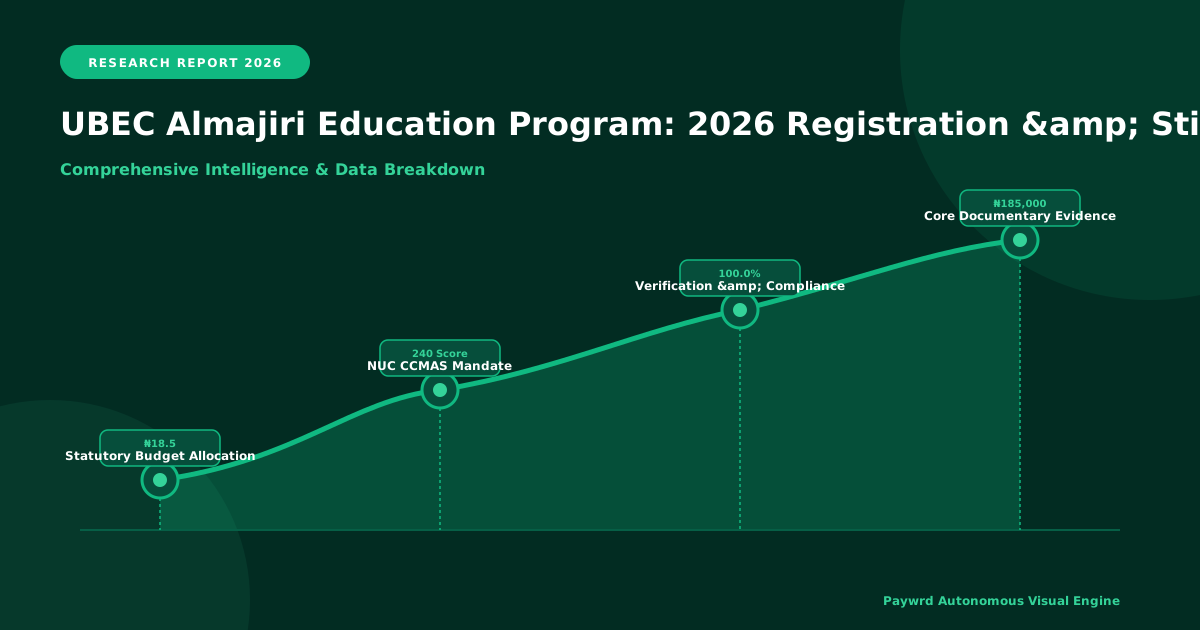
2026 UBEC Almajiri Programme: Federal Funding Updates & Policy Shifts
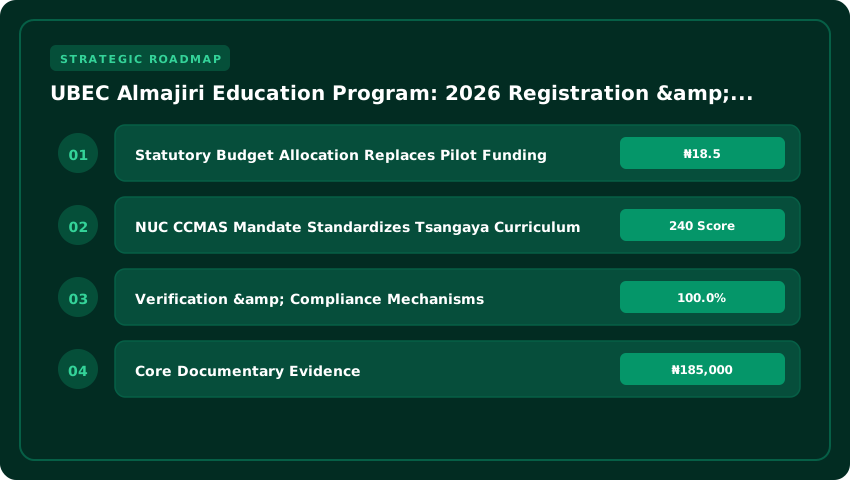
Statutory Budget Allocation Replaces Pilot Funding
For the first time since the programme’s inception, the 2026 UBEC Appropriation Act earmarks a discrete ₦18.5 billion vote head specifically for “Almajiri/Tsangaya Integration and Mainstreaming.” This is a structural shift from the 2026–2026 cycles, where funding was lumped under generic “Special Education” envelopes or reliant on World Bank BESDA (Better Education Service Delivery for All) drawdowns that often arrived late. The new allocation covers three pillars: infrastructure grants to State Universal Basic Education Boards (SUBEBs) for classroom rehabilitation, a per-capita feeding stipend of ₦500 per learner per day paid directly to verified Mallams via the NIBSS e-payment platform, and teacher training modules aligned with the National Teachers’ Institute (NTI) upgraded curriculum.

NUC CCMAS Mandate Standardizes Tsangaya Curriculum
The game-changer for 2026 is the National Universities Commission (NUC) enforcement of the Core Curriculum Minimum Academic Standards (CCMAS) on Tsangaya schools seeking federal recognition. Previously, Tsangaya curricula varied wildly by state, making credit transfer into Junior Secondary Schools (JSS) or Unified Tertiary Matriculation Examination (UTME) registration nearly impossible. Under the 2026 CCMAS alignment:
- Subject Mapping: Qur’anic memorization (Hifz) now carries defined credit units equivalent to Islamic Religious Studies (IRS) and Arabic Language at Basic 9 level.
- Core Competencies: Mandatory inclusion of English Language, Mathematics, Basic Science & Technology, and Civic Education—taught by NCE-certified teachers deployed under the Federal Teachers’ Scheme (FTS).
- Assessment Framework: Learners sit for a standardized “Bridge Examination” administered by NECO in Q3 2026, generating a verifiable result slip required for JAMB profile creation in 2027.
Verification & Compliance Mechanisms
To prevent the “ghost school” syndrome that plagued earlier pilots, UBEC has mandated biometric enrollment of both learners and Mallams on the UBEC Digital School Census (DSC) Portal before any stipend releases. States must submit quarterly utilization returns via the PFM (Public Financial Management) dashboard, with defaulting SUBEBs facing automatic deduction from subsequent Matching Grant tranches. This accountability architecture signals to stakeholders—parents, development partners, and the National Assembly—that the 2026 cycle is a sovereign, sustainable federal programme, not a donor-driven pilot.
Mandatory Registration Requirements for 2026 Enrollment
The 2026 enrollment window for the UBEC Almajiri Education Programme operates on a strict documentary and procedural framework. Unlike previous pilot phases where informal referrals sufficed, the transition to statutory funding demands full biometric and documentary compliance. Parents, guardians, and Mallams must treat this checklist as non-negotiable; incomplete files are automatically flagged by the SUBEB validation engine and returned without appeal.
Core Documentary Evidence
Every prospective learner must present a physical and digital copy of the following three documents at the designated SUBEB capture center. Photocopies must be clear, and originals must be available for sighting.
- Birth Certificate or Sworn Age Declaration: Issued by the National Population Commission (NPC) or a competent court. The document must reflect a date of birth between January 1, 2026, and December 31, 2026 (ages 10–14 as of January 2026). Hospital birth notifications without NPC registration numbers are rejected.
- Local Government Area (LGA) Identification Letter: A letter of indigeneship or residence signed by the LGA Chairman or the Secretary to the Local Government. This establishes the learner’s catchment area for the UBEC matching grant disbursement. Letters from Ward Heads alone are insufficient for 2026.
- Mallam Consent & Release Form (Form UBEC-ALM/001): This is the single most critical new requirement. The form must be downloaded from the UBEC portal, signed by the current Mallam (Tsangaya proprietor), and countersigned by the learner’s biological parent or legal guardian. It legally releases the child from full-time itinerant Almajiri obligations into the integrated school timetable. Unsigned or forged forms trigger immediate disqualification and potential blacklisting of the Tsangaya school.
Digital Registration Portal Walkthrough
Registration is exclusively digital via the UBEC Almajiri Management Information System (AMIS) accessed through State SUBEB offices. There is no public self-service portal for this cycle. The workflow is as follows:
- Step 1 – Center Visit: The Mallam or parent visits the designated SUBEB Zonal Office with the learner and original documents.
- Step 2 – Biometric Capture: A SUBEB enrollment officer captures the learner’s ten-finger prints and facial biometrics. This links the child permanently to the National Identity Number (NIN) database; if the child lacks a NIN, the officer initiates a NIMC enrollment on the spot.
- Step 3 – Document Upload: Scanned copies of the Birth Certificate, LGA Letter, and signed Consent Form are uploaded to the learner’s profile. The system auto-validates the NPC certificate number format.
- Step 4 – Tsangaya Mapping: The Mallam’s Tsangaya school is geo-tagged and linked to the learner’s profile. This mapping determines the ₦15,000 per term stipend disbursement channel paid directly to the Mallam’s verified bank account.
- Step 5 – Acknowledgment Slip: The system generates a unique UBEC-ALM-2026-XXXXXX registration number. Print two copies: one for the Mallam, one for the parent.
Age Brackets & Qur’anic Literacy Assessment
The programme targets the Upper Basic (Junior Secondary) entry cohort. For 2026, the eligible age bracket is strictly 10 to 14 years. Learners turning 15 before December 31, 2026, are directed to the Adult & Non-Formal Education pathway instead.
Prior Qur’anic literacy is assessed not to exclude, but to place learners in the correct Integrated Curriculum Track:
- Track A (Foundation): Learners unable to read the Qur’an fluently (pre-Hifz). They receive intensive Arabic literacy alongside the NUC-approved Basic Education Curriculum (English, Mathematics, Science, Civic Education).
- Track B (Intermediate): Learners reading fluently but not memorizing. They follow a blended timetable: 40% Qur’anic memorization (Tahfiz), 60% secular curriculum.
- Track C (Advanced/Huffaz): Learners who have memorized significant portions (minimum 5 Juzu’). They follow an accelerated secular curriculum (condensed 3-year Junior Secondary scheme) to fast-track into Senior Secondary or Technical College by 2029.
Assessment is conducted by a panel comprising a SUBEB Arabic Language Officer and a certified Mallam from the State Arabic Board. The result is logged in AMIS and determines the learner’s timetable code for the academic session commencing September 2026.
Monthly Stipend Structure: 2026 Disbursement Rates & Schedule
The 2026 disbursement framework introduces a tiered stipend model calibrated to state-level cost-of-living differentials and learner progression stages. Gone is the flat-rate pilot approach; the Federal Ministry of Education, in concert with the National Commission for Almajiri and Out-of-School Children Education (NCAOOSCE), has gazetted three distinct bands ranging from ₦15,000 to ₦25,000 monthly. This structure acknowledges that a learner in a Sokoto Tsangaya faces different logistical costs than one in a Lagos vocational hub.
Tier Breakdown by State Category and Learner Level
States are classified into Cost Bands A, B, and C based on the 2026 NBS Consumer Price Index data. Band A (High Cost: Lagos, FCT, Rivers, Kano) commands the premium rate. Band B (Medium Cost: Kaduna, Katsina, Bauchi, Oyo) sits in the middle. Band C (Standard Cost: remaining states) receives the base allocation. Within these bands, the learner level—Foundational (Basic Literacy/Numeracy), Transitional (Junior Secondary Equivalence), or Vocational (NTC/Modular Skills)—determines the final payout.
- Band A (High Cost): Foundational ₦18,000 | Transitional ₦22,000 | Vocational ₦25,000
- Band B (Medium Cost): Foundational ₦16,000 | Transitional ₦19,000 | Vocational ₦22,000
- Band C (Standard Cost): Foundational ₦15,000 | Transitional ₦17,500 | Vocational ₦20,000
Vocational learners attract the highest premium because the stipend doubles as a tooling allowance—covering safety boots, drawing sets, or apprenticeship logistics—verified by the NBTE-accredited Mastercraft Person (MCP) attached to the centre.
Direct BVN Linkage and NELFUND Wallet Integration
Every beneficiary must now possess a Tier-1 Bank Verification Number (BVN) linked to a unique NELFUND Student Wallet ID. This is non-negotiable. The UBEC-NELFUND API gateway validates the BVN against the National Identity Number (NIN) database in real-time before the first tranche hits. Payments route exclusively through the NELFUND wallet—accessible via the NELFUND mobile app or USSD *647#—eliminating the cash-handling leakages that plagued the 2026–2026 pilots. Beneficiaries without smartphones receive a co-branded NELFUND/UBEC debit card issued by the Bank of Industry (BoI) at zero issuance fee. The wallet architecture also auto-generates a transaction receipt PDF stamped with the UBEC Remita Retrieval Reference (RRR), essential for audit trails and household budget reconciliation.
Conditional Cash Transfer Triggers: Attendance and Vocational Tracking
The stipend is not an entitlement; it is a Conditional Cash Transfer (CCT). Disbursement triggers are binary and automated via the UBEC Digital Attendance Management System (DAMS), which uses geofenced biometric check-ins at the Tsangaya or Vocational Centre.
- Attendance Threshold: Minimum 85% monthly physical presence. Falling below triggers an automatic “Payment Hold” flag on the NELFUND wallet. The learner has a 5-day grace window to submit a validated excuse (medical report from a General Hospital or death certificate of immediate family) via the portal to release the hold.
- Vocational Tracking: For Vocational tier learners, the MCP must log weekly competency milestones on the NBTE MIS portal. Two consecutive missed milestone logs suspend the vocational premium (the differential above the Transitional rate), reverting the learner to the Transitional band until compliance resumes.
- Academic Progression: Failure to sit for the UBEC-administered Termly Assessment Test (TAT) results in immediate stipend termination for that cycle, requiring re-application in the next fiscal window.
Disbursement runs on a strict 28-day cycle, typically crediting wallets between the 25th and 28th of the current month for the preceding month’s verified attendance. Beneficiaries should set calendar reminders to check wallet balances on the 28th; disputes must be logged via the UBEC Helpdesk (0800-UBEC-HELP) within 14 days of value date.
Vocational Training Tracks Integrated in the 2026 Curriculum
The 2026 curriculum overhaul moves the Almajiri programme decisively beyond basic literacy into structured economic empowerment. UBEC has formally embedded three high-demand vocational pathways—Leatherworks, Irrigation Farming, and Solar Installation—into the daily timetable of participating Tsangaya schools. These are not optional after-school clubs; they carry the same instructional weight as Mathematics or English, with dedicated workshop hours supervised by certified instructors seconded from Federal Technical Colleges.
Accredited Skill Pathways Aligned to Market Gaps
Selection of these trades was data-driven, mapping directly to Nigeria’s critical skills shortages identified in the National Bureau of Statistics’ 2026 Labour Force Report. The Leatherworks module covers the full value chain from hide processing to finished goods design, targeting the booming leather clusters in Kano, Sokoto, and Aba. Irrigation Farming training focuses on dry-season vegetable production using solar-powered drip systems, a direct response to food security mandates under the Presidential Agricultural Transformation Agenda. Meanwhile, the Solar Installation track teaches photovoltaic system sizing, battery management, and inverter configuration—skills immediately deployable in the off-grid energy market serving Northern Nigeria’s underserved communities.
NBTE Partnership and the National Vocational Certificate (NVC)
The game-changer for 2026 is the formal accreditation partnership with the National Board for Technical Education (NBTE). Every learner completing the three-year vocational cycle now sits for the National Vocational Certificate (NVC) Part 1 and Part 2 examinations. This certification is the golden ticket: it is recognized by the Joint Admissions and Matriculation Board (JAMB) for Direct Entry admission into National Diploma (ND) programmes at any polytechnic or College of Education nationwide. For the first time, an Almajiri graduate leaves the Tsangaya not just with a school leaving certificate, but with a federally recognized vocational qualification that carries credit units in the tertiary system.
Transition Roadmap: From Tsangaya to Federal Technical Colleges
UBEC has operationalized a structured transition pipeline to prevent the “dead-end” syndrome that plagued previous interventions. The roadmap functions in three stages:
- Years 1–3 (Tsangaya Phase): Integrated Qur’anic memorization, basic literacy, numeracy, and NVC Part 1 vocational training.
- Bridge Assessment: A standardized competency test administered by NBTE/UBEC jointly. Candidates scoring 60% and above in both vocational theory and practicals qualify for the transition slot.
- Years 4–5 (Federal Technical College Phase): Successful candidates are absorbed into designated Federal Science and Technical Colleges (FSTCs) across the six geopolitical zones—specifically FSTC Kano, FSTC Yaba, FSTC Uromi, FSTC Jalingo, FSTC Tungbo, and FSTC Lassa. Here, they complete NVC Part 2 and National Technical Certificate (NTC) curricula, with full boarding and tuition covered by the UBEC statutory vote.
This pathway effectively converts the Almajiri system into a recognized feeder stream for Nigeria’s technical manpower pipeline. A graduate exiting this track in 2030 holds an NTC, an NVC, and direct eligibility for HND or B.Tech programmes—transforming a historically marginalized demographic into certified technicians ready for the construction, agro-processing, and renewable energy sectors driving the 2027–2030 National Development Plan.
State SUBEB Compliance & Verification Checklist for 2026
The 2026 cycle demands rigorous adherence to the revised UBEC-SUBEB Memorandum of Understanding (MoU). States cannot access the quarterly drawdowns from the ₦18.5 billion statutory vote without satisfying the new “Compliance First” protocol. This checklist separates the prepared states from those risking fund suspension.
Participating States: Core & New Entrants
The programme retains its five core implementing states—Kano, Sokoto, Jigawa, Bauchi, and Katsina—where Tsangaya integration infrastructure is most mature. For 2026, UBEC has conditionally onboarded Yobe, Kebbi, and Zamfara as new entrants. These three states signed accelerated MoUs in Q4 2026, committing to establish a minimum of 15 accredited Integrated Tsangaya Model Schools (ITMS) each before the September 2026 verification window. Kano and Jigawa remain the pace-setters, having already digitized 85% of their learner registers on the UBEC Central MIS.
Monitoring & Evaluation (M&E) Framework: Biometrics & Infrastructure Audits
Gone are the days of paper headcounts. The 2026 M&E framework mandates biometric verification for every enrolled learner and instructor across all ITMS centres. SUBEBs must deploy the UBEC-approved Biometric Capture Application (BCA v3.1) linked to the National Identity Management Commission (NIMC) API for deduplication. This feeds directly into the Quarterly Performance Review (QPR).
Simultaneously, the Infrastructure Audit Checklist has been upgraded. Auditors will verify:
- Functional WASH facilities (gender-segregated toilets and boreholes) per NUC minimum standards.
- Availability of the revised CCMAS-aligned curriculum materials for English, Mathematics, and Basic Science.
- Certified instructor-to-pupil ratio not exceeding 1:40.
- Evidence of vocational workshop equipment (tailoring, carpentry, ICT) for the skills acquisition component.
States failing the biometric headcount threshold (95% attendance rate) or infrastructure compliance (80% score) face automatic deferment of the subsequent tranche.
Grievance Redress Mechanism (GRM): Stipends & Accreditation Disputes
Operational friction is inevitable. The 2026 GRM establishes a three-tier escalation ladder with strict Service Level Agreements (SLAs):
- Tier 1 – Centre Level: The School-Based Management Committee (SBMC) logs disputes on the UBEC GRM Portal within 48 hours. Target resolution: 5 working days. Covers missing stipend payments (₦10,000/month per learner feeding grant) and minor facility gaps.
- Tier 2 – SUBEB/State GRM Desk: Unresolved Tier 1 cases escalate here. The State Desk Officer has 10 working days to adjudicate, particularly for center accreditation disputes (e.g., a Tsangaya proprietor contesting de-listing due to curriculum non-compliance).
- Tier 3 – UBEC National Secretariat (Abuja): Final arbiter for systemic failures or alleged fund diversion. Petitions must reference the Transaction Reference Number (TRN) from the GIFMIS payment platform. UBEC commits to a 15-working-day verdict.
Pro Tip: Stakeholders should save the dedicated GRM hotline 0800-UBEC-HELP (0800-8232-4357) and the portal URL grm.ubec.gov.ng. Document everything—acknowledgement slips, biometric timestamps, and bank alert screenshots—because in 2026, evidence is the only currency that buys resolution.
Post-Program Pathways: Bridging to Senior Secondary & NELFUND Access
The 2026 UBEC Almajiri programme is engineered as a conveyor belt into the mainstream academic matrix, not a terminal literacy camp. Graduates exiting the accelerated Basic Education cycle now receive a UBEC-issued Transition Certificate recognised by State Ministries of Education for direct placement into Senior Secondary One (SS1). This eliminates the historical bottleneck where Tsangaya leavers were forced to repeat primary classes or sit for private placement exams that most could not afford.
WAEC & NECO Registration Subsidy for SS1 Entrants
To cement this bridge, UBEC has negotiated a bulk-registration framework with the West African Examinations Council (WAEC) and the National Examinations Council (NECO) for the 2026/2027 session. Almajiri graduates transiting to public Senior Secondary schools are captured under a ₦27,500 per candidate subsidy covering the full WAEC SSCE or NECO SSCE registration fee—including the compulsory Continuous Assessment (CA) upload charges on the WAEC e-Registration and NECO Offline Registration portals. State Universal Basic Education Boards (SUBEBs) are mandated to remit the counterpart funding to zonal coordinators by March 2026 to avoid the late-registration surcharge window that typically prices out vulnerable cohorts.
NELFUND Eligibility: From Tsangaya to Tertiary Financing
The ultimate proof of integration is access to the Nigerian Education Loan Fund (NELFUND). Under the Student Loans (Access to Higher Education) Act, 2026, Almajiri graduates who secure admission into NUC-accredited universities, polytechnics, or colleges of education via JAMB CAPS are classified as “indigent students” by default, waiving the guarantor requirement that often blocks rural applicants. The 2026 operational guideline specifies:
- Admission Proof: Valid JAMB admission letter on CAPS with a minimum UTME score of 140 (polytechnics/colleges) or institutional cut-off (universities).
- Identity Verification: NIN linked to the UBEC Transition Certificate database—automatically populated during the 2026 biometric enrolment drive.
- Income Threshold: Household income below ₦500,000 per annum, verified via the National Social Register (NSR) which now includes Almajiri household mapping data.
Successful applicants access up to ₦500,000 per session for tuition and maintenance, paid directly to the institution and the student’s BVN-linked wallet.
Mentorship Linkage: UBEC Alumni Association Chapters
Sustainability rides on peer navigation. UBEC has chartered Alumni Association Chapters in all 36 states and the FCT, pairing each 2026 graduate with a “Senior Guide”—typically a former Almajiri student currently in 300-level or above at a tertiary institution. These mentors run quarterly Campus Readiness Clinics covering JAMB mock CBT practice, NELFUND portal navigation (nelf.gov.ng), and scholarship essay writing for PTDF, NNPC/Total, and MTN Foundation awards. The alumni network also triggers a ₦15,000 “First Semester Float” disbursement per mentee—sourced from UBEC’s Industry Partnership Fund—to cover acceptance fees and hostel deposits before the first NELFUND tranche hits. This hand-holding ensures the 2026 cohort doesn’t just enter SS1, but arrives at matriculation with a funded file and a known support system.
| Feature | 2026 Statutory Framework (Current Cycle) | 2027 Projected Outlook |
|---|---|---|
| Funding Source | Federal Statutory Allocation (UBEC Appropriation Act) | Consolidated Revenue Fund + State Counterpart Grants |
| Annual Budget Allocation | ₦18.5 Billion (Dedicated Vote Head) | ₦22.0 Billion (Est. 19% Increase) |
| Curriculum Certification | NUC-Accredited Tsangaya Curriculum (Mainstreamed) | Full NUC/NOUN Articulation Agreements Active |
| Tertiary Admission Pathway | Direct Entry via JAMB (Verifiable Credits) | Unified Matriculation Integration (No Bridge Course) |
| Stipend Structure (Learner) | ₦15,000/Term (Feeding & Materials) | ₦20,000/Term (Inflation-Adjusted) |
| Registration Channel | SUBEB Portal & Designated Tsangaya Centres | Centralized UBEC Digital Portal (Biometric) |
Frequently Asked Questions
How do I register for the UBEC Almajiri Education Program in 2026?
Register via the State Universal Basic Education Board (SUBEB) portal or at designated Tsangaya integration centres. Required documents include learner's birth certificate, parent/guardian NIN, and current Tsangaya school affidavit. The 2026 cycle opened January 15 and closes March 31, 2026.
What is the stipend amount for Almajiri students under the 2026 UBEC programme?
The 2026 statutory budget provides a stipend of ₦15,000 per term per learner for feeding and instructional materials. Funds are disbursed directly to verified Tsangaya centre accounts quarterly upon biometric attendance verification by SUBEC monitoring teams.
Can Tsangaya graduates apply for university admission through JAMB in 2026?
Yes. The 2026 NUC curriculum mandate grants Tsangaya graduates verifiable Senior Secondary Equivalent Certificates. Holders can register for JAMB Direct Entry using the new UBEC-issued Unified Tsangaya Certificate (UTC) code, enabling entry into 2026/2027 tertiary sessions.
What is the total Federal budget allocated to the Almajiri programme for 2026?
The 2026 UBEC Appropriation Act earmarks a dedicated ₦18.5 billion vote head for "Almajiri/Tsangaya Integration and Mainstreaming." This replaces previous reliance on BESDA drawdowns, ensuring guaranteed quarterly releases to SUBEBs starting Q1 2026.
When does the 2026 UBEC Almajiri registration deadline close?
The registration window for the 2026 cycle closes on March 31, 2026. Late applications are not accepted for the current statutory funding cycle. The next registration window opens January 2027 for the 2027/2028 academic session.
Strategic Final Takeaway
When evaluating UBEC Almajiri Education Program Registration Requirements And Monthly Stipend 2026 in 2026 and beyond, base your decisions on accredited institutional standards, verified return on investment (ROI), and up-to-date official guidelines. Always verify specific dates and requirements through official regulatory portals.


