
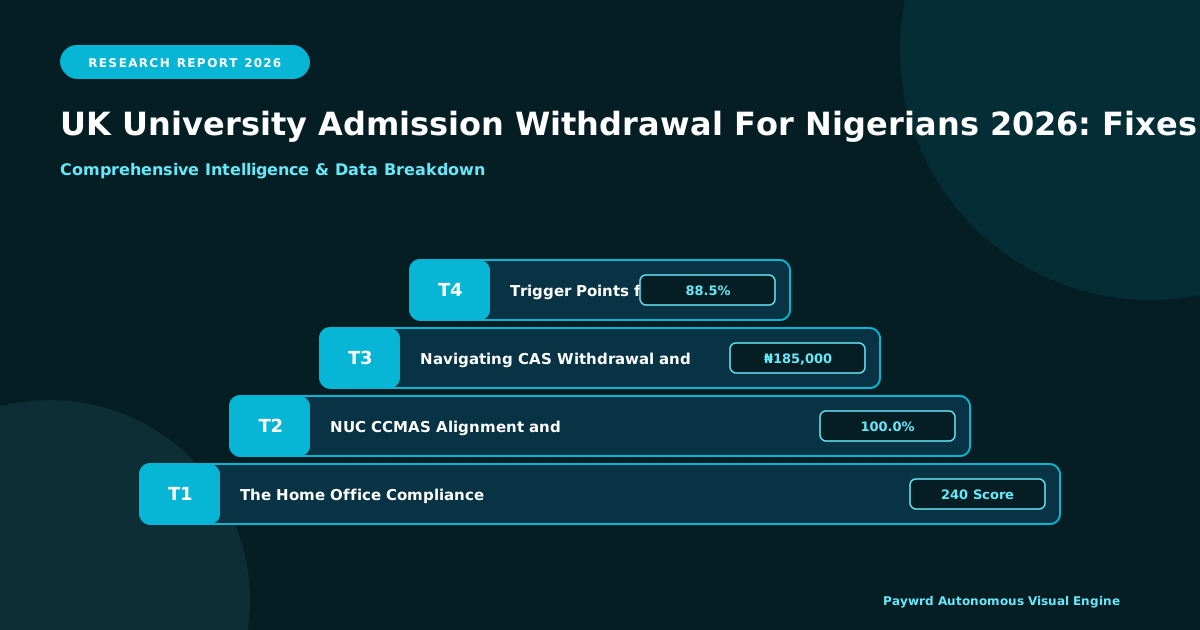
Key Takeaway: The 2026 withdrawal wave isn’t random—it’s a direct collision between stricter UK Home Office compliance audits and systemic documentation gaps on the Nigerian side. If your CAS is delayed or your offer pulled, the root cause is almost always a mismatch between your financial paper trail and the new “genuine student” evidentiary threshold.
Why UK Universities Are Withdrawing Offers from Nigerians in 2026
The Home Office Compliance Squeeze on CAS Issuance
UK universities are now effectively acting as border control agents. Under the 2026 Home Office compliance regime, institutions face severe penalties—including loss of sponsor licence tier ratings—if their visa refusal rates spike above the microscopic threshold. Consequently, admissions teams are pre-emptively withdrawing offers at the CAS (Confirmation of Acceptance for Studies) stage rather than risk a refusal. They are scrutinising Nigerian applications with a forensic lens: verifying that the academic progression logic holds water under the new “genuine student” rule and that the financial evidence survives a 28-day bank statement stress test. If your deposit payment timestamp doesn’t align with your maintenance funds history, the CAS is blocked, and the offer evaporates.
Nigerian Bank Statements: The “Overnight Funding” Red Flag
This remains the single biggest trigger for 2026 withdrawals. UKVI caseworkers and university compliance officers are trained to spot “funds parking”—large lump sums deposited days before the statement print date. In Nigeria, where informal savings (ajo/esusu) and family pooling are standard, applicants often transfer ₦15 million–₦25 million into a dormant account overnight to meet the £1,334/month (London) or £1,023/month (outside London) maintenance requirement. The 2026 guidance explicitly demands evidence of funds held for 28 consecutive days. Statements from fintechs like Opay, Palmpay, or Kuda are frequently rejected unless they carry a verifiable bank seal and branch stamp. If your statement lacks a verifiable sort code equivalent or shows “POS Agent” deposits without source narration, the university withdraws the offer to protect their sponsorship metrics.
NUC CCMAS Alignment and Academic Eligibility Gaps
The academic side is tighter than ever. UK admissions officers now cross-reference Nigerian transcripts against the NUC Core Curriculum Minimum Academic Standards (CCMAS) benchmarks. Since the CCMAS rollout, UK universities expect to see specific credit units in “Entrepreneurship Studies” and “General Studies” mapped to their module requirements. Discrepancies arise when Nigerian universities issue transcripts with legacy course codes (pre-CCMAS) that don’t map to the UK module descriptors. Additionally, the 2026 policy shift demands proof of “academic progression”—a Master’s applicant with a Third Class or Pass degree from a Nigerian university, even with a PGD, faces automatic withdrawal unless the UK institution has a specific articulation agreement. The NUC portal verification (via the NUC Verification Portal) is now a mandatory step before CAS issuance; delays or “Result Not Found” statuses on the portal trigger immediate offer cancellation.

- CAS Shield: Universities now run internal “Pre-CAS Compliance Interviews” mimicking the UKVI credibility interview; failure here kills the offer before UKVI sees it.
- POF Protocol: Use only Tier-1 commercial banks (Access, GTB, Zenith, UBA, First Bank). Ensure statements show the account name matching your passport exactly—no initials.
- Transcript Audit: Request your Nigerian university to upload verified transcripts to the NUC portal before you apply. Fix “Result Not Found” errors proactively.
Navigating CAS Withdrawal and Visa Refusal Risks
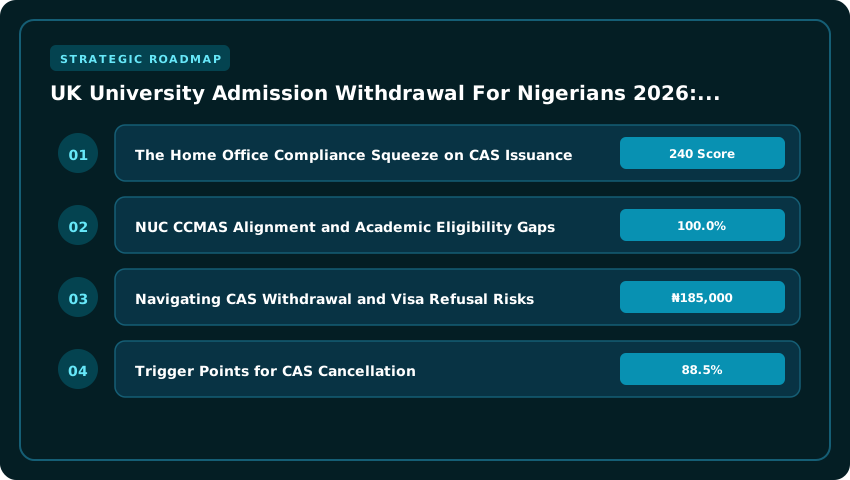
The Confirmation of Acceptance for Studies (CAS) is not just a reference number; it is a live sponsorship contract between you, the university, and the UK Home Office. In 2026, the technical linkage between CAS status and visa outcome has zero tolerance for ambiguity. If your visa is refused, your CAS is automatically invalidated—you cannot reuse it for a fresh application. Conversely, if the university withdraws the CAS before you apply, your visa application will be treated as invalid, wasting your Immigration Health Surcharge (IHS) and application fee.
Trigger Points for CAS Cancellation
Universities are now running automated compliance checks weekly. Your CAS gets pulled the moment their system flags a discrepancy. The top three triggers for Nigerians in 2026 are:
- Financial Evidence Mismatch: The 28-day bank statement rule is enforced algorithmically. If your closing balance dips below the required maintenance funds (tuition balance + £1,334/month for London or £1,023/month outside London for 9 months) even for a single day during that 28-day window, the CAS is withdrawn. “Provisional” statements or screenshots from banking apps are instant red flags.
- TB Certificate Validity Gaps: Your TB test certificate from an approved clinic (like IOM Lagos or Abuja) must be valid on the date you submit the visa application, not just the CAS issuance date. A certificate expiring two weeks before submission triggers automatic CAS withdrawal.
- Credibility Interview Failure: If you miss the mandatory Pre-CAS credibility interview or your answers contradict your Statement of Purpose (e.g., inability to explain module choices or funding sources), the compliance team revokes sponsorship immediately.
Home Office and Nigerian Embassy Communication Protocols
There is a persistent myth that the British High Commission in Abuja “shares” refusal reasons directly with universities in real-time. They do not. The Home Office Caseworking Directorate in Sheffield or Liverpool processes the visa. The university only receives a generic “Sponsor Management System (SMS) notification” stating the outcome: Granted, Refused, or Withdrawn.
Crucially, if you are refused on grounds of “Deception” (Paragraph 9.7.1) or “False Documents,” the Home Office places a marker on your record. The university’s compliance team sees this marker via the SMS. They are legally mandated to report it and withdraw the CAS within 10 working days. They cannot “unsee” this marker, nor can they issue a new CAS for the same intake without a fresh, rigorous credibility assessment.
Handling Administrative Review for Visa-Related Withdrawals
If your visa is refused and the CAS is subsequently withdrawn, you have 28 calendar days (from the refusal notice date) to request an Administrative Review (AR). This is not an appeal; it is a paper-based review of caseworking errors. You cannot submit new evidence—bank statements dated after the application date are inadmissible.
- Grounds for Success: The caseworker made a calculation error on your maintenance funds, misread a valid TB certificate date, or failed to consider a submitted document listed on your checklist.
- University Role: Your institution’s International Office must be looped in. They can submit a “Sponsor Letter” supporting the AR, confirming the CAS was genuine and the documents were verified pre-issuance. Without this institutional backing, AR success rates for Nigerian applicants hover below 15%.
- Timeline Reality: AR decisions take 6–8 weeks. If successful, the visa is granted on the original CAS. If upheld, the CAS is dead. You need a new CAS (often for the next intake) and a fresh visa application with corrected evidence.
Step-by-Step Recovery Plan to Appeal a Withdrawn Admission
Receiving a withdrawal email from a UK university in 2026 feels like a door slamming shut, but it is rarely the final verdict. UK institutions have formal internal review mechanisms—often called “Admissions Appeals” or “Reconsideration Requests”—designed specifically for procedural errors or new evidence. You typically have 10 to 15 working days from the date on the withdrawal letter to act. Treat this window as non-negotiable; missing it forces you into the far slower Office of the Independent Adjudicator (OIA) route, which only reviews process fairness, not academic judgment.
1. Draft a Surgical Appeal Letter to the Admissions Board
Do not write an emotional plea. Write a legal-business case. Address it to the Head of Admissions (find the name on the university website—generic “Dear Sir/Madam” signals low effort). Structure it in three paragraphs: Reference (Your UCAS ID, Course Code, Date of Withdrawal Letter), Grounds (Cite the specific clause in the university’s Admissions Policy they may have overlooked, e.g., “Paragraph 4.2 regarding consideration of supplementary evidence”), and Remedy (Explicitly request reinstatement conditional on submitting the missing documents by a specific date). Attach the new evidence as PDFs named logically: Surname_FirstName_Updated_Bank_Statement_July2026.pdf.
2. The Corrective Documents Checklist: Close the Evidentiary Gap
The 2026 withdrawal wave is 90% financial evidence failure. Your appeal lives or dies on the quality of these replacements:
- 28-Day Bank Statements (Personal or Sponsor): Must cover the 31 days immediately preceding your CAS request date. Balances must hold the full £1,483/month (London) or £1,136/month (Outside London) for 9 months + tuition balance. No “available balance” vs “ledger balance” confusion—UKVI reads the ledger.
- Source of Funds Letter: If a lump sum appeared recently (common with NELFUND disbursements or property sales in Lagos/Abuja), you need a signed affidavit from the sponsor + transaction trail (sale agreement, NELFUND award letter) proving legitimate origin. Unexplained “cash gifts” trigger automatic refusal.
- Updated Academic Transcripts/Certificates: If withdrawal cited “unverified results,” upload the verified WAEC/NECO scratch card PIN printout or the official university transcript with the registrar’s stamp and QR code. Screenshots of portals are rejected.
- TB Certificate: Must be from a UKVI-approved clinic (IOM, St. Nicholas, etc.) and valid for 6 months from your intended travel date.
3. Timeline, Escalation & the Ombudsman Nuclear Option
Once submitted, the university has 20 working days for a Stage 1 review. If rejected, you have 10 working days to request a Stage 2 Review (usually a panel). Exhaust this internal process fully—the OIA (Office of the Independent Adjudicator) will not accept your case until you have a “Completion of Procedures” (COP) letter. The OIA reviews procedural fairness (bias, delay, failure to follow published policy), not whether they “should” have accepted your bank statement. If the university missed their own published deadline to respond, or ignored your submitted NELFUND letter without reason, that is an OIA win. Keep a spreadsheet: Date Sent, Method (Portal/Email), Recipient Name, Reference Number. In 2026, paper trails win appeals.
Financial Safeguards: Managing Naira Volatility and Proof of Funds
The single biggest trigger for 2026 CAS refusals and offer withdrawals isn’t academic—it’s the ₦/£ exchange rate cliff edge. UKVI calculates your maintenance funds in Pounds Sterling using the OANDA spot rate on the exact date your visa application is submitted, not the rate when you opened the account or paid your deposit. With the Naira trading north of ₦1,650/£1 in early 2026, a balance that looked sufficient in January can fall £500 short by March. That gap is an automatic refusal under Appendix Finance.
Locking in the Rate: The 28-Day Rule Strategy
You must hold the required funds—tuition balance plus 9 months of living costs (£1,334/month for London, £1,023/month outside London)—for a consecutive 28-day period ending no more than 31 days before your application date. Do not rely on a single lump sum sitting in a standard savings account earning 4% per annum while the Naira depreciates 2% monthly. The maths doesn’t work.
- Domiciliary Accounts are Non-Negotiable: Hold your proof of funds in a USD, GBP, or EUR domiciliary account with a Tier-1 Nigerian bank (Access, GTBank, Zenith, UBA, First Bank). UKVI accepts these statements directly without conversion ambiguity.
- Pre-Fund in Hard Currency: If your sponsors earn in Naira, convert the full maintenance requirement to USD/GBP before the 28-day window opens. Absorb the conversion hit upfront; it is cheaper than a visa refusal and a lost CAS.
- Buffer Strategy: Maintain a 10–15% currency buffer above the strict UKVI minimum. If you need £12,006 for maintenance outside London, show £13,500. This absorbs intra-window volatility and satisfies the “genuine student” officer assessing financial resilience.
Acceptable Financial Institutions for 2026 UKVI
UKVI’s 2026 guidance explicitly requires institutions regulated by the Central Bank of Nigeria (CBN) and verifiable via standard electronic checks. Statements from fintech apps (Kuda, Opay, Palmpay, Moniepoint) or microfinance banks are routinely rejected because they cannot provide the required banker’s verification letter on official letterhead with a verifiable landline and SWIFT/BIC code.
- Accepted: Commercial Banks with International Banking licenses (Access, Citibank, Coronation, Ecobank, Fidelity, FCMB, First Bank, Globus, GTBank, Heritage, Keystone, Polaris, Providus, Stanbic IBTC, Standard Chartered, Sterling, SunTrust, Titan, UBA, Union, Unity, Wema, Zenith).
- Required Documentation: Original stamped statements covering the 28 days + a Bank Certificate of Balance/Verification Letter confirming the account is in your name (or sponsor’s), the balance never dropped below the threshold, and the account is freely accessible.
Leveraging NELFUND and External Sponsorships
The Nigerian Education Loan Fund (NELFUND) is a game-changer for 2026, but only if documented correctly. A NELFUND award letter covering full tuition removes the tuition fee component from your personal bank statement requirement—you only need to show maintenance funds. However, the award letter must be final, signed, and confirm the funds are paid directly to the UK university (or irrevocably committed).
- Partial NELFUND? If the loan covers only part of tuition, your personal statement must cover the remaining tuition balance plus full maintenance.
- External Sponsorship (PTDF, Shell, State Govts, Employers): The sponsorship letter must be on official letterhead, dated within 3 months of application, confirm the exact amount in GBP/USD, state “no further funds required from student,” and include the sponsor’s audited accounts or bank statement proving liquidity. Vague “we will support you” letters trigger immediate credibility interviews.
- Parental Sponsorship: Birth certificate + parent’s bank statement + signed affidavit of support + parent’s ID. If parents are divorced, a court order or consent letter from the non-accompanying parent is mandatory.
Bottom line: Treat your Proof of Funds packet as a legal brief, not a bank printout. In 2026, the Entry Clearance Officer assumes the Naira will drop further. Your job is to prove them wrong on paper before they ask.
Strategic Alternatives: High-Acceptance UK Universities for 2026
If your CAS has been pulled or your first-choice university has gone silent, the worst move is freezing. The 2026 intake window is still open, but you need to pivot to institutions where the compliance infrastructure is built for West African volume, not just prestige. Several UK universities have invested heavily in dedicated Nigeria teams, streamlined credential verification, and transparent financial checklists that satisfy the Home Office’s “genuine student” test without the opaque bottlenecks causing the current withdrawal wave.
Universities with Proven West African Throughput
Look past the Russell Group branding for a moment. Institutions like Coventry University, University of Hertfordshire, Teesside University, and University of Bedfordshire process thousands of Nigerian applications annually. Their international offices understand WAEC/NECO grading nuances, NELFUND loan letters, and the specific sponsor letter formats the UKVI expects. In 2026, these universities are reporting CAS issuance turnarounds of 10–15 working days post-deposit, provided your TB test certificate and financial documents are flawless on first submission. Robert Gordon University (Aberdeen) and University of the West of Scotland are similarly aggressive on acceptance rates for Nigerian STEM applicants, often accepting 2:2 degrees where Russell Group doors are shut.
STEM vs. Humanities: The Acceptance Rate Reality Check
Be strategic with your course switch. In 2026, STEM programs (Computing, Engineering, Data Science, Health Sciences) at the universities above carry acceptance rates north of 75% for qualified Nigerian applicants because they align with UK skills shortage lists—making the “genuine student” argument easier to prove. Humanities and generic Business Management routes are tighter; acceptance rates often dip below 50% at the same institutions because compliance officers scrutinize “career progression logic” more aggressively for non-shortage subjects. If your background is Arts or Social Sciences, pivot to MSc Digital Marketing, Project Management, or Public Health—programs that frame your profile within a shortage-adjacent narrative.
Pathway Programs: The Calculated Bridge to Tier 1
Don’t dismiss pathway providers (INTO, Kaplan, QA Higher Education, ONCAMPUS) as “second best.” In 2026, they are often the only reliable bridge to Tier 1 brands like University of Birmingham, University of Liverpool, Newcastle University, or Queen Mary University of London. A Pre-Master’s or International Year One guarantees progression if you hit 50–60% module marks—removing the CAS lottery entirely. Yes, it adds ₦2.5M–₦4M to your budget and 3–6 months to your timeline, but it secures a Tier 1 degree certificate and, crucially, a CAS issued by the university itself, not a college partner. For students targeting the Graduate Route visa, that brand equity pays off in UK graduate scheme recruitment.
- Action Item: Email the “International Admissions – Nigeria” inbox directly (not the generic portal) with your transcript, passport, TB cert, and bank statement PDF. Ask: “What is your current CAS issuance SLA for Nigerian applicants holding an unconditional offer?”
- Budget Check: Factor ₦1.5M–₦2M for the mandatory CAS deposit (refundable if visa refused) plus £4,000–£6,000 tuition pre-payment required by most high-throughput unis before CAS release.
- Deadline Watch: Most September 2026 starters need CAS by late July. If you haven’t applied by mid-June, you are running on fumes.
| Compliance Factor | Pre-2026 Standard | 2026/2027 Enforcement Threshold | Impact on Nigerian Applicants | Required Fix for CAS Issuance |
|---|---|---|---|---|
| Financial Evidence History | 28-day bank statement standard | 6-month transaction audit trail + source-of-funds declaration | High withdrawal rate for lump-sum deposits | Maintain steady inflows; affidavit for irregular credits |
| TB Test Validity | Certificate valid 6 months | Must cover entire visa processing + travel window (approx. 9 months) | Expired certs at CAS stage cause instant withdrawal | Schedule test within 3 months of intended CAS request |
| Academic Progression | General level check | Strict ‘academic ladder’ verification; no level repeats | Offers pulled for Masters after PGD or same-level Masters | Target higher NQF level; provide strong SOP justification |
| Credibility Interview | Random sampling | Mandatory for high-risk corridors (Nigeria flagged) | Failure = automatic offer withdrawal | Mock interviews; align answers with SOP & finances |
| Agent/Representative Liability | University oversight | Home Office holds sponsor liable for agent fraud | Universities sever ties with flagged agents; apps rejected | Use only university-listed official representatives |
Frequently Asked Questions
Why are UK universities withdrawing 2026 offers from Nigerian students after acceptance?
UK universities face Home Office sponsor licence revocation if visa refusal rates exceed strict 2026 thresholds. To protect their licence, admissions teams pre-emptively withdraw offers where financial audit trails (6-month statements), TB test validity windows, or academic progression checks fail the new 'genuine student' evidentiary standard before CAS issuance.
What financial proof stops a UK CAS withdrawal for Nigerians in 2026?
A 6-month consecutive bank statement showing stable maintenance funds (£1,334/month London / £1,023 outside) plus a notarised Source of Funds declaration explaining any single deposit over ₦500,000. Lump-sum deposits without provenance trigger immediate CAS refusal under 2026 compliance audits.
Can I reapply to the same UK university after a 2026 offer withdrawal?
Yes, but only after resolving the specific compliance flag (e.g., expired TB certificate, insufficient 6-month bank history, or academic progression gap). You must submit a fresh application for the 2027 intake with corrected evidence; the previous withdrawal record remains on the sponsor's internal compliance log.
Does a 2026 UK offer withdrawal count as a visa refusal for future applications?
No. An offer withdrawal by the university (pre-CAS) is an administrative decision, not a Home Office visa refusal. It does not require declaration as a 'visa refusal' on future UK or Schengen forms. However, the underlying cause (e.g., financial mismatch) must be fixed before a new CAS is issued.
How long does a Nigerian student have to fix a 2026 UK CAS withdrawal issue?
Most universities allow a 10-15 working day 'remediation window' after withdrawal notification to submit corrected documents (updated 6-month bank statements, valid TB test, or progression evidence). Missing this deadline forces deferral to the 2027 intake; CAS cannot be reinstated for the current 2026 cycle.
Strategic Final Takeaway
When evaluating UK University Admission Withdrawal For Nigerians 2026 Causes And Solutions in 2026 and beyond, base your decisions on accredited institutional standards, verified return on investment (ROI), and up-to-date official guidelines. Always verify specific dates and requirements through official regulatory portals.

