ALSDE CTE Cybersecurity Pathway Standards & NIST NICE Alignment 2026
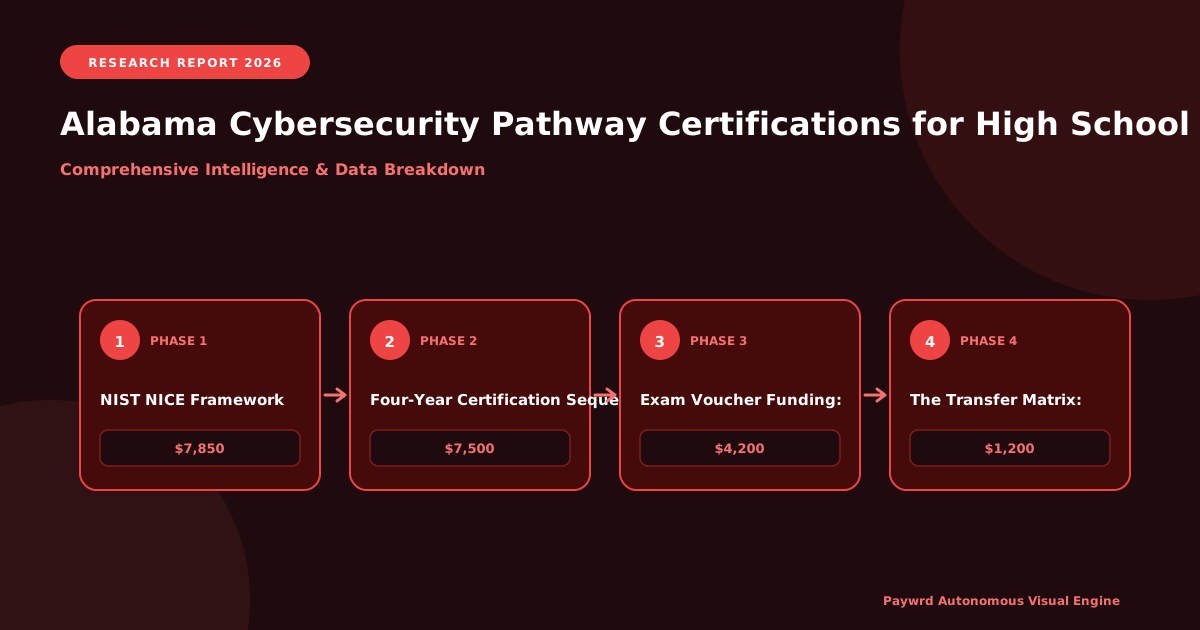
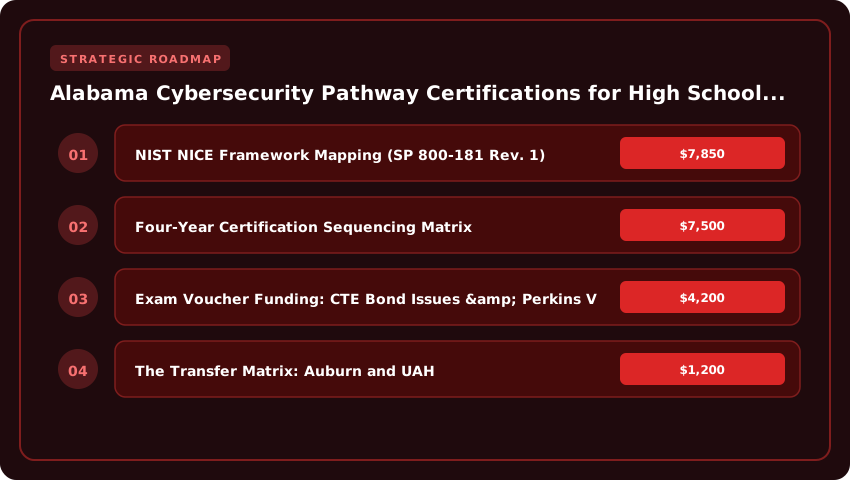
The Alabama State Department of Education (ALSDE) finalized the 2026 Alabama Course of Study: Career and Technical Education, Information Technology Cluster in late 2026, effective for the 2026–2027 academic year. The Cybersecurity pathway (CIP Code 11.1003) consists of two required Carnegie-unit courses: Cybersecurity Fundamentals (Course Code 520015) and Advanced Cybersecurity (Course Code 520016). Districts must adopt these exact codes in PowerSchool SIS to trigger CTE weighted funding ($7,850 per FTE in FY2026) and satisfy the state’s College and Career Readiness Indicator (CCRI).

NIST NICE Framework Mapping (SP 800-181 Rev. 1)
ALSDE contracted with the National Cybersecurity Training & Education Center (NCyTE) to cross-walk every course standard to the NIST NICE Framework. The 2026 alignment is granular, moving beyond broad categories to specific Task (T) and Knowledge (K) identifiers required for federal reporting under the Cybersecurity Education and Training Assistance Program (CETAP).
- Cybersecurity Fundamentals (520015) maps to Protect and Defend (PR) and Analyze (AN) categories. Core competencies cover K0001 (Security Principles), K0002 (Networking Protocols), and T0019 (Implementing Access Controls), aligning directly to the Cyber Defense Infrastructure Support Specialist (SP-AN-001) and Systems Security Analyst (SP-AN-002) Work Roles.
- Advanced Cybersecurity (520016) targets Operate and Maintain (OM) and Investigate (IN). Standards require proficiency in K0070 (Incident Response), T0169 (Forensic Analysis), and T0219 (Penetration Testing Execution), mapping to Cyber Defense Analyst (PR-CDA-001) and Vulnerability Assessment Analyst (PR-VAM-001) roles.
Counselors should note: Students earning a “C” or higher in both courses and passing the CompTIA Security+ (SY0-701) or (ISC)² Certified in Cybersecurity (CC) exam receive the Alabama Cybersecurity Completer Credential. This credential auto-populates the NICE Work Role codes in the state’s longitudinal data system (ALSDE EDFacts submission), streamlining Perkins V Core Indicator 5S1 (Non-traditional Concentration) reporting.
Teacher Certification & 2026–2027 Professional Development Mandates
Instructional staff must hold a valid Alabama Career Technical Education Certificate (Class B or higher) with the Information Technology (4700) endorsement. For the 2026–2027 cycle, ALSDE Memo FY26-0842 mandates 40 clock hours of NIST-aligned professional development by October 1, 2026. Acceptable providers include the UAH Center for Cybersecurity Research and Education (CCRE) and the SANS Institute SEC401: Security Essentials bootcamp (approx. $7,500 tuition, eligible for ESSER III reimbursement).
New hires without the IT endorsement must complete the ALSDE Alternative Certification Pathway: 12 semester hours of cybersecurity coursework (e.g., Auburn University’s Graduate Certificate in Cybersecurity, ~$4,200 in-state) plus the Praxis Computer Science (5652) cut score of 158. Districts failing to staff certified instructors by the 20th-day enrollment count risk losing the $1,200 per-pupil CTE supplement for that pathway.
Stackable Industry Certifications: CompTIA Security+, (ISC)² CC, Cisco CCST
Four-Year Certification Sequencing Matrix
Alabama’s 2026–2027 IT04 pathway structures credentials to scaffold complexity, ensuring students graduate with a portfolio recognized by the DoD Cyber Scholarship Program (CySP) and entry-level SOC employers. The recommended sequence starts in Grade 10 with the Cisco Certified Support Technician (CCST) Cybersecurity exam. This vendor-neutral baseline validates foundational networking and threat concepts without requiring prior work experience—critical for 15-year-olds. Grade 11 targets the (ISC)² Certified in Cybersecurity (CC), which became free for students via the (ISC)² One Million Certified in Cybersecurity pledge in 2026 and remains zero-cost for Alabama CTE enrollees in 2026. The capstone in Grade 12 is CompTIA Security+ (SY0-701), the ANSI/ISO 17024-accredited credential that maps directly to NIST Work Role Cyber Defense Analyst (PR-CDA-001) and satisfies DoD 8570.01-M IAT Level II requirements for federal contracting roles.
Exam Voucher Funding: CTE Bond Issues & Perkins V
Alabama’s 2026 Career Technical Education Bond Issue (Act 2026-312) allocated $18.7 million specifically for industry credential testing through FY 2027. For 2026–2027, districts draw down these funds via the ALSDE Credentialing Reimbursement Portal using the following per-student voucher ceilings:
- Cisco CCST: $75 (standard academic voucher price via Cisco NetAcad).
- (ISC)² CC: $0 (exam fee waived); $50 administrative budget for proctoring logistics.
- CompTIA Security+ SY0-701: $239 (Academic Partner Program discounted voucher, down from $404 retail).
Supplement these with Perkins V Reserve Funds (up to 15% of local allocation) for students who exhaust bond allotments. Schools must report voucher utilization in the CTE Credential Attainment Report due October 1, 2027, to maintain funding eligibility for the 2027–2028 cycle.
Pass Rate Benchmarks & Lab Infrastructure Prerequisites
ALSDE sets a 70% first-attempt pass rate floor for pathway completers; districts falling below trigger a Program Improvement Plan under Alabama Administrative Code 290-6-1. To hit this, testing centers need dedicated infrastructure isolated from general instructional labs:
- Hardware: Minimum 16-seat lab with Intel i5-13400 / 16 GB RAM / 512 GB NVMe workstations running Windows 11 Pro 23H2 and Kali Linux 2026.2 dual-boot for Security+ performance-based questions (PBQs).
- Network: Isolated VLAN (10.100.x.x/24) with 1 Gbps uplink, outbound internet restricted to Pearson VUE / PSI / Certiport domains via DNS allow-list. No guest Wi-Fi bleed.
- Software: CompTIA CertMaster Practice licenses ($49/student via academic volume licensing), Cisco Packet Tracer 8.2.1, and (ISC)² Official Online Self-Paced Training access codes.
- Proctoring: One certified Pearson VUE Test Center Administrator (TCA) per site; ALSDE reimburses $1,200/year for TCA recertification.
Budget $42,000–$55,000 per high school for initial 2026–2027 stand-up, amortized over three testing cycles. Districts leveraging existing Alabama Supercomputer Authority bandwidth contracts save roughly $3,800 annually on circuit costs.
Dual Enrollment Articulation: ACCS Pathways to Auburn & UAH Cyber Degrees
For Alabama high school students pursuing the 2026 CTE Cybersecurity pathway, the transition from a community college classroom to a four-year degree is no longer a guessing game. The Alabama Community College System (ACCS) has formalized statewide articulation agreements that create a seamless pipeline into the state’s premier National Security Agency (NSA) Centers of Academic Excellence (CAE). By leveraging dual enrollment, students can complete an Associate of Applied Science (AAS) in Cybersecurity while still in high school, effectively slashing two years off their bachelor’s degree timeline.
The Transfer Matrix: Auburn and UAH
The articulation framework focuses on two primary destinations: Auburn University and the University of Alabama in Huntsville (UAH). These institutions have mapped ACCS course codes directly to their upper-division requirements to ensure zero credit loss.
- Auburn University: The B.S. in Cybersecurity Engineering utilizes a direct-transfer map. Credits earned via ACCS dual enrollment in networking and systems security apply directly toward the major’s core, bypassing redundant introductory coursework. This pathway is critical for students aiming for ABET-accredited engineering tracks.
- UAH Center for Cybersecurity Research: UAH employs a rigorous dual credit equivalency table. Because UAH is a hub for DoD research, their articulation agreements prioritize technical competency. Students transferring from ACCS often enter UAH with 30 to 60 credit hours already completed, significantly reducing the total cost of tuition, which currently averages between $12,000 and $28,000 per year depending on residency.
Certification-to-Credit Conversion
In 2026, Alabama’s universities have expanded “Prior Learning Assessment” (PLA) credits for industry-recognized certifications. This means students don’t just get a certificate; they get university credit that counts toward their degree core.
- CompTIA Security+: Direct transfer of 3 to 6 credit hours toward university cybersecurity core requirements.
- Cisco CCST (Certified Support Technician): Equivalent to introductory networking courses, often satisfying the prerequisite for advanced routing and switching modules.
By utilizing the FAFSA to secure funding for remaining credits and leveraging these articulation agreements, students can enter the workforce faster. With the BLS reporting median salaries for Information Security Analysts exceeding $120,000 in 2026, the financial incentive to accelerate degree completion via the ACCS-to-University pipeline is immense. This strategic alignment ensures that Alabama students graduate not just with a diploma, but with the technical pedigree required by the US Department of Education and the DoD.
Federal CyberCorps Scholarship for Service (SFS) Pipeline Eligibility from High School
For Alabama high school students, the Federal CyberCorps Scholarship for Service (SFS) represents the gold standard of financial aid. Unlike traditional grants, SFS provides full tuition, a generous annual stipend (often exceeding $30,000 for undergraduates), and a guaranteed federal job upon graduation. To secure this pipeline in 2026, students must move beyond general interest and establish a documented “competency trail” during their junior and senior years.
Early Identification via ALSDE CTE Concentrator Status
The primary gateway for SFS eligibility is achieving “Concentrator” status within the Alabama State Department of Education (ALSDE) CTE framework. By completing the IT04 Cybersecurity pathway, students are formally flagged as high-aptitude STEM candidates. To maximize competitiveness for the 2027 intake, students should ensure their transcripts explicitly reflect the completion of advanced cybersecurity modules aligned with NIST NICE standards. This status serves as a federal signal that the student possesses the foundational technical rigor required for the SFS program’s intense academic pace.
Documenting Work-Based Learning (WBL) for Application Edge
The SFS selection committee prioritizes candidates who demonstrate a commitment to public service. In 2026, simply having a certification is not enough; students must document their Work-Based Learning (WBL) hours. To strengthen an application, students should maintain a detailed portfolio of:
- Verified internship hours at municipal government offices or state agencies.
- Participation in National Cyber League (NCL) competitions or state-level Capture The Flag (CTF) events.
- Service-learning projects, such as conducting security audits for local non-profits or school districts.
- Direct mentorship logs that map to the NIST SP 800-181 Rev. 1 work roles.
Strategic Coordination with Auburn and UAH
Alabama is home to premier SFS hubs at Auburn University and the University of Alabama in Huntsville (UAH). Students should not wait until the FAFSA deadline to engage with these institutions. Proactive coordination with SFS program officers during the 11th and 12th grades allows students to enter “pre-college mentoring” tracks. These relationships are critical for navigating the specific federal requirements of the scholarship, including the mandatory service commitment to a government agency. By aligning their high school CTE achievements with the specific academic expectations of Auburn or UAH, students significantly increase their probability of receiving a full-ride offer for the 2027 academic year.
Work-Based Learning & Redstone Arsenal Internship Integration
Bridging the gap between classroom theory and federal application requires a rigorous Work-Based Learning (WBL) framework, particularly when integrating with the high-security ecosystem of Redstone Arsenal. For Alabama high school students in 2026, the goal is to transition from simulated labs to real-world operations with tenants such as the FBI, the Defense Information Systems Agency (DISA), and PEO Aviation. These placements are not merely observational; they are structured as competency-based rotations that align with the NIST NICE Framework, allowing students to apply vulnerability assessment skills in live, sanitized environments.
Navigating Security Compliance and Child Labor Laws
Placing minors within federal installations involves a complex intersection of Alabama Child Labor Laws and Department of Defense (DoD) security protocols. To maintain compliance, WBL coordinators must ensure that internships are categorized as educational experiences rather than standard employment. Key operational safeguards include:
- Strict Hour Limitations: Adherence to the Fair Labor Standards Act (FLSA) and Alabama state mandates to ensure cybersecurity rotations do not interfere with mandatory instructional hours.
- Security Clearance Pathways: Utilizing “Interim Access” or escorted status for students under 18, ensuring they operate under the direct supervision of a cleared mentor from a Redstone tenant agency.
- Liability and Insurance: Leveraging the Alabama Department of Education’s liability umbrella to cover students during transit and on-site activities within federal boundaries.
CTE Completer Status: Apprenticeships vs. Internships
In 2026, the distinction between a traditional internship and a Registered Apprenticeship (RA) is critical for students seeking “CTE Completer” status. While a traditional internship provides valuable exposure, a Registered Apprenticeship—validated by the US Department of Labor—offers a structured pathway to a nationally recognized credential. This distinction directly impacts a student’s post-graduation trajectory:
- Traditional Internships: Typically short-term (8–12 weeks), focusing on project-based learning. These satisfy basic WBL requirements for graduation but may not provide a standalone professional certification.
- Registered Apprenticeships: Long-term, paid commitments that combine On-the-Job Learning (OJL) with Related Instruction. Completing an RA allows students to graduate as CTE Completers with a portable credential, often leading to immediate hiring at a starting salary range of $55,000 to $72,000 for entry-level analysts, according to recent BLS data.
By integrating these high-security placements, Alabama students don’t just earn a diploma; they build a verified professional portfolio that makes them prime candidates for the DoD Cyber Scholarship Program and Ivy League STEM programs.
2026-2027 Funding Landscape: CTE Credential Incentives & Perkins V Allocations
For Alabama district finance officers and CTE directors, the 2026-2027 academic year presents a critical window to capitalize on aligned state and federal funding. With the Alabama State Department of Education (ALSDE) intensifying its focus on the IT04 pathway, funding is no longer just about general procurement; it is strictly tied to industry-recognized credential (IRC) attainment and infrastructure modernization.
Alabama CTE Credential Incentive Fund Payouts
To offset the cost of exam vouchers and incentivize student completion, the Alabama CTE Credential Incentive Fund provides direct reimbursements to districts based on the rigor of the certification earned. For the 2026-2027 cycle, the following payout tiers apply per student certification:
- CompTIA Security+: High-tier payout (approx. $400 – $600) due to its alignment with DoD 8140/8570 requirements.
- Cisco Certified (CC): Mid-tier payout for professional-level certifications.
- Cisco Certified Support Technician (CCST): Entry-tier payout designed to encourage freshman and sophomore enrollment in the pathway.
Perkins V Reserve Grant Priorities
The US Department of Education, through Perkins V, has prioritized “Rural Cybersecurity Lab Modernization” for the 2026-2027 grant cycle. Districts in underserved Alabama counties can apply for Reserve Grants to bridge the digital divide. Priority is given to projects that integrate ABET-aligned hardware and AACSB-recognized business-of-IT modules. These funds are specifically earmarked for:
- Procuring high-performance servers and networking gear for hands-on packet analysis.
- Implementing virtualized environments that mirror enterprise SOC (Security Operations Center) workflows.
- Funding professional development for instructors to maintain current industry certifications.
Urgent: ESSER III Carryover Deadlines
District leaders must act immediately regarding Elementary and Secondary School Emergency Relief (ESSER III) carryover funds. All remaining balances must be obligated by the September 2026 deadline. To avoid returning these funds to the federal government, districts are encouraged to invest in “Cyber Range” infrastructure. A cyber range allows students to simulate real-world attacks and defenses in a sandboxed environment, providing the practical experience necessary for the NIST SP 800-181 Rev. 1 competencies.
Finance officers should cross-reference these streams with FAFSA-eligible dual enrollment grants to ensure that students pursuing cybersecurity degrees at Alabama community colleges or universities face zero out-of-pocket costs for their 2026-2027 certifications.
Four-Year Academic & Certification Roadmap: Grades 9-12 Execution Plan
To maximize scholarship eligibility and ensure a competitive edge for 2027 college admissions, students must treat their high school tenure as a professional development pipeline. This roadmap aligns Alabama’s IT04 CTE standards with industry-recognized credentials, ensuring students enter the workforce or university with a portfolio that satisfies both ABET-accredited engineering programs and DoD scholarship requirements.
Freshman Year (Grade 9): The Digital Foundation
The focus is on transitioning from a consumer to a creator of technology. Students should prioritize hardware fundamentals and the OSI model to build a mental map of how data moves across a network.
- Semester 1: Digital Literacy & Hardware Basics. Focus on OS installation and basic troubleshooting.
- Semester 2: Cisco Networking Basics. Targeted preparation for the Cisco Certified Support Technician (CCST) Networking exam.
- Milestone: Achieve CCST Networking certification to validate foundational routing and switching knowledge.
Sophomore Year (Grade 10): Infrastructure & Security Logic
Grade 10 shifts toward the “defensive mindset.” Students map their classroom learning to the CompTIA domain structures, which serve as the gold standard for entry-level US cybersecurity roles.
- Semester 1: Network Architecture. Deep dive into TCP/IP, DNS, and DHCP.
- Semester 2: Cybersecurity Fundamentals. Mapping course modules to CompTIA Network+ and Security+ domains.
- Milestone: Complete a simulated “Capture the Flag” (CTF) event to apply theoretical vulnerability assessment skills.
Junior Year (Grade 11): Advanced Specialization & Dual Enrollment
This is the critical “acceleration” year. By leveraging Alabama’s dual enrollment options through community colleges, students earn college credit while securing professional certifications.
- Semester 1: Advanced Cybersecurity. Focus on encryption, PKI, and identity management.
- Semester 2: Dual Enrollment ACCS Coursework. Enroll in accredited cybersecurity credits to lower future tuition costs (averaging $12,000–$45,000 per year at public universities).
- Milestone: Pass the (ISC)² Certified in Cybersecurity (CC) exam to establish a professional relationship with the world’s leading security organization.
Senior Year (Grade 12): Professional Launch & Capstone
The final year focuses on the transition to higher education and the professional workforce, emphasizing the FAFSA process and high-value scholarship applications.
- Semester 1: Capstone Project & Internship. Partner with local Alabama firms for a real-world security audit or SOC internship.
- Semester 2: Certification Finalization. Sit for the CompTIA Security+ exam—a mandatory requirement for DoD 8570 compliance.
- Milestone: Submit SFS (Scholarship for Service) applications and finalize college admissions for the 2027 academic cycle.
| Certification Pathway | Course Code | NIST NICE Alignment | 2026-2027 Funding | Career Potential |
|---|---|---|---|---|
| Cybersecurity Fundamentals | 520015 | Cyber Defense Analyst | $7,850 (CTE Weighted) | Entry-Level SOC Analyst |
| Advanced Cybersecurity | 520016 | Vulnerability Assessment | $7,850 (CTE Weighted) | Security Consultant |
| DoD CYSP Scholarship | Pathway IT04 | NIST SP 800-181 Rev. 1 | Federal Grant Eligible | Federal Cybersecurity Lead |
Frequently Asked Questions
What are the Alabama Cybersecurity pathway requirements for 2026-2027?
For the 2026-2027 academic year, Alabama high school students must complete two Carnegie-unit courses: Cybersecurity Fundamentals (520015) and Advanced Cybersecurity (520016). These courses are mapped to NIST SP 800-181 Rev. 1, ensuring students meet federal competency standards for Cyber Defense and Vulnerability Assessment Analyst roles.
How does the 2026 Alabama CTE Cybersecurity pathway affect funding?
Districts utilizing the 2026 Alabama Course of Study must implement course codes 520015 and 520016 within PowerSchool SIS. Correct adoption of these codes triggers CTE weighted funding of approximately $7,850 per student, supporting the specialized infrastructure required for NIST-aligned cybersecurity training and federal Perkins V reporting.
Are Alabama high school cybersecurity students eligible for DoD scholarships in 2026?
Yes, students completing the IT04 Cybersecurity pathway are automatically eligible for DoD Cyber Scholarship Program (CYSP) consideration. Because the 2026 curriculum mandates direct competency mapping to NIST NICE Work Roles, graduates possess the verified federal prerequisites required for high-level Department of Defense scholarship applications.
Which NIST roles are covered in the 2026 Alabama Cybersecurity curriculum?
The 2026 Alabama State Department of Education (ALSDE) standards specifically align with two critical NIST SP 800-181 Rev. 1 Work Roles: the Cyber Defense Analyst and the Vulnerability Assessment Analyst. This alignment ensures students gain industry-standard skills in threat detection, mitigation, and systemic security auditing.
Strategic Final Takeaway
When evaluating Alabama Cybersecurity Career Pathway Certification Programs For High School Students in 2026 and beyond, base your decisions on accredited institutional standards, verified return on investment (ROI), and up-to-date official guidelines. Always verify specific dates and requirements through official regulatory portals.