
Decoding the 2026 PMP ECO: Domain Weight Shifts & Task Updates
If you are still drilling the 2026 domain split—People 42%, Process 50%, Business Environment 8%—you are studying for an exam that no longer exists. The 2026 Examination Content Outline (ECO) introduces a decisive tilt toward strategic acumen. The new allocation stands at People 35%, Process 45%, Business Environment 20%. That 12-percentage-point jump for Business Environment is the single biggest signal PMI has sent in a decade: technical delivery is table stakes; organizational value delivery is the differentiator.
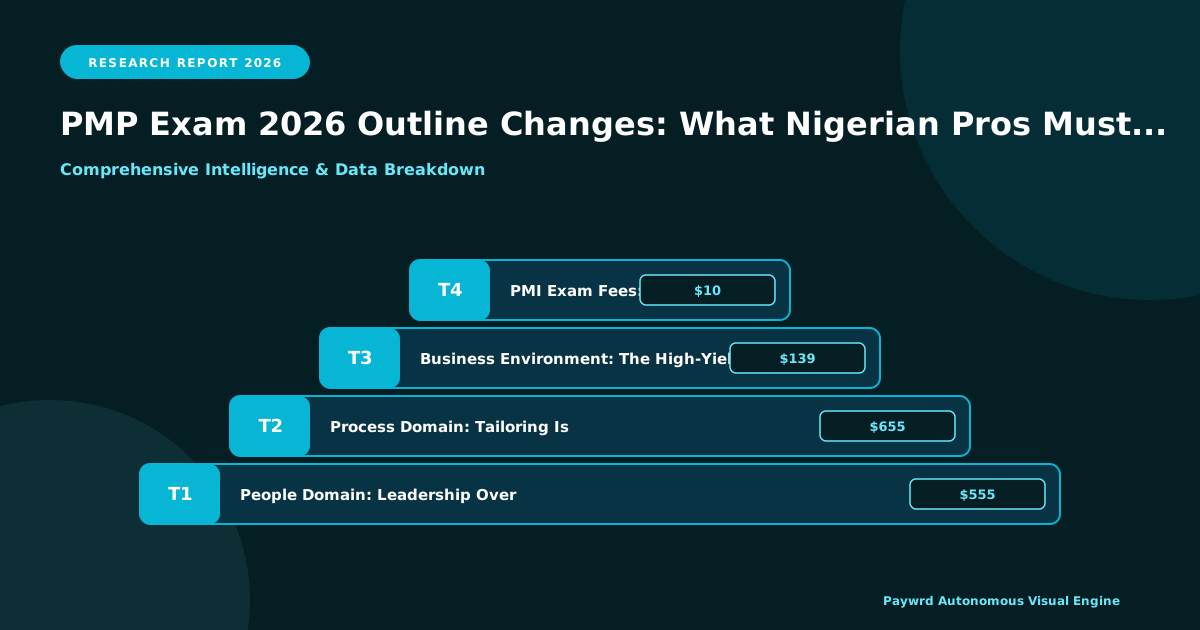
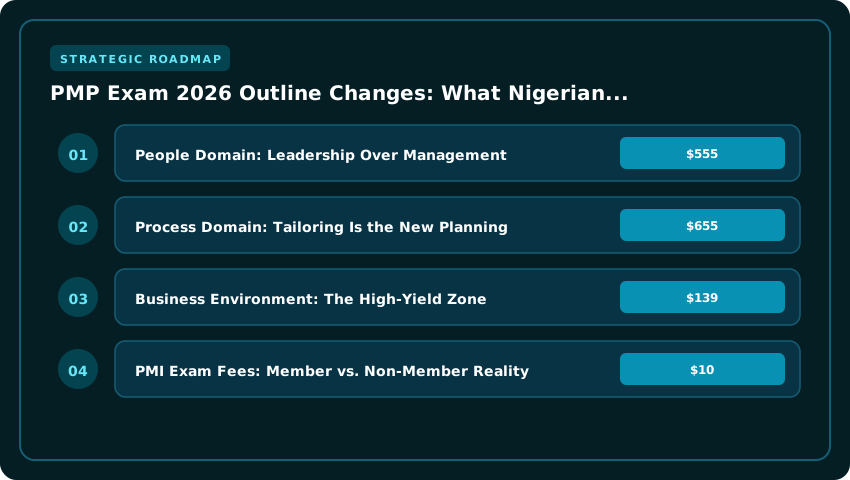
People Domain: Leadership Over Management
The People domain sheds administrative task statements. Gone are the generic “manage conflict” and “support performance” bullet points. In their place, the 2026 ECO inserts high-fidelity tasks: “Mentor relevant stakeholders,” “Promote team empowerment,” and “Address and remove impediments, obstacles, and blockers.” For a Nigerian PM leading cross-functional squads across Lagos, Abuja, and remote hubs, this translates to situational questions testing servant leadership in low-trust, high-power-distance cultures. Expect fewer “choose the best communication method” items and more “how do you unblock a stalled vendor negotiation with NITDA compliance implications” scenarios.
Process Domain: Tailoring Is the New Planning
Process drops from 50% to 45%, but the cognitive load increases. The outline explicitly removes “Manage Project Compliance” as a standalone task, folding compliance into “Plan and Manage Project/Phase Closure” and “Execute Project with Urgency.” Predictive vs. Adaptive life cycles are no longer separate silos. The new Enabler Mapping framework requires you to select artifacts (Charter, Backlog, Release Plan) based on delivery cadence, not methodology label. You must demonstrate fluency in hybrid configurations—say, a fixed-scope infrastructure rollout for a state government agency using adaptive sprints for the software layer.

Business Environment: The High-Yield Zone
This domain now carries 1 in 5 questions. New task statements demand you “Assess and prioritize opportunities to improve organizational performance” and “Evaluate project alignment with strategic objectives.” For Nigerian pros, this means mastering the intersection of project execution and macro volatility: FX fluctuation clauses in contracts, NELFUND-style funding milestone gates, and NUC CCMAS curriculum alignment for ed-tech projects. Discard any prep material treating “Business Environment” as a PESTLE acronym exercise. The 2026 exam tests whether you can pivot scope when the CBN adjusts the MPR mid-sprint.
- Study Priority: Allocate 40% of prep time to Business Environment case studies—this is where the pass/fail line sits.
- Discard: Any simulator still weighting Process at 50% or treating Agile as a separate “knowledge area.”
- Action Item: Map your last three projects to the new Enabler list (Charter, Roadmap, Backlog, Burndown, Retrospective) and identify gaps.
Agile & Hybrid Dominance: Navigating the 2026 Methodology Mix
If your PMP prep still treats Agile as a “section” you cram in the last two weeks before sitting at a Prometric center in Lagos or Abuja, you are already failing the 2026 exam. The new Examination Content Outline (ECO) doesn’t just include Agile; it assumes Agile and Hybrid fluency as the baseline language of project delivery. Predictive (Waterfall) approaches now account for roughly 30–35% of the questions, while Agile and Hybrid scenarios collectively command the remaining 65–70%. This isn’t a suggestion—it’s a structural reweighting that mirrors how Nigerian banks, telcos, and fintechs actually ship products today.
The terminology shift is your first trap. PMI has formally retired “Servant Leadership” in favor of “Stewardship” across the People domain tasks. On the exam, this changes how you evaluate correct answers. When a scenario asks how a Project Manager supports a self-organizing team, the winning option will emphasize stewardship behaviors—removing organizational impediments, safeguarding psychological safety, and enabling value flow—rather than the older “serving the team” phrasing. Nigerian candidates used to CAPM or older Rita Mulcahy editions will trip over this nuance if they don’t update their mental models.
Artifact literacy is now non-negotiable. You must operate fluently with the Product Backlog (not just a WBS), Release Planning horizons (balancing fixed-date regulatory deadlines common in CBN or NCC projects with iterative delivery), and the inspect-and-adapt cycle of Sprint Reviews versus Retrospectives. Expect scenario questions where a stakeholder demands a fixed scope/date/cost triangle—classic Predictive pressure—and you must demonstrate how to negotiate a Minimum Viable Product (MVP) using Hybrid release cadences. That is the “Process” domain in action for 2026.
- Backlog Refinement > Detailed Upfront Requirements: Questions test your ability to prioritize value (MoSCoW, WSJF) over freezing scope.
- Release Planning is Hybrid Currency: Know how to map Sprint increments to a milestone-driven roadmap for executive reporting.
- Sprint Review vs. Retrospective: Distinguish stakeholder feedback loops (Review) from team process improvement (Retro)—exam distractors conflate these constantly.
- Stewardship over Command: Correct answers empower the team; incorrect answers assign tasks or escalate prematurely.
Stop buying “Waterfall-only” crash courses sold in Ikeja computer villages. The 2026 PMP validates your ability to lead in complexity—switching seamlessly between a Gantt chart for a physical infrastructure rollout in Lekki and a Kanban board for the software layer running it. That versatility is what the new ECO measures, and that is what earns the charter.
Exam Format & CBT Logistics for Nigerian Candidates (Lagos/Abuja)
Walking into a Pearson VUE center in 2026 without a logistics plan is how you fail before the first question loads. The PMP exam remains a grueling 180-minute marathon with 230 questions—only 200 are scored, but you treat all 230 as live fire. You get two scheduled 10-minute breaks (after questions 75 and 150), and the clock does not stop for unscheduled bathroom trips. Know this cold: if you raid the water dispenser outside the break windows, your timer keeps burning.
Pearson VUE Center Reality: Lagos, Abuja & Port Harcourt
Slot availability in Lagos (Victoria Island & Ikeja hubs) and Abuja (Garki & Wuse centers) evaporates 4–6 weeks out. Port Harcourt has fewer terminals—often just 8–10 seats—so book the minute your PMI eligibility email lands. As of 2026, the exam fee is $555 for PMI members (roughly ₦830,000–₦890,000 depending on the CBN rate) and $655 for non-members. Pay via the PMI portal with a dollar-denominated card; Naira cards get declined at the final gateway. Pro tip: target the 8:30 AM slot. Afternoon sessions in Lagos run higher risk of “system latency” excuses from invigilators when the generator kicks in.
Online Proctored (OP) Exam: The Power & Internet Checklist
If you choose OP, your environment is the test center. PMI’s system check is necessary but insufficient for Nigerian infrastructure. You need:
- Dual Internet: A primary fiber/4G connection (MTN 5G or Airtel Fiber) plus a hotspot backup on a different provider. Run a 30-minute Speedtest streak the night before; anything under 10 Mbps down / 3 Mbps up is a fail risk.
- Uninterrupted Power: A 2kVA inverter or UPS rated for 4+ hours. NEPA/PHCN “light” is not a valid appeal reason. Test your laptop + monitor + router on battery for 3 hours straight two days prior.
- Room Scan Rigor: Clear walls, no second monitor, no phones within arm’s reach. The proctor will ask for a 360-degree pan via webcam. Do this in a locked room—family walking through triggers an instant flag.
- System Specs: Windows 10/11 (64-bit) or macOS 12+. Disable antivirus pop-ups, Windows Update, and “Find My” services. Run the OnVUE app install 24 hours early.
Final word: arrive at the physical center 30 minutes early with your international passport (the only accepted ID). For OP, log in 15 minutes prior. Your biometric check-in—palm vein scan at centers, facial recognition at home—is non-negotiable. Miss the window by 15 minutes, and you forfeit the fee. No refunds, no reschedules within 48 hours. Plan the logistics like a project deliverable; your certification depends on it.
PMP 2026 Certification Cost Breakdown in Naira (₦) & Funding Options
Budgeting for the PMP in 2026 requires more than a dollar-to-naira conversion; it demands a strategy that accounts for CBN forex volatility, PMI’s pricing tiers, and the specific training vendors accredited for the new ECO. As of Q2 2026, we are calculating at a conservative ₦1,550/$ (CBN I&E window average) to buffer against mid-year depreciation. If you are waiting for rates to drop before registering, you are gambling with your 2027 career trajectory.
PMI Exam Fees: Member vs. Non-Member Reality
The exam fee is fixed in USD, but your membership status dictates the naira outflow. PMI membership costs $139 (≈ ₦215,450) annually plus a $10 (≈ ₦15,500) application fee for new members.
- PMI Member Exam Fee: $405 ≈ ₦627,750. Total first-year outlay (Membership + Exam): ~₦843,200.
- Non-Member Exam Fee: $575 ≈ ₦891,250.
- Verdict: Membership saves you ~₦48,000 net on the exam alone, plus unlocks the PMBOK Guide 7th Edition/Process Group PDF (saving ~₦60,000 in book costs) and free access to the PMI Career Navigator. For Nigerian professionals, membership is a mathematical no-brainer, not a loyalty perk.
ATP Training Costs: Lagos Physical vs. Virtual Live
You cannot sit the 2026 exam without 35 Contact Hours from an Authorized Training Partner (ATP). Prices have diverged sharply post-COVID.
- Lagos In-Person (Weekend/Weekday Bootcamps): Premium providers (e.g., PMINg Chapter partners, Harrybaker, JK Michaels) now charge ₦350,000 – ₦480,000. This covers venue logistics, printed ECO-aligned workbooks, and networking. Budget an extra ₦50k–₦80k for Lagos transit/feeding over 4–5 weekends.
- Virtual Live Instructor-Led (Zoom/Teams): Same ATPs offer this for ₦220,000 – ₦320,000. You get real-time Q&A for the new “Business Environment” domain, recorded replays, and zero transit risk. Recommendation: Virtual live is the optimal ROI for 2026—ensure the ATP issues the official 35 Contact Hour certificate with their PMI ATP ID visible.
- Self-Paced/Recorded Only: Avoid. PMI audits reject “asynchronous only” certificates lacking live instructor interaction timestamps.
Funding the 2026 Uptake: NELFUND, ITF & Corporate L&D
Do not self-fund 100% if you can avoid it. Three distinct pipelines exist for Nigerian pros in 2026:
- NELFUND (Student Loan Act): Currently limited to tuition in NUC-accredited tertiary institutions. Workaround: If your ATP partners with a university (e.g., Unilag Consult, LBS Executive Education) for the PMP prep, the fee qualifies as “tuition.” Apply via the NELFUND portal citing “Professional Certification Course.” Approval takes 4–6 weeks; start now for Q4 2026 exams.
- ITF (Industrial Training Fund) Reimbursement: If your employer contributes 1% payroll to ITF, they can claim up to 50% of your training cost via the Reimbursement Scheme. HR must submit the ATP invoice, course outline mapped to the 2026 ECO, and proof of payment to the ITF Area Office before training starts. This is the most underutilized pot in corporate Nigeria.
- Corporate L&D Budgets (FY 2026/2027): Frame the ask around “ECO 2026 Compliance.” The new Business Environment domain (regulatory volatility, ESG, strategic alignment) maps directly to CBN/SEC compliance risks your bank, telco, or oil major faces. Submit a one-pager: Cost: ₦1.1M | Risk Mitigation: Regulatory Project Failure | ROI: 90% First-Pass Rate with ATP X. Approvals accelerate when tied to audit findings.
Bottom Line: Total all-in budget (Member + Virtual ATP + Exam + Buffer) = ~₦1.25M – ₦1.4M. Secure ITF or L&D sign-off by August 2026 to beat the inevitable Q4 price adjustment.
Selecting PMI-ATP Training Providers in Nigeria: 2026 Vetting Checklist
Not every “PMP training” advert on LinkedIn or WhatsApp qualifies you for the 2026 exam. PMI’s audit team rejects applications daily because candidates present certificates from vendors who lost Authorized Training Partner (ATP) status years ago or never held it. In Nigeria, the stakes are higher: you are paying in Naira—often ₦300,000 to ₦600,000—and a rejected application means zero refund and a delayed career trajectory. Your first filter is the official PMI ATP Directory. Search the provider’s legal name exactly as registered; “Harrybaker Training” and “Harrybaker Consulting” are not interchangeable in PMI’s database.
Verified 2026 ATP Landscape in Nigeria
As of Q2 2026, the consistently verified ATPs delivering the updated ECO curriculum include Project Management College (PMC), Harrybaker Training, and KnowledgeHut (via UpGrad). Several local university partners—notably Lagos Business School (LBS) Executive Education and Covenant University’s Centre for Systems Engineering—run accredited cohorts aligned to the new “Business Environment” weight. Avoid any center advertising “PMI-REP”; that program sunset in 2026. If a vendor cannot produce a current ATP ID number verifiable on pmi.org/atp, walk away.
35 Contact Hours: Certificate Validity & Audit Traps
The 35 Contact Hours certificate must explicitly reference the 2026 ECO domains (People, Process, Business Environment). Certificates citing the old 2026 split (People 42%, Process 50%, Business Environment 8%) are technically invalid for 2026 applications and will trigger an automatic audit flag. Ensure the PDF certificate includes: ATP Provider Name, ATP ID, Your Full Name (matching passport), Course Title “PMP Exam Prep – 2026 ECO Aligned,” Date Range, and 35 Contact Hours. Screenshots of Zoom attendance or generic “Certificate of Completion” without the ATP ID will be rejected by PMI’s automated intake bot.
Mock Exam Simulators: PMI-Style vs. Generic Banks
Your ATP should grant access to a PMI-style simulator—ideally the official PMI Authorized PMP Exam Prep platform or a licensed equivalent like PMTraining or RMC Learning Solutions question banks updated for the 2026 task mappings. Generic Udemy question banks (often 1,500+ questions for ₦15,000) test recall, not the situational judgment the new ECO demands. Vet the simulator by checking: 1) Questions map to the 12 Principles and 8 Performance Domains; 2) Explanations cite the PMBOK® Guide – 7th Edition and Process Groups: A Practice Guide; 3) Timed, full-length 180-question exams with the new 230-minute interface. If your provider only offers a PDF dump, you are not exam-ready.
- Action Item: Download the provider’s ATP verification screenshot from pmi.org before wire transfer.
- Red Flag: “Guaranteed pass” or “exam leak” promises—PMI revokes ATP status for this.
- Budget Tip: Negotiate corporate rates; LBS and PMC often discount 15–20% for groups of 5+ from the same organization.
Bridge the Gap: Upgrading Pre-2026 Study Materials for Current Outline
You don’t need to burn your library or drop another ₦350,000 on a 2026 bootcamp. The 2026 ECO shift is structural, not foundational—PMI still tests the same PM DNA, but the expression of that DNA has mutated toward business acumen and adaptive delivery. If you own a solid 2026–2026 stack (PMBOK 7th, Process Groups Practice Guide, Rita 10th/11th, or Andy Crowe 6th), you are 70% ready. The remaining 30% is surgical patching, not reconstruction.
PMBOK 7th Ed vs. Process Groups Practice Guide: 2026 Priority Chapters
Stop reading PMBOK 7th cover-to-cover. The 2026 ECO leans heavily on the Process Groups Practice Guide (PGPG) for the “Process” domain (now weighted differently) and PMBOK 7th’s Principles & Performance Domains for “People” and “Business Environment.” Prioritize this triage:
- PGPG Chapters 3, 4, 5 (Planning, Executing, Monitoring/Controlling): Map these directly to the new “Process” task statements around governance, compliance, and release management. Nigerian pros: pay special attention to the “Compliance” sub-sections—think NDPR data sovereignty or CBN regulatory reporting constraints.
- PMBOK 7th Sections 3 (System View) & 4 (Performance Domains): Focus on “Measurement,” “Uncertainty,” and “Stakeholder” domains. The 2026 ECO explicitly tests “Benefits Realization” and “Organizational Change Management” as core tasks, not footnotes.
- Discard: Deep memorization of ITTO tables from PMBOK 6th. The 2026 exam tests application of tailoring models, not input/output recall.
Rita Mulcahy / Andy Crowe: 2026 Supplement Pages vs. New Edition Wait
Do not wait for the “Rita 12th Edition” or “Crowe 7th” to hit Roving Heights or Laterna. They typically lag 6–9 months post-ECO release. Instead, buy the official PMI 2026 ECO PDF (free for members, ~$22/₦35,000 for non-members) and build a “Delta Supplement” in OneNote or Notion.
- Rita 10th/11th Owners: Her “Tricks of the Trade” sidebars are gold for the new “Business Environment” scenario questions. Add sticky notes linking her “Change Management” chapter to the new ECO Task 3.4 (Assess and manage business environment changes).
- Andy Crowe Owners: His “Process Chart” appendix remains the best visual map for PGPG alignment. Annotate the 2026 “Agile/Hybrid” task verbs (e.g., “Facilitate,” “Empower,” “Inspect/Adapt”) onto his Waterfall flow.
- Cost Hack: If your budget is tight (NYSC allowance tight), skip the new book. Use the PMIstandards+ platform (included with membership) for the updated “Stakeholder Engagement” and “Business Acumen” modules.
Free PMI ECO 2026 PDF Cross-Reference Worksheet for Self-Study
Download the PMP Exam Content Outline 2026 PDF from PMI.org. Do not just read it—reverse-engineer it. Build a three-column spreadsheet:
- Column A: Every 2026 Task Statement (verbatim).
- Column B: Your current book chapter/page/video timestamp that covers it.
- Column C: Gap Status: Covered, Weak, Missing.
Filter for “Missing.” That is your 2026 study plan. For Nigerian candidates juggling Lagos traffic or Port Harcourt shift rosters, this worksheet turns 200 hours of vague reading into 60 hours of targeted gap-filling. Pair it with the free PMI Authorized PMP Exam Prep course preview modules (often released on YouTube or PMI Chapter sites) to validate your “Weak” columns. You aren’t studying harder; you’re studying smarter for the 2026 reality.
Post-Certification ROI: Leveraging PMP in Nigeria’s 2026 Job Market
Let’s talk returns. In Nigeria’s 2026 economy, the PMP isn’t a vanity badge—it is a verified salary multiplier and a mobility passport. The credential signals to employers across Lagos, Port Harcourt, and Abuja that you can deliver scope inside volatile regulatory windows and FX fluctuations. That competence commands a premium.
2026 Salary Bands by Sector (₦/Annum)
Data aggregated from recent Jobberman, MyJobMag, and LinkedIn Nigeria salary insights for PMP-certified roles shows clear stratification. These figures represent total compensation packages (base + allowances) for mid-to-senior Project Managers (5–10 years’ experience).
- Oil & Gas (IOCs & Indigenous Majors): ₦18,000,000 – ₦32,000,000. Deepwater and FPSO projects pay the highest premium for risk management rigor.
- Fintech & Digital Banking: ₦14,000,000 – ₦25,000,000. Agile-hybrid delivery leads (Squad Leads/Release Train Engineers) with PMP + SAFe certs hit the ceiling.
- Telecoms (MTN, Airtel, Globacom, 9mobile): ₦12,000,000 – ₦22,000,000. 5G rollout and fiber backbone projects drive demand for infrastructure PMs.
- Construction & Real Estate (Eko Atlantic, Lekki Free Zone): ₦10,000,000 – ₦18,000,000. ESG compliance and local content law adherence push rates up.
Uncertified peers in identical roles typically trail by 25–35%. The delta pays for the exam, training, and renewal within the first six months.
Maintenance Economics: The 60 PDU Cycle
Keeping the credential active requires 60 Professional Development Units (PDUs) every three years. In 2026, this is a net-zero cost activity if you plug into the PMI Nigeria Chapter. The chapter hosts monthly physical meetups in Lagos (Victoria Island/Ikeja), Abuja, and Port Harcourt, plus virtual webinars covering “Business Environment” nuances—local tax reforms, NDPR compliance, and AfCFTA trade facilitation. Attending just four chapter events annually yields ~16 PDUs (Technical/Strategic) for free. The remaining 44 PDUs are easily harvested via free PMI webinars, corporate L&D platforms (LinkedIn Learning, Coursera via employer license), or volunteering as a mentor—earning “Giving Back” PDUs.
Visa & Relocation Leverage: The Global Mobility Multiplier
For professionals targeting the “Japa” route, PMP is a recognized occupational credential, not just a certificate.
- UK Skilled Worker Visa: Project Manager (SOC 2133) is on the Shortage Occupation List. PMP satisfies the “appropriate qualification” threshold for RQF Level 6 equivalence, reducing the salary threshold requirement to £26,200/year (approx. ₦48M at 2026 rates) versus the standard £38,700. It also awards 20 points under the UK points-based system for “qualifications in a shortage occupation.”
- Canada Express Entry (FSW): PMP validates NOC 13100 (Project Managers). It strengthens the Educational Credential Assessment (ECA) profile—WES/ICAS often treat it as a “Professional License” equivalent to a Master’s level credential for CRS points, adding up to 50 points under “Skill Transferability” (Foreign Work Experience + Certificate).
Bottom line: The 2026 PMP pays dividends in Naira today and converts to Pounds or Canadian Dollars tomorrow. The ROI isn’t theoretical; it’s baked into the current hiring algorithms of the biggest employers in Nigeria and the immigration policies of top destination countries.
| Criteria | Previous ECO (Pre-2026) | 2026 ECO (Current) | Impact for Nigerian Pros |
|---|---|---|---|
| People Domain Weight | 42% | 35% | Reduced emphasis on pure leadership; soft skills now baseline expectation. |
| Process Domain Weight | 50% | 45% | Technical execution (Agile/Waterfall) remains critical but slightly de-prioritized. |
| Business Environment Weight | 8% | 20% | Major shift: Strategy, compliance & regulatory navigation are now core competencies. |
| Exam Prep Timeline (2026) | N/A | 3-4 Months | Requires new materials (PMBOK 7th Ed, Process Groups Guide, Business Analysis). |
| Estimated Total Cost (NG) | ₦650,000 – ₦900,000 | ₦750,000 – ₦1,100,000 | Includes PMI membership ($139), Exam fee ($405/$555), & updated bootcamps. |
| PDU Requirement (CCR) | 60 PDUs / 3 yrs | 60 PDUs / 3 yrs | Unchanged; focus new PDUs on ‘Business Acumen’ & ‘Strategic Alignment’ categories. |
Frequently Asked Questions
What are the new PMP exam domain weights for 2026?
The 2026 PMP Exam Content Outline allocates 35% to People, 45% to Process, and 20% to Business Environment. This replaces the previous 42/50/8 split, significantly increasing focus on strategic alignment and regulatory compliance for Nigerian project managers.
How much does the PMP certification cost in Nigeria for 2026?
Total 2026 PMP costs in Nigeria range from ₦750,000 to ₦1,100,000. This covers PMI membership ($139), the exam fee ($405 for members/$555 non-members), and updated 2026-compliant training bootcamps. Budget for exchange rate volatility on dollar-denominated fees.
Which study materials are mandatory for the 2026 PMP exam update?
Candidates must use PMBOK Guide 7th Edition, the Process Groups Practice Guide, and the Business Analysis for Practitioners guide. The Agile Practice Guide remains relevant. Older 6th Edition PMBOK materials are insufficient for the new 20% Business Environment domain.
Does the 2026 PMP exam change affect my current PMI application eligibility?
No. The 2026 ECO changes only affect exam content, not eligibility criteria. You still need 35 contact hours and either a degree with 36 months experience or a diploma with 60 months. Applications approved in 2026/2027 will test on the new outline immediately.
How should Nigerian PMs prepare for the increased Business Environment domain?
Focus study on organizational strategy, regulatory compliance (Nigerian local laws & international standards), and benefit realization. Allocate 40% of prep time to case studies involving stakeholder governance and market volatility, mirroring the new 20% exam weight.
Strategic Final Takeaway
When evaluating What Changed In PMP Exam 2026 Outline in 2026 and beyond, base your decisions on accredited institutional standards, verified return on investment (ROI), and up-to-date official guidelines. Always verify specific dates and requirements through official regulatory portals.


Zuerst sollte man frische Krauter auswahlen, die gut zu den Gerichten passen, die man zubereiten mochte.
Sie mochten [url=https://bestattungen-vonderheydt.de/2026/10/13/kraeutersalz-selber-machen-so-wird-es-aromatischer-als-gekauft/]herbal salt with organic herbs[/url] selbst herstellen, um ein aromatisches und naturbelassenes Krautersalz zu erhalten.
Das Herstellen von Krautersalz ist eine kreative und schmackhafte Methode, um die Kuche aufzuwerten.Je nach Rezept kann das Salz grob oder fein gemahlen werden, um unterschiedliche Texturen zu erzielen.