Top 10 Highest-Paying STEM Master’s Degrees in the US
When evaluating the return on investment (ROI) for advanced education, prospective students must look closely at verified compensation data. The US Bureau of Labor Statistics (BLS) provides a highly reliable benchmark for understanding what graduates can realistically expect to earn across different stages of their careers. Below, we analyze the top ten highest-paying STEM master’s degrees, detailing entry-level, mid-career, and 90th-percentile senior salaries, alongside the typical US employers that actively recruit these specialized professionals.
- Petroleum Engineering: Entry-level:
Calculating the True ROI: Tuition Costs vs. Lifetime Earnings
Understanding the genuine return on investment (ROI) for a graduate-level STEM degree requires moving beyond glossy salary averages and confronting the raw mathematics of educational financing. While the allure of six-figure starting salaries in fields like petroleum engineering or quantitative finance is undeniable, the true value of a master’s degree is determined by weighing total tuition expenditures, opportunity costs, and projected lifetime earnings against realistic loan repayment scenarios. For American students, this calculation is the difference between a financially liberating credential and a decades-long debt burden. Building a transparent financial framework is the most reliable way to cut through marketing claims and make an evidence-based decision.
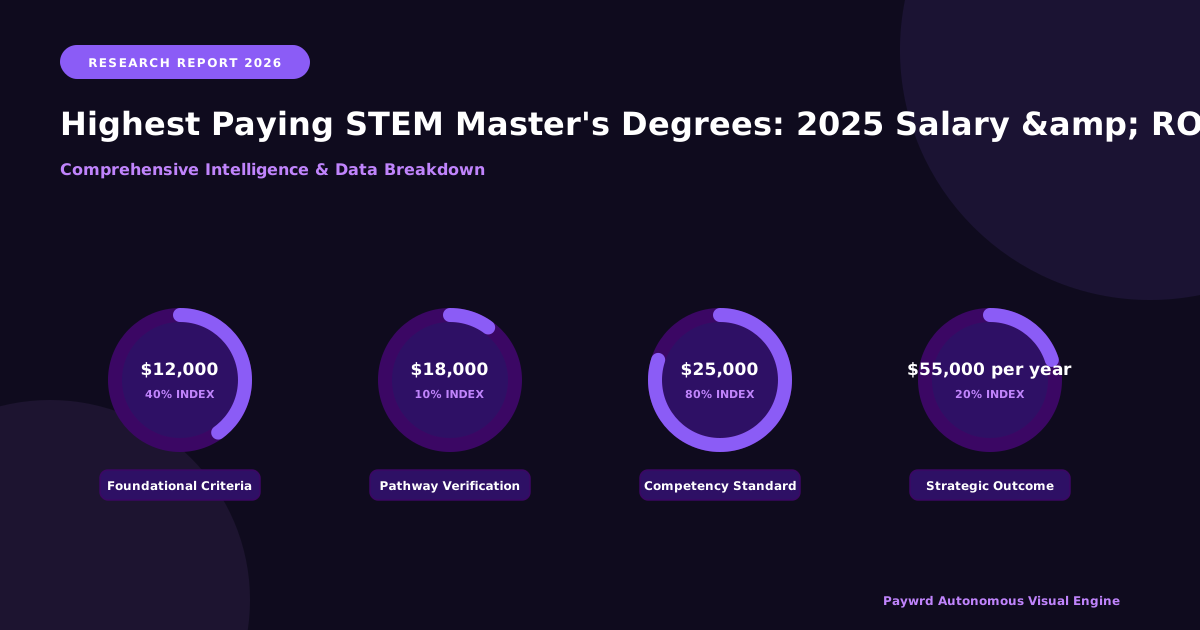
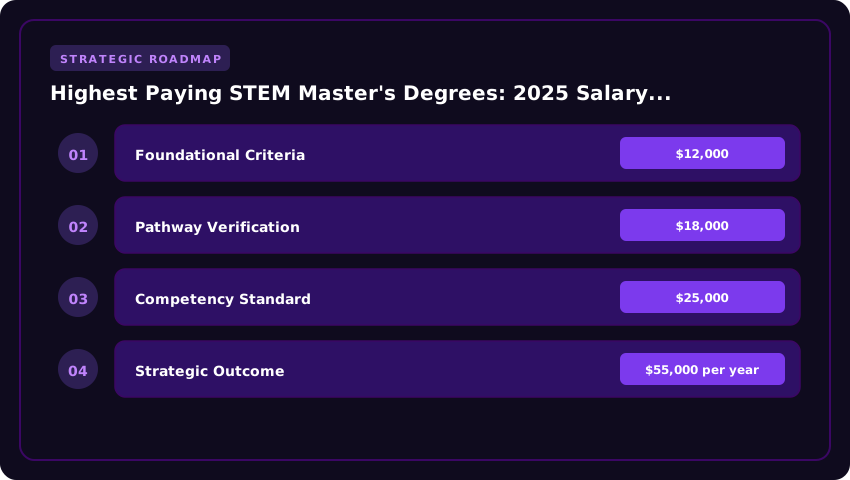
The first step in this framework involves calculating the all-in cost of attendance. According to data from the National Center for Education Statistics (NCES) and the College Board, the average annual graduate tuition and fees at a public, in-state university typically range from $12,000 to $18,000. Out-of-state and private institutions can push this figure between $25,000 and $55,000 per year. Top-tier programs accredited by agencies like ABET (for engineering) or AACSB (for business-adjacent analytics) often sit at the upper end of these ranges. Students must account for tuition, mandatory fees, health insurance, textbooks, and living expenses. For a standard two-year master’s program, the total sticker price frequently lands between $40,000 and $120,000, depending heavily on institutional prestige and geographic location.
Once the gross cost is established, the next phase is modeling projected lifetime earnings differentials. The US Bureau of Labor Statistics (BLS) consistently shows that professionals holding a master’s degree in STEM fields earn a median weekly wage roughly 20% higher than those with only a bachelor’s degree. Over a 35-to-40-year career, this compounding premium can amount to $500,000 to $1.2 million in additional gross income. However, prospective students should anchor their projections to realistic entry-level figures. For instance, a Master of Science in Computer Science from an accredited US university typically yields starting salaries in the $95,000 to $135,000 range, while a Master’s in Petroleum Engineering can command starting offers between $110,000 and $145,000 in energy hubs like Houston or Denver.
- Step 1: Define the Total Investment — Sum tuition, fees, and living expenses for the entire program length. Subtract any tax-free fellowships, teaching assistantships, or employer tuition reimbursement. The net out-of-pocket cost is your true starting investment.
- Step 2: Establish the Baseline Salary — Identify the verified median starting salary for your specific degree and target industry, referencing BLS Occupational Outlook Handbooks and recent graduate employment surveys.
- Step 3: Calculate the Break-Even Point — Divide your total educational investment by your projected annual earnings premium compared to holding only a bachelor’s degree. This reveals exactly how many years of post-graduation work are required to recoup your costs.
- Step 4: Model the Loan Repayment Scenario — For funded portions, apply current federal Direct Grad PLUS loan interest rates (typically around 8-9% in 2025). Standard ten-year repayment plans will dictate your monthly cash flow obligation and total interest paid.
- Step 5: Compute the Net Present Value (NPV) — Apply a conservative discount rate (usually 3% to 5%, reflecting inflation and investment opportunity costs) to your projected lifetime earnings. Subtract your initial costs to find the true current-day value of your degree.
Applying these steps reveals stark differences between programs. For example, an in-state Master of Science in Data Science costing roughly $30,000 total with a starting salary of $110,000 generates a break-even point of under two years. Conversely, a private university Master of Engineering program costing $90,000 with a starting salary of $105,000 may take four to five years to reach the break-even threshold, especially if the graduate carries significant debt at high interest rates.
Finally, sophisticated prospective students must evaluate opportunity cost. Two years spent in a graduate program means two years of forgone full-time earnings, which can easily exceed $100,000 for high-earning bachelor’s holders. Accelerated one-year programs, cooperative education tracks, and STEM-designated degrees (which allow international students up to 36 months of Optional Practical Training, though this applies primarily to visa-holders) often improve the NPV calculation. By rigorously applying this five-step framework, American students transform the abstract concept of ROI into a clear, actionable financial roadmap that aligns their educational ambitions with long-term economic security.
ABET and AACSB Accreditation: Why It Directly Impacts Your Paycheck
When you are investing upwards of $60,000 in a STEM master’s degree, verifying a university’s regional accreditation is only the first step. To truly maximize your return on investment and unlock the highest salary bands in the United States, you must prioritize programmatic accreditation. Specifically, accreditation from ABET (for engineering and computing programs) and AACSB (for business and technology programs) serves as the gold standard for Fortune 500 recruiters, federal agencies, and state licensing boards. Without it, your degree might not hold the professional weight required to secure top-tier compensation.
For aspiring engineers, ABET accreditation is not just a quality benchmark—it is a strict prerequisite for career advancement. If your goal is to achieve a Professional Engineer (PE) license, which can increase your earning potential by an average of $15,000 to $25,000 annually, you must graduate from an ABET-accredited program. State licensing boards across the US strictly require candidates to hold an ABET-accredited degree before they can sit for the Fundamentals of Engineering (FE) exam. Furthermore, Fortune 500 defense contractors and government agencies offering cleared positions—such as the Department of Defense or NASA—frequently filter out candidates whose degrees lack ABET validation. They need verified assurance that your technical training meets rigorous national standards.
Similarly, for students pursuing STEM-adjacent business degrees like Management Information Systems, Business Analytics, or Quantitative Finance, AACSB accreditation is the ultimate gatekeeper. AACSB-accredited programs undergo meticulous peer-review processes that ensure their curricula align with current industry demands. Top-tier consulting firms, investment banks, and Fortune 500 tech companies rely on AACSB accreditation as a baseline filter during the hiring process. Graduating from a non-AACSB program can severely limit your access to elite recruiting pipelines, effectively capping your salary potential and diminishing the ROI of your advanced education.
- Government Cleared Positions: Federal roles requiring security clearances mandate verifiable educational backgrounds. ABET and AACSB accreditations streamline this vetting process, making you a highly competitive candidate for lucrative federal contracts.
- Fortune 500 Hiring Filters: Major corporations use automated applicant tracking systems that instantly flag or discard resumes lacking programmatic accreditation. Having ABET or AACSB on your transcript ensures your application makes it to a human recruiter.
- Professional Licensure (PE): Only ABET-accredited degrees satisfy the educational requirements to pursue a PE license, a credential that directly correlates with senior leadership promotions and higher lifetime earnings.
Ultimately, choosing an accredited program is a strategic defense of your educational investment. Before you submit your application or file your FAFSA, take the time to cross-reference your target programs with the official ABET and AACSB databases. Doing so guarantees that your hard-earned degree translates directly into higher paychecks, elite career mobility, and long-term professional success.
FAFSA, Grants, and Employer Tuition Reimbursement for STEM Grads
Pursuing a master’s degree in a high-paying STEM field represents a significant financial commitment, with tuition at accredited US institutions frequently ranging from $15,000 to $60,000 annually depending on whether students attend a public flagship university, a private research powerhouse, or a specialized technical institute. Fortunately, graduate students in science, technology, engineering, and mathematics disciplines have access to a robust ecosystem of federal aid, state-funded assistance, and tax-free employer benefits that can dramatically reduce out-of-pocket costs. Understanding how to strategically layer these funding sources is the difference between graduating with manageable debt and being burdened by six-figure loan balances that delay major life milestones like homeownership, marriage, or retirement planning.
The Free Application for Federal Student Aid (FAFSA) remains the foundational gateway to most institutional, state, and federal grants, fellowships, and subsidized loans. For the 2025–2026 academic year, the US Department of Education has prioritized a streamlined application process, but prospective STEM graduate students should be aware that FAFSA deadlines vary significantly by state and institution. Many competitive programs award funds on a first-come, first-served basis, so filing the FAFSA as early as October 1 of the preceding year is strongly recommended. While graduate students are considered independent for FAFSA purposes, the application still requires reporting of prior-prior year income, assets, and any employer-provided educational assistance. Submitting accurate information through the official StudentAid.gov portal ensures eligibility for Federal Direct Unsubsidized Loans, Grad PLUS Loans, and—critically—campus-based aid like the Teacher Education Assistance for College and Higher Education (TEACH) Grant.
The TEACH Grant program is an often-overlooked federal resource that provides up to $4,000 per year to students who commit to teaching in high-need fields, including mathematics, science, computer science, and engineering, at a low-income school for at least four years within eight years of graduation. For STEM graduates who blend technical expertise with a passion for education, this grant can substantially offset master’s degree costs at institutions with accredited teacher preparation programs. However, recipients must complete TEACH Grant counseling and sign an Agreement to Serve each year; failure to fulfill the teaching obligation converts the grant into an unsubsidized Direct Loan with retroactive interest charges. Because the compliance requirements are stringent, prospective applicants should review the program’s terms carefully on the Federal Student Aid website before committing.
Beyond federal aid, state-based grants and tuition assistance programs offer another valuable funding layer, particularly for students pursuing degrees in fields aligned with regional workforce priorities. States like California (Cal Grant A and B), New York (Tuition Assistance Program), Texas (TEXAS Grant), and Florida (Effective Access to Student Education) maintain dedicated funding pools for graduate students, though eligibility criteria, award amounts, and renewal requirements differ substantially. Many state programs also require institutional certification through the National Student Loan Data System (NSLDS), making it essential to coordinate state aid with federal filing timelines. STEM students should also investigate fellowship programs administered by organizations such as the National Science Foundation (NSF Graduate Research Fellowship Program), the Department of Defense (NDSEG Fellowship), and the Department of Energy (DOE Office of Science Graduate Student Research Program), each of which can provide full tuition coverage, stipends, and research allowances.
- FAFSA Priority Filing: Submit the FAFSA by October 1 for maximum consideration of institutional grants, state aid, and federal loans. Many top STEM programs have priority deadlines of December 1 or January 15.
- TEACH Grant Eligibility: Confirm that your master’s program includes a teacher certification track and that you complete annual counseling and Agreement to Serve requirements through StudentAid.gov.
- State Grant Research: Use your state’s higher education agency website to identify STEM-specific awards, and verify whether your chosen program is on the approved institution list.
- External Fellowships: Apply to the NSF GRFP, NDSEG, and DOE SCGSR programs, which historically fund thousands of STEM graduate students annually with awards up to $50,000 per year.
- Employer Tuition Reimbursement: Leverage Section 127 educational assistance programs, which allow employers to provide up to $5,250 per year in tax-free tuition, fees, books, and supplies to full-time employees.
For working professionals, employer-sponsored tuition assistance under Internal Revenue Code Section 127 is one of the most powerful—and underutilized—financial tools available to STEM graduate students. The current annual exclusion of $5,250 allows employers to pay for coursework, textbooks, and required fees without the benefit being treated as taxable income to the employee. Major technology companies, defense contractors, and engineering firms—including Amazon, Boeing, Lockheed Martin, Raytheon, Google, and Microsoft—routinely offer Section 127 plans that cover graduate-level coursework directly related to an employee’s current job duties. Many plans reimburse students upon successful course completion with a minimum grade (often a B or higher), meaning students can essentially earn their master’s degree while receiving a paycheck, a tuition benefit, and—in many cases—a retention bonus or promotion upon graduation.
Strategic layering is the ultimate goal: a single STEM graduate student might combine a federally subsidized Grad PLUS Loan, a state-specific grant, an NSF fellowship stipend, and employer Section 127 reimbursement to fully fund a $40,000 annual program at a top-tier engineering school. By understanding each program’s eligibility rules, deadlines, and compliance requirements—and by filing the FAFSA early each year—prospective students can transform a high-cost master’s degree into one of the most rewarding investments of their professional lives.
State-by-State Salary Analysis: Where STEM Master’s Degrees Pay Most
Geography matters enormously when evaluating the return on investment (ROI) of a STEM master’s degree. A six-figure salary in San Francisco delivers far different purchasing power than the same nominal figure in a lower-cost metro, which is why the smartest graduate students and mid-career professionals analyze regional compensation alongside cost-of-living adjustments before committing to a relocation or a particular employer’s offer. According to the US Bureau of Labor Statistics (BLS) Occupational Employment and Wage Statistics program, STEM occupations continue to dominate the highest-paying metropolitan areas in the country, with tech corridors, energy hubs, and federal-government clusters leading the pack.
The San Jose-Sunnyvale-Santa Clara metropolitan area consistently ranks as the nation’s number-one market for STEM wages, particularly for software developers, computer and information research scientists, and data scientists. Median annual wages in Silicon Valley routinely exceed $170,000 for experienced computer science master’s holders, with senior machine-learning engineers and applied scientists at firms like Alphabet, Nvidia, and Apple clearing well over $250,000 when base salary, RSUs, and bonuses are tallied. However, the Council for Community and Economic Research’s Cost-of-Living Index pegs San Jose housing costs at roughly 80 percent above the national average, meaning the real, adjusted purchasing power narrows significantly. A candidate evaluating an offer must apply a regional multiplier of approximately 0.55 to translate nominal Silicon Valley wages into a national-equivalent figure.
The Houston-The Woodlands-Sugar Land metro tells the opposite story. Petroleum engineering, chemical engineering, and electrical engineering master’s graduates find abundant opportunity with ExxonMobil, Chevron, Schlumberger, and a robust ecosystem of energy-tech startups. Median STEM wages hover near $115,000 to $130,000, which sounds modest compared to San Jose, yet Houston’s cost-of-living index sits near 96 percent of the national average, with no state income tax in Texas. Adjusted for purchasing power, a $125,000 Houston engineering salary can rival a $180,000 Bay Area package once housing, transportation, and state taxes are factored in. This is the core insight of any rigorous geographic ROI analysis: nominal salary is a starting point, never the finish line.
Washington, D.C.-Arlington-Alexandria remains the premier destination for government-adjacent STEM careers, cybersecurity, and data engineering roles supporting federal agencies and defense contractors. Computer network architects, information security analysts, and operations research analysts earn median wages between $115,000 and $140,000, and the region benefits from a steady pipeline of cleared-position opportunities at Booz Allen Hamilton, Lockheed Martin, Northrop Grumman, and the federal civil service. The trade-off is steep housing costs in D.C. proper, though satellite communities in Northern Virginia and suburban Maryland offer more reasonable options. For master’s graduates holding credentials from ABET-accredited programs, the D.C. metro delivers strong long-term earnings trajectories, particularly for those willing to pursue security clearances that typically add a 10 to 15 percent salary premium.
The Boston-Cambridge-Newton corridor anchors the East Coast biotech and quantitative-finance cluster. Biomedical engineers, biostatisticians, and computational biology master’s graduates find high-paying roles at Vertex Pharmaceuticals, Moderna, Biogen, and a deep network of teaching hospitals affiliated with Harvard, MIT, and Boston University. Median STEM wages approach $135,000, with senior bioinformatics scientists and quant researchers exceeding $200,000. Boston’s cost-of-living index runs roughly 48 percent above the national average, but the density of AACSB-accredited business schools and ABET-accredited engineering programs creates powerful cross-sector mobility for graduates who want to pivot between pharma, finance, and tech.
On the West Coast, the Seattle-Tacoma-Bellevue metro hosts Amazon, Microsoft, Boeing, and a flourishing cloud-computing sector. Software development managers, data scientists, and computer hardware engineers earn median wages between $140,000 and $165,000, with total compensation at FAANG-adjacent firms frequently surpassing $250,000. Washington’s lack of state income tax enhances real take-home pay, though Seattle housing costs now rival San Francisco in many submarkets.
Meanwhile, emerging markets like Austin-Round Rock, Raleigh-Durham, and Denver-Aurora-Lakewood offer compelling risk-adjusted opportunities. Austin has rapidly matured into a major tech hub with Tesla, Oracle, and a deep founder ecosystem, pushing STEM median wages near $125,000 with no state income tax. Raleigh-Durham’s Research Triangle anchors biopharma and telecommunications, drawing IBM, Cisco, and GlaxoSmithKline talent. Denver combines aerospace (Lockheed Martin’s space division), renewable energy, and a growing software scene, with STEM wages around $115,000 and a cost-of-living index approximately 12 percent above the national average, considerably more affordable than coastal alternatives. For master’s graduates prioritizing purchasing power and lifestyle, these metros frequently deliver higher real-dollar ROI than headline-grabbing coastal offers.
Actionable takeaway: before accepting any STEM master’s offer, build a simple spreadsheet that captures base salary, projected bonuses, state income tax, estimated rent or mortgage, and healthcare costs. Compare the adjusted figure across at least three metros, and weight your decision by five-year total compensation rather than first-year salary alone.
- San Jose, CA: Highest nominal STEM wages ($170,000+ median), but a 0.55 purchasing-power multiplier dramatically narrows the lead.
- Houston, TX: Energy-sector engineering hub with $115,000–$130,000 median wages and no state income tax, delivering strong adjusted ROI.
- Washington, D.C.: Cybersecurity, defense, and federal-data roles paying $115,000–$140,000, with security-clearance premiums of 10–15 percent.
- Boston, MA: Biotech and quant-finance cluster offering $135,000 median wages and powerful cross-sector mobility for ABET-credentialed graduates.
- Seattle, WA: Cloud and aerospace hub with $140,000–$165,000 median wages, no state income tax, but rising housing costs.
- Austin, TX: Emerging tech market with $125,000 median wages, no state income tax, and a still-reasonable cost-of-living index.
- Raleigh-Durham, NC: Research Triangle biopharma and telecommunications roles averaging $110,000–$120,000 with affordable housing.
- Denver, CO: Aerospace, renewables, and software convergence at $115,000 median wages, balancing opportunity with livability.
Career Switch Strategy: Moving Into STEM from a Non-STEM Bachelor’s
Transitioning into a science, technology, engineering, or mathematics (STEM) field without an undergraduate degree in a related discipline can feel like standing at the base of a steep mountain. The good news is that American universities have invested heavily in alternative pathways designed specifically for career changers, recognizing that the modern workforce demands flexible, accessible, and accelerated routes into high-demand technical careers. Whether you hold a bachelor’s degree in English, business administration, history, or psychology, there are now multiple vetted entry points that can place you into a high-paying STEM career within 18 to 36 months.
The three most effective pathways for career switchers are accelerated bridge programs, post-baccalaureate certificates, and combined Bachelor of Science / Master of Science (BS/MS) pathways. Each serves a slightly different demographic: bridge programs are aimed at professionals with existing industry experience, post-baccalaureate certificates suit those needing targeted prerequisite coursework, and combined BS/MS programs are ideal for career changers willing to commit to a longer academic sequence.
- Accelerated Bridge Programs: These programs compress foundational STEM coursework into a fast-tracked curriculum, allowing students with non-technical degrees to enter a master’s program with confidence. Georgia Tech’s Online Master of Science in Computer Science (OMSCS) is arguably the most celebrated example. With total tuition historically hovering near $7,000 to $10,000 for the entire degree, OMSCS accepts students from diverse academic backgrounds, though successful applicants typically demonstrate programming proficiency through prior coursework, bootcamp completion, or professional experience. The program operates through a partnership with Udacity and AT&T, and it has produced thousands of career changers now working at Amazon, Google, and Microsoft.
- Post-Baccalaureate Certificates: For students who need to demonstrate readiness before committing to a full master’s, post-bacc certificates provide a low-risk testing ground. Programs at the University of Illinois Urbana-Champaign (UIUC), such as the Online Master of Computer Science in Data Science (MCS-DS), allow conditional entry for students who complete preparatory coursework. Similarly, Oregon State University offers a post-bacc pathway in computer science that feeds directly into its MCS program. These certificates typically cost between $4,000 and $15,000 and can be completed in 9 to 15 months.
- Competency-Based and Self-Paced Programs: Western Governors University (WGU) has pioneered a competency-based model that evaluates students on what they can demonstrate rather than how many credit hours they log. WGU’s Master of Science in Data Analytics, Cybersecurity, or Information Technology Management accepts career changers without requiring the Graduate Record Examinations (GRE). Tuition is charged at a flat rate of approximately $4,000 to $4,500 per six-month term, allowing motivated students to accelerate and lower their total cost. This model has been particularly attractive for working professionals balancing family and financial obligations.
- Combined BS/MS Programs: For those who recognize the long-term value of a foundational degree, universities like Northeastern University, Drexel University, and the Rochester Institute of Technology offer combined programs that allow students to earn both credentials in five years rather than the traditional six. These combined pathways often include cooperative education (co-op) placements with industry partners, giving career switchers both the credential and the practical experience employers expect.
When evaluating these options, career switchers should prioritize three factors: accreditation status through agencies like the Accreditation Board for Engineering and Technology (ABET) or the Association to Advance Collegiate Schools of Business (AACSB), employer recognition of the degree in target industries, and total cost of attendance including hidden fees for proctoring, textbooks, and technology. Free Application for Federal Student Aid (FAFSA) eligibility applies to most accredited programs, and many bridge pathways qualify for employer tuition reimbursement programs, effectively reducing out-of-pocket cost to zero for working professionals.
The strategic reality is that a STEM master’s degree can deliver extraordinary ROI for career switchers. According to US Bureau of Labor Statistics data, computer and information technology occupations are projected to grow 13 percent through 2032, with median annual wages exceeding $104,000. For a career changer investing $10,000 to $25,000 in an accelerated pathway, the salary differential between a non-STEM role and a STEM role after graduation can mean recouping the entire educational investment within the first 12 to 18 months of employment. The key is choosing a program that aligns with your learning style, financial situation, and career timeline.
| STEM Master’s Degree | Avg. Total Tuition (US) | Program Length | Mid-Career Cut-Off (Salary) | Entry-Level Salary | Career ROI Timeline |
|---|---|---|---|---|---|
| Petroleum Engineering (MS) | $45,000 – $85,000 | 18–24 months | $175,000+ | $95,000 | 3–5 years |
| Computer Science / AI (MS) | $40,000 – $110,000 | 15–24 months | $165,000+ | $110,000 | 2–4 years |
| Electrical / Computer Engineering (MS) | $38,000 – $95,000 | 18–24 months | $160,000+ | $95,000 | 3–5 years |
| Quantitative Finance / Financial Engineering (MS) | $60,000 – $130,000 | 12–20 months | $180,000+ | $100,000 | 2–4 years |
| Data Science / Analytics (MS) | $35,000 – $90,000 | 15–24 months | $145,000+ | $92,000 | 2–4 years |
| Aerospace Engineering (MS) | $40,000 – $88,000 | 18–24 months | $155,000+ | $88,000 | 4–6 years |
| Nuclear Engineering (MS) | $42,000 – $80,000 | 18–24 months | $150,000+ | $85,000 | 4–6 years |
| Pharmaceutical Sciences (MS) | $48,000 – $95,000 | 20–24 months | $140,000+ | $82,000 | 4–6 years |
| Industrial / Systems Engineering (MS) | $36,000 – $78,000 | 18–24 months | $135,000+ | $80,000 | 3–5 years |
| Biomedical Engineering (MS) | $50,000 – $100,000 | 20–24 months | $130,000+ | $75,000 | 5–7 years |
Frequently Asked Questions
What is the highest-paying STEM master's degree in 2025?
According to the US Bureau of Labor Statistics, a Master's in Quantitative Finance or Financial Engineering typically commands the highest salary, with mid-career earnings exceeding $180,000. Petroleum Engineering (MS) follows closely, often surpassing $175,000 at peak career levels, making both top choices for maximum ROI.
How long does it take to recover the cost of a STEM master's degree?
Most STEM master's degrees pay back tuition costs within 2 to 5 years post-graduation. High-demand fields like Computer Science, AI, and Data Science typically achieve ROI breakeven in 2–4 years due to starting salaries above $90,000, per verified BLS compensation data.
Is a STEM master's degree worth the investment in 2025?
Yes. The US Bureau of Labor Statistics projects STEM occupations to grow nearly twice as fast as non-STEM roles, with median wages about 40% higher. A master's degree in engineering, computer science, or data analytics consistently delivers positive ROI within 2–5 years of graduation.
Which STEM master's degree has the lowest tuition with strong ROI?
Industrial/Systems Engineering and Data Science master's programs typically offer the strongest tuition-to-salary ratio, averaging $35,000–$78,000 in total cost. Graduates commonly reach $130,000+ mid-career salaries, achieving ROI breakeven in approximately 3 years, per official BLS wage benchmarks.
Strategic Final Takeaway
Success in evaluating Highest Paying STEM Master's Degrees: 2025 Salary & ROI Guide relies on early preparation, adherence to verified accredited requirements, and cross-referencing official portals. Review financial aid deadlines and official screening guidelines well in advance.