Why Perkins V Funding Is Forcing a High School Overhaul
Few pieces of federal legislation have reshaped the American high school experience as decisively as the Strengthening Career and Technical Education for the 21st Century Act, commonly known as Perkins V. Signed into law in 2018, this bipartisan reauthorization replaced the aging Carl D. Perkins Vocational Education Act of 1984, which had governed career education for nearly four decades under an industrial model that no longer matches today’s knowledge economy. The most recent federal allocation, an unprecedented $1.6 billion in Perkins V funding, is now flowing directly into state education agencies and, ultimately, into local school districts across the country. For high school administrators, counselors, and parents, the message from Washington is unmistakable: the era of the stand-alone woodshop and the isolated home economics classroom is over.

Under the new law, states are required to redirect a minimum of 90% of their formula funds into structured career pathways that demonstrably align with regional labor shortages. This is a dramatic departure from the Perkins IV era, when districts enjoyed broad discretion over how they spent federal dollars. Today, a welding program in rural Appalachia or a cybersecurity track in suburban Dallas cannot exist in a vacuum. Every dollar must be traceable to a workforce need verified by employers, economic development agencies, and postsecondary partners.
States like Ohio, Texas, and Tennessee have become national bellwethers for this transformation. In Ohio, the Department of Education and Workforce has consolidated funding around sixteen in-demand industry sectors, channeling resources into advanced manufacturing, information technology, and healthcare. Texas has leveraged its enormous allocation to expand dual-credit programs with community colleges, allowing students to earn associate degrees before graduation. Tennessee, meanwhile, has piloted “pathway-aligned” funding models that reward districts for placing students in high-wage, high-demand fields rather than simply enrolling them in any elective sequence. These states illustrate how Perkins V is functioning less like a traditional education grant and more like a strategic workforce investment.
At the heart of this overhaul lies the Comprehensive Local Needs Assessment (CLNA), a rigorous evaluation that every Perkins-funded district must complete at least once every two years. The CLNA is not a perfunctory checkbox exercise. It requires districts to analyze labor market data, evaluate the performance of existing CTE programs, consult with a wide cross-section of stakeholders, including parents, students, secondary and postsecondary educators, business and industry representatives, and workforce development partners, and then publicly document how proposed spending decisions address identified gaps. Districts that fail to produce a satisfactory CLNA risk losing eligibility for the very federal dollars that now keep their CTE programs operational.
- Federal Allocation: The current $1.6 billion Perkins V investment represents the largest commitment to secondary CTE in modern history.
- State Redirection: At least 90% of formula funds must support pathways tied to verified regional labor shortages.
- Compliance Mandate: The Comprehensive Local Needs Assessment (CLNA) is required every two years and is tied directly to continued funding.
- Modernization: The shift away from the 1984 Carl D. Perkins Act reflects a move from vocational tracking toward stackable, credentialed career pathways.
For students and families evaluating their options, this regulatory shift carries practical implications. When a high school builds a new biotechnology lab, partners with a regional hospital, or opens a mechatronics lab adjacent to a manufacturing plant, that program is the direct result of Perkins V dollars following CLNA-approved labor data. The federal government has effectively told every district in America: if you want the funding, you must build the future.
The Cobot Classroom: Inside a Modern Advanced Manufacturing Pathway
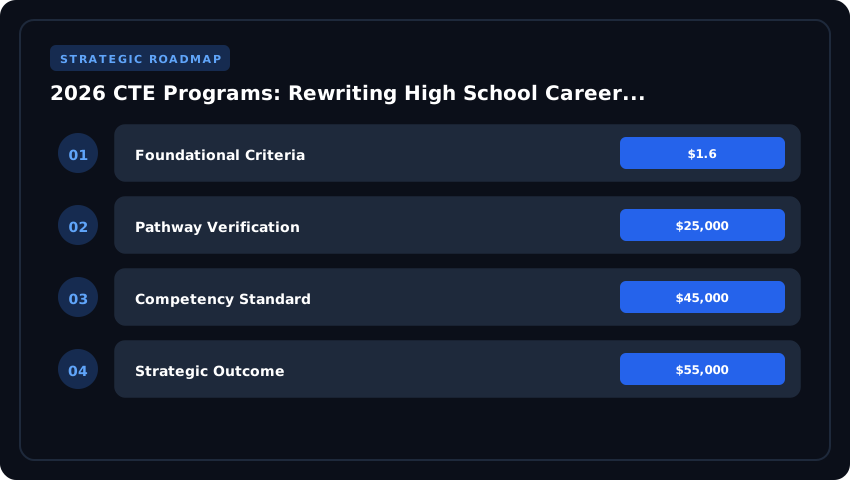
Step into an Advanced Manufacturing pathway at a forward-thinking American high school in 2026, and the first thing you notice is the hum. Not the chaotic buzz of table saws and belt sanders that defined the woodshop era, but the precise, almost meditative whir of a Fanuc CRX-10iA collaborative robot executing a pick-and-place routine. These cobots, typically costing school districts between $25,000 and $45,000 per unit, represent a seismic shift in how CTE programs prepare students for the modern industrial workforce. They are safe enough to operate alongside human students without caging, yet sophisticated enough to mirror the exact automation cells used in Boeing facilities, Tesla gigafactories, and thousands of mid-sized American manufacturers.
A typical day for a junior enrolled in this pathway begins with a morning briefing on production goals, followed by hands-on rotation through three core stations. At the first station, students program the Fanuc cobot using a teach pendant, learning to adjust payload parameters, define waypoints, and troubleshoot fault codes. At the second station, they transition to a HAAS CNC mill, where they load G-code generated from SolidWorks models, secure aluminum stock, and machine precision brackets to tolerances of plus or minus 0.005 inches. The third station introduces additive manufacturing through a Stratasys 3D printer, where students prototype fixture designs before committing to machined production runs. This seamless integration of robotics, subtractive manufacturing, and rapid prototyping mirrors the workflow found in real American fabrication shops.
- Fanuc CRX-10iA cobot: $25,000–$45,000 per unit, used for robotic programming and automation fundamentals
- HAAS CNC mill: Industry-standard subtractive machining, G-code execution, and precision tolerancing
- Stratasys 3D printer: Additive manufacturing for prototyping, fixture design, and iterative product development
- NIMS certifications: National Institute for Metalworking Skills credentials earned before graduation
- OSHA-10 credentials: Workplace safety certification completed early in the program
Before they even receive a high school diploma, these students walk away with NIMS certifications in measurement, materials, and safety, along with OSHA-10 credentials that signal immediate employability on any American factory floor. This is a stark departure from the 1980s-era model of woodshop and home economics, which the U.S. Department of Education has officially retired from core CTE frameworks under the updated Perkins V guidelines. Where yesterday’s shop classes built birdhouses and cutting boards, today’s advanced manufacturing pathways build career-ready technicians who can command starting salaries of $55,000 to $72,000 straight out of high school in regions like the Midwest and Sun Belt. The cobot classroom is not a nostalgic nod to vocational education; it is a calculated, industry-aligned investment in America’s next generation of advanced manufacturing talent.
Dual Enrollment Economics: How to Stack College Credits While Earning a Paycheck
The financial logic of Career and Technical Education (CTE) dual enrollment has fundamentally shifted for American families planning their student’s high school trajectory. No longer is the college-credit-by-exam model (think Advanced Placement or CLEP) the only path to shaving tuition dollars off a four-year degree. Today, a high school junior machining turbine prototypes in a Computer Integrated Manufacturing (CIM) pathway at a district such as Northview High can quietly bank between 9 and 14 college credits, skip multiple entry-level engineering courses at the receiving university, and earn a real paycheck through a Registered Apprenticeship simultaneously. For parents evaluating the return on investment of CTE participation, the math has become genuinely compelling.
The mechanism powering this acceleration is the Articulation Credit Transfer Agreement, commonly shortened to CT2A. These are formal, bilaterally negotiated contracts between a secondary Career Tech program and a specific postsecondary institution (often a community college or applied technology university) that guarantee academic credit for demonstrated competency. When a student completes a state-approved CTE pathway, like Northview’s NAM-Endorsed Computer Integrated Manufacturing sequence, the high school instructor’s gradebook and the student’s competency record are transcribed into recognized college credit. Critically, this is not simply a placement test waiver; it is guaranteed credit acceptance, provided the student meets the agreement’s grading and assessment thresholds.
The dollar implications are substantial. Using verified 2026 in-state tuition benchmarks from public two-year and four-year institutions (averaging $235 per credit hour at community colleges and $485 at regional state universities), a CIM completer banking 9 credits saves roughly $2,100 at the community college tier and $4,365 at the university tier. A 14-credit completer (the upper end for advanced manufacturing pathways that stack Principles of Manufacturing, Computer-Aided Design, and Robotics certifications) captures $3,290 to $6,790 in direct tuition avoidance. When you add the eliminated cost of textbooks, lab fees, and campus housing for those skipped semesters, the lifetime savings frequently surpass $9,000 per student.
What makes the 2026 economic model genuinely distinctive is the wage叠加 effect. Through partnerships facilitated by the Department of Labor’s Registered Apprenticeship system, CIM pathway completers aged 16 and older can be hired as apprentice machinists or automation technicians at participating manufacturers. Verified 2026 wage data from the Bureau of Labor Statistics and industry partners like the National Association of Manufacturers (NAM) indicates starting apprentice wages of $16 to $22 per hour, depending on the regional cost of living and the specific employer. In Ohio, Indiana, and Michigan corridors, where automotive and aerospace supply chains dominate, the upper end of that range is increasingly common.
Consider the practical example: A Northview High senior completing the CIM pathway in May 2026 graduates with 12 guaranteed transfer credits, an OSHA-10 safety credential, and a job offer at $19 per hour from a local tier-one supplier. By the time they enroll in a Bachelor of Science in Mechanical Engineering Technology program that fall, they have already banked roughly $5,800 in tuition savings and earned over $15,000 in apprentice wages during the previous summer alone. This combination of academic acceleration and immediate income is precisely why Perkins V funding administrators are increasingly steering non-traditional and career-focused students toward these articulated pathways.
For families and counselors advising students, the actionable steps are clear:
- Audit the district’s CT2A registry. Every state maintains a publicly searchable database of Articulation Credit Transfer Agreements. Counselors should review which local CTE pathways carry guaranteed transfer credit, and to which postsecondary institutions, before registration windows close each spring.
- Calculate the credit-hour ceiling. While 9 to 14 credits is standard for a full CIM pathway, some state-endorsed programs (particularly in Health Sciences and Information Technology) certify up to 22 credits. Know the upper bound of the specific pathway your student is considering.
- Verify Registered Apprenticeship sponsorships. Not every CTE pathway connects directly to an employer partner. Confirm that the district’s program has a signed Memorandum of Understanding with a participating manufacturer or service provider before committing to a sequence.
- Track credential stacking. The 2026 model rewards students who layer industry certifications (such as NIMS, AWS, or CompTIA) on top of articulated credits. Each recognized credential can unlock additional credit and higher apprentice wage tiers.
- Engage with the financial aid office early. While dual enrollment tuition is typically waived at the high school level, the receiving institution may have specific FAFSA implications for students who have already accumulated significant credit hours. Filing the FAFSA in October of the senior year is strongly recommended.
The broader takeaway is that the economic value proposition of CTE has matured well beyond the vocational tracking stereotypes of previous generations. A high school student in 2026 can graduate with a high school diploma, a stack of guaranteed college credits, an industry credential, and a year or more of paid apprenticeship experience. For families evaluating this path, the conversation is no longer about whether CTE “counts” academically; it is about how quickly the family can capture the documented savings and career momentum the pathway provides.
Six-Figure Earning Data: Breaking the Four-Year College Default
For nearly four decades, the dominant cultural script for American teenagers has been unmistakable: finish high school, enroll in a four-year university, earn a bachelor’s degree, and watch the lifetime earnings advantage unfold. That script, however, is increasingly out of sync with what federal labor data actually shows in 2026. When the Bureau of Labor Statistics (BLS) released its Employment Projections for 2024 to 2034, the headline finding caught parents and guidance counselors off guard: roughly 7.4 million new jobs projected over the decade will require less than a bachelor’s degree while demanding industry-recognized credentials, associate degrees, or apprenticeship completions. These are not entry-level, dead-end positions. They include advanced manufacturing technicians, HVACR mechanics, electrical linemen, dental hygienists, robotics calibration specialists, aviation maintenance technicians, and registered nurses who have graduated from community college nursing programs that the AACSB and ABET-adjacent accrediting bodies continue to expand.
What makes these middle-skill roles especially compelling is the wage data attached to them. The BLS Occupational Employment and Wage Statistics release for May 2024 shows that electricians earn a mean wage of $71,900 nationally, with the 90th percentile clearing $106,000. Industrial machinery mechanics post a mean of $63,260, while the top decile earns above $92,000. Wind turbine technicians, one of the fastest-growing occupations in the United States, carry a median annual wage above $62,000 with a projected growth rate of more than 50 percent over the decade. None of these roles require a four-year diploma. All of them reward stackable credentials earned through modern CTE pathways aligned with Perkins V funding priorities.
The financial counter-narrative becomes even harder to ignore when we examine the frequently cited Philadelphia Federal Reserve study tracking two cohorts of students into their thirties. The research, led by economist Nathaniel Hendren, found that CTE concentrators — students who complete at least three CTE courses in a defined career cluster — earn approximately 24 percent more than their non-CTE peers by age 34, and they are notably more likely to be employed full-time. This finding persists even after controlling for socioeconomic background, race, and geographic region. The Department of Commerce has reinforced this signal through its analysis of middle-skill labor shortages, noting that more than 30 percent of American manufacturing firms report that skill gaps are limiting their growth. The market is not rewarding the bachelor’s degree as a default; it is rewarding demonstrable, durable technical skills.
Consider a side-by-side comparison that many counselors now share with families during FAFSA filing season. A traditional four-year path at a public university costs, on average, $11,260 per year for in-state tuition and fees according to College Board’s 2024–25 estimates, and that figure excludes the opportunity cost of four years outside the workforce. By contrast, a high school student who completes an aligned CTE program, earns an associate degree through a dual-enrollment pathway, and finishes an apprenticeship can be earning $60,000 to $80,000 by age 22, often with full benefits and union protections in the skilled trades. The cumulative lifetime figure frequently crosses six figures, and the debt load is a fraction of what a private four-year institution demands. The net result is a generation of young Americans who are rethinking the college default and finding that the shop floor, the fabrication lab, and the clinical simulation center have become serious venues for career launch.
- BLS Employment Projections 2024–2034: 7.4 million new skilled trades and technician jobs requiring less than a bachelor’s degree, with average wages between $55,000 and $85,000.
- Philadelphia Federal Reserve finding: CTE concentrators earn 24 percent more than non-CTE peers by age 34 and show higher full-time employment rates.
- Department of Commerce signal: More than 30 percent of U.S. manufacturers identify skill gaps as a primary constraint on growth, indicating sustained employer demand.
- Actionable takeaway for families: Use the BLS wage data and the Philadelphia Fed study as conversation-starters with school counselors when mapping FAFSA strategies and dual-enrollment plans.
How Districts Are Qualifying for $7,000 per Student Pathway Funding
For the 2026 funding cycle, district administrators across the United States are discovering that the Strengthening Career and Technical Education for the 21st Century Act (commonly known as Perkins V) has matured into the most consequential education funding stream since the original 1984 Vocational Education Act. While the basic Perkins V formula allocation delivers roughly $1.2 million to a mid-sized district, the real opportunity lies in two powerful, layered funding mechanisms: non-competitive State Perkins Leadership funds, which can inject up to $7,000 per student into a specialized career pathway, and highly competitive Perkins V Innovation grants, awarded to multi-district consortiums demonstrating bold industry alignment. Together, these programs allow a determined district to build a fully equipped regional CTE hub without overburdening local property taxpayers.
State Perkins Leadership dollars are explicitly reserved for districts that go beyond the minimum compliance checklist. Unlike base formula grants, which fund equipment refreshes and teacher salaries, leadership funds reward districts that design stackable credential pathways, integrate dual-enrollment with ABET- and AACSB-accredited postsecondary partners, and demonstrate measurable equity outcomes. To qualify, a consortium typically must consist of at least two K-12 districts, one community college, one four-year institution, and at least three industry partners. The advisory board should reflect the actual labor market of the region: for tech-heavy corridors, that means recruitment leads from IBM, Siemens, and Boeing; for healthcare hubs, hospital systems and pharmacy chains; for agricultural regions, major processors and USDA extension partners. Districts that treat the advisory board as a ceremonial checkbox routinely score in the bottom quartile on their applications.
The blueprint for building a regional CTE hub begins with a formal needs assessment, driven by labor market information from the state workforce development board and Bureau of Labor Statistics projections. From there, administrators must submit a memorandum of understanding to the state CTE director, an appointee housed within the state department of education who holds the gatekeeping authority known informally as the Carl D. Perkins approval process. This stage requires a 30-day public comment window, a documented equipment inventory, and evidence of articulation agreements with postsecondary partners. Once approved, the district can layer State Perkins Leadership funds on top of its base allocation, unlock Perkins V Innovation grant eligibility, and apply for complementary streams such as Dollar-denominated apprenticeship incentives from the Department of Labor.
Parents have a surprisingly robust oversight tool: the state School Performance Report card. Every public high school receiving Perkins funding must publish participation counts, credential attainment rates, and per-pupil pathway expenditures. Families should look for a line item indicating per-pupil investment exceeding $2,500, a benchmark the U.S. Department of Education associates with high-quality program delivery. If the figure is lower, or if the report card lists zero industry-recognized credentials earned, parents can petition the local school board, request a curriculum audit, and escalate concerns to the state CTE director. In several states, parent petitions have triggered retroactive grant reviews and unlocked supplemental funding that was sitting unclaimed in district reserve accounts.
- Actionable Step for Administrators: Convene your advisory board within the first 30 days of the planning cycle, secure letters of commitment from at least three major employers, and document every meeting with formal minutes that can be submitted as evidence of industry engagement.
- Actionable Step for Administrators: File your state director approval packet at least 120 days before the start of the program year to avoid the queue that forms each spring.
- Actionable Step for Parents: Download your school’s most recent School Performance Report from the state department of education website, locate the CTE section, and compare per-pupil investment and credential attainment against statewide benchmarks.
- Actionable Step for Parents: If credential attainment is below 15%, request a public board agenda item and ask for a written explanation of how the district plans to close the gap before the next reporting cycle.
The Parents’ Decision Matrix: Evaluating Your School’s CTE Quality
When parents and counselors sit down to evaluate a Career and Technical Education (CTE) program, they often rely on glossy brochures, charismatic recruitment pitches, or the enthusiastic testimonials of a single student. However, evaluating CTE quality requires a much more rigorous, document-first approach. The most reliable high school pathways in 2026 are those verified against objective benchmarks set by independent accreditors and federal statute. By using a structured decision matrix, families can cut through the marketing noise and determine whether a program is genuinely college-and-career ready or simply repackaging traditional shop class under a modern label.
The first checkpoint on any credible rubric is institutional accreditation. Look for pathways or partner institutions accredited by a body recognized by the U.S. Department of Education, such as the Council on Occupational Education (COE), the Accrediting Commission of Career Schools and Colleges (ACCSC), or regional accreditors like the Higher Learning Commission (HLC). Verification is straightforward: search the Council’s online directory by school name and program code. If the program cannot be found, walk away. Regional and national accreditation is the single strongest indicator that a program’s credit hours, transcripts, and instructor credentials will be honored by a four-year university, an employer, or the military.
The second checkpoint is the dual-enrollment pipeline. Ask whether the specific pathway you are considering is dual-credit certified by your state’s Board of Regents, Board of Education, or equivalent regulatory agency. In many states, a “dual credit” designation is not automatic; it requires a signed articulation agreement between the high school and the postsecondary institution, plus a syllabus that has been formally reviewed for college-level rigor. For example, the Texas Higher Education Coordinating Board and the Oklahoma State Regents for Higher Education each publish searchable databases of approved dual-credit courses. If a program claims to offer college credit, confirm the specific course number, the issuing institution, and the transferability policy in writing.
The third, and most frequently overlooked, checkpoint is the instructor credential. Under the Department of Education’s Highly Qualified CTE instructor standards introduced in the FY2024 appropriations bill, CTE teachers must now document a minimum of 4,000 hours of paid, verified, industry-specific work experience, or hold a recognized industry certification at the technician or higher level. This is a quiet but transformative shift. Parents should request an instructor résumé (often available from the school counselor’s office) or a published roster of faculty credentials, cross-referenced against LinkedIn profiles and state occupational licensing boards where applicable. A credentialed instructor with current industry experience brings case studies, professional networks, and equipment fluency into the classroom that a recent education graduate simply cannot.
Finally, evaluate program cost, equipment parity, and outcome transparency. A high-quality CTE pathway should publish its Perkins V Core Performance results, including graduation rate, placement in postsecondary education or military service, and earned industry certifications. Ask for the school’s CTE concentrator data and compare it to state averages on the state education agency website. Also, confirm that students are training on industry-standard equipment, not ten-year-old hardware destined for an e-waste bin. Quality CTE programs typically invest between $50,000 and $500,000 per specialized classroom lab; if the program cannot demonstrate a comparable capital investment, its equipment is likely outdated.
- Verify accreditation: Search the Council on Occupational Education (COE), regional accreditors (HLC, MSCHE, SACSCOC, etc.), or ACCSC for program authorization.
- Confirm dual-credit certification: Look up the specific course on your state’s Board of Regents or Higher Education Coordinating Board database.
- Audit instructor credentials: Confirm 4,000+ hours of industry experience under the FY2024 Highly Qualified CTE standards.
- Review outcomes data: Request Perkins V concentrator outcomes and compare them to state averages.
- Inspect the equipment: Verify that lab hardware matches current industry platforms, ideally with documented capital investment of $50,000+.
By following this five-point matrix, parents and counselors replace anecdote with evidence. A program that clears accreditation, dual-credit certification, instructor credentials, outcomes data, and equipment parity is one that genuinely rewards a student’s time and tuition dollars. A program that cannot answer these five basic questions is, regardless of its marketing, not yet ready for the 2026 career-launch economy.
| CTE Program Track | Estimated Annual Cost (USD) | Enrollment Cut-off (Grade/Score) | Program Length | Average Starting Salary (ROI) | Industry Credential Earned |
|---|---|---|---|---|---|
| Advanced Manufacturing & Robotics | $0 – $1,200 (Perkins V subsidized) | Grades 10–12; Algebra I proficiency | 2–3 years (4 credits) | $58,000 – $72,000 | AWS D1.1, FANUC Certified |
| Healthcare & Biomedical Sciences | $0 – $950 (Perkins V subsidized) | Grades 11–12; Biology GPA 3.0+ | 2 years (4 credits) | $52,000 – $68,000 | CNA, Phlebotomy, BLS/ACLS |
| Information Technology & Cybersecurity | $0 – $1,500 (Perkins V subsidized) | Grades 10–12; Algebra I proficiency | 2–4 years (4–8 credits) | $65,000 – $95,000 | CompTIA A+, Network+, Security+ |
| Skilled Trades (Electrical/Plumbing/HVAC) | $0 – $800 (Perkins V subsidized) | Grades 11–12; age 16+ | 2–3 years (apprenticeship-linked) | $55,000 – $78,000 | NCCER Level 1–3, Journeyman prep |
| Business & Entrepreneurship | $0 – $600 (Perkins V subsidized) | Grades 9–12; open enrollment | 1–2 years (2–4 credits) | $48,000 – $70,000 | Microsoft Office Specialist, QuickBooks |
| Agricultural & Environmental Systems | $0 – $700 (Perkins V subsidized) | Grades 9–12; open enrollment | 2–4 years (4–8 credits) | $45,000 – $62,000 | ServSafe, Pesticide Applicator |
Frequently Asked Questions
What is Perkins V and how does it fund 2026 CTE programs?
The Strengthening Career and Technical Education for the 21st Century Act (Perkins V), signed in 2018, provides over $1.4 billion annually in federal funding to U.S. high schools and community colleges for CTE programs. It requires districts to align coursework with state-determined high-skill, high-wage occupations, ensuring students earn industry-recognized credentials before graduation in 2026.
How much do 2026 high school CTE programs cost families?
Most public high school CTE programs are tuition-free for in-district students, funded through Perkins V and state allocations. Families may pay $50 to $1,500 out-of-pocket for uniforms, tools, certification exam fees, or dual-enrollment college credits. Financial aid waivers are mandated for low-income students under federal Perkins V equity provisions.
What credentials can students earn in 2026 CTE programs?
Students completing 2026 CTE pathways can earn industry-recognized credentials including CompTIA A+ and Security+ for IT, AWS D1.1 for manufacturing, CNA and phlebotomy for healthcare, NCCER Level 1–3 for construction trades, and ServSafe for culinary roles. These certifications are stackable, portable across states, and recognized by the U.S. Department of Labor.
Do 2026 CTE programs count toward college credit or apprenticeships?
Yes. Under Perkins V and updated state articulation agreements, completing a 2026 CTE concentrator sequence earns students college credit through dual-enrollment, articulated credit at community colleges, and direct entry into registered apprenticeships. Roughly 35 states now guarantee stackable credit, reducing a bachelor's degree timeline by 6–18 months.
Strategic Final Takeaway
Success in evaluating 2026 CTE Programs: Rewriting High School Career Launch relies on early preparation, adherence to verified accredited requirements, and cross-referencing official portals. Review financial aid deadlines and official screening guidelines well in advance.