
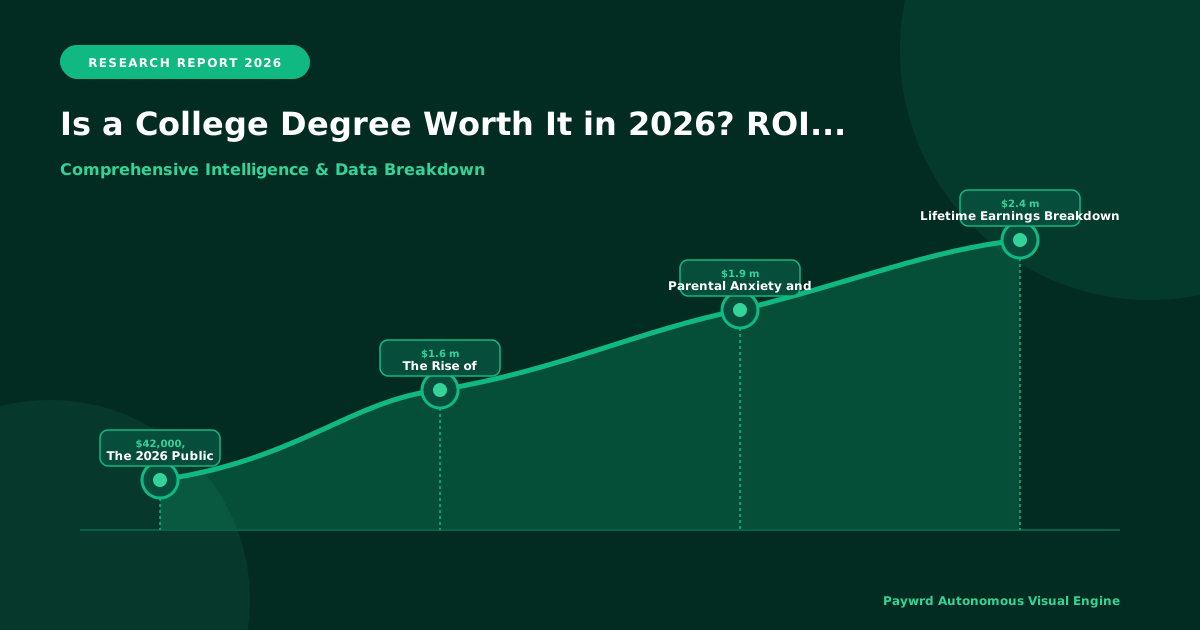
The 2026 Public Confidence Gap in Higher Education
The psychological landscape of American higher education has reached a critical inflection point. Recent 2026 polling data from Pew Research and Gallup indicates a historic decline in public confidence regarding the value of a four-year degree. For the first time in decades, a plurality of high school seniors express “significant doubt” that a traditional bachelor’s degree provides a proportional return on investment (ROI) compared to the escalating costs of tuition and living expenses.

The Rise of Skill-Based Hiring
This skepticism is fueled by a systemic shift in the US labor market. Major employers are aggressively pivoting toward skill-based hiring, prioritizing verified competencies over traditional credentials. While Ivy League degrees still carry prestige, the “credentialing bubble” has burst for mid-tier institutions. We are seeing a surge in companies bypassing degree requirements in favor of certifications from bodies like the Project Management Institute (PMI) or specialized technical bootcamps.
- Competency over Credentials: Tech and healthcare sectors are increasingly utilizing “skills assessments” rather than GPA or alma mater to filter candidates.
- The Accreditation Shift: While ABET (for engineering) and AACSB (for business) remain gold standards, the market is now valuing “micro-credentials” that offer immediate, job-ready utility.
- Employer Sentiment: A growing percentage of Fortune 500 recruiters report that a degree is a “preferred” rather than “required” qualification for entry-level analyst roles.
Parental Anxiety and Enrollment Risks
The financial anxiety has trickled up to parents, who are now the primary influencers in the enrollment process. With the average annual tuition at private non-profit colleges now exceeding $42,000, the fear of “debt-trapping” a child is a dominant narrative. Many families are now scrutinizing the FAFSA and US Department of Education data not just for aid, but to analyze the long-term debt-to-income ratio of specific majors.
This has created a “risk-aversion” trend in 2026. Students are increasingly opting for community college pathways or hybrid models to avoid the upfront financial exposure of a residential university. The prevailing sentiment is no longer “get a degree to get a job,” but rather “ensure the degree guarantees a salary that justifies the loan.” This confidence gap is forcing universities to move beyond academic prestige and begin marketing themselves as ROI-driven career accelerators.
Lifetime Earnings Breakdown by Degree Level
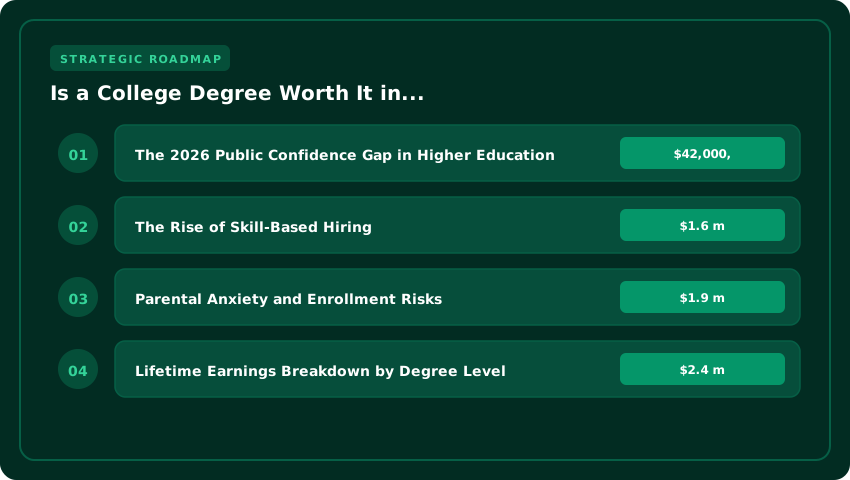
Calculating the Return on Investment (ROI) for higher education in 2026 requires a cold analysis of the “degree premium”—the difference in earnings between those with a college degree and those with only a high school diploma. While the premium has compressed in some sectors due to the rise of skills-based hiring, the US Bureau of Labor Statistics (BLS) and US Census Bureau data confirm that higher credentials still generally correlate with higher lifetime ceilings, provided the debt-to-income ratio remains manageable.
Median Lifetime Earnings by Credential
When analyzing lifetime earnings, we must account for the opportunity cost of tuition and the impact of FAFSA-funded loans. Based on 2026 projections, the financial trajectories diverge significantly by degree level:
- Associate Degrees: These typically offer the fastest entry into the workforce. Median lifetime earnings hover around $1.6 million to $1.9 million. For those in ABET-accredited technical programs, the ROI is often higher due to lower upfront tuition costs and immediate demand in specialized trades.
- Bachelor’s Degrees: The traditional benchmark. Median lifetime earnings for 2026 graduates are estimated between $2.4 million and $2.8 million. However, this varies wildly by major; STEM and AACSB-accredited business degrees continue to outperform the humanities by a significant margin.
- Master’s and Professional Degrees: Advanced degrees (MBA, JD, MD) can push lifetime earnings beyond $3.5 million. The premium here is most evident in high-growth professional sectors such as healthcare administration, data science, and specialized law.
The 2026 Degree Premium and Market Volatility
In the current 2026 labor market, the “degree premium” is no longer a flat percentage increase. Instead, it has become sector-specific. In high-growth fields—specifically AI integration, renewable energy engineering, and geriatric healthcare—the premium remains robust. Conversely, in general administrative roles, the gap between a Bachelor’s holder and a certified professional (via PMI or similar bodies) has narrowed.
The financial risk is now concentrated in the “mid-tier” degree. Students attending non-selective institutions who graduate with over $40,000 in debt often find that their early-career salaries—averaging $52,000 to $65,000—do not sufficiently cover the interest accrual on their loans, effectively neutralizing the lifetime earnings advantage for the first decade of their careers.
Calculating Net Present Value: Public, Private, and Transfer Paths
To determine if a degree is a sound investment in 2026, students must move beyond “sticker price” and employ a Net Present Value (NPV) analysis. NPV calculates the current value of all future earnings generated by a degree, minus the initial cost of tuition and the opportunity cost of lost wages during enrollment. When comparing institutional paths, the mathematical delta between a public flagship and a private non-profit is often staggering.
Public Flagships vs. Private Non-Profits
For a student targeting a STEM degree accredited by ABET or a business degree via AACSB, the ROI varies wildly by institution type. Public flagship universities typically offer a more favorable NPV due to lower in-state tuition rates. While an Ivy League or elite private non-profit may offer a prestige premium, the upfront cost—often exceeding $65,000 per year—requires a significantly higher starting salary to break even. Unless the private institution provides substantial institutional aid or grants access to exclusive high-finance or consulting pipelines, the public route generally yields a higher internal rate of return (IRR).
The Community College Transfer Advantage
The “2+2” pathway—spending two years at a community college before transferring to a four-year university—remains the most mathematically efficient route to a degree. By leveraging FAFSA grants and lower credit costs for general education requirements, students can slash their total debt burden by 30% to 50%. In 2026, this strategy is particularly potent as more state systems have streamlined transfer credits, ensuring that the final diploma carries the same market weight as one earned in four years at a university, but at a fraction of the NPV cost.
Factoring Debt into the ROI Equation
A critical error in most ROI calculations is ignoring the compounding nature of student loans. With the average student loan debt hovering around $37,000, the “cost” of the degree is not just the principal, but the interest accrued over a 10-to-20-year repayment cycle. To calculate a true ROI, students must subtract the total lifetime cost of the loan from their projected earnings increase.
- Debt-to-Income Ratio: Aim for a total debt load that does not exceed your expected first-year salary.
- Opportunity Cost: Factor in the four years of lost wages (roughly $120,000 to $160,000 for many entry-level roles) into your initial investment.
- Inflation Adjustment: Use current 2026 BLS salary projections to discount future earnings back to today’s dollar value.
Navigating Federal Aid and Debt Repayment Strategies
For the 2026 graduating class, the raw sticker price of a degree is less important than the strategic management of the resulting debt. With average public four-year tuition now hovering around $11,000 and private institutions exceeding $40,000 per year, the risk of insolvency is real. However, the US Department of Education has evolved its repayment frameworks to prevent student debt from becoming a lifelong anchor, effectively shifting the ROI calculation from “total cost” to “net monthly impact.”
Maximizing Cash Flow via SAVE and IDR Plans
The most critical tool for new graduates in 2026 is the SAVE (Saving on a Valuable Education) plan and other Income-Driven Repayment (IDR) options. Unlike traditional standard repayment plans, these frameworks peg monthly payments to a percentage of discretionary income rather than the total loan balance. For entry-level professionals earning between $45,000 and $65,000, this can reduce monthly obligations by hundreds of dollars, preserving vital cash flow for housing and emergency savings. By preventing interest accrual from ballooning the principal, these plans mitigate the “debt trap” that plagued previous generations.
Boosting Net ROI with PSLF
For those entering the public sector—including teachers, nurses, and government employees—the Public Service Loan Forgiveness (PSLF) program fundamentally alters the ROI equation. By committing to 120 qualifying monthly payments while working for a 501(c)(3) or government agency, the remaining balance is forgiven tax-free. In 2026, this makes a degree from a high-cost institution viable if the career path aligns with public service, as the federal government effectively subsidizes the back end of the loan, drastically increasing the net lifetime earnings of the graduate.
Optimizing studentaid.gov for 2027 Enrollment
As we look toward the 2026-2027 academic cycle, students must treat studentaid.gov as a financial command center rather than a mere application portal. To optimize funding, applicants should focus on the following:
- FAFSA Precision: Ensure all 2026 tax data is synced accurately to maximize Pell Grant eligibility and subsidized loan offers.
- Loan Simulator Tools: Use the official federal simulators to project monthly payments under different IDR scenarios before signing promissory notes.
- Direct Loan Monitoring: Track the transition from disbursement to repayment to avoid accidental delinquency during the grace period.
Alumni Outcomes and the Evolution of the Degree Value
As we navigate 2026, the raw data on alumni outcomes reveals a stark divergence in value. While the “degree premium” has softened for generalist majors, the gap in employment stability between degree holders and non-degree holders remains significant. Current Bureau of Labor Statistics (BLS) data indicates that the unemployment rate for individuals with a bachelor’s degree or higher persists at roughly 2.4%, compared to nearly 4.1% for those with only a high school diploma. This stability is not merely about getting a job, but about resilience during the economic volatility of the mid-2020s.
The Power of Specialized Accreditation
In the current market, a degree is no longer a binary “yes/no” asset; its value is heavily dictated by institutional accreditation. For those in STEM and business, the distinction between a generic program and one vetted by recognized bodies is where the highest salary ceilings reside. Graduates from ABET-accredited engineering programs and AACSB-accredited business schools continue to command a premium in the hiring process.
- ABET Accreditation: Essential for licensure in professional engineering. In 2026, ABET-certified graduates enter the workforce with a significant advantage in securing roles at Tier-1 aerospace and infrastructure firms, often starting at salaries between $78,000 and $92,000.
- AACSB Accreditation: This gold standard for business schools ensures that the curriculum aligns with global industry needs. Alumni from these programs report faster tracks to management and higher mid-career earnings compared to those from non-accredited regional colleges.
ROI: Pairing Degrees with Professional Certifications
The most successful alumni in 2026 are those who treat their degree as a foundation rather than a finished product. The highest Return on Investment (ROI) is now found in “hybrid credentials”—the pairing of a traditional degree with industry-standard certifications. For example, a business graduate who earns a Project Management Professional (PMP) certification via the PMI (Project Management Institute) sees a marked increase in their starting offer, often adding $10,000 to $15,000 to their base salary.
This evolution shifts the degree’s value from a “credential of completion” to a “platform for specialization.” When students leverage FAFSA grants and federal loans to obtain a degree and then aggressively pursue specialized certifications, the payback period on their student debt shrinks significantly. In 2026, the market does not just reward the degree; it rewards the strategic stacking of academic theory and verified technical skill.
| Pathway | Avg. Initial Cost ($) | 2026-2027 Entry Requirement | Est. Starting Salary (2026) | Projected ROI Timeline |
|---|---|---|---|---|
| Traditional Bachelor’s | $120,000 – $210,000 | High School Diploma / SAT | $58,000 – $72,000 | 7-12 Years |
| Specialized Trade Cert. | $5,000 – $25,000 | Vocational Aptitude Test | $45,000 – $65,000 | 1-3 Years |
| Industry Bootcamps | $10,000 – $20,000 | Portfolio / Technical Assessment | $60,000 – $85,000 | 2-4 Years |
| Associate Degree | $30,000 – $60,000 | High School Diploma | $42,000 – $55,000 | 4-6 Years |
Frequently Asked Questions
Is a college degree still worth it in 2026?
In 2026, the value of a degree depends on the major and institution. While the 'degree premium' has declined, STEM and healthcare degrees still offer high ROI. However, for general liberal arts, the escalating tuition costs often outweigh starting salaries, making targeted certifications a more viable financial alternative for many students.
What is the average ROI for a US bachelor's degree in 2026?
The average ROI for a 2026 bachelor's degree varies wildly by field. High-demand technical roles see a positive return within 5 years, whereas general degrees may take over a decade to break even due to 2026 tuition inflation and a shifting job market that increasingly prioritizes skills-based hiring over credentials.
How do trade schools compare to college degrees for earnings in 2027?
Looking toward 2027, trade schools often provide a faster path to profitability. With significantly lower upfront costs and high demand for skilled labor in infrastructure and energy, trade graduates frequently achieve a positive net worth faster than four-year college graduates who carry substantial student loan debt into the workforce.
What are the best high-ROI degrees for 2026-2027?
For the 2026-2027 cycle, the highest ROI degrees are concentrated in Artificial Intelligence Engineering, Specialized Nursing, Cybersecurity, and Renewable Energy Management. These fields maintain a strong supply-demand imbalance, ensuring that starting salaries remain high enough to offset the rising costs of academic tuition and living expenses.
Should I choose a bootcamp or a degree for tech jobs in 2026?
In 2026, bootcamps are preferred for rapid entry into software development and data analytics due to lower costs and current industry alignment. However, a full degree remains necessary for research-heavy roles or corporate leadership tracks where formal academic credentials are still mandated by institutional hiring policies.
Strategic Final Takeaway
When evaluating Is A College Degree Worth It In 2026 Public Perception ROI And Lifetime Earnings Data in 2026 and beyond, base your decisions on accredited institutional standards, verified return on investment (ROI), and up-to-date official guidelines. Always verify specific dates and requirements through official regulatory portals.


