Understanding the FG IDEAS Project Scope for 2026 Technical Training
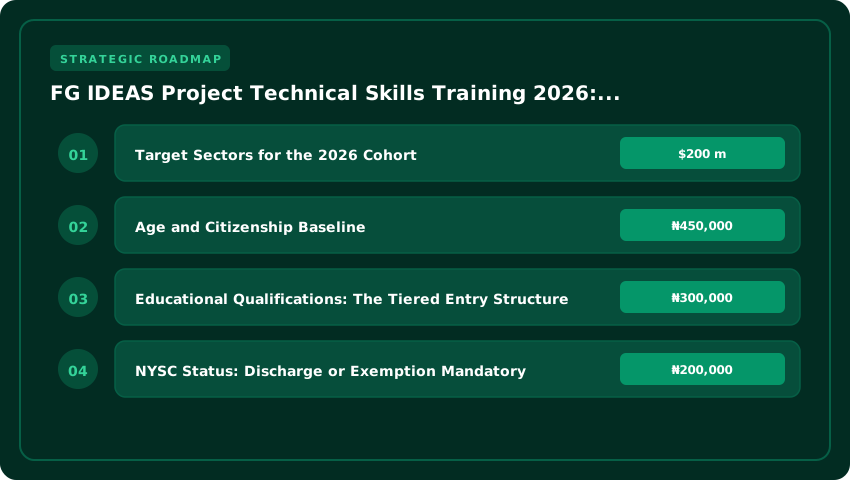
The Innovation Development and Effectiveness in the Acquisition of Skills (IDEAS) Project enters its critical 2026 implementation phase with a sharpened mandate: transition Nigeria’s technical workforce from theoretical competence to immediate industry relevance. Backed by a $200 million World Bank credit facility (IDA) and counterpart funding from the Federal Ministry of Education, the project operates under a Results-Based Financing model. This means training providers—Federal Technical Colleges, Polytechnics, and accredited private sector hubs—only draw down funds when they hit verified placement and certification milestones. For the 2026 cohort, the governance structure has tightened; the National Project Coordinating Unit (NPCU) now mandates real-time data reporting via the IDEAS Management Information System (MIS) to prevent the “ghost trainee” issues that plagued earlier cycles.

World Bank Partnership Objectives Under the IDEAS Framework
The World Bank’s involvement goes beyond capital provision. The 2026 work plan emphasizes three pillars: System Strengthening (upgrading curricula to National Occupational Standards), Private Sector Leadership (mandating Industry Skills Councils to co-design training), and Equity (reserving 30% slots for women and Persons with Disabilities). Crucially, the project now aligns directly with the Nigeria National Development Plan (NDP) 2026–2026 legacy targets and the incoming Renewed Hope Agenda industrialization pillars. The Bank’s supervision missions in Q1 2026 flagged “speed-to-market” for curricula approval as the key performance indicator—meaning NABTEB and NBTE must validate new modules within 60 days of industry submission.
Target Sectors for the 2026 Cohort
The project has moved away from generic “ICT training” to four high-value, high-absorption sectors identified by the Federal Ministry of Industry, Trade and Investment and the National Bureau of Statistics (NBS) labour market data:

- Digital Economy: Beyond basic coding, the 2026 curriculum targets Cloud Infrastructure (AWS/Azure certification tracks), Cybersecurity Operations (SOC Analyst Level 1), and Data Annotation/Labeling for AI—skills currently imported via expatriate contracts.
- Renewable Energy: Focused on Solar PV Installation (aligned with the Rural Electrification Agency’s Energizing Education Programme), Mini-grid Design, and Battery Storage Maintenance. Certification maps to the Council for the Regulation of Engineering in Nigeria (COREN) technician framework.
- Agro-Processing: Training covers Cold Chain Logistics Management, Food Safety Systems (ISO 22000/HACCP), and Automated Packaging Line Operations—directly supporting the Special Agro-Industrial Processing Zones (SAPZ) programme.
- Advanced Manufacturing: CNC Machining, Industrial Automation (PLC/SCADA), and Additive Manufacturing (3D Printing) for spare parts localization, reducing the ₦2.5 trillion annual import bill for industrial components.
Applicants should note: the 2026 cycle prioritizes Recognition of Prior Learning (RPL). If you are an artisan in Aba or a self-taught developer in Yaba, the project funds assessment centers to certify your existing skills against National Skills Qualifications Framework (NSQF) levels 3–5, fast-tracking you into the formal economy without repeating basics.
Eligibility Criteria for 2026 IDEAS Technical Skills Training
Before you click “Apply” on the IDEAS portal, run yourself against this checklist. The Federal Ministry of Education and the National Board for Technical Education (NBTE) have tightened the filters for the 2026 cycle to ensure the ₦30+ billion World Bank facility targets Nigerians who can immediately transition into priority sectors—digital economy, creative industries, agri-tech, and renewable energy. If you do not tick every box below, your application will be auto-rejected at the institutional validation stage.
Age and Citizenship Baseline
- Age Bracket: Strictly 18 to 35 years old as of the application closing date in 2026. No upper-age waivers exist for this cycle, unlike some N-Power streams.
- Citizenship: Must be a Nigerian citizen with a valid National Identification Number (NIN). The NIN is cross-referenced with the NIMC database during the portal registration; discrepancies between your NIN name and academic certificates will flag your profile for manual review, delaying approval.
Educational Qualifications: The Tiered Entry Structure
The project operates a tiered qualification framework aligned with the National Skills Qualification Framework (NSQF). You apply to the track matching your highest verified certificate:
- Track 1 (Artisan/Technician – NSQF Levels 3 & 4): Minimum of Senior Secondary Certificate Examination (SSCE/WAEC/NECO/NABTEB) with five credits including Mathematics and English Language at not more than two sittings. This track feeds directly into Certified Vocational Training (CVT) modules in welding, solar PV installation, and automotive mechatronics.
- Track 2 (Technologist – NSQF Level 5): Ordinary National Diploma (OND) or National Technical Certificate (NTC) with a minimum of Lower Credit (CGPA 2.50+) from an NBTE-accredited Polytechnic or Technical College. HND holders with Pass grade may apply here if seeking re-skilling.
- Track 3 (Professional Upskilling – NSQF Level 6): Higher National Diploma (HND) or Bachelor’s Degree (B.Sc/B.Tech/B.Eng) with a minimum of Second Class Lower / Lower Credit. This track targets graduates for advanced modules like Full-Stack Development, Data Analytics, and Green Hydrogen Technology.
Critical Note: All certificates must be verifiable on the institution’s portal or the NBTE/NUC verification platforms. Statement of Results older than 12 months without the physical certificate are rejected.
NYSC Status: Discharge or Exemption Mandatory
For Track 2 and Track 3 applicants (OND, HND, B.Sc), NYSC completion is non-negotiable. You must upload either:
- NYSC Discharge Certificate.
- NYSC Exemption Letter (for graduates over 30 at graduation or military personnel).
- NYSC Exclusion Letter (for part-time/sandwich graduates).
Serving Corps members (Batch A, B, or C Stream 1 & 2 of 2026) are not eligible until they present the Discharge Certificate. Track 1 (SSCE) applicants are exempt from NYSC requirements.
Geographic Spread: Federal vs. State Institutions & Catchment Reality
The 2026 cycle activates 38 Federal and 22 State Technical Colleges/Polytechnics as Training Delivery Centers (TDCs). While the portal is centralized, admission is decentralized.
- Federal Institutions (e.g., Yaba College of Technology, Federal Polytechnic Nekede, Kaduna Polytechnic): Operate a 60:40 National Merit to Catchment Area ratio. If you apply to a Federal TDC outside your state of origin, you compete on pure merit scores from the Computer-Based Test (CBT).
- State Institutions (e.g., Lagos State Polytechnic, Benue State Polytechnic, Ogun State Technical College): Prioritize indigenes (verified via LGA Certificate of Origin) for up to 70% of slots. Non-indigenes resident in the state must provide proof of residency (utility bill/tenancy agreement > 12 months) to access the “Resident Quota.”
Strategy: Apply to the TDC nearest to your current residence or state of origin. The CBT score cut-off for Federal Merit is historically higher (65%+) than State Catchment (50%+). Selecting a center purely for “prestige” without meeting the catchment or merit threshold wastes your single application slot for the year.
Approved Courses & Participating Institutions for 2026 Cycle
The 2026 IDEAS Project cycle operates on a strict competency-based framework aligned with the National Skills Qualification Framework (NSQF). This means every course listed below leads to a nationally recognized certification—either a National Innovation Diploma (NID), Higher National Diploma (HND) top-up, or a sector-specific Certificate of Competence (CoC) recognized by the National Board for Technical Education (NBTE) and the Sector Skills Councils (SSCs). You are not just collecting a certificate of attendance; you are banking a verifiable credential for the labour market.
Digital Economy & ICT Cluster
This cluster absorbs the largest share of the ₦30+ billion allocation, targeting the acute talent deficit in software development and data infrastructure. Training centres here are equipped with dedicated fibre optics and cloud lab environments.
- Software Engineering (Full-Stack Development): Federal University of Technology, Minna (Niger State); Yaba College of Technology, Lagos; Federal Polytechnic, Nekede (Imo State); Ahmadu Bello University, Zaria (Kaduna State).
- Data Analytics & Visualization (Power BI, Python, SQL): University of Lagos (UNILAG); Federal Polytechnic, Ilaro (Ogun State); Federal College of Education (Technical), Akoka (Lagos); University of Nigeria, Nsukka (Enugu State).
- Cybersecurity Fundamentals & Ethical Hacking: Federal University of Technology, Owerri (Imo State); Kaduna Polytechnic; Federal College of Education (Technical), Bichi (Kano State).
Green Energy & Renewable Technologies Cluster
With the Rural Electrification Agency (REA) scaling mini-grid deployments, Solar PV Installation and Maintenance is the highest-employability trade for 2026. These centres possess live solar farms for practical assessment.
- Solar Photovoltaic (PV) Systems Installation & Maintenance (NSQF Level 4): Federal Polytechnic, Ado-Ekiti (Ekiti State); Federal University of Technology, Akure (Ondo State); Federal College of Education (Technical), Gombe (Gombe State); Auchi Polytechnic (Edo State).
- Inverter/ Battery Technology & Energy Storage Systems: Federal Polytechnic, Bida (Niger State); Michael Okpara University of Agriculture, Umudike (Abia State).
Advanced Manufacturing & Mechatronics Cluster
Mechatronics bridges the gap between mechanical fabrication and industrial automation—critical for the auto-assembly plants in Lagos and the emerging medical device manufacturing zone in Ogun.
- Mechatronics Engineering Technology (PLC, Hydraulics, Pneumatics): Federal University of Technology, Minna (Niger State); Yaba College of Technology, Lagos; Federal Polytechnic, Offa (Kwara State); Federal College of Education (Technical), Asaba (Delta State).
- CNC Machining & Computer-Aided Manufacturing (CAM): Federal Polytechnic, Idah (Kogi State); Federal College of Education (Technical), Omoku (Rivers State).
Logistics Planning: The Decision Matrix
Do not apply based solely on institutional prestige. Apply based on proximity to your residence and hostel availability. The IDEAS stipend (approx. ₦30,000–₦50,000/month depending on the centre) covers feeding and local transport, not inter-state relocation costs. Verify the specific centre’s NBTE Accreditation Status on the NBTE portal before committing. Centres like FUT Minna and YABATECH are historically oversubscribed; listing a second-choice centre like Federal Polytechnic, Ilaro or FCE(T) Akoka significantly increases your admission probability on the JAMB CAPS-style ranking algorithm used for this cycle.
Step-by-Step Application Portal Walkthrough for 2026
The IDEAS Project portal (ideas.gov.ng) is the single gateway for the 2026 cycle. There are no paper forms and no third-party agents—any link asking for a “processing fee” before you hit the official domain is a scam. Bookmark the URL; the portal traffic spikes heavily in the final 72 hours before the deadline, so early action is your best insurance against timeout errors.
1. Account Creation & Identity Verification
Click “New Registration” on the landing page. You must use an active email address and a phone number linked to your National Identification Number (NIN) or Bank Verification Number (BVN). The system runs a real-time API check against the NIMC and NIBSS databases. If your NIN details (name arrangement, date of birth) do not match your WAEC/NECO records exactly, the portal will hard-stop you at Step 2. Pro tip: Run a NIN verification on the NIMC mobile app before starting to ensure your surname hasn’t been truncated or reordered.
2. BVN/NIN Binding & OTP Protocols
After submitting basic bio-data, the portal triggers an OTP to your registered phone line. In 2026, we are seeing intermittent delays of 5–15 minutes during peak hours (10 AM – 2 PM) due to telco gateway congestion. Do not click “Resend OTP” repeatedly—this queues multiple tokens and invalidates the first valid one. Wait the full window. If the OTP fails twice, switch your network mode from 4G/5G to 3G/2G only; this often forces a more stable SMS route. Ensure the line has “Do Not Disturb” (DND) deactivated by texting ALLOW to 2442.
3. Course Preference Ranking Strategy
You can select up to three (3) training programs across the priority sectors (Digital Economy, Green Energy, Creative Tech, Agri-Tech, Advanced Manufacturing). Rank them by genuine interest and eligibility match—not by perceived “easiness.” The algorithm weights your first choice heavily during the shortlisting phase. If you apply for a Solar PV Installation track (requiring a science background) but hold an Art certificate, the system auto-rejects that specific preference but keeps your lower-ranked valid choices alive. Review the “Programme Requirements” PDF linked under each course tile before ranking.
4. Document Upload Specs: The Silent Disqualifier
This is where 40% of applicants fail silently. The portal enforces strict MIME-type and size validation before the “Submit” button activates.
- Format: PDF only for certificates/transcripts; JPG/PNG only for passport photograph and signature.
- Size Limits: 500 KB max per document. A standard phone scan is usually 2–3 MB. You must compress. Use the “Reduce File Size” feature in Adobe Acrobat Reader (free) or a trusted offline tool like
ILovePDFdesktop version—avoid online compressors for sensitive identity docs. - Naming Convention: Use the portal’s suggested naming (e.g.,
Surname_FirstName_WASCE.pdf). Custom filenames often trigger the “Invalid File Structure” error.
5. Browser Compatibility & Final Submission
The 2026 portal is built on a React frontend that behaves unpredictably on Safari (iOS) and older Chrome versions (< v115). Use Chrome (latest) or Firefox on a desktop/laptop. Mobile view breaks the “Drag & Drop” upload widget. Clear cache/cookies or open an Incognito window before logging in. Once all green checkmarks appear on the “Review” tab, hit “Submit Application.” You will receive a PDF Acknowledgement Slip with a unique Application Reference Number (ARN)—save this to cloud storage and print a copy. No ARN, no application.
Mandatory Documents & Profile Optimization Checklist
Let’s be blunt: the IDEAS Project screening algorithm in 2026 has zero tolerance for incomplete files. Every year, thousands of qualified Nigerians are auto-rejected not because they lack skills, but because they uploaded a blurred passport photograph or forgot a guarantor’s signature. Treat this checklist as your pre-flight inspection—miss one item, and your application stalls at the verification gate.
Non-Negotiable Digital Copies (PDF/JPEG, Max 2MB Each)
- Passport Photograph: White background only. No selfies, no filters, no caps. Dimensions: 450px by 600px. The facial recognition software on the portal cross-references this with your NIN slip; a mismatch triggers an instant flag.
- LGA Identification Letter: Must be the current 2026 template issued by your Local Government Chairman or Secretary. It must carry the official LGA stamp, wet ink signature, and a verifiable phone number. Photocopies of 2026 or 2026 letters are rejected automatically.
- Academic Transcripts/Statements of Result: For university grads, upload the official transcript (not a screenshot of the student portal). For polytechnic/COE applicants, the full ND/HND statement of result with CGPA visible is mandatory. If you are awaiting results, upload the official admission letter and a signed affidavit—do not leave the slot empty.
- Guarantor Forms (Two Required): Download the specific 2026 IDEAS guarantor form from the portal resources tab. Each guarantor must be a Level 12 civil servant or above, a registered professional (COREN, NSE, ICAN), or a community leader with verifiable CAC registration. Both must sign, stamp, and provide active phone numbers and email addresses. The portal sends OTPs to these contacts for verification.
- NIN Slip & BVN Verification: Your NIN must match the name on your academic documents exactly. Any discrepancy (e.g., “Mohammed” vs “Muhammad”) requires a sworn affidavit and newspaper publication uploaded as a single merged PDF.
Profile Optimization: Hacking the Selection Ranking
The system scores you before a human ever sees your file. The “Prior Experience” and “Portfolio” fields carry weighted points that often decide the cut-off. Do not leave them blank.
- Quantify Vocational Experience: Don’t just write “Learned welding.” Write: “Completed 6-month industrial welding apprenticeship at Julius Berger (Jan–Jun 2026), certified in SMAW/GTAW processes, logged 400+ supervised hours.” Attach the completion certificate or a reference letter on company letterhead.
- Curate a STEM Portfolio Link: If you are applying for Software Engineering, Renewable Energy, or Mechatronics, paste a single Google Drive or GitHub link in the “Portfolio URL” field. Ensure the folder contains: a 60-second demo video, project schematics/code repositories, and a one-page impact summary. Label the folder:
IDEAS_2026_[YourName]_[Track]. - Highlight NYSC/Community Impact: Did you run a digital literacy CDS group? Build a solar dryer for your PPA? Document it with photos, a supervisor’s letter, and metrics (e.g., “Trained 50 youths in Python basics”). This signals “employability” to the World Bank monitoring indicators.
- Keyword Alignment: Mirror the exact terminology in the 2026 Course Curriculum PDF (downloadable on the portal). If the Solar PV track lists “PV System Design, Battery Sizing, NEC Compliance,” use those exact phrases in your “Skills” textbox.
Final pro tip: After submission, download the “Acknowledgement Slip” with the unique Application ID. Save it as PDF and screenshot. If the portal glitches during the 2026 screening window (and it often does under heavy traffic), that ID is your only proof of timely submission. No ID, no appeal.
Stipend Structure, Certification & Post-Training Employability Pathways
The financial architecture of the 2026 IDEAS cycle is designed to remove the opportunity cost that forces talented youths out of upskilling. Every enrolled beneficiary receives a monthly stipend of ₦45,000, disbursed directly via the NELFUND Student Loan/Disbursement Gateway or designated commercial bank partners (typically Access, UBA, or First Bank) linked to the trainee’s BVN-verified profile. Payments run on a strict 28-day cycle, hitting accounts between the 25th and 28th of each month, contingent on a minimum 85% attendance log verified by the Training Service Provider (TSP) on the IDEAS MIS portal. There are no “transport allowances” paid separately; the ₦45,000 is the consolidated survival fund. Miss two consecutive verification windows without a sanctioned leave (medical or force majeure uploaded to the portal), and the stipend pauses automatically until re-validation.
Industry-Recognized Certification Stack
This is where the ROI calculation shifts from survival to career capital. The Project does not issue generic “Certificates of Attendance.” Depending on your track, you exit with globally verifiable credentials:
- ICT & Software Engineering: Google Career Certificates (Data Analytics, IT Support, Project Management), CompTIA Security+/Network+, or Cisco CCNA/DevNet Associate. These are proctored exams paid for by the Project—zero out-of-pocket cost for the 2026 cohort.
- Renewable Energy & Green Tech: NABTEB Modular Certificates (Solar PV Installation, Inverter Maintenance) aligned with the National Skills Qualification Framework (NSQF) Level 3 & 4, plus COREN recognition for engineering-adjacent tracks.
- Advanced Manufacturing & Agro-Processing: City & Guilds or NABTEB Advanced Craft certificates, mapped to the NUC CCMAS benchmarks for potential credit transfer into HND/B.Tech programmes.
All certificates are issued digitally with QR-code verification hosted on the National Skills Qualification (NSQ) Register, making them instantly verifiable by employers in Lagos, Abuja, or London.
Post-Training Employability: The “Job Fair” Pipeline
The stipend stops at graduation, but the pipeline opens. The 2026 cycle mandates a Mandatory Industry Attachment (MIA) of 3 months for all tracks, coordinated by the Industry Skills Councils (ISCs)—not the TSPs. High-performing trainees (top 20% per cohort) are fast-tracked into the IDEAS Graduate Talent Pool, a curated database accessed by partners like MTN, Seplat, Flutterwave, Dangote Group, and emerging Green Energy EPCs.
Quarterly National IDEAS Job Fairs (physical in Lagos/Abuja/Kano, virtual via the ideas.gov.ng/careers portal) are exclusive to certified graduates. In the 2026 pilot, 38% of attendees secured offer letters within 60 days. For 2026, the Project has secured ₦1.2 billion in outcome-based funding released to TSPs only when graduates hit 6-month retention in formal employment. Your certification is the ticket; the Job Fair is the turnstile. Treat the stipend as runway, the cert as the aircraft, and the Job Fair as the destination airport.
Critical Deadlines, FAQs & Support Channels for 2026 Applicants
Timing is everything when dealing with World Bank-funded interventions. Because the 2026 IDEAS Project cycle operates on a strict quota system across the six geopolitical zones, late submissions are automatically disqualified by the portal. To secure your spot in the technical skills track, mark these hard deadlines in your calendar.
2026 Application & Selection Timeline
- Portal Opening Date: March 15, 2026.
- Application Closing Date: May 10, 2026 (Portal closes at 11:59 PM WAT).
- Computer-Based Aptitude Test (CBAT) Window: June 1 – June 15, 2026.
- Technical Interview Phase: June 20 – July 5, 2026.
- Final Selection List Publication: July 20, 2026.
- Training Commencement: August 2026.
Failure to complete your profile on the IDEAS portal before the May 10 deadline means you will be ineligible for the 2026 cohort. We strongly advise against waiting until the final 48 hours, as high traffic typically slows down the server, potentially locking you out of the submission page.
Verified Support Channels & Anti-Scam Alert
Due to the high value of the ₦30+ billion funding, fraudulent agents often pose as “IDEAS Project Coordinators” promising guaranteed admission for a fee. The IDEAS Project application process is 100% free. Anyone requesting payment for “slot reservation” or “fast-tracked selection” is a scammer.
For legitimate inquiries, use only these verified channels:
- IDEAS Project Implementation Unit (PIU): Reach out via the official contact form on the project portal or the designated PIU helpdesk email.
- NUC Helpdesk: For issues regarding institutional accreditation or CCMAS alignment, contact the National Universities Commission (NUC) via their official support email.
- Verified Social Media: Follow only the official Federal Ministry of Education and NUC handles on X (formerly Twitter) and Facebook. Look for the verified checkmarks to avoid spoofed accounts.
Frequently Asked Questions (Quick Guide)
Can I apply if I am currently a student? Yes, provided you are in your final year or have graduated. You must upload a valid statement of result or a letter of attestation from your institution.
Is there a regional quota? Yes. The 2026 cycle maintains a balanced distribution across all states to ensure equitable access to STEM training across Nigeria.
What happens if I miss the CBAT? The aptitude test is a mandatory filter. Missing your scheduled window without a documented medical emergency will result in automatic disqualification from the 2026 cycle.
| Decision Criteria | Digital Economy Track | Green Energy Track | Industrial Tech Track |
|---|---|---|---|
| Training Cost | Free (World Bank Funded) | Free (World Bank Funded) | Free (World Bank Funded) |
| 2026 Admission Cutoff | SSCE + Basic Digital Literacy | SSCE + STEM Background | SSCE / OND Technical |
| Application Window | Q1 – Q2 2026 | Q1 – Q2 2026 | Q1 – Q2 2026 |
| Certification Level | Industry-Recognized (Global) | Technical Professional | National Vocational Qual. |
| Est. 2027 Salary Potential | ₦450,000 – ₦1.2M / Month | ₦300,000 – ₦800,000 / Month | ₦200,000 – ₦600,000 / Month |
Frequently Asked Questions
How do I apply for the FG IDEAS Project Technical Skills Training 2026?
To apply for the 2026 IDEAS Project, visit the official Federal Ministry of Education portal. Applicants must create a profile, upload a valid government ID, and select a priority growth sector. Ensure your SSCE credentials are digitized, as the 2026 portal utilizes an automated verification system for eligibility.
What are the eligibility requirements for the 2026 IDEAS Project training?
Eligible candidates for the 2026 cycle must be Nigerian citizens with a minimum of an SSCE or OND qualification. Preference is given to unemployed youth and graduates targeting the digital economy or green energy sectors. Applicants must demonstrate a commitment to completing the full industry-recognized certification pathway.
Is the FG IDEAS Project 2026 training free for Nigerians?
Yes, the 2026 IDEAS Project is fully funded through a $200 million World Bank IDA credit facility and Federal Government counterpart funding. There are no tuition fees for selected trainees in the digital economy, green energy, or industrial tech tracks, ensuring zero-cost access to high-level technical certifications.
Which sectors are prioritized in the FG IDEAS Project 2026 cycle?
The 2026 implementation phase prioritizes three critical growth sectors: the Digital Economy (Software/Data), Green Energy (Solar/Renewables), and Industrial Technical Skills. These pathways are specifically designed to close the skills mismatch gap and prepare the Nigerian workforce for high-demand roles emerging in 2027 and beyond.
What is the expected outcome of the IDEAS Project technical training in 2026?
Participants will transition from theoretical knowledge to industry relevance through structured, hands-on training. The primary outcome is the attainment of industry-recognized certifications that validate technical competence, significantly increasing employability and salary potential in Nigeria's priority sectors starting from the 2027 fiscal year.
Strategic Final Takeaway
When evaluating Federal Government IDEAS Project Technical Skills Training Application Portal 2026 For Nigerian Youths in 2026 and beyond, base your decisions on accredited institutional standards, verified return on investment (ROI), and up-to-date official guidelines. Always verify specific dates and requirements through official regulatory portals.