
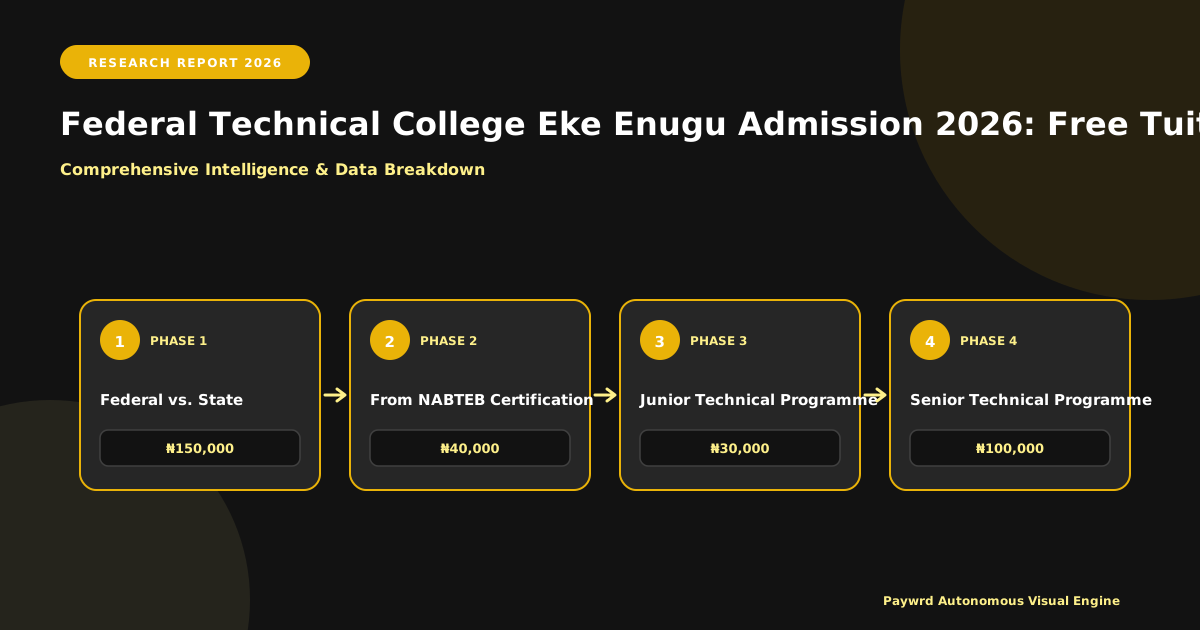
<div class="paywrd-highlight-box" Key Takeaway: Federal Technical College (FTC) Eke delivers a fully funded vocational package—tuition, boarding, uniforms, and three square meals—at zero cost to parents, a financial relief unmatched by state or private alternatives in Enugu State for the 2026/2027 session.
Federal Technical College Eke Enugu Admission 2026: Free Tuition & Application Guide
Why Choose Federal Technical College Eke Enugu in 2026: The Zero-Cost Advantage
In an era where the average private vocational centre in Enugu demands ₦350,000 to ₦600,000 per session for tuition alone, FTC Eke stands as a strategic outlier. As a Federal Government-owned Unity College under the direct supervision of the Federal Ministry of Education, the institution operates on a 100% tuition-free mandate for the 2026/2027 academic year. But the “Zero-Cost Advantage” extends far beyond classroom fees. The Federal Government capital allocation covers boarding accommodation, standard school uniforms, laboratory/workshop consumables, and three daily meals for every enrolled student. For a typical household in the South-East navigating current economic realities, this comprehensive funding eliminates the hidden costs—PTA levies, development fees, and feeding allowances—that often inflate the true cost of “free” education elsewhere.

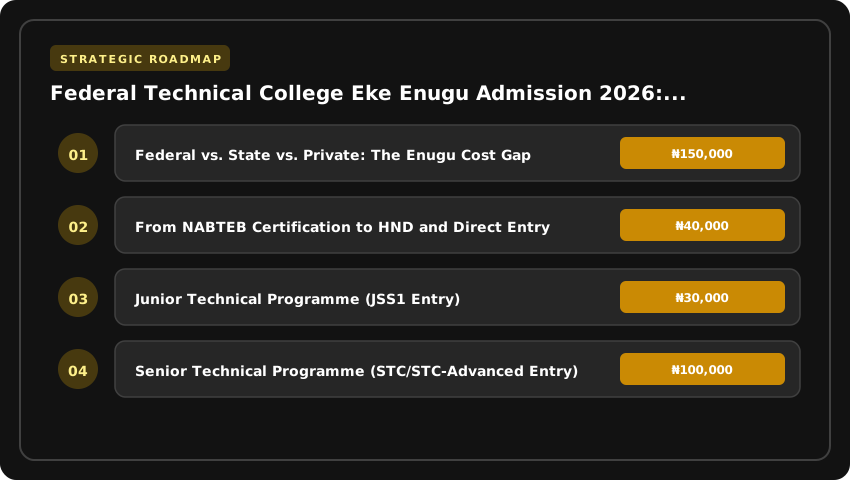
Federal vs. State vs. Private: The Enugu Cost Gap
When benchmarked against peers in the Enugu axis, the disparity is stark. State Technical Colleges (e.g., Government Technical College, Enugu) typically charge subsidized tuition (approx. ₦25,000–₦40,000) but require parents to bear full boarding costs, uniform kits, and feeding—often pushing the real session cost above ₦200,000. Private Vocational Centres offer modern equipment but operate purely on cost-recovery models; a National Business and Technical Examinations Board (NABTEB) preparatory programme frequently exceeds ₦500,000 annually without guaranteed certification recognition parity. FTC Eke delivers the same NABTEB curriculum, federally certified workshops, and nationally recognized certification for ₦0 tuition and near-zero ancillary spend.
From NABTEB Certification to HND and Direct Entry
The value proposition does not expire at graduation. FTC Eke’s curriculum is strictly aligned with the National Board for Technical Education (NBTE) standards, ensuring your NABTEB Advanced (ANBC) or Craft Certificate is a verified passport for progression.
- Polytechnic HND Pathway: Graduates with Upper Credit in NABTEB Advanced directly articulate into Higher National Diploma (HND) programmes at Federal Polytechnics (e.g., Institute of Management and Technology, Enugu; Federal Polytechnic, Nekede) without sitting for UTME again.
- University Direct Entry (DE): Holders of NABTEB Advanced certificates with a minimum of 3 ‘A’ level passes (or equivalent Upper Credit) qualify for 200-Level Direct Entry admission into Engineering, Technology, and Vocational Education programmes across Nigerian universities via JAMB DE registration.
- Entrepreneurship & Trade Test: The college facilitates National Directorate of Employment (NDE) Trade Test certification (Grades III, II, I) concurrently, enabling immediate artisan employment or NYSC mobilization post-HND.
Choosing FTC Eke in 2026 is not merely a cost-saving decision; it is a strategic investment in a federally guaranteed pipeline from secondary-level technical mastery straight into tertiary engineering corridors or the skilled labour market—without the debt burden.
2026 Eligibility Criteria for Junior & Senior Technical Programmes
Before you even touch the application portal, run your credentials against this checklist. Federal Technical College (FTC) Eke operates under strict Federal Ministry of Education guidelines, and the 2026 cycle enforces these benchmarks without exception. Missing a single criterion—especially on age or subject combinations—results in automatic disqualification, regardless of your exam scores.
Junior Technical Programme (JSS1 Entry)
The Junior Technical track targets pupils transitioning from primary school into a vocational-secondary hybrid. For the 2026/2027 academic session, the college adheres to the Universal Basic Education (UBE) framework.
- Age Limit: Candidates must be 10 to 13 years old as of September 30, 2026. Birth certificates or sworn declarations dated before 2026 are mandatory; baptismal cards are not accepted.
- Basic Education Certificate (BECE): Applicants must have sat for the 2026 BECE (organized by NECO or the Enugu State Ministry of Education) and possess a valid result slip.
- Minimum Score: A minimum aggregate of 60% across core subjects (English, Mathematics, Basic Science & Technology, and Pre-Vocational Studies) is the baseline for consideration.
- Medical Fitness: A certified medical report from a recognized government hospital confirming fitness for workshop practicals is required post-provisional admission.
Senior Technical Programme (STC/STC-Advanced Entry)
This is the competitive tier for artisans and technicians. You are applying for a specific trade, and your WAEC/NECO subject combination must map directly to that trade’s curriculum. General “O’Level passes” are insufficient.
- Core Mandatory Credits: Five (5) credits at not more than two sittings in WASSCE, NECO, or NABTEB. English Language and Mathematics are non-negotiable for every single trade.
- Trade-Specific Combinations (Examples):
- Engineering Trades (Mechanical, Electrical, Welding, Auto): Physics, Chemistry, and Technical Drawing/Metalwork.
- Construction Trades (Blocklaying, Carpentry, Plumbing): Physics, Technical Drawing/Woodwork, and any other Science/Technical subject.
- ICT/Business Trades (Computer Craft, Secretarial Studies): Physics or Chemistry, Economics/Commerce, and Technical Drawing or Further Mathematics.
- Catering/Hospitality: Biology/Agric Science, Food & Nutrition/Home Management, and Chemistry.
- NABTEB Holders: National Technical Certificate (NTC) holders with Credit passes in Trade Theory, Trade Practice, and the related Science/Math subjects qualify for direct STC-Advanced (Year 2) entry, subject to a practical trade test.
Catchment Area & Indigene Considerations
FTC Eke is a Federal Unity College. While it admits nationally, the 2026 admission policy weights the Catchment Area (Enugu, Ebonyi, Anambra) heavily—typically allocating 60% of slots to qualified indigenes of these three states.
- Proof of Indigeneity: A valid Certificate of Local Government of Origin (not just State of Origin) from the candidate’s LGA Chairman or Secretary is required during screening. JAMB/NECO registration data showing “State of Origin” is used for initial filtering, but the LGA certificate is the final arbiter.
- National Merit (40%): Candidates from non-catchment states compete strictly on aggregate BECE/WAEC scores. The cut-off mark for national merit candidates is historically 15–20 points higher than the catchment cut-off.
- Host Community (Eke/Udi LGA): A micro-quota exists for the immediate host community; candidates must present a community endorsement letter alongside the LGA certificate.
Bottom Line: If your age exceeds the JSS1 cap, or your WAEC subjects lack Technical Drawing for an Engineering trade, do not apply. Save the ₦2,500–₦3,000 application fee and target a programme where your paper trail matches the curriculum map exactly.
Full List of Accredited Technical Trades Offered at Eke Campus 2026
Choosing the right trade at Federal Technical College (FTC) Eke is not just about picking a subject; it is about aligning your aptitude with workshops that have passed rigorous NABTEB accreditation scrutiny for the 2026/2027 academic session. The college structures its curriculum around the National Business and Technical Examinations Board (NABTEB) syllabus, ensuring every graduate leaves with a National Technical Certificate (NTC) recognized for direct entry into polytechnics or immediate workforce integration. Below is the verified breakdown of active trades at the Eke campus for the current cycle.
Engineering Trades: Heavy Machinery & Power Systems
The engineering cluster remains the flagship of FTC Eke, backed by the newly refurbished mechanical workshop funded through the 2026 Federal Government intervention grant. These trades demand strong spatial reasoning and comfort with industrial safety protocols.
- Mechanical Engineering Craft Practice: Covers lathe operations, milling, shaping, and fitting. The workshop currently runs on conventional and newly installed CNC simulation units, preparing students for the NABTEB practical exams in Machine Shop Engineering.
- Electrical Installation & Maintenance Work: Focuses on domestic/industrial wiring, conduit bending, motor rewinding, and solar PV installation basics—a 2026 curriculum update reflecting Nigeria’s energy transition drive.
- Welding & Fabrication Engineering Craft: Trains candidates in arc welding (SMAW), gas welding (OAW), and TIG/MIG processes. The department boasts a functional fabrication bay where students execute live projects like gate construction and tank fabrication for internal revenue generation.
Construction Trades: Built Environment Mastery
These trades leverage the college’s expansive practical grounds. The 2026 curriculum emphasizes sustainable building materials and site management software awareness.
- Blocklaying, Bricklaying & Concreting: Goes beyond mortar mixing to include setting out, formwork design, reinforcement detailing, and quality control testing for compressive strength.
- Carpentry & Joinery: Distinguishes between site carpentry (roofing, formwork) and bench joinery (furniture, cabinetry). The workshop maintains a stock of seasoned hardwoods (Iroko, Mahogany) for final-year NABTEB project assessment.
- Plumbing & Pipe Fitting: Covers cold/hot water supply, sanitation drainage, gas piping, and fire protection systems. Students now train on PPR, CPVC, and copper jointing techniques to match current Nigerian building code standards.
Emerging Skills: Digital & Creative Economy Alignment
FTC Eke has aggressively expanded this cluster to meet the Federal Ministry of Education’s Skills for Employability mandate. These workshops received equipment upgrades in late 2026.
- Computer Craft Studies: Moves past basic literacy. The 2026 syllabus includes hardware troubleshooting, network fundamentals (Cisco Packet Tracer), Python programming basics, and graphic design (CorelDraw/Photoshop) for NABTEB practical certification.
- Catering Craft Practice: Operates a training kitchen and a functional canteen serving staff and students. Curriculum covers Nigerian/continental cuisine, pastry, food safety (HACCP), and cost control—critical for hospitality entrepreneurship.
- Garment Making: Integrates industrial sewing machines, pattern drafting (manual & CAD), textile science, and fashion illustration. The department partners with local fashion hubs in Enugu for industrial attachment placements.
Pro Tip: Before selecting a trade on the JAMB registration portal (or the college’s direct application portal), visit the Eke campus during open days to inspect the specific workshop bays. Confirm the student-to-equipment ratio; for instance, the Mechanical Engineering section currently maintains a 1:4 lathe-to-student ratio, which is superior to the national benchmark.
Step-by-Step: Applying via the Federal Ministry of Education Portal (2026 Cycle)
The Federal Ministry of Education (FME) e-admission portal is the single gateway for all Federal Technical Colleges, including FTC Eke. For the 2026 cycle, the workflow has been tightened around NIN verification to eliminate duplicate registrations. You cannot proceed without a valid National Identification Number (NIN) linked to an active phone number and email address. Start by visiting admission.federalministryofeducation.gov.ng — bookmark it, as you will return multiple times before the entrance examination.
1. Account Creation: NIN Verification & Email Authentication
Click “New Registration” and enter your NIN. The system pings the NIMC database instantly; if your biometrics or date of birth do not match what you type, the portal locks you out for 24 hours. Double-check your NIN slip before you start. Once verified, you will receive a One-Time Password (OTP) on the registered phone line and a confirmation link in your email. Complete both steps immediately — the link expires in 30 minutes. Your login credentials (Application ID and Password) are generated at this stage; screenshot and save them offline.
2. Completing the Bio-Data Form
Log in and navigate to “Bio-Data”. Every field marked with a red asterisk is mandatory. Pay special attention to:
- Names: Must appear exactly as on your NIN slip and birth certificate — no initials, no nicknames.
- State of Origin & LGA: These determine catchment area consideration; errors here are difficult to correct later.
- Disability Status: Select accurately if applicable; FTC Eke has provisions for inclusive education.
- Parent/Guardian Details: Provide a reachable phone number; the ministry sends exam updates via SMS.
Save each section before moving to the next. The portal auto-saves every 60 seconds, but never rely on it — hit “Save & Continue” manually.
3. Uploading Required Documents
The upload module accepts only JPEG/PNG images under 200KB each. Prepare scanned copies beforehand:
- Passport Photograph: White background, recent (not older than 6 months), no glasses or caps. Dimensions: 35mm x 45mm.
- Birth Certificate: Issued by the National Population Commission (NPC) or a sworn affidavit with a court stamp. Hospital certificates are rejected.
- BECE/WAEC Result Scratch Cards: You must upload the PIN and Serial Number from your result checking card (WAEC or NECO BECE). The portal validates these against the examination body’s database in real-time. If you used a school-issued card, ensure the PIN hasn’t been maxed out on checks.
After each upload, a green checkmark appears. If you see a red “X”, compress the image further or re-scan at 150 DPI.
4. Selecting Federal Technical College Eke as First Choice
Under “Choice of Institution”, use the dropdown filter: Type: Federal Technical College → State: Enugu → Institution: Federal Technical College, Eke. Set it as 1st Choice. The portal allows a 2nd Choice, but FTC Eke’s competitive cut-off means your 1st Choice carries the weight. Do not select “Any Federal Technical College” — that dilutes your placement priority.
5. Printing the Examination Photocard
Once the form shows “Submitted Successfully”, the “Print Photocard” button activates. Print two copies on A4 paper (colour preferred). The photocard contains your Examination Center, Date, Time, and unique Candidate Number. Laminate one copy; you must present it at the exam hall alongside your NIN slip. No photocard, no entry — there are no exceptions in the 2026 cycle.
Inside the 2026 Entrance Examination: Format, Syllabus & Cut-off Marks
The Federal Technical College (FTC) Eke entrance examination remains the primary gateway for Junior Secondary School leavers targeting the 2026/2027 academic session. Unlike standard secondary school placement tests, this paper is engineered to filter for technical aptitude alongside core academic competence. For 2026, the Computer-Based Test (CBT) format is fully entrenched, meaning candidates must be comfortable navigating a digital interface—drag-and-drop questions, on-screen calculators, and timed section navigation are standard.
Subject Breakdown & Syllabus Focus
The 2026 paper comprises four distinct sections, weighted to reflect the college’s dual mandate of academic certification and trade proficiency:
- English Language (40 Questions): Focus shifts heavily to comprehension passages drawn from technical manuals and safety guidelines, alongside standard lexicon, structure, and oral English. Expect 15 questions on comprehension, 15 on grammar/structure, and 10 on vocabulary/phonetics.
- Mathematics (40 Questions): The syllabus aligns with the NERDC Junior Secondary curriculum but emphasizes applied arithmetic. Key areas: Mensuration (volumes of cylinders/cones—critical for welding/fabrication trades), Algebraic processes, Statistics (mean, median, mode of grouped data), and Trigonometric ratios. Pure theoretical proofs are rare; word problems simulating workshop scenarios dominate.
- General Science (30 Questions): A fused Physics/Chemistry/Biology paper. Priority topics include: Electricity & Magnetism (Ohm’s law, series/parallel circuits), Matter & Chemical Reactions (acids, bases, salts, electrolysis), and Human Anatomy/Health Science (respiratory/circulatory systems). Practical knowledge of lab apparatus identification is tested via diagrams.
- Technical Aptitude (30 Questions): This is the differentiator. It assesses spatial reasoning, mechanical comprehension (gears, pulleys, levers), technical drawing basics (orthographic projections, scaling), and workshop safety protocols. Candidates for Engineering trades must score high here; it carries implicit weighting during trade allocation.
Total duration is 150 minutes for 140 questions. There is no negative marking, so intelligent guessing on difficult Technical Aptitude items is advised rather than leaving blanks.
Historical Cut-off Trends: The Trade Disparity
Cut-off marks are not uniform; they are trade-specific and driven by subscription pressure. Historical data from the 2026–2026 cycles reveals a stark divide:
- High-Demand Trades (Electrical Installation, Computer Craft Practice, Mechatronics, Refrigeration & AC): Effective cut-offs typically settle between 165–180 out of 200. In 2026, Electrical Installation required a minimum of 172 for Enugu indigenes and 178 for non-indigenes due to oversubscription ratios exceeding 5:1.
- Mid-Tier Trades (Welding & Fabrication, Motor Vehicle Mechanics, Carpentry & Joinery): Cut-offs hover around 140–155. These trades offer solid employability but attract fewer first-choice applicants.
- Low-Subscription Trades (Block Laying & Concreting, Plumbing & Pipe Fitting, Catering Craft): Often admit candidates scoring 120–135, provided they meet the college’s general minimum benchmark (usually 100/200).
Strategy: If your aggregate is 150, listing Electrical as first choice and Welding as second is risky—you may miss both if the Electrical cut-off spikes. Align your first choice with your realistic score band.
2026 Examination Centres in Enugu Metropolis
For the 2026 exercise, the College Management has designated specific CBT centres to decongest the campus. Accredited centres within Enugu metropolis include:
- FTC Eke Main Campus CBT Hub (Primary centre, capacity 300 seats).
- Enugu State College of Education (Technical), Enugu – ICT Centre.
- Federal Cooperative College, Oji River – E-Testing Lab.
- Approved Private CBT Centres: JAMB-accredited centres like Digital Bridge Academy (Independence Layout), NIIT Enugu (Okpara Avenue), and Zinox Technologies (GRA) are typically contracted for overflow. The final gazetted list is published on the FTC Eke official portal two weeks before the exam.
Candidates must print their examination slips (available on the portal from mid-June 2026) which specify the exact centre, date, and reporting time (usually 7:00 AM for biometric verification). Arriving late is an automatic disqualification—no appeals.
Post-Examination Process: Admission Lists, Acceptance & Resumption Protocol
Passing the entrance examination is only half the battle; securing your spot at Federal Technical College (FTC) Eke requires strict adherence to the administrative timeline. For the 2026/2027 session, the Federal Ministry of Education (FME) manages the central admission portal, but the college notice board remains the authoritative physical source. Candidates must monitor both channels religiously from July through September 2026.
Tracking the Three Admission Batches
The FME typically releases admission in three distinct batches—1st, 2nd, and 3rd—via the FME Admission Portal (admissions.fme.gov.ng). The 1st Batch usually drops in mid-July 2026, targeting candidates with the highest aggregate scores. The 2nd Batch follows in early August to fill vacant slots, and the 3rd Batch (often called the “Supplementary List”) appears by late August or early September. Do not rely solely on SMS alerts. Log in with your JAMB registration number and examination slip details weekly. Simultaneously, visit the FTC Eke main gate notice board; the college publishes a stamped, signed hard copy that serves as the legal document for acceptance fee payment. If your name appears, print the admission letter immediately—it carries a unique verification code required for the next steps.
Acceptance Fees: Decoding “Free Tuition” vs. Mandatory Levies
While the Federal Government’s Zero Tuition Policy covers academic instruction for 2026, “Free Tuition” does not mean “Zero Cost.” Successful candidates must pay the Acceptance Fee Package to activate their studentship. For 2026, this typically totals ₦35,000 – ₦45,000 (verify exact figure on the college portal), broken down into:
- Acceptance Fee: ~₦15,000 (Non-refundable, confirms your slot).
- PTA Levy: ~₦10,000 (Parents-Teachers Association infrastructure support).
- Development Levy: ~₦10,000 (College capital projects).
- Identity Card & Portal Access: ~₦5,000.
Payment is made strictly via Remita on the FTC Eke portal (ftceke.edu.ng) generating an RRR code. Pay at any commercial bank (First Bank, Zenith, UBA) or via USSD/Banking App. Deadline is usually 2 weeks after list publication. Failure to pay within this window auto-forfeits your slot to the next candidate on the waiting list. Keep the bank teller and Remita receipt; you will present originals during physical clearance.
Medical Screening & Boarding House Resumption Essentials
FTC Eke is a full boarding institution; medical fitness is non-negotiable. After fee payment, download the Medical Examination Form from the portal. You must undergo screening at a Government-owned General Hospital or Teaching Hospital (private clinic reports are routinely rejected). Required tests include: Genotype (Hb Electrophoresis), Blood Group, Urinalysis, Chest X-Ray, and Hepatitis B Surface Antigen. The medical officer must sign, stamp, and seal the form in an envelope.
For resumption (typically mid-September 2026), the college enforces a strict “Compulsory Items” checklist. Arriving without these items leads to denial of hostel access. Budget approximately ₦150,000 – ₦200,000 for quality items:
- Bedding: 2 White bedsheets, 1 Blanket, 1 Pillowcase, Mosquito net (treated).
- Toiletries: Bucket (2), Bathing soap, Detergent, Toothpaste, Towels (2), Toilet roll (4 rolls), Sanitary pads (girls).
- Academic: Mathematical set, Scientific calculator (Casio fx-991ES Plus recommended), 20-leaf notebooks (6), Graph book, Drawing instruments (Technical Drawing set).
- Wear: Black leather school shoes (low heel), White canvas shoes, White socks (6 pairs), Black socks (3 pairs), College uniform (purchased only from approved vendors on campus after verification).
- Provisions: Padlock (2 heavy-duty), Cutlery, Water bottle, Nightwear.
Pro Tip: Parents/Guardians must accompany students for the physical screening and hostel allocation exercise. No proxy is allowed for the initial medical clearance and bed space balloting. Bring originals and 3 photocopies each of: Birth Certificate, LGA Certificate, JAMB Result Slip, WAEC/NECO Result (if available), Admission Letter, Remita Receipts, and Medical Report.
| Criteria | FTC Eke (Federal) | Other Federal Technical Colleges | State Technical Colleges (Enugu) | Private Technical Schools |
|---|---|---|---|---|
| Tuition Fee (2026/2027) | ₦0 (Free Federal Policy) | ₦0 (Free Federal Policy) | ₦15,000 – ₦35,000/term | ₦150,000 – ₦500,000+/term |
| Boarding & Miscellaneous Fees (Annual Est.) | ₦45,000 – ₦65,000 | ₦40,000 – ₦70,000 | ₦30,000 – ₦50,000 | ₦100,000 – ₦300,000 |
| Admission Examination (2026 Entry) | NECO NCEE (JSS1) / State Exam (SSS1) | NECO NCEE (JSS1) / State Exam (SSS1) | State MINEDUC Entrance Exam | School-specific Entrance Exam |
| Certification Awarded | NABTEB / WAEC / NECO | NABTEB / WAEC / NECO | NABTEB / WAEC / NECO | NABTEB / WAEC / NECO / City & Guilds |
| Program Duration | 3 Years Junior + 3 Years Senior | 3 Years Junior + 3 Years Senior | 3 Years Junior + 3 Years Senior | Variable (Often 3-6 Years Combined) |
| 2026 Application Portal Opens | April 2026 (NECO Portal) | April 2026 (NECO Portal) | May 2026 (State Portal) | Rolling / Year-round |
| Hostel Accommodation | Compulsory Boarding | Compulsory Boarding | Optional / Day & Boarding | Optional |
Frequently Asked Questions
What is the total cost for Federal Technical College Eke admission 2026?
For the 2026/2027 session, tuition is free at FTC Eke per Federal Government policy. New students pay approximately ₦45,000–₦65,000 covering boarding, uniforms, textbooks, PTA levy, and medicals. Exact breakdown is released on the school portal upon admission list publication in August 2026.
How do I apply for FTC Eke Enugu JSS1 admission for 2026?
Apply via the NECO National Common Entrance Examination (NCEE) portal opening April 2026. Select 'Federal Technical College Eke' as first choice during registration. Sit for the exam in June 2026. Admission lists are published on the NECO and college websites by August 2026 based on merit and catchment quotas.
What are the 2026 cutoff marks for Federal Technical College Eke?
FTC Eke does not publish a fixed cutoff mark. Admission for 2026 follows the Federal 'Merit 60%, Catchment 30%, Educationally Less Developed States 10%' formula. Historically, Enugu indigenes require 130–150/210 in NCEE; non-indigenes need 160+. Final 2026 thresholds release with the admission list in August.
Is boarding compulsory at Federal Technical College Eke for 2026 intakes?
Yes, FTC Eke operates a mandatory full-boarding system for all Junior and Senior students. The 2026 admission letter includes a compulsory boarding fee component (approx. ₦25,000/term). Day-student status is not permitted; hostel spaces are allocated upon physical registration in September 2026.
When does Federal Technical College Eke resume for 2026/2027 academic session?
New JSS1 and SSS1 students resume for screening and orientation in mid-September 2026 (exact date on admission letter). Returning students resume early September. The 2026/2027 academic calendar runs September 2026 to July 2027 with three terms. Late registration attracts penalties after the second week.
Strategic Topic Exploration
Strategic Final Takeaway
When evaluating Federal Technical College Eke Enugu Admission Requirements And Application Process in 2026 and beyond, base your decisions on accredited institutional standards, verified return on investment (ROI), and up-to-date official guidelines. Always verify specific dates and requirements through official regulatory portals.

