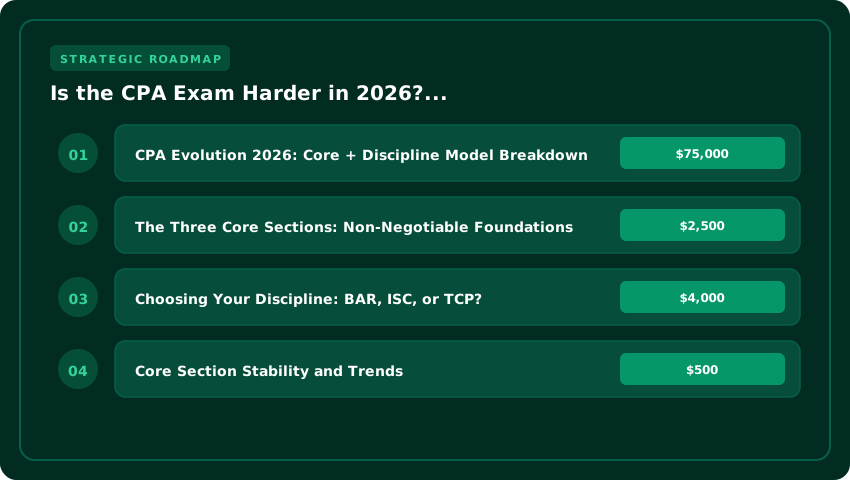
CPA Evolution 2026: Core + Discipline Model Breakdown
The AICPA and NASBA didn’t just tweak the syllabus; they rewrote the architecture. Gone are the days of AUD, BEC, FAR, and REG as four equal pillars. Starting January 2026, the Uniform CPA Examination operates on a Core + Discipline framework designed to validate the baseline competencies every CPA needs while letting you demonstrate deeper expertise in a specific domain. This isn’t administrative shuffling—it changes how you budget study hours, which review course modules you prioritize, and ultimately, how employers perceive your technical readiness.

The Three Core Sections: Non-Negotiable Foundations
Every candidate, regardless of career path, must pass three Core sections. These assess the “universal” knowledge the profession deems essential for a newly licensed CPA in 2026. The content weighting shifts reflect the profession’s pivot toward data analytics, systems controls, and risk assessment.
- Auditing and Attestation (AUD): Weighted heavily toward risk assessment, evidence evaluation, and reporting (roughly 70–80% of the section). Expect heavier simulation emphasis on SOC engagements and data-driven audit procedures.
- Financial Accounting and Reporting (FAR): Remains the “beast” of the exam. The 2026 blueprint allocates significant weight to state/local governmental accounting, not-for-profit reporting, and complex consolidation scenarios. IFRS is largely removed from the Core, pushed to the BAR Discipline.
- Taxation and Regulation (REG): Federal taxation (individuals, entities, property transactions) dominates at 60–70%. Ethics, professional responsibilities, and business law constitute the remainder. The Tax Cuts and Jobs Act provisions currently sunsetting are fair game.
Choosing Your Discipline: BAR, ISC, or TCP?
This is where strategy meets career trajectory. You select one Discipline section. Your choice signals specialization to the market and dictates your final 8–10 weeks of study intensity.
- Business Analysis and Reporting (BAR): The natural heir to old BEC and advanced FAR. Target this if you’re heading into corporate finance, FP&A, or assurance. It covers financial statement analysis, technical accounting (derivatives, leases, revenue recognition), and data analytics visualization. Difficulty signal: Highest volume of technical accounting memorization.
- Information Systems and Controls (ISC): The IT audit and cybersecurity track. Covers IT governance, SOX compliance, system development life cycles (SDLC), and data privacy frameworks (GDPR, CCPA). Ideal for: Candidates targeting Big 4 IT Risk Assurance, internal audit, or consulting. Requires conceptual mapping more than rote calculation.
- Tax Compliance and Planning (TCP): Deep-dive federal tax. Advanced entity taxation (S-corps, C-corps, partnerships), multi-jurisdictional issues, and high-net-worth planning strategies. Ideal for: Tax track hires. If you took advanced tax electives in your MAcc, this leverages existing academic credit.
Strategic Advice: Don’t pick based on perceived “ease.” Pass rates for Disciplines will stabilize around 50–55% historically. Align the Discipline with your first two years of work experience. If your firm places you in Audit, BAR or ISC reinforces daily work. If you’re in Tax, TCP turns study time into billable competence. Register for your Discipline when you schedule your first Core section—slots fill fast at Prometric centers during the 2026 testing windows.
2026 Pass Rate Analysis: NASBA Data vs Prior Benchmarks
Analyzing the 2026 NASBA and AICPA data reveals a distinct shift in candidate performance following the full integration of the CPA Evolution model. While the legacy exam was characterized by a broad, shallow knowledge base across four sections, the 2026 metrics indicate that the “Core + Discipline” structure has created a bifurcated difficulty curve. Current quarterly trends show that while Core section pass rates have stabilized, the Discipline sections are acting as the primary gatekeepers for licensure.
Core Section Stability and Trends
The three Core sections—designed to ensure a baseline of competency for all US CPAs—are currently mirroring historical averages. According to 2026 NASBA data, pass rates for the Core components are hovering between 44% and 52%. This suggests that the fundamental accounting and auditing principles remain consistent in difficulty, provided candidates utilize updated review materials that align with the 2026 US Dept of Education standards for professional certification.
Discipline Performance Metrics: BAR, ISC, and TCP
The real volatility lies in the Discipline sections. Data from the first half of 2026 indicates a significant variance in pass rates based on the chosen specialty:
- Business Analysis and Reporting (BAR): Currently the most challenging, with pass rates dipping toward 38%. This is attributed to the heavy emphasis on advanced technical accounting and complex financial analysis.
- Information Systems and Controls (ISC): Showing a moderate pass rate of approximately 46%, reflecting the increasing importance of IT audit and cybersecurity in the modern corporate landscape.
- Tax Compliance and Planning (TCP): The most accessible of the three, with pass rates trending near 54%, likely due to the direct overlap with traditional REG coursework.
Statistical Comparison to Pre-Evolution Benchmarks
When comparing 2026 data to the pre-Evolution historical averages (the legacy FAR, AUD, REG, BEC era), the “difficulty delta” is not found in the volume of material, but in the depth of application. Historically, candidates faced a “mile wide and inch deep” challenge. In 2026, the data shows a higher failure rate in the Discipline sections compared to the old BEC section, suggesting that specialization requires a more rigorous level of critical thinking.
For candidates planning their 2027 trajectory, these figures underscore the importance of selecting a Discipline that aligns with their existing strengths. With the average starting salary for a licensed CPA in the US now exceeding $75,000 according to BLS data, the strategic choice of a Discipline is no longer just about passing—it is about professional positioning.
Discipline Section Deep Dive: BAR, ISC, TCP Content Shifts
Choosing your discipline in 2026 is no longer a matter of “which section is easiest,” but rather which career trajectory you intend to pursue. The AICPA has shifted the exam to mirror the actual demands of modern public accounting and corporate finance. Whether you are aiming for a Big Four audit role or a CFO track in a mid-market firm, your choice between BAR, ISC, and TCP will dictate the technical rigor of your final hurdle.
Business Analysis and Reporting (BAR)
BAR is the natural successor for those who excelled in the legacy FAR section. It moves beyond basic financial reporting into advanced technical accounting. Candidates must master complex areas that were previously reserved for senior managers, including:
- Advanced Technical Topics: Deep dives into derivative instruments, consolidated financial statements, and governmental accounting.
- Financial Analysis: A heavy emphasis on ratio analysis and forecasting to support strategic business decisions.
- Managerial Accounting: Cost accounting and variance analysis that align with PMI (Project Management Institute) standards for operational efficiency.
Information Systems and Controls (ISC)
As AI and cloud computing redefine the ledger, ISC has become the critical path for candidates eyeing IT Audit or Risk Advisory. This section is less about “number crunching” and more about the architecture of data. Key focus areas include:
- Data Governance: Analyzing how data is captured, stored, and protected to ensure integrity and compliance with SOC reporting.
- System Implementation: Evaluating the internal controls of ERP systems and the risks associated with automated workflows.
- Cybersecurity Frameworks: Understanding the intersection of IT controls and financial reporting to prevent systemic fraud.
Tax Compliance and Planning (TCP)
TCP is designed for the future tax specialist. While the Core sections cover basic tax law, TCP dives into the nuances of high-net-worth individuals and complex corporate entities. It requires a sophisticated understanding of:
- Entity Nuances: Advanced strategies for S-Corps, Partnerships, and C-Corps, focusing on multi-state tax implications.
- Individual Planning: Complex wealth transfer, gift taxes, and strategic tax mitigation for high-earners.
- Compliance Logic: Navigating the latest IRS code updates and the integration of tax software in professional practice.
Aligning your discipline with your professional goals is essential. For example, an ISC specialist may find higher immediate demand in tech-heavy hubs, while a TCP expert is indispensable for private wealth management firms. Regardless of the path, ensure your study materials—whether through Becker or other providers—are updated for the 2026 technical specifications.
Becker vs UWorld Roger vs Surgent: 2026 Course Alignment Review
With the 2026 CPA Evolution model now fully operational, the stakes for choosing a review provider have shifted. You are no longer just studying for a general exam; you are investing in a specific pathway toward a Discipline specialization. Given that CPA candidates often spend between $2,500 and $4,000 on review materials, aligning your software with the current AICPA blueprint is critical for avoiding costly retakes.
Becker: The Gold Standard for Simulation Readiness
Becker remains the industry titan, primarily because of its deep integration with the 2026 Core and Discipline simulations. While other providers focus on multiple-choice questions (MCQs), Becker’s 2026 updates emphasize “simulation readiness.” Their platform mirrors the actual Prometric testing environment, which is vital for the complex Task-Based Simulations (TBS) found in the BAR and ISC disciplines. For candidates aiming for Ivy League-level corporate placements or Big Four firms, Becker’s comprehensive approach remains the safest investment, despite the higher price point.
UWorld Roger: Discipline-Specific Mastery
UWorld Roger has pivoted aggressively toward the 2026 “Core + Discipline” architecture. Their strength lies in lecture delivery; Roger CPA Review utilizes high-energy, conceptual teaching that breaks down the dense technical requirements of the TCP (Tax Compliance and Planning) discipline. Rather than rote memorization, UWorld focuses on the “why” behind the tax code, making it an ideal choice for candidates who struggle with the abstract nature of the new specialized sections. Their 2026 question banks are highly praised for their detailed explanations, which act as secondary study guides.
Surgent: Adaptive Efficiency for the Core
For candidates balancing full-time employment or those utilizing FAFSA-backed loans to fund their education, Surgent’s A.I.-driven adaptive learning technology is the most efficient route through the three Core sections. Surgent’s 2026 algorithm analyzes your performance in real-time, stripping away material you have already mastered and forcing focus on your weakest areas. This “efficiency gain” can reduce study hours by up to 30%, allowing you to reach the Discipline phase of your journey faster without sacrificing the passing probability.
- Becker: Best for those prioritizing simulation accuracy and Big Four alignment.
- UWorld Roger: Best for conceptual learners needing deep dives into Discipline-specific lectures.
- Surgent: Best for time-constrained professionals seeking the fastest path through the Core.
150-Hour Rule & State Licensing Variations for 2026 Candidates
While the 2026 CPA Exam format has evolved into the Core + Discipline model, the “150-hour rule” remains the primary gatekeeper for licensure across nearly every US jurisdiction. To earn your license, you generally need 30 credit hours beyond a standard bachelor’s degree. However, the challenge for 2026 candidates is no longer just hitting the number, but ensuring those credits align with the specific technical requirements of your chosen Discipline—whether that be Business Analysis and Reporting (BAR), Information Systems and Controls (ISC), or Tax Compliance and Planning (TCP).
State Board Credit Recognition & Discipline Alignment
State boards of accountancy are currently updating their educational requirements to recognize the specialized nature of the Discipline sections. If you are pursuing the ISC discipline, for example, some states now prioritize or mandate specific credits in information technology or data analytics to satisfy the 150-hour threshold. Candidates must verify with their specific state board whether “general” business credits will suffice or if they need targeted coursework to avoid a deficiency during the licensure application process.
NASBA Advisory Reports, Mobility, and Reciprocity
Navigating the patchwork of state laws requires a strategic look at the NASBA Advisory Report. In 2026, mobility—the ability to practice in multiple states—depends heavily on “substantial equivalency.” If you qualify for a license in a strict state like New York or California, you generally gain easier reciprocity in others. However, if you utilize alternative credits (such as community college or certain online certifications) to reach 150 hours, some boards may reject your application for mobility, limiting your career trajectory to a single state.
Strategic Enrollment Planning for 2026-2027
To avoid costly delays and unnecessary tuition—which can range from $500 to $2,000 per credit hour at private institutions—candidates should adopt a phased enrollment strategy:
- FAFSA & Funding: Leverage the 2026 FAFSA updates to secure grants or loans for a Master of Accountancy (MAcc) or a specialized certificate program.
- AACSB Accredited Institutions: Ensure all supplemental credits come from AACSB-accredited schools to guarantee seamless acceptance by state boards.
- The “Bridge” Approach: Instead of a full master’s degree, consider a 30-hour certificate program that specifically mirrors the Core + Discipline syllabus to maximize study efficiency.
- Early Evaluation: Submit your transcripts for a preliminary review by your state board before enrolling in additional courses to ensure every credit counts toward the 150-hour goal.
New CPA Salary Outlook: Big 4 vs Industry Compensation 2026
Entering the workforce in 2026, newly licensed CPAs are seeing a significant shift in compensation structures. The “CPA Evolution” model has transitioned the credential from a generalist badge to a specialized asset. For those entering public accounting—specifically the Big 4 (Deloitte, PwC, EY, and KPMG)—starting salary bands for first-year associates have climbed to reflect the increased technical rigor of the new Discipline sections. In major US metropolitan hubs, starting base salaries now typically range from $72,000 to $85,000, often supplemented by signing bonuses ranging from $5,000 to $15,000.
However, the most aggressive growth is currently found in the private sector. Industry roles in corporate accounting, financial planning and analysis (FP&A), and internal audit are offering competitive entry-to-mid-level packages to lure talent away from the grueling hours of public accounting. Current 2026 market data indicates that licensed CPAs moving into industry roles can command base salaries between $75,000 and $110,000+, depending on the sector and geographic location.
The ROI of Discipline Specialization
The 2026 “Core + Discipline” model has created a direct link between the exam section you choose and your long-term earning trajectory. By specializing early, candidates are effectively signaling their market value to employers before they even step into an interview. The ROI varies significantly based on the chosen path:
- Information Systems and Controls (ISC): This is currently the highest-earning trajectory. With the convergence of AI and auditing, CPAs who master ISC are commanding a premium, often seeing 10-15% higher starting offers in risk advisory and cybersecurity audit roles.
- Tax Compliance and Planning (TCP): This remains the gold standard for stability. Specialists in TCP are seeing strong demand in high-net-worth wealth management and corporate tax strategy, with clear paths to partner or Director of Tax roles.
- Business Analysis and Reporting (BAR): This path is the primary engine for those targeting the CFO track. BAR specialists are highly valued in corporate controllership and strategic finance, where the ability to analyze complex financial reporting is critical.
Regardless of the path, the financial incentive remains clear. According to recent trends analyzed alongside BLS data, the “CPA bump”—the salary increase granted upon licensure—remains a critical milestone. Many firms now offer an immediate $5,000 to $10,000 salary adjustment the moment the license is active, ensuring that the investment in review courses like Becker yields a tangible, immediate return.
Strategic Study Plan: Passing the New Format Efficiently
Navigating the 2026 CPA Evolution model requires a tactical shift from traditional rote memorization to a strategic application of knowledge. With the 18-month window ticking, your goal isn’t just to study, but to optimize your sequence to maximize carry-over knowledge across the Core and Discipline sections.
Optimal Section Sequencing: Core vs. Discipline
For the majority of candidates, the Core-First approach is the most efficient path. By tackling the three Core sections first, you build a foundational knowledge base that simplifies the specialized content in your chosen Discipline (BAR, ISC, or TCP). If you jump into a Discipline first, you risk encountering advanced concepts that assume a mastery of Core principles you haven’t yet acquired.
- Recommended Order: Core 1 → Core 2 → Core 3 → Chosen Discipline.
- The Exception: If you are currently working in a specialized role (e.g., a tax associate), taking the TCP Discipline early can leverage your daily professional experience, potentially shaving weeks off your study time.
Mastering Task-Based Simulations (TBS)
In 2026, the “pass or fail” threshold often hinges on the Task-Based Simulations. Many candidates fail not because they lack knowledge, but because they lack the stamina for complex, multi-step simulations. To master these, you must shift your time allocation:
- The 40/60 Rule: Spend 40% of your time on Multiple Choice Questions (MCQs) to build speed, and 60% on TBS to build depth.
- Benchmark: Aim for at least 15-20 high-complexity simulations per section before sitting for the exam. Focus specifically on document review and research-based simulations, as these are high-weight areas in the current format.
Leveraging Review Course Analytics
Stop studying what you already know. Whether you use Becker or another top-tier provider, the 2026 interface provides granular data on your performance. Use these analytics for weak area remediation to avoid burnout.
Analyze your “Incorrects” and “Unfamiliar” tags. If your analytics show a consistent dip in a specific sub-topic—such as lease accounting or internal control frameworks—dedicate a “Deep Dive Day” to that specific module. By targeting your lowest-performing percentiles rather than reviewing the entire textbook, you can reduce your total study hours by 20% while increasing your probability of a passing score.
| Decision Criteria | Core Sections (Required) | Discipline: BAR | Discipline: ISC | Discipline: TCP |
|---|---|---|---|---|
| Focus Area | Baseline Competencies | Advanced Reporting & Analysis | Information Systems & Control | Tax Compliance & Planning |
| 2026 Study Hours | 300-400 Hours per Section | 150-200 Hours | 150-200 Hours | 150-200 Hours |
| Exam Timeline | Jan 2026 – Dec 2026 | Flexible Window 2026/2027 | Flexible Window 2026/2027 | Flexible Window 2026/2027 |
| Salary Potential | Entry-Level CPA Base | High (Corporate Finance) | High (IT Audit/Risk) | High (Private Wealth/Tax) |
| Prerequisites | 150 Semester Hours | Core Completion Recommended | Core Completion Recommended | Core Completion Recommended |
Frequently Asked Questions
How does the 2026 CPA Exam Core + Discipline model work?
The 2026 CPA Exam requires all candidates to pass three identical Core sections covering essential accounting competencies. After completing the Core, candidates must choose and pass one specialized Discipline section—either BAR, ISC, or TCP—allowing them to demonstrate expertise in a specific domain before obtaining their professional license.
Which CPA Discipline is best for 2026 candidates: BAR, ISC, or TCP?
The best choice depends on your career goals for 2026 and 2027. BAR is ideal for corporate reporting and analysis; ISC is tailored for those pursuing IT audit and cybersecurity risk; and TCP is designed for candidates specializing in complex tax compliance and strategic planning for high-net-worth clients.
Is the 2026 CPA Exam harder than previous versions?
While the 2026 format is more specialized, it is not necessarily harder. The 'Core + Discipline' model reduces the breadth of required knowledge in the final section, allowing candidates to focus on a specific area of interest, which can optimize study efficiency compared to the legacy four-pillar structure.
What are the 2026 CPA Exam requirements for US candidates?
For 2026, US candidates must typically meet the 150-semester-hour education requirement. They must pass the three mandatory Core sections and one chosen Discipline section (BAR, ISC, or TCP) within the NASBA-mandated timeframe to qualify for licensure, alongside completing the required professional experience hours.
How should I budget study hours for the 2026 CPA Evolution format?
Candidates should allocate 300-400 hours per Core section due to their foundational breadth. For the Discipline sections in 2026, a focused budget of 150-200 hours is generally sufficient, provided the candidate has a strong grasp of the related Core concepts and utilizes a modern review course like Becker.
Strategic Final Takeaway
When evaluating Is The CPA Exam Harder In 2026 New Format Difficulty Vs Becker Review in 2026 and beyond, base your decisions on accredited institutional standards, verified return on investment (ROI), and up-to-date official guidelines. Always verify specific dates and requirements through official regulatory portals.