2026 Funding Landscape: TETFund NRF, International Consortia & Pharma Partnerships
The money has moved from “capacity building” to “clinical delivery.” For Nigerian sickle cell disease (SCD) researchers in 2026, three distinct pillars dominate the high-value landscape: the revamped TETFund National Research Fund (NRF), the post-H3Africa NIH ecosystem, and direct industry fellowships tied to West African trial sites. Missing the nuance of co-funding mandates on any of these is the fastest way to a rejection letter.

TETFund NRF 2026 Cycle: Genomics First, Infrastructure Second
The 2026 NRF Guidelines (released Q1 2026 via the TETFund portal) explicitly prioritize translational genomics over basic equipment procurement. The maximum ceiling for a Centre of Excellence cluster remains ₦1.2 billion over three years, but the eligibility gate has tightened. You now need a signed MoU with a teaching hospital ethics committee before submission, plus a verified biobank SOP aligned with H3ABioNet 2.0 standards. The 2026 deadline is August 31, 2026. Crucially, TETFund now demands 15% institutional counterpart funding—cash, not in-kind lab space. Universities like UNILAG, ABU Zaria, and UNN that pre-positioned matching funds in their 2026 budgets are already drafting concept notes.
NIH & Wellcome: The H3Africa Successor & DELTAS II Reality
With H3Africa sunsetted, the action is in the DSI-Africa (Data Science for Health Discovery and Innovation in Africa) consortium awards (PAR-24-XXX series). Nigerian PIs are eligible only as Multi-PI (MPI) leads partnered with a US institution—solo Foreign Component applications are non-responsive. The 2026 receipt date is May 25, 2026 (R01 equivalent). Budget caps sit at $500k direct costs/year. Simultaneously, Wellcome Trust DELTAS II (Phase 2, 2026–2030) is open for “Research Training Programmes” led by African institutions. Nigerian eligibility requires a host institution with a functioning Grants Management Office (GMO) audited to Wellcome standards—currently, only about six Nigerian universities hold this certification. The Expression of Interest deadline closed March 2026; full proposals are due September 2026.
Industry Fellowships: Novartis, Pfizer & Global Blood Therapeutics (GBT)
This is where the unrestricted operational cash lives, but access is gated by trial site activation.
- Novartis Africa Sickle Cell Disease Fellowship: 2026 cycle funds 10 clinical research associates (CRAs) and 5 genomic data scientists embedded at Lagos University Teaching Hospital (LUTH), Aminu Kano Teaching Hospital (AKTH), and University of Benin Teaching Hospital (UBTH). Stipend: ~₦4.8M/annum + tuition. Application via Novartis Clinical Trials Portal; deadline June 15, 2026. Requires active GCP certification.
- Pfizer Rare Disease Research Grants (West Africa Hub): Focused on voxelotor and crizanlizumab real-world evidence. Open to Nigerian pharmacologists and health economists. Grant size: up to $75k. Deadline Rolling until Nov 2026. Must demonstrate access to NHIS/NHIA enrolled patient cohorts.
- Global Blood Therapeutics (GBT/Pfizer) Trial Site Investigator Grants: Not a fellowship—this is site activation funding (₦15M–₦40M) for IRB-ready sites to onboard the GBT021601 (inclacumab) Phase 3 extension. If your hospital pharmacy cannot maintain -80°C cold chain with 24/7 backup power, do not apply.
Strategic Move: Align your TETFund NRF co-funding ask with the personnel budget of an industry fellowship. Use the NRF to build the biobank; use the Novartis/Pfizer money to staff it. That is the only model surviving 2026 peer review.
Genomics Career Tracks Inside Nigerian Tertiary & Health Systems
The 2026 recruitment cycle signals a structural shift: Nigerian institutions are no longer hiring generic “molecular biologists.” They are budgeting for defined genomics cadres with CONUASS and CONMESS salary structures that finally reflect global competency benchmarks. If you hold a PhD in Bioinformatics or Human Genetics, the entry point is no longer a vague Graduate Assistantship but a substantive Lecturer I or Principal Research Officer slot.
Bioinformatician & Computational Biologist Roles at ACEGID, NIMR, and NUC Centres of Excellence
At the African Centre of Excellence for Genomics of Infectious Diseases (ACEGID) at Redeemer’s University and the Nigerian Institute of Medical Research (NIMR) Yaba, the 2026 establishment circulars list Bioinformatician II (CONUASS 04) and Computational Biologist I (CONUASS 05) as distinct cadres. Starting basic salary for CONUASS 04 sits at ₦3,450,000 per annum (approx. ₦287,500 monthly), rising to ₦4,100,000 at CONUASS 05. These roles demand demonstrable pipeline deployment on H3Africa or H3ABioNet servers, not just certificate courses. Promotion to Senior Research Fellow (CONUASS 06) requires first-authorship on two Q1 genomics papers and evidence of grant capture — typically a minimum of ₦50 million in external funding as Co-PI within the assessment window.
- ACEGID: Prioritizes candidates with long-read sequencing (ONT/PacBio) analysis for SCD haplotype phasing.
- NIMR: Requires GWAS pipeline management for the Nigerian 100K Genome Project node.
- NUC CoEs (e.g., UNILAG, ABU, UNN): Mandate teaching load compliance (minimum 3 CU/semester) alongside research.
Molecular Pathologist & Genetic Counsellor Vacancies in Federal Medical Centres
The Federal Ministry of Health’s 2026 Newborn Screening (NBS) scale-up — active in FMC Abuja, FMC Owerri, UCH Ibadan, and AKTH Kano — created gazetted posts for Molecular Pathologist (CONMESS 06) and Genetic Counsellor (CONHESS 09). The Molecular Pathologist basic salary starts at ₦5,800,000 per annum (CONMESS 06 entry), with specialist allowance pushing total package toward ₦9.5 million. Genetic Counsellors enter at CONHESS 09 (₦2,900,000 basic) but attract a scarce-skill hazard allowance of 15% and clinical duty tour allowance. Vacancy circulars explicitly require certification from the Medical Laboratory Science Council of Nigeria (MLSCN) for Pathologists and the Genetic Counselling Association of Nigeria (GCAN) registration for Counsellors. Promotion criteria for Pathologists hinge on ISO 15189 lab accreditation leadership; for Counsellors, it is documented cascade training of 20+ nurses per annum across the zonal network.
Academic Progression: Lecturer I to Professor via NUC CCMAS Genomics Curriculum
Under the NUC Core Curriculum Minimum Academic Standards (CCMAS) 2026 revision, universities must offer Genomics & Precision Medicine as a 3-credit unit core in MBBS, BMLS, and BSc Biotechnology. This creates a direct promotion pipeline. A Lecturer I (CONUASS 04, ₦3.45M) moving to Senior Lecturer (CONUASS 05, ₦4.1M) must now show: (1) Development of a CCMAS-compliant course module with practical NGS lab manual, (2) Supervision of at least two MSc theses using local SCD cohort data, and (3) A TETFund IBR or NRF grant as PI. The jump to Professor (CONUASS 07, ₦5.8M basic) requires a minimum of six Scopus-indexed publications in the last three years, one patent or validated diagnostic kit, and evidence of PhD graduation (not just supervision) under the new genomics curriculum. The era of “publish or perish” has been replaced by “curriculum, cohort, and cash.”
Critical 2026/2027 Application Windows & Documentary Checklists
Missing a deadline by 48 hours in Abuja isn’t a near-miss; it’s a hard rejection with zero appeal. The 2026/2027 cycle operates on a compressed, unforgiving calendar. If your Concept Note isn’t sitting in the TETFund NRF portal by the close of business on March 31, 2026, you are writing for 2028. The window opened January 15; the “grace period” narrative is a myth peddled by consultants who don’t lose sleep over desk rejections.
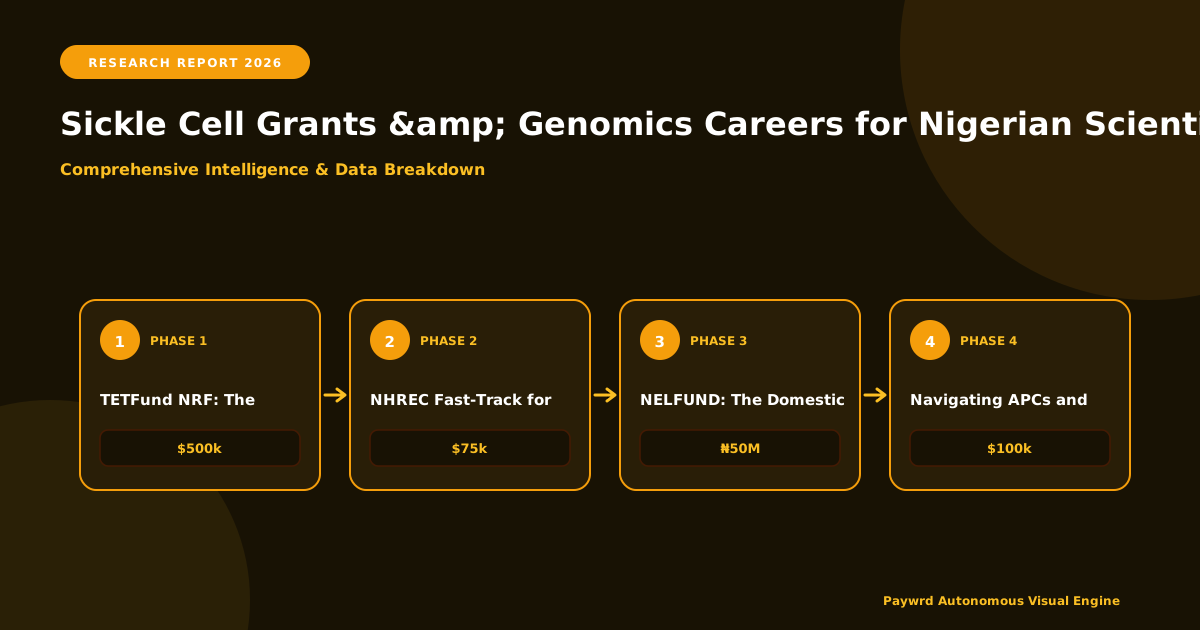
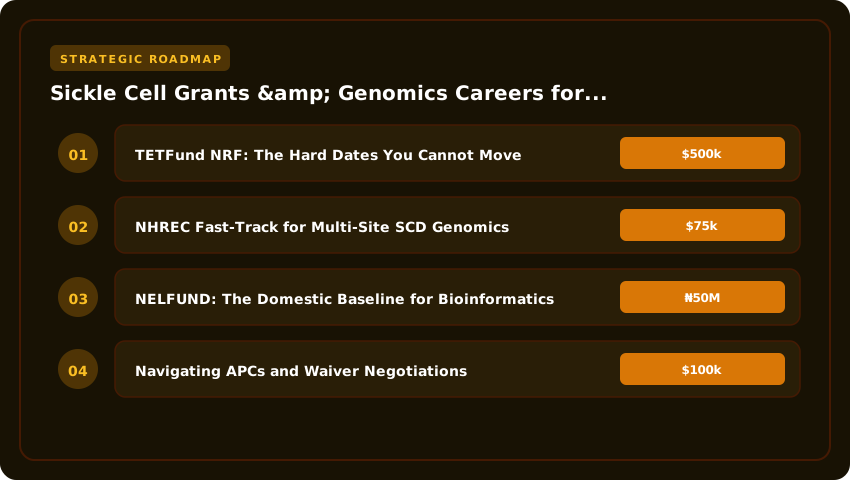
TETFund NRF: The Hard Dates You Cannot Move
- January 15 – March 31, 2026: Concept Note submission via the TETFund NRF portal. Multi-institutional MoUs (signed, stamped, scanned) must be uploaded with the Note, not promised for later.
- April 15 – May 30, 2026: Shortlisting & Invitation for Full Proposal. Check your spam folder daily; the invitation email expires in 72 hours.
- June 1 – July 31, 2026: Full Proposal development. Budget ceiling: ₦150M for Phase 1 consortia. No single line item >15% for equipment without Vice-Chancellor countersignature.
- August 15 – September 30, 2026: Physical Defense at the National Universities Commission (NUC) Auditorium. Travel budget for all Co-PIs must be pre-approved in the proposal; “virtual attendance” flags automatic disqualification for clinical genomics tracks.
- November 2026: Award Letters & First Tranche Release (40%).
NHREC Fast-Track for Multi-Site SCD Genomics
Standard NHREC clearance takes 90 days. For multi-site Sickle Cell Disease genomic studies involving whole-genome sequencing (WGS) or CRISPR validation, you need the Expedited Multi-Centre Protocol (EMCP) route. Submit the Master Protocol, Site-Specific Appendices, and a unified Data Transfer Agreement (DTA) compliant with the Nigeria Data Protection Act (NDPA) 2026 to the NHREC Secretariat by February 1, 2026. The secret: attach a letter of collaboration from your international sequencing partner (e.g., Sanger, Broad, or H3Africa node) confirming compute capacity. Without that letter, the “fast-track” reverts to standard timeline, pushing your TETFund defense past the August cutoff.
Digital Identity Audit: ORCID, Scopus & NUC Researcher Profile
Reviewers in London, Bethesda, and Singapore check your ORCID before they open your PDF. In 2026, a bare ORCID iD is a red flag. You need:
- ORCID: Minimum 15 verified works (peer-reviewed + datasets). Link your NUC Researcher Profile ID and Scopus Author ID in the “Also Known As” section.
- Scopus Author Profile: Merge duplicates now. If your name appears as “A. Adebayo,” “Adebayo A.,” and “Abdul Adebayo,” you have three h-indices. Request merger via Scopus Author Feedback Wizard by January 20.
- NUC Researcher Profile (CCMAS Portal): Update your “Active Grants” and “PhD Graduands” tabs. The TETFund screening committee cross-references this against your CV. Discrepancy = “Administrative Non-Compliance.”
Checklist for Desk-Rejection Proofing (Attach as Appendix Z): Signed Consortium MoU (Notarized), NHREC EMCP Acknowledgement Slip, ORCID/Scopus/NUC Profile Screenshots (dated < 30 days old), NDPA-Compliant DTA, Co-PI CVs (max 4 pages each, TETFund template), and Letter of Sequencing Capacity from International Partner. Staple this checklist to the front of your submission binder. If Appendix Z is incomplete, the administrative officer bins the file before the science panel ever sees it.
Leveraging NELFUND & Tertiary Scholarships for PhD/Postdoc Genomics Training
The 2026 funding architecture allows you to stack domestic safety nets with prestigious international awards, effectively eliminating the personal cost of a PhD or postdoc in genomics. The strategy is sequential: secure your domestic baseline first, then layer the high-value international scholarships on top.
NELFUND: The Domestic Baseline for Bioinformatics
Under the 2026 Student Loan Act amendments, NELFUND now explicitly covers PhD programmes at NUC-accredited Nigerian universities and approved partner foreign institutions running split-site or dual-degree arrangements (e.g., UNILAG/University of London, ABU/Queen Mary). For a Bioinformatics or Genomics PhD, the loan covers tuition (paid directly to the bursary) and a maintenance allowance of ₦30,000–₦40,000 monthly paid to your verified BVN-linked account. Crucially, eligibility requires your programme to be on the NELFUND Approved Course List—verify this on the nelf.gov.ng portal before accepting admission. Foreign partner universities must have a valid MoU with your Nigerian home institution registered with the NUC; standalone foreign admissions are not funded.
PTDF & Bilateral Quotas: The SCD Research Carve-Outs
This is where the “zero-cost” magic happens. For the 2026/2027 cycle, PTDF Overseas Scholarships (OSS) and the PTDF/Commonwealth Split-Site PhD scheme have ring-fenced 15–20% of total slots for Sickle Cell Disease (SCD) Genomics and Haematology. The Chevening Nigeria programme similarly prioritizes “Climate Health & Genetic Resilience” themes. To access these:
- PTDF OSS: Apply via the
ptdf.gov.ngportal when the 2026 advert drops (usually Q3). You need a First Class/2:1, NYSC discharge/exemption, and an unconditional offer from a UK Top 50 university for a genomics programme. The award covers full tuition, bench fees, return flights, and a £1,400+ monthly stipend. - PTDF/Commonwealth Split-Site: You remain employed in Nigeria, spending 12–18 months at the UK host lab. This preserves your salary—critical for the next step.
- Chevening: One-year Master’s route into a funded PhD. Deadline is typically November 2026 for 2027 entry. Highlight SCD population genomics in your leadership essay.
Structuring “Study Leave with Pay” with University Senates
Do not resign. Nigerian public universities (governed by the Conditions of Service, 2026 Revised Edition) permit Study Leave with Pay for staff pursuing PhDs relevant to institutional mandates. Since SCD Genomics aligns with the NUC CCMAS curriculum for Medical Laboratory Science and Biotechnology, your Head of Department (HOD) and Dean have grounds to recommend approval.
- The Playbook: Secure the PTDF/Chevening award letter first. Submit a formal application through your HOD → Dean → Registrar → Senate, attaching the award letter, admission letter, and a Bond Agreement (typically 2–3 years post-return service).
- Stacking: While on paid study leave, you draw your full Nigerian salary (CONUASS 03/04 entry ~₦2.5M–₦3.5M/annum) plus the foreign stipend (£18k–£22k/yr). NELFUND is paused during funded overseas study but reactivates if you return for a split-site write-up phase.
- TETFund IBR: If you are a lecturer, simultaneously apply for the TETFund Institution-Based Research (IBR) grant (₦15M–₦30M) to fund the local lab consumables for your genomic data analysis upon return. This closes the loop: foreign training funded by PTDF/Chevening, local infrastructure funded by TETFund, living costs covered by salary + stipend.
Bottom line: In 2026, a Lecturer I in Zaria or Ibadan can launch a world-class Genomics PhD at Oxford or Cambridge with zero personal debt by aligning NELFUND eligibility (domestic safety net), PTDF/Commonwealth quotas (SCD priority), and Study Leave with Pay (salary retention). The paperwork is heavy; the payout is total.
Data Sovereignty, NDPR Compliance & Community Engagement Protocols
In 2026, the Nigeria Data Protection Regulation (NDPR) is no longer a compliance checkbox—it is the gatekeeper for international publication and funding renewal. The Nigeria Data Protection Commission (NDPC) now requires a Data Protection Impact Assessment (DPIA) before any Whole Genome Sequencing (WGS) or GWAS dataset leaves a Nigerian server. If your consortium exports de-identified genomic data to the European Genome-phenome Archive (EGA) or dbGaP without a valid Standard Contractual Clause (SCC) addendum approved by the NDPC, your next TETFund NRF tranche will be frozen. Budget ₦2.5–₦4 million annually for a certified Data Protection Compliance Organization (DPCO) to audit your biobank’s data flow maps and breach notification protocols.
Community Advisory Boards: Budgeting for Real Engagement
International funders (NIH, Wellcome, Gates Foundation) now mandate proof of a functional Community Advisory Board (CAB) with compensated members, not just names on a letterhead. For a multi-site SCD cohort study recruiting 2,000 participants across Lagos, Kano, and Enugu, allocate ₦8–₦12 million in your Year 1 budget for CAB operations. This covers quarterly honoraria (₦50,000–₦75,000 per member per sitting), transport reimbursements, and a Community Liaison Officer salary (₦150,000–₦200,000/month). The CAB must co-own the Informed Consent Form (ICF) language—specifically the “broad consent” clause for future unspecified research. Without documented CAB minutes approving the MTA scope, your IRB (NHREC or institutional) will not issue the final ethical clearance certificate required for sample shipment.
Material Transfer Agreements: Retaining IP & Commercial Rights
Never sign a foreign collaborator’s boilerplate MTA. Nigerian institutions (via NUC CCMAS guidelines and NOTAP regulations) must negotiate three non-negotiable clauses:
- Benefit Sharing & IP Ownership: Insert a clause stating that any commercial product (drug, diagnostic kit, gene therapy vector) derived primarily from Nigerian genomic variants triggers a minimum 3–5% gross royalty stream back to the originating Nigerian university’s Research Foundation, not just the PI’s lab.
- Sample Destruction & Repatriation: Define a hard sunset clause (e.g., 5 years post-project or upon collaborator’s commercial licensing). Residual samples must be destroyed or repatriated to the Nigerian biobank at the collaborator’s shipping cost (≈₦1.5M/shipment for -80°C dry shippers).
- Publication Rights & Data Sovereignty: Retain the right of first publication for Nigerian first authors. The MTA must explicitly forbid the foreign partner from depositing raw FASTQ/BAM files into public repositories without written NDPC clearance—even if the data is “de-identified.” Genomic data is inherently identifiable.
Engage NOTAP before sample shipment. Their technology transfer registration certificate (cost: ~₦500,000 processing) is your legal shield if a collaborator patents a variant discovered in your cohort. In 2026, data sovereignty is not ethics—it is asset protection.
High-Impact Publication Strategy: Target Journals & Authorship Economics 2026
In the 2026 funding cycle, your publication record is the primary currency for securing NELFUND research grants and international fellowships. For Nigerian scientists specializing in Sickle Cell Disease (SCD) and genomics, the goal is no longer just “publishing” but strategic placement in journals that influence global clinical guidelines. To maximize your citation impact for 2027 renewal cycles, you must move beyond local bulletins and target high-impact factor (IF) outlets while aggressively managing the costs of Open Access.
Navigating APCs and Waiver Negotiations
Article Processing Charges (APCs) can be prohibitive, often exceeding ₦2,500,000 for top-tier journals. However, most elite journals have expanded their equity programs for Low-and-Middle-Income Countries (LMICs). When submitting to The Lancet Haematology, Blood, or Nature Genetics, do not simply pay the invoice. Explicitly request a full APC waiver based on the “HINARI” eligibility or the journal’s specific African research equity policy. For regional impact, prioritize the African Journal of Laboratory Medicine (AJLMM) and the Nigerian Journal of Medicine (NJM); these are critical for demonstrating local relevance to TETFund reviewers.
Authorship Positioning in Multi-Author Consortia
With the 2026 shift toward multi-institutional consortia, authorship disputes are common. Early-career Nigerian researchers must negotiate their position before data collection begins. To build a competitive grant-track record, aim for one of two positions:
- First Author: Essential for PhD candidates and Post-docs to prove technical execution and primary analysis.
- Last/Corresponding Author: The “Gold Standard” for aspiring PIs. If you are leading the Nigerian site of a global trial, insist on being the corresponding author for the regional cohort analysis to signal leadership to funding bodies.
Staking Priority via Pre-print Servers
The lag time for peer review in genomics can be 6 to 12 months, during which time a competing lab may publish a similar SCD variant. To stake your claim and establish priority, adopt a “Pre-print First” workflow. Deposit your manuscripts on medRxiv for clinical findings or AfriArXiv for African-centric genomic data immediately after internal review. This creates a time-stamped public record of your discovery, ensuring that your 2027 grant applications can cite “published” (pre-print) evidence of novel variants, effectively accelerating your perceived productivity.
| Funding Pillar | Primary Focus (2026/2027) | Key Prerequisite | Estimated Funding Scale | Success Probability |
|---|---|---|---|---|
| TETFund NRF | Clinical Delivery & Genomics | Multi-institutional Consortium | ₦50M – ₦200M | Moderate |
| NIH/Post-H3Africa | Population Genomics | International Partnership | $100k – $500k | Competitive |
| Pharma Fellowships | SCD Trial Site Integration | Clinical Site Affiliation | $50k – $150k (Stipend) | High (if linked) |
| Industry Grants | Therapeutic Translation | Novartis/GBT Trial Link | Variable (Project-based) | Selective |
Frequently Asked Questions
How can Nigerian scientists secure Sickle Cell genomics grants in 2026?
To secure funding in 2026, Nigerian scientists must shift from solo applications to multi-institutional consortia. Priority is given to researchers linked to clinical sites recruiting for Novartis or GBT trials. Focus on the revamped TETFund NRF and post-H3Africa NIH ecosystems, emphasizing clinical delivery over general capacity building.
What are the 2026 TETFund NRF requirements for genomics research?
The 2026 TETFund National Research Fund (NRF) cycle mandates a transition toward clinical delivery. Successful applicants must demonstrate a collaborative framework involving multiple institutions and a clear pathway for translating genomic data into patient outcomes, as solo PI applications are rarely approved in the current funding landscape.
Which genomics career paths offer the highest salary potential in Nigeria for 2027?
The highest salary potential for 2027 lies in Clinical Trial Management and Genomic Data Analysis tied to international pharma partnerships. Specialists capable of managing West African trial sites for global biotechnology firms command premium rates compared to traditional academic roles due to the surge in SCD therapeutic trials.
What is the role of clinical site affiliation in 2026 SCD funding?
In 2026, clinical site affiliation is the primary gatekeeper for high-value grants. Researchers affiliated with sites conducting active trials for global pharma leaders are prioritized for funding. Without a direct link to a recruiting clinical center, scientists are effectively invisible to the largest industry-led genomic cheques.
How does the 2026 NIH ecosystem support Nigerian sickle cell researchers?
The post-H3Africa NIH ecosystem in 2026 focuses on population genomics and international consortia. It provides critical funding for Nigerian scientists who can integrate local genomic datasets into global research frameworks, provided they meet the strict co-funding mandates and partnership requirements established for the 2026/2027 cycle.
Strategic Final Takeaway
When evaluating Sickle Cell Disease Research Grants And Genomics Career Pathways For Nigerian Medical Scientists 2026 in 2026 and beyond, base your decisions on accredited institutional standards, verified return on investment (ROI), and up-to-date official guidelines. Always verify specific dates and requirements through official regulatory portals.