
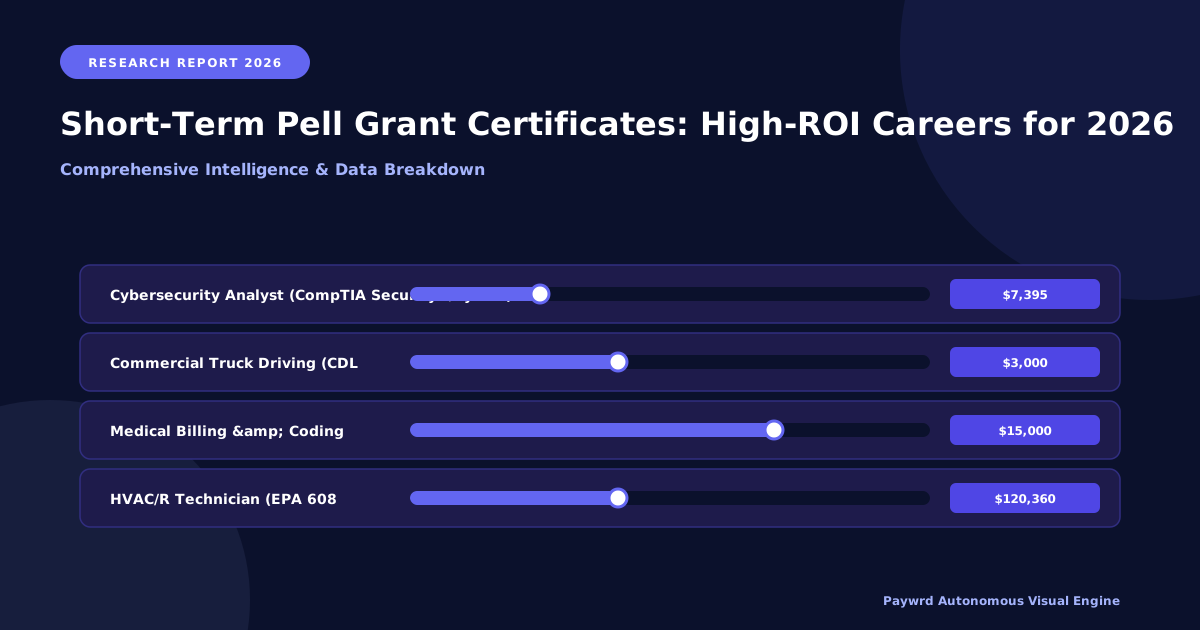
2026 Pell Grant Expansion: Qualifying Short-Term Programs Under New Rules
The bipartisan Workforce Pell provision—finalized in the 2026 appropriations cycle and effective for the 2026–27 award year—represents the most significant shift in federal student aid since the program’s inception. For the first time, students can apply Pell dollars toward non-degree credentials lasting between 150 and 600 clock hours (roughly 8 to 15 weeks). This targets the “middle-skill” gap: roles in cybersecurity, advanced manufacturing, healthcare technology, and commercial transportation where employers demand validated competencies faster than a two-year associate degree delivers them.

Workforce Pell Eligibility Criteria for Sub-15-Week Programs
Not every bootcamp or certificate qualifies. To access these funds, a program must meet three statutory gates established by the Education Department’s Short-Term Pell Grant Final Rule:
- Clock-Hour Threshold: Programs must span 150–600 clock hours. Anything under 150 hours remains ineligible; anything over 600 hours falls under standard Pell rules for longer credentials.
- Workforce Alignment: The curriculum must lead to an industry-recognized credential tied to a “high-skill, high-wage, or in-demand” occupation as defined by the Workforce Innovation and Opportunity Act (WIOA) and state labor market data.
- Completion & Placement Metrics: Providers must demonstrate a 70% completion rate and a 70% employment placement rate in the related field within one year of graduation. These metrics are audited annually via the Gainful Employment (GE) framework reinstated for 2026.
Title IV Funding Limits and Lifetime Eligibility Used (LEU) Impact
Workforce Pell awards follow the standard Pell calculation—cost of attendance minus Student Aid Index (SAI)—but with a hard cap: the maximum award for a short-term program cannot exceed the prorated amount for a full-time student in a traditional term. Critically, every dollar drawn counts against your Lifetime Eligibility Used (LEU) limit of 600% (equivalent to 12 full-time semesters). An 8-week program consuming 12.5% LEU (150% of a standard semester) reduces your remaining eligibility for future bachelor’s or graduate study. Students must file the 2026–27 FAFSA and verify the school’s Title IV participation agreement explicitly lists the short-term program code.
Institutional Accreditation Requirements for Non-Degree Credentials
Accreditation is the gatekeeper. The institution—not just the program—must hold accreditation from a U.S. Department of Education-recognized agency (regional or national) that authorizes Title IV participation for non-degree credentials. Many coding bootcamps and corporate academies lack this; they partner with accredited community colleges or universities acting as the “institution of record.” Before enrolling, confirm the school’s Program Participation Agreement (PPA) on the Federal Student Aid Partner Connect portal lists the specific CIP code for your certificate. Without that listing, no Pell disbursement occurs, regardless of curriculum quality.
Top 5 High-ROI Certificates: Median Salary vs. Total Cost Analysis
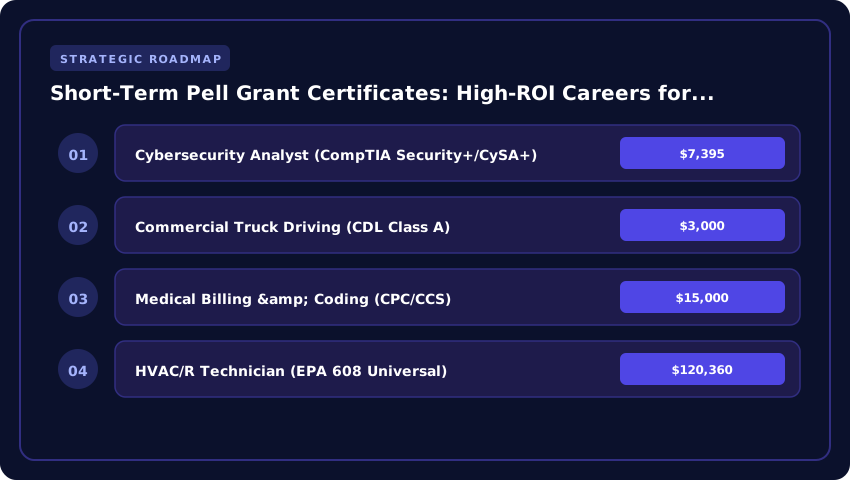
The “Workforce Pell” expansion fundamentally changes the math for short-term credentials. For the 2026–27 award year, the maximum Pell Grant sits at $7,395. Because these programs typically cost between $3,000 and $15,000 total, many students will cover tuition entirely with grant aid—zero loans, zero interest. Below, we rank five certificates where the median first-year earnings vastly outpace the net out-of-pocket cost, using May 2026 BLS Occupational Employment and Wage Statistics (released April 2026) and current community college tuition schedules.
1. Cybersecurity Analyst (CompTIA Security+/CySA+)
Median annual wage for Information Security Analysts: $120,360 (BLS 15-1212). Entry-level SOC roles in secondary markets start around $75,000. A typical 16-week bootcamp or community college certificate runs $4,500–$6,500. After max Pell, net cost is often $0. ROI multiple: infinite in year one. The CompTIA Security+ (SY0-701) remains the DoD 8570 baseline; adding CySA+ (CS0-003) pushes candidates into threat-hunting roles paying a 12% premium over general IT support.
2. Commercial Truck Driving (CDL Class A)
Heavy and Tractor-Trailer Truck Drivers median pay: $54,320 (BLS 53-3032). Company-sponsored training often costs $0 upfront with a 12-month contract. Independent schools average $4,000–$7,000; Pell covers the bulk. The real split appears in year two: Company drivers average $65,000–$75,000 with benefits. Owner-operators gross $180,000–$220,000 but net $70,000–$90,000 after fuel, insurance, and maintenance. For Pell recipients avoiding debt, the company-driver route delivers immediate positive cash flow.
3. Medical Billing & Coding (CPC/CCS)
Medical Records Specialists median wage: $48,780 (BLS 29-2072). AAPC CPC or AHIMA CCS prep programs run 9–12 months at $3,500–$5,500. Net cost after Pell: negligible. The remote-work premium is measurable: fully remote coders with CCS certification report median compensation of $56,200 (AAPC 2026 Salary Survey), a 15% lift over on-site peers. Stacking the CPMA (auditing) or CRC (risk adjustment) adds another $5,000–$8,000 annually within 24 months.
4. HVAC/R Technician (EPA 608 Universal)
Heating, Air Conditioning, and Refrigeration Mechanics median pay: $57,300 (BLS 49-9021). Certificate programs (30–45 credits) cost $4,000–$8,000. Pell covers most; apprenticeships cover the rest via earn-while-you-learn wages starting at $18–$22/hour. Year-three journeymen with Universal 608 and NATE certifications routinely hit $75,000–$85,000. Specializing in commercial refrigeration (R-744/CO2 systems) or building automation (BACnet) adds a 20% premium in metro markets like Dallas, Phoenix, and Atlanta.
5. Welding Technology (AWS D1.1 Structural)
Welders, Cutters, Solderers, and Brazers median wage: $48,940 (BLS 51-4121). A 24-week AWS-aligned certificate runs $5,000–$9,000. Net cost after Pell: often under $1,500. The salary ceiling is defined by alloy and process. D1.1 structural steel gets you on the jobsite; adding ASME Section IX (pipe) or AWS D17.1 (aerospace aluminum/titanium) pushes median earnings to $72,000+. Nuclear and pressure-vessel welders in shipyards (Newport News, Ingalls) or energy hubs (Houston, Baton Rouge) clear $90,000–$110,000 with per diem and overtime.
- Bottom Line: All five programs qualify for Workforce Pell starting July 1, 2026, provided the school holds Title IV eligibility and the program maps to a DOL high-demand occupation.
- Action Item: Verify the institution’s Cohort Default Rate (CDR) and Gainful Employment metrics on College Scorecard before enrolling—Pell eligibility alone doesn’t guarantee quality.
Stackable Credentials: Building a Degree Pathway Without Debt
The real power of the 2026 Workforce Pell expansion isn’t just funding an 8-week certificate—it’s using that credential as the first rung on a ladder toward an associate or bachelor’s degree without burning through your lifetime Pell eligibility. The strategy hinges on stackability: ensuring every credit you earn today counts toward a degree tomorrow. If you treat a short-term certificate as a terminal credential, you leave money and mobility on the table.
Lock In Articulation Agreements Before You Enroll
Do not assume your community college credits will automatically transfer to a state university. You need a written articulation agreement—sometimes called a transfer pathway or 2+2 agreement—signed by both the community college and the four-year institution. In 2026, states like Virginia, Tennessee, and Texas have mandated statewide articulation frameworks for high-demand CTE pathways (cybersecurity, advanced manufacturing, healthcare IT). Before you file your FAFSA for that Workforce Pell-eligible program, demand to see the degree map. It should list exactly how your 15-to-30 certificate credits apply to specific general education and major requirements at the target university. Without this document, you risk “credit leakage,” where courses transfer as generic electives rather than degree requirements, forcing you to retake classes and spend down your remaining Pell Grant Lifetime Eligibility Used (LEU).
Convert Industry Certifications into Academic Credit via CPL
Credit for Prior Learning (CPL) is the accelerator pedal. If your short-term program prepares you for a CompTIA Security+, AWS Certified Cloud Practitioner, or NCLEX-PN, many colleges will transcript that certification as 3-to-12 academic credits via portfolio assessment, challenge exams, or ACE (American Council on Education) recommendations. The 2026–27 award year sees expanded Department of Education guidance encouraging institutions to standardize CPL policies for Workforce Pell programs. Ask the registrar: “What is the maximum CPL credit allowed toward the associate degree?” and “Is there a transcription fee?” Some community colleges charge a nominal $50–$100 per credit hour to post CPL, which is a fraction of the $150–$400 per credit tuition rate. Banking these credits early shortens your time-to-degree and preserves Pell dollars for upper-division coursework at the university level.
Protect Satisfactory Academic Progress Across Stacked Terms
Stacking credentials means stacking academic terms, and that triggers Satisfactory Academic Progress (SAP) monitoring across your entire aid history. Federal rules require a 2.0 cumulative GPA and a 67% completion pace (credits earned vs. attempted). A common trap: a student completes a 12-credit certificate with a 3.0 GPA, transfers to a university, struggles in the first semester, and drops below the pace threshold. Because SAP is calculated cumulatively, those early “W” (withdrawal) grades from the certificate program count against you. Action plan: Treat every certificate course as a degree course. If you must withdraw, do it before the census date so it doesn’t count as “attempted.” Map your entire stack—certificate → associate → bachelor’s—with an advisor at the four-year school before you start the certificate. This ensures you never exceed the 150% maximum timeframe rule (e.g., 90 attempted credits for a 60-credit associate degree), keeping your Workforce Pell and future Pell awards intact.
Employer Partnership Programs: Tuition Reimbursement + Pell Stacking
The 2026 Workforce Pell expansion does not exist in a vacuum. Its real power emerges when federal grant dollars meet corporate tuition assistance plans that explicitly allow “stacking”—applying employer funds to the remaining balance after Pell is applied. For the 2026–27 award year, three major ecosystems stand out for reducing out-of-pocket costs to near zero for eligible workers.
Amazon Career Choice & Walmart Live Better U: Retail Giants, Refined Lists
Both retailers overhauled their eligible provider networks in late 2026 to align strictly with the new Title IV short-term program requirements. Amazon Career Choice now pre-filters its partner colleges—such as Western Governors University, National University, and select community college districts—to display only programs holding active Title IV eligibility codes for the 8-to-15-week window. Amazon pays tuition and fees upfront (capped at $5,250 annually for hourly associates), meaning a $3,000 Pell Grant covers the bulk of a $4,500 cybersecurity certificate, leaving Amazon to cover the delta with zero employee contribution.
Walmart’s Live Better U (LBU) operates similarly through its Guild Education partnership. For 2026, LBU added a “Pell First” workflow in the Guild portal: associates apply for FAFSA, accept the Pell award, and Walmart automatically funds the remaining direct costs for approved supply chain, HVAC, and data analytics certificates at partners like Penn Foster and Rio Salado College. The key differentiator? Both programs now cover books and certification exam fees—costs Pell traditionally ignores—effectively delivering a $0 net price.
Healthcare Systems: The CNA-to-RN “Earn-and-Learn” Pipeline
Hospital systems are the most aggressive stackers in 2026 because they face acute RN shortages. Major networks—HCA Healthcare, Ascension, and Kaiser Permanente—have formalized “earn-and-learn” pathways where a Certified Nursing Assistant (CNA) works 24–32 hours weekly while enrolled in an accelerated LPN or ADN bridge certificate.
- Tuition Structure: Employers typically offer $5,000–$8,000 annual tuition reimbursement (often tax-free up to $5,250 under IRS Sec. 127).
- The Stack: A 12-week LPN bridge certificate at a Title IV community college costs roughly $6,500. The maximum 2026–27 Pell Grant ($7,395) covers tuition entirely; the employer reimbursement then refunds the student for books, scrubs, and NCLEX-PN exam fees ($300–$500).
- Commitment: Most require a 12-to-24-month post-graduation work commitment, but the wage jump from CNA (~$38,000 median) to LPN (~$59,000 median, per BLS 2026 data) makes the ROI immediate.
Manufacturing Institute FAME: Advanced Manufacturing Tracks
The Federation for Advanced Manufacturing Education (FAME), stewarded by The Manufacturing Institute, operates a distinct “work-and-learn” model across 14 states. For 2026, FAME chapters (partnering with employers like Toyota, Honda, and Bosch) have mapped their Advanced Manufacturing Technician (AMT) curriculum to the new Workforce Pell clock-hour standards.
Students spend two days a week in a Title IV-eligible community college lab and three days on the factory floor earning $18–$22/hour. The 18-month AMT certificate totals roughly $10,000. Pell covers up to $7,395; the employer sponsor covers the remaining tuition balance directly. Graduates exit with an associate-level credential, zero debt, and a median starting salary of $60,000–$65,000. Crucially, FAME programs report 85%+ conversion rates to full-time employment, making this the highest-certainty stack in the 2026 landscape.
State-Level Grant Stacking: Maximizing Aid Beyond Federal Pell
Federal Pell Grants cover tuition and fees for eligible short-term programs starting July 1, 2026, but they rarely stretch far enough to cover living expenses, industry certification exam fees, or specialized tools. That is where state workforce grants come in. Because most of these programs are funded through Workforce Innovation and Opportunity Act (WIOA) allocations or state general funds, they can legally “stack” on top of federal aid without reducing your Pell eligibility. The trick is knowing which agency holds the purse strings and applying before cohort caps close.
California: Golden State Education & Training Grant Program (GSETG)
For 2026–27, the California Student Aid Commission (CSAC) administers GSETG awards up to $2,500 per academic year for students enrolled in qualifying short-term career education programs at community colleges or approved private institutions. Unlike the Cal Grant, GSETG has no GPA requirement and explicitly targets programs between 8 and 16 weeks—perfectly aligned with the new Workforce Pell window. You must file a FAFSA or CADAA and demonstrate financial need. Funds are first-come, first-served; the 2026–27 application cycle opened October 1, 2026, and historically exhausts by March.
Texas: Workforce Commission Skills Development Fund
The Texas Workforce Commission (TWC) does not cut checks directly to students. Instead, the Skills Development Fund grants—averaging $500,000 to $1 million per employer consortium—flow to community colleges (like Texas State Technical College or Alamo Colleges) to build custom curricula for local employers. If you enroll in a TWC-approved “High-Demand” short-term certificate (welding, CNC machining, cloud fundamentals), the college often waives tuition and provides tool vouchers worth $500–$1,500 using these funds. Ask the financial aid office specifically for “SDF-supported cohorts”; they are not advertised on the main website.
Ohio: TechCred Reimbursement Overlay
Ohio’s TechCred program reimburses employers up to $2,000 per credential for tech-focused certificates (CompTIA Security+, AWS Cloud Practitioner, Six Sigma). For 2026, the application windows run quarterly (January, April, July, October). If you are already employed—even part-time—your employer can claim the reimbursement after you pass the exam, effectively making the certificate free. Critically, TechCred stacks with Pell: Pell pays the college tuition; TechCred pays the employer back for the exam fee and study materials. Self-employed learners do not qualify unless they incorporate and pay themselves W-2 wages.
Indiana: Workforce Ready Grant (Next Level Jobs)
Indiana’s Workforce Ready Grant covers 100% of tuition and mandatory fees for high-value certificates at Ivy Tech Community College or Vincennes University. For 2026, eligible sectors include Advanced Manufacturing, Building & Construction, Health & Life Sciences, IT & Business Services, and Transportation & Logistics. There is no income cap, but you must be an Indiana resident, hold a high school diploma (or equivalent), and not already hold an associate degree or higher. The grant acts as a “last-dollar” scholarship: Pell applies first, then Workforce Ready covers the remaining balance, leaving you with zero tuition out-of-pocket.
- Stacking Rule: Always accept Pell first on your award letter; state agencies require proof of federal packaging before releasing supplemental funds.
- Deadline Discipline: State grant cycles (especially Texas SDF and Ohio TechCred) operate on employer or institutional fiscal calendars, not the federal June 30 FAFSA deadline.
- Tool Stipends: California GSETG and Texas SDF are the only two programs in this set that explicitly allow funds for physical tools (welding hoods, stethoscopes, laptop stipends).
Avoiding Low-Value Programs: Red Flags in Gainful Employment Data
The July 1, 2026, launch of Workforce Pell injects billions into short-term credentials, but it also creates a prime hunting ground for predatory providers. The Department of Education’s 2026 Gainful Employment (GE) final rule is your primary defense. Before you commit FAFSA dollars—or your time—you must know how to read the new transparency data on the College Scorecard. A certificate that leaves you with $8,000 in debt for a $32,000 job fails the federal sniff test, and the 2026 rules finally make that failure public and consequential.
Decoding the 2026 Debt-to-Earnings Thresholds
The 2026 GE framework relies on two distinct metrics pulled from actual graduate cohorts (typically 2026–2026 completers reported in the 2026 data release). First, the Debt-to-Earnings (D/E) Rate: your annual loan payment cannot exceed 8% of total
Application Timeline: FAFSA 2026-27 Deadlines for Short-Term Starts
The 2026–27 FAFSA cycle opened on October 1, 2026, but for the new Workforce Pell programs launching July 1, 2026, the standard academic calendar does not apply. Because eligible certificate programs—often 8 to 15 weeks long—operate on monthly or rolling start dates, you must treat the FAFSA as a real-time funding trigger rather than a once-a-year chore. The federal processor will accept applications through June 30, 2027, yet most Title IV institutions impose internal “priority deadlines” 30 to 60 days before a cohort launches to verify eligibility before census date. If your program starts October 12, 2026, aim to submit a complete, verified FAFSA no later than August 15, 2026. Late submissions risk missing the cohort cap, leaving you on the hook for the full tuition—often $3,500 to $7,200 for high-demand credentials like CNC machining or cybersecurity analytics.
Navigating Non-Standard Term Calendars
Unlike semester-based degrees, short-term workforce programs define their own “payment periods.” The Department of Education requires schools to calculate Pell eligibility based on the specific clock hours or credit hours in your payment period. Confirm the exact program start date listed on your enrollment agreement—not the institutional term start—and submit the FAFSA at least 45 days prior. This buffer accounts for the Institutional Student Information Record (ISIR) transmission, school-level packaging, and the mandatory 30-day delay for first-time borrowers if you also accept Direct Loans. Pro tip: Ask the financial aid office for their “Verification Deadline Calendar” specific to Workforce Pell cohorts; many community colleges and technical institutes publish a separate schedule for these accelerated tracks.
Verification Documentation for Independent Students
Roughly 30% of FAFSA filers are selected for verification, and independent students—common in upskilling demographics—face a distinct document burden. For 2026–27, you must provide a signed copy of your 2026 IRS Tax Return Transcript (or a signed 2026 Form 1040 with all schedules) plus W-2s from all employers. If you were not required to file, submit a “Verification of Non-filing Letter” from the IRS (Form 4506-T) and a signed statement certifying income sources. Crucially, if you received unemployment benefits in 2026, include the Form 1099-G; this income counts toward your Student Aid Index (SAI) but also flags you for potential Professional Judgment review. Upload documents via the school’s secure portal immediately—verification holds freeze all federal disbursement, including the $7,395 maximum Pell Grant.
Professional Judgment Appeals for Income Reduction
If you lost a job or suffered a significant pay cut after filing your 2026 taxes, the standard SAI will overstate your ability to pay. Every Title IV school has authority under Section 479A of the Higher Education Act to adjust your FAFSA data elements via Professional Judgment (PJ). Request a “Special Circumstances Appeal” form the moment you enroll. You will need: a termination letter or layoff notice dated after January 1, 2026; final pay stubs showing year-to-date earnings; and documentation of unemployment benefits received. Schools typically recalculate using projected 2026 income, which can drop your SAI to -$1,500 (the minimum), unlocking maximum Pell and potentially the Federal Supplemental Educational Opportunity Grant (FSEOG). Submit the PJ packet concurrently with your verification documents; processing takes 2–4 weeks, and funds cannot disburse until the adjustment is finalized.
| Decision Criteria | Traditional Pell (Degree Programs) | Workforce Pell (Short-Term Certificates 2026–27) |
|---|---|---|
| Program Length | 2–4 Years (Associate/Bachelor’s) | 8–15 Weeks (150–600 Clock Hours) |
| Effective Award Year | Ongoing | July 1, 2026 (2026–27 Award Year) |
| Max Pell Award (2026–27) | $7,395 (Projected) | Prorated by Clock Hours (Max $7,395) |
| Institutional Eligibility | Title IV Participating | Title IV + Program-Level Approval Required |
| Curriculum Mandate | General Education + Major | Must Map to DOL High-Demand Occupation |
| Target Occupations (2026) | Broad Professional Fields | Cybersecurity, Adv. Manufacturing, Health Tech, Logistics |
| Median Entry Salary Potential | $45,000–$65,000 (Varies Widely) | $50,000–$80,000 (Middle-Skill Technical Roles) |
| Admission Prerequisites | HS Diploma/GED, SAT/ACT Often | HS Diploma/GED; Industry Aptitude Assessments |
| ROI Break-Even Timeline | 3–5 Years Post-Graduation | 6–18 Months Post-Completion |
| Stackability Requirement | Inherent (Degree Pathway) | Must Articulate to Degree/Career Lattice |
Frequently Asked Questions
When can I apply for Pell Grants for 8-week certificate programs in 2026?
Applications for Workforce Pell open for the 2026–27 award year starting July 1, 2026. Students must complete the 2026–27 FAFSA form and enroll in a Title IV-eligible program between 150–600 clock hours that aligns with a Department of Labor high-demand occupation list.
Which short-term certificates qualify for Workforce Pell funding in 2026?
Qualifying 2026 programs include cybersecurity (CompTIA Security+, (ISC)2 CC), advanced manufacturing (CNC machining, mechatronics), healthcare technology (EKG, phlebotomy, sterile processing), and commercial trucking (CDL Class A). Programs must be offered by Title IV schools and appear on the Eligible Training Provider List (ETPL).
How much Pell Grant money covers a 150-hour certificate program?
For the 2026–27 award year, Pell awards are prorated based on clock hours. A 150-hour program (minimum threshold) receives roughly 12.5% of the scheduled annual maximum ($7,395), equating to approximately $924. A 600-hour program receives 50%, or roughly $3,697, paid directly to the institution for tuition/fees.
Do Workforce Pell certificates require attendance at a Title IV college?
Yes. Only institutions currently participating in Title IV federal aid programs can offer Workforce Pell-eligible certificates. Non-degree providers (bootcamps, private academies) must either gain Title IV eligibility or partner with an eligible community college acting as the fiscal agent for the 2026–27 award year.
What salary outcomes justify Workforce Pell eligibility for 2026 programs?
The Department of Labor requires programs to lead to occupations with median annual wages exceeding $45,000 and projected growth above 5% through 2032. 2026 eligible fields like cybersecurity analysts ($112,000 median), CNC programmers ($60,000), and surgical technologists ($57,000) meet these high-ROI thresholds for middle-skill roles.
Strategic Final Takeaway
When evaluating Short Term Pell Grant Eligible Certificate Programs High ROI Careers 2026 in 2026 and beyond, base your decisions on accredited institutional standards, verified return on investment (ROI), and up-to-date official guidelines. Always verify specific dates and requirements through official regulatory portals.

