Quick Take: Before you touch the NELFUND portal, run two checks — confirm your school is NUC-accredited and your household earns under ₦500,000 annually. Miss either one, and your application gets rejected regardless of your BVN or JAMB documentation.
2026 NELFUND Eligibility: Income Thresholds & Institutional Accreditation Checks
The NELFUND student loan framework for 2026 has tightened its gatekeeping. With thousands of applicants flooding the portal every cycle, the system filters out ineligible candidates early using two primary checkpoints: institutional accreditation and household income verification. If you are applying for the first time or reapplying after a deferral, understanding these checkpoints saves you weeks of frustration.

Step 1: Confirm Your Institution Is on the NUC CCMAS List
NELFUND only disburses loans to students attending universities, polytechnics, and colleges of education that appear on the National Universities Commission’s current CCMAS (Centre for Corporate Management and Accreditation Services) approved institutions register. This is non-negotiable. If your school lost its accreditation, was placed on probation, or operates under a provisional license, your application will not proceed past the initial screening stage.
Here is how to verify your institution:
- Visit the official NUC CCMAS portal and navigate to the accredited institutions register.
- Search by your institution’s full name or registration number.
- Confirm the accreditation status shows as active — not provisional, not suspended.
- Screenshot the result for your application records.
If your institution is a newly licensed university that has not yet appeared on CCMAS, contact the NELFUND helpdesk before submitting your application. Do not assume approval — wait for written confirmation.
Step 2: Validate Your Household Income Against the ₦500,000 Cap
For the 2026 cycle, NELFUND set the maximum household income threshold at ₦500,000 per annum. This means the combined gross income of your parents or legal guardians must fall below this figure. The threshold is reviewed annually, so do not rely on previous year benchmarks.
Income verification runs through your BVN-linked bank records and the NIMC database. NELFUND cross-references your declared income against actual financial footprints. Misrepresentation at this stage carries serious consequences, including blacklisting from future federal education intervention programmes.
Key income checks to run before applying:
- Confirm your parents’ or guardians’ combined annual income is below ₦500,000.
- Ensure your BVN is active and linked to a valid Nigerian bank account.
- Verify your NIN (National Identification Number) matches your NIMC records exactly.
- Have your JAMB registration letter and admission documentation ready for upload.
Once both checks clear, you can confidently proceed to the NELFUND portal to complete your BVN verification, upload your NIN, and submit your JAMB letter as part of the application sequence. Self-qualifying first means every document you upload actually moves your application forward instead of landing it in a rejection queue.
Mandatory Pre-Application Setup: Linking BVN to NIN on the NELFUND Portal
If you skip this step, you are not applying; you are just testing the server’s patience. The single biggest technical killer of NELFUND applications in 2026 isn’t a missing JAMB letter or a low CGPA—it is a BVN-NIN identity mismatch. The portal’s backend runs a real-time handshake between the Nigeria Inter-Bank Settlement System (NIBSS) and the National Identity Management Commission (NIMC) databases before you even see the “Submit” button. If the name on your BVN reads “Chukwudi Emmanuel” but your NIN slip says “Chukwudi E.”, the session dies instantly. No error ticket, no appeal window, just a generic “Verification Failed” toast notification.
Fixing the Name Mismatch via the NIMC Verification Endpoint
Do not walk into a bank branch first. Banks can update BVN records, but they cannot rewrite the NIMC master record. Start at the source. Log into the NIMC Self-Service Portal (selfservice.nimc.gov.ng) or use the *346# USSD code on the phone number registered to your NIN. Select “Verify/Update Data.” The system will display the exact demographic string stored in the National Identity Database. Compare this character-for-character against your BVN printout. If your middle name is abbreviated on one and full on the other, you must initiate a Data Modification request on the NIMC portal. This attracts a ₦500 fee payable via Remita (RRR generation) and requires a biometric recapture at an enrollment center. Only after the NIMC record reflects your full legal name—as it appears on your JAMB admission letter—should you approach your bank for a BVN correction.
Securing the OTP Channel: Phone Number Hygiene for 2026
The 2026 application cycle relies heavily on One-Time Passwords (OTPs) sent to the phone number linked to your BVN, not your NIN. This is a deliberate architecture choice by NELFUND to tie financial identity to the banking layer. If you swapped SIM cards in 2026 and never updated your bank, you will stare at a loading spinner until the session times out.
- Check the active number: Dial *565*0# on any line (MTN/Airtel/Glo/9mobile). The masked number displayed is what NIBSS holds. If it is not the SIM currently in your phone, visit your bank branch with your NIN slip and valid ID to update it immediately.
- DND Status: Ensure “Do Not Disturb” is not blocking shortcodes. Text “ALLOW” to 2442 to whitelist transactional SMS.
- Dual-SIM Strategy: If you run dual SIMs, put the BVN-linked line in Slot 1 (primary data/SMS slot) on Android devices to avoid routing issues during the 60-second OTP window.
Complete this reconciliation before you create your NELFUND account. The portal does not allow you to edit BVN or NIN post-registration; a mismatch forces a full account abandonment and re-registration, burning precious time during the application window. Treat your BVN-NIN sync as the gatekeeper—it either opens the door to the ₦500,000 annual household income check, or it keeps you locked out entirely.
JAMB Admission Letter Protocols: 2026 UTME/DE Verification & PDF Specs
If you are applying for the 2026 NELFUND student loan, your JAMB admission letter is not just paperwork — it is your primary identity proof on the portal. The NELFUND system runs automated OCR validation the moment you upload, and a poorly formatted or wrong-coloured document will trigger an instant rejection. Here is exactly how to get it right.
Downloading the Correct Coloured Admission Letter from JAMB CAPS
Log into your JAMB CAPS account and navigate to the “Admission Status” section. You will see two versions of your admission letter: a white version and a coloured version. The coloured one is what NELFUND requires. It contains embedded security features, including a unique verification code and your biometric data, which the OCR engine uses to cross-reference your BVN and NIN details. Download the coloured PDF directly — do not screenshot it, and do not print it to scan again. Screenshots strip metadata and will fail validation every time.
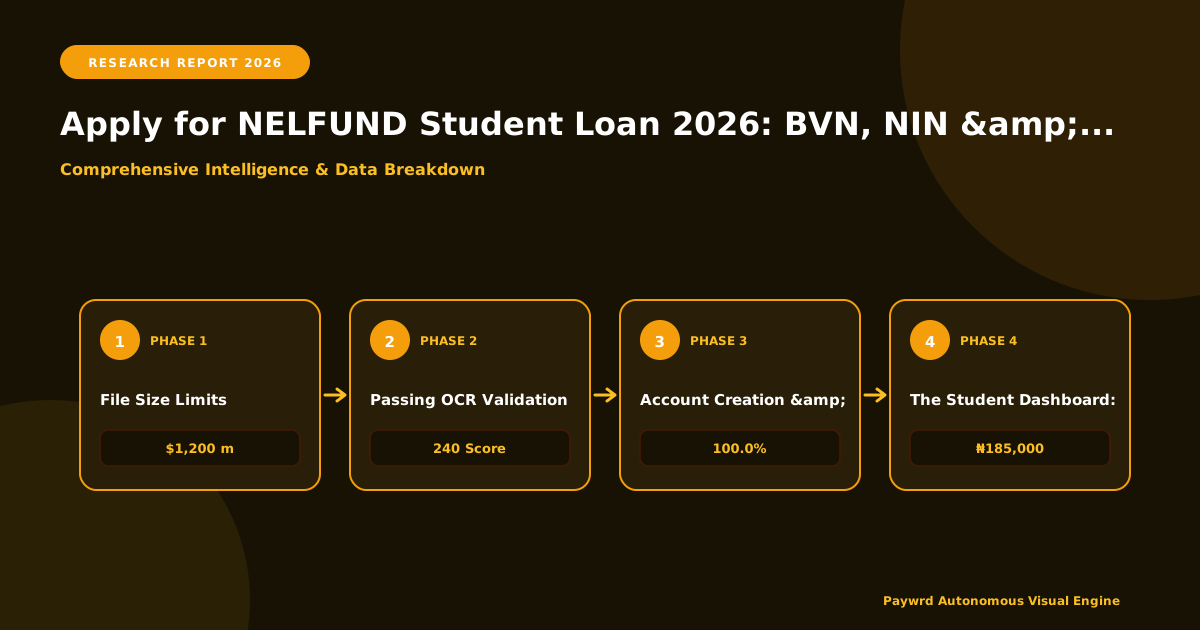
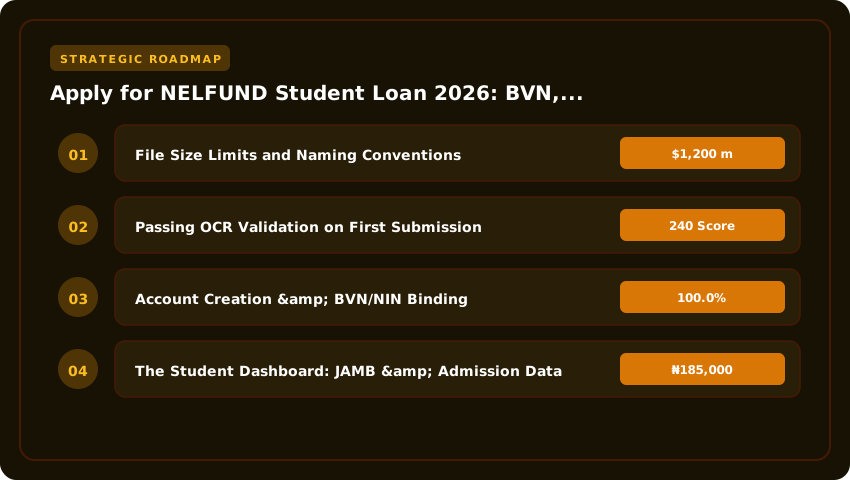
File Size Limits and Naming Conventions
The NELFUND upload portal accepts a maximum file size of 2MB. If your admission letter exceeds this, compress it using a legitimate PDF tool before uploading. The portal expects your file to follow this exact naming format: SURNAME_FirstName_JAMB_RegNo.pdf. For example, ABUJA_OLUWASEUN_JAMB123456789.pdf. Do not use spaces, special characters, or informal language in the file name. The automated parser reads the underscore-delimited structure to match your document with your BVN and NIN records instantly.
- Maximum file size: 2MB
- Accepted format: PDF only
- Naming format: SURNAME_FirstName_JAMB_RegNo.pdf
- Coloured version required (not monochrome)
- No screenshots, no scanned prints
Passing OCR Validation on First Submission
Before hitting upload on the NELFUND portal, run three checks. First, open the PDF on your phone and confirm the coloured background renders properly — some downloads default to grayscale, so verify on screen. Second, confirm your JAMB registration number, surname, and date of birth are clearly legible. Third, ensure the PDF is not password-protected or corrupted. If all three check out, your admission proof clears the automated OCR gate without needing manual review, saving you weeks in the NELFUND processing queue.
Your JAMB admission letter works hand-in-hand with your BVN and NIN. Any inconsistency — a misspelled name, a mismatched registration number, or a wrong institution code — flags your entire application. Get the letter right first, then proceed to the financial and eligibility sections of the NELFUND form.
Portal Walkthrough: Account Creation to Final Submission Checklist
Once you clear the eligibility gate, the NELFUND portal at nelf.gov.ng is where the real work happens. Most applicants lose 30 minutes hunting for buttons that sit in plain sight. Follow this exact click-path to finish in under 15 minutes.
1. Account Creation & BVN/NIN Binding
Click “Apply Now” on the homepage. Select “Student Loan” (not Institutional Fee). The system demands your NIN first — this is your primary key. Enter it, hit “Verify NIN”, and wait for the green toast notification. Do not refresh. Next, input your BVN. The portal cross-references the BVN name against your NIN record; a single typo in middle names triggers a manual review queue that adds weeks. Once both show “Verified”, create your password. Use a password manager; you will need this login for disbursement tracking later.
2. The Student Dashboard: JAMB & Admission Data
Land on the Student Dashboard. You will see four tabs: Profile, Institution, Loan Request, Disbursement. Start with Institution.
- JAMB Registration Number: Paste directly from your 2026 UTME slip. The auto-fill pulls your course and institution.
- Admission Letter: Upload the PDF from JAMB CAPS (not a screenshot). File size limit is 2MB; compress via
ilovepdf.comif needed. - Matric Number: If you are a returning student (200 Level+), enter it here. Freshers (100 Level) leave blank — the system flags this automatically.
Hit “Save & Continue”. A green checkmark appears on the Institution tab.
3. Bank Details for Disbursement
Switch to the Disbursement tab. This is where 40% of applicants stall. You must link a Tier 3 KYC bank account (full KYC, not a student/lite account) in your exact NIN name.
- Bank Name: Select from the CBN-licensed dropdown (e.g., Access, GTB, Zenith, UBA, First Bank, Opay, Moniepoint MFB).
- Account Number: Enter 10-digit NUBAN. The portal runs an instant NIBSS name enquiry. If the name mismatch banner appears do not proceed — go to your bank branch for a name alignment affidavit.
- Account Type: Savings or Current. No domiciliary accounts.
Click “Validate Account”. Wait for the “Account Verified Successfully” badge.
4. Digital Signature & Final Declaration Workflow
Navigate to Loan Request. Select “Upkeep Loan” (₦20,000/month) and/or “Institutional Charge” (paid direct to school). The Digital Signature step is mandatory and legally binding under the 2026 Act.
- Draw your signature in the canvas box using mouse/touchpad. It must resemble your physical signature on your Bank Verification Card.
- Type your full legal name in the “Full Name (Digital Signature)” field exactly as it appears on your NIN slip.
Scroll to the Final Declaration Checkbox. You must tick three distinct boxes sequentially:
- ☐ “I confirm all information provided is true and verifiable.”
- ☐ “I consent to NELFUND verifying my data with NIMC, CBN, JAMB, and my Institution.”
- ☐ “I accept the repayment terms: 10% deduction at source upon employment earning above ₦30,000/month.”
The “Submit Application” button turns blue only after all three are ticked. Click it. You receive an Application Reference ID (e.g., NELF-2026-XXXXXX) instantly on screen and via SMS. Screenshot this ID — it is your only proof of submission for support tickets.
Post-Submission Tracking: 2026 Disbursement Schedules & Repayment Triggers
Once you hit submit on the NELFUND portal, the waiting game begins. Understanding the status codes on your dashboard is the only way to manage your cash-flow expectations for the 2026/2027 session. Do not confuse “Application Under Review” with “Awaiting Funding” — they sit at opposite ends of the approval pipeline.
Decoding Your Dashboard Status Codes
- Application Under Review: Your file is with the Student Affairs Division of your institution. They are cross-referencing your JAMB admission letter, matriculation number, and fee schedule against the NUC-accredited programme list. This stage typically takes 10–15 business days during peak 2026 cycles. If your school’s bursary has not uploaded the verified nominal roll to NELFUND, you stay stuck here.
- Awaiting Funding: Congratulations — your institution has certified you. Your name is on the batch list sent to the Fund’s treasury unit. Disbursement now depends on the Central Bank of Nigeria (CBN) release schedule to NELFUND’s commercial bank partners. In 2026, batches are processed monthly in arrears. If your batch closes on the 20th, expect credit alerts by the 5th of the following month.
- Disbursed: Funds have hit your verified BVN-linked account. Confirm the exact amount matches your school’s approved tuition + upkeep breakdown. Discrepancies must be reported via the portal’s “Dispute” button within 48 hours.
Repayment Commencement: The Two-Trigger Rule
Repayment is strictly income-contingent, but the trigger to start the clock is binary. You do not choose when to start; the system detects it.
- Trigger A — NYSC Completion: The moment your NYSC discharge certificate is uploaded to the NYSC portal (or your exemption letter is verified), a 24-month grace period activates. If you remain unemployed after those two years, repayment pauses automatically — no forms needed.
- Trigger B — Employment Threshold Detection: This is where most 2026 graduates get caught. NELFUND integrates with the National Identity Management Commission (NIMC) and Pension Commission (PenCom) databases. The second an employer remits your pension contribution (RSA) or files PAYE tax showing a monthly gross income above ₦30,000, the grace period evaporates immediately — even if you are still serving NYSC or within the 24-month window.
Bottom line: Track your status weekly via the portal. Budget for tuition gaps assuming the “Awaiting Funding” lag. And understand that your first payslip above ₦30k/month — not your NYSC passing-out parade — is the real start gun for repayment.
Top 5 Rejection Codes in 2026 & Immediate Remediation Steps
Getting a rejection code on the NELFUND portal in 2026 does not mean your dreams are over. It means the system caught a data problem that you can fix yourself — often in under 30 minutes. Below are the five most common rejection codes applicants encounter this cycle, along with exact steps to resolve each one without queuing for support.
Error Code 102: Invalid JAMB Registration Number
This is the single most frequent rejection code in the 2026 NELFUND cycle. It fires when the JAMB registration number you entered on the NELFUND portal does not match the record sitting in the Joint Admissions and Matriculation Board Consolidated Admission Processing System, or CAPS. The mismatch usually happens for three reasons: you transcribed a digit incorrectly, you used a JAMB number from a previous registration that was rolled over, or your institution has not yet finalized your admission status in CAPS.
To fix this, log into the official JAMB CAPS portal using your original JAMB profile credentials. Verify that your registration number displays correctly and that your admission status reads “Accepted” or “Offered” for the 2026/2027 academic session. If CAPS shows a different number than what you entered on NELFUND, copy it directly — do not retype. Return to the NELFUND application, navigate to the personal information section, and update the JAMB field. Resubmit and screenshot the confirmation page immediately.
Error Code 504: BVN Tier 1 Account Required
Error 504 means the Bank Verification Number linked to your application is either unregistered, dormant, or tied to a Tier 2 or Tier 3 account that NELFUND does not accept for disbursement. In 2026, NELFUND requires an active Tier 1 account — the basic, fully KYC-compliant account — because loan disbursements and repayments flow through this channel.
To resolve this remotely, contact your bank’s customer care line or visit a branch with your NIN, passport photograph, and a valid means of identification. Request a Tier 1 account upgrade or a fresh account opening with full KYC. Once your banker confirms the account is active and Tier 1 classified, update your banking details on the NELFUND portal under the financial information tab. Do not apply again until the system reflects the updated BVN verification, which typically takes 24 to 48 hours.
Error Code 203: Household Income Exceeds Threshold
Code 203 triggers when your declared household income surpasses the ₦500,000 annual ceiling for 2026. If your parents or guardians recently received a salary raise or bonus, recalculate carefully. You can file an appeal by uploading fresh income evidence through the NELFUND portal’s appeals section before the submission window closes.
Error Code 307: Institution Not NUC-Accredited
This code appears when your school lacks current accreditation from the National Universities Commission. Cross-check your institution’s status on the NUC CCMAS portal. If your school is newly accredited, wait for the NUC database sync before reapplying.
Error Code 411: NIN Verification Failed
Code 411 means your National Identification Number could not be validated against the National Identity Management Commission database. Visit an NIMC enrollment centre to confirm or re-enroll, then update your NIN on the NELFUND portal.
Most rejection codes are data problems, not eligibility failures. Tackle them early, keep every screenshot, and reapply before the next submission window closes.
Strategic Alternatives: NELFUND vs State Bursaries & Private Edu-Loans (2026 Rates)
Smart funding isn’t about picking one source — it’s about stacking them legally to graduate with zero toxic debt. In 2026, the NELFUND loan remains the only true 0% interest facility in the market, but it covers only tuition and a maintenance stipend capped at current institutional rates. If your program costs ₦1.2 million annually and NELFUND pays ₦800,000, you still have a ₦400,000 gap. That is where the comparison gets sharp.
Private Bank Edu-Loans: The 2026 Reality Check
FirstBank’s FirstEdu Loan and Access Bank’s Student Loan product are the two heavyweights, but they operate on commercial rails. As of Q2 2026, FirstBank offers a reducing balance rate of 24% per annum with a 1% management fee, while Access Bank sits at 26% per annum with a ₦5,000 processing charge. Both require a guarantor earning a minimum of ₦150,000 monthly and collateral or a domiciled salary account. Repayment starts six months after disbursement — often while you are still in school. Contrast that with NELFUND: repayment kicks in two years post-NYSC, deducted at 10% of income via the tax authority (FIRS). The math is brutal. A ₦500,000 private loan at 24% balloons to roughly ₦780,000 over three years. NELFUND stays ₦500,000 forever.
State Bursaries & Scholarships: The “Free Money” Layer
Every state runs a scholarship board (e.g., Lagos State Scholarship Board, Rivers State Sustainable Development Agency). Awards range from ₦50,000 to ₦250,000 per session for indigenes in accredited public universities. These are grants, not loans. The catch? Disbursement is notoriously late — often hitting accounts in the second semester. You cannot budget for them, but you must apply. The application windows usually open January–March 2026 on respective state portals. Require your LGA identification certificate, admission letter, and current CGPA transcript.
Stacking Legally: NELFUND + PTDF + State Awards
The Student Loans Act 2026 (as amended) does not prohibit concurrent holding of a scholarship and the NELFUND loan. However, you must declare all funding sources on the NELFUND portal during the “Funding Declaration” step. The Petroleum Technology Development Fund (PTDF) Local and Overseas Scholarships (MSc/PhD) explicitly allow “top-up” from other sources. For 2026, PTDF Overseas covers full tuition, flight, and a $1,200 monthly stipend. If you secure PTDF, you technically don’t need NELFUND, but keeping the NELFUND line open as a contingency for exchange rate shocks on maintenance is a valid risk hedge — just disclose it.
- Priority 1: Secure NELFUND (0% interest, income-contingent repayment).
- Priority 2: Apply for State Bursary/Indigene Scholarship (Grant, no repayment).
- Priority 3: Target PTDF/PTDF Overseas or Federal Scholarship Board (BEA) awards (Full ride).
- Last Resort: Private Edu-Loan (FirstBank/Access) — only for verified funding gaps after exhausting 1–3.
Pro tip: Keep a “Funding Stack Tracker” spreadsheet. Log application dates, portal references (NELFUND Application ID, State Scholarship Reference Number), and disbursement status. This prevents double-dipping flags during NELFUND’s backend audit with NUC and JAMB CAPS data.
| Criteria | NELFUND Student Loan (2026/2027) | Federal Govt Scholarship (BEA/PTDF) | Commercial Bank Education Loan | State Govt Bursary/Scholarship |
|---|---|---|---|---|
| Interest Rate | 0% (Interest-free) | 0% (Grant) | 15% – 25% per annum | 0% (Grant) |
| Repayment Start | 2 years post-NYSC completion | N/A (Non-repayable) | Immediate or 6-month moratorium | N/A (Non-repayable) |
| Income Threshold | Household income < ₦500,000/yr | Merit-based (No income cap) | Parent/Guardian income proof required | Varies by state (often < ₦300,000) |
| Institutional Requirement | NUC-accredited & CCMAS compliant | Specific partner universities globally | Accredited institutions only | State-owned or Federal institutions |
| Key Documentation | BVN, NIN, JAMB Admission Letter, Matric No | Academic transcripts, NYSC cert, Int’l passport | Collateral, Guarantor forms, Pay slips | Indigene letter, LGA ID, Admission letter |
| Application Window 2026 | Portal opens Q1 2026; Rolling cycles | Annual cycles (Jan–Mar 2026 typical) | Year-round | Annual (Mid-year 2026 typical) |
| Funding Coverage | Tuition + Upkeep (Maintenance) | Tuition + Stipend + Airfare (Overseas) | Tuition only (Rarely upkeep) | Fixed cash award (₦50k–₦200k) |
| Guarantor Required? | No (Govt-backed) | No | Yes (2 Civil Servants/Property) | No |
Frequently Asked Questions
What is the household income limit for NELFUND 2026 eligibility?
For the 2026/2027 session, NELFUND requires the applicant's total household income to be below ₦500,000 per annum. This threshold is verified via the BVN-linked financial profile during the application process. Exceeding this limit results in automatic disqualification regardless of academic merit or admission status.
Can I apply for NELFUND 2026 without a JAMB admission letter?
No. A valid JAMB admission letter is a mandatory prerequisite for the 2026 NELFUND application. The system cross-references your JAMB registration number with the NUC-accredited institution database. Applicants with 'Direct Entry' or 'Part-time' admissions must present their specific JAMB Direct Entry admission letter to proceed.
Why does my NELFUND application show 'Institution Not Accredited' error in 2026?
This error indicates your institution is not on the current NUC Core Curriculum Minimum Academic Standards (CCMAS) list for 2026. NELFUND only funds students in fully accredited programs at recognized public universities, polytechnics, and colleges of education. Confirm your department's accreditation status on the NUC website before reapplying.
When does repayment start for the 2026 NELFUND loan batch?
Repayment for the 2026 cohort begins exactly two years after completion of the mandatory National Youth Service Corps (NYSC) programme. Deductions are automated at 10% of the beneficiary's monthly salary via the employer's payroll system once earnings exceed the ₦30,000 minimum wage threshold.
How do I link my BVN and NIN to the NELFUND 2026 portal?
Log into the NELFUND portal with your registered email. Navigate to 'Profile Verification' and input your 11-digit NIN and 11-digit BVN. The system triggers an OTP to the phone numbers linked to both identifiers. Successful OTP validation auto-populates your bio-data; ensure names match your JAMB records exactly to avoid verification failure.
Strategic Final Takeaway
When evaluating How To Apply For NELFUND Student Loan 2026 Step By Step With BVN NIN And JAMB Admission Letter in 2026 and beyond, base your decisions on accredited institutional standards, verified return on investment (ROI), and up-to-date official guidelines. Always verify specific dates and requirements through official regulatory portals.