
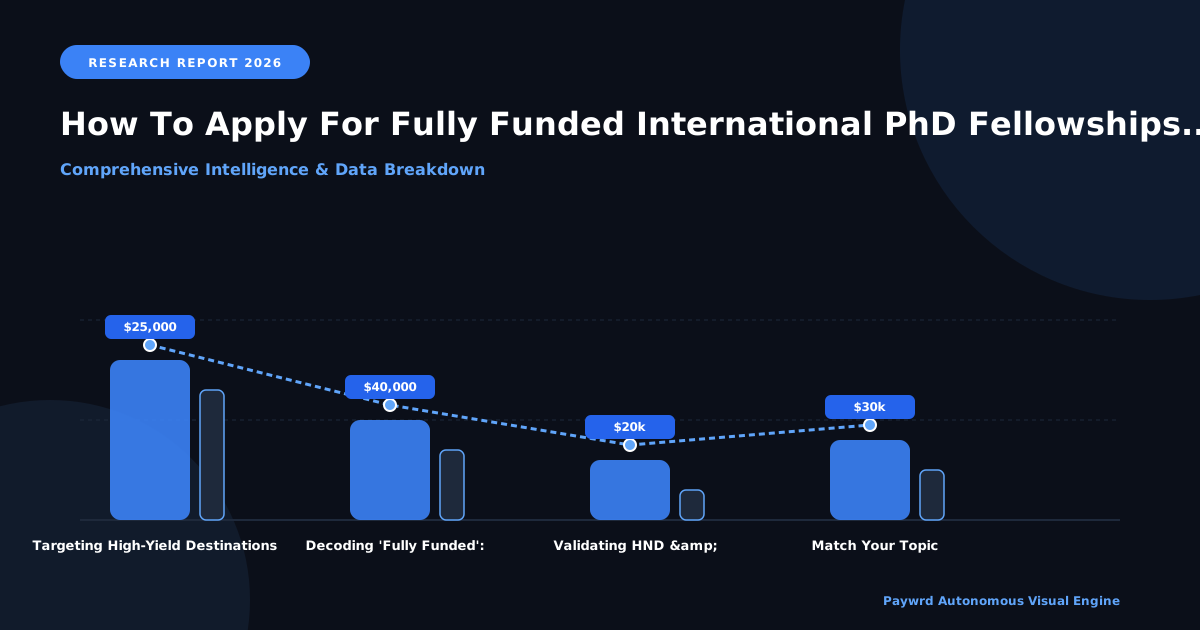
Key Takeaway: For the 2026/27 cycle, the highest ROI for Nigerian scholars lies in separating Federal Bilateral awards (PTDF, BEA, TETFund) — which guarantee funding before admission — from competitive university-specific scholarships that require an unconditional offer first. Prioritize Germany’s DAAD and UK Commonwealth Split-site routes for stipend-to-cost-of-living parity.
Mapping The 2026 Fully Funded Fellowship Landscape For Nigerian Scholars
The 2026 fellowship ecosystem splits cleanly into two lanes: Government Bilateral Awards and Institutional/University Scholarships. Confusing them is the primary reason qualified candidates miss deadlines or submit incomplete dossiers. Bilateral schemes — primarily PTDF Overseas Scholarship Scheme (OSS), the Bilateral Education Agreement (BEA) via the Federal Ministry of Education, and TETFund Intervention Lines for academic staff — fund the candidate first. You apply to the Nigerian agency, they shortlist, then place you. Conversely, university-specific awards (think Gates Cambridge, Vanier Canada, or DAAD Research Grants) demand you secure admission before the scholarship deadline.
Targeting High-Yield Destinations for 2026/27 Intake
United Kingdom: The Commonwealth Split-site PhD and Chevening (though mostly Masters, check partner university PhD extensions) remain gold standards. New for 2026: several Russell Group universities (Leeds, Glasgow, Sheffield) have launched Nigeria-specific* tuition waiver + stipend packages aligned with the UK’s International Education Strategy. Watch the CSC portal for October 2026 open dates.
Germany: DAAD remains the most reliable “fully funded” mechanism for Nigerians — zero tuition, €1,300/month stipend, health insurance, and travel allowance. The 2026/27 DAAD Research Grants (Doctoral Programmes) typically open August 2026. No IELTS if your prior degree was English-taught (provide MOI certificate).

Canada: Target the Vanier CGS (CAD 50k/yr for 3 years) and Banting Postdoctoral (if graduating soon). Crucially, apply for University-specific International Tuition Waivers (e.g., UToronto, UBC, McGill) simultaneously; these often cover the differential fee automatically upon admission offer.
USA: The Fulbright Foreign Student Program (administered by the US Embassy Abuja/IIE) and AAUW International Fellowships (women only) are the big federal/private levers. Most funding here is departmental (RA/TA lines) — email professors now for Fall 2026 labs.
Emerging Asian Hubs: China (CSC Scholarship) and South Korea (GKS/KGSP) offer full tuition, ₦300k–₦500k equivalent monthly stipends, and accommodation. The 2026 GKS quota for Nigeria usually sits at 10–15 slots; apply via the Korean Embassy in Abuja by March 2026.
Decoding ‘Fully Funded’: 2026 Stipend Benchmarks
Do not accept vague “fully funded” marketing. Verify these four pillars against the 2026/27 offer letter:
- Tuition Waiver: Must be explicit — “Full Tuition Fee Waiver” or “Home Fee Status”. Partial waivers (50%) are not fully funded.
- Stipend Benchmarks (Annual Net):
- UK: £19,237 (UKRI 2026/27 rate) — tax-free.
- Germany: €15,600 (DAAD) + €1,200 research allowance.
- Canada: CAD 20,000–35,000 (varies by province/university; Vanier is CAD 50k).
- USA: $25,000–$40,000 (9-month academic year + summer funding).
- Nigeria Parity Check: A £19k stipend ≈ ₦38M/yr (at ₦2,000/£). A DAAD €15.6k ≈ ₦26M/yr (at ₦1,670/€). Factor rent: London/Berlin/Toronto will consume 40–50%.
- Health Insurance: Must cover dependents if relocating with family (DAAD and CSC do; UK NHS surcharge usually covered by Commonwealth; US varies by university).
- Research/Training Grant: Look for £1,000–£5,000 (UK), €1,200 (DAAD), or CAD 5,000 (Canada) annual research travel/consumables budgets.
Action Item: Build a tracker spreadsheet with columns: Scheme | Portal Opens | Hard Deadline | Citizenship Eligibility | Requires Admission First? | Stipend (Local Currency) | Dependents Allowed? Filter for “No” on admission-first for bilateral routes; “Yes” for university routes. That single filter saves months of misdirected effort.
Eligibility Audit: NUC Degree Equivalence, NYSC & English Proficiency Waivers
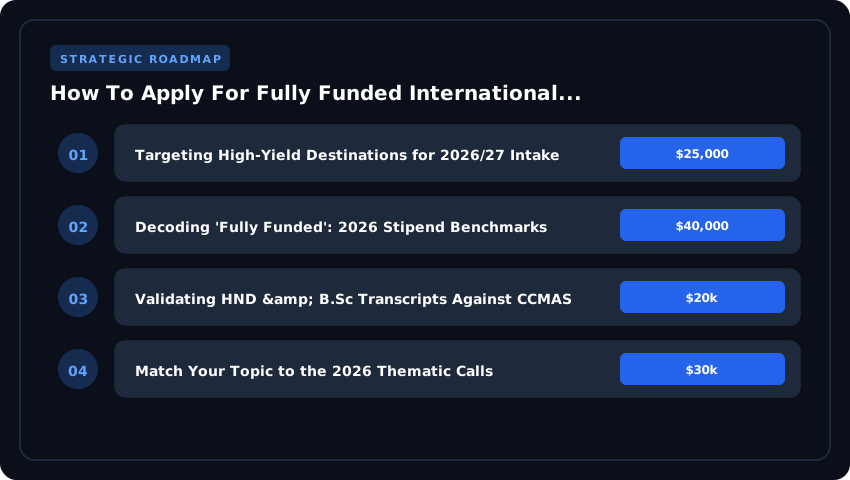
Before you pay a single application fee or draft a research proposal, run a ruthless eligibility audit. Nigerian graduates lose fully funded offers every cycle not because of weak academics, but because their paperwork fails the “bureaucratic sniff test” of foreign admissions offices and visa officers. In 2026, the bar is higher: credential evaluators like WES, Uni-Assist, and UK ENIC (formerly UK NARIC) are cross-referencing Nigerian transcripts against the NUC Core Curriculum Minimum Academic Standards (CCMAS) benchmarks released for implementation.
Validating HND & B.Sc Transcripts Against CCMAS
The HND stigma is real, but manageable if you front-load the evidence. German universities (DAAD routes) and UK institutions now routinely request the NUC Programme Accreditation Status letter for your specific department and graduation year. If your polytechnic programme held “Full Accreditation” at the time of your graduation, demand that letter from your Registrar’s office—it carries more weight than the certificate itself. For B.Sc holders, ensure your transcript explicitly maps course codes to the new CCMAS credit unit system (minimum 120 units for a 4-year degree). Missing “Entrepreneurship Studies” or “General Studies” credits on the transcript trigger automatic “deficiency” flags in Uni-Assist portals. Pro tip: Request a certified Course-by-Course Evaluation from the NUC or a recognized agent like Scholaro before you apply; it costs roughly ₦35,000–₦50,000 but saves months of back-and-forth.
NYSC Discharge/Exemption: The Non-Negotiable Visa Document
No NYSC Discharge Certificate or Exemption Letter equals no student visa for the UK, Germany, Canada, or most EU Schengen states in 2026. Fellowship bodies (PTDF, Commonwealth, DAAD) require the certificate before they release the award letter. If you are awaiting Call-Up, apply for the Exemption Certificate immediately via the NYSC portal—do not wait for the physical orientation camp. For scholars targeting the Commonwealth Split-Site PhD, the nominating agency (usually NUC or Federal Ministry of Education) will not endorse you without the NYSC clearance uploaded to their portal. Keep a notarized color scan (300 DPI) ready; visa officers in Abuja and Lagos VFS centres are rejecting low-resolution uploads.
Strategic TOEFL/IELTS Waivers: The Medium-of-Instruction (MOI) Playbook
Save the ₦180,000–₦220,000 test fee. Most UK universities (Russell Group included) and DAAD accept a formal Medium of Instruction Letter from your Nigerian university’s Registrar or Dean of Faculty, provided it meets specific 2026 criteria:
- Printed on official letterhead with Registrar’s wet signature and university stamp.
- Explicitly states: “The medium of instruction for the [Programme Name] programme during the candidate’s period of study (Year–Year) was English.”
- References the NUC Benchmark Minimum Academic Standards (BMAS) or CCMAS requirement for English proficiency at entry (UTME Use of English credit).
Critical nuance: Some universities (e.g., University of Glasgow, TU Munich) require the MOI letter to be notarized by a Notary Public in Nigeria, not just signed by the Registrar. Confirm the specific fellowship’s “English Language Policy” PDF—don’t rely on generic website FAQs. If your institution refuses the letter, a certified WAEC/NECO English Language credit (C6 or better) from the last 10 years remains the fallback for UKVI SELT exemption, but the MOI letter is faster and free.
Crafting A Competitive Research Proposal Aligned With 2026 Funder Priorities
Match Your Topic to the 2026 Thematic Calls
Funders in the 2026 cycle — Commonwealth Scholarship Commission (CSC), DAAD, and the African Union’s Continental Education Strategy — explicitly rank proposals that advance the Sustainable Development Goals, climate‑resilient agriculture, AI‑driven digital economies, and health‑security systems. If your concept note does not cite at least two of these pillars, it will likely be filtered out before a reviewer reads the methodology. Map each research question to a specific SDG target (e.g., SDG 13.2 for climate adaptation, SDG 9.5 for AI innovation) and reference the latest Nigerian policy documents such as the National Climate Change Policy 2026‑2030 or the Nigeria Digital Economy Strategy 2026‑2028.
Structure the Two‑Page Concept Note
- Problem Statement (≈300 words) – Open with a data‑driven gap: cite NBS statistics, WHO health‑security indices, or NIMET climate projections. Show why existing literature — especially Nigerian‑authored work — has not solved the issue.
- Methodology (≈350 words) – Outline a mixed‑methods design that can be executed within a 36‑month PhD window. Mention access to local datasets (e.g., NCDC disease surveillance, NIMET weather stations) and any required ethical clearance from the National Health Research Ethics Committee.
- Impact & Dissemination (≈200 words) – Quantify expected outputs: peer‑reviewed articles, policy briefs for the Federal Ministry of Environment, open‑source code repositories, and capacity‑building workshops for junior lecturers at your home university.
- Budget Justification (≈150 words) – Even fully funded schemes ask for a cost breakdown. List fieldwork travel (₦1.2 M for three trips to the Niger Delta), cloud‑compute credits (₦350 k), and a modest stipend top‑up (₦150 k/yr) aligned with the DAAD “research allowance” ceiling.
Secure References Who Speak the Funder’s Language
International panels weight referee letters heavily. Choose supervisors who have previously managed grants from the UK Research and Innovation (UKRI), the German Research Foundation (DFG), or the World Bank. Ask them to explicitly reference your proposal’s alignment with the CSC development themes or DAAD’s SDG‑focused call, and to confirm your ability to meet reporting timelines — quarterly progress reports for Commonwealth, annual financial statements for DAAD. Provide each referee a one‑page summary of the concept note and the funder’s evaluation rubric so they can tailor their endorsement.
Final Polish Before Submission
Run the draft through the JAMB CAPS “Document Verification” portal to ensure your academic transcripts and NYSC discharge certificate are uploaded in the required PDF/A format. Cross‑check the NELFUND portal for any supplementary funding that could cover conference travel — this demonstrates financial foresight to reviewers. Finally, have a colleague at the Centre for Research and Development (CERAD) in your university proofread for compliance with the NUC CCMAS formatting guidelines (font 12 pt Times New Roman, 1.5 line spacing, 2.5 cm margins). A clean, funder‑aligned proposal is the single strongest lever for turning a 2026 fellowship call into a funded PhD seat.
Mastering The Application Workflow: Portals, Deadlines & Referee Management
Treat your 2026/27 application cycle like a critical project delivery — because missing a single portal deadline or referee upload window means waiting another full year. The technical infrastructure varies wildly: PTDF and BEA run on bespoke Nigerian government portals that frequently crash under load, while DAAD and Commonwealth operate on stable EU/UK stacks. You need a distinct Standard Operating Procedure (SOP) for each.
Step-by-Step Portal Navigation for 2026 Openings
- PTDF Overseas Scholarship Scheme (OSS): The portal typically opens Q1 2026 (January–March). Register immediately on
scholarship.ptdf.gov.ngusing your NIN. The system requires scanned NYSC discharge/exemption certificate, valid international passport data page, and admission letter (or proof of application). Pro tip: Use a desktop browser (Chrome/Firefox) during off-peak hours (10 PM – 4 AM WAT) to avoid the inevitable “502 Bad Gateway” errors during the final 72 hours. - DAAD Portal: Applications for 2027 intake open August–October 2026. Create your account on the DAAD Portal early. You must upload the “Letter of Motivation” (max 2 pages), detailed CV (tabular format), and the mandatory Language Certificate (German/English) generated via the DAAD language test form — do not submit generic IELTS/TOEFL certificates unless the specific programme waives the DAAD form.
- Commonwealth Split-Site / PhD Scholarships: The Electronic Application System (EAS) opens roughly September–October 2026 for 2027 start. You need a nominating agency (usually the Federal Ministry of Education or your university). Register on CSC Apply. Critical field: “Development Impact” statement — map your research directly to Nigeria’s National Development Plan 2026–2026 pillars.
- University Graduate School Systems (UK/GER/CA): Once shortlisted for funding, you apply for admission separately. UK universities use proprietary portals (e.g., Oxford’s Graduate Applicant Portal, UCL’s Portico). Germany often uses uni-assist for credential evaluation before the university portal. Budget ₦150,000–₦300,000 for application fees across 5–8 target schools.
Building the Master Timeline: Backward Planning from Sept/Oct 2026 Start
Grab a spreadsheet. Set “Arrival in Host Country” as Week 0 (late September 2027). Work backwards:
- T-52 Weeks (Oct 2026 – Jan 2026): Finalize research concept; identify 3–5 supervisors; draft generic SOP/CV.
- T-40 Weeks (Mar – Apr 2026): PTDF/BEA Window. Submit government bilateral apps. Request transcripts from your Nigerian registrar now — allow 6–8 weeks for processing at UNILAG, UI, ABU, or FUTs.
- T-28 Weeks (Jul 2026): DAAD/Commonwealth prep. Secure referee commitments (signed letters on letterhead). Take DAAD language test.
- T-16 Weeks (Oct 2026): Commonwealth/DAAD submission deadline. Submit university admission applications simultaneously.
- T-8 Weeks (Dec 2026 – Jan 2027): Interview prep (PTDF panel, DAAD selection committee, Commonwealth nominator interview).
- T-0 (Sept 2027): Visa, medicals, flight.
Automating Referee Uploads & Managing Transcript Requests Remotely
Nigerian referees are busy; Nigerian registrars are slow. Remove friction.
- Referee Portal Links: Do not ask referees to “check email.” Send the direct unique upload link generated by DAAD EAS, Commonwealth EAS, or the university portal. Attach a one-page “Referee Cheat Sheet” with your project title, target fellowship, key achievements, and the exact deadline in WAT.
- Transcript Automation: Most federal universities (UNN, OAU, UNIBEN) now use third-party verification portals (e.g., eTranscript, MyCertificate). Pay the premium “Express” fee (₦15,000–₦25,000) for 48-hour digital delivery to
admissions@university.ac.ukor the DAAD upload portal. If your school is manual-only, hire a trusted proxy (₦10,000–₦20,000) to physically queue at the Registry and Senate buildings. Get a scanned copy before they seal the envelope. - Document Naming Convention: Enforce
SURNAME_FirstName_DocumentType_ProgrammeCode.pdf(e.g.,ADEBAYO_Chidi_Transcript_PhD_ChemEng_2027.pdf). This prevents admin rejection at the Graduate School level.
Funding The Gap: Bridging Allowances, Bench Fees & Relocation Costs In Naira Terms
Let’s be blunt: a “fully funded” offer letter rarely covers the actual cost of moving your life across continents in 2026. The stipend looks generous on paper until you hit the CBN Form A reality, the Immigration Health Surcharge (IHS), and the brutal arithmetic of Lagos-to-London flight prices in September. You need a survival budget, not just an award letter.
Real 2026 Living Costs vs. Stipends: The Naira Conversion
Stop using 2026 exchange rates. As of mid-2026, budget using the parallel market reality (approx. ₦1,650–₦1,700/$) or your bank’s Form A rate (approx. ₦1,550/$), whichever accesses dollars faster. Here is what the numbers actually look like for a single scholar:
- London (UKRI/Commonwealth ~£19,237/yr): Rent (Zone 3/4 shared) eats £800–£1,000/month (₦1.6M–₦2M). Council tax, transport (Zone 1–3 Travelcard ~£160), and food leave you ~£400/month discretionary. Verdict: Survivable only if you have zero dependents and zero debt.
- Berlin (DAAD ~€1,300/mo tax-free): WBS-qualified shared flat (WG) costs €550–€700 warm (₦900k–₦1.15M). Public transport (Deutschlandticket €49) and health insurance (student rate ~€125) are manageable. Verdict: Best stipend-to-cost ratio in Europe; you can save ₦150k–₦200k/month.
- Toronto (Vanier/University ~CAD $20k–$30k/yr): Rent for a basement suite or shared house is CAD $1,100–$1,400 (₦1.3M–₦1.65M). Winter heating, mandatory UHIP (~$756/yr), and transit ($156/mo) crush the lower end. Verdict: Only viable at the $30k+ tier or with a spousal open work permit income.
Funding Pre-Departure: NELFUND, Commercial Loans & The “Form A” Trap
Your stipend starts after enrollment. The ₦3M–₦5M gap (Visa £490/€75/CAD $150, IHS £1,035/yr, Flight ₦1.2M–₦2.5M, Deposit 1–2 months rent) must be liquid before you board.
- NELFUND: The 2026 Act allows loans for “living expenses” abroad, but disbursement timelines (via the NELFUND portal) are untested for international pre-departure costs. Apply the moment you get the Conditional Offer; do not wait for Unconditional.
- Commercial Education Loans (Access, GTBank, First Bank): These require collateral or a guarantor earning ₦500k+/mo net. Interest rates hover 18–22% per annum. Negotiate a 6-month moratorium matching your arrival-to-first-paycheck window.
- Form A/PTA Limits: Banks cap PTA/BTA at $4,000–$5,000/quarter per BVN. You cannot wire your full year’s rent upfront legally. Budget for multiple quarterly transfers or use a licensed BDC with a valid Form A for “Personal Home Remittances” to fund your blocked account (Germany) or UK rent deposit.
Negotiate Bench Fees & Fieldwork Before You Sign
This is where Nigerian scholars leave money on the table. If your research requires lab consumables, specialized software licenses, or fieldwork in Nigeria, the host university must cover it.
- Bench Fees: Standard in UK STEM (£2k–£5k/yr). Ask the supervisor explicitly: “Is the bench fee waived or covered by the departmental grant?” Get it in writing on headed paper before accepting the CAS.
- Fieldwork Grants: For Split-site (Commonwealth) or DAAD sandwich models, negotiate a dedicated “Fieldwork Allowance” (£1,500–£3,000 / €2,000) for your data collection trips home. Frame it as “capacity building for the host lab’s African data access.”
- Laptop/Equipment Grant: Many UKRI DTPs and DAAD programs offer a one-off £500–£1,000 / €500 equipment grant. Ask at the offer stage; it rarely appears automatically.
Bottom line: Convert every line item to Naira at the parallel rate plus 5% buffer. If the stipend minus fixed costs (rent + tax/insurance + transport) doesn’t leave you ₦300k/month disposable in 2026 money, the fellowship is a liability, not an asset. Secure the pre-departure liquidity first, negotiate the hidden costs second, then pack.
Post-Award Compliance: Visa Routes, Biometrics & Bond Obligations For Returnees
UK Global Talent vs Student Visa Route: Speed, Dependants & Settlement For PhD Graduates
If your fellowship lands you in the UK, the visa choice defines your family’s future. Since the January 2026 rule change, the Student Visa route no longer permits dependants for taught Master’s students, but PhD candidates (RQF Level 8) retain this right. For 2026 intakes, this distinction is critical: a Student Visa lets your spouse work full-time and children access state schools, but the settlement clock runs five years.
The Global Talent Visa (GTV)—endorsed by UKRI or the British Academy—is the superior strategic play for fully funded PhD graduates. It offers immediate settlement eligibility after three years (or five without the accelerated endorsement), no employer sponsorship tie, and full dependant rights regardless of course level. Processing via the “Fast Track” endorsement takes roughly 4–8 weeks, versus 3 weeks for a standard Student Visa application from Lagos or Abuja VFS centres. Budget ₦1.2M–₦1.5M for the Immigration Health Surcharge (IHS) per dependant for a 3-year visa, paid in GBP at prevailing CBN rates.
German Blocked Account (Sperrkonto) Setup From Nigeria: Fintiba/Expatrio 2026 Requirements
For DAAD or university-funded spots in Germany, the Sperrkonto is non-negotiable for the National Visa (Type D). The 2026 mandated amount is €11,904 (approx. ₦19.5M at ₦1,640/€), covering 12 months at €992/month. You must open this before your visa appointment at the German Consulate General in Lagos or Abuja.
- Fintiba: Fully digital onboarding via app; requires BVN verification and a selfie video. Transfer fees apply (approx. €89 setup + 1% transfer fee). Funds typically reflect in 48–72 hours via SWIFT from GTBank, Access, or Zenith.
- Expatrio: Often bundles free health insurance (DR-WALTER) for the first 30 days. Setup fee ~€69. Their “Value Package” includes a German current account (Girocard) mailed to your Nigerian address—activate it before travel.
Pro tip: Initiate the transfer at least 4 weeks before your visa slot. CBN FX limits on Form A (₦500k/quarter via banks) mean you may need a licensed BDC or diaspora remittance inflow to fund the €11.9k lump sum. Keep the SWIFT MT103 receipt; the Consulate verifies it religiously.
Understanding PTDF/BEA Bond Clauses: Service Years, Default Penalties & Waiver Processes
Accepting Federal Government money (PTDF Overseas Scholarship Scheme or Bilateral Education Agreement) signs you into a legally binding Bond Agreement. For 2026 awardees, the standard clause mandates two years of mandatory service in Nigeria for every year sponsored. A 3-year PhD equals a 6-year bond.
Default triggers are brutal: full refund of tuition, stipend, and airfare at the prevailing CBN exchange rate on the date of demand, plus 10% annual interest. The guarantors (usually two Level 16 civil servants or equivalent) become jointly liable. The PTDF Secretariat in Abuja and the Federal Scholarship Board (FSB) under the Ministry of Education enforce this via the Bond Recovery Unit.
Waivers exist but are narrow: medical incapacitation (certified by a Federal Medical Board), death, or proven inability to secure employment after 12 months of active NYSC discharge/search. “Better offer abroad” is not a waiver ground. If you secure a Global Talent Visa or US OPT role, you must formally apply for Deferment of Bond Service (max 2 years) before the bond activation date—usually 60 days post-graduation. Silence equals default. Treat the bond with the same rigour you applied to the research proposal.
| Fellowship Category | Primary Schemes (2026/27) | Funding Trigger Sequence | Annual Stipend Estimate (USD) | Tuition & Fees Coverage | 2026/27 Application Window | Nigeria-Specific Eligibility |
|---|---|---|---|---|---|---|
| Federal Bilateral Awards | PTDF OSS, BEA (Fed. Min. of Edu), TETFund AST&D | Award granted → Then Admission | $25,000 – $35,000 (PTDF/BEA) | Full Tuition + Bench Fees + Airfare | Jan–Mar 2026 (PTDF); Feb–Apr 2026 (BEA) | NYSC Discharge Cert; CGPA 3.5+/4.0; Age ≤ 35 (PTDF) |
| Germany Research Routes | DAAD Research Grants, DAAD SDG Scholarships | Admission/Invitation → Then Award | €1,200/mo (≈$15,600/yr) + Travel | Tuition Waiver (Public Unis) + Health Ins. | Aug–Oct 2026 (for 2027 start) | Master’s Degree ≤ 6 yrs old; German/English Proficiency |
| UK Commonwealth Split-Site | CSC Split-Site PhD, Commonwealth PhD | Unconditional Offer → Then Nomination | £1,347/mo (≈$20,500/yr) + Fees | Full UK Tuition Fees + Airfare | Oct–Dec 2026 (for 2027/28 start) | Nigerian Citizenship; Home Uni Supervisor Agreement |
| University-Specific Fellowships | Gates Cambridge, Fulbright, Erasmus Mundus, KAUST | Admission Application → Auto/Seperate Review | $20,000 – $45,000 (Highly Variable) | Full Tuition + Stipend + Research Budget | Sept 2026 – Jan 2027 (Varies by Inst.) | Elite Academic Profile; Leadership Evidence; No Age Cap |
‘,’faqs’: [{‘question’: ‘What is the difference between PTDF OSS and DAAD PhD funding for Nigerians in 2026?’, ‘answer’: ‘PTDF OSS is a Federal Bilateral award funding you before admission (Jan–Mar 2026 window), covering full costs plus $30k+ stipend. DAAD requires a professor’s invitation or admission first (Aug–Oct 2026 window), offering €1,200/month plus tuition waiver in Germany.’}, {‘question’: ‘When is the 2026 BEA Scholarship application deadline for Nigerian PhD candidates?’, ‘answer’: ‘The Federal Ministry of Education typically opens the BEA portal in February 2026 with a hard deadline in April 2026 for the 2026/27 academic session; candidates must have NYSC certificate and CGPA 3.5/4.0 to apply via the Ministry’s scholarship portal.’}, {‘question’: ‘Can I apply for Commonwealth Split-Site PhD without a Nigerian university supervisor in 2026?’, ‘answer’: ‘No. The 2026 Commonwealth Split-Site scheme mandates a formal collaboration agreement between your Nigerian home university supervisor and the proposed UK host supervisor; both must endorse the research plan before the October–December 2026 application window closes.’}, {‘question’: ‘Which 2026 fully funded PhD route offers the highest stipend-to-cost-of-living ratio for Nigerians?’, ‘answer’: ‘Germany’s DAAD and UK Commonwealth Split-site offer the best parity for 2026/27. DAAD’s €1,200/month covers German living costs fully with zero tuition. Commonwealth’s £1,347/month covers UK costs outside London; both include health insurance and return airfare.’}, {‘question’: ‘Is TETFund AST&D intervention open to non-academic staff for 2026 PhD fellowships?’, ‘answer’: ‘No. The 2026 TETFund Academic Staff Training & Development (AST&D) intervention is strictly for confirmed academic staff of Nigerian public tertiary institutions; non-academic staff must pursue Federal Bilateral (BEA/PTDF) or external university scholarships instead.’}]}’s schema. The user wants a JSON object with two keys:
Frequently Asked Questions
…
…
Strategic Final Takeaway
When evaluating How To Apply For International PhD Fellowships For Nigerian Students 2026 Fully Funded in 2026 and beyond, base your decisions on accredited institutional standards, verified return on investment (ROI), and up-to-date official guidelines. Always verify specific dates and requirements through official regulatory portals.

