2026 NGX Dealing Clerk Role: Mandate & Market Relevance
The Nigerian Exchange Group (NGX Group) completed its demutualisation and holding company restructuring in recent years, fundamentally altering the operational mandate for dealing clerks. As of 2026, a Dealing Clerk is a registered representative of a Trading Licence Holder (TLH)—the new designation for stockbroking firms—authorised to execute orders on the NGX Trading System (X-Gen) across Equities, Fixed Income, ETFs, and Derivatives segments. This is a statutory role under the Investments and Securities Act (ISA) 2026 and the NGX Rulebook, not just an internal HR title.
Distinction from the Legacy Authorised Dealer Clerk (ADC) Status
Graduates often confuse the new Dealing Clerk certification with the old “Authorised Dealer Clerk” (ADC) terminology used loosely in the pre-demutualisation era. The difference is regulatory weight. An ADC was typically an internal compliance designation with limited direct liability on the trading floor. The 2026 Dealing Clerk, however, holds a personal registration number with the SEC via the NGX RegCo (Regulation Company). This means individual accountability for trade execution, client suitability assessments under the “Know Your Client” (KYC) rules, and adherence to the Market Making Obligations for Fixed Income securities. You are a regulated functionary, not just support staff.
Current Demand Drivers: Equities & Fixed Income Desks
Why are TLHs aggressively hiring certified clerks in 2026? Three structural drivers:

- Retail Onboarding Surge: The NGX Invest platform and Pension Fund Administrators (PFAs) increasing equity allocation limits (now pushing 15-20% of AUM) have exploded retail order flow. Firms need licensed clerks to manage DMA (Direct Market Access) channels and high-touch execution without breaching latency or compliance thresholds.
- Fixed Income Market Making: With the Federal Government’s Domestic Debt strategy relying heavily on FGN Bonds and Treasury Bills via the NGX Fixed Income platform, TLHs require clerks certified to quote two-way prices and manage settlement risk (T+1 cycle) on the FMDQ/NGX integrated gateway.
- Derivatives & ETF Rollout: The launch of NGX 30 Index Futures and Sectoral ETFs demands clerks who understand margin calculations, mark-to-market settlements, and corporate action adjustments—skills explicitly tested in the updated Chartered Institute of Stockbrokers (CIS) Professional Exams.
For a 2026 graduate, this certification signals immediate billability. You are not “learning the ropes”; you are stepping into a regulated seat where your signature moves market capitalisation. That is the ROI justification.
Eligibility Criteria: Academic & NYSC Compliance for 2026
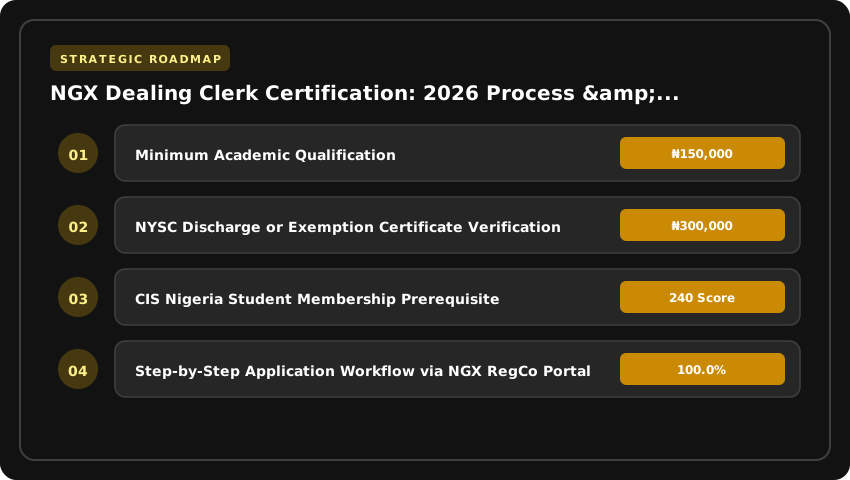
Before you even think about paying the NGX Dealing Clerk application fee in 2026, you need to run through a hard self-check. The Nigerian Exchange Group has tightened its entry standards since the restructuring, and candidates who do not meet every single criterion below will face rejection at the CAPS screening stage—no exceptions, no appeals, no second chances. Here is your definitive qualification checklist.
Minimum Academic Qualification
The baseline educational requirement for the 2026 NGX Dealing Clerk licence is a Bachelor’s degree or Higher National Diploma (HND) from a recognised Nigerian or accredited foreign institution. However, the classification matters significantly. A degree must be at least a Second Class Lower (2:2) division, or for HND holders, a minimum of Upper Credit. Candidates with a Pass or Lower Credit classification will not be considered, regardless of other qualifications. This threshold was introduced to align dealing clerk competency with the increased regulatory scrutiny NGX Group now operates under.
- B.Sc / B.A. — Minimum: Second Class Lower (2:2) or equivalent
- HND — Minimum: Upper Credit
- Relevant disciplines include Economics, Finance, Banking, Accounting, Business Administration, or related fields
- Final-year students may apply provisionally but must submit conferral evidence before the verification deadline
NYSC Discharge or Exemption Certificate Verification
NGX Group now requires all applicants to have either a valid NYSC discharge certificate or an official exemption letter. The verification protocol has moved entirely online through the NELFUND and NYSC portals. During application, you must upload a scanned copy of your discharge or exemption certificate, and the NGX regulatory team cross-references this against the NYSC database. Candidates who are currently serving their corps year must provide their call-up number and a letter from their zonal commander confirming active service status. Those who have not yet completed NYSC must ensure discharge is obtained before the licence issuance stage—provisional approvals do not carry forward.
- Upload legible scanned NYSC discharge or exemption certificate
- Current corps members: provide call-up number and zonal commander’s confirmation letter
- Exemption certificate holders: ensure exemption letter is dated and officially stamped
- Verification is now automated—false or tampered documents lead to permanent blacklisting
CIS Nigeria Student Membership Prerequisite
Another non-negotiable requirement is active student membership with the Chartered Institute of Stockbrokers (CIS) Nigeria. This membership must be established before you submit your dealing clerk application. CIS student membership confirms that you are undergoing the professional development pathway required under the Securities and Exchange Commission’s framework. Without this membership, your application will be flagged as incomplete at the initial screening. You can register for CIS student membership through the official CIS Nigeria portal, and you should obtain your membership confirmation number before proceeding to the NGX CAPS application.
- Active CIS Nigeria student membership is mandatory
- Obtain membership confirmation number prior to NGX application
- Non-student CIS members may apply but must meet additional experience thresholds
- Membership must be in good standing with no outstanding dues
Step-by-Step Application Workflow via NGX RegCo Portal
The 2026 application lifecycle lives entirely on the NGX Regulation (NGX RegCo) portal. There is no paper fallback, and the system enforces a strict sequential logic: you cannot unlock the document upload module until your identity verification clears, and you cannot submit the final application without a sponsoring Dealing Member firm’s digital endorsement. Most graduates stall at the sponsorship gate because they treat it as a formality rather than a commercial negotiation.
1. Account Creation & Mandatory BVN/NIN Linkage
Start at regco.ngxgroup.com. Select “New Applicant Registration” and provide a functional email address—preferably a personal Gmail or Outlook address, not a university domain that expires after convocation. The portal immediately triggers a Bank Verification Number (BVN) and National Identification Number (NIN) cross-check via the NIBSS sandbox. Critical 2026 rule: The name on your BVN must match your academic certificates character-for-character. A middle initial discrepancy (e.g., “Chinedu O. Adebayo” vs “Chinedu Obi Adebayo”) hard-locks the profile, requiring a physical visit to the NGX RegCo office at The Exchange House, Marina, with a sworn affidavit and newspaper publication. Link your NIN at this stage; the portal rejects standalone BVN verification for new 2026 applicants.
2. Document Upload Specifications: Zero Tolerance for Metadata Errors
Once identity clears, the “Document Vault” unlocks. Upload specs are non-negotiable:
- Academic Transcript: Single PDF, max 2MB, scanned at 300 DPI in greyscale. Must show CGPA, graduation date, and the Registrar’s wet-ink signature stamp. Password-protected PDFs auto-reject.
- NYSC Discharge/Exemption Certificate: PDF or high-res JPEG (max 1.5MB). The portal runs OCR against the NYSC database; “Certificate in View” printouts are invalid for final submission.
- Passport Photograph: White background, 450×600 pixels, 50–100KB, JPEG only. Taken within the last six months. No eyeglasses, no filters.
- Referee Forms (Two): Download the templated Form RegCo/DC/Ref-2026 from the portal. Referees must be capital market professionals (Chartered Stockbrokers, Authorised Dealing Clerks, or C-suite execs at Dealing Member firms). They sign, stamp, scan, and email directly to
refs@ngxregco.ngwith your Application ID in the subject line. You cannot upload these yourself.
3. The Sponsorship Bottleneck: Securing a Dealing Member Firm Backing
This is where 70% of qualified graduates exit the pipeline. You cannot self-sponsor. A Dealing Member (stockbroking firm) must log into their RegCo Principal dashboard, navigate “Clerk Sponsorship,” and digitally append their firm’s seal to your profile. This constitutes a legal undertaking: the firm accepts vicarious liability for your trades.
Firms typically require:
- A signed Indemnity Bond (₦500,000–₦1,000,000 range, firm-dependent).
- Commitment to a minimum 12-month Articleship/Traineeship at a stipend often below ₦100,000/month.
- Proof of CIS (Chartered Institute of Stockbrokers) student membership or exemption.
Pro tip: Do not apply on the portal until you have a verbal commitment from a Principal. The system timestamps your “Application Submitted” date; if sponsorship isn’t clicked within 30 days, the application archives, forcing a full restart and a fresh ₦15,000 processing fee. Network via the CIS Lagos District Society meetings or the NGX Annual Conference—cold emails to compliance officers rarely convert.
CIS Professional Exams: Exemptions & 2026 Syllabus Focus
If you are a Finance or related degree holder chasing the 2026 NGX Dealing Clerk licence, this is where your timeline either compresses or stretches. The Chartered Institute of Stockbrokers (CIS) professional examination structure has been recalibrated to align with the NGX Group’s unified trading architecture, and understanding the exemption matrix is the single most strategic move you can make right now.
Mapping Finance Degree Courses to CIS Exemption Papers
Not every Finance degree qualifies for automatic exemptions. The CIS exemption board evaluates specific course content against its professional paper syllabi. Graduates with a B.Sc. in Finance, Banking & Finance, or Financial Economics from NUC-accredited institutions can typically seek exemptions on the foundational papers — specifically those covering capital market structure, securities regulation, and basic trading mechanics. However, you must present your official transcript through the CIS registration portal to have individual papers assessed. A General Finance degree with thin coverage of derivatives or market microstructure will likely leave you writing more papers than expected.
- Strong exemption candidates: B.Sc. Finance, Banking & Finance, Financial Economics — potentially 2–3 foundational papers waived.
- Partial exemption candidates: Economics, Business Administration, Accounting — usually 1–2 papers waived, depending on course content overlap.
- No exemption: Degrees without substantive capital markets or securities law modules.
Do not assume your degree auto-qualifies. Submit transcripts early — the CIS assessment process itself can take 4–6 weeks through the official portal.
Mandatory ‘Dealing Clerk’ Elective Module Content Updates for 2026
The 2026 Dealing Clerk elective module now carries significantly heavier weight on NGX-specific operational procedures. Updated content areas include real-time clearing and settlement workflows under the new NGX holding company structure, electronic order routing protocols, and compliance obligations tied to the restructured NGX Group’s unified trading architecture. This is not the legacy ADC curriculum. If you trained on pre-2026 materials, you are studying the wrong framework.
CBT Exam Scheduling Windows & Pass Mark Thresholds
CIS administers its professional examinations via Computer-Based Testing (CBT) across designated windows annually. For 2026, candidates should monitor the official CIS portal for published scheduling dates — typically two main sittings per year. The pass mark threshold for each paper sits at 50%, but competitive placement for Dealing Clerk licence applicants often demands significantly higher raw scores given the volume of candidates. Treat 50% as the minimum legal pass, not your target.
Tactical takeaway: map your degree transcript against the current CIS syllabus, file exemption requests immediately, and concentrate your study hours on the updated Dealing Clerk elective papers. This approach can realistically compress your certification timeline by 6 to 12 months compared to writing every paper from scratch.
Cost Breakdown: 2026 Fees (£) & Hidden Expenses
Budgeting for the 2026 NGX Dealing Clerk certification is where most graduates stall—not because they lack ability, but because they underestimate the total financial outlay. The fees below are denominated in Naira and reflect the current regulatory landscape under NGX Group’s restructured holding company model. Plan early, and you will not abandon the process mid-stream.
NGX RegCo Processing Fee vs. CIS Subscription Dues
The Nigerian Exchange Regulation Company (RegCo) processes your dealing clerk application and charges a non-refundable regulatory fee, typically in the range of ₦25,000–₦50,000 depending on the application category. This is separate from your professional body dues. The Chartered Institute of Stockbrokers (CIS) requires an annual subscription, generally around ₦30,000–₦50,000, which grants you access to CIS-accredited training modules and formal certification standing. Do not confuse these two—they are distinct payments serving different purposes.
- RegCo processing: ₦25,000–₦50,000 (non-refundable)
- CIS annual subscription: ₦30,000–₦50,000
Sponsor Firm Indemnity Bond & Fidelity Insurance
Every dealing clerk candidate must be sponsored by a licensed brokerage firm. Your sponsor provides the indemnity bond, but as the candidate, you should budget for ancillary processing costs of roughly ₦10,000–₦25,000. Fidelity insurance, which protects against occupational risk on the trading floor, typically runs ₦5,000–₦15,000 for individual coverage. Some firms absorb this entirely—confirm before you start spending.
Budgeting for Study Materials
Approved textbooks, NGX-issued study guides, and online resource subscriptions will cost you between ₦15,000–₦30,000. Avoid pirated materials; the 2026 exam content reflects updated market microstructure rules and digital trading protocols that outdated PDFs will not cover.
CBT Centre Logistics
The examination is computer-based. CBT centre fees per sitting range from ₦3,500–₦7,000. Choose a centre within commuting distance—fatigue from long travel on exam day is a silent performance killer. Verify your chosen centre is accredited on the official NGX portal before registering.
Resits & Hidden Costs
If you fail a section, resit fees apply per subject, usually matching the original CBT fee. Candidates who fail twice often spend an additional ₦10,000–₦20,000 on remedial tutoring. Budget a 15% contingency on your total estimate to cover late registration penalties, certificate collection fees, and any unexpected administrative charges.
Realistically, a graduate should plan for a total outlay of approximately ₦90,000–₦180,000 from application through certification, depending on whether your sponsor covers certain line items. Start saving now—this investment pays for itself the moment you stand on the NGX trading floor.
Post-Certification Compliance: CPD & License Renewal 2027+
Securing the NGX Dealing Clerk licence in 2026 is the starting line, not the finish line. The NGX Regulation Limited (NGX RegCo) operates a zero-tolerance compliance regime where the licence is a living privilege, contingent on annual proof of competence and ethical standing. Treat your first renewal cycle in 2027 as your first real performance review.
Annual CPD Hour Mandates: The Non-Negotiable Baseline
Effective the 2027 renewal window, every Dealing Clerk must log a minimum of 20 verifiable CPD hours between January 1 and December 31, 2026. This is not a suggestion; the NGX RegCo portal auto-rejects renewal applications where the CPD tracker shows a deficit. The curriculum splits into two buckets: 10 mandatory hours covering regulatory updates (NGX Rulebook amendments, SEC guidelines, AML/CFT typologies specific to Nigerian capital markets) and 10 elective hours covering derivatives mechanics, fixed income analytics, or fintech integration (API trading protocols). Providers must be accredited by the Chartered Institute of Stockbrokers (CIS) or NGX Academy—random LinkedIn Learning certificates will not pass the audit. Log them in real-time on the NGX RegCo portal; backdating entries triggers a “Fit & Proper” query.
NGX RegCo ‘Fit & Proper’ Re-Assessment Triggers
The “Fit & Proper” test isn’t a one-off at onboarding. It is re-run automatically at every renewal and triggered ad-hoc by specific events. In 2027+, expect immediate re-assessment if:
- Client Complaints: Two or more upheld complaints via the NGX Investor Protection Fund (IPF) or SEC complaints framework within a rolling 12 months.
- Trading Anomalies: Flagged patterns by the NGX Surveillance Engine—wash trades, layering, or fat-finger errors exceeding ₦50 million notional value.
- Regulatory Sanctions: Any fine imposed by SEC or NGX RegCo, regardless of amount.
- Financial Probity: Evidence of personal insolvency, unresolved tax liabilities (FIRS TCC expiry), or adverse credit bureau reports (CRC/FirstCentral).
A failed re-assessment doesn’t just delay renewal; it triggers a supervisory attachment where your trading rights are suspended pending a hearing. Keep your Tax Clearance Certificate (TCC) and Police Character Certificate current—expired documents are the most common avoidable failure point.
Migration Path: Dealing Clerk to Chartered Stockbroker
The Dealing Clerk licence is the apprenticeship rung for the Chartered Stockbroker (CIS) designation. The migration path is structured but demanding. You need 36 months of post-licence supervised experience (backdated to your 2026 registration date) and a pass in the CIS Professional Examinations (PE I & II). Crucially, your 20 CPD hours annually should be strategically aligned with the PE syllabus—Corporate Finance, Securities Law, and Portfolio Management—to avoid double-studying. Upon passing PE II and securing a sponsorship from a Dealing Member (Stockbroking Firm) willing to nominate you for the “Call to the Bar” equivalent (the CIS Investiture), you transition from an employee executing orders to a principal liable for the firm’s conduct. The salary band jumps from the clerk range (₦2.5M–₦4.5M/annum) to the Chartered Associate band (₦7M–₦12M/annum plus profit share). Plan your 2027 CPD calendar with this exit velocity in mind.
Common 2026 Rejection Triggers & Appeal Mechanisms
Even well-prepared candidates face administrative friction. In the 2026 cycle, the NGX Regulation Company (NGX RegCo) has tightened data integrity checks against the Central Securities Clearing System (CSCS) and JAMB databases. Understanding the top three rejection vectors allows you to pre-empt them or navigate the appeal window efficiently.
1. JAMB/University Matriculation Number Discrepancies
This remains the single largest cause of automatic disqualification. NGX RegCo now cross-references the JAMB registration number submitted on the Form 3 application against the matriculation number on the university transcript and the NYSC discharge certificate. A single transposed digit, a missing forward slash (e.g., UJ/2026/LAW/0045 vs UJ2018LAW0045), or a mismatch between the JAMB admission letter name order and the degree certificate triggers a “Data Integrity Flag.”
Mitigation: Before submission, obtain a certified true copy (CTC) of your JAMB admission letter directly from the JAMB portal (not a printout from a cybercafé). Ensure the name sequence (Surname-Firstname-Othername) matches your BVN and international passport exactly. If a historical error exists, secure a sworn affidavit and a formal correction letter from the university registrar before applying; RegCo rarely accepts affidavits alone post-submission.
2. Sponsor Firm Capital Adequacy Shortfalls
Your application is only as strong as your sponsor’s balance sheet. Under the 2026 NGX Rules, a Dealing Member Firm (DMF) must maintain a minimum Liquid Capital of ₦500 million and a Risk-Based Capital Adequacy Ratio (CAR) above 15% at the point of clerk nomination. If your sponsor firm breached these thresholds in the preceding quarter—verified via their filed FPR (Financial Position Returns) on the NGX Issuer Portal—your application is rejected under Rule 3.18(b), irrespective of your personal qualifications.
Mitigation: Request the firm’s latest audited accounts and quarterly FPR filing receipt before accepting the sponsorship slot. Confirm the firm has no outstanding regulatory sanctions or “Capital Deficiency Notices” from NGX RegCo. If the firm is recapitalising, wait for the post-recapitalisation regulatory sign-off; provisional approvals do not suffice for clerk onboarding.
3. Formal Appeal Timeline & NGX RegCo Hearing Committee Process
If rejected, you have 14 calendar days from the date on the formal rejection letter (delivered via the NGX RegCo portal and email) to file a Notice of Appeal. Miss this window, and the matter is closed administratively—no extensions are granted.
- Step 1 – Written Submission: Address the “Secretary, NGX RegCo Hearing Committee.” Attach the rejection letter, evidence correcting the trigger (e.g., JAMB correction letter, sponsor’s updated FPR acknowledgement), and a ₦50,000 non-refundable appeal fee (payable via Remita to NGX RegCo TSA).
- Step 2 – Hearing Schedule: The Committee sits bi-monthly (typically second Wednesday). You will receive a hearing date within 21 days of filing. Attendance is mandatory; legal representation is permitted but not required.
- Step 3 – Determination: Rulings are communicated within 10 business days post-hearing. A successful appeal results in a “Conditional Approval” pending final document verification. A failed appeal exhausts internal remedies; judicial review at the Federal High Court (FHC) is the only remaining recourse, but it is costly and rarely overturns regulatory discretion on factual grounds.
Pro tip: Engage the NGX RegCo Helpdesk (regulation@ngxgroup.com) for a pre-submission “sanity check” on your sponsor’s standing and your document bundle. It is an informal courtesy, not a guarantee, but it catches 80% of the mechanical errors that clog the appeal docket.
| Criteria | NGX Dealing Clerk (2026/2027) | Legacy ADC Framework |
|---|---|---|
| Regulatory Status | Statutory Representative of TLH | General Brokerage Assistant |
| System Access | Unified X-Gen Trading Architecture | Segmented Legacy Terminals |
| Certification Cost | ₦150,000 – ₦250,000 (Est.) | Variable/Firm-funded |
| Prerequisites | University Degree + SEC Registration | Diploma or Degree |
| Asset Scope | Equities, Fixed Income, ETFs, Derivatives | Primarily Equities |
| Salary Potential | ₦300,000 – ₦750,000 Monthly (Entry) | Standard Entry-level Grade |
Frequently Asked Questions
How do I become a certified NGX Dealing Clerk in 2026?
To become an NGX Dealing Clerk in 2026, graduates must be employed by a Trading Licence Holder (TLH). You must complete the mandatory NGX certification program, pass the regulatory examinations, and obtain statutory registration with the Securities and Exchange Commission (SEC) to legally execute trades on the X-Gen system.
What are the 2026 requirements for the NGX Dealing Clerk license?
The 2026 requirements include a minimum of a university degree in Finance, Economics, or a related field, sponsorship by a registered Trading Licence Holder (TLH), and successful completion of the NGX Group's unified trading architecture training. Candidates must also pass the SEC's professional conduct and regulatory compliance assessments.
What is the difference between a Dealing Clerk and a legacy ADC in 2026?
Unlike the legacy Authorised Dealer Clerk (ADC), the 2026 Dealing Clerk is a registered representative of a Trading Licence Holder (TLH) with specific legal authority. They operate across a unified architecture covering Equities, Fixed Income, and Derivatives, whereas the ADC role was limited to basic brokerage support functions.
What is the salary potential for NGX Dealing Clerks in 2026/2027?
Entry-level NGX Dealing Clerks in 2026 typically earn between ₦300,000 and ₦750,000 monthly, depending on the size of the Trading Licence Holder (TLH). Total compensation often includes performance-based commissions tied to trading volume and portfolio growth within the NGX Group's restructured trading environment.
Which trading systems do NGX Dealing Clerks use in 2026?
As of 2026, all certified Dealing Clerks utilize the X-Gen Trading System. This unified architecture integrates Equities, Fixed Income, ETFs, and Derivatives into a single operational interface, allowing for seamless order execution and real-time settlement across all Nigerian Exchange Group asset classes.
Strategic Final Takeaway
When evaluating NGX Dealing Clerk Certification Process And Requirements For Nigerian Finance Graduates 2026 in 2026 and beyond, base your decisions on accredited institutional standards, verified return on investment (ROI), and up-to-date official guidelines. Always verify specific dates and requirements through official regulatory portals.